







Abstract
Background
Newborn screening (NBS) programs are employed to detect various disorders with the aim of early identification and scope for early intervention. They are increasingly being accepted by parents in many countries.
Aim
The aim of this study is to know about the awareness of NBS programs among parents and gain knowledge about their perspectives on and experiences with the screening program.
Settings and Design
This is a cross-sectional study done over a period of three months among parents of newborns who underwent the NBS program in a tertiary care teaching center in South India.
Material and Methods
The demographic details, awareness of parents regarding NBS, and their experiences during the procedure were recorded using a pretested and piloted questionnaire, and the results were analyzed.
Statistical Analysis Used
Frequencies and percentages were used for descriptive statistics. Chi-square test or Fisher’s exact test was used for finding an association between nominal variables.
Results
We found that the awareness about NBS programs is very low 14% (95% CI: 8.5–22.1) among parents in the studied population. There are multiple concerns among parents such as cost involved, the diseases screened, the method of sampling, interpretation of results, and further management options.
Conclusion
In spite of high literacy and good socioeconomic status, awareness is low among parents about the NBS program.
Introduction
Newborn screening (NBS) program is one of the largest public health screening programs. The conditions screened vary depending on the epidemiological aspects of the region. Although it is successfully implemented in several countries, in India it is still in a preliminary stage, with some state-run programs in Goa, Chandigarh, and Kerala and some hospitals offering the screening on parental preferences. 1 Commonly screened disorders are congenital hypothyroidism, congenital hearing loss, glucose 6-phosphate dehydrogenase deficiency, and congenital adrenal hyperplasia. This does not include disorders such as hemoglobinopathies and other inborn errors of metabolism, which are not uncommon in our population.2, 3 In the last decade, the use of tandem mass spectrometry (TMS) increased widely as it can screen for around 60 metabolic disorders with a simple dried blood spot (DBS) sampling. The specificity and sensitivity are also high for most organic acidemias, amino acid disorders, fatty acid oxidation disorders, and mucopolysaccharidosis. 4 Implementation of NBS programs involves multiple steps including education of parents, choosing the appropriate tests, sample collection process, results reporting strategies, and follow-up plans for further evaluation and management. 5 Limited research data is available regarding parental views and experiences about the NBS programs that exist currently in India. This is important as the screening panels are expanding, potentially leading to an increasing amount of complex information among parents. This study proposes to understand the parental views and experiences regarding NBS programs.
Subjects and Methods
A cross-sectional analytical study was done in the neonatology unit of a tertiary care teaching hospital over a period of three months between October and December 2021. The study was presented to the Institutional Review Board and Institutional Ethics Committee, and approval was obtained. The hospital has been doing NBS TMS 62 using DBS sampling for the past 10 years. This test screens for 62 diseases that includes inborn errors of metabolism, hemoglobinopathies, G6PD deficiency, and endocrine disorders like congenital adrenal hyperplasia. All newborns including those in NICU who were on feeds of at least 100 ml/kg/day were considered eligible for NBS testing. The information regarding NBS procedure, advantages, and disadvantages was explained to the parents in detail by the principal investigator during the postnatal period, and informed consent was obtained for the test procedure. The timing of the sampling for TMS 62 is combined with sampling for serum bilirubin done at 48 hours of life.
Positive results were communicated by telephone within one week, and parents were asked to come back for review with the newborn for examination and repeat sampling, which includes TMS, GCMS, and confirmatory tests, if available. Negative results were communicated to the parents through e-mail by 2–3 weeks. After the parents had received the results, they were contacted by telephone, and consent was obtained for the study. Parents of all consecutive neonates who underwent NBS were approached, and those willing were enrolled in the study. Parents who were not willing to participate and who gave incomplete information were excluded from the study. Lack of parental awareness regarding NBS was 70% in previous studies. 6 Assuming it to be lesser in this part of the country, lack of awareness was taken as 80%, precision of 8%, and confidence level of 95%, and the sample size required for the study was estimated to be 96. A minimum sample size of 100 was targeted to achieve a significant statistical result.
Information regarding sociodemographic details including parents’ educational status, socioeconomic status, and self-reported health status of parents and the newborn was collected using a pretested piloted questionnaire. The questionnaire was prepared in English, translated to Tamil, and back-translation was done. The language of administration was based on parental preference.
Parents’ awareness on NBS programs and their source of information about NBS were documented. Perspectives of parents regarding satisfaction on the pretest information provided and satisfaction on communication of results were recorded. Responses were graded using a 5-point Likert scale. For a meaningful analysis, the willingness to consent for the screening program was divided into three groups: positive, neutral, and negative. Similarly, all the satisfaction responses were classified as more satisfied, neutral, and less satisfied. Parents’ views regarding the need for NBS programs, implementation of such programs at the national level, cost of the screening tests, and concerns during waiting period were also recorded.
Frequencies and percentages were used for descriptive statistics. Chi-square test or Fisher’s exact test was used for finding an association between nominal variables. P value less than .05 was considered statistically significant.
Results
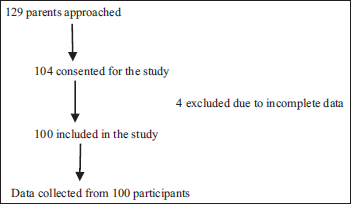
The flow of the study is represented by Figure 1. Among the 100 participants, 39% were parents of female babies and 61% were parents of male babies. Thirty percent of the study participants were from rural areas, and the remaining 70% were from urban areas. Sixty percent of newborns were of the first birth order, and 40% were of the second or third birth order.
Flow of the Study.
Parents’ educational and occupational classifications were done based on the modified Kuppuswamy Scale. In the study group, all the parents were educated, and 85% of the mothers and 84% of the fathers had an educational qualification up to the graduation level and above (Table 1).
Distribution of Parents’ Education and Occupation.
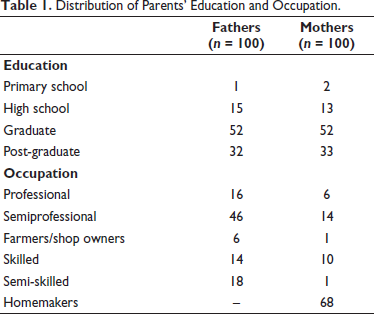
Most of the fathers (62%) were semiprofessionals and professionals by occupation, and remaining 38% were nonprofessionals. Among mothers, 32% were working and 68% were homemakers. Eleven percent of the study participants were healthcare workers.
Awareness of the NBS Program
Only 14% (95% CI: 8.5–22.1) of parents had awareness regarding NBS programs prior to admission to the hospital for delivery. Of the 14% of parents who were aware, the source of information was mostly healthcare professional counseling during previous deliveries.
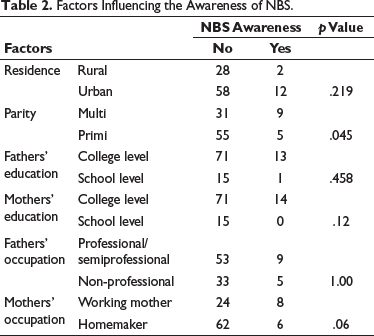
There was no significant association between residence, educational status, and occupational status of the father or mother with awareness of NBS programs. But there was a significant association between the parity of mother and NBS awareness (P = .045). Multiparous mothers had more awareness regarding NBS, which is probably due to exposure during previous pregnancies (Table 2). Sixty-two percent parents were happy regarding the pretest information given before testing, and 10% were not happy with the pretest information, while 26% gave neutral response.
Factors Influencing the Awareness of NBS.
Willingness to Undergo NBS
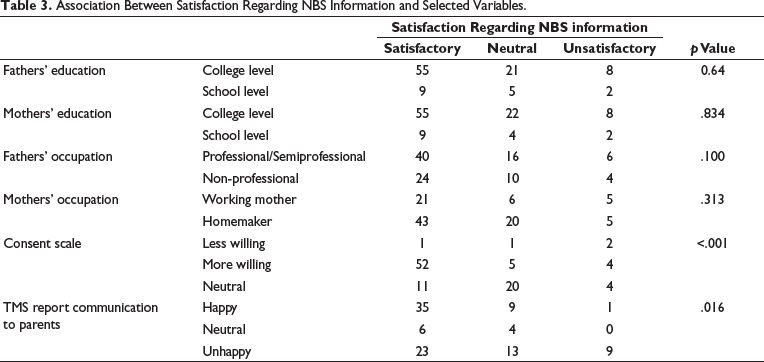
Sixty-one percent of parents were more willing to consent for the screening test, while 39% parents were either less willing or neutral. There was no significant association between educational qualification or occupational status of the father or mother with satisfaction regarding the pretest information (Table 3). Similarly, neither the educational qualification nor the occupation of father or mother had any significant association with the willingness to consent for the NBS. But a statistically significant association was found between positive pretest information rating and willingness to consent for the procedure (P value < .001) (Table 3). Parents who were satisfied with the pretest information gave a more positive response for the willingness to consent for the procedure.
Association Between Satisfaction Regarding NBS Information and Selected Variables.
Fifty-six percent of parents felt the cost of NBS program is expensive, and 44% felt the cost is acceptable. Sixty-one percent parents suggested that NBS be incorporated in national programs.
TMS 62 Results
Among the study participants, four newborns had positive TMS 62 screening reports. All the four were contacted and counseled on further confirmatory testing and management. Disorders that came positive in NBS were classical galactosemia, HbE disease, isovaleryl acidemia, and propionic acidemia.
An equal number of parents (45%) were happy and unhappy with the reporting method, while 10% gave a neutral response. There was a statistically significant association between pretest information about NBS and satisfaction with the result communication (P = .016) among parents (Table 3). This indicates that most parents who were unsatisfied with the pretest information gave a negative response with result reporting.
Parental Concerns Regarding NBS Tests
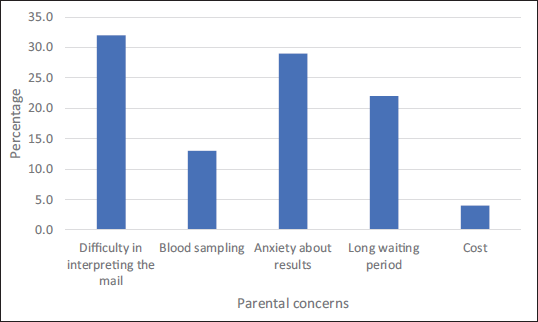
Parental concerns are represented by Figure 2. Common concerns expressed by parents were noted (Figure 2). Most of the parents felt the turnaround time of 7–10 days was too high and stressed on earlier reporting of results. They preferred result being communicated verbally by a healthcare professional rather than by e-mail as the interpretation was difficult.
Parental Concerns Regarding NBS.
However, 88% parents accepted the expanded NBS tests as a useful screening method and will recommend the screening test for others.
Discussion
The study participants were mostly educated. This study shows that despite high literacy levels and good occupational status, the awareness of NBS programs among our population is very less (14%). This is less than those observed in a study done by Raveendran et al, in North India (30%). 6 Studies done by Al Sulaiman et al also showed less knowledge among mothers regarding the NBS program. 7 Awareness regarding newborn hearing screening was also similarly less as observed in some studies. 8
Willingness to undergo NBS was stronger among parents who gave satisfactory response regarding pretest information. A similar association was observed in other studies showing higher acceptability rate for NBS with good pretest education among parents.9, 10
This implies the need to educate and counsel the parents by more effective means such as providing information sheets and earlier counseling starting from the antenatal period. Information such as (a) availability of such screening programs, (b) their merits and demerits, (c) the extent of the diseases that are covered, and (d) the expected duration for reporting of results and further follow-up plan should be discussed with the parents.1, 5, 11, 12
Awareness on NBS program was good among multiparous women than primigravida mothers. Similar results were observed in a study by Frankova et al. 10
Cost is an important factor in establishing a successful NBS program. In this study also, many parents commented that NBS is expensive and some parents suggested it should be incorporated in national programs. Other common concerns were anxiety during result turnaround time and difficulty in interpreting results.
Despite the above concerns and low awareness about NBS, most parents have positive attitude toward NBS and are willing to recommend it to others. Similar positive attitude among parents was noted in other studies also.7–9, 13
Parental anxiety and concerns can be minimized by educating them on the process of NBS. Educating parents forms an essential component of the program especially for parents with positive reports in the initial NBS test.14, 15
Strengths of the study include scarcity of published studies on parental perspectives regarding NBS in our country, questionnaire in the language of parents’ preference, grading of responses using the Likert scale, and availability of few open-ended questions regarding parents’ experiences. The limitations of the study include a convenient sampling technique and telephonic collection of details using a questionnaire that would have provided less time for interaction with parents and a considerable probability for recall bias.
Conclusion
The awareness of NBS programs even among educated population is low. Costs and lack of awareness regarding NBS are main hindering factors for acceptance of NBS. More future studies with a larger sample size will aid in understanding the parental expectations and potential barriers in the implementation of NBS programs. Increasing the awareness and addressing these concerns can help in successful implementation of NBS programs.
Footnotes
Declaration of Conflicting Interests
The authors declared no potential conflicts of interest with respect to the research, authorship, and/or publication of this article.
Ethical Approval
The study was presented to the Institutional Review Board and Institutional Ethics Committee and approval was obtained (IEC:RC/2021/42).
Funding
The authors received no financial support for the research, authorship, and/or publication of this article.
Informed Consent
Informed consent was obtained for the test procedure.
