







Abstract
In this article, we explore and probe the critical visual analysis framework on the ‘challenge’ illustrations of Jide Okonkwo distributed on Facebook in 2019 while considering contents, contexts and communication of the images. Engaging with critical visual analysis is in order to deepen our understanding of its dynamics and potential for visual semiosis. The images are visual data for this analysis, and they are relevant considering their rich visual contents. Using critical visual analysis framework as developed by Jiayu Wang, we explore and interpret these images against the backdrop of their sociocultural and communication foci. The theoretical analysis is substantiated with elements of visual grammar (VG). The article expounds the understanding regarding the theoretical tool as well as the semiosis of the social practices connected with these images.
Introduction
Critical visual analysis (CVA) affords ways of reading, understanding and contextualising images and texts (Schroeder, 2006). In this article, we give a rounded exploration of the visual structure and semiosis of images from Jide Okonkwo’s Facebook ‘challenge’ illustration based on CVA framework. Our exploration dwells on Wang’s (2014) approach, which was developed from the theory of critical discourse analysis (CDA). Wang’s model of CVA is grounded with elements of ‘visual grammar’ (VG) developed by Kress and van Leeuwen (2006), the concept of intertextuality, and of visual metaphors. Kress and van Leeuwen’s VG provides a useful resource aimed at examining images for multimodal communication. The Facebook images we read here provide a rich content for the theoretical probing as intended in this study.
The engagement with these visual compositions points to the various visual and semiotic characterisations, as well as social contexts known of social media with reference to Nigeria and Africa (Alozie, 2010; Jibril, 2020; Voorveld & van Noort, 2014). Jide Okonkwo’s ‘Daily Bible Illustration Challenge’ was a series of digital illustrations distributed on Facebook. Facebook, like other social networking sites, has become a platform for several visual exploration and engagement emanating from individual users (Georgakopoulou, 2017). The visual challenge spanned 2 months of daily illustrations of biblical references in 2019. The producer, Jide Okonkwo, is an adept draughtsman and a creative digital media exponent who trained in painting at University of Nigeria between 2002 and 2007. Leveraging on his interest, expertise and the potential of digital media technology, he assumed profession in graphic designing, illustration and animation. His Facebook illustrations form an excellent depository of semiotic resources, with a huge possibility for use in describing and expounding on the CVA theory and the Nigerian social practices as expressed in the images. The relevance of this study is not only for theoretical exponents but also for the audience of the social practices and cultural producers who deal with ideational possibilities. It is upon this relevance that we objectivise the reading of a selected portion of the illustrations in order to underpin the theoretical approach, while, at the same time, implicating them for social and visual communication.
Theoretical Framework
Critical Visual Analysis
We explore Wang’s (2014) framework, the CVA or critical visual (Discourse) analysis, which derives from critical discourse analysis (CDA) developed by Fairclough (1989, 1995). In CVA, Wang developed three analytical strands: discursive narrative, visual intertextuality and critical visual metaphoric analysis. In this study, we articulate the theoretical framing for reading our data, while using the concept of VG proposed by Kress and van Leeuwen (2006) to express the visual elements contained in them. The elements that foreground the theory as we use them are given below.
CDA, developed largely through the works of Fairclough (1989, 1995), was built upon his earlier works on ‘Language and power’ and ‘Critical discourse awareness’. It developed out of critical theory of language, which sees the use of language as a form of social practice. Like the discourse theory, critical discourse analysis was propounded as a tool for reading and analysing linguistic texts and verbal discourses (Gee, 2008) rather than for visual reading. Since the 1970s, discourse analysis has focused primarily on language and its forms, while leaving out such semiotic resources as images, space and architecture, thereby giving rise to what O’Halloran (2004) calls an ‘impoverished view’ of discourse. Drawing on Foucault’s insight, Fairclough maintained that in discourse, meanings are constituted, and discourse itself is expressed as practice, in which humans reflect and represent, verbally and non-verbally (Locke, 2004). Fairclough presents three dimensions to consider in the analysis of critical discourse practice. They include text analysis and discourse practice, which cover the process of text production, distribution and consumption, as well as the sociocultural practices that govern these processes (Janks, 1997). The text analysis level provides a description of the text. The discourse analysis aspect comes with the interpretation of text, while, at the social analysis level, explanation of the text is given (Luo, 2019; Schneider, 2013).
On the integration of VG, we draw from The Grammar of Visual Design by Kress and van Leeuwen (2006). However, it is important to state clearly at this point that the concept of VG was developed as a descriptive approach to communication, thereby providing ‘mandatory prescriptions’ and rules (Jewitt & Oyama, 2001) based on social semiotics. It is on this notion of social formation of representation that VG also gains traction as acknowledged by Goodman that ‘it is difficult … to find a single text which uses solely verbal English’ (Thuy, 2017, p. 1). VG was developed as a procedure for reading visual contents in congruence with linguistic semiosis. Kress and van Leeuwen explain that VG is a general grammar in contemporary visual design in ‘Western’ cultures—an account of explicit and implicit knowledge and practices around a resource, consisting of the elements and rules underlying a culture-specific form of visual communication. VG helps break down images into more accessible, interpretable objects for study since visual language has no formal syntax or semantics, but visual objects themselves can be classified.
To develop VG, Kress and Leeuwen adopted and charged Halliday’s tripodal linguistic meta-functions with equivalent roles for visual reading. Hence, they accredited every visual composition with ‘representational’, ‘interactional’ and ‘communicational’ characterisations. This idea forms a key part of the concept of VG as a rule for examining images and accounting for the different elements imbued in visual compositions. Based on social semiotics, this tool affords the possibility of exploring the ‘representational structures’ of the visual data, which involve the narrative and conceptual details of the image. At its ‘interactive level’, two kinds of ‘participants’ are known (Wang, 2014). ‘Participants’, here, stand for the represented elements in a visual composition (that is, the subjects). It also stands for the viewer interacting with the representations and forming a part of the meaning-making process or communication. On the other hand, the ‘compositional system’ furnishes details on key elements like image salience and informational values (Kress & van Leeuwen, 2006).
Moreover, it is important to note how the emerging ideas around the framework of CVA are connected with the notion of intertextuality. The understanding of visual intertextuality is strongly underpinned in connecting texts to various references or previous pointers. It refers to drawing inspiration or texts from different sources, by authors and artists, consciously or unconsciously. Readers and viewers also interpret what they see in relation to previously seen or known discourses, ‘texts’ and/or images (Butt, 2010; Chandler, 2007; D’Angelo, 2009). Although the concept was formulated by Mikhail Bakhtin in his work on ‘dialogism’, intertextuality, which denotes ‘the transposition of one (or several) sign system(s) into another’ was coined by Kristeva (1984). It underscores the fact that texts, visual representations and literature, as constructed mixture of words, elements and forms, are done by means of citations, quotations, allusions, borrowings, adaptations, appropriations, parody, pastiche, imitation, bricolage and the like (D’Angelo, 2009). So, in a creative practice, the artist cannot be barred from connecting with his previous visual experiences. This, further, underscores the reflexive nature of art making and meaning-making. When interpretation connects with the process of content production, conceptualisation goes from the known to the unknown, and from the simple to the complex. In such a way, certain complex ideas could be visualised or reified as metaphors, in order to provide a ground for meaning-making.
Metaphors in linguistics have a common presence, with related theories taking after such postulations as expressed in Andrew Ortony’s (1979, 1993) Metaphor and Thought, and Lakoff and Johnson’s Metaphors We Live By (Forceville, 2005, 2009; Lakoff & Johnson, 1980). Basically, Lakoff and Johnson characterise the use of metaphor for expressing and understanding things in terms of another. They also identify the prevalence of metaphors as what we live by, albeit not very many are aware of them. In developing a corpus of approach to critical metaphor analysis (CMA), Charteris-Black (2004) underscores its connection with Fairclough’s CDA framework. While CDA generally employs an interdisciplinary approach in decoding and interpreting social ideologies and power relations found in verbal and linguistic discourses, CMA seeks to extend discourse to the metaphorical nuances of language and thought that are socially ingrained. It informs of certain ways of seeing to which an outsider might be unaware of. Charteris-Black, therefore, argues that metaphor analysis is a way to achieve the aims of CDA. In its basic analytical structure, CMA follows three bold steps of identification, interpretation and explanation of metaphors in texts.
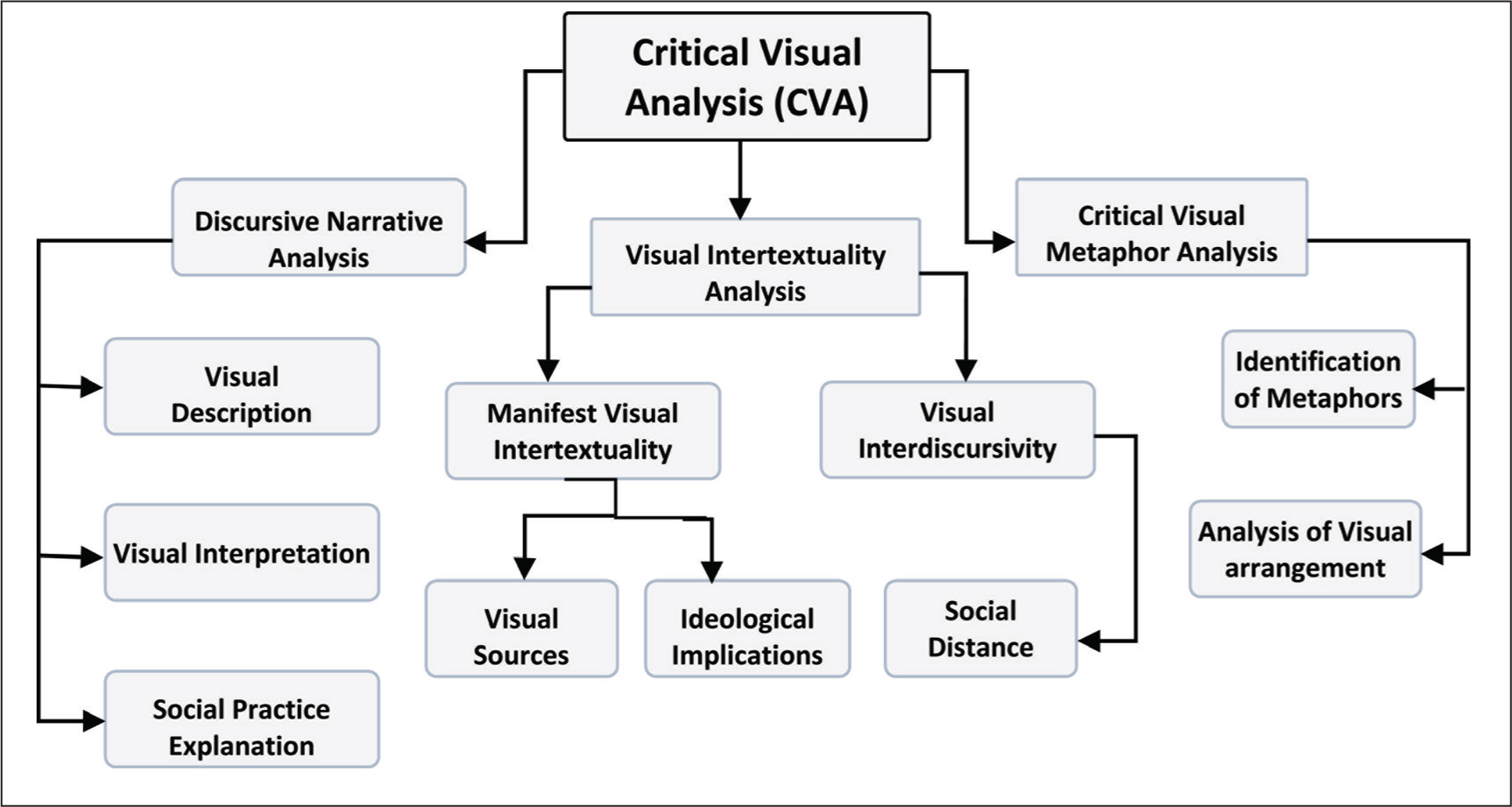
In Figure 1, we show the elements of CVA framework as expansively identified and as we employ them in this study. Narrowing down from the aforementioned explanations, three broad modules are expressed for CVA as drawn from Wang (2014): discursive narrative, visual intertextuality and critical visual metaphoric analysis. These are the broad dimensions of the analysis, and the interpretation of our data follows this structure. First, the discursive narrative dimension covers three specific components, which include visual description, interpretation and explanation. The visual intertextuality level deals with the direct and indirect references, between images and other known visual forms, as well as the social practice alluded to in the representation where possible. In the last aspect, metaphoric expressions in the images are identified and analysed. This also covers the explanation of the of design elements and the design general structure.
Analysis of Visual Composition
The analysis of these images follows the three modules of the CVA. These images were purposively selected from a corpus of 21 visual compositions (Etikan et al., 2016). In selecting them, attention was paid to the secular features of their subjects or participants. The content of the illustrations shows general societal issues (see Figure 2[a–j]).

Discursive Narrative
This is the first and major aspect of the analysis. It offers dimensions of critical discourse, which include visual description, visual interpretation and social explanation of the practice.
Visual Description
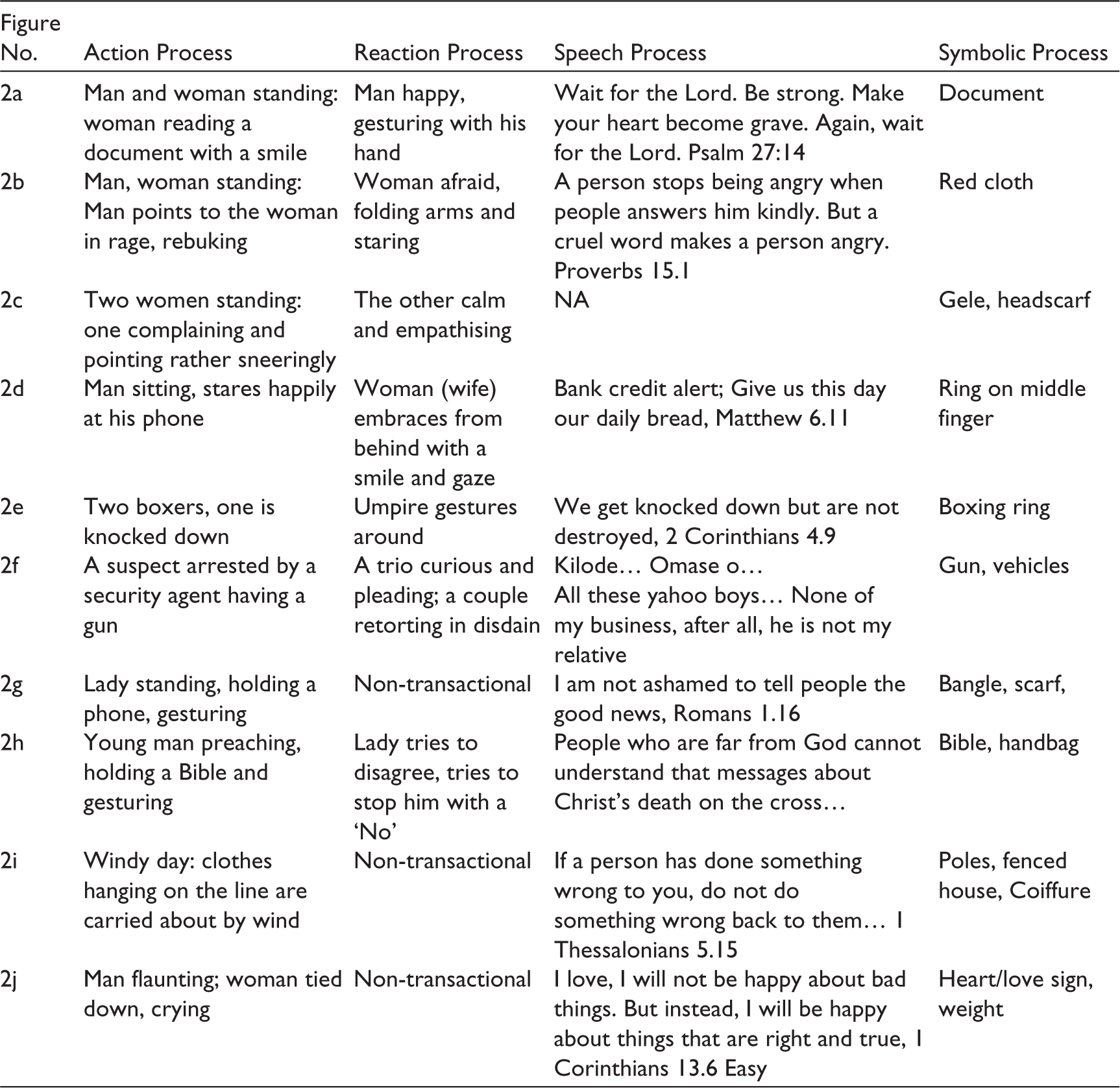
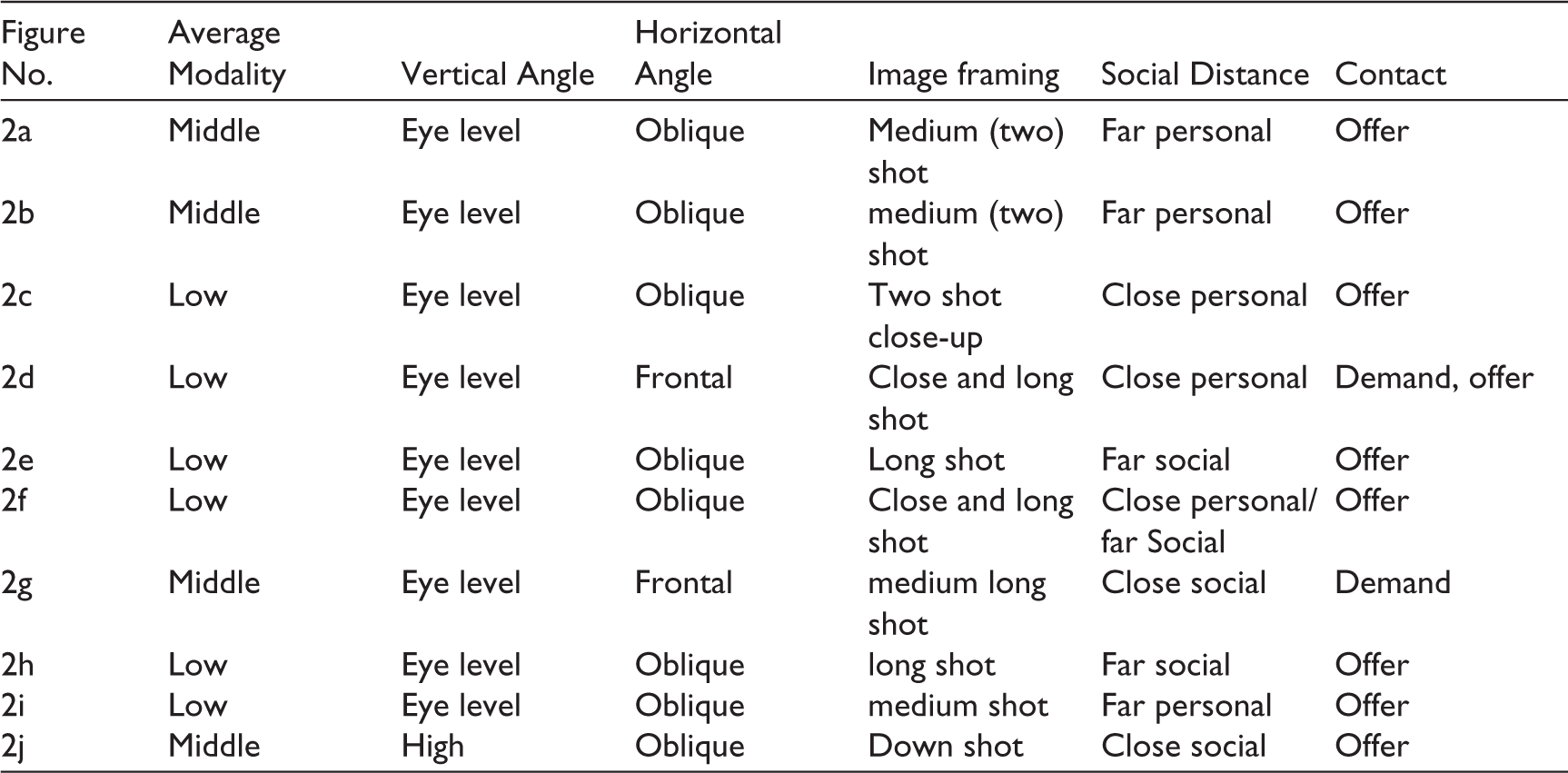
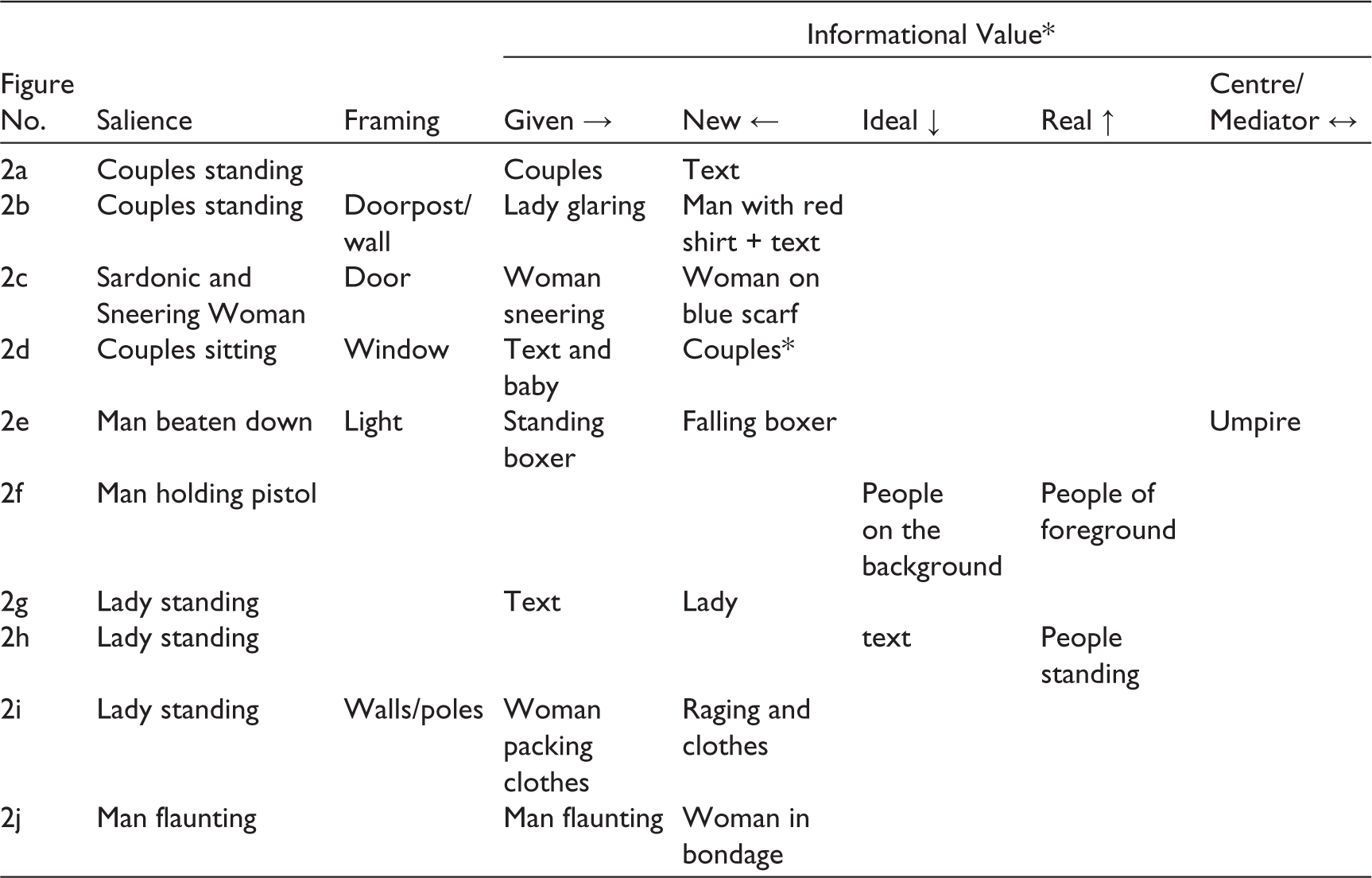
Figure 2—[a–j] is presented and described in this section. The presentation is tabulated using Kress and van Leeuwen’s (2006) structure of VG, and it covers three aspects: representational structure, interactive meanings and compositional system of the images. On the representational structure (Table 1), each image is presented in detail with action, reaction and the linguistic texts shown in each piece, as well as other syntagms that carry symbolic implication. Beyond distilling these representational elements, using VG, we offer a brief discussion on each. The interactive process (Table 2) shows the interpersonal side of the communication between the participants in the pieces and viewers, while the compositional system (Table 3) of the description involves the informational values.
Representational Structure
Interactive Meanings
Compositional System
The representational structure (Table 1) describes the visual contents of the images. In Table 1, we present a description of the subjects or represented participants of each piece, while defining the actions expressed in them as well as the mood or reaction to such actions. Text or words, shown in each piece, are also identified while further underscoring other symbolic subjects or cultural manifestations that require deeper explanation. In these 10 illustrations, 12 female and 13 male figures are shown. Visually, it is noteworthy how most of the female subjects have a touch of pink or red in their representation, whereas most of the male subjects are rendered in shades of blue. This tells of the artist’s inclination to the two chromatic schemes for gender identity, or perhaps, it shows the kind of tone the different genders are socially identified with in Nigeria.
In the interactive dimension (Table 2), VG defines modality towards understanding reality and credibility of representation with such qualifications as probability and certainty. In other words, it shows the degree of reality in the representations, classified within the ranges of low, medium and high. Markers of modality or factors that define modality of an image include colour, reality by dominant society standard, sharpness, brightness and contrast, saturation, image background, etc. So, for these images, Table 2 contains the average modality based on the culmination of available markers. It is then important for creative producers to understand the key elements that bring about different effects and modalities.
Another dimension in communicating these images is the ‘social distance’. Social distance defines the distance (literal or represented) maintained between people in daily interaction. So, in a sense, this is shown by the type of shot or frame taken by the camera, such as ‘close-up’, ‘medium shot’, ‘long shot’, ‘extreme close-up’ and ‘big close-up’. It shows the parts of the image visible in the picture frame or field of vision. For instance, ‘far social distance’ depicts the frame with entire height and width of figures and the spaces around them. Table 2 gives a summary of the images presented in this study in terms of their framing and social distances.
When represented participants, look directly at the viewer who is the interactive participant, a form of eye connection is established. This is referred to as ‘contact’, and this is more prominent when viewing human subjects. The angle of shot—high, low or frontal—contributes to the kind of contact that exists between the represented and interactive participants. These kinds of shot also convey certain relation of power between the participants. Basically, two kinds of ‘contacts’ are known to exist in any visual representation: ‘demand’ or ‘offer’. ‘Demand’ shows that the subject of a piece is gazing at the viewer, and ‘offer’ means there is no direct gaze on the viewer. The contact in Figure 2(d) shows both ‘demand’ and ‘offer’. This shows that there is more than one figure in the illustration.
On the compositional system of the images (Table 3), three major factors are considered: salience, framing and the informational value. First, salience describes the most eye-catching element in each image or composition. The modality of an image contributes to its salience. A number of factors that determine salience include foreground, size of subject, sharpness of focus, amount of light defining the subject, placement, colour, etc. Second, framing as a compositional feature describes elements, implied or real, that provide a kind of frame for a particular subject in a piece. So, framing can connect or disconnect a represented participant from other elements in a composition. Third, informational value of a composition can either be a ‘Given’ or a ‘New’ as against left and right. The idea also ‘shows the placement of subjects and contents in a visual composition for up or down, centre or margin paradigmatic structure of composition’. ‘Given’ suggests what the viewer should be familiar with, while ‘New’ suggests the message—the new information brought to the viewer. This understanding is hugely applicable to texts and image of news articles. Usually, for horizontal layouts, the ‘New’ is placed on the right, while the ‘Given’ occupies the left [→,←];in vertical layouts, the positioning is defined as ‘Ideal’ + ‘Real’, covering top to bottom [↓,↑]. The sign ‘↔’ denotes the centre + margin value. Moreover, compositions in the study have been identified and details of their informational values are tabulated in Table 3.
Visual Interpretation
The analysis of these images follows the VG concept. The above-mentioned visual description points to three modules of the interpretation of the image: the production, distribution and consumption. The ‘production’ analysis defines how the producer presents his composition and the process of production, while the ‘distribution’ focuses on how the images engage the viewer and how the dissemination of ideologies in the visuals occur. The consumption level shows how the messages in the images are received. The producer has presented almost all the images (Figure 2[a–j]) as dynamic, and not static, showing action and reaction processes, which the represented participants portray as well as the background, which they carry.
On the production of the images, they are digitally done as narrative presentations. They convey diverse forms of narrative and emotive functions, as viewers could form a social connection with the represented participants. The narrative structures here are evident in the vectors, which are defined by the figures in the action process. Vectors are real or implied elements in a composition that connect represented participants. They could be formed by parts of the human body like the limbs (Kress & van Leeuwen, 2006). The presence of vectors connote that an action is taking place between represented participants. Figure 2(a–j) shows actions in which the actors are demonstrating with either hands or feet, forming diagonally implied lines, which are vectors. For instance, in Figure 2(a), the woman is the actor. The action is shown by her hands holding the document, while, in Figure 2(b), the man forms the actor with his finger pointing to the woman’s face. It is also important to see how the background images of some of these visuals reveal walls or windows as vectors, howbeit, in soft tones and low modality. Examples are seen in Figure 2(a, b and i).
A total of 7 out of the 10 images (Figure 2[a–f and h]) are transactional in their narrative structures, showing participants’ interaction in action and reactional processes. Transactional structures are achieved when two or more participants interact in a composition, while non-transaction process occurs when there is a single participant or when there is no interactive ‘Goal’. In Figure 2 both (g) and (i) contain single actor or participant; hence, the resulting structure is non-transactional as interaction resides in the single participants (Kress & van Leeuwen, 2006). Although Figure 2(j) has more than one participant, it lacks interactive process, owing to the fact that the producer is merely differentiating between the effects of love and hate. This is suggested by the speech texts. The action processes in these compositions, therefore, have no ‘Goals’. It is also noted how the artist made a good use of the ‘Centre’ in the compositions. The majority of the participants in these compositions are in pairs subtly or slightly centralised.
The emotive direction of the composition can be observed mainly in two ways: the action of participants and the colours used by the producer. On the action process, the gestures, the eye contacts and the flaunting of actors in Figure 2(b, c, g and j) are examples of the emotive function of the compositions. Moreover, colours are another important element that shows emotive values and sensory experiences. This is defined by individual colours, colour significance and symbolism, as well as by people’s preference. It is important to recognise various African skin colours of the represented participants and how light and shade play on them. These colours manifest in tones of brown and dark.
Further, the distribution of roles of the participants in these compositions is grouped by whether a participant is an actor or a reactor. This identification has been carried out in Table 1. Furthermore, the symbolic processes of the compositions appear in Figure 2(c–j). These symbolic parts of the representation are used to support the theme, which each piece carries. These compositions use speech processes to articulate its narrative potentials. The process in each composition involves texts taken from the Bible. The illustrations are more or less a depiction of the understanding taken from the words associated with or written on each composition.
On the other hand, parts of the represented participants such as the gele (headscarf), ring, gun, vehicles, Bible, handbag and heart symbols function in different ways. In real social context, these show the cultural elements of the people ranging from religious, to social control, and to fashion, among others. By this, the artist, pushes forward his ideology. In fashion, the use of gele by a participant is common among married women as shown in Figure 2(c) (Morgan, 2016). Within the Nigerian context, a vehicle, for instance, may connote a level of wealth. The representation of the Bible suggests Christian religion, and the heart symbol suggests love. Generally, the source reference of these illustrations is the Bible with various moral instructions. It is important to consider how taking biblical instruction as explicated by these illustrations and their textual portions could potently function in social control instead of using a gun. The presence of a gun in Figure 2(f) shows an arrest being conducted by security personnel in order to control criminal practices common in Nigeria (Jibril, 2020). From their production to distribution and consumption phases, certain of the reactional processes provide an imaginary space for a viewer to interact with the piece. For instance, Figure 2(i) shows that the figure is looking and eyeballing an imaginary person on her left side as the wind rattles louder. In all, one would agree ‘that texts [both visual and linguistic] are instantiations of socially regulated discourses and that the processes of production and reception are socially constrained’ (Janks, 1997, p. 329).
Explanation of Social Practice
In this section, the activities shown in the visual description and interpretation are presented within a larger social or cultural context. This is done in order to reveal the possible ways through which the interpretation of visual representation can affect viewers’ perception. Here, further definition is given to the different visual elements built up in the earlier part of the analysis in order to offer a clearer understanding. Social practice refers to the activities typically performed in a given society. The meaning of such everyday activities are known by the people (Holtz, 2014). Moreover, the notion of such practices ranges from the mental to the physical, and to the material objects, as well as skills required in creating them.
The social practices discussed here include those of routine and socially shared behaviours, including activities, subjects and relations, objects, time and place, consciousness and values (Wang, 2014). They are defined along three broad components of the practices: material, meaning and competence (Holtz, 2014). Of the illustrations we analyse in this study, the setting of the production is Lagos, Nigeria, which is one of the most populous cities in Africa, with over 20 million people. The living standard is highly variegated, ranging from the poorest to the richest. This locale is characterised by struggle for survival with diverse kinds of jobs. There is no particular historical connection to any of the social practices shown in these illustrations. An important point to note is that most part of these compositions is emotion laden; there are emotional nuances and outbursts. Expressions and causes of emotional outburst vary from place to place. In Nigeria, sources of emotional content or discontent may be connected to issues of economy, family, gender and others (Smith, 2007).
Unhappy, angry or belligerent emotions are common here. Examples are seen in Figure 2(b, c, f, h and i). Evidently, Figures 2(a, b and d) are representations suggesting married partners. Two of these are in happy moods (Figure 2[a and b]), while Figure 2(d) shows an outburst of aggression. Aggression is usually expressed visually by gestures, like gaping of the mouth and blaring of the eyes. The rebuking, pointing of fingers and animated gestures of the man in this piece define the material components in the image. The woman in Figure 2(b) is seen folding her arms downwards, suggesting fear, intimidation and/or abuse of relationship. The reverse is equally true; in every society, social affinity, empathy and cheerful emotions are also evident. These could be gestured in embracing or holding of the shoulder and other happy moods (Figure 2[a, c, d and j]). Figure 2(j) may reveal certain kinds of gratification that occur when the other is psychologically or physically trapped, extorted, bewitched or raped.
Another important source of enthusiasm and entertainment for Nigerians is games, as shown in Figure 2(e). Figure 2(e) shows a boxing activity. It is understandable that Nigerians are consumers of vast bazaar of digital products from across the world, and Nigeria’s Nollywood is famous in its entertainment feat (Morgan, 2020). Nigerian people are not left out of the entertainment that comes from theatre and fashion as another significant means of dousing their discontent. Yet, one cannot ignore the reality that globalisation has bequeathed much on Africa. The effect of globalisation among women has taken a very serious dimension that allows the married and unmarried women to strive in fashion. So the line is now blurred.
In Figure 2(h), a lady is standing with her bag, signalling ‘a stop’ to the young man standing close to her. In this piece, there appear two social practices known in Nigeria: women carrying handbags as part of fashion and the freedom of religion, which allows preachers to engage people with the Bible gospel on their agreement. Religion is an important part of Nigeria’s society today alongside the use of social networking sites. People preach around, but here, one can see the dichotomy that exists between religion and waywardness. Another social practice is the activity in Figure 2(i), which shows a woman gathering clothes spread on the line as a rainstorm begins to disturb the environment. As a practice, most people dry their clothes under the sun, Nigeria being a tropical country. The speech process on each of the compositions is part of the social practice of the Nigerian people. Through these texts, alongside the action and reactional processes, the producer emphasises the social interactions as it were between the represented participants and the viewers.
On meaning as a component of social practice, relevant issues supporting or surrounding the material presentation of these images are included. Meaning in this regard includes understandings, beliefs and emotions associated with the materials, as shown in the visual composition. This also includes the immaterial stances that justify the association of material elements in the practice, linking the action and reactional process to the symbolic. The environmental components represented in these images, for instance, form the social part of the practices so defined in the compositions.
Nigerians are largely gregarious. Figure 2(f) provides an instance. The participants at the background of this piece are either terrified or unhappy, or they are trying to create nuances following the arrest of a suspect by a security operative. This is not unconnected with several security or criminal issues for which such populous cities as Lagos are known (Jibril, 2020). The atmosphere in this piece is suggested by the speech process in Yoruba language: kilode (what happened?), omase o! (It is a pity). The participants in the foreground are rather indifferent as shown in the speech and the expression of their faces. In instances of arrest or strange occurrences, many Nigerians, especially in cities, would prefer to distance themselves from allegations by leaving crime surroundings. This idea is suggested by the speech: ‘none of my business, after all, he is not my relative’.
All of the symbolic processes provide meanings that can be understood and internalised by a viewer in a social practice. The skills and knowledge required for the performance of social practice are also considered as they are culturally rooted. This is called competence. Examples of competence shown in these visuals include those of gestures, speaking and reading, using the phone, boxing and tying gele, among others.
Visual Intertextuality Analysis
The idea of intertextuality here explains how the visualisation and meaning of images are affected by previous information and imageries known to the artist. Intertextuality denotes ‘the transposition of one (or several) sign system(s) into another’ (Kristeva, 1984). In ‘The Photographic Message’ and ‘Rhetoric of the Image’, Barthes (1977) drew a connection between visual forms and texts. This connection he referred to as ‘anchorage,’ which he defines as the uses and functions of written texts as captions or titles over images and photographs. Thus, anchorage acts as a linguistic message that clarifies the denotative meanings of a visual representation, since according to Barthes ‘all images are polysemous’ (Barthes, 1977, p. 38). By anchorage, Barthes underscored that linguistic contents of a visual composition constrain the image to certain desired meanings.
Visual intertextuality is discernable if there is analogous connection with verbal discourses (Wang, 2014). In itself, intertextuality can be overt or manifest in direct reference to extant sources. However, there is also a subtle and indirect allusion to extant sources or discourses. This is interdiscursivity. Interdiscursivity is characterised by certain heterogeneity and entwinement with other discourses (Bartesaghi & Noy, 2015; Fairclough, 1995). Manifest visual intertextuality can occur when there are direct captions of different pieces, when a visual composition is derived from a particular source. By belonging to a particular genre, images share in interdiscursivity. The intertextuality or the interdiscursivity of images is extended to include the instinctual derivation of visual concepts from previously identified subjects by the producer. This indirectly becomes part of the growing discourse. It can also manifest from the sharing of cultural and social practices.
Primarily, the visual compositions in this study are largely impacted by words drawn from the Bible. The images have no direct historical affiliation that informed its production. Rather, the choice of subjects is informed by either the producer’s artistry, sense of the media or reflexive experiences. So, the major intertextual source for these images is the Bible. The producer rendered the works with both the literal and connoted sense made of the source text. The images implicatively show Christian principles, although some of them are denotatively ideated. For instance, in Figure 2(e), the text reads, ‘we are knocked down, but are not destroyed’. This text is rendered rather literally. Another instance on intertextuality is observed in Figure 2(h), as the artist uses allusion to define the biblical quote in that piece. The texts allude to the nature of the lady in the piece as undermining or lacking understanding of the message from the preacher.
Some others emerge rather interdiscursively. Figure 2(d) shows a discourse that begins verbally and continues visually. The text, ‘give us this day our daily bread’, does not seem to be represented literally. It is more like the provision of daily bread is metaphorised by the receiving of financial credit alert on the phone as is suggested in the piece. Several people earn their living through digital means, and so that elicits joy as is perceivable in the piece. We live in an intertextual world, ranging from the physical setting to the socio-virtual world, which digital technology affords today.
It is clear, then, how the artist has tried to give visual interpretations of the biblical passages based on his own experience and perception. Such reflexivity drives the intertextuality of these pieces. For example, Figure 2(e) suggests that one must be aware of the nature of boxing before representing it. In all, these visual compositions largely show an approach to employing interdiscursivity. Yet, a dimension to manifest intertextuality is that in which artists copy and/or tamper with imageries from other sources. In art practice, such terms as appropriation, imitations and adaptations are common (D’Angelo, 2009). Furthermore, whether applied in a negative or positive sense, one must underscore the reality of the digital age in which intertextuality manifests in the manipulation and faking of images. This altogether buoys down to the death of the image (Mirzoeff, 1999; Rose, 2001).
Critical Visual Metaphor Analysis
We daily live by metaphors. Lakoff and Johnson (1980) provide an understanding of the dynamics of working with metaphors. In mapping out metaphors, two conceptual areas are noted—the ‘source domain’ and ‘target domain’. The source domains refer to the signs and metaphors as represented, while the target domain refers to what they signify or refer to (Forceville, 2005, 2009). Metaphors are used to delineate complex knowledge or cognitive experiences (Lara-Garcia & Lara-Rosana, 1999). In other words, a complex or difficult subject as the target domain is represented in a simple concept, which is the source domain. Metaphor is persuasive and constructive in representation by either reifying, personifying or de-personifying its target concepts. In an attempt to represent an idea simply, a content producer straddles different frames of thought, especially when trying to represent abstract concepts. In dealing with linguistic metaphors, there are three key steps for critical analysis of metaphor as underscored by Charteris-Black (2004). They include identification, interpretation and explanation However, metaphors of visual representations are characteristically pervasive in themselves. For critical analysis of visual metaphors, Wang (2014) has proposed two levels of reference: identification of the metaphor and analysis of the visual arrangement of the composition.
Identifying Metaphors in the Compositions
Metaphors of visual forms are identifiable with varying degrees of visibility. In many of the compositions in this article, one can observe metaphors whose targets are psychologically inclined. In Figure 2(b, c, h, i and j), whole or part, metaphors show the emotion of anger and resentment as target. For instance, in Figure 2(b), the wide opening of the eyes, the wild and wide gaping of the mouth, the pointing of finger as well as the removal or holding of red shirt unworn are source domains and metaphors of such emotions.
Emotional targets are seen: happiness in Figure 2(a), represented by the smiles and the raising of the fist; joy in Figure 2(d) expressed by the look and smile on the teeth; ecstasy or frenzy in Figure 2(j) shown by the flaunting of self as seen in the male participant. Considering the setting of the narratives in the illustrations, possible reasons for the happiness may include confirmation of pregnancy as shown by the bulging stomach of the woman, or a possibility of more than one foetus shown by medical document in Figure 2(a). The text in Figure 2(d) shows the reason for which the metaphor of joy is expressed here using facial expression and a mobile phone.
Moreover, the interpretation touches on the social relations that are expressed by these metaphors. For instance, the metaphor of anger expressed in the male participant and his standing with the female participant (Figure 2[b]) shows the social agency of the home in fostering domestic violence, bitterness, brawl or expression of other emotions. Another dimension to the representation of metaphor is seen in Figure 2(e), which captures the essence in which failure or defeat in life can be rendered as one ‘knocked’ down. In other words, life is represented as a boxing ring in which the one succeeding stands, and the one failing is helplessly downed. Social agencies and institutions seem to determine who gets what. Another dimension to understanding visual metaphors and semiosis is by decoding the design elements used and their organisation.
Arrangement of Visual Elements
The visual arrangements here are defined by the way elements of design such as space, line, visual texture and texts are employed in the production of the visual compositions. Relevantly, the producer maintains certain reflexivity as he visually articulates his point of view and feeling using design elements (Charteris-Black, 2004). The textual anchorage on these compositions, for instance, is important an element that aids visual semiosis and the ideological codes of the images beyond the producer’s point of view and feeling. These compositions are action-laden as expressed in their visual arrangement.
On the arrangement of visual elements of these compositions, we also identify the colour scheme the artist has employed. Blue is the most dominant colour of the entire illustrations. It is important to note that blue which itself signifies tranquillity and peace (Kurt & Osueke, 2014; Ou, Luo, Woodcock, & Wright, 2004) has largely been used in these pieces despite the intensity of social tension expressed in some of the narratives (Figure 2[b, c, e, f, h and i]). In a general sense, such chromatic rendering can connote a social conditioning, where people can be suffering and smiling (Smith, 2007). For instance, in Figure 2(f) where an arrest is made, blue tones are used to saturate the space rather than warm hues. On the other hand, as part of the visual orchestra, while majority of the male characters in the collection are rendered in blue, pink or shades of red are used for most of the female characters. Another important arrangement of visual forms is that in which the producer focused on urban settings as suggested by the structures and objects identifiable in the scenes: cars, tall buildings, urban transport modes in Nigeria and dress styles.
There is a use of sfumato as a technique in dealing with the elements, colours, forms and backgrounds of the compositions. The designer also chose to give a soft definition of the subjects perhaps in pursuit of certain cinematic effects or chiaroscuro. The subtle blend and the spatial organisation of these compositions reveal the producer’s social inclination and ideology. It is also noteworthy that most activities in these compositions seem to be nocturnal, as suggested by the light effects in the settings.
Conclusion
We have explored and probed the CVA framework postulated by Wang (2014) on the digital illustrations of Jide Okonkwo’s Facebook Daily Bible Challenge. The tripodal structure of the theory has shown a potential to deliver on the semiosis of such visual composition. The visual semiosis of the data for description, interpretation and social practice reveals various cultural and social inclinations that are common in Nigeria. This, in other words, has helped to deepen our understanding of this tool of critical reading of signs with a focus on contents, context and communication of the images. We can conclude that this analytical tool can strongly engage visuals and texts forms in ways that meanings are more broadly made.
The analysis of the images, in the aspect of visual metaphors, unveils the condensed or encoded ideologies expressed through the compositions. The processes here range from identifying the visual metaphors, to explicating the visual elements that are used in composing the visual forms. The producer has made his representation in line with extant social ideologies revealed in the social practices and activities in Nigeria. Although strands of the metaphors are deductible and the images pose diverse semiotic undertones, our reading gives a broad interpretation of these compositions drawing from reflexive account. Key metaphors shown in these images are emotional realities prevalent in the most part of these compositions. This perhaps informs why the producer calls for ethical or moral ways to containing discontents in a religiously potent society like Nigeria.
The visual intertextuality connects the viewers with the represented participants. It, as well, shows the connection of these images as sources of discourse and their impact on the viewers towards a growing discourse. In other words, audiences and writers who correspond with these images can derive from their analysis and interpretations. The interpretation here does not only relate to the social import of these forms, but it also reveals creative and theoretical formation of these images. Advertently or otherwise, this study provides a reference to the growing web of discourse on social and visual culture. Social practices, alongside their cultural underpinnings, are also construable based on space and time.
Although the visual representations in this study referred to biblical teachings, the producer localised the contents and social practice to that which could be readily understood or appreciated by his audience. While majority of viewers would relish these visual representations in conversance, for others, the illustration could provide a peep into the several social practices of Nigerians. For instance, it is significant to underscore how a religious thought can become a subject of social (media) discourse in Nigeria without aversion, especially when positioned around secular events. Many Nigerians seem to seek solace in religious practices, considering that the government has not been able to proffer solution to several public needs. This position does not in any way preclude or minimise the efficacy of religion.
Footnotes
Declaration of Conflicting Interests
The authors declared no potential conflicts of interest with respect to the research, authorship and/or publication of this article.
Funding
The authors received no financial support for the research, authorship and/or publication of this article.