






Abstract
This article analyses the depth of engagement with climate change education policy across all 13 provinces and territories in Canada. A comparative content analysis of 13 climate action plans (CAP) and 90 K-12 education policy documents shows a major gap existing between Canada’s climate and education policies. While subnational climate policy calls for education to contribute substantially to addressing climate change, education policy is not aligned towards this call. Three themes emerged within the overview of the provinces and territories: shallow engagement with climate change within education policies; the predominance of energy efficiency upgrades for schools as a foremost education sector objective; and policy gaps that show a lack of attention to many areas of climate education. Further detailing the climate change education objectives in four provinces identified as playing a leadership role in climate policy, this research suggests that even among these climate leaders, K-12 education policy minimally attends to climate change. Alignment between Canadian and international trends in climate change education is also assessed.
Keywords
Introduction
Meeting Canada’s recent commitments to international climate change goals will require not only unprecedented technological, institutional, economic and energy use changes but also broader sociocultural and micro-behavioural shifts. The potential contribution of the education sector in responding to climate change is clearly recognized in the promotion of climate change–related educational programmes and public awareness campaigns within Article 6 of the United Nations (UN) Framework Convention on Climate Change (UN, 1992), as well as the UN-led Climate Change Education for Sustainable Development (CCESD) Programme (Mochizuki & Bryan, 2015; UNESCO, 2016).
This article evaluates the congruence and engagement between climate change education in kindergarten to grade 12 (K-12) education policy and provincial climate policy across Canada. Following Mochizuki and Bryan (2015), we understand climate change education as referring to ‘processes aimed at improving the degree to which an education system is prepared for, and is responsive to, the challenges of climate change’ (p. 5). We use the term climate education as a short-hand for climate change education.
Both education policy and climate change policy are largely developed at the provincial and territorial jurisdiction. Recently, the Canadian federal government has tasked each province and territory with developing action plans at that jurisdictional level to reduce climate-related emissions and address adaptation and mitigation (Government of Canada, 2016). In order to map to what degree education policies are also developing to take up this mandate of climate action in relation to these broader provincial policy, in this article, we examine the two policy types together: provincial K-12 education policies and provincial CAPs, across all 13 provinces and territories (hereafter referred to as ‘jurisdictions’). Specifically, the analysis focuses on two sets of policy documents: (a) CAPs and/or strategies (the most recent, highest-level jurisdictional policies dealing with climate change and which we refer to as climate policies); and (b) the highest-level sustainability-specific policy documents, curriculum frameworks and subject curriculum frameworks, as issued across all 13 ministries of education. The focal inquiry in this article is the degree of congruence between the subnational climate change policy documents and climate-related educational mandates in formal EC-12 policy across Canada.
We begin with a review of the existing literature on climate education and a discussion of our content analysis methodology. We then review climate and education policy in the 13 jurisdictions before moving into an in-depth analysis of four provinces that are especially active on climate education policy. We conclude with a summary of the key themes found in this pan-Canadian comparison of climate and education policies.
Climate Change and Educational Research
Educational attainment has been identified as the most important predictor of people’s awareness of climate change (Lee, Markowitz, Howe & Ko, 2015, p. 1014). However, the gap between public awareness and engagement remains troublesome and has been a strong focus in the climate change communication and related non-formal education literature (Anderson, 2010; Boyd & Osbahr, 2010; Stevenson, Peterson, Bondell, Moore & Carrier, 2014; Wibeck, 2014). Affective and cognitive processes, social norms, sense of agency, worldviews, media and other social institutions are among the factors that contribute to shaping patterns of public (dis)engagement with climate change, including in formal education (APA Task Force, 2011; Brulle & Dunlap, 2015; Norgaard, 2011).
Overall, educational research has largely failed to confront global climate change; however, there have been some notable exceptions to this trend within sustainability education and small pockets of science education. Such scholarship includes research on climate change pedagogy (e.g., Hayden et al., 2011; Kenis & Mathijs, 2012; Robelia, Greenhow & Burton, 2011) and curriculum (e.g., Anderson, 2012). There have also been national overviews of climate education in various countries, such as Brazil (Trajber & Mochizuki, 2015), China (Han, 2015) and the Republic of Korea (Sung, 2015). Another focus has been on student and teacher (mis)conceptions of climate change, with extensive knowledge gaps identified among both groups (e.g., Arslan, Cigdemoglu & Moseley, 2012; Boon, 2010; Boon, 2014; Dawson, 2015; Porter, Weaver & Raptis, 2012; Punter, Orchando-Pardo & Garcia, 2011). A systematic literature review of education policy research conducted by Aikens, McKenzie and Vaughter (2016) identified the overall lack of quality engagement with the wide-ranging implications of climate change for educational policy and the associated need for ‘engaged, political, practical, and imaginative forms of education policy research’ (p. 20).
We also see a lack of engagement with climate education in the climate policy literature more broadly. The climate policy integration (CPI) literature has focused mostly on sectors such as energy, agriculture and transportation (Adelle & Russel, 2013). The CPI bears similarities to the more established field of environmental policy integration (EPI), since both approaches focus on integrating environmental or climate change goals into the aims and policymaking processes of non-environmental sectors (Adelle & Russel, 2013; Lafferty & Hovden, 2003). However, CPI has a more strategic focus on a narrow set of policy sectors such as energy and transportation, whereas EPI engages a more expansive array of areas (Adelle & Russel, 2013, p. 4). Although the education sector is not typically mentioned in discussions of CPI or EPI, integration of climate change objectives in formal education will clearly be needed to meet the education and training objectives outlined in the UNFCCC (UN, 1992). One exception to the lack of focus in these literatures is an emphasis on the role of technical and vocational education and training (TVET) in low-carbon transitions, where a lack of effective policy coordination of TVET has been identified (Strietska-Llina, Hofmann, Durán Haro & Jeon, 2011).
Clearly, both education policy and climate policy research need to explicitly grapple more with the implications of climate change for educational policy and practice. Such research is also needed in relation to particular national educational systems, which we now address in relation to Canada.
Climate change Education in the Canadian Context
Climate education in Canada needs to be understood in relation to the country’s geography and political economy. Canada is a large, geographically diverse country with a relatively small population for its size. It has a strong resource extraction industry with a significant fossil fuel sector in several provinces, including the Alberta–Saskatchewan oil sands that have been identified as a significant contributor to climate change greenhouse gas (GHG) emissions (Erickson & Lazarus, 2014; Palen et al., 2014). Canada’s per-capita level of GHG emissions is among the highest in the world (Burch & Harris, 2014). Despite ratifying the 1997 Kyoto Protocol in 2002 and hosting the annual international negotiations on climate change in 2005, the governing Liberal Party failed to implement an adequate plan to meet its Kyoto targets (Burch & Harris, 2014). After the Conservative Party came to power in 2006, the Kyoto Protocol was vigorously opposed, culminating in Canada’s formal withdrawal from Kyoto in 2011. In the decade of Conservative rule through 2015, federal support for large-scale emissions’ production (such as the oil sands) increased, and environmental organizations faced significant political opposition (Stoddart, Haluza-Delay & Tindall, 2015). A new federal government elected in Fall 2015 has implemented or proposed several climate initiatives with subnational jurisdictions and on the international stage, most recently announcing national carbon pricing.
Existing research on climate education in Canada has focused on terminological trends, teacher misconceptions and post-secondary education policy. With regard to terminological trends, Blum, Nazir, Breiting and Goh (2013) compared conceptualizations of the key terms climate education, environmental education (EE) and education for sustainable development (ESD) within and across the national education systems of Canada, Denmark, Singapore and the UK. This study concluded that educational systems tend to frame climate education as a subtheme of existing EE, ESD or science education subjects (see also Nazir, Pedretti, Wallace, Montemurro & Inwood, 2009). For example, reports by the Council of Ministers of Education Canada (CMEC) on the state of ESD in Canada include some discussion of climate change (Council of Ministers of Education Canada [CMEC], 2006).
There has also been some research on teacher’s (mis)conceptions of climate change in Canada. A survey of Nova Scotia pre-service and in-service teachers found misconceptions among teachers, especially with respect to specific causes and impacts but also found strong levels of support for individual, community and government climate action (Baker & Loxton, 2013).
Comparative research has focused on the response of Canada’s higher education system to climate change. In particular, in addition to the research discussed in this article, the Sustainability and Education Policy Network (SEPN) has been gathering data on sustainability uptake in K-12 and higher education across all 13 jurisdictions in Canada (Aikens et al., 2016; Beveridge, McKenzie, Vaughter & Wright, 2015; Lidstone, Wright & Sherren, 2014, 2015; McKenzie, Bieler & McNeil, 2015; Vaughter, Wright & Herbert, 2015; Vaughter, McKenzie, Lidstone & Wright, 2016). Drawing on this data, a content analysis of climate and sustainability policies from a representative sample of 50 post-secondary institutions from across Canada found that nearly half had some form of climate policy (Henderson, Bieler & McKenzie, 2016). Policies tended to focus on improving the efficiency of the campus operations and generally had underdeveloped engagement with climate across the institutional domains of overall governance, curriculum, research and community engagement.
There are several reasons for looking at recent trends in climate education nationally, across all 13 jurisdictions, at the K-12 level. First, internationally focused research gives a fragmented picture of climate education in Canada. An example is found in the UNESCO (2012) climate education report. An entire section of the report was devoted to ‘Provincial Policy Making in Canada’ but the discussion was limited to Newfoundland and Labrador (p. 15). Similarly, Nazir and colleagues (2009) reviewed climate education in the context of ESD initiatives in formal K-12 policy across only the jurisdictions of Manitoba, Nunavut, Newfoundland and Labrador, and Ontario. Second, international developments warrant increased attention to climate education in formal policy today. According to LaessØe and Mochizuki (2015), these include: (a) a global increase in extreme weather events and related discourse on adaptation and disaster risk reduction; (b) international discussion on the post-2015 development agenda, including increasing ‘green economy’ discourses and commensurate attention to TVET in preparing for green jobs; and (c) economic crises and related shifts in economic policy, enabling more consideration of the green economy and low-carbon transitions (p. 29). We can add the agreement reached at the Paris COP 21 meeting under the UNFCCC (UN, 2015), which became an internationally binding agreement as this article was being prepared.
Existing research on climate change education has recently started to interrogate curriculum and pedagogy but has largely failed to engage with educational policymaking. Aside from some initial work on the post-secondary sector, there is a lack of comparative research on climate change in Canadian education policy. And there has been insufficient attention to climate policy coordination with the education sector and education policy. A recent census of K-12 education policies at ministry and school division level conducted by the SEPN research team found that in addition to some inclusion at the ministry level, climate change was one of the four most common foci of school division level sustainability policies in Canada (7% of policies) (Beveridge et al., forthcoming). To date, there has not been comparative review across Canada of climate-specific content in ministry-level education policies or in relation to climate policies outside of education. To build on prior research and address this gap, we conducted a content analysis of ministry of education policy documents and CAPs.
Methodology
Document Collection
A content analysis of ministry of education policy documents and CAPs from each of Canada’s 13 jurisdictions was conducted to assess the congruence between the two types of documents. For each province, we selected the most recent publicly available, formalized climate policy document we could find. These are typically called CAPs but are also sometimes referred to as climate change strategies or similar terms. Two jurisdictions did not have CAPs. For the province of Saskatchewan, we used a report on stakeholder consultations about climate change in the province (Saskatchewan Ministry of Environment, 2010). For the Northwest Territories, a report on climate-related impacts and adaptations is included in lieu of an action plan (Government of Northwest Territories, 2008). The climate policy documents were collected primarily by searching each government website devoted to environment and climate change. Environmental ministries were frequently linked to from the federal government’s climate action website (
Similarly, education policy documents were collected by reviewing the websites of all 13 ministries/departments of education as part of a broader census of sustainability uptake in K-12 education policy (Beveridge et al., forthcoming). The selection of ministry of education policy documents included the highest-level sustainability-specific documents, including sustainability focused curriculum resources, curriculum frameworks and subject curriculum frameworks available for each jurisdiction. In total, we collected 90 education policy documents and 13 climate policy documents from across all 13 jurisdictions.
Data Analysis
Nvivo 10 qualitative data management software was used for document analysis. We organized the 90 education policy documents into one set and the 13 climate policy documents into another set, which allowed for querying each of these document types in isolation or together via the Nvivo program. Policy documents were coded using a common codebook for each set of policy documents as well as inter-coder reliability checks (Vaughter et al., 2016). One codebook was developed for the analysis of the education policy documents and a separate codebook was used for the analysis of the CAPs. Both codebooks were developed inductively. The codes were developed via iterative reading of the policy texts followed by reliability checks among coders. Following the completion of coding, we conducted queries to determine the frequency counts for each code pertaining to climate change (CC) and climate education. Finally, we conducted a thematic analysis of both sets of policy documents focusing on how each set of documents referred to the educational sector in relation to climate change.
In the final stage of analysis, we developed a climate education engagement scale to represent varying levels of engagement with climate education in the policy texts. The climate education engagement scale draws inspiration from Agyeman’s (2005) Just Sustainability Index (JSI), 1 which uses an ordinal rating of 0–3 to describe a continuum of engagement with environmental justice. Haluza-DeLay and Fernhout (2011) used the JSI to assess Canadian environmental organization engagement with environmental justice. Modifying this procedure for climate change engagement, we used an ordinal rating to assess relative levels of engagement with climate education within the two sets of policy documents (Table 1). The climate education engagement scale ranges from no mention of climate change (0) to outlining specific climate education targets (3).
Description of the Climate Education Engagement Scale

We applied the scale through an evaluation of all coded references in the policy texts. We then assigned a rating of 0–3 for each climate policy and for each set of education policy documents for a given jurisdiction. Given the limited attention devoted to climate education as a whole, we were fairly generous in applying the scale; for example, indicators of a number three rating could include either high-level objectives or specific target details such as funding and timelines related to climate education. A rating of two was assigned if there were short discussions of some aspect of climate education that did not identify specific objectives, and a rating of one was assigned if climate education was simply listed or placed into a table without accompanying discussion. Each jurisdiction was then assigned ratings for its engagement with climate education in each of the province’s climate and education policies, thereby, allowing for comparison across the two sets of policy documents. Ratings are tabulated in Table 2 along with the date of the most recent climate policy in each jurisdiction and the range of dates for the education policies since there were several relevant documents in each jurisdiction.
Canada-Wide analysis of climate Education
Our findings suggest that a significant gap exists between the focus on education in Canada’s climate policies and the attention to climate change in education policies, including sustainability education policies. All jurisdictions mentioned education as part of addressing climate change within climate policies, but fewer than half (6/13) mentioned climate change in their educational policies.
Specific objectives for climate education were expressed within the climate policies of six jurisdictions (each therefore receiving a level three rating on the climate education engagement scale). However, these six jurisdictions expressed significant variation in the extent of detail offered with respect to timelines and funding for implementation of the stated climate education objectives. Overall, the climate education focus in these policies was primarily concerned with school energy efficiency.
Compared to the consistent references to education in climate policies, references to climate change within education policy documents were cursory and relatively scarce. Specific objectives were expressed within the education policies of only two jurisdictions, both focusing on school energy efficiency. British Columbia, Manitoba, Saskatchewan, Québec, Ontario and Prince Edward Island include some specification of climate change or global warming 2 in their education policies. We found the most detailed discussions of climate change curricula within environment or sustainability focused curriculum resources for educators, as well as within subject-specific curriculum guides.
The climate education engagement scale allows us to compare results from climate and education policies for particular jurisdictions. Scale ratings are evaluations serving as an aggregated heuristic for further evaluation (Table 2). For example, British Columbia and Manitoba rated a level three engagement with climate education for both climate and education policies as a result of identifying specific energy efficiency objectives for school infrastructure which are referenced in both document types. Both Ontario and Québec rated a level three engagement within climate policies as a result of identifying school energy efficiency goals, but show lower levels of engagement within education policies. Newfoundland is notable for including specific objectives for energy efficient schools in its CAP, thereby earning a rating of three for its climate policy. Northern territories’ climate policies include a strong focus on indigenous knowledge. Nunavut rated a level three for ambitious objectives within its CAP, such as integrating indigenous knowledge, culture and climate change into the curriculum. The Northwest Territories and Nunavut expressed level two engagement in their climate policies, which include accounts of integrating indigenous knowledge into climate education. However, like many others, these northern territories fail to specifically mention climate change in education policies.
Climate Education Engagement Scale of Each Jurisdictional Policy Document
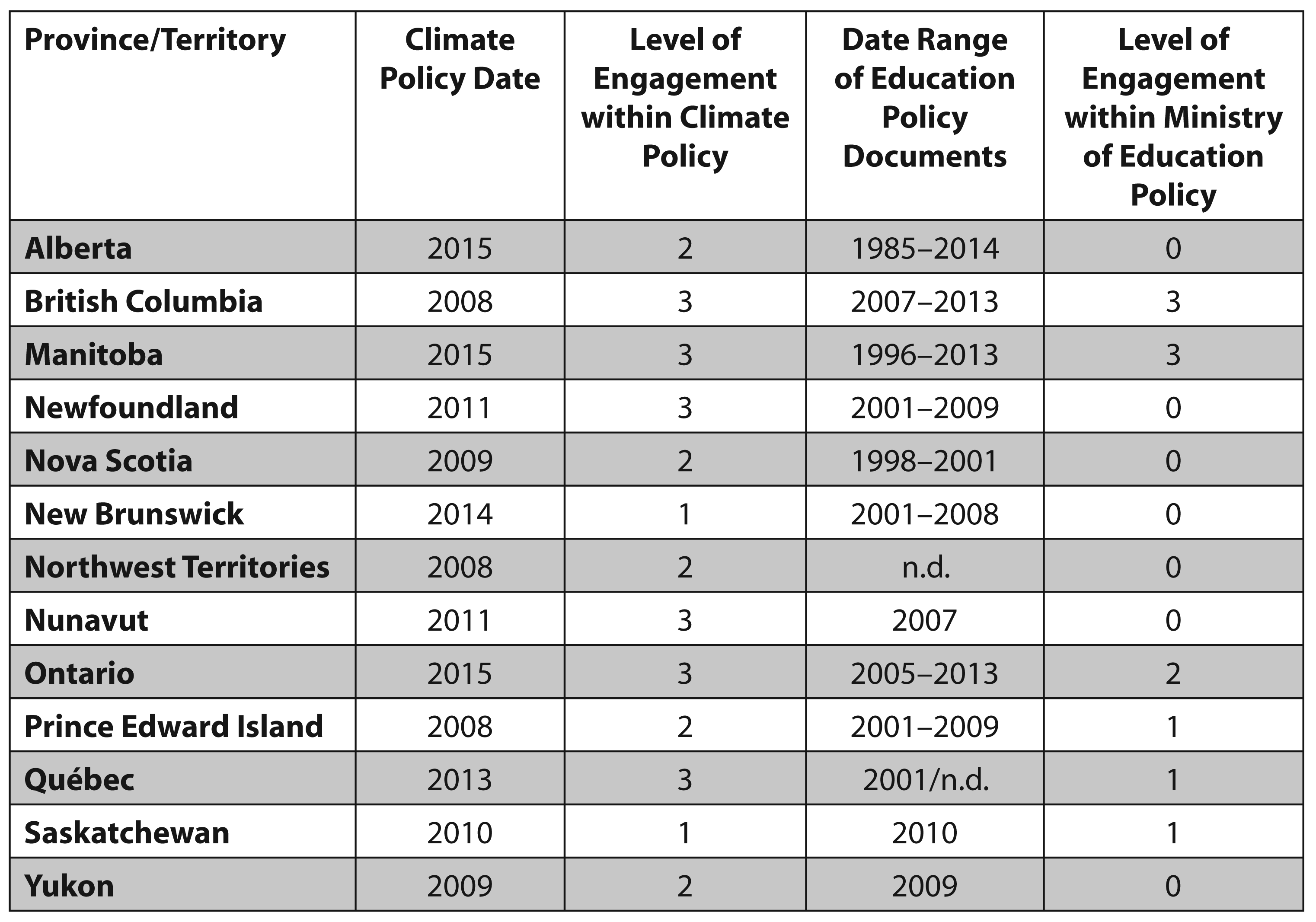
Looking across both climate and education policies, we found a wide diversity in jurisdictional uptake of climate education (Table 2). Only British Columbia and Manitoba were rated a level three engagement for education policies, while only Ontario received a level two rating. All three of these jurisdictions had been rated level three on their climate policies. Several jurisdictions received ratings of zero. Discrepancy is even greater when comparing climate policy engagement and the corresponding education policy engagement. Alberta, Nova Scotia and the Yukon received level two ratings for climate plans, yet received zero ratings in their education plans. More surprisingly, Newfoundland and Labrador and Nunavut were rated at the highest level for climate policy reference to education, yet rated at the lowest level for education policy engagement with climate. Further research would be necessary to identify local reasons for such discrepancies. As indicated in Table 2, the early dates of some of the education policies may be a factor in some of the discrepancies.
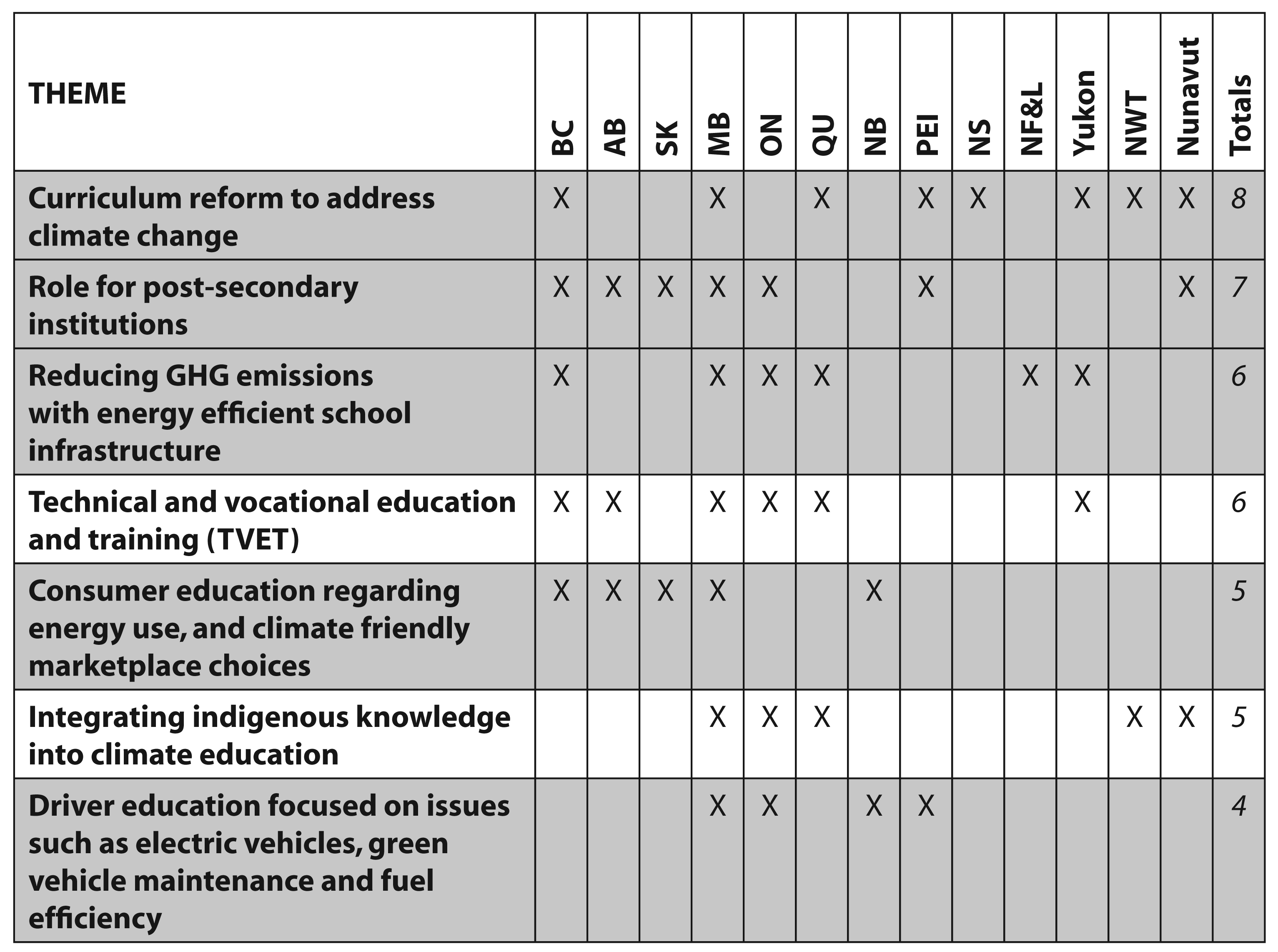
Looking across the climate policies, we identified seven prevalent education-related themes (Table 3). Curriculum reform was mentioned most often, with reference to the K-12 system (8/13). A role for post-secondary institutions in terms of research, innovation and basic instruction was also mentioned by more than half the provinces (7/13) while energy efficiency measures for school infrastructure to reduce GHG emissions was also mentioned by nearly half the policies (6/13). The TVET as a form of education was also mentioned in nearly half the climate policies (6/13). Consumer education regarding energy use was a theme in five climate policies. The integration of indigenous knowledge into climate education was mentioned within five policies, and driver education was a theme in four climate policies. Climate policies also referenced a wide range of potential audiences associated with education (e.g., students, consumers, drivers), thematic foci (e.g., energy efficiency, job training), formal (e.g., schools, universities) and informal places of learning about climate change (e.g., residential energy consumption) (Table 3).
Case Studies of Climate Change Education Policy
To offer further depth on the types of findings highlighted already, in what follows we narrow to four jurisdictions and offer a thematic analysis of major themes running across both types of documents. The four provinces of Ontario, Québec, British Columbia and Manitoba were selected for further analysis as they are widely perceived to be leaders on climate policy within the Canadian federation (Beveridge et al., forthcoming; MacNab & Kniewasser, 2016). Two of the four also released new climate policy action plans in 2015 (Ontario and Manitoba). To see whether this provincial leadership on climate action translates into climate education policy, we identified three themes for cross-provincial comparison: (a) energy efficiency to reduce GHG emissions; (b) integration of climate change into K-12 curricula; and (c) articulations of climate change in policy discourse, that is, what language is used to discuss the natural environment and climate within the policies (Coffey & Marston, 2013). These themes were chosen based on their relative prominence across the four jurisdictions and, with regard to the final theme, were also informed by theoretical concerns.
How Education Is Mentioned in Climate Policies or Action Plans
More specifically, we draw on Nisbet’s (2014) typology of public articulations of the issue and solutions to climate change in considering theme three of policy discourse. Nisbet’s typology was developed to analyse the role of public intellectuals in shaping climate discourse, but can be used to map broader trends in framing climate change (Nisbet, 2014). The typology includes: (a) ‘ecological activists’, who argue that climate change is symptomatic of deep-seated dysfunctions in capitalism and solutions involve grassroots community mobilization and climate justice, often with special attention to indigenous people’s knowledge; (b) ‘smart growth reformers’, who reframe climate change as a market opportunity for sustainable economic growth and investment in new sectors like renewable energy; (c) ‘ecological modernists’, who argue for social innovation and government investment in a range of technological and policy solutions. Whereas ecological activists such as Bill McKibben and Naomi Klein frame climate change in relation to the planetary impacts of capitalism, smart growth reformers such as Nicholas Stern frame climate change as a market failure. Ecological modernists (or ecomodernists, for short), such as Stewart Brand, reframe climate change in relation to social resilience and energy innovation. In terms of policy proposals, ecological activists push for industry regulations and economic localization, whereas smart growth reformers tend to place more emphasis on a combination of international agreements and national carbon pricing. Ecomodernists focus on policies that work across different levels of society to improve social resilience and catalyse energy innovation (Nisbet, 2014, p. 814). Nisbet’s typology is useful for mapping the ways in which climate change is articulated within climate and education policies. It was also used to examine the post-secondary education policy responses to climate change (Henderson et al., 2016). In our use of this typology, we focus only on the discourses that manifest within the two types of policy documents that we analysed, as opposed to broader manifestations of discourse within the everyday life of institutions or in the public sphere (e.g., news media). As a short form reference to how these types of climate discourses manifest within policy documents, we use the term ‘policy discourse’.
We now turn to an analysis of how the three themes of energy efficiency, integration of climate change into curricula and ‘policy discourse’ manifest across the four jurisdictions.
Climate Education Policy in Ontario
Ontario has a newly released CAP with the highlighted message from the Minister of Environment and Climate Change (a position title that aims to give significance to the issue) stating ‘Climate change is the critical issue of our time’ (Government of Ontario, 2016, p. 3). Among other efforts, Ontario was part of the Western Climate Initiative from 2008 to 2012 that attempted to coordinate efforts of seven American states and four Canadian provinces to reduce GHGs. Ontario has also subsidized renewable energy and was the first Canadian province to allow distributed energy generation with a feed-in tariff. It is developing a carbon pricing system, which intends to link to other emissions trading systems. Ontario’s current climate policy commitments are projected to result in a 22 per cent decrease in emissions by 2030 (MacNab & Kniewasser, 2016, pp. 2–3; Pembina Institute, 2016). The respective climate education engagement scale ratings were three and two for the climate policy and education policies. Specific goals were set for school energy efficiency in the climate policy and there was some substantive content on climate change within education policies.
With respect to theme one, Ontario’s climate policy includes details on funding energy efficient schools. The province aims to invest $400–$800 (CAD) million starting in 2017–2018 for improved energy efficiency in schools, universities, colleges and hospitals (Government of Ontario, 2016, p. 26). Although categorized alongside other public-sector buildings and with a somewhat loose start date (i.e., 2017/18), this commitment marks one of the most detailed commitments to energy efficient schools. This focus on energy efficiency is characteristic of an ecomodernist response to climate education since it addresses the issue primarily through technology and innovation.
In terms of climate integration in K-12 curricula, climate change is indeed included in Ontario’s curriculum. It is most explicitly stated as a learning outcome for Grade 10 Applied Science but is also connected to subject-specific learning outcomes across a wide variety of subject areas. A strand on earth and space science within Grade 10 Applied Science includes more deliberate integration of climate change into learning outcomes than any other jurisdiction, such as in this outcome: ‘Analyse effects of human activity on climate change, and effects of climate change on living things and natural systems’ (Government of Ontario, 2008, p. 90). Beyond Applied Science, EE curriculum guides in the province make connections between climate change and subject-specific curricula. A 2011 curriculum guide for grades 9–12 includes climate questions for a wide range of classes from Grade 10 Media Arts to Social Studies and Grade 11 Environmental Science (Government of Ontario, 2011).
Ontario’s policy discourse across both document types is consistent with a smart growth perspective, including in underlining the role of TVET. Specifically, education is commonly connected to climate change via discussions of the role of TVET in low-carbon transitions. For example, the new climate plan states, ‘New and expanded programs would be developed to ensure Ontario’s buildings sector has the skilled workers it needs’ (Government of Ontario, 2016, p. 29). This focus on greening TVET to meet the needs of a low-carbon economy aligns with international trends in CCESD, since UNESCO has recently started to underline the interrelations among TVET, ESD and CCESD (LaessØe & Mochizuki, 2015). Ontario’s focus on TVET is framed as part of a green growth narrative that has been strong within provincial discussions of EE and is consistent with the smart growth framing of climate change as an economic opportunity. This narrative is also exemplified in the Minister’s message about the ‘tremendous economic opportunities that exist for Ontario as the world seeks to mitigate and adapt to climate change’ (Government of Ontario, 2016, p. 5).
Another dimension of Ontario’s policy discourse is the focus on training indigenous workers in the ‘Just transition’ subtheme of the climate policy. The provincial climate policy states that ‘Ontario will invest in training and skill development specific to the low-carbon economy, including through training programmes for Indigenous workers’ (p. 9). The TVET is also discussed as a way of realizing a ‘Just Transition’ to the low-carbon economy of the future so that workers in phased-out industries will not be left behind. These features of Ontario’s climate policy could be identified as a ‘climate justice’ perspective in that social groups traditionally marginalized and disproportionately impacted by climate change are deliberately included. Canada’s indigenous peoples will be more significantly affected by changing climate than most other Canadians, and there is an imperative for renewable energy and other low-carbon innovations in remote indigenous communities (Arriaga, Canizares & Kazerani, 2013). It is unclear whether Ontario’s indigenous groups will receive more resources or if TVET will be the primary climate focus. In sum, Ontario’s new climate change plan weaves together references to some elements of climate justice (without reference to the global south, for example), green growth and UNESCO discourses to address provincial aims for a low-carbon economy.
Climate Education Policy in Québec
Québec has a Sustainable Development Act which includes 16 principles that all departments must address in their daily operations, an emissions trading system that is linked to the state of California, and a climate change plan (Government of Québec, 2013). According to the Pembina Institute, Québec’s current climate policy initiatives are expected to result in a 23 per cent decrease in emissions by 2030 (MacNab & Kniewasser, 2016, pp. 2–3). The respective climate education engagement scale ratings were three and one for the climate and education policies: specific goals were identified for energy efficient schools in climate policy, and there was only brief reference to climate change within education policies.
With respect to energy efficient schools, the climate policy has an objective of replacing heavy or light fuel heating systems with renewable energy systems by 2020 (Government of Québec, 2013, p. 18). Like Ontario, Québec includes this objective for both health and education buildings and identifies an annual $20 (CAD) million budget that can be used up to 2016, with the possibility of renewal thereafter. However, unlike Ontario, Québec does not mention any specific energy conservation measures such as energy efficient windows or similar building upgrades.
Little specificity is provided in Québec’s education policies in terms of engagement with climate change in the K-12 curriculum. Mention of climate change appears within Québec’s Ministry of Education curriculum guide for mathematics, science and technology education (Government of Québec, n.d.). However, in comparison to Ontario, these references were few, and less strongly connected to learning outcomes. Climate change is listed as one of many ‘possible cultural references’ that could be included within curriculum on earth and space science focused on compulsory concepts such as atmosphere, hydrosphere and lithosphere (Government of Québec, n.d., p. 245). Other ‘cultural references’ include deforestation, erosion of agricultural land and water as a resource, or in other words, a variety of environmental issues.
With regard to policy discourse, Québec’s climate policy includes high-level discussions of the important role of the elementary and secondary education sector in tackling climate change. The policy includes detail that shows a strong commitment to the role of the education sector.
The notion of climate change can be broached in certain courses in the education program or on the initiative of trainers through transversal competencies or extracurricular activities. Teachers and trainers will be encouraged to acquire and transmit notions on climate change. An assessment of needs, in particular among teachers and their associations, will be conducted to ensure that teachers have at their disposal the appropriate educational programs. (Government of Québec, 2013, p. 16)
In line with an overarching focus in the provincial climate policy on engaging professional and civil society stakeholders, the intention to assess the needs of teachers in the area of climate education is particularly timely. Given the rapidly shifting and emergent character of climate change adaptation and mitigation science and research, this kind of policy action may be useful to identify potential gaps not only in curriculum but also in professional development. The inclusion of ‘transversal competencies’ highlights the need for climate education to foster skills, values and abilities to think and act beyond disciplinary silos, as well as, across multiple sectors and communities in responding to climate change (Government of Québec, 2013, p. 16). Unfortunately, in contrast, the education policies in Québec give no indication of these kinds of expectations for assessment or competency development in K-12 education. Furthermore, the lack of detail in the climate plan on specific timelines, funding and methods of assessment is problematic. Nor is there any apparent attention to issues of climate justice. The Québec approach does include some attention to renewable energy and social innovations such as ‘transversal competencies’, which loosely aligns it with an ecomodernist discourse. The focus on emissions trading in the provincial climate policy can be categorized as a form of ‘smart growth’, with the hope that market mechanisms might drive a climate response. So, Québec’s policy discourse can be categorized as a mix of ecomodernist and smart growth. As a whole, Québec’s education policies appear incongruent with its image as a climate leader and its adoption of Agenda 21 education throughout its schools.
Climate Education Policy in Manitoba
Manitoba rolled out its new climate change and green economy action plan in December 2015 announcing ‘climate change is the defining global environmental issue of our time’ (Government of Manitoba, 2015, inside cover) and promising to reduce GHG emissions by one-third by 2030 and achieve carbon neutrality by 2080. Manitoba intends to develop a cap-and-trade system linked to Québec and California markets (CBC News, 2015). Mirroring national-level discussions of climate change at the CMEC, Manitoba’s climate policies engage with climate education under the umbrella of ESD. Manitoba received the highest available rating for both its climate and education policies on the climate education engagement scale.
Schools, school divisions, universities and colleges are addressed under the umbrella of the province’s Sustainable Development Act with respect to facilities management to reduce GHG emissions (Government of Manitoba, 2004). This Act includes energy conservation goals for public facilities like schools to minimize energy consumption at all stages, use more renewable energy and facilitate energy efficiency. Unlike other provinces, specific funding amounts were not assigned to facilitate energy efficiency. However, the CAP states an aim of working with post-secondary institutions, especially for green renovations. Although funding amounts are not given for schools, the plan does include a timeline: ‘embedding ESD in existing school plans in every school by 2019’ (p. 40).
Within education curriculum documents, Manitoba addresses climate change in a resource guide called Education for a Sustainable Future (2000). Climate change is among several possible sustainability links listed within a series of curriculum tables that illustrate ways of connecting ESD to various K-12 curricula. These references are typically less detailed than the examples and prompt questions included within Ontario’s sustainability-specific curriculum guides. Similarly, in a subject-specific curriculum guide for Grade 9 Social Studies (2007), ‘climate change initiatives and agreements’ is included as a possible topic on ‘Canada in the Global Context’ for students to research in a global issues assignment (p. 220). This was the only reference to climate change found within Manitoba’s subject-specific curriculum documents.
With regard to policy discourse, climate change is framed as a subtheme of ESD and connected to a number of specific policy goals. Within climate policy, Manitoba has established a number of policy goals to engage climate change through the education sector, including school planning goals by 2019, promotion of ESD in teacher education, strengthening TVET, integrating indigenous knowledge into climate change curriculum and retrofitting schools for energy efficiency (Government of Manitoba, 2015, p. 40). Manitoba’s approach treats climate education as a subtheme of ESD. Among the four cases, Manitoba offers one of the most holistic lists of policy actions on climate change in the K-12 sector. For instance, the plan states the goal of ‘strengthening climate change education to include incorporating traditional knowledge and Indigenous perspectives on climate change in the curriculum’ (p. 40). This statement aligns with some of the language in Nunavut’s CAP and is significantly broader than Ontario’s focus on making TVET more accessible to indigenous communities. As well as linked with truth and reconciliation efforts bridging indigenous and non-indigenous knowledge and perspectives, this may generously be interpreted as a consideration of climate justice implications, although not named as such. Finally, Manitoba’s aim of strengthening TVET includes a focus on the special need for training in rural areas of the province (p. 40). There are some climate justice elements present, but mainly Manitoba focuses on employment and other innovations for a greener economy so represents a mix of smart growth and ecomodernist discourses on climate change. In sum, climate education seems to be addressed more comprehensively within Manitoba’s new CAP and Sustainable Development Act, with less extensive engagement visible in Ministry of Education policy texts.
Climate Education Policy in British Columbia
In comparison to the other provinces, British Columbia has lagged in recent years in terms of developing new climate policy initiatives. On the other hand, under its 2008 CAP, the province is on track to see a 39 per cent increase in emissions by 2030 (MacNab & Kniewasser, 2016, p. 3). The province implemented an innovative and effective carbon tax (Sodero, 2015), as well as an integrated legislative and policies, incentives and voluntary measures (Dale, 2015). Furthermore, the province has some unique policies within the education sector. One example is the Climate Action Charter (2011) that outlines terms of agreement between the Province and the Boards of Education with regard to climate change and specifies objectives for energy efficient schools. The Province also outlines curricular connections to climate change within environment-specific Ministry of Education guides. Indicating a unique configuration of lifelong learning and climate education, the province includes TVET as part of its LiveSmart public engagement programme. Like Manitoba, British Columbia received the highest available rating for both its climate and education policies on the climate education engagement scale.
In the area of energy efficient schools, the Climate Action Charter states that both the Province and the school boards are subject to the Greenhouse Gas Reduction Targets Act, with requirements for reporting GHGs and planning for carbon neutrality. The province established a five-million-dollar fund for school districts to implement energy efficiency projects. The British Columbia public sector achieved carbon neutrality in June 2011, which includes government offices, schools, post-secondary institutions, Crown corporations and hospitals (Dale, 2015).
The British Columbia CAP outlines general priorities for engaging K-12 school curriculum, to ‘ensure that all our children learn about the science of climate change, as well as strategies for mitigation and adaptation’ (p. 73). It is unclear to what extent these goals of curriculum integration are being achieved within education policy and instructional practice. Like Ontario and Manitoba, British Columbia addresses climate education within environment-focused curriculum frameworks or guides. For example, in one guide, climate change is addressed within a series of tables illustrating connections between subject-specific curricula and environmental learning. In particular, this document lists climate change as a topic for Grade 10 Science, Grade 12 Geography and Grade 11 Social Studies (2008/2009, pp. 42–48). Although Grade 11 Earth Science includes climate change–related subjects (e.g., atmosphere, weather, hydrologic cycle), neither climate change nor global warming is listed in the learning outcomes column. And in contrast to the wide range of subject areas connected to climate change in Ontario’s environment-specific curriculum guides, British Columbia’s does not address the arts or language arts.
With regard to policy discourse, we see some aspects of both smart growth and ecological modernization discourses, which are especially visible in discussions of TVET. British Columbia’s CAP includes discussion of training for the low-carbon economy via a component of the public engagement programme called LiveSmart. In contrast to Ontario’s narrower focus on training for construction, energy and transportation sectors, British Columbia highlights the need for training for new service sectors such as carbon auditing, verification and brokering (Government of British Columbia, 2008, p. 73). Like Ontario, there is a strong focus on the role of TVET in realizing the economic opportunities associated with the fight against climate change, with emphasis on responding to ‘emerging business opportunities with job creation and skills development in new demand areas’ (Government of British Columbia, 2008, p. 73). Such language clearly corresponds to a smart growth framework but British Columbia’s broad policy innovations and targets show more of an ecological modernization approach (Nisbet, 2014). In sum, given the ambitious statements within the Climate Action Charter (2011) and climate policy and British Columbia’s reputation as a climate policy leader, one would expect stronger integration of specific climate change learning outcomes across the K-12 curriculum.
Discussion
Looking across the four jurisdictions at this greater depth, in sum, we see a strong focus on energy efficient schools. Specific objectives for energy efficient schools are elaborated by all four jurisdictions, although with varying depth in relation to timelines and funding details. With regard to the integration of climate change into K-12 curriculum, we see most of the attention to climate education within environment-specific curriculum guides for the provinces of Ontario, British Columbia and Manitoba. The province of Québec offers little specificity on climate change goals within education policy documents. Across all four jurisdictions, climate change is most explicitly connected to learning outcomes in the sciences and relatively less attention is devoted to it in the arts and language arts curricula. Ontario’s education policies connect climate change to a relatively broader range of subjects, especially within subject-specific and environment-specific curriculum guides. In terms of policy discourse, we see a strong presence of smart growth discourses that frame climate education as a way of realizing economic opportunities associated with climate change, as well as, ecomodernist discourses underlining the role of various technological and policy innovations in making schools more efficient. In this context, the provinces of Ontario, Manitoba and British Columbia include a strong focus on the role of TVET in moving towards low-carbon economies within their jurisdictions. On a somewhat less explicit note, we also see some limited but nonetheless significant attention to climate justice themes in both the Ontario and Manitoba climate policies.
Our national analysis thus reveals an overall incongruity between climate and education policies. Whereas climate policies often reference the significance of the education sector in combating climate change, education policies do not seem to have taken up the challenge. Within the 90 Ministry of Education policies that we examined, only weak engagement with climate change is evident. This is in contrast to strongly expressed provincial governmental statements like ‘climate change is the defining global environmental issue of our time’ (Government of Manitoba, 2015, inside cover).
Our analysis reveals three main themes: shallow engagement with climate change in education policies; more specific objectives outlined for school energy efficiency; and policy discourse gaps. In concluding, we will discuss each of these in turn, making links back to existing literature and next steps for future research.
Provincial and territorial curriculum guidelines are woefully lacking in preparing an engaged citizenry to help mitigate and adapt to climate change. Aside from a few environmentally focused curriculum guides and subject-specific resources, curricula seem to be largely ignoring the challenge of integrating climate change across the curriculum.
The poor engagement with climate change within education policies might be interpreted in relation to the policy coordination literature (e.g., Adelle & Russel, 2013). In particular, this finding seems to align with international research highlighting a lack of policy coordination between climate-related and education policymakers; it has been suggested that agencies involved in education and skills policy are not strongly engaged in environmental policymaking (Strietska-llina et al., 2011). On the other hand, the reference to TVET in six jurisdictional climate policies seems relatively impressive since international research on this area of policy coordination has found fragmented and isolated integration of skills development into environmental policy (Strietska-llina et al., 2011). Of course, further research would be necessary to identify the reasons behind these trends and gaps in CPI.
Further research is needed to examine the possible impacts of shallow engagement with climate change in jurisdictional education policies. For instance, researching actual teaching practices can contribute to understanding the enactment of policy, rather than assuming education operates in alignment with policy. Baker and Loxton (2013), for example, found that many teachers in Nova Scotia integrate climate change into their teaching despite its near absence in the province’s curricula. Another area to explore is the circulation of education policies. Although environment-specific curriculum guides for teachers included climate change as a sustainability topic that connects to various subject areas, the circulation and reception of such curriculum guides would have to be researched to understand the extent to which teaching practice is affected. Likely, teachers already attentive to integrating environmental content into their subject areas may use these curricular connections, whereas those without a sustainability education background likely do not happen across such guides in the first place.
School energy efficiency objectives are laudable, especially where funding and timeline details are included; however, this can be characterized as low-hanging fruit, and it is easier to change our buildings than change curriculum to educate about the necessary changes to human systems and micro-behavioural social change. This focus on energy efficiency is consistent with the post-secondary sector where only the University of British Columbia has integrated sustainability into its disciplines (Robinson et al., 2014). Thus, in alignment with recent findings on the higher education sector (Henderson et al., 2016; Vaughter et al., 2016), our study confirms a tendency towards ecologically modernizing sites of learning without adequately attending to what is learned therein (i.e., curriculum and pedagogy). In cases where teaching and learning are addressed in relation to climate in policy in Canada, we see a dominance of smart growth reform discourses that position education as training for low-carbon sectors and a green economy.
Another major theme was policy discourse gaps. Our analysis reveals a number of blind spots or, in other words, subjects that are left almost entirely unaddressed within either climate or education policies. Policies largely fail to address the following topics: (a) ways of adapting vulnerable school infrastructure to climate impacts, especially in northern and remote communities; (b) specific initiatives for teacher professional development, despite Québec and Manitoba’s mention of its significance; (c) stronger ways of integrating leading-edge climate change science and research into subject area learning outcomes not only in STEM disciplines but also across the arts and humanities, only briefly addressed in a few curriculum guides; (d) climate change pedagogy, which is entirely absent from discussions; (e) the intersection of climate change and disaster risk reduction education, which is an area that is often discussed in the climate education literature (e.g., Kagawa & Selby, 2012) and (f) minimal attention to climate justice dimensions although there was some reference to indigenous communities and indigenous knowledge systems in two of the four case study provinces. In other words, there are many areas of climate-related substantive issues that are left almost entirely unaddressed within the examined policies, leaving K-12 students underprepared for climate mitigation and adaptation into the future. These blind spots gesture to the ways in which dominant discourses, such as smart growth and ecomodernist discourses, tend to ‘privilege particular ways of thinking and make it possible to speak and understand some issues, and at the same time, exclude other perspectives’ (Turunen & Rafferty, 2013, p. 45).
Looking across the country, we see some alignment between Canadian and international trends in how education is connected to climate change in policy discourse. Namely, the increasing attention to TVET seems to be aligned with UNESCO’s renewed focus on the role of TVET in ESD and CCESD (Mochizuki & Bryan, 2015). The provinces of Alberta, British Columbia, Manitoba, Québec, Ontario and the Yukon Territory are notable examples of this alignment with international policy discourse trends. Second, the framing of climate change in relation to ESD, especially in Manitoba, is aligned with UNESCO’s launch of the CCESD programme as a ‘flagship programme of the section of Education for Sustainable Development’ (Mochizuki & Bryan, 2015, p. 5).
We see little sign of effective CPI with the education sector. This perhaps indicates the need to engage education agencies and policymakers in the kinds of paradigm shifting, double-loop learning processes that will be required for effective CPI in educational curriculum in Canada. Another necessary prerequisite would be closer relationships and knowledge transfer between post-secondary researchers and leadingedge climate research outcomes and secondary and elementary educators. Without a critical alignment and more-in-depth coherence among provincial, territorial climate policies and educational policies and collaboration between researchers and educators, Canadian students will be ill prepared for their future.
Footnotes
Acknowledgements
This publication draws on research from the Sustainability and Education Policy Network (SEPN), supported by a Partnership Grant from the Social Sciences and Humanities Research Council of Canada (Grant No. 895-2011-1025, Principal Investigator Marcia McKenzie). For more information visit