







Abstract
This article argues that the Indian state can develop the capacity to deliver economic rights in a citizen-friendly way, despite serious challenges posed by patronage politics and clientelism. Clientelistic politics reveals why the Indian state fails to deliver the basic rights such as the right to work, health and education. We argue that the ability of the state to deliver owes a lot to bureaucratic puzzling and political powering over developmental ideas in a path-dependent way. We combine powering and puzzling within the state to argue the case for how these ideas tip after they have gained a fair amount of traction within the state. We test the powering and puzzling leading to a tipping point model on the implementation of the Mahatma Gandhi National Rural Employment Guarantee Scheme (MGNREGS) in undivided Andhra Pradesh (AP). How and why did undivided AP develop the capacity to make reach employment to the rural poor, when many other states failed to implement the right to work in India?
Introduction
India presents a real paradox—it is a successful procedural democracy, which has often failed to deliver economic rights (Kothari, 1964; S. H. Rudolph & L. I. Rudolph, 2008; Stepan, Linz, & Yadav, 2011). There are evidence to demonstrate that economic growth impacted poverty alleviation more gradually in India than in many other parts of the world (Corbridge, Harriss, & Jeffrey, 2013, pp. 47–79). A realization that growth alone will not engender economic rights for a more equal society led to the rights-based approach to development. India’s rapid economic growth, after all, was a means to improve the human condition rather than an end in itself. Non-market driven interventions like the right to work were advanced to deploy the resources drawn from the growth process towards human well-being. The rights-based approach to development was launched in India in 2005, when the Congress Party came into power (Dreze, 2010; Mukherji, 2014b, pp. 101–156).
Given the paradox of jobless growth, the right to work became a major moral and financial commitment of the government. It was implemented through the Mahatma Gandhi National Rural Employment Guarantee Scheme (MGNREGS), which ensured 100 days of employment in rural areas. It became the world’s largest employment generation programme. MGNREGS was a need-based programme where those who demanded work would have received it, if they were willing to participate in hard manual labour. If it worked well, it would break the barrier of caste and bring all the poor to work places. Employment generation was to be coupled with the provision of rural public goods such as rural roads, water harvesting facilities, and the like.
Implementation of the right to work is a good way to explore how the clientelistic politics can be transcended in India. How does the state develop the capacity to deliver economic rights? Clientelism occurs when politicians trade particularistic favours for votes (Hicken, 2011; Wantchekon, 2003; Wilkinson, 2007). Typically, politicians are captured by some voting constituencies who would vote for the politician. Clientelistic politics in India can be based on class or caste. 1 Consequently, the politician works for narrow constituencies rather than for the citizenry at large. MGNREGS is typically opposed successfully by powerful landed farmers and construction companies. These are powerful constituencies whose wage rate depends on the level of unemployment in a particular area. As employability of the landless and those with land that cannot sustain them for an entire year increases, so does the cost of larger famers who need farm hands, as well as that of the construction companies that depend on migration of the unemployed from rural areas.
Therefore, it is not surprising that the implementation of MGNREGS is rather uneven in India. Economists have pointed out that the benefits of MGNREGS depended a great deal on how well the programme was implemented on the ground (Imbert & Papp, 2015; Klonner & Oldiges, 2014). Poverty-stricken states like Bihar and Jharkhand were unable to generate substantial jobs. Even the Communist Party of India—Marxist (CPIM)—ruled West Bengal, it could not generate as many jobs as Andhra Pradesh (AP). Whereas the national average of the person–days of work per family was 16 in 2007/2008, the same figures were 8 and 96, respectively, for West Bengal and AP. AP created 208 million days of work, whereas the same figure for West Bengal was 96 million. AP was also able to target the poor with greater efficiency than other states (Jha, Gaiha, & Shankar, 2010; Klonner & Oldiges, 2014; Maiorano, 2014; Markussen, 2011; Muralidharan, Niehaus, & Sukhtankar, 2016).
Moreover, AP’s graduation from clientelism towards programmatic policies is puzzling because of its history of clientelistic politics. The ruling Congress Party was known to be a coalition of the upper caste groups, who made alliances with the most socially depressed castes of the Dalits and Muslims (Jaffrelot, 2010; Kohli, 1987; Swamy, 2010). The ruling Congress Party had continuously ruled a state where land reforms were unsuccessful (Sitapati, 2016; Srinivasulu, 2002; Suri & Raghavulu, 1996). In the jargon of comparative politics, AP with its history of poor land reforms was not a likely case for redistributive politics (Eckstein, 1975). Moreover, it was the Congress Party that implemented this fairly radical strategy of empowering the poor. Why then did the right to work succeed in AP when it had failed in so many other parts of the country? How did the government develop the capacity to deliver on economic rights?
We propose a tipping point model of policy change that takes both ideas and politics within the state seriously. We view that state as an actor has a certain view of governance born out of a process THAT we call “powering” and “puzzling.” “Puzzling” civil servants need “powering” politicians for policy paradigms to sustain or transform themselves (Blyth, 2002; Hall, 1993; Heclo, 1974). Often “puzzling” and “powering” about policy paradigms produce a tipping threshold from where policy paradigms change. Policy ideas go through layered stages that build on each other to reach a threshold. We elaborate the tipping model in the next section and test it against the evolution of the policy paradigm in AP.
The Tipping Point Model
Historical institutionalism in political science and in sociology faces the problem of explaining institutional change. Institutions, after all, are path dependent and are known to persist. There are those who believe that increasing returns to scale renders those institutions that are resistant to change. To give one example, the QWERTY format of the typewriter may not have been the most efficient one. However, once its use became widespread, it had become difficult to change the standard. This is the reason why industrial clusters tend to concentrate competitiveness in some areas rather than others (David, 1985, pp. 252–256; Pierson, 2000). Consistent with this view, political scientists have argued why the different varieties of capitalism persist, despite the homogenizing propensities of capital. In the case of India, Pranab Bardhan (1984) has argued for the enduring pathologies of the dominant and proprietary classes that impede India’s development. Game theorists have opined that the way to solve the prisoner’s dilemma game is to produce such institutions that play the game over and over again—so that cheating problems can be alleviated through trust and reciprocity (Axelrod, 1984; Oye, 1985). All these arguments tell us how institutions evolve and resist change.
How then do institutions change? A lot of social and political science addresses this issue by invoking the idea of a punctuated equilibrium. A punctuated equilibrium occurs at a critical juncture. According to this view, a critical juncture is a short period of time when an exogenous shock, which is short-term in nature makes a long-term impact on an institutional path. This is the meteor model of change. A meteor’s sudden impact, for example, may have led to the extinction of dinosaurs and changed the course of an evolutionary path that is dominated by humans today (Capoccia & Kelemen, 2007; Gould & Eldredge, 1977, pp. 145–177; Krasner, 1984).
Punctuation has been used to describe institutional change. To give one example, Acemoglu and Robinson describe the impact of colonialism on institutional formation in North and South America. They argue that British colonialism gave birth to good institutions in North America, while the rapacious nature of Portuguese and Spanish colonialism engendered more regressive institutions in the South. Colonialism, which had a relatively short-term exogenous impact, changed the course of post-colonial institutions. This explains why Mexico looks substantially different from California (Acemoglu & Robinson, 2013). Similarly, Albert Hirschman argued that the victory of the USA in the Second World War led to the export of Keynesian ideas to Europe through American aid programmes like the Marshall Plan. US economic policy advisors were convinced about the utility of Keynesian economics for economic recovery after the Second World War. They then used their financial muscle to implement these ideas. The result was the long-term impact of Keynesian ideas in many parts of Europe (Hirschman, 1989, pp. 347–360). Scholars have also made the case for how the Washington consensus was imposed on the developing world during financial crises in post-colonial developing countries. A financial shock then led to externally imposed policies and institutions in the developing world (Haggard & Maxfield, 1996, pp. 35–68; Simmons & Elkins, 2003, pp. 275–304). 2
We propose an endogenous layering model of institutional change leading to a tipping point. First, what is a tipping point? A tipping point is an endogenous model of institutional change. An ideational tipping point is produced by an endogenous process, where new policy ideas contest with old ones in the quest of achieving primacy. Policy ideas such market-oriented economic adjustments or ideas, which suggest that the state must play a powerful role in producing an egalitarian society, contest the policy space (Hall, 1993; Kaviraj, 1997; Kudaisya, 2002; Mangla, 2018; Naseemullah, 2016). In a tipping model, a new idea slowly gains prominence to reach a threshold. Mukherji (2014a), for example, demonstrated how the idea of private sector orientation and globalization came to contest the policy paradigm of import substituting industrialization to reach a threshold around 1991. The balance of payments crisis in 1991 helped the state in gaining a certain autonomy from powerful interest groups like industrialists who were largely opposed to the economy’s opening up. India made virtue of necessity to boldly orient the economy towards favouring the private sector and make it compete with the rest of the world. Mukherji, argued for the importance of endogenous processes by comparing the two balance of payments crises—one in 1966 and another in 1991. In the first case, Indian policy makers were not convinced and India did not relent to globalization. In 1991, on the other hand, India convinced the multilaterals and opted for a home-grown heterodox approach to economic management because the idea of globalization and deregulation had reached an ideational tipping point. Mukherji demonstrates how policy ideas favouring globalization gained traction over time and came to dominate the policy space, especially among technocrats (Mukherji, 2013, 2014a).
An ideational tipping point therefore has a couple of characteristics. First, we should be able to demonstrate that ideological and normative contestations will finally produce a coherent ideational movement towards threshold in a certain direction. When ideas have reached a certain velocity, momentum and distance, they can tip the scales in favour of institutional and policy change. This is the earthquake model of change. In the case of an earthquake, movements in the tectonic plates can be slow and invisible over a period of time. However, when the tectonic shifts have occurred over a period of time and two plates come closer to each other, the system can produce an earthquake. Meteorologists are astute observers of tipping points. Even though they may not exactly predict an earthquake, they can tell us when one is likely and in which parts of the world. Similarly, students of institutional and policy change, like meteorologists, need to look at the movement of ideas within a policy space and how they gain momentum over older ones that they contest. When ideas reach a threshold institutional change, they can be characterized as a tipping point—what looks spectacular is largely the result of endogenous processes. We are not arguing here that Indian policy makers were not learning from the rest of the world. Our contention is that this learning is part of an endogenous problem of puzzling with past problems (Capoccia & Kelemen, 2007, pp. 82–90; Mukherji, 2014a, pp. 23–33; Pierson, 2004).
In this article, we propose a slow moving layered process leading to a redistributive tipping point in AP in 2005. Layering involves institutional progression by allowing growth of a new institution (or idea) differentially along the edges of the old one and allowing the new one to grow differentially (Hacker, 2005, pp. 40–82; Streeck & Thelen, 2005, pp. 1–39). Over time and after considerable layering, the system may reach a tipping point from where transformation occurs. Mukherji (2013, 2014a) has used the layering leading to a tipping point argument to explain the growth and consolidation of the India’s telecom regulator. India’s promotion of competitiveness in telecommunications had a history in the 1980s that enabled the system to tip in favour of private sector participation in 1991. The layered process of promoting the private sector and competition, however, was a long drawn process that led to the establishment of the regulator only in 1997 and its further consolidation in 2000. It is important to discern the slow-moving and almost invisible processes in order to discern how some policy ideas come to rule the policy space in a significant way (Mukherji, 2014b, pp. 108–146; Pierson, 2004, pp. 79–102; Pierson & Skocpol, 2002, pp. 703–704). Jha (2018) has demonstrated how the right to information in India, which was enacted in 2005, was the result of similar layered process of contestation between the norm of secrecy and the norm of openness, which tipped around 2005. This was neither an imposition from outside nor a sudden phenomenon that occurred with the Congress Party’s assuming power in 2005.
This article explores the question: How did AP develop the capacity to redistribute to the poor around 2005, when the right to work was legislated in the Indian Parliament? We contend that this was a layered process that went through three distinct phases. One was the phase of need-based politics when the state learned to distribute basic necessities such as food and clothing to the poor in the 1980s. This phase was taken over by a second one of fiscal conservatism in the 1990s when the state kept the redistributive idea alive but with minimal fiscal expenditures. The final phase when the system tipped in favour of redistribution was characterized by fiscally generous targeting of employment opportunities for the poor through the right to vote. We will demonstrate how the state learned both from fiscal profligacy as well as from fiscal conservatism. It was these learnings or puzzling from the past that produced a genuinely redistributive tipping point around 2005—when the state benefited from central fiscal transfers when it had already developed the capacity to target service delivery to the poor.
The article will also take early steps in disentangling “puzzling” within the bureaucracy from “powering” which connotes the political support needed to afford the policy space to “puzzling” bureaucrats (Blyth, 2002; Heclo, 1974; Krasner, 1984). New policy ideas displace the old ones after contestations through a process of puzzling and powering. Puzzling alone cannot produce a shift in the policy paradigm unless political chief executives within a liberal democracy afford economic ideas with political power (Hall, 1989).
The Puzzle
The successful implementation of MGNREGS in AP by the centre-left Congress government is astonishing in terms of our conventional understanding about the party ideology and the interests of dominant actors within the party. The Congress Party ruled the state uninterruptedly from independence till 1983. The party mostly favoured the interests of the landed castes (see Bernstorff, 1973; Harrison, 1956). The well-recorded history of clientelistic politics in AP makes it a tough case for programmatic citizen-friendly politics (Elliott, 2011, 2016; Srinivasulu, 2002). 3
From 1956 until 1983, non-Reddy Chief Ministers (CMs) like Sanjivayya or P. V. Narasimha Rao found it tough to continue their tenure in AP. For instance, Narasimha Rao as CM introduced several progressive land reforms in favour of less advantaged peasants with the Central Government’s support. S. R. Sankaran,
4
a Gandhian and pro-poor Indian Administrative Service (IAS) officer, provided the first draft of the legislation. The Legislative Assembly passed the bill (The Land Reform Bill, 1972). While the Communist Party of India and the Congress Party supported the land reforms, several Congress leaders at the state level opposed it. Reddi (1994, p. 201) and Sitapati (2016, pp. 38–41) elucidate how upper caste landlords and their allies in the Congress opposed this agrarian reform. Powerful Congress politician Brahmananda Reddy and his faction in the Congress directed the Jai Andhra agitation against land reforms. Finally, land reforms crusader Rao could not finish his tenure, and President’s Rule was imposed in 1973. Sankaran (1996, p. 22) has described the lack of political will and landlord power as the main cause for the failure of land reforms in AP:
The principal reasons are the total lack of political will … Indeed, it cannot be denied that many of the senior officers of the government were sympathetic to the landlords or on friendly terms with them, while the lower echelons of the revenue administration, apart from lacking in integrity, were also under the sway of large landowners who wielded considerable political power.
That is why the successful implementation of the right to work under a Congress government under the leadership of Y. S. Reddy is puzzling for scholars. Dominated by the leaders from a landed caste, AP did not possess the classic prerequisites for the programme implementation. Neither was the state blessed with Communist Party rule, nor did it enjoy a good track record for implementing land reforms.
Phase 1: The Need-based Phase (1983–1989)
Welfare politics in AP came alive after the advent of non-Congress Telugu Desam Party (TDP) rule in 1983. The TDP came to power for the first time in 1983 under the leadership of N. T. Rama Rao (NTR). 5 He challenged the supremacy of the Congress Party by introducing his version of need-based politics with the slogan “basic needs to the poor.” His blending of charismatic leadership, identity politics and need-based redistribution measures paved the path for the appearance of the second political actor in AP (Kohli, 1988; Tummala, 1986). Similar to Prime Minister Indira Gandhi’s 20-Point Program, NTR introduced a 15-point “Pragati Patham” (the path of progress). By implementing Pragati Patham and reaching out to the poor, NTR demonstrated that his government could deliver to the poor more meaningfully than the Congress Party.
NTR realized that distribution of lands had destabilized the previous governments. He therefore concentrated on serving the basic needs of the poor such as food and clothing. He opined:
It is the duty of the popular Government to see that the essential commodities supplied to the public at reasonable prices. Telugu Desam shall create a proper distribution system for essential commodities and put a check on the indue profits that are being made so far by the middlemen.
Accordingly, the most significant policy was to reach subsidized rice at ₹2 per kg. The government also offered subsidized clothing at half price to poor citizens. A total of 3.1 million people benefited from the subsidized cloth scheme by 1984–1985 (Rao, 1994). The state government was able to make reach the ration cards as well as shops to the most remote people of AP; that is why, the TDP government earned substantial political support. Whereas Olsen (1989) and Indrakanth (1997) highlighted the shortcomings of the food distribution in AP in terms of targeting and leakage, the comparisons between AP and other states portray another image. In heyday of NTR (1986–1987), AP along with Kerala enjoyed the best performance in public distribution of rice among major Indian states in term of the coverage, leakage and targeting (Ahluwalia, 1993, p. 50). Instead of targeting a specific caste, minority or region, the scheme targeted those who had been identified as poor. 6 The evolving capacity of the state government in AP and political will of the leadership produced success: the coverage of food redistribution programme in AP was universal and the poor in AP benefited more than their counterparts in other states (Dutta & Ramaswami, 2001, p. 1531). The coverage of the food security programme in AP was almost universal, the poor as well as non-poor were benefited by it (Radhakrishna et al., 1997, p. 31). The TDP government decided to offer subsidized handloom Sarees and Dhotis at half price to people with an annual income of less than ₹6,000. Rao (1994, p. 86) noted that 3.1 million people benefited from the Janata cloth scheme by the end of 1984–1985. These schemes made an impact on mass poverty in the State (V. N. Balasubramanyam & A. Balasubramanyam, 2012, pp. 49–50).
Need-based welfare served the poor. It also generated a worrying fiscal situation for the state (Olsen, 1989, pp. 1603–1609). Fiscal concerns forced the state government to borrow to even finance the revenue expenditure. Consequently, loan repayment and interest obligations rose sharply thereby further straining the state government resources. This engendered unsustainable budget deficits. Over the years, this process led to fiscal concerns that would render fiscally conservative welfare programmes the order of the day (see Lalitha, 1997, p. 108; Rao, 2005, pp. 14–18).
Phase 2: Puzzling with the Fiscal Problem
Trajectories away from redistributive and need-based welfare in AP emerged in a layered, path-dependent and largely endogenous way since the late 1980s, driven by the state’s techno-bureaucratic elite’s puzzling over redistributive concerns and fiscal constraints. In the 1980s, state’s bureaucracy responded to the new schemes in two distinct ways: First, senior bureaucrats realized the fiscal impact of these need-based programmes and opposed them. These civil servants largely criticized the schemes for their fiscal burden. As K. Lakshminarayana,
7
who served in the CM office, recalls:
All the bureaucrats were against it. They said the finance would not allow it. You cannot give like this. This is the populism. Some of them said this is competitive populism. (Dr K. Lakshminarayana, the retired IAS officer, personal interview, 17 September 2017)
Not only did the technocratic elites criticize the fiscal burdens of the need-based approach, they also questioned its effectiveness. For example, as senior economist and civil servant, Subbarao (1992) noted the cost to the state for providing one-rupee subsidy was approximately the same amount. There needed to be cheaper ways of disbursing subsidies.
Second, a few government agencies with direct contact with the rural population and the poor such as the Civil Supplies Department, the Housing Department and the Rural Development Department welcomed the need-based approach (our interview with Kambhampati Rammohan, the former Member of Parliament and TDP’s representative in Delhi, 17 September 2017). Remarkably, the substantial support for need-based welfare came from the Rural Development Department that had evolved a tradition over the years with iconic civil servants such as S. R. Sankaran and B. N. Yugandhar. Sankaran was a leader among civil servants. He had dedicated his professional career to the welfare of the most deprived people in AP. He could inspire a team of committed young civil servants who genuinely believed in rural welfare (Harsh, 2004; Sarma, 2010). A team of committed and talented young bureaucrats puzzled over how to redistribute wealth among the poor while keeping the fiscal burden under control.
To give one example, Koppula Raju, 8 a civil servant who had experienced poverty experimented low-cost poverty alleviation strategies. As the collector (administrative) of Nellore district in the late 1980s and early 1990s, Raju decided to take the centrally funded ‘National Literacy Mission’ seriously. More than 65 per cent of 2.5 million Nellore residents was illiterate at that time. Raju as Collector administratively in-charge of the district organized 70,000 young volunteers to accept the charge of educate 10 illiterates in their villages and train them. His aim was to educate 700,000 illiterates using funds from the centrally sponsored National Literacy Mission. 9
The education campaign improved the self-awareness among rural women in AP. They recognized that the consumption of cheap alcoholic drinks by their men had drained the family’s financial resources. Moreover, it often produced domestic violence. This awareness among rural women mobilized them to protest against the sale of cheap liquor (Ilaiah, 1992). The collector backed the closure of liquor shops in Nellore despite its negative impact on state’s exchequer. 10
Since the 1970s, numerous NGOs had organized poor women to use their savings via the early versions of self-help groups (SHGs). Nevertheless, the SHGs emerged as the critical anti-poverty measure just after the support of the technocracy within the district. 11 An SHG is a small group of rural people (especially women), seeking a solution to common problems such as livelihood generation, medical issues or watershed management with a degree of self-sufficiency. Members of SHGs use their savings to provide small loan for others. These resources had been saved from being drained through the sale and consumption of cheap country liquor. By introducing SHGs, the technocracy and the NGOs attempted to divert these resources into savings and investment for empowerment. They advocated the idea of self-empowerment instead of direct redistribution; as a result, 50,000 groups were formed in Nellore between 1993 and 1995 (Aiyar et al., 2007, p. 106).
Phase 3: Fiscal Prudence and Self-Help Groups (1995–2004)
Political commitment to improve the fiscal condition marked the era of economic growth along with a citizen empowering approach to welfare began in 1995 during Chandrababu Naidu’s government. This signifies a transition from the first layer of institutional change to the second layer, when the redistributive and need-based welfare had transformed itself into the idea of empowerment and became part of mainstream politics. Empowerment was to be implemented with limited resources. This led to the development of SHGs with support from the United Nations Development Programme (UNDP) and the World Bank.
In the 1994 election, NTR promised liquor prohibition in the state to capture the rural women’s vote. The TDP under the leadership of NTR defeated the Congress and implemented the prohibition immediately. However, in 1995, Chandrababu Naidu dismissed NTR, his father in law, through a “Palace coup” in the TDP. Naidu did not enjoy the cinematic charisma of his predecessor. He was opposed to the unsustainable fiscal commitment that was essential for need-based welfare. Technocrats in the State Finance Commission released a White Paper stressing the necessity of fiscal prudence a year after Naidu’s assuming office in 1995. The document recommended limiting subsidies and privatization of public utilities. Consequently, the TDP government initiated several reform plans and schemes to cope with the financial crisis by facilitating a business-friendly environment. Naidu’s decision to raise the price of subsidized rice and partial lifting of the revenue generating ban on liquor was a visible sign of his drive towards fiscal prudence.
Bureaucrats puzzling over SHGs met a CM who powered the idea. Naidu needed some targeted fiscally prudent welfare measures. Advisors like Sambasiva Rao, the successor of Raju in Nellore district who was appointed Secretary to the CM, convinced Naidu about the significance of the SHGs based on the Nellore experience. The CM was also aware of the success of the pilot project, conducted in three districts of AP by the UNDP-assisted South Asia Poverty Alleviation Programme (SAPAP) in 1996. 12
K. Raju of the Nellore experiment was appointed as the national project coordinator of SAPAP in 1996. SAPAP rapidly expanded the idea and initiated a pilot project in three districts of AP. 13 Mobilizing the poor, skill development and capital formation were three goals of the project. The experiment began “with thrift and credit groups, but designed these also to stimulate social change and improve the status and power of women and poor groups” (Aiyar et al., 2007, pp. 109–110). SAPAP could gain strong support from the CM, whose first priority was fiscally friendly welfare measures. The SAPAP required little public investment. Despite powerful support, the state bureaucracy and panchayats could hinder the function of the SAPAP. Nevertheless, by bypassing panchayats with the CM’s support, Raju protected NGOs and SAPAP employees from government interference (Rattaiah, 2012, p. 101).
Furthermore, SAPAP promoted the “campaign approach” and built relationships with women in several villages in SAPAP Mandals. 14 The SAPAP thus earned a remarkable level of trust at the grassroots level, covering 5,201 SHGs, federated in 380 community organizations covering 64 per cent of the targeted households (UNDP, 2003, p. 17). This programme revealed the significance of community participation, group mobilization and ownership in achieving efficiency and sustainability.
Inspired by the performance of SAPAP in AP, the state government introduced the District Poverty Initiatives Project (DPIP) with the cooperation the World Bank. Naidu cultivated his state as a World Bank model for entrepreneur-oriented poverty alleviation, based on a home-grown approach. 15 In 2000, SHGs were institutionalized within the state as “Society for Elimination of Rural Poverty” (SERP) building on the SAPAP experience. The World Bank requested CM Naidu to invite Raju to the state bureaucracy to implement the DPIP. The CM of AP would be the chairperson of SERP, and the national project coordinator of SAPAP. Raju was inducted as the Chief Executive Officer of this society. Under Raju’s leadership and the support of the CM’s office, the DPIP began work in the six most backward districts of AP. Raju and his team expanded SHGs by empowering with credit, training and literacy to experiment entrepreneurship. Under the Velugu 16 programme, 7.8 million poor women were organized in 617,472 SHGs by 2005 (Aiyar et al., 2007, p. 106). The technocracy incorporated the significant lessons from SAPAP in the implementation of DPIP by modifications and additions such as common investment fund and risk management component (UNDP, 2003, p. 17).
The redistributive idea had now moved from subsidized rice to the more fiscally prudent subsidized credit with which the poor could achieve a number of objectives. These ideas on welfare matured and consolidated within state thinking, and their weight and momentum incrementally rendered the issues of welfare as a right within the state. Nevertheless, the domination of fiscal concerns in the state was the main obstacle towards a more inclusive and right-based notion of welfare. The election of Y. S. Rajasekhara Reddy (YSR) as CM of AP was a tipping point for the rights-based approach to development in 2005.
Phase 4: The Right to Work Tipping Point—Welfare with Growth (2005–2014)
The victory of Congress under the leadership of YSR, a charismatic regional leader with the support of rural masses, engendered a rapid policy shift in the state in favour of the agriculture sector and the rural population. YSR sustained the growth momentum with substantial emphasis on generous rights-based welfare.
In this section, we argue that the technocratic puzzling coupled with powering under the victorious Congress Party (2004) headed by the CM YSR produced a redistributive rights-based tipping point (Maiorano, 2014, pp. 96–97). The right to work legislated in 2005 would benefit the poor more directly than SHGs. The unemployed now had a right to work at an assured wage. This would hurt farmers and construction companies that thrived on abundant cheap labour. YSR was a grounded politician who had traversed 1,500 km in AP by foot. He had a good understanding of rural distress in the state. 17
After the victory of the Congress, the dramatic implementation of MGNREGS was the clear sign of synergy between political will and commitment of puzzling bureaucrats who had experimented during the need-based phase, as well as, the more fiscally prudent phase of SHGs.
K. Raju, who had experimented and puzzled with his team as the chief executive officer of SERP, was tasked to lead the Rural Development Department. The department was well-equipped to seize a political opportunity to promote a bold redistributive agenda.
The Department explained to YSR that non-market interventions through the right to work were essential for poverty alleviation, and this would have excellent electoral consequences. Technocrats pointed out that SHGs had a limited impact on poverty and could threaten the Congress Party’s political fortunes. The Congress Party would have a brighter future than the TDP if the CM could insulate the programme from its powerful adversaries—contractors and large farmers. CM YSR was suitably convinced. He powered the puzzling bureaucrats to proceed with the plan.
More than ideational synergy between the political class and bureaucrats, the infrastructural capacity of the bureaucracy that had evolved over years of puzzling during the need-based phase and the SHG phase was a significant variable that contributed to the rights-based tipping point. The puzzling and learning during the experience of empowerment of women through SHGs in the state impacted the implementation MGNREGS in a number of ways.
As Mukherji and Jha (2017, pp. 56–57) note, the most successful innovation in implementing the scheme was the creation of the Society for Social Audit and Accountability (SSAAT), which became an effective regulator of corruption. The SSAAT successfully implemented public hearings in rural areas to uncover corruption as government practice. The rural development bureaucracy developed and transcended the successful experience of cooperation with NGOs as non-governmental partners in the SHG experience into a new governmental form bringing society into the state in SSAAT (Maiorano, 2014, p. 97; Mukherji & Jha, 2017, pp. 56–57). SSAAT was government agency headed by an activist who chose to remain a consultant rather than a government employee.
Furthermore, as Mukherji and Jha (2017, p. 57) point out, there was a prevailing view within the technocrats that caste politics and corruption have dominated village-level governments (panchayats). Therefore, wages had to reach the poor directly rather through village governments.
Numerous postal accounts were opened to reach wages directly to the poor. Subsequently, AXIS Bank cards were provided to the rural poor to avoid corruption at the level of post offices. The SHG experience via postal accounts and banks enhanced the infrastructural capacity of the state. The National Bank for Agriculture and Rural Development (NABARD) had collaborated with SHG promoters (state and NGO). In 1992, banks and the state began the linkage programme. Although, the scale was initially small, in 1996, the RBI decided to mainstream the bank–SHG linkage. The bank–SHG linkage used the vast existing network of commercial, rural and cooperative banks (on relations between banking sector and SHGs, see Tankha, 2012). The network of 160,000 retail outlets provided more than 90 per cent of the population with a bank branch within five km (Aiyar et al., 2007, p. 111).
Civil servants in AP were acquainted with the advantages of information technology and computerization of administrative process via several e-governance programmes launched by the TDP government under Naidu. Hyderabad’s high-tech city was developed as one of the country’s leading centres for software exports (see Das, 2015; Kennedy, 2007). This experience enabled the bureaucracy to approach Tata Consultancy Services for providing a complimentary software that would track the flow of funds from the government to the worker (Mukherji & Jha, 2017, pp. 56–57).
Finally, the state government had no significant financial challenge for implementing the scheme. India’s rapid economic growth and the political will of the Central Government ensured the flow of funds from the centrally sponsored MGNREGS. At the very time that the right to work was enacted, the puzzling technocrats enjoyed the political support of CM YSR. This political support enabled the state to insulate the right to work from its powerful adversaries. Moreover, the infrastructural and ideational capacity of the state built of years of puzzling with during the earlier two phases enabled the bureaucracy to devise innovative means to reach the poor.
Conclusion
To summarize, Table 1 shows that the article explored a layered evolutionary process of the consolidation of the idea of redistribution within AP that reached a right-based tipping point around 2005. Each layer in the process improved the state’s capacity to mount the most successful right to work programme in India. Ideational consolidation towards a tipping point is the combination of technocratic puzzling backed by political powering that consolidates the moral purpose of a state. A tipping point is a transformatory moment when gradual endogenous consolidation in a certain direction produces disruptive change.
MGNREGS as Layered Tipping Point
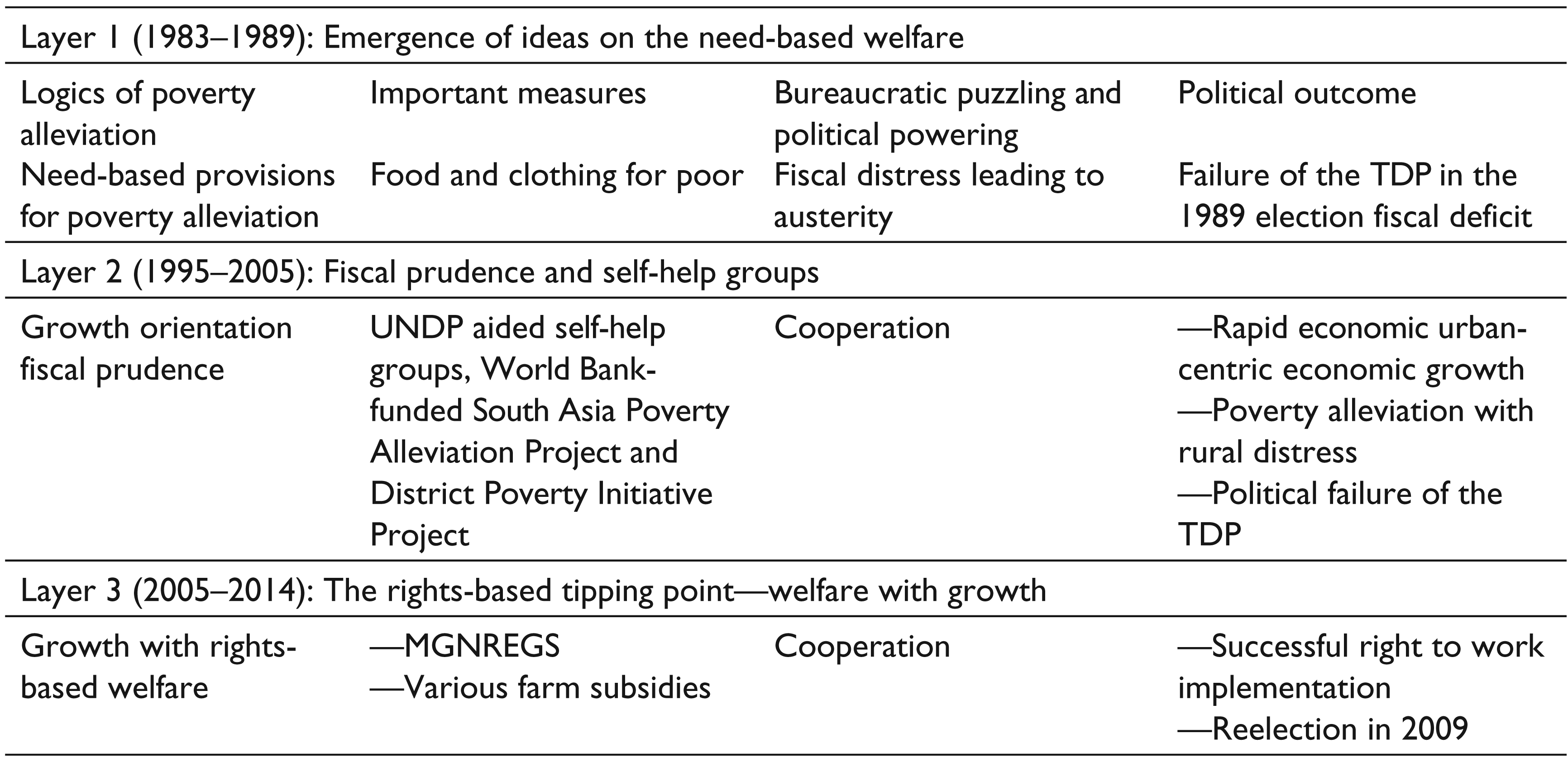
The first layer of the process phase was driven by meeting the needs of the poor in AP. This need-fulfilment phase enabled the state to serve subsidized rice and cloth to the poor based on political commitment that implemented brilliantly the Department of Rural Development. This phase enabled the state to build capacity to deliver food and clothing to the poor by minimizing leakages. The political orientation of CM Rama Rao enabled the pro-poor bureaucracy to device means to beat clientelistic networks. The state earned a good record for transcending clientelism through this effort.
The second phase of fiscally conservative welfare politics was driven by a fiscal crisis engendered by the need-based welfare policies of Phase 1. The liquor ban in AP was removed to raise revenues from liquor consumption. Bureaucratic puzzling and political powering now drove the state to create women’s SHGs that worked like a state-driven microcredit and welfare-promoting activity meant largely for rural women. This exercise taught the state to work with NGOs for mobilizing the poor. SHGs enhanced the capacity of the state to reach the poor directly. It also brought home the lesson to technocrats about the limits of subsidized credit as a poverty alleviation tool.
In the final phase, they are these lessons from the need-based and the fiscally prudent SHG phase that enabled the system to tip in favour of the most successful rights-based implementation around 2005 in undivided AP. The puzzling bureaucrats in the Department of Rural Development found a political opening with the arrival of YSR as CM in 2004. This enabled the state to deal with the powerful political adversaries of the right to work. What occurred after 2005, when the system tipped was substantially more transformative than what had been achieved during the gradual evolution of redistributive politics in the past. The state in AP was thus able to make a substantial impact on poverty. This is an especially important development in the capacity of a sub-national state in India because the implementation of the right to work varies wildly with state capacity in India.
Declaration of Conflicting Interests
The authors declared no potential conflicts of interest with respect to the research, authorship and/or publication of this article.
Funding
This research has been supported by Field of Focus 4 (FoF4), Heidelberg University, Germany.
Footnotes
Acknowledgements
This article is part of a larger project that seeks to compare the implementation of the MGNREGS in undivided AP and West Bengal since 2006. This article has benefited from presentations at the Centre for Economic and Social Studies, Hyderabad, at the Centre for the Advanced Study of India, University of Pennsylvania and at the Department of Political Science, Columbia University and Nehru Memorial Museum and Library – NMML, New Delhi. We thank R. Radhakrishna, S. Galab, Jack Snyder, K. C. Suri, Devesh Kapur and Bilal Baloch for comments. Our study also has benefited from the insights and perspectives of Kambhampati Rammohan and K. Lakshminarayana.