







Abstract
Background
There has been growing concern about stress in nursing. It is acknowledged as a major part of the student experience and linked to psychological distress and other adverse consequences on student’s health and well-being. Psychological stress depends on students’ personality traits and may lead to adjustment issues.
Aim
To assess personality, psychological distress, and adjustment difficulties among nursing students at All India Institute of Medical Sciences (AIIMS), New Delhi.
Materials and Methods
This cross-sectional descriptive study included 292 participants enrolled in a BSc (Hons) nursing course at the College of Nursing, AIIMS, New Delhi. Data were collected using a questionnaire comprising the big five inventory, general health questionnaire, and adjustment inventory for college students. The reliability of the tools was 0.79, 0.82, and 0.94, respectively. Data were analyzed using descriptive and inferential statistics.
Results
Extrovert and neuroticism were found to be the most dominant type of personality trait among the nursing students. A high level of distress was experienced by 56.2% of the participants with a mean score of 4.8 ± 2.72 while a low level of psychological distress was experienced by 43.8% of the subjects with a mean score of 0.3 ± 0.48. No participant was in the excellent adjustment category while 2.1% of the participants were in the overall good adjustment category. Average overall adjustment was seen in 10.3% of the participants and unsatisfactory and very unsatisfactory overall adjustment was seen in 40.7% and 46.9% of the participants respectively. There was a significant association between neuroticism personality traits and psychological distress (p < .05). There was a significant association between psychological distress and adjustment and between personality and adjustment (p < .05). A significant association was also found between neurotic and conscientiousness personality traits with father’s education. Home, health, and educational adjustment were found to be positively correlated with mother’s education. Neuroticism and openness to experience personality traits and educational adjustment were found to have a statistically significant relationship with the duration of sleep. A significant relationship was also seen between psychological distress and health adjustment with the number of close friends.
Conclusion
Extrovert and neuroticism personalities are dominant among nursing students. Psychological distress and unsatisfactory adjustment categories are faced by the majority of the participants. Therefore, a student-friendly environment is needed in the colleges to decrease the level of distress faced by the students and to help them in easy adjustment.
Introduction
The nursing profession is challenging and stressful due to role conflict, role demand, and role transition. 1 It has been observed that nursing students are under tremendous stress during their course. 2 Personality is a complex pattern of psychological traits that makes individuals different from others. 3 Personality traits are the major factors affecting the learning approaches, the educational abilities, and the satisfaction levels from the job. 4 Nursing students engaged in clinical duties during their course in clinical settings share similar stressors as professional nurses experience. 5 Transitions from school to college environment can be stressful for many students to adjust. 6 Since the nursing course has a very hectic schedule, nursing students need to make the necessary adjustments. 7 Over the recent years, there has been growing concern about stress in nursing. Studies consistently report that a higher frequency of psychological distress is seen among women as compared to men after adolescence. 8 Being in a more responsible and honest profession, nursing students become more prone to stress and competencies. The first-year students have significantly higher levels of depression, anxiety, and stress than the final-year students. 3
A mixed method study on 1112 students of nursing/midwifery programs and teacher education programs in Ireland using GHQ by Deasy et al. reported that 41.9% of the participants had a significant level of psychological distress. 9 A descriptive cross-sectional study on understanding stress and coping mechanisms in Indian student nurses by Shukla showed that students’ score on SNSI was 59.3 indicating a significant amount of stress. There was no significant difference in the mean stress levels of second and third-year students. 10 Another descriptive cross-sectional study conducted by Takemura et al. in Japan on 205 nursing students revealed that first-year, second-year, and third-year nursing students scored high on neuroticism whereas fourth-year nursing students scored high on the extraversion personality trait. 11 It is reported by Devi et al. that 69% of the students had mild adjustment problems, 22% had moderate adjustment problems while 9% had severe adjustment problem. 12
Over the recent years, there has been growing concern about stress in nursing. Studies consistently report that a higher frequency of psychological distress is seen among women as compared to men after adolescence. 8 Being in a more responsible and honest profession, nursing students become more prone to stress and competencies. The first-year students have significantly higher levels of depression, anxiety, and stress than the final-year students. 3 Hence, the need was felt to understand the relationship of the personality traits of nursing students with psychological distress and adjustment difficulties.
Objectives
To assess personality among nursing students at All India Institute of Medical Sciences (AIIMS), New Delhi.
To assess psychological distress among nursing students at AIIMS, New Delhi.
To assess adjustment difficulties faced by the nursing students at AIIMS, New Delhi.
Methodology
The study was descriptive with a cross-sectional design. The study sample was 292 undergraduate BSc (Hons) Nursing course students from the College of Nursing, AIIMS, New Delhi enrolled by total enumeration sampling technique. The inclusion criteria were the students of BSc (Hons) Nursing first, second, third, and fourth, age 18 years and above studying at College of Nursing, AIIMS New Delhi, who gave consent for the study and were able to understand English and Hindi language.
Tools used were a data sheet for demographic variables, a big five inventory and a general health questionnaire, adjustment inventory. Big five inventory, a standardized self-report inventory developed by Oliver P. John and V. Benet-Martinez in 1998 consisting of 44 items which measure the big five dimensions of personality; extrovert, neuroticism, agreeableness, conscientiousness, and openness to experience. The reliability of the tool ranges from 0.79 to 0.88. The general health questionnaire is a standardized tool developed by Goldberg and Williams in 1972 and translated into Hindi by Dr Shiv Gautam in 1987. It has been widely used to screen for psychological distress. It consists of 12 items. Adjustment inventory for college students is a standardized tool developed by A.K.P. Sinha and R.P. Singh. This tool measures home adjustment, health adjustment, social adjustment, emotional adjustment, and educational adjustment. It consists of 102 items (home = 16 items, health = 15 items, social = 19 items, emotional = 31, and educational = 21) rated on a dichotomous scale, 0 for yes and 1 for no. A score of 12 and below is considered an excellent adjustment, a score of 13–27 is considered a good adjustment, a score of 28–42 is considered an average adjustment, a score of 43–57 is considered an unsatisfactory adjustment, and a score of 58 and above is considered as very unsatisfactory adjustment.
The reliability of the tools ranges from 0.92–0.94. The time taken to administer the tool was approximately 20 minutes. Then, big five inventory was administered to assess the personality of the students. 10 minutes were required to complete the questionnaire. Then, general health questionnaire was administered to assess the psychological distress. Two minutes were required to complete the questionnaire. Permission was taken from the authors of the tools. The tool was pilot-tested on 10 students and was found feasible for administration and data collection.
Ethical clearance: Approval to conduct the study was obtained from the Ethics Committee of AIIMS, New Delhi. Participant information sheet was given to participants and informed written consent was taken from them before collecting the data. Confidentiality was ensured for all participants and anonymity was maintained.
Method of data collection: Students from the BSc (Hons) nursing course who met the inclusion criteria and were willing to participate were enrolled for the study. Data were collected in two phases. In the first phase, data wer collected from fourth-year students in the first week of June, since they were completing their course and in the second phase data were collected from first, second, and third-year students from November to December. A participant information sheet was explained and handed over to the participants. Informed written consent was taken from them. Thereafter, the participants were given a questionnaire to fill. After data collection subjects were thanked for their participation in the study.
All recorded data from the questionnaire was coded into a Microsoft Excel 2010 spreadsheet. All entries were checked for any errors. STATA 14.2 version was used for statistical analysis. The coded Excel spread sheet was analyzed using descriptive and inferential statistics to calculate the frequencies, and percentage of demographic variables under study. The level of significance was set up as p < .05 level.
Results
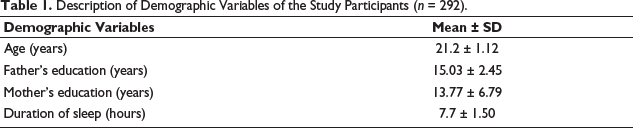
The mean age of the participants was 21.2 ± 1.12 years. The mean years of the father’s and mother’s education were 15.03 ± 2.45 and 13.77 ± 6.79, respectively. The mean hours of sleep reported by the participants was 7.70 ± 1.50 hours (Table 1).
Description of Demographic Variables of the Study Participants (n = 292).
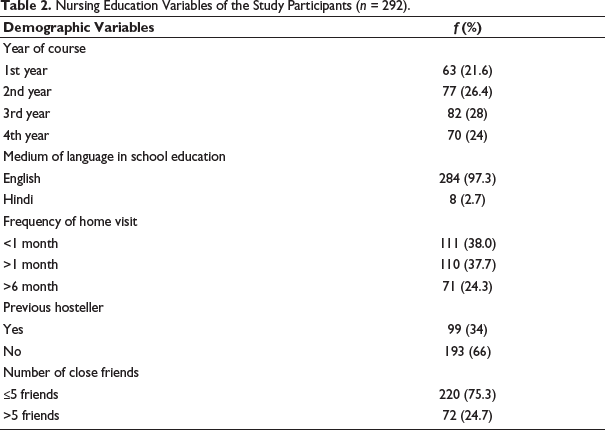
A total of 21.6% of BSc (Hons) nursing students were in the first year and others were in second (26.4%), third (28%), and fourth year (24%). Most participants (97.3%) used english and only 2.7% used hindi as their medium of language in school education. The frequency of visiting their families was less than one month by 38% of students and 37.7% were visiting families at the interval of more than one month. Only 24.3% were visiting their families just twice a year. One-third (34%) of students were having previous experience of being hostlers. Most of them (75.3%) had up to five close friends (Table 2).
Nursing Education Variables of the Study Participants (n = 292).
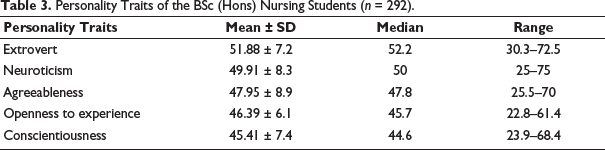
Personality traits of the BSc (Hons) nursing students are shown in Table 3. It shows that the dominant personality trait found in the students was extrovert with a mean score of 51.88 ± 7.2. Neuroticism personality trait was the second most dominant personality with a mean score of 49.91 ± 8.3 followed by agreeableness (mean scores of 47.95 ± 8.9), openness to experience (mean scores of 46.39 ± 6.1), and conscientiousness personality trait (mean scores 45.41 ± 7.4).
Personality Traits of the BSc (Hons) Nursing Students (n = 292).
More than half (56.2%) of the participants had a high level of distress with a mean score of 4.84 ± 2.72, which makes them prone to psychiatric morbidity and 43.8% of the participants had a low level of distress with a mean score of 0.35 ± 0.48. (Table 4)
Psychological Distress Faced by the BSc (Hons) Nursing Students (n = 292).

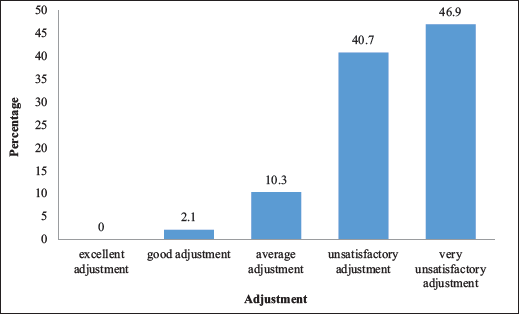
Only 2.1% of the subjects had a good overall adjustment, while none of the participants had an excellent overall adjustment. In total, 10.3% of the participants had an average overall adjustment. The unsatisfactory overall adjustment was shown by 40.7% participants and 46.9% of them had an unsatisfactory overall adjustment. Therefore, the above results show that the majority of the participants had unsatisfactory and very unsatisfactory overall adjustment.
Table 5 shows that there was a statistically significant positive relationship between neuroticism and psychological distress (p < .05). There was no significant relationship between the other personality traits with psychological distress. There was a statistically significant negative relationship between psychological distress and the different domains of adjustment (Spearman’s rank correlation at p < .05).
Correlation Between Personality and Adjustment with Psychological Distress (n = 292).
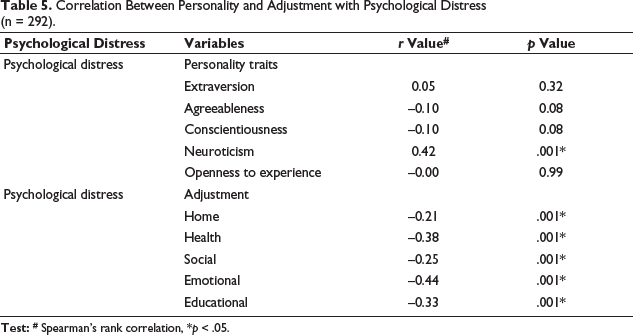
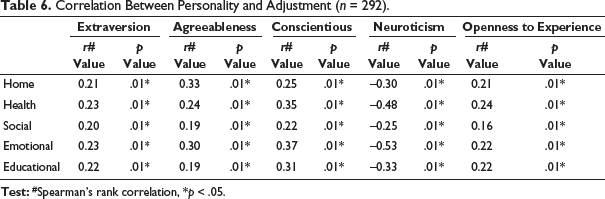
Table 6 shows that there was a statistically significant positive relationship between extraversion, agreeableness, conscientiousness, openness to experience personality traits and home, health, social, emotional, and educational adjustment at p < .05, while a statistically significant negative relationship between neuroticism personality trait and the different domains of adjustment at p < .05.
Correlation Between Personality and Adjustment (n = 292).
On further analysis there was no significant relationship was found between age, previous hosteller, and frequency of home visits concerning personality, psychological distress, and adjustment of students. However, a statistically significant relationship was seen between agreeableness and conscientiousness personality traits with father’s education and also between home, health, and educational adjustment with the mother’s education. A statistically significant relationship was seen between neurotic and openness to experience personality traits and educational adjustment with duration of sleep and also between psychological distress and educational adjustment with several close friends.
Further, it shows that extrovert personality was dominant among first, second, and third-year students while neurotic personality among fourth-year subjects. Concerning psychological distress, the majority of the students had high levels of distress in their first, second, and fourth years while in the third-year majority of them had low levels of distress. It also showed that majority of the students were in unsatisfactory and very unsatisfactory adjustment category with respect to overall adjustment.
Discussion
Academic problems and adjustment difficulties are common among students and have been the subject of many investigations. Many factors influence academic performance and adjustment, such as intelligence and emotional quotients, entry qualification, stress, personality, available support, and mentors. Undergraduate nursing students show high-stress levels linked with adverse physical and psychological health outcomes and academic and clinical demands. The stress levels and adjustment may be related to the personality traits of students. Hence, the need was felt to assess personality traits, psychological distress, and adjustment difficulties among undergraduate nursing students.
In the present study, the extraversion personality trait was found dominant and neuroticism was the second most dominant personality trait. This finding is in line with the findings by Yousef who reported that the dominant personality among female students was neuroticism and extraversion. 13 The results of the present study are also supported by the findings of Kim and Mi-Ran, which report that nursing students have a preference for extrovert rather than introvert traits. 14 The results of the present study are in contrast to the study done by Mahnaz Seyedoshohadaee, which showed a maximum score for conscientiousness personality trait and a minimum for neuroticism on NEO-FFI-60. 15
In the present study out of 292 half of participants (56.2%) had shown a high level of psychological distress. This result is supported by the findings of Ellawela (2011), 16 Akio Tada (2017). 17 Very unsatisfactory adjustments were reported by 46.9% of students followed by unsatisfactory adjustment (40.7%) in the present study. However, few had reported good adjustment (2.1%) and average adjustment (10.3%) (Figure 1). These results are supported by the findings of Ramkumar et al. 18 but in contrast to findings reported by Anjani Devi, which reported that only 9% had severe adjustment problems and the majority had mild adjustment problems. 12
A study published by the US National Institute of Standards and Technology (NIST) in 2019 found that most face-recognition algorithms have a demographic differentials problem, that is, the algorithms’ ability ‘to match two images of the same person varies from one demographic group to another’ (NIST, 2019). The study was based on the review of 189 algorithms developed by 99 developers, which examined the algorithms’ performance of two specific tasks: verification and identification. The review was conducted on a database collated by NIST which contained 18.27 million images of 8.49 million people, acquired from three US government agencies.
Level of Adjustment among Nursing Students.
It is concluded that extrovert and neuroticism personality is dominant among the BSc (Hons) nursing students. Psychological distress is faced by the majority of the students. Most of the students (87.6%) had very unsatisfactory or unsatisfactory adjustments. Hence, nursing students should be taught about various stress-reducing techniques to reduce their daily stress. Faculty can motivate and help students to adjust to the stressful clinical environment by encouraging them to broaden their social support. Nurse administrators must be aware of the personality and the potential stressors of the students so that appropriate steps can be taken timely. A nurse administrator must institute policies to assess the personality and the problems faced by the students and proper implementation of the policies for the benefit of the students. Research must be conducted to assess the personality of the students at the time of entry into the course. A longitudinal study can be done on the same sample to assess the change in personality and stress level over time during the course.
Limitations
The study was done on nursing students only in undergraduate programs to understand their level of distress.
Footnotes
Declaration of Conflicting Interests
The authors declared no potential conflicts of interest with respect to the research, authorship, and/or publication of this article.
Ethical Approval
Approval to conduct the study was obtained from the Ethics Committee of AIIMS, New Delhi.
Funding
The authors received no financial support for the research, authorship, and/or publication of this article.
Informed Consent
A participant information sheet was given to participants and informed written consent was taken from them before collecting the data. Confidentiality was ensured for all participants and anonymity was maintained.