






Abstract
Introduction
Culturally competent nursing care is essential in today’s diverse healthcare environment to ensure respectful, personalized, and effective patient outcomes. This study explores the insights and awareness of nursing officers regarding culturally competent care.
Methodology
The present study was a descriptive design, cross-sectional study including 315 nursing officers. The study participants were selected using purposive sampling technique and willing to participate in the study. The present study was carried out among 315 registered nurses (RNs) working in North Indian tertiary care institutions. The data collection tool consist of a bio-demographic sheet of nursing officers, including age, work area, clinical experience, and educational background, and a standardized Modified Cultural Awareness Scale, which has a total of 23 items.
Results
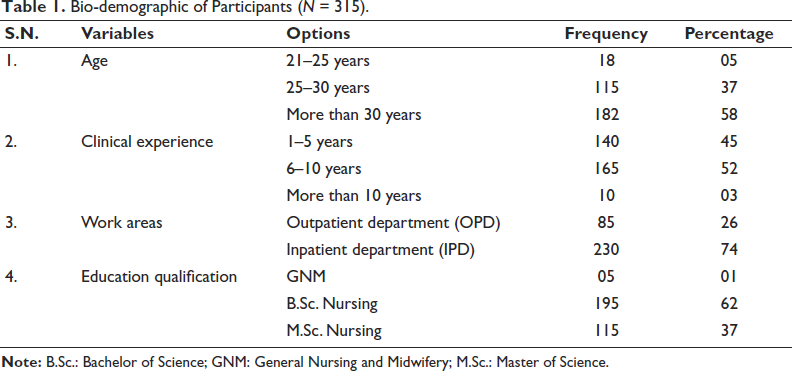
Out of the 315 nursing officers, the most (58%) were over 30 years old, (52%) had 6–10 years of clinical experience, (74%) worked in an inpatient department (IPD), and had baccalaureate-level education. In general, nursing officers have knowledge of providing culturally competent care.
Conclusions
Assessing cultural competence can help shape future program for the development of nurses and provide a valuable assessment of administrators and nursing leaders in order to support culture competence nursing care in each institution.
Introduction
Improving patient outcomes and reducing healthcare inequities are two benefits of providing culturally competent nursing care. Joint Commission’s recommendations on nursing education and law clearly demonstrate how important cultural competence in care is in healthcare environments. Cultural competence nursing care is the outcome of the integration of four discrete components, that is, cultural sensitivity, cultural knowledge, cultural awareness, and cultural skill. 1 A person’s affective response and capacity to recognize and critically analyze personal prejudices towards different cultures, ways of life, and ideologies are known as their cultural awareness. Cultural skill stresses psychological and physical assessment. Cultural knowledge concentrates on cognition and information. Cultural sensitivity refers to the behaviors and face-to-face interactions that occur between people. Culture competence nursing care emerges as a result of several interconnected and related factors. 2
Cultural competence in nursing care exchanges that are viewed as meaningful and courteous and that improve a client’s health and well-being. Building relationships and practicing compassion are abundant chances that arise from encounters between nurses and patients, for example, assessment and teaching activities that naturally reflect the attitudes of the individual nurses.3, 4
Various nursing care theories place a strong emphasis on the interactions and connections between nurses and patients, viewing caring and participation as equally crucial to an individual’s well-being as is caring for tasks that require focus. The appropriate display of care in culturally competent situations can be difficult, though, because transmitting compassion is a socially constructed phenomenon that is based on the views and interpretations of both the sender and the recipient.5, 6 It is understandable why actions meant to be perceived as acts of kindness may not be, especially when combined with the extra stress that frequently accompanies hospital stays. This can lead to an asynchrony that can be harmful to the relationship between the nurse and the patient. 7
Swanson’s caring philosophy serves as the cornerstone for nursing practice. This council started a comprehensive program that included participatory events, an annual conference, and ongoing education sessions about diversity and culture. An annual multicultural fair, an online calendar of regional cultural and ethnic activities, and a website including recommended books and films that highlight variety on aspects other than race, ethnicity or language, like socio-economic class and belief systems, are a few examples.
While offering culturally sensitive instruction has long been a feature of academic curricula, hospitals are taking on a greater role in facilitating continuing staff development initiatives linked to culture and diversity, too. There are still difficulties in assessing the effectiveness and impact of these activities, even as facilities work to support the development of these talents. The main aim of this study was to evaluate and characterize the cultural awareness of clinical nurses regarding the work environment in relation to diversity and the different cultures of our patients.
Material and Methods
A cross-sectional study with descriptive design was conducted among registered nurses (RNs) employed at Tertiary care institutes of North India were included. A total of 315 nursing officers were selected after obtaining written informed consent. Nursing officers who were working in different units and had more than 1 year of experience were included in this study.
The data collection tool mainly consists of two sections. First section consists of bio-demographic variables of nursing officers, that is, age, clinical experience, work area, and educational qualification. Second section consists of the standardized Modified Cultural Awareness Scale, which consists of a total of 23 items.
Data analysis was done by using Statistical Package for the Social Sciences (SPSS) for Windows version 23.0 (IBM Corp., Armonk, NY, USA). In descriptive statistics, frequency and percentage were calculated to analyze the data.
Results
Bio-demographic of Participants
Out of 315 nursing officers, the majority aged more than 30 years (58%), had 6–10 years (52%) clinical experience, working in IPD (74%), and were baccalaureate level educated (62%) (Table 1).
Bio-demographic of Participants (N = 315).
Modified Cultural Awareness Scale Findings
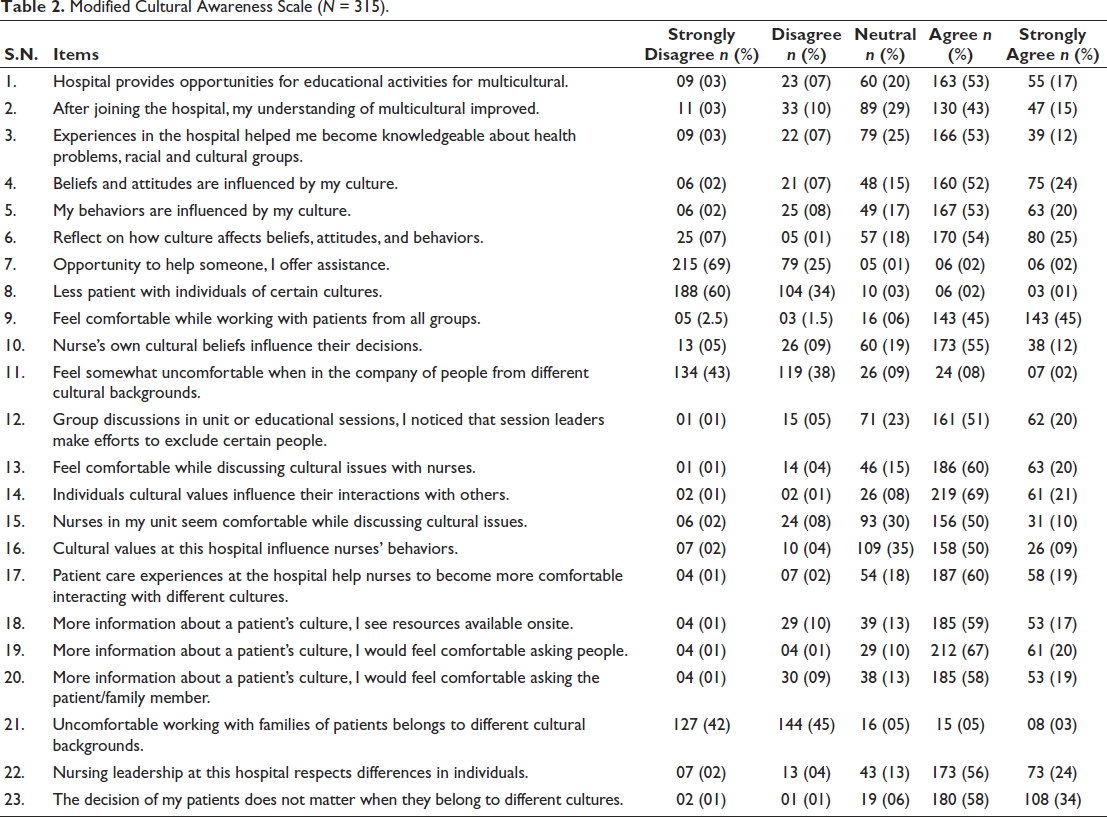
According to the Modified Cultural Awareness Scale, 70% of nursing officers of the hospital offer chances for educational activities pertaining to ethnic concerns in nursing. My knowledge of multicultural issues has grown since I started working at this hospital (58%). My experiences here have also helped me learn about the health issues that are specific to different racial and cultural groups (65%). They believe that my culture influences my beliefs and attitudes (76%), that my culture influences my behaviors (73%), that their culture influences their beliefs, attitudes, and behaviors (79%), that they feel comfortable working with patients of all ethnic groups (90%), and that nurses’ own cultural beliefs influence their nursing care decisions (67%).
I have observed that the session leaders try to make sure that no one is left out of group discussions, exercises, or educational sessions (71%); they feel comfortable talking about cultural issues with nurses on my unit (80%); they believe that people’s cultural values affect how they interact with others (90%); nurses on my unit seem to be at ease talking about cultural issues (60%); the nursing officer believes that the cultural values that are communicated at this hospital affect how nurses behave in the clinical setting (59%); and they think that the patient care experiences at this hospital help nurses become more at ease interacting with people from different cultures (79%). They feel that the nursing leadership at this hospital (CNO, Directors, Nurse Managers, and CN IV) respects differences in individuals from diverse cultural backgrounds (80%), and I respect my patients’ decisions when they are influenced by their culture, even if I disagree (92%). If I need more information about a patient’s culture, I would use the resources available onsite (76%), if I need more information about a patient’s culture, I would feel comfortable asking the patient or family member (77%), and if I needed more information, I would feel comfortable asking the patient or family member (77%).
The majority of nursing officers disagreed or strongly disagreed with the following statements: I usually feel a little uneasy when I am around people from cultural or ethnic backgrounds different from my own (81%), and I feel a little uneasy when I work with the families of patients from cultural backgrounds different from my own (87%). I also offer assistance less frequently to people of certain cultural backgrounds (94%), and they are less patient with people of certain cultural backgrounds (94%). In general, nursing officers were knowledgeable about providing culturally competent treatment (Table 2).
Modified Cultural Awareness Scale (N = 315).
Discussion
The present study sought to evaluate the cultural awareness and competence of nursing officers working in tertiary care institutions in North India. Findings reveal that the majority of participants demonstrated a high degree of cultural competence, particularly in their attitudes, comfort levels, and willingness to engage with patients and families from diverse cultural backgrounds. These findings are consistent with global trends highlighting the growing awareness and integration of culturally competent practices in nursing.
A significant proportion of nursing officers (over 90%) reported feeling comfortable working with patients from all ethnic backgrounds and respected decisions made by patients even when influenced by different cultural beliefs. This aligns with a study by Kaihlanen et al., which highlighted that nurses with prior exposure to multicultural education and work environments tend to display more cultural humility and are more likely to practice patient-centered care that respects individual belief systems. 8
Moreover, 76%–90% of participants acknowledged that their cultural beliefs and values influenced their behaviors and clinical decision-making, reflecting a self-aware nursing workforce. These results are comparable to a study conducted by Campinha-Bacote, which emphasized that cultural awareness—the first step in achieving cultural competence—is strongly associated with a nurse’s ability to reflect on their own biases and adapt their care strategies accordingly. 9
The study also found that most nurses disagreed with statements implying discomfort or bias toward patients from different cultures. For instance, 94% disagreed with offering less assistance to individuals from certain cultural backgrounds, and 87% disagreed with feeling uncomfortable working with families from different cultural groups. This suggests a largely inclusive and empathetic nursing workforce. Similar trends were observed in a study by Loftin et al., where nursing students and professionals with exposure to diverse patient populations exhibited higher scores in cultural sensitivity and lower levels of implicit bias. 10
However, it is noteworthy that 30%–35% of participants remained neutral regarding the influence of institutional culture on their clinical behaviors and the extent of cultural discussions among peers. This indicates an area for improvement in workplace communication and leadership engagement. A study by Shen supports this observation, suggesting that while individual cultural competence may be strong, institutional support systems (e.g., ongoing training, inclusive leadership, interprofessional dialogues) are crucial in sustaining and enhancing culturally competent care. 11
The role of educational qualifications also emerged as a key determinant, with a majority of culturally aware responses coming from those with baccalaureate and master’s-level nursing education. This supports findings by Jeffreys, who demonstrated that formal education is a critical enabler of cultural knowledge and skills in nursing professionals. 12
Lastly, while hospitals in the current study provide educational opportunities on multicultural issues, the variability in responses suggests a need for structured and regular in-service training programs. According to Horvat et al., culturally competent training interventions are associated with improved provider knowledge, enhanced patient-provider interactions, and better patient satisfaction. 13
Implications for Practice
This study emphasizes the need for integrating structured cultural competence programs within hospitals, reinforcing supportive leadership, and promoting interdisciplinary discussions to improve awareness and sensitivity. Nurse educators and hospital administrators must collaborate to foster an environment that embraces cultural diversity not only in patient care but also in staff development and institutional culture.
Conclusion
Evaluating cultural competence can direct future nurses’ development initiatives and offer a useful evaluation of nursing leaders and administrators to cater culture competence nursing care in each hospital. Since nursing leaders and administrators serve as role models for culture competence nursing care, they can gain from continuing nursing education that improves their knowledge of nurses regarding culture competent nursing care.
Footnotes
Acknowledgements
The authors thank all the participants and the study team members who participated in this study.
Sincere thanks to the nursing officers of various hospitals for taking part in this study.
Authors’ Contribution
All authors listed meet the authorship criteria according to the latest guidelines of the International Committee of Medical Journal Editors.
Declaration of Conflict of Interests
The authors declared no potential conflicts of interest with respect to the research, authorship, and/or publication of this article.
Ethical Approval
Ethical approval was obtained from the Institute Ethical Committee (AIIMS/IEC/20/53 on dated 08.02.2020).
Funding
The authors received no financial support for the research, authorship, and/or publication of this article.
Informed Consent
Written informed consent was obtained from each study participant, and their anonymity and confidentiality were maintained during whole study.
