







Abstract
In recent times, sustainable development has received huge attention of academia, corporations, government and society at large as there has been an increasing concern about the rapid exhausting of the earth's natural resources and related environmental issues.There has been plenty of research done on corporate social responsibility (CSR) which leads to the growing realisation that corporate inclination towards it results in sustainable development. This is important because corporates are the major users and often abusers of our limited stocks of the various forms of natural capital upon which our economic, social and cultural well-being are based. Interestingly, many authors believe that those corporations which are socially responsible are considered to be good companies by the society (customers). Thus, customer acts as a primary stakeholder and it affects the long-term survival of the business.
A conceptual framework on CSR orientation has been developed for sustainable society development on the basis of two dimensions, namely, corporate orientation and consumer orientation. It has four quadrants where the best case is both corporate and consumer showing high orientation towards social responsibility. The worst scenario is Menace when both display low orientation. The quadrant Blind is also not favourable because only corporations are highly oriented whereas consumers are not.The case may be contrary when consumers are enlightened and corporations are not.The main endeavour behind this study is to unleash the power of consumer and in extreme cases employ the method of boycott to pressurise business firms to follow sustainable guidelines. Effort has been made to highlight how consumer can be a key driving force for CSR.
Introduction
‘Sustainable development involves the simultaneous pursuit of economic prosperity, environmental quality and social equity. Companies aiming for sustainability need to perform not against a single, financial bottom line but against the triple bottom line (TBL)' (WBCSD, 1997). Sustainable development is the most widely debated topic among academia, corporations, government and society at large. However, its prime theme revolves around meeting the needs of the present generation without hampering future's needs by saving a healthier and better planet for tomorrow. Mounting ethical concerns about the impact of modern consumption culture on society and the environment, the rising prominence of these environmental and social issues within mainstream media, the emergence of organised consumer activist groups etc. have all led to a growing awareness by consumers and impacts their purchasing and consumption behaviour (Carrigan & Attalla, 2001; Crane & Matten, 2004). Ethically minded consumers feel a responsibility towards the environment and the society, and seek to express their values through ethical consumption and purchasing (or boycotting) behaviour (De Pelsmacker, Driesen & Rayp, 2005).
Today, there is increased concern about the earth's depleting natural resources and related environmental issues. Corporations utilise the limited natural resources for their benefit and thus there has been an increasing realisation that corporations need to give back to the society through their Corporate Social Responsibility (CSR). Traditionally, CSR was seen merely as a philanthropic activity, as giving alms to the society. According to the former chairman of Infosys, Mr Narayana Murthy ‘CSR encompasses the ideas of corporate governance, sustainable wealth creation, corporate philanthropy and advocacy for the goals of the community.' 1
http://csrworld.net/Talk-on-Corporate-Social-Responsibility-by-n-r-narayana-murthy. asp (accessed on 20 September 2014).
Consumers are demanding more than ‘product' from their favorite brands. Employees are choosing to work for companies with strong values. Shareholders are more inclined to invest in businesses with outstanding corporate reputations. Quite simply, being socially responsible is not only the right thing to do; it can distinguish a company from its industry peers. 2
http://www.starbucks.com/assets/6ee14301a2364729abe59867fb913520.pdf (accessed on 4 July 2014).
Unfortunately, there is less unanimity in defining CSR as many researchers, authors and practitioners have diverse opinions and viewpoints on what CSR should embrace and what would be its role. From shareholder's points of view, it is drainage of profit that actually belongs to them while some think that this is the tactic by which the corporations veils their unethical or unsustainable practices but some believe that this is the real attempt to help and uplift the society (Lindgreen & Swaen, 2010).
CSR encompasses many terms in its bracket like business ethics, corporate
citizenship, and corporate conscience or social responsibility. There has been a lot
of debate on what should come under the purview of CSR. According to Epstein (2008), CSR
concentrates on nine areas: ethics, governance, transparency, business
relationships, financial return, community involvement, product value, employment
practices and environmental protection. Carroll (1979, p. 499) introduced a widely
accepted and commonly cited definition of social responsibility by quoting that
‘to fully address the entire range of obligations business has to society, it
must embody the economic, legal, ethical and discretionary categories of business
performance.' European commission narrated the main features of CSR as
follows (European Commission,
2002): CSR is behaviour by business over and above legal requirement,
voluntary adapted because businesses deem it to be in the long-term
interest. CSR is intrinsically linked to the concept of sustainable
development: business need to integrate the economic, social and
environment impact in their operation. CSR is not an optional ‘add-on' to business
activities but about the way in which business are
managed.
CSR and Sustainable Development
Today sustainable development is a prime focus both globally and nationally (Lehtoranta, Nissinen, Mattila & Melanen, 2011) as it revolves around fulfilling the needs of the present generation without hindering future's ability to meet their needs. World Business Council on sustainable development states, ‘Sustainable development involves the simultaneous pursuit of economic prosperity, environmental quality and social equity. Thus, Sustainability runs on Triple Bottom Line (TBL) approach which is called as three pillars of sustainability—Environment, Economy, and Society' (Elkington, 1998).
Today nations all over the world have initiated many programmes to foster sustainable development where governments play a key role. Another important development is the role of corporations through their social responsibility agenda. Since corporations are the major users and abusers of the scarce natural resources, there is an increasing body of research dedicated to corporate responsibility for sustainable development (e.g., Donaldson & Dunfee, 1994; Figge, Hahn, Shaltegger & Wagner, 2002; Heikkurinen & Bonnedahl, 2013; Reed & Reed, 2010; Sastry, 2011; Warhurst, 2005; Wood, 1991). CSR initiatives vary from voluntary programmes and partnerships to mitigate the environmental impact of industrial plants and production methods (Rondinelli & Berry, 2000) to any other developmental initiatives related to social welfare.
Rondinelli and Berry (2000) also reported that large multinationals can be powerful forces for achieving sustainable development objectives. This gives a strong supporting argument that CSR will lead to sustainable development. One of the most comprehensive definitions highlighting this argument is given by the World Business Council for Sustainable Development (WBCSD, 2009, p. 2) which defines CSR as ‘the commitment of business to contribute to sustainable economic development, working with employees, their families, the local community and society at large to improve their quality of life.'
Customers and CSR
Stakeholders
An important question often raised is in whose interest a corporation should serve and to whom it should be accountable? Various authors gave different views on who are the stakeholders, their importance and to whom the corporation must attend to for its survival. Freeman (2010) described that a stakeholder can be any person, group, organisation, institution, society and even natural environment. In other words, stakeholder may be an individual, a group or an entity, who is capable enough to exert force that determines business performance or the fate of business firms. There must be a mutual and interdependent relationship between the businesses and the stakeholders which will result in business sustainability as well as societal development.
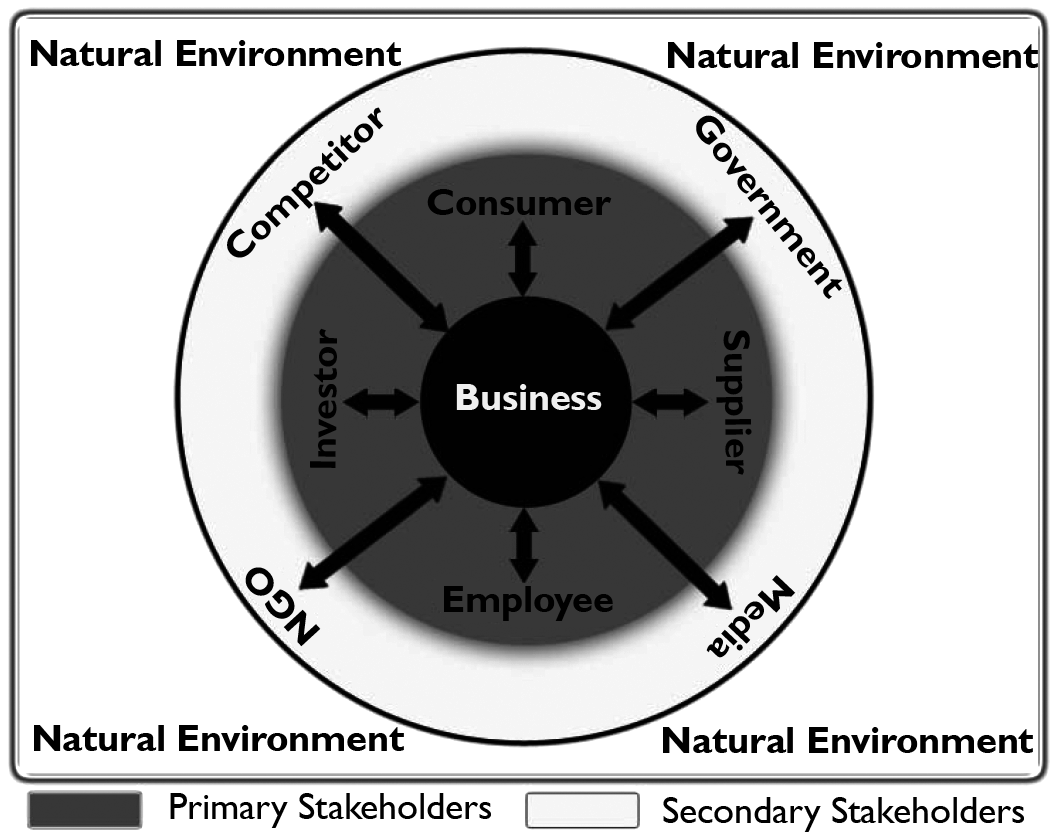
While Freeman (2010) gave the broader view of stakeholder theory, Mitchel, Agle and Wood (1997) introduced a much narrower view explaining which groups of stakeholders should deserve maximum management attention. According to them, stakeholders like consumers, employees, investor and suppliers are necessary for corporate survival (Figure 1). They can be regarded as primary stakeholders because they hugely influence the firm and also get affected by the firm's activities. If any of the primary stakeholder groups withdraws its support, the firm's operation is adversely affected (Clarkson, 1995). In this study, the primary focus is given to one of the primary stakeholders, namely, customers.
Consumer as a Stakeholder
It follows from the above observation that many authors or researchers perceived customer as a primary stakeholder and believe that company's long-term survival is truly dependent on consumer. Clarkson (1995) opined that customers are essential for survival of companies and represent a central feature of every CSR report. It would not be wrong if we say that consumers are responsible for the ultimate survival of any business. They not only affect the business performance but also affect other stakeholders of the firm like employees, investors, supplier, etc. Business firms can attract the customers by being socially responsible, offering the best, innovative and eco-friendly products or services. Therefore, it would be imperative to say that consumers have enough power to become key drivers for CSR to the extent that they could even compel business firms to become more socially and environmentally responsible. This is the need of the hour as natural resources are depleting at a much faster pace and there is a desperate need to save the earth for tomorrow's generations. This thought is discussed at greater length in the conceptual framework.
CSR, Corporate Image and Consumer Perception
Perception is the mental image framed in the mind through observations and experiences. Previous researches confirm that consumers perceive business firms differently based on their CSR inclination. Corporations must ensure that consumer, who actually decides the fortune of the business, must be aware and frame a positive image in their mind about CSR initiatives. Oberseder, Schlegelmilch and Murphy (2013) and Wigley (2008) observed that awareness about CSR initiatives influence consumer's attitude positively and they have stronger intention to purchase the company's offerings. Moreover Becker-Olsen, Cudmore and Hill (2006) and Ellen, Webb and Mohr (2006) assert that motives behind the CSR initiatives plays a great role in shaping consumer's perception towards businesses. So consumers having high awareness level about the CSR initiatives perceived positive image about those corporations that are socially responsible and in turn, it influences their product evaluation and purchase decision. According to Sen and Bhattracharya (2001), key moderators of consumer response to CSR are individual consumer and company-specific factors. They observed that the consumer reaction to CSR is contingent as consumer react negatively to negative CSR information and positively to positive CSR information. Lee, Park, Rapert and Newman (2012) observed that consumer perceived CSR initiatives favourably and positively when it matches with the consumer's lifestyle and values which consequently increases C–C (consumer–company) identification and improves brand loyalty. The consumer's positive and favourable CSR belief leads to strong C–C identification (Bhattacharya & Sen, 2003), and strengthens the consumer–brand relationship.
CSR and Consumer Purchase Behaviour
Corporate CSR friendliness builds a positive corporate image in the society, enhances brand value and improves product evaluation, while the reverse may ruin the corporate reputation and consequently lead to hostile stakeholder relationship. For example Brown and Dacin (1997) observed that negative CSR associations ultimately can have a detrimental effect on overall product evaluations, whereas positive CSR associations can enhance the product evaluations.
Vogel (2005) reported that up to 90 per cent of consumer's purchase and consumption behaviour is influenced by corporate responsibility practices of the firm. Lee et al. (2010) also observed that there is a linear relationship between consumer awareness of company's CSR initiatives and their purchase intentions. Ross, Patterson and Stutts (1992) and Sprinkle and Maines (2010) also found that many consumers claim to be more willing to buy products from companies involved in social causes; and also have direct and positive influence on consumer loyalty to a firm (Garcia, Crespo & Rodriguez, 2005; Lee et al.2012). Therefore, it affirms the fact that CSR has a positive effect on consumer evaluations of the company and its products which leads to increased willingness of purchasing behaviour (Brown & Dacin, 1997; Sen & Bhattacharya, 2001). Consumer buys product/services from the company when they Know, Like and Trust the company. The trust factor can only be built by being socially responsible in the eyes of the consumers. Khojastehpour and John (2014) highlighted in their study that environmental CSR has a positive effect on corporate reputation and corporate profitability.
The Cognitive Dissonance
Even though the attitude of consumers favours CSR but many researchers like Auger and Devinney (2007), Carrigan and Attalla (2001), Carrington, Neville and Gregory (2014) and De Pelsmacker et al. (2005) reveal that consumer do not walk on their talk and exhibit intention—behaviour gap. This shows how cognitive dissonance exists in the attitude and buying pattern of consumers which may be due to various reasons like awareness, accessibility, high cost, limited options, trust, time, habit, etc. The study of Carrington et al. (2014, p. 2759) reveals four interrelated factors affecting the ethical intention—behaviour gap: (a) prioritisation of ethical concerns, (b) formation of plan/habits, (c) willingness to commit and sacrifice and (d) modes of shopping behaviour. They propose that closing the gap will have positive outcome on the future sustainability of economies, societies and environments.
The Conceptual Framework
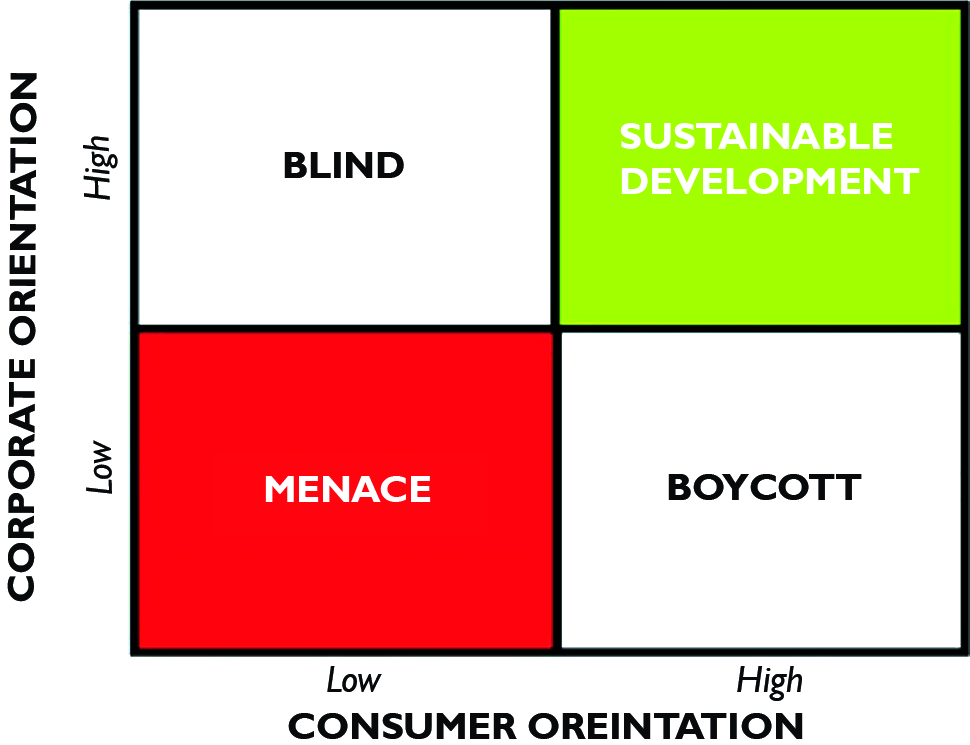
CSR Orientation Grid is a conceptual framework which is developed on the basis of two dimensions, namely, corporate orientation and consumer orientation towards social responsibility ranging from low to high. Sustainable development and making the world a safer and better place to live in depends on the mutual responsibilities of both consumers and business firms. The conceptual framework as depicted in Figure 2, has four quadrants, namely, Menace, Boycott, Blind and Sustainable Development.
The Two Dimensions
Corporate Orientation
It reveals the extent of corporate policies and practices, their social responsiveness and their intentions towards societal development. High CSR orientation exhibits better responsibility towards society through corporate philanthropy, proactive initiative to social causes, sustainable practices like eco-friendly processes, products, etc. as compared to low CSR orientation.
Consumer Orientation
Consumer's orientation describes the consumer perception and purchase behaviour. The high-oriented consumers think themselves as responsible citizens of the society and perceive firms which are socially and environmentally responsible as positive, and frame favourable purchase intention for the products offered by them. They stand against socially irresponsible business firms and can even go to the extent of boycotting against those firms in extreme cases. On the contrary, low-oriented consumers take a laidback attitude and show low participation in community development activities. They generally exhibit low or no awareness about CSR initiatives. They easily purchase available products and do not make deliberate attempt to go for eco-friendly products/services.
The Quadrants
Menace
This quadrant is termed as menace to the society because both corporations and consumers exhibit low orientation towards CSR. They believe that societal development issues are taken care of by external agencies like government, NGOs or charitable organisations. This quadrant reflects the biggest threat to the society's sustainability.
Boycott
This quadrant is characterised by corporate's low orientation towards CSR, whereas consumers are highly oriented. Consumers do not tolerate corporation's irresponsible policies and practices. So the term boycott is used and it is appropriate as consumer detest corporation's unsustainable practices and market offerings and call for boycott to punish them. The term ‘boycott' began with Charles C. Boycott of Ireland who was ostracised in 1880 for refusing to reduce rents. In India, the term came into greater prominence when the great boycott was called against British by Mahatma Gandhi for salt and cloth (Bondurant, 1965).
In our context, consumer boycott is a prominent punishment mechanism for unsustainable and unsocial practices by business firms. Friedman (1985) defined boycott as ‘an attempt by one or more parties to achieve certain objectives by urging individual consumers to refrain from selected purchases in the marketplace'. Boycotts may be only the most manifest example of a broader phenomenon of consumer behaviour influenced by perceived CSR lapse (Smith, 1990). It represents the idea that consumers can influence business practices by refraining from purchase (John & Klein, 2003). The Economist (1990, p. 69) reported in its article that ‘consumer boycotts have become popular for one simple reason—they work'. Friedman (1999) stated that, ‘economic consumer boycotts’ can be called against unfair marketing practices, and in particular to unfair price increases. According to Grappi, Romani and Bagozzi (2013), consumer reacts negatively towards corporate irresponsibility and adds that stronger the perceived corporate ethical transgression, the greater the felt of contempt, anger and disgust, which leads to negative word of mouth and even protest behaviour. Customers stop buying products or go for legal suits, shareholders sell their stocks, employees do not perform and environmental advocates sue (Wood, 1991). Thus, stakeholders react negatively to the irresponsible behaviour of firms. The reaction might range from boycotting the company to even taking legal action against the company.
Companies with a socially irresponsible behaviour were more likely to be punished and less likely to be rewarded by the consumers (Sweetin, Knowles, Summey & McQueen, 2013). In a survey in 1999 of 25,000 consumers in 23 countries, it was found that 40 per cent of them had at least thought about punishing a specific company over the past few years they viewed as not behaving responsibly (Environics, 1999). There are numerous instances in the world history where consumers penalised the corporates and altered their policies and practices towards more socially and environmentally responsible practices. The power of consumers in a similar fashion has also been highlighted in the famous Michael E. Porter's Five Forces Strategic Model which mentions the buyer's bargaining power and its ability to alter the equation of business competition (Porter, 2008). Consumers are vital for any business corporation as they not only affect economic prospects of the business but to a large extent decide corporation's reputation, its brand image and stakeholder relationship. This underlines the power of consumers as they can prove to be very influential in aligning business firms towards CSR.
Boycott or protest cost a lot to the corporation and research found that product boycott announcements are associated with significant negative stock market reactions (Davidson, El-Jelly & Worrell, 1995). In 1995, European boycott of Royal Dutch/Shell over its plan to dump the Brent Spar oil platform at sea resulted in widespread negative publicity and up to 50 per cent decline in sales in some markets (Paine & Moldoveanu, 1999). The pesticide controversy of Pepsi and Coca-Cola beverages in India reduced the sales of both companies by 60 per cent (Financial Express, 2006). Another example is the multi-country boycott of Nike over alleged sweatshop conditions at Asian suppliers, still struggling to recover their lost brand image in footwear industry. This quadrant remains the prime focus of this study as it highlights the important facet of consumer power which can even go to the extent of boycotting the business firms following unsustainable practices. Authors assert that consumer could play a vital role in bringing sustainability.
Blind
In this quadrant, corporations have high orientation towards CSR and their practices are environmentally sustainable as they offer eco-friendly products, engage in philanthropic activities, etc., but consumer are either not aware of them or suspect the intentions of CSR. Such situation is called as blind where consumer undermines firm's initiatives.
Authors believe that corporations can only be able to develop and uplift society when they have enough economic resources to execute and sustain CSR activities meaning that corporations have to sustain themselves to engage in better and bigger CSR roles. CSR must be seen as an investment, that is, corporate should get gains in return in terms of increased sales of their sustainable products or processes through increased consumer purchases. It is a virtuous cycle as firms having more economic resources will be able to contribute more towards the society. The ideal CSR policy should help in building company's profitability which will ultimately help in ploughing more money into CSR activities for sustainable development. This is explained in greater detail in the last quadrant given below.
Sustainable Development
In this conceptual model, the best quadrant is the sustainable development, which is an ideal combination of consumer and corporate high orientation towards CSR. Here, the perfect synergy exists between consumer and corporate. This is the winwin situation. It can reap huge benefits not just for the society but also the corporations. The concept of sustainability is built on the foundation that what cannot continue forever will not continue forever. Corporations are obviously major users and often abusers, of our limited stocks of the various forms of natural capital upon which our economic, social and cultural well-being are based (Stoner & Wankel, 2010). There has been an increasing concern about the rapid exhausting of the earth's natural resources which has been the debate around many sustainability conferences. Corporate should always oblige towards society because as Carroll (1991) commented that having granted the right by society to operate within a community, corporations have an implied social responsibility towards the community. Mintzberg (1983, p. 12) wrote, ‘there is no such thing as a purely economic strategic decision for a big business' and so there is no neat distinction between economic goal (of business) and social goals. Thus, the World Business Council stated that companies aiming for sustainability need to perform not against a single, financial bottom line but against the triple bottom line— social, economic and environment.
Discussion
The outcome of the CSR initiatives is still debated upon. Although some researchers deny any link between CSR and business performance, many other believe that it is positive for the business. Review on the literature reveals that CSR benefits is not just limited to enhancing financial performance but also delivers non-financial benefits. For example, Lichtenstein, Drumwright and Braig (2004) briefed that socially responsible firm brings various benefits like increased purchases and donations from consumer for charitable causes. It enhances the shareholder value and more specifically create goodwill among consumers (Martin, 2002). According to Mishra and Suar (2010, p. 587)
An increase in the aggregate CSR boosts firm performance. CSR-related benefits may arise due to two reasons. First, the CSR-induced revenue can increase from enhanced sales and margins. Second, the CSR-induced cost decrease can result from tax concessions, reductions of duties by the government to promote CSR activities, efficiency gains from environment-friendly technologies and reduced cost of capital.
Gupta and Sharma (2009) elaborated how social initiatives can be seen as a business opportunity, and corporations can manage both social benefits and economic benefits simultaneously (Porter & Kramer, 2002).
There are number of instances where corporations devote large resources for social causes and it turns to be beneficial. For example, Indian Insurance giant, Life Insurance Corporation of India collaborated with microcredit federations in the rural Andhra Pradesh which expanded their customer base and led to increase in their gross margin by 27 per cent (Brugmann & Prahalad, 2007). Similarly, Hindustan Unilever Limited launched an initiative called ‘Project Shakti' in 2001 for creating a livelihood for rural women in India. Indian Market Research Bureau (IMRB) reveals that since then the consumption of its products in rural house-holds has increased by 15–20 per cent (Sood & Arora, 2006). Today this project has 65,000 Shakti Entrepreneurs according to the Business Sustainability Report of HUL 2013–2014 (Hindustan Unilever Limited). Another such example is ICICI building a business by launching insurance policies for small land holding farmers to insure them against climatic changes. Tata's new social initiative opened driving school to train drivers. This is a two-fold benefit strategy that gives employment opportunities for the youth and at the same time deals with the subject of road safety. Tata's CSR administrative head, G.S. Uppal, commented that ‘To maintain the growth momentum of the industry we decided to take up this skilling initiative under CSR. It will not only help the society but also the business in general' (Chaudhari, 2011). The impact of firm's proactive environmental practices on market share, profitability and return on investment is better in environmentally conscious companies compared to not so conscious companies (Ahmed, Montagno & Firenze, 1998).
Apart from the above gains, Porter and Kramer (2002) suggested that CSR provides competitive advantage to the business firm and according to Waddock and Graves (1997) it can be achieved through tax savings, decreased regulatory burden and improvements in the quality of local labour. Moreover, Kanter (1999) adds that it brings about product differentiation among the peers. Du, Bhattacharya and Sen (2010) believe that social responsibility behaviour not only shape a positive and favourable attitude and belief about the company but also build a corporate/brand image and strengthen stakeholder–company relationships. They also claim that advocacy behaviours like good word-of-mouth marketing, employee–organisational commitment and citizenship behaviour will be increased. Husted (2003) asserted that when firms focus their social actions on communities in and around their area of operation, they reap the benefits of a socially responsible image among their employees and the local community. So, CSR is not a cost centre but an effective management tool with multidimensional benefits (Gupta & Sharma, 2009, p. 396). European Commission on CSR reported, ‘The main function of an enterprise is to create value through producing goods and services that society demands, thereby generating profit for its owners and shareholders as well as welfare for society…' (European Commission, 2002).
Conclusion
The main endeavour behind this study is to unleash the power of consumer in influencing corporations towards sustainable development. Effort has been made to highlight how consumer can be a key driving force for CSR and subsequently pressurise business firms to go for more CSR activities that will lead to societal growth and development. Through the conceptual framework on CSR, it has been demonstrated that both corporation's and consumer's high orientation towards social responsibility could proceed towards not just sustainable development of the society but also ensuring corporate sustainability. In the CSR orientation grid, the worst scenario is depicted when both corporate and consumer display low orientation which may endanger the future of sustainable development of society and has been termed as Menace. There is also the not so favourable case where corporations are highly oriented but consumers are not, which is termed as Blind. This may be due to lack of trust on corporate motives, awareness, accessibility, high cost, limited options, trust, time, habit, etc. There might also be a difference in the attitude and action of consumers which is a case of cognitive dissonance. The case may be contrary when consumers are enlightened and corporations are not ready to pump in more CSR and in the process ends up delivering less ecofriendly products and services or the business process not fulfilling ecological safety standards. Then it becomes paramount to utilise the power of consumers to have a check on the system and employ the method of Boycott to compel the corporations to follow sustainable guidelines or simply choose to run out of business. This important facet of consumer power which will lead to sustainable society by influencing the corporations is the main focus of this study.
Thus, consumers have immense power to save the world and make it a better place to live in. Enlightened consumers and corporations can go hand in hand and together they can create a win-win situation which can go a long way towards sustainability. This will pledge the importance of a sustainable planet and thus leaving a better and greener earth for tomorrow's generations.
This study is conceptual in nature and could be taken as foundation work that would trigger further evidence-based research on this emerging area that link consumer, corporations and sustainable development. This study might prove beneficial for corporations, academicians, consumers, researchers, society at large and especially for those who wish to see a better, safer, healthier and cleaner society in the future.