







Abstract
This study aims to provide a comprehensive understanding of start-up’s sustainable development by integrating systems theory and gender schema theory. We examined the impact of support systems created by government (SFGS), social (SFSS) and human capital (SFHC) on the corporate sustainability of start-ups (SS). Additionally, this study explored the moderating role of board/founders’ gender (G) in these dynamics. To address this gap, data were collected from a sample of 350 start-ups. The researcher employed exploratory factor analysis and confirmatory factor analysis to assess and validate the proposed hypotheses. Findings represented the positive impact of support systems created by human capital on the sustainable development of rural Indian start-ups. Notably, the research also revealed that the founders’ gender moderated two of the three identified effects. It shows sustainability supports start-ups, including the role of gender in sustainability and entrepreneurship literature. Managerially, it highlights the significance of network building, gender equity and skill development. The government needs to put more effort into excluding gender-related barriers in developing countries. This study suggests the integration of system and gender schema theories for start-up corporate sustainability in developing nations. The moderating role of founders’ gender and the use of start-ups as sample units make this research more original and novel.
Keywords
Introduction
Start-ups are the higher-risk institutions/firms during the period of infancy, and entrepreneurial support is a mandatory factor for the survival of start-ups (Ezema et al., 2021). The researcher has convoyed the present trend of research on start-ups, innovation and sustainability; hence, this research is a scholarly understanding of the start-up support system because the findings available show that new firms grow faster and contribute more employment than the older firms (Haltiwanger, 2015; Ratinho et al., 2020). The supported sources identified by Ratinho et al. (2020) are from the government, incubators, investors, universities, internal business environment and personnel. These sources create the following three major factors: government support comprises support from initiatives and policies offered by the government; social capital comprises support available from incubators, networks, universities, etc.; and human capital support comprises support from the skills and talent of personnel of the firm. Government support for sustainable entrepreneurship plays a significant role (Brown & Mason, 2014; Hall et al., 2012). Worldwide, the government is devoting huge resources to creating and steering start-ups and small businesses, incubation centres and entrepreneurial education for the younger generations (Audretsch et al., 2018; Zaidi et al., 2021). Sustainable development goals set by the United Nations (UN) for the 2030 agenda include gender equality in the 5th goal (Filho et al., 2022; Queisser, 2016). Globally, sustainable entrepreneurship has become a burning topic (Peng & Walid, 2022). In India, a huge gender gap is found in entrepreneurship (Jameel & Ahmed, 2022).
Academic interest in social and human capital in corporate sustainable entrepreneurship has emerged (Garrigos-Simon et al., 2018). Therefore, efforts by rural start-ups are essential for the UN’s sustainability goals to encourage corporate sustainability and gender perspectives (Domecq et al., 2020). India has multiple opportunities for entrepreneurship since growing up to 35% of the millennial population (Juneja & Banerjee, 2022), as well as huge diversity in culture, language, ethnicity and natural and human resources (Korreck, 2019).
Moreover, start-up opportunities have increased since the government of India started the ‘Start-up India Scheme’ in 2016 (Singh, 2021). However, sustainability issues exist and start-ups are unable to cope with these challenges. Therefore, spurring the start-up’s sustainability will help India achieve its 2030 sustainable development target (Roy & Pramanick, 2019), with social capital serving as a contributor to corporate sustainability (Garrigos-Simon et al., 2018).
System theory is commonly used to study intermediaries’ connections, including the domains of entrepreneurial support, formal and informal networks, leadership, marketing, human capital and government aids, and it provides distinguish resources and knowledge to develop sustainable ecosystems in the local area (Theodoraki et al., 2017). It creates an entrepreneurship ombudsman to involve the local community in sustainable development by assisting new ventures towards sustainability (Hayter, 2016). Gender equality among board members is a major global provocation and social barrier that must be prevented through entrepreneurship in order to adhere to corporate sustainable development opportunities (Kato, 2019). In this context, gender theory explains a crucial aspect of the mental image of gender, society and community. This theory is based on the establishment and development of individual abilities like thinking, speaking, behaving and perceiving over time (Gupta et al., 2020).
The primary objective of this study is to investigate the support system framed through the government, social capital and human capital, with the added complexity of corporate sustainability in start-ups. The study displays the novelty of advancing the knowledge of start-up sustainability while including gender diversity.
This study addresses the following research gaps: There is less evidence, particularly in the context of corporate sustainability; rather, focus has been drawn on supporting factors of the success of start-ups (Kee et al., 2019). It is noteworthy that extensive research has been conducted on various aspects related to the influence of social and human capital on sustainability within entrepreneurship, particularly in countries such as the USA, England, the Netherlands, China and Australia. Surprisingly, out of a substantial pool of 653 documents, only 16 were centred on India. This significant disparity underscores the pressing need for empirical investigations in these specific areas (Garrigos-Simon et al., 2018).
This study focused on the Indian context. To the best of our knowledge, no comprehensive study has been conducted in India focusing on these frameworks, particularly for start-ups. By contrast, international evidence exists (Dickel & Eckardt, 2020; Elmhirst, 2013; Gaweł & Krstić, 2021). Numerous studies have explored the gender gap in entrepreneurship (Guzman & Kacperczyk, 2019; Yang & Aldrich, 2014). However, they are relatively underexplored as potential moderating factors for start-up corporate sustainability (Outsios & Farooqi, 2017).
Hence, this study initiates novelty by combining system theory and gender theory on start-up sustainability. To address this gap, we developed the following research question:
How do the components of the support system, as represented by the three pillars of social capital, human capital and government initiatives, contribute to and influence the sustainability of start-ups? How is the concept of sustainability shaped by gender-related factors in start-ups? To what extent does gender operate as a moderating variable in the relationship between the support system, characterised by three pillars (social capital, human capital and government support), and the sustainability of start-ups?
Literature Review
Extensive literature describes the role of three aspects of support systems that impact start-up growth along with sustainable development, which are important components of entrepreneurial empowerment (Bell-Masterson & Strangler, 2015). Gender always remains a researchable topic in entrepreneurship (Shinnar et al., 2012). New venture development faces gender discrimination and lack of government support (Korreck, 2019). In the past few years, a growing body of literature has highlighted the necessity of social capital for entrepreneurs (Cox et al., 2021). Social capital can vary from region to region; thus, it is important to study regional social capital to mobilise the resources and abilities of entrepreneurs. Stam’s (2015) system theory presents a business firm as composed of various subsystems, networks and formal and informal relations to acquire different talent skills in the venture creation process. The system for start-ups consists of social networks, incubators and accelerator support, government, marketing support, outsourcing of talent, experience and job knowledge expertise teams that resemble social, human capital and government support, which has a deep impact on corporate sustainability (Theodoraki et al., 2017).
Human Capital Support
The human capital theory is extensively used in entrepreneurship (Unger et al., 2011). Human capital plays a significant role in economic growth, and intellectual human capital provides a return on investment in skills by reducing production costs and increasing productivity (Schlepphorst et al., 2020). Human capital offers various advantages in entrepreneurship as it provides resources to new ventures that help diminish risk and spur innovation, ultimately leading to firm success in raising venture capital and network connections (Pierrakis & Owen, 2022). Human capital has been argued to be highly utilised when it applies to specific tasks that need to be performed, including the work skills required for the current task of the venture, such as industrial and start-up experiences. However, as non-task-related human capital includes formal education of human resources (staff), most of the literature (about 51%) is based on non-task-related concepts (Marvel et al., 2016), and both forms of human capital affect the venture creation process (Aboobaker & Renjini, 2020) and play a vital role in start-up formation.
Social Capital Support
The literature review has identified several dimensions of social capital, both formal and informal, as well as strong and weak ties with other organisations (Theodoraki et al., 2017). Thomas & Autio (2014) proposed social ties with members with specialised resources, where each member contributes via their competency and collaboration to strengthen the performance of the venture (Garrigos-Simon et al., 2018). A bibliometric study on social and human capital and sustainability stated ‘social capital’ as the trending term in the literature from 1981 to 2017. Social capital strongly impacts entrepreneurial activities among Turkish women entrepreneurs (Kawamorita et al., 2021) and immigrant entrepreneurship. Social capital determinants include network interpersonal trust and institutional trust, and it has been shown that social capital can cause variation in entrepreneurial intention (Turkina & Thai, 2013).
Government Support (SFGS)
Any venture receives multifarious support from the government, which could include tax exceptions, subsidies, loans and technological support (Burt, 2000; Li et al., 2020; Peng & Walid, 2022). If a firm has strong ties with the government, it becomes stronger to access essential resources that spur the chances of venture survival (Yang et al., 2018). Several studies have assessed the direct impact of government support on the performance, survival and growth of start-ups; however, it has also been found that the government has some united negative effects on the social and environmental domains (Bryant et al., 2017). Previous studies on start-ups emphasise that government support is vital for entrepreneurship; it boosts entrepreneurial intention and competencies (Lee & Ha, 2015), and firms obtain support from the government to survive and sustain longer, as it reduces the heterogeneity of the external environment and social embeddedness (Li et al., 2020; Shivhare et al., 2023).
Start-up Corporate Sustainability
Sustainable entrepreneurship is an emerging need in entrepreneurship to achieve competitiveness, but sustainability must be kept above the political boundary of sustainable development goals. It is essential for the planet’s well-being, and the start-up is considered a solution for sustainable development (Horne & Fichter, 2022) and profitability with the betterment of society, environment and economy (Peng & Walid, 2022). Corporate sustainability has a multitude of theories and approaches; it is essentially rooted in the intersection of economic, social and environmental sustainability culture or practices among business enterprises (Olteanu & Fichter, 2017). When it applies to the company or firm, it encompasses corporate firm sustainability (Wijethilake, 2017). Corporate sustainability makes a firm grow and profitable for its survival with minimal or no side effects on the natural and social environment. Hence, green, eco-friendly, social and sustainable start-ups are emerging to enhance sustainable culture from the very early age of businesses (Souto, 2021). Various business models are adopted by nascent venture entrepreneurs to see opportunities in sustainable ventures, such as sustainable innovation model, sustainable model and circular innovation model (Shivhare & Shunmugasundaram, 2023).
Gender
Several studies have evaluated the impact of gender on corporate sustainability practices, reporting and disclosure (Bananuka et al., 2022). Entrepreneurship is strongly embedded in the traditional notion of masculinity (Kato, 2019). However, arguments made by contemporary scholars break this stereotype: social ventures are key entrepreneurial areas owned by women (Gupta et al., 2020); gender schema theory studies the psychological difference in masculine and feminine traits, individuals when they acquire gender-specific characteristics as per their culture (Hyde et al., 2019), which create differences in behaviour among males and females in the sector of business and entrepreneurship, and it causes mental development, perceptions, motivations, attention and other circumstantial causes (Fan et al., 2021).
Globally, nascent ventures/start-ups are more often established and operated by males than females (Dickel & Eckardt, 2020; Kelley et al., 2012). Women perceived less human capital and comparatively less entrepreneurial behaviour at the early stage (Domecq et al., 2020); instead, it was found that women were able to raise the economic status of low-income families by utilising their social capital stock in the form of social networks in the social environment (Achmad et al., 2022). The gender perspective for sustainable venture development needs to be understood to increase corporate sustainability in a business (Zahra et al., 2014).
Hypothesis Development
SFSS and SS
Social capital is an important factor for sustainable development (Mishchuk et al., 2022). The evidence of social capital was assessed on promotion of sustainable development (Zhang et al., 2023). To test the impact of social capital on the sustainable competitiveness of business firms, Lontchi et al. (2022) assessed the role of social capital on sustainable development through financial inclusion in the USA. Haque et al. (2019) statistically analysed the impact of social capital on the corporate sustainability of micro-enterprises owned by women in a cross-cultural manner to explore the contribution of micro-training and non-financial services. Social capital can increase the adoption of sustainable management (Rust et al., 2020). Kim et al. (2020) assessed that sustainable intention is impacted by social capital in consumer purchase decisions of fashion products, and Richardson et al. (2017) analysed the relationship between social capital, career and sustainability. Business incubators have a significant impact on sustainability (De Azevedo Marques et al., 2022). Jamil and Rasheed (2023) have found similar results from the research conducted on 266 stock exchange-listed firms in Pakistan that revealed the substantial association between firm sustainability and social capital.
H1: SFSS has a positive impact on SS.
SFHC and SS
The entrepreneurial journey should combine the skills, efficiency and knowledge of potential entrepreneurs to explore business opportunities, as in the case of sustainable entrepreneurship (Crnogaj et al., 2014), it is necessary to carefully recruit and train staff to obtain maximum performance along with the environment and social mission (Pierrakis & Owen, 2022). Furthermore, Griggio and Oxenswärdh (2021) in their study found a relationship between human capital and sustainability in American lifestyle start-ups; however, similar evidential studies are also available in developing countries, where Nauman and Hussain (2017) found that similar relations exist between human capital and corporate sustainability in Pakistan’s banking sector.
Similarly, Gharib et al. (2022) assessed the impact of green human capital as a type of green intellectual capital on environmental sustainability in the famous cement and methanol industry of Oman. Similar relations are found not only in business firms but also in the agricultural sector, which postulated the impact of human capital on sustainable food crop production and technical efficiency (Hoang-Khac et al., 2021).
H2: SFHC positively impacts SS.
SFGS and SS
Start-ups are not only in securing enough growth for the economic development of the country but also have a crucial impact; thus, major countries such as the USA, Japan, China and Korea are actively supporting start-ups that have a significant impact on their corporate sustainability (Lee & Kim, 2019). In addition, a study conducted in China examined the government resources that support environmental investment and sustainable development, including loans and tax benefits (Quan et al., 2018). The study recognised that government regulations and policies encourage firms’ sustainability in supply chain start-ups in a turbulent environment (Chatterjee & Chaudhari, 2021). Yasmeen et al. (2019) outlined the role of the government in both civil and corporate sustainability concerning the environment, arguing that government initiatives significantly increase implementation sustainability in organisations. Moreover, Dickel and Eckardt (2020) assessed the effect of perceived desirability and social and sustainable entrepreneurial intentions in general entrepreneurship as well as in entrepreneurship with governmental support.
H3: SFGS positively impact SS.
Gender as a Moderator
Gender has been used as a moderating variable in various studies in different areas of the literature, such as psychology, education and entrepreneurship. In sustainability literature, a moderator such as board gender diversity moderates the relationship between corporate social responsibility and the environmental and social performance of listed companies in Europe (Orazalin & Baydauletov, 2020). Customer gender has been considered a moderator in the relationship between motivational factors and sustainable behaviours of customers (Fan et al., 2021). Romano et al. (2020) examined the role of board gender diversity in performance and corporate sustainability practices. Javeed et al. (2022) claimed the moderating role of diversity of gender on corporate financing and green innovative strategies in Chinese manufacturing firms. Gender has a substantial moderating effect on opportunity recognition and start-up entrepreneurial intention (Ryu & Kim, 2020). Refer Figure 1 for hypothesis and relations among variables.
Conceptual Framework.
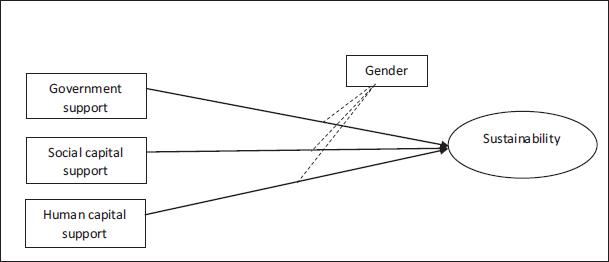
H4: Gender has a significant moderating effect on the relationship between SFGS and SS.
H5: Gender has a significant moderating effect on the relationship between SFSS and SS.
H6: Gender has a significant moderating role in the relationship between SFHC and SS.
Research Methodology
Questionnaire and Sample
This research follows a quantitative methodology and is exploratory. The objective of this type of methodology is to generalise the result based on the results obtained through the use of statistical tools. Questionnaires were prepared to analyse start-ups’ perceptions of sustainability through social capital, human capital and government support (refer Appendix B).
After preparing the questionnaire, founders of start-ups in India were selected as the respondents for this study. For this, the definition of a start-up given by the Department of Promotion of Industry and Internal Trade (DPIIT, GOI) is as follows: a start-up is a business firm established within the past ten years, having turnover under ₹1,000 million and not more than 250 employees. Thus, the final respondents of the study were the chief executive officer/owner/founders/partners and other key persons of the start-up firm.
To calculate the sample size for this study, we applied the criteria for the sample variable ratio suggested by Memon et al. (2020), which stated that there must be a minimum of 20 respondents for each independent variable in this study (20:1). This study had three independent constructs with 14 independent variables (5 + 5 + 4 = 14). Hence, the minimum sample size was calculated as 280 (20 × 14 using the 20:1 formula).
The researcher contacted 600 prospective respondents at their convenience using Google Forms and thoroughly explained the purpose of the survey. It was also mentioned that the information given by them was anonymous, confidential and solely used for research purposes. Of the 600, 480 respondents agreed to participate, with a good response rate of 80%. However, only 350 valid and complete questionnaires were taken as the sample for this study (the final respondent profile is discussed in Table 2). The studies by Shahbaz et al. (2020) and Aftab et al. (2020) also explored the moderation impact of gender using 283 and 250 valid samples, respectively. Thus, it ensures a balanced sample for addressing the moderating impact of gender of board members.
Instrument and Measures
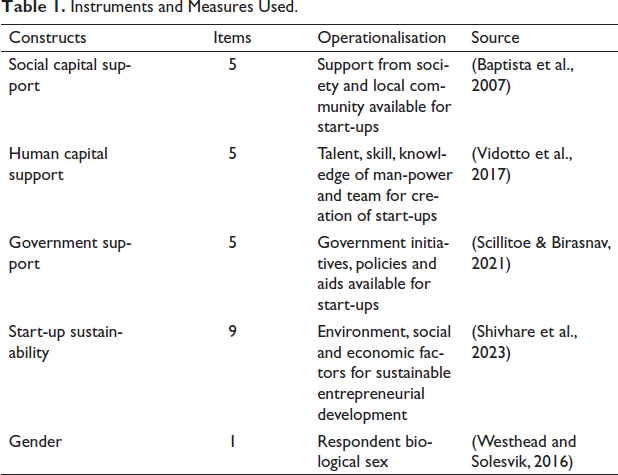
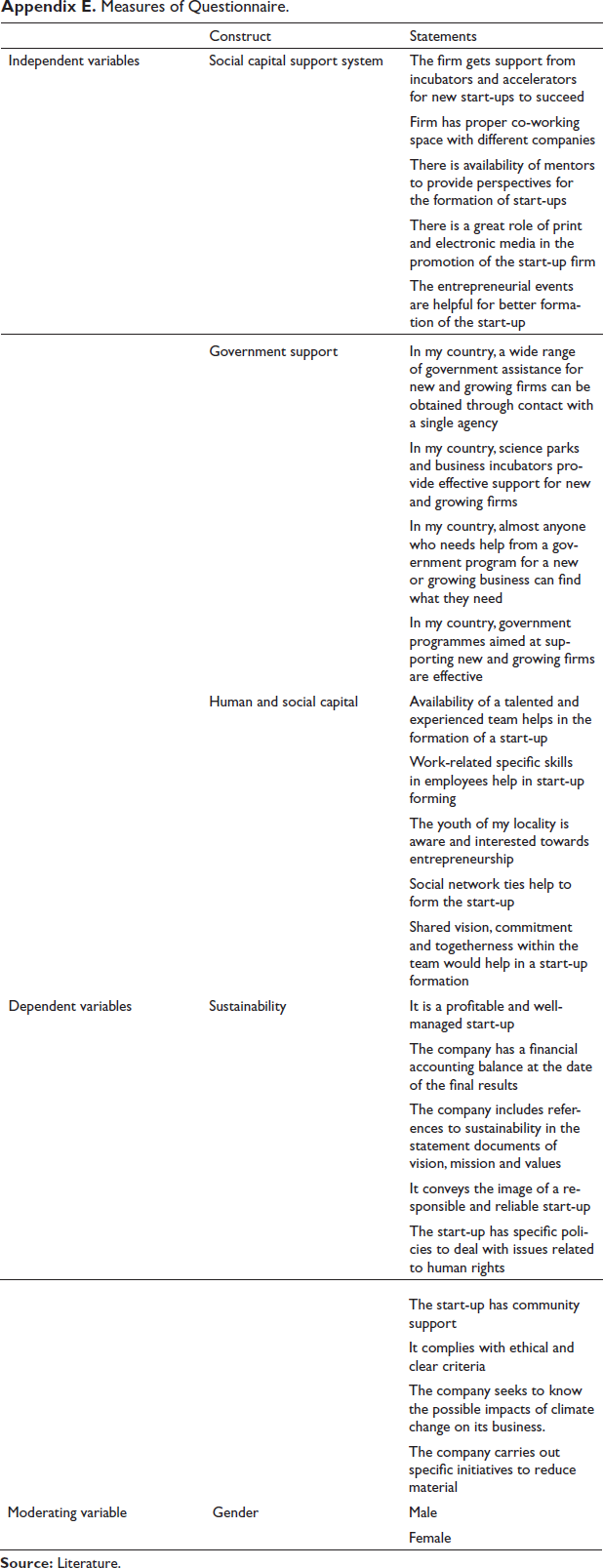
The measurement items were adopted from various previously validated studies, with slight modifications. The items for independent variables, including social capital, human capital and government support, were adopted from the studies by Baptista et al. (2007), Scillitoe and Birasnav (2021) and Vidotto et al. (2017). For dependent constructs, the scale was adopted from a study by Shivhare et al. (2023). Each item is measured on a five-point Likert scale, ranging from 1 (strongly disagree) to 5 (strongly agree). For the moderating variable gender, scale 1 for males and scale 2 for females were used based on a study by Westhead and Solesvik (2016) (details of the source are provided in Table 1 and Appendix E).
Instruments and Measures Used.
Statistical Tools
This study applied exploratory factor analysis (EFA) using the principal component method with varimax rotation to evaluate the minimum number of common factors required to adequately reproduce the item correlation matrix based on the methodology of Rodrigues et al. (2020). We applied EFA using SPSS tools for the analysis because the scale adopted was slightly modified from the perspective of startupreneurs. To ensure validity and reliability, EFA and confirmatory factor analysis (CFA) were applied using structural equation modelling (SEM) on SmartPLS 4.0. As suggested by Hair et al. (2020), the use of partial least squares (PLS)-SEM is justified by the presentation of reflective and formative indicators, and it also overcomes the apparent dichotomy between explanation and prediction and also provides managerial implication development (Hair et al., 2020).
Common Method Bias
A single-factor Harman test was implemented to check for the existence of common method bias in the dataset. The explained variance was less than 50%, which justifies the absence of common method bias in this study (Sivathanu & Pillai, 2019).
Data Analysis
Demographic Profiles of the Respondents
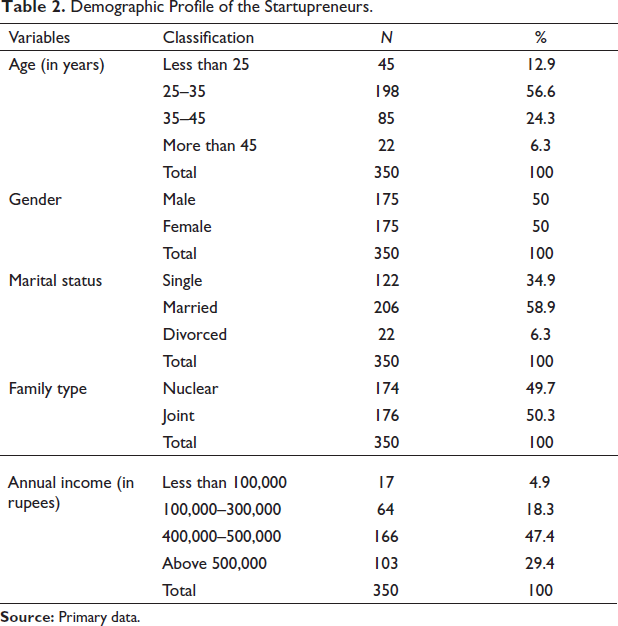
Of the 350 start-ups, male and female were taken in equal proportion. Regarding age, 56.6% of the respondents were between 25 and 35 years old, and 24.3% were between 35 and 45 years old. However, only 6.3% of start-ups were older than 45 years, and most start-ups were owned by younger people. More than half of the startupreneurs (65.4%) were enrolled in graduate programmes, the remaining 14.3% were high school educated and 13.1% were post-graduate and above. Only 3.1% of respondents were illiterate and showed great literacy among entrepreneurs of start-ups. Regarding the respondents’ family types, the response was dicey, as approximately the same percentage was obtained for the nuclear and joint families to which start-up owners belonged. Moreover, more than half of the respondents (58.9%) were married, and only 6.3% were divorced. Regarding their annual income, 47.4% had an annual income between ₹400,000 and ₹500,000, and 29.4% had an annual income of more than ₹500,000. Only 4.9% have a very low annual income of less than ₹100,000 (see details in Table 2).
Demographic Profile of the Startupreneurs.
EFA
The collected data were analysed using SPSS software. EFA was conducted on 23 items to identify latent factors (Churchill, 1979; Jha et al., 2018). A factor analysis was performed to empirically identify the variables that form a particular construct.
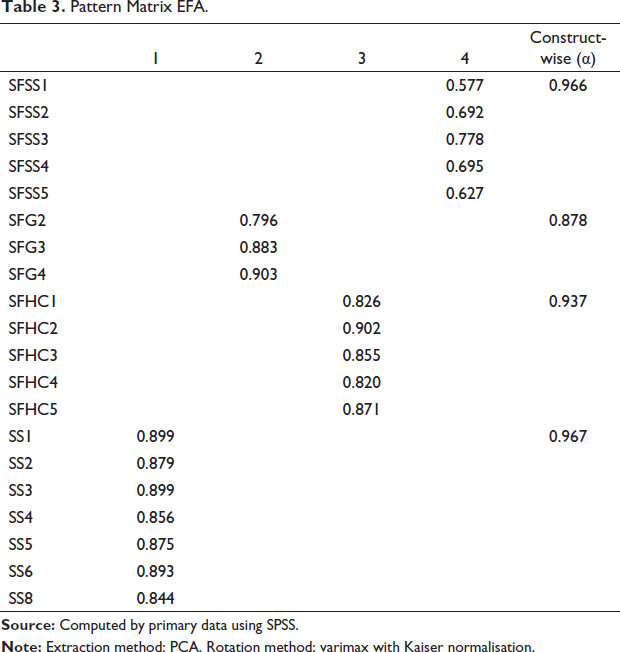
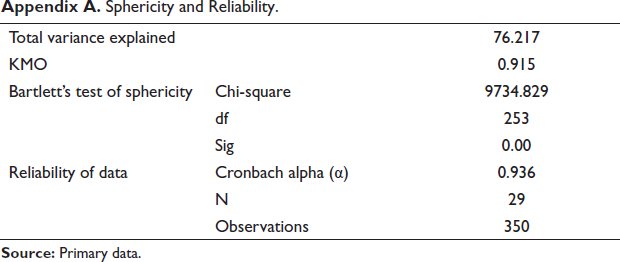
EFA was conducted to identify underlying factors. First, it measures the sample adequacy through a test such as Bartlett’s test of sphericity and the KMO test, where Bartlett’s test scored ꭓ2 = 9734.829, degree of freedom (df) = 253, significance level = 0.000 and KMO sampling adequacy value 0.915 that ensures the fitness of the dataset for factor is more than the standard KMO value of 0.6 (Loewen & Goulal, 2015), using principal component analysis (PCA) with varimax rotation. The commonalities of all the measures were above 0.5 (Watkins, 2018; refer to Appendix A).
However, the commonalities of all the standards were greater than 0.5, except for one statement from the construct of government support and one statement from the construct of sustainability. These two statements were excluded from further analysis. The factor loadings of all the measures were above 0.5 (Hair et al., 2019). Four factors were extracted, explaining 76.217% of the total variance (Jha & Alam, 2021). These factors were government (SFGS), social capital (SFSS), human capital (SFHC) and start-up corporate sustainability (SS; presented in Table 3). In addition, the overall Cronbach’s alpha of the 29 items was 0.936, and Cronbach’s alpha was calculated after examining the items constructing four constructs.
Pattern Matrix EFA.
CFA
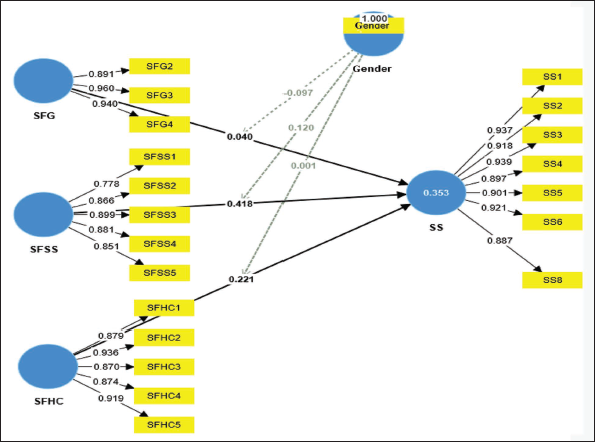
To conduct CFA, PLS-SEM software (version 4.0; Hair et al., 2020) was used to develop and improve the reflecting measured construct based on the domain sampling model for primary data analysis. The measurement characteristics of SEM in the final model were calculated to determine the relationship between latent constructs. We conducted bootstrapping with 5,000 samples, and the r2 value of the model was obtained at 35.3% (Sivathanu & Pillai, 2019; Appendix D).
Convergent Validity and Internal Consistency
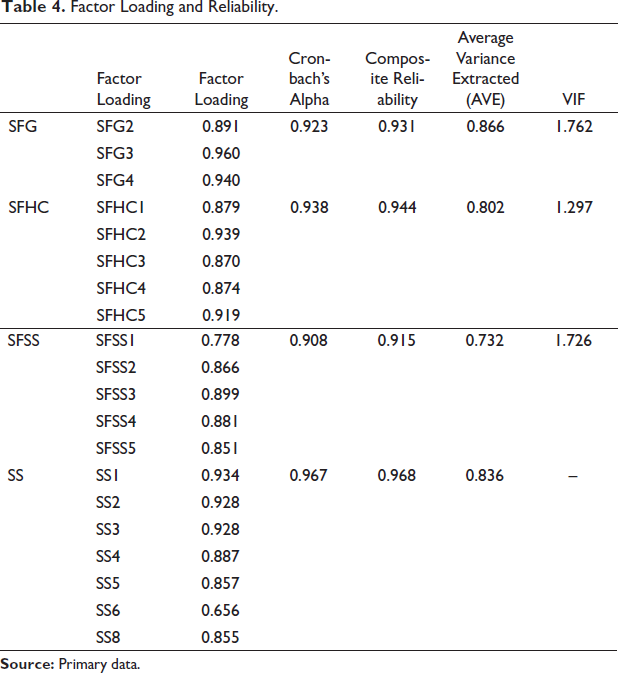
The convergent validity of the dataset was investigated through factor loading, average variance extracted (AVE), composite reliability and Cronbach’s alpha value. All the extracted constructs confirm that the factor-loading value of more than 0.5 (Hair et al., 2020; Sivathanu & Pillai, 2019) and AVE is more than 0.5 (Hair et al., 2020; Benitez et al., 2020). Along with a Cronbach’s alpha score of more than 0.7, which ensures convergent validity and high internal consistency of the data, factor-loading scores are greater than 0.6, which ensures high internal consistency (Aburumman et al., 2022) (refer Table 4).
Factor Loading and Reliability.
Multicollinearity
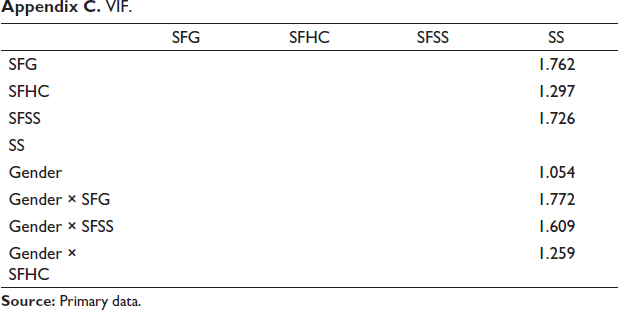
It is essential to check the presence of multicollinearity for formative scale type, and, for this purpose, the weight and variance inflator factor (VIF) was used by Becker et al. (2012). The VIF value must be more than 3.3, which explains the presence of multicollinearity in the dataset. The present study reported all VIF scores less than 3.3, which ensures that multicollinearity is not present in this study (Diamantopoulos & Siguaw, 2006; see Appendix C).
Discriminant Validity
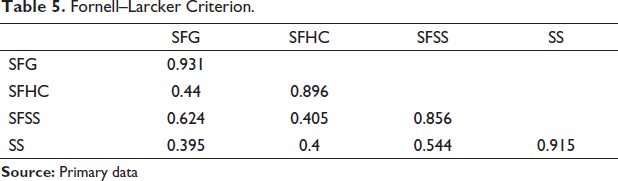
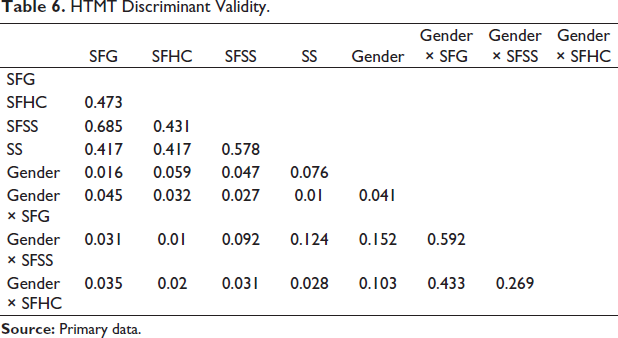
To establish discriminant validity, it must be noted that the construct of the model is distinct from each other. Rasoolimanesh’s (2022) study uses the Fornell–Larcker and HTMT ratio (Henseler et al., 2015), while the Fornell–Larcker criterion assesses discriminant validity by calculating the square root of the AVE score of each underlying factor; it must be higher than its correlation with other underlying factors (Hami et al., 2017). Another measure of discriminant validity is the HTMT test, which measures the correlation between two latent constructs. The standard value of the HTMT score must be under 9.0 (Chan & Lay, 2018); if any value exceeds this low discriminant validity, the underlying construct is less than 0.90, which displays the discriminant validity of the data in the present study (Tables 5 and 6).
Fornell–Larcker Criterion.
HTMT Discriminant Validity.
Structural Model
The relationship between the underlying constructs was assessed through path analysis using SEM. Table 7 shows the path coefficient value, T-score and its significance level, and the theoretical model presented in Figure 2 has been texted.
Hypothesis Testing.
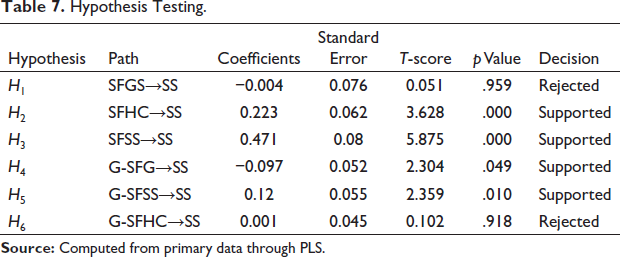
Table 7 reveals the hypothesis that H1 tested the relationship between SFGS and SS and found no significant relationship between the two (β = −0.004, p > .05). H2 was supported by the result that displayed a positive relationship between the SFHC and SS (β = 0.23, p < .01). H3 represents the relationship between SFSS having a direct and positive impact on SS (β = 0.47, p < .01). Thus, H2 and H3 were supported by the results of the hypothesis testing, whereas H1 was rejected (Table 7).
Moderating Effect
H4, H5 and H6 show the moderating effect of board gender on SS through SFG, SFSS and SFHC, respectively. The results showed a negative moderating impact of gender on the relationship between SFG and SS (β = −0.097, p < .05) and a positive moderating impact of gender on the relationship between SFG and SS (β = 0.120, p < .01). However, gender had no moderating impact on the relationship between SFHC and SS (β = 0.001, p > .05). Hence, out of the three hypotheses on the moderating impact of gender, hypotheses H4 and H5 have a significant moderation effect and H6 does not show a significant moderation result.
Discussion and Implications
Direct Impact
The results confirmed that there is no effect that startupreneurs have with government support on their start-up corporate sustainability (H1), and the corresponding findings by Bryant et al. (2017) discussed the united negative impact of government when discussing social and environmental concerns. However, this result contradicts that reported by Lee and Kim (2019). The results revealed a positive and significant impact of human capital on start-up sustainability (H2), which is in agreement with Griggio and Oxenswärdh (2021) and Verma et al. (2023) that show the positive impact of human capital on societal sustainability in green start-ups of high-contact services, and lifestyle entrepreneurs such as findings show that social capital has a positive impact on the sustainability of start-ups. H3 is accepted, and similar findings available in studies such as Mishchuk et al. (2022) found a similar result in enterprises in Ukraine, and more evidence is available that shows that social capital is an enabler of sustainable development (Lontchi et al., 2022). These findings are beneficial for sustainable development, as the results show no discrimination based on the gender of sustainability. Studies conducted on the tourism sector show that there is no sustainability without gender equality (Alarcón & Cole, 2019). However, this result is inconsistent with the findings due to the heterogeneity of demographics and industrial areas (Sifers et al., 2022).
Moderating Effect
Regarding the moderating impact of gender on the sustainability of start-ups, we find support for H5; that is, gender has a moderating role in the relationship between government support and start-up sustainability, despite no direct impact revealed by the findings of H1, where government support has an insignificant impact on start-up sustainability. The findings support H5, which depicts gender diversity as a moderating variable between social capital support and start-up sustainability that shows the social skills of women can enhance the more sustainable outcome in nascent ventures (Mohr et al., 2022). For H6, unfortunately, the result is not confirmed with this, that there is no discernible between human capital support and sustainability. However, this result is heterogenous with the study of Ploum et al. (2017), which shows women tend to have low human capital and are less competent (Lohani and Aburaida, 2017) in sustainable entrepreneurial behaviour. A similar result was found by Abbas et al. (2021) that shows recruitment selection and sustainability are not moderated by gender.
Implications
Theoretical Implications
In terms of theoretical implications, this study uncovers previously unexplored associations between support systems and start-up corporate sustainability. It builds upon existing literature by providing empirical evidence (Domecq et al., 2020; Garrigos-Simon et al., 2018; Quan et al., 2018). Moreover, it demonstrates the relevance of demographic factors in the context of sustainable entrepreneurship by examining the moderating impact of gender on start-up sustainability (Barrachina et al., 2021; Outsios & Farooqi, 2017). This study contributes significantly to the theoretical underpinnings of gender in entrepreneurship (Marlow, 2020; Shneor et al., 2013). Additionally, it emphasises the importance of a combined approach to social and human capital support for enhancing sustainability in nascent ventures.
Managerial Implications
Regarding the managerial implications of this research, the study delivers a practical tool to assist startupreneurs and managers. It suggests that network building should be a part of strategic decisions, considering resource needs and collaborative network opportunities (Passaro et al., 2020). Managers and startupreneurs can benefit from the model by promoting gender equality in start-ups. This implies that managers and leaders should be mindful of potential gender-related challenges in accessing government support. Furthermore, managers can leverage the positive moderating effect of gender on social capital support by fostering diverse teams and networks. Initiatives for skill development should be adopted by startupreneurs, including regular training and upskilling, which can improve human capital and enhance the collective capabilities of start-ups for long-term sustainability.
Practical Implications
The interpretative framework developed in this study can serve as a practical tool for policymakers to design government-sponsored accelerator programmes aimed at training startupreneurs and connecting them with skilled accelerators and networking events for sustainable planning (Owen, 2023). Founders and investors should prioritise investments in human capital development through training, education and skill enhancement programmes. A knowledgeable team remains a cornerstone of sustainable start-ups, regardless of other external factors (Barendsen et al., 2021). Gender-inclusive policies and support mechanisms for women startupreneurs should be implemented, as the study reveals the positive moderating effect of gender on sustainability through government support and social capital. Thus, promoting and fostering gender diversity in collaborative networks becomes imperative in practical scenarios. These implications underscore the practical significance of this study’s findings for both managers and policymakers, offering guidance on how to enhance start-up sustainability through strategic support systems and gender-inclusive practices.
Conclusions and Delimitations
The study examined how government support, social capital and human capital all have significant contributions to the sustainability of start-ups. This emphasises the importance of strong human resource needs in interpersonal networks, skills and expertise. Government support does not have a direct impact on sustainability, raising questions about government support in the Indian start-up ecosystem. The study also examined the role of gender, which, while not directly affecting sustainability, plays a crucial role through its interaction with social and government support. This calls for further research with a robust moderating and mediating impact of new variables such as social awareness and owner’s commitment. Longitudinal study design with large datasets may be beneficial.
Appendices
Sphericity and Reliability.
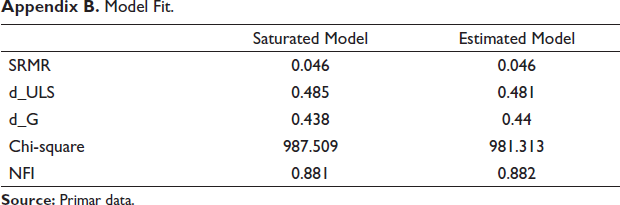
Model Fit.
VIF.
R2.

Measures of Questionnaire.
Footnotes
Declaration of Conflicting Interests
The authors declared no potential conflicts of interest with respect to the research, authorship and/or publication of this article.
Funding
The authors received no financial support for the research, authorship and/or publication of this article.
