







Abstract
The rapidly transforming Arctic has led to rethink the concept of security in the region. The increasing global warming and opening up of the Arctic have brought multiple geopolitical issues before the Arctic and non-Arctic states. 1 In pursuit of their perceived geopolitical, geo-economics and strategic interests, a race to ‘securitise the Arctic’ has started amongst the major Arctic states. This process of securitisation appears to be dictated and driven not only by traditional military-strategic considerations but also by non-traditional security threat dilemmas related to energy, environment, sustainability, human security, connectivity, etc. As the old and the new Arctic challenges are being taken out of the realm of ‘normal politics’ and placed in the contested domain of ‘security politics’, the Asian states, that are directly or indirectly impacted by the changing Arctic realise that securitisation of the Arctic is leaving little space for addressing common issues of global concern. This study argues that all these emerging issues (otherwise perceived as ‘security threats’) in the Arctic, instead of being addressed in the securitisation framework, could and should be approached and addressed as compelling reasons for mutual cooperation and thus in need of de-securitisation.
Keywords
Introduction
The Arctic is witnessing unprecedented physical and geopolitical transformations. There is no single formal definition of the Arctic because the region reveals multiple identities when considered from multiple perspectives. Geographically, the Arctic is defined as a region above 66° 33’ North of the Arctic circle. 2 It is also defined as a region north of the Arctic tree line, marked by a frozen landscape of shrubs and lichens. The thermal definition of the Arctic is a region where the average summer day temperature does not exceed 10 degrees Celsius (National Snow and Ice Data Center, 2020). Yet another imaginary geopolitical identity of the Arctic is the northern wildered landscapes marked by ice covers and exotic polar animals such as reindeers and polar bears. This region is currently experiencing severe challenges of increased global warming in the form of heavy melting of sea ice, increasing disruptions in polar aquatic and mammal activity, enhancement in strategic and military activities, increased shipping transits along Northern Sea Route (NSR) and a rising trend in commercial and economic activities (Weber, 2020). The Arctic is surrounded by the territories of eight 3 states out of which five 4 are playing a dominant role in the emerging geopolitics of the region. There are also a number of states of Europe 5 and Asia 6 that find themselves directly or indirectly impacted by the ‘changing Arctic’. The accelerated rate at which global warming is occurring in the Arctic is bringing up numerous challenges with regional as well as global implications. The heavy summer ice melt in the Arctic has direct linkages with Asian monsoons, including northern India (Grunseich & Wang, 2016; Ravichandran 2018). Changes occurring in the Arctic directly impact the climate system of China, with wide-ranging implications for agriculture, forestry, fishery, marine industry and various other sectors (The State Council, 2018). Diminishing polar sea ice is also contributing to sea-level rise which poses a direct threat to coastal states and islands territories of the Indian Ocean and the Pacific Ocean (Gadihoke, 2012). The regional implications of dramatic changes in the Arctic are contributing to multiple challenges for indigenous communities.
Rather than addressing these emerging challenges in a holistic manner, the Arctic states appear to be engaged in prioritising their national economic, strategic and geopolitical interests in the region (Keil, 2014; Sergunin & Konyshev, 2015). Increased global warming, while bringing numerous challenges before the Arctic states, is also paving the way for huge economic and strategic returns (Working Group Report, 2018). States involved are rather using these emerging issues as a cover to meet their own national interests in the region. By perceiving and projecting these ‘emerging issues’ of the Arctic as threats to ‘national security’, the dominant Arctic states are relocating them to the domain of ‘security politics’. Such securitising discourses are being used by these Arctic states to establish their own dominance over the region and its immense resource and strategic potential. This in turn is leaving little space for non-Arctic states to even address the prominent issues of common global concerns. The notion of ‘Arctic State’ as an ‘identity’ is being used by dominant five to turn the geopolitical weights to their own national agendas when it comes to important decision-making or rule setting for the region. The geopolitics of fear is being deployed to label emerging Arctic ‘challenges’ as emerging Arctic ‘threats’ and justify heavy military build-ups in the region (Nilsen, 2017; Shea, 2019; Staalesen, 2018). The emerging issues related to Arctic climate change, with serious regional and global implications, are getting eclipsed in the face of alleged, amplified ‘security and sovereignty threats’ of the dominant Arctic five. Some of these Arctic states are seen as flexing their military muscle under the pretext of protecting one’s own or regional sovereignty and territorial integrity in the Arctic (Lackenbauer & Lajeunesse, 2016; Sergunin & Konyshev, 2017).
This study aims at a close and critical examination of emerging challenges in the Arctic that have regional as well as global linkages. Initially, the study highlights some important aspects of the region that demand and deserve immediate attention but remained unaddressed by the dominant, largely state-centric, discourses of security in the region. Further, this study attempts to make a normative call for de-securitisation in the Arctic by asserting that all issues of the region need not be seen through a security lens but should be addressed as issues of common global concerns to humankind. Finally, in addition to the already existing de-securitisation theory of the Copenhagen School of security studies, this study tries to introduce a new perspective on ‘de-securitising’ the Arctic through India’s traditional philosophy of Vasudhaiva Kutumbakam.
Arctic Ecosystem
The immediate visible evidence of increasing global warming in the Arctic is the heavy melting of Arctic sea ice. As per the latest publication by the Arctic Monitoring and Assessment Programme, it has been estimated that the Arctic is warming at a rate three times the global average (AMAP, 2021). These observed changes are not just in terms of reduced sea ice extent but also in terms of ice thickness, increase in run-off water, increasing precipitation and variation in the length of the ice seasons. Simulated climate models have estimated that if global climate change continues at the current rate, the Arctic could become completely ice-free by 2050 (Thackeray & Hall, 2019; Vihma, 2014). Scientific processes of ‘Arctic amplification’ 7 and a significant reduction in ‘earth’s albedo’ would accelerate the release of vast amount of methane and methane-derived carbon dioxide from gas hydrates that lie beneath Arctic ice, thus further compounding the overall warming process in the Arctic (IPCC, 2013; Ruppel & Kessler, 2017).
The first impact of this diminishing ice in the north is visible in terms of disruption in the Arctic’s biodiversity. The Arctic flora and fauna are under intense stress due to increased global warming and sea ice melting. These climatic alterations are facilitating the northward movement of many species. Lesser sea ice and opening of the Arctic water are making the region accessible to the sub-Arctic and temperate invasion of new species that are resulting in colonisation of the Arctic ecosystems (Convey et al., 2012). Increasing encounters and invasions of polar bears in human settlements of the north in search of food due to receding Arctic ice are the emerging signs of disrupting ecosystem of the region (Stewart, 2019). Disruptions in food webs of flora and fauna are causing alteration in human food chains by making the Arctic indigenous communities directly vulnerable to new diseases (Chaturvedi, 2016, p. 181; Petersen et al., 2007). Exposure of Arctic marine and human food webs to heavy metals and other foreign substances is causing new diseases and gene alterations in plants, animals and indigenous human communities of the region (Bjerregaard et al., 2004). Ancient ‘zombie viruses’ beneath the Arctic ice could make inroads in present-day ecosystems. In the year 2015, researchers working in Siberia discovered two such giant viruses beneath Arctic permafrost. Out of these two, one ‘Mollivirus’ on its revival in a controlled lab experiment succeeded in infecting amoeba. Professor Jean-Michel Claverie who led this experiment is of the view that as the melting of the Arctic ice increases, it could unleash such ancient deadly viruses that lie beneath Arctic ice from millions of years and that are still infectious (Roper, 2019; Yong, 2014). The emerging interconnectivity between the Arctic, Atlantic, Indian and Pacific oceans due to melting ice and inflow of water can further enhance the transfer of such viruses in food chains of states dependent on these oceans. Fish and other species’ migration from warm waters to Arctic waters and vice versa can make the population of north and south vulnerable to new diseases and challenges that have been never seen in the past (Wormer et al., 2019). Transfer of viruses and deadly infections through migratory birds from the Arctic to Asia and vice versa will add a further new dimension to such challenges (Munster et al., 2007; Winker et al., 2007). The rising temperature in the circumpolar north is enhancing longer flights for survival amongst polar migratory birds towards the Global South. Similarly, the opening of the north in summers is witnessing increased reverse migratory patterns of bird species from Europe and Asian countries towards the circumpolar north. The Arctic tern (Sterna Paradisaea)—which approximately travels 30,000 km making a round trip between the Antarctic and the Arctic, by making several short and long stays in Asian countries en route off its entire journey—is one such classic example of long bird migration and interconnectivity between the regions (Johnson & Herter, 1990). This largest north–south criss-crossing of migratory birds between the Arctic and Asian sub-continents is making the regions directly interconnected and exposed to unprecedented challenges.
New Shipping Routes
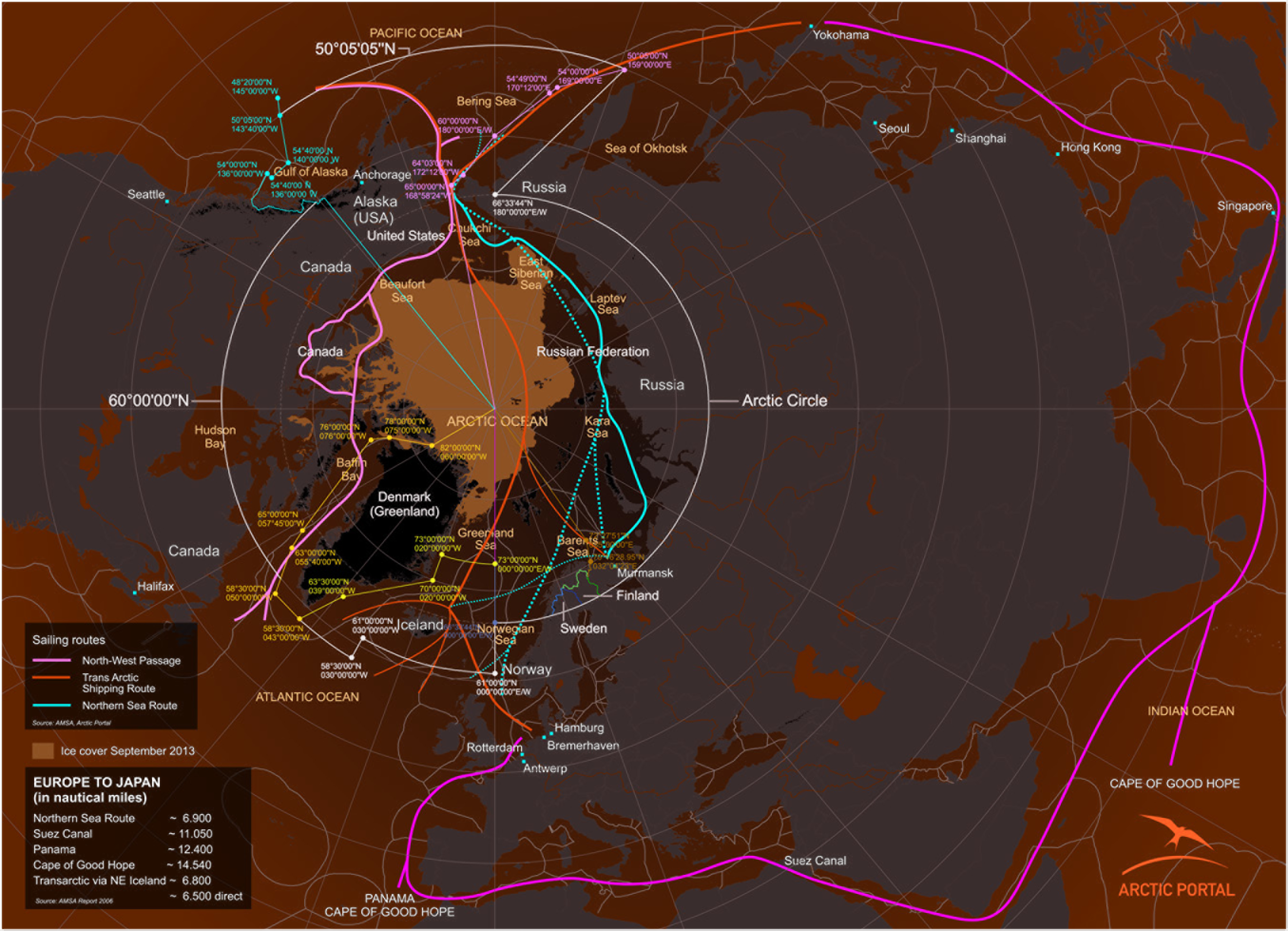
The Arctic offers three alternative polar shipping routes, that is, the Northwest Passage (through the Canadian archipelagos), the Transpolar Route (from the Atlantic to Pacific via North Pole) and the NSR from Europe to Asia along the Russian coast (Figure 1). Shipping voyages between Europe to Asia through Northwest Passage and the transpolar route are difficult to undertake due to sea ice extent, floating icebergs and other operational limitations, but ship traffic through NSR along the Russian coast is slowly but surely gaining much prominence (Østreng et al., 2013).
The importance of the NSR is scintillating in terms of its potential to transit goods at economically cost-efficient prices between Europe and Asian markets. It has been estimated that the shipping distance between Europe and East Asian ports is 6,000 nautical miles shorter than the ship transits through the Cape of Good Hopes. Similarly, distance via NSR is 2,700 nautical miles shorter than the Suez Canal route and 5,380 nautical miles shorter than the Panama Canal routes respectively (Aksenov et al., 2017). This can reduce the transit time of ships sailing between Europe and Asia by 10–12 days and can eventually contribute to more fuel efficiency and significant reductions in carbon emissions (Hong, 2012). Presently, though there are many practical challenges for ships and shipping companies taking their course via NSR in terms of limited shipping charts, high insurance costs, limited polar specialised crew, few search and rescue options, limited sailing window in a year, etc. (Schøyen & Bråthen, 2011), but these challenges tend to fade away in coming decades with the emerging economic and geopolitical prospects of shipping through this route. Analysing the emerging potential of new polar routes, the Arctic States such as Russia, Canada and the United States are making tremendous inroads in the region. Such states are pushing hard through political, economic and military means to influence the region’s shipping through these emerging routes. Opening of these new shipping lanes is also opening access to new places in the region that were earlier inaccessible. The Arctic states under the perceived notion of sovereignty threats to these new emerging regions and routes, are trying hard to dominate these for their own economic and strategic gains (Melia et al., 2017). The discourses of fear and threat of foreign adversary or immediate neighbour are being used by some states to justify their own acts of increased military build-ups and domination in these regions. Such states are themselves making their own dominance by acting as a security guarantor to these emerging challenges (termed as threats) in the Arctic (Pezard, 2018). Russia’s assertion of dominance over the governance of NSR, by calling it as a ‘national single transport communication of the Russian Federation’ (Russian Federation, 2008) in its Arctic strategy and imposition of strict enforcement measures to regulate shipping in the region, is noteworthy. Similarly, Canada’s position on the Northwest Passage, by calling it ‘internal waters’ and the subsequent enforcement measures taken to regulate shipping in the region (Pharand, 2007), depicts Canada’s assertiveness to enhance its control in the region. The impositions of heavy tariffs by Russia on foreign vessels transiting through NSR and other heavy charges levied in terms of services such as ice breaker escorts, use of port facilities, etc., are further instances of influencing region’s geopolitics to their own favour (Liu & Kronbak, 2010; Moe 2014).
The Circumpolar Arctic: ‘res nullius’ or ‘res communis’?
The territorial issues in the Arctic came to limelight at the beginning of the twentieth century. The signing of the Spitsbergen Treaty in 1920 formally acknowledged Norwegian’s sovereignty over the Arctic Archipelago of Svalbard. The treaty provided Norway with absolute sovereignty over all the islands situated between 10° and 35° longitude East of Greenwich and between 74° and 81° latitude North (Spitsbergen Treaty, 1920). The treaty also provided certain rights and equal opportunities to high contracting parties involved, in terms of fishing, mining, hunting, shipping, scientific installations, etc. Apart from this treaty, an important international mechanism available for making legal territorial claims in Arctic waters is the United Nations Convention on the Law of the Sea (UNCLOS) that came into force in 1994 (Dodds & Nuttall, 2016). Similar to its applicability in determining state’s rights over the territorial sea, exclusive economic zone (EEZ) and extended EEZs (if any) in their adjoining seas and oceans, the convention holds its validity for addressing issues related to territorial jurisdiction in the Arctic waters too. As per UNCLOS, coastal states are provided with 12 nautical miles as territorial waters (from baseline) (UNCLOS, 1994, p. 27, Article 3) and 200 nautical miles as EEZ (UNCLOS, 1994, p. 44, Article 57). There is also provision under UNCLOS for a signatory state to make its claim in an area beyond 200 nautical miles of its designated EEZ if that signatory state becomes successful in justifying (through scientific and technical data) before Commission on the Limits of the Continental Shelf (CLCS) that the area beyond its designated EEZ is an extension of its continental shelf (UNCLOS, 1994, p. 54, Article 76). These claims before CLCS can be made only within 10 years of ratification of this treaty by a signatory state (UNCLOS, 1994, p. 146, Annex. 2, Article 4). All four dominating Arctic rim states except the United States are signatories to UNCLOS and soon after its ratification started filing legal claims for extended continental shelf before CLCS. Russia in 2001 submitted its claims before CLCS for an extended continental shelf in the Arctic which got rejected due to insufficient scientific evidence. CLCS asked Russia for more scientific data to justify its claim which the latter did in 2015 by making partially revised submissions of its claims (Jensen, 2016). Similarly, Denmark (on behalf of Greenland) made its submissions before CLCS for northern and north-eastern continental shelf zones of Greenland in 2013 and 2014, respectively. The latest submission on extended EEZ in the Arctic came from Canada (in May 2019), and on all these submissions CSCL has yet to make its final recommendations. To date, Norway is the only country whose claims in the Arctic Ocean, Barents Sea and the Norwegian Sea have been approved by CLCS in accordance with the provided scientific data, and these recommendations (CLCS, 2009) have been also accepted by the Norwegian Government.
The complexity of territorial claims in the Arctic is not just confined to acknowledgement by CLCS but rather the claimant states are also in disagreement amongst themselves over the question of exactly where such claims overlap (Spohr et al., 2013). These states call for addressing such differences through mutual cooperation and dialogue, but the reality is quite different. To make their territorial claims stronger in the region, the states are pursuing hard realist measures in the form of enhanced military patrols of aircraft and navy vessels, forward positioning of troops and military bases, extreme research expeditions and large-scale military exercises (Spohr et al., 2013, p. 34; Staalesen, 2018). The year 2007 marked yet important significant event when to make its position stronger on territorial claims in the region Arthur Chilingarov, a Russian polar explorer planted a titanium Russian flag on the seabed at the North Pole with Russian submersible Mir-1 (Steinberg et al., 2015, p. 18). This event received a lot of international attention followed by sharp comments from leaders of other Arctic states criticising this Russian move. The basic argument regarding territorial claims in the Arctic is that the states involved are no doubt initially making their claims as per CLCS’s guidelines by providing required scientific data, but the real important questions are: Will the state be ready to give away its claims if the CLCS’s decision (after analysing the submitted data) come against that particular state? How much will state A compromise or acknowledge to CLCS’s decision (if CLCS’s decision comes in favour of state B) where there are overlapping claims in the region between A and B? Looking at the strategic, economic and emerging military postures in the region such sovereignty claims can bring these states to direct military confrontations. Any unilateral military action by a state to claim its territory in the Arctic (in that case scenario if CLCS’s decision comes against particular state’s claims) could provoke complex military stand-offs between the states involved and could challenge the credibility of CLCS’s decisions. The sense of ‘Arcticness’, that is, being engraved through knowledge–power nexus into the nationalistic aspiration of the local population would leave very little space for cooperation on such territorial issues and would rather push state governments for military measures if they felt that their national interests are at stake in the Arctic.
Arctic Energy Resources
Apart from geo-strategic and geopolitical concerns, the basic reason for states to make their territorial claims in the Arctic is to benefit from the vast resource reserves that lie underneath Arctic sea ice, sub-soil and waters column. As per United States Geological Survey, the Arctic is estimated to hold 90 billion barrels of undiscovered oil, 1,670 trillion cubic feet of undiscovered natural gas and 44 billion barrels of undiscovered, but technically recoverable, natural gas liquids in the region’s 25 geologically defined areas. This accounts for an estimated 22% of the total world’s undiscovered, but technically recoverable energy resources (Gautier et al., 2009; Robertson & Pierce, 2016). It has been estimated that most of these resources are located offshore at a depth less than 500 meters of water. Arctic natural gas reserves are three times higher than oil reserves and are mainly located in the Russian EEZ (Gautier et al., 2009). There are some scholars (Schaller, 2020) who challenge the legitimacy of these resource estimates in the Arctic, but the argument remains valid with the fact that apart from US Geological Survey data, there are no other credible sources available depicting similar or counter claims on resource potentials in the region. Russia remains to be the biggest coastal state in the Arctic and accounts for the largest chunk of Arctic resource land (Dobretsov & Pokhilenko, 2010). Russia’s main priority in the region remains towards the extraction of energy and available resources; therefore majority of the state’s developments are channelised in this very direction (Gazprom, 2019; Rosneft, 2019).
With the geopolitical shift in global energy prices, the world is witnessing a sharp transition in global energy demands and supply chains (U.S. Energy Information Administration, 2019). The emerging potential of the Arctic’s vast energy resources naturally attracts Asian economies to meet their growing future energy needs. For a country like China, opening up of the Arctic’s vast energy reserves offers huge economic and strategic gains for its oil and gas shipments traversing via NSR (Nanda, 2019). Therefore, the emerging importance of the transforming Arctic remains well rooted within policy spheres of China and other Asian states in the region. Though there are significant temptations for energy, routes and other resources from the region, Asian states are simultaneously concerned regarding the unsustainable exploitation of Arctic resources. The increasing unsustainable practices in energy and resource exploitation projects in the Arctic are enhancing global warming phenomenon. These transitions in the Arctic ecosystem are interlinked to environmental catastrophes’ occurring in Asian states in the form of floods, droughts, heavy rainfalls and climatic variations (Gadihoke 2012; Morozov, 2012). Therefore, Asian states strongly view that all such issues of the Arctic need to be addressed through mutual cooperation and consultations amongst not just permanent states of the Arctic Council but also with Asian states and other representatives whose interests are at stake in the fast-transforming region. This is also the reason that most of the Asian states official Arctic policy papers (The State Council, 2018; The Headquarters for Ocean Policy, 2015; Pronina et al., 2020; Tonami, 2016) argue that the exploitation of Arctic resources needs to be carried out by considering the most fragile nature of the region’s ecosystem and as per sustainable ecological practices.
Militarisation or Arctic Securitisation
Ole Wæver of Copenhagen School of Security Studies defines security through language theory and calls it a ‘speech act’. Wæver argues that the mere utterance of the word ‘Security’ itself is the act.
By saying it something is done (as in betting, giving a promise, naming a ship). By uttering ‘security’ a state representative moves a particular development into a specific area, and thereby claims a special right to use whatever means are necessary to block it. (Wæver, 1998, p. 40)
The invocation of any issue by using the word ‘security’ as a suffix creates a sense of fear and invokes images of threat as to what would happen if security did not work in the first place. Application of this language of security to emerging ‘Arctic issues’ by the dominant Arctic state representatives or designated authorities, through speech acts and other discourses, is leading to complex traditional as well as non-traditional security dilemmas. These security dilemmas are getting diverse when these states try to address the issues of environment, resource, connectivity, energy, human, health and so on by labelling them through ‘security’ suffixes and by traditional security deployments in the Arctic. There do exists a limited cooperation amongst the Arctic states on all these issues, but their language of security to these is reducing space for ‘dialogic politics’ and is pushing the states towards competition and dominance through enhanced military posturing. The Arctic states feel that if they did not uphold their military strength, the other powerful states may threaten their state’s national interests in the region; whereas, if they did strengthen their own military capabilities in the Arctic, it might create a sense of insecurity in their immediate neighbours, thus compelling them to take similar enhanced security measures (Åtland, 2014). In practice, the circumpolar Arctic is witnessing a significant increase in militarisation in the form of expansion to military bases, developments in military infrastructure, increasing military exercises, deployment of sophisticated weapons, radars, surveillance equipment and so on (Jensen & Rottem, 2010; Nilsen, 2018; Sharp, 2011; Spohr et al., 2013, p. 34; Wang, 2013). Involved states’ emerging documents, policy briefs, significant research papers and media reporting on the Arctic are becoming increasingly assertive on addressing these emerging issues (termed as security threats) through the language of ‘security’, where the emphasis is laid on protecting the state’s interests through enhancing its hard traditional military measures in the region (Barnes, 2017; Boulègue, 2019; Danish Ministry of Defence, 2018; Department of the Navy, 2021; Devyatkin, 2019; Dittmann, 2009; Norwegian Government, 2017, p. 18). The extent of this securitisation in the Arctic is such the states involved are even training and using polar marine mammals such as whales, dolphins and sea lions for military missions in the Arctic (Lee, 2019; The Siberian Times, 2017). Due to their deep-diving capabilities and strong senses for detection and communication, states are providing these creatures with advanced training for military roles (Nilsen, 2019; Thomas, 2019). An encounter of a white Beluga whale with Norwegian fishermen in Norwegian waters wearing an empty harness (with an inscription stating ‘Equipment of St. Petersburg’) along with a GoPro camera holder raised huge concerns and speculations amongst intelligence communities within the region and internationally (Nikel, 2019). An another incident in December 2019 came to limelight when Sergei Kavray, who works for the World Wildlife Fund in the Chukotka region, spotted a Polar bear marked ‘T-34’ with a cryptic graffiti. ‘T-34’ was a Soviet-era tank used during the Second World War that was credited with outgunning and outmanoeuvring its German contemporaries. The intentions behind this act and the agency responsible remain unclear, but this disturbing grainy image clearly recreates the past mental constructs of militarisation in the Arctic (Figure 2).

Securitisation in the Arctic is not a new phenomenon, as the region witnessed intense securitisation during the cold war due to its strategic significance from multiple perspectives (Hummel, 2010; Njølstad, 2007; Spohr et al., 2013). The Arctic offered the shortest missile route for both US and Soviet Union’s intercontinental ballistic missiles and strategic bombers to reach each other’s mainland. It offered as a safe hiding base for strategic nuclear submarines beneath its sea ice. The region’s importance in terms of launching, shielding and as a warning time provider to any incoming attack on each other remained well understood to both the cold war adversaries. The geographical proximity (between the United States and Union of Soviet Socialist Republics) and the importance of the Arctic as a space for placing strategic weapons and early warning systems made the region one of the most heavily militarised region of the world during the Cold War. The first unilateral call for the de-securitisation of the Arctic came from Mikhail Gorbachev when in 1987, the Soviet leader made his famous ‘Murmansk Speech’ from the Soviet polar capital city of Murmansk, where he called for making the Arctic as a ‘Zone of peace’ (Gorbachev, 1987). Though there were also several other geopolitical reasons of time that led Gorbachev to make such a call for the Arctic (Rosenberg, 1988), the Soviet leader became quite successful in his initiative initially by focusing on ‘non-military’ security issues (economic, environmental, societal, etc.) of the region which ultimately contributed to significant reductions in ‘military’ security rhetoric in the Arctic (Åtland, 2008). Also, the decade from late 1980 onwards was the period of political détente where several other initiatives such as Intermediate-Range Nuclear Forces Treaty (1987), Treaty on Conventional Armed Forces in Europe (1990), Strategic Arms Reduction Treaty I (1991) and Strategic Arms Reduction Treaty II (1993) were taken which led to a significant reduction in military build-ups in the region. The onset of the twenty-first century and a significant transition in the human–environment relationship due to enhanced anthropogenic activities are once again taking the Arctic towards the new zenith of securitisation. The emerging vicious spirals of hard military built-ups by Russia and similar counter North Atlantic Treaty Organization responses to this re-militarisation are leading the region towards re-securitisation.
De-Securitising Arctic: The Indian Approach of Vasudhaiva Kutumbakam
Ole Wæver initially defined de-securitisation as a securitisation move that fails due to the target audience refusing to accept the authority and legitimacy of an initial securitisation move (Wæver, 1998, p. 56). This definition stands broadened in the sense that ‘issues could be deliberately de-securitised not in consequence of any audience failure to accept securitisation, but as a deliberate “positive” normative-political move to reject the “exceptional” realm of security politics’ (Austin & Brossard, 2017, p. 6). Emerging issues of the Arctic that are on the high verge of ‘securitisation’ need to be deliberately addressed through such ‘positive normative-political de-securitisation moves’. To achieve de-securitisation Copenhagen School outlines three strategies: (a) not to talk about issues in terms of security in the first place; (b) managing securitisation (if issues got securitised) and preventing security dilemmas and vicious circles; and (c) moving securitised issues back to normal politics (Wæver, 2000). The transforming Arctic presents multiple issues that are at different levels of attaining securitisation; therefore all these strategies outlined by the Copenhagen School could be applied to achieve de-securitisation in the region. The emerging issues of the Arctic, such as environment, ecology, human and connectivity, need to be addressed as issues of common global concern and approached through mutual cooperation. Issues regarding Arctic resources and territorial claims over land and ocean could be managed by strictly adhering to international laws and through mutual cooperation between states to avoid any further security dilemmas. Issues of traditional military build-ups and other hard security measures in the region could be addressed through both military and non-military Confidence Building Measures and other such unilateral and multilateral initiatives to bring them back to normal politics. Emerging Arctic issues that possess global challenges need not be looked at through narrowly framed regional or one particular state’s interests but should be addressed through combined global efforts and as per UN sustainable development goals.
Asian states especially India could play a constructive role in solving these emerging Arctic issues through its long history and experience of polar science research in Hindu Kush Himalayas and Antarctica (Chaturvedi, 2014, p. 78). India’s scientific engagements in the Arctic mainly focus on climate research by studying Arctic sea ice variations and their links with Indian monsoons (Ministry of External Affairs, 2013). India’s focused approach mainly in terms of scientific research in the Arctic justifies the country’s serious commitments towards understanding and addressing emerging issues of human–environment context that have global implications for mankind. India, with its large coastal population residing in coastal cities and a significant part of the country’s gross domestic product coming from its agriculture sector (Government of India, 2020), simply cannot afford to neglect the future consequences of climate emerging from the transforming Arctic. Environmental challenges from the Arctic will not only impact Indian agriculture and coastal communities but many other Asian states with large coastal cities and populations centres will also become vulnerable to these drastic changes in future. Therefore, India along with other Asian states needs to at least collaborate on all these issues that bear common implications for Asian region. The basic fundamental argument that Asian states could collectively put here is that the Arctic needs to be preserved for its wilderness to remain as ‘Arctic’. Only the Arctic five could not set rules for the region that is on a brink of posing global challenges.
In addition to insights provided by Copenhagen School’s theoretical approach to de-securitisation, India’s traditional philosophical approach of Vasudhaiva Kutumbakam can play a new constructive role in de-securitising the Arctic. The philosophy of Vasudhaiva Kutumbakam, which traces its origins in ancient Indian texts of Maha Upanishads is composed of three words: ‘Vasudha’ which means ‘earth’, ‘Iva’ which means ‘is’ and ‘Kutumbakam’ means ‘the family’. So, this combined phrase reads as ‘the world is one family’. This ancient Indian philosophy argues that the entire humanity is one family and is made of one life energy. The fundamental pillars of Vasudhaiva Kutumbakam are love and harmony, cooperation and mutual support, feelings of kinship and relationship (Lakhanpal, 2018). Therefore, emerging issues of environment, Arctic biodiversity, resources, routes and scientific research could be addressed through such a proactive normative approach of mutual cooperation and global harmony. The context of Vasudhaiva Kutumbakam in the Arctic should not be misunderstood as something in cognisance to the concept of ‘global commons’ (Nanda, 2019, p. 12) nor it should be confused with the controversial call of ‘the Arctic as a common heritage of mankind’ (Brady, 2017, p. 16). India should rather call for Vasudhaiva Kutumbakam as a positive normative philosophical approach in the Arctic for ‘addressing’ those issues of the region (termed as threats) that impacts global mankind and are otherwise on a verge of getting securitised through security discourses of the dominant five. Such an approach of cooperation and solidarity in the Arctic can generate a space for mutual trust rather than conflicts. Further, Vasudhaiva Kutumbakam in the Arctic needs to be promoted with due adherence to solving other complex issues of the region (such as issues of territorial sovereignty and international navigation) through mutual cooperation amongst the Arctic states and as per international laws. This way India’s ancient philosophical approach of Vasudhaiva Kutumbakam could bring those issues of the region out of the realm of security politics which are common to global mankind but are getting securitised in the face of protecting dominant Arctic state’s national interests in the region. The Arctic council to date does not maintain any formal channel for cooperation on military matters, apart from some other informal mechanisms such as the Annual Chief of Defence Staff meeting and Arctic Security Forces Round Table (Moe, 2016). Therefore, India’s Vasudhaiva Kutumbakam as a guiding philosophy to any future formal or informal setup for cooperation on military matters in the Arctic could bring a new perspective in de-securitising the region. Such guiding philosophy at its core would even be with due adherence to all the postulates laid out for member states in the Arctic council which would further facilitate peace and cooperation in the region.
India maintains robust bilateral relations with all the Arctic states in the region. The justification for this rests with the fact that India’s membership as a permanent observer state in the Arctic council received a majority of support (twice) from the permanent Arctic member states within the council (Menon & Dikshit, 2013). India’s presence in the council has been also supported due to the country’s long experience of scientific research in Polar Regions. Also, some states within the Arctic council views India’s presence as a necessary geopolitical counterweight to China’s emerging involvements in the region (Sharma, 2020). But India’s participation in the Arctic council remains to be far low, as compared to other Asian states (Babin & Lasserre, 2019, p. 8). Therefore, it is high time for India to come up with its traditional approach of peace and cooperation and make a strong appeal in support of uniting the regional Arctic and Asian states for solving emerging issues of human–ecological context. India could also raise a point for opening up of the Arctic council to more Asian states that are being impacted by this transforming region. Finally, Asian states can together gain a lot if they strengthen their mutual collaborations on the scientific, environmental and social science research matters in the Arctic.
Conclusion
The close geographical proximity between the two old superpowers rivals led to heavy securitisation of the Arctic during the Second World War and Cold War period that remained intact until 1987. This heavily militarised region of the world witnessed a gradual decline in securitisation initially with Gorbachev’s unilateral call for de-securitisation through his famous Murmansk speech. Analysing the pristine ecosystem of the region and other geopolitical compulsions of that time, Gorbachev’s call for peace and cooperation in the Arctic was well received and reciprocated by the United States, and the region started witnessed significant reductions in military infrastructures on both sides. With the onset of the Anthropocene, the Arctic has once again started witnessing drastic physical, environmental and geopolitical changes. The dominant Arctic states that visualise this transforming region as an opportunity for their economic, social, strategic and geopolitical gains, have started re-securitising the region. This re-securitisation of the polar north is being perceived initially through the ‘language theory’ where the dominant state actors are using the security language to bring emerging issues of the region out of ‘normal politics’ to ‘security politics’. By labelling emerging issues of the region as potential threats to their national interests, the Arctic states are limiting the intensity of such issues to a regional scale which otherwise has global consequences. Enhancements in security infrastructures by using geopolitics of fear and nationalism are reducing space for cooperation amongst states in the region. Increased security developments in the region are coming up at a crucial juncture when the regional indigenous communities and non-Arctic states (both European and Asian) are confronting with various challenges of human–environment– ecological context from this region. Asian states, such as India, Singapore, Japan, South Korea and China, are at direct environmental vulnerabilities that may erupt from the region in near future (Alvarez et al., 2019). Analysing the emerging complex interplay of environment, geopolitics and emerging socio-economic issues, it can be argued that the Arctic could not afford to become an arena of re-securitisation and strategic competition between the Arctic five. With the advent of globalisation marked by emerging interconnectivity neither can the region afford to be the site of ‘connectivity wars’ (Chaturvedi, 2020). In this new epoch of Anthropocene, the Arctic needs to be preserved for its most fragile and pristine ecosystem. The emerging issues of the region need to be addressed through a de-securitisation context. In addition to Copenhagen School’s approach for de-securitisation, India’s traditional philosophy of Vasudhaiva Kutumbakam can become a guiding principle in protecting this region going towards an exceptional realm of security politics. India needs to support the voices of the Arctic indigenous communities that have lived in the region for generations, through the Arctic Council and other available platforms. People-to-people contacts, confidence-building measures, cooperation in scientific and social science research, stronger regional and global response mechanism in case of any military accident, natural disaster or shipping emergency in the region could be few other measures that need to be promoted in the Arctic.
Footnotes
Acknowledgements
The author is thankful to Professor Sanjay Chaturvedi, South Asian University, New Delhi for his scholarly comments and expert suggestions on this study. The author is also indebted to Professor Ashutosh Kumar, Chairperson, Department of Political Science, Panjab University, Chandigarh for his continuous support and granting unrestricted access to the department’s facilities even during COVID-19 lockdown.
Declaration of Conflicting Interests
The author declared no potential conflicts of interest with respect to the research, authorship and/or publication of this article.
Funding
The author received no financial support for the research, authorship and/or publication of this article.