







Abstract
This article investigates the plant-level characteristics that can affect plant-level productivity. Using Annual Survey of Industries (ASI) data from 1998–1999 to 2012–2013, we find that plant-level productivity is positively correlated with the number of products produced in the plant. It implies that the multi-product plants are relatively more productive than plants that produce only one product. We also find that plants are more productive if they enter the export market, and plant-level productivity is negatively associated with the ratio of production to non-production workers. This finding supports the fact that the plants with more skilled labour compared to unskilled labour are comparatively more productive. Additionally, we find that information and communication technology (ICT) has a significant and positive association with a plant’s productivity level.
Keywords
Introduction
Over the past few years, India has experienced an increase in the growth rate of productivity in the manufacturing sector (Chatterjee & Jain, 2019). The pertinent question is to understand whether the internal factors like managerial ability and input choice have affected the productivity levels, and hence its changes over time. Most of the existing studies examining the productivity in the manufacturing sector have given little emphasis on the impact of plant-level characteristics on productivity in the context of India.
Majumdar (1997), using data of 1020 firms in India, found that larger firms, in terms of size, are less productive but earn more profits than smaller firms. More recently, Commander, Harrison, and Menezes-Filho (2011) found a positive association between information and communication technology (ICT) and productivity for 1000 firms in two developing countries like Brazil and India, using different econometric specification strategies.
Adding on to this strand of literature, this article seeks to focus on the plant-level characteristics that can affect plant-level productivity. Specifically, we consider whether plants are engaged in single or multi-product production, whether they are exporting or not, employing more of skilled workers (non-production) compared to unskilled workers (production), and if investing in computer equipment really improves plant-level productivity or not. Briefly, our objective in this article is to examine whether plant-level characteristics have any effect on productivity.
To analyse and comprehend these questions, we use 15 years of plant-level Annual Survey of Industries (ASI) data for the period from 1998–1999 to 2012–2013. To the best of our knowledge, this article is the first to explore the association between plant-level characteristics and productivity using the ASI panel data. We use fixed effect regression analysis to examine the relationship between plant-level productivity and its characteristics. Our findings are compelling. We found that exporting plants are more productive than non-exporting plants. However, the number of exporting plants is less, ranging from 7 per cent to 9 per cent in our data. The reason behind this small proportion of exporting plants could be the self-selection of firms which can bear the additional costs associated with the export market (Haidar, 2012; Wagner, 2007).
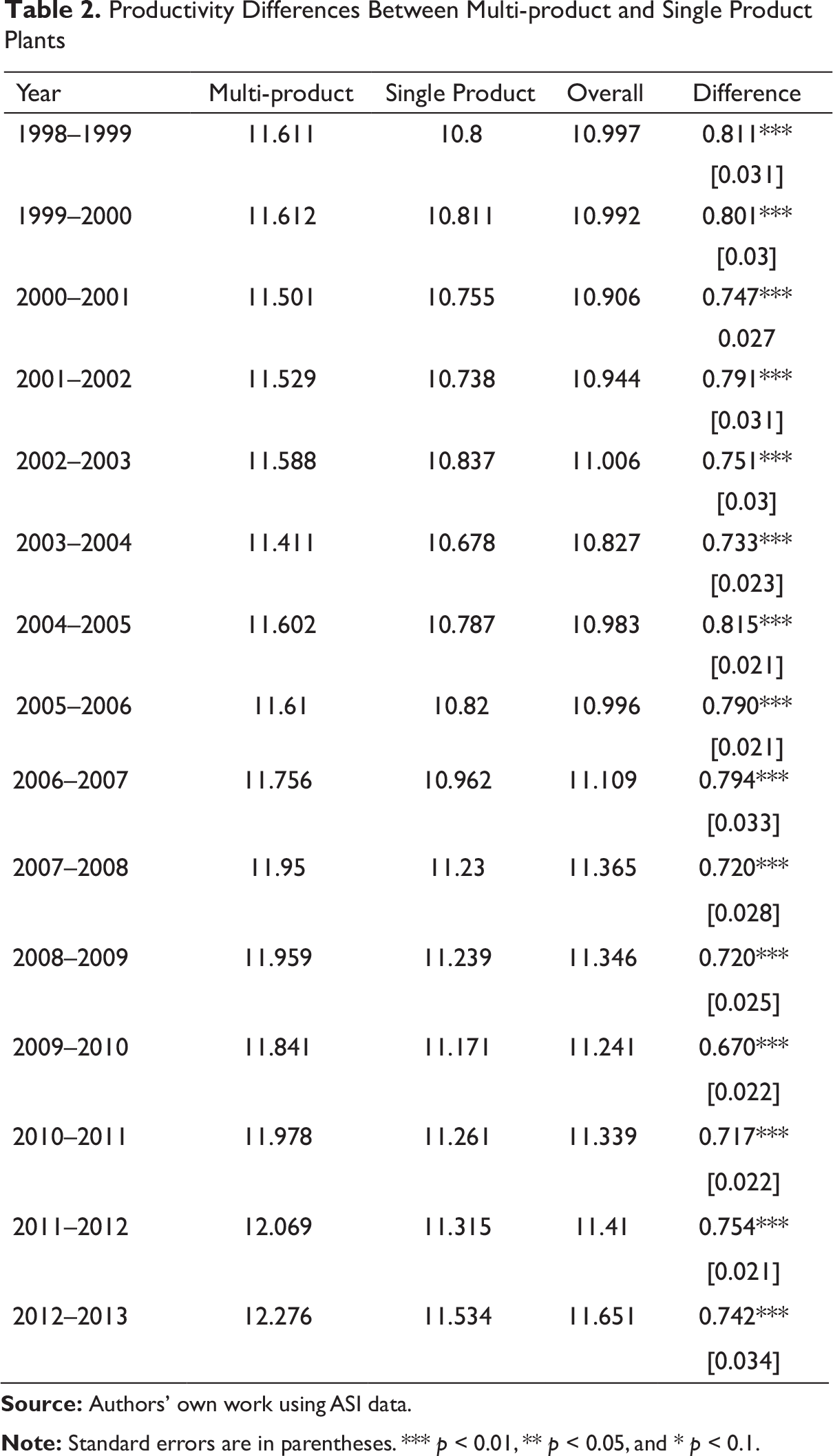
Next, we found that firms which diversify themselves by engaging in the production of multiple products are more likely to be much productive than firms that specialise in the production of only one product. Bernard, Redding, and Schott (2006) show that total factor productivity (TFP) is positively correlated with number of products produced and multi-product plants are more productive. In fact, they also find that the number of firms producing single product is more than the number of firms producing multiple products, which is consistent with our findings as well.
Studies have also found that information technology leads to productivity gains in the context of USA. (Jorgenson, 2001; Oliner & Sichel, 2000). In our data, plants have revealed their capital expenditure on computer software and equipment, which we use as a proxy for ICT. We find that ICT is significantly and positively associated with plant-level productivity.
Chuang and Lin (1999) in their study have shown that there is a significant impact of labour quality on the productivity of the manufacturing sector in Taiwan. Similarly, our result also shows that the plants with more non-production workers (skilled labour) compared to unskilled labour (production workers) are comparatively more productive. Moreover, we look at technology defined by capital intensity—the ratio of capital to total number of employees—and find that capital intensity is negatively associated with productivity, which can be due to capacity underutilisation.
The article has the following sections. The second section describes the data, the third and fourth sections give the descriptive analysis and regression results, respectively, and the fifth section concludes the article.
Data and Estimation Strategy
To understand the plant-level dynamics of productivity, we use the ASI panel data from 1998–1999 to 2012–2013 collected by the Central Statistical Office (CSO). The survey comprises of the following: (a) factories employing 10 or more workers with power and those employing 20 or more workers without power; (b) bidi and cigar manufacturing units registered under the Bidi & Cigar Workers Act; (c) all electricity manufacturing undertakings registered with the Central Electricity Authority (CEA); and (d) water supply, cold storage and repairing service units. Defence establishments, oil storage and distribution depots, restaurants, hotels, cafe and computer services and the technical training institutes, etc. are excluded from the purview of the survey. These factories are registered under Sections 2m(i) and 2m(ii) of the Factories Act, 1948.
Using the ASI data, we employ Hseih and Klenow (2009) methodology to calculate TFP. We calculate the productivity in terms of physical quantity (TFPQ).
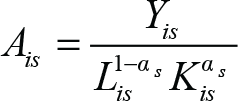
However, plants disclose their nominal output (
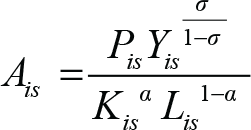
where Ais is the measure of productivity of a plant i in industry s, PisYis is the nominal output of a plant i in industry s, Lis is the wage payments of a plant i in industry s, Kis is the average capital employed by a plant i in industry s. Labour income share (1 − αs) is the share of wage payments to gross value added in industry s at four-digit National Industrial Classification (NIC) industry level. Gross value added is the difference between the values of output and input.
Our measure of productivity is estimated at 4-digit NIC industry code. NIC is used to identify the economic activities of all the units. Over the years, there have been several changes in the NIC level. From 1998 to 1999 onwards, NIC 1998 was introduced and followed till 2003–2004. For the period from 2004–2005 to 2007–2008, the classification was made according to NIC 2004. Latest, NIC 2008 was used for the period from 2008–2009 to 2012–2013. The units are grouped into one of these NIC classifications based on their principal product irrespective of the number of products being produced by them. We have also evaluated concordance between NIC 1998 and NIC 2004 using NIC 2008.
We assume that production technology has constant returns to scale (Iyer, 2011). Due to this assumption, we exclude those industries whose labour income share is greater than 1 and less than 0. We limit our sample to those plants which have their log of productivity as non-negative. Our productivity measure is in logarithms, and we keep the plants with non-negative productivity.
We further use the information on plants’ geographical location, sectors (urban or rural), plant’s capital, depreciation, fixed assets, that is, land and building, furniture, fixtures, wages, number of factories, number of workers, employees, unpaid employees, quantity manufactured, quantity sold, ex-factory value of output, intermediate inputs, imported inputs and share of exports (in percentage) available in 8 different blocks of schedule. This information helps us to determine the plant-level characteristics.
Plants report their products and by-products which they produce during the year. This helps in segregation of single product and multi-product plants. Second, we estimate the size of the plant using the total number of employees employed by the factory manager measured in terms of logarithms. The total number of employees is defined as the sum of workers—directly employed or contractual workers, supervisors, managerial staff and other employees.
With rapid digitalisation across industries, we should expect a positive relationship between productivity and ICT. In order to validate this theory, we consider the data on investment in computer and its equipment including software and take it as proxy for ICT. We have taken the ratio of investment in computer and its equipment software to total capital investment by the plant. Capital intensity (in logarithm) is measured in terms of ratio of investment in capital to number of employees. The relationship between capital intensity and productivity is expected to be positive, as an increase in capital investment and decrease in the number of employees employed would lead to one-to-one increase in productivity.
Further, we calculate the ratio of production to non-production workers, It is used as a proxy for ratio of unskilled to skilled labour in our data. Production workers are engaged in routine operations and production process, whereas non-production workers are essentially managers who are responsible for supervision and decision-making. In our data, production workers are either employed directly by the plant or are hired on contract. On the other hand, supervisors and other employees comprise the non-production workers. Moreover, our data comprises of a share of products or by-products sold abroad (in percentage) by plants from 2008–2009 to 2012–2013. We construct a binary variable for exports which takes value 1 if the percentage share of products exported for a particular plant is greater than 0 and otherwise 0.
Now, we explore the relationship between plant-level characteristics and productivity using fixed effects regression estimation strategy:

where i denotes plant in industry s at year t,
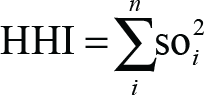
where
Descriptive Analysis and Systematic Productivity Differences
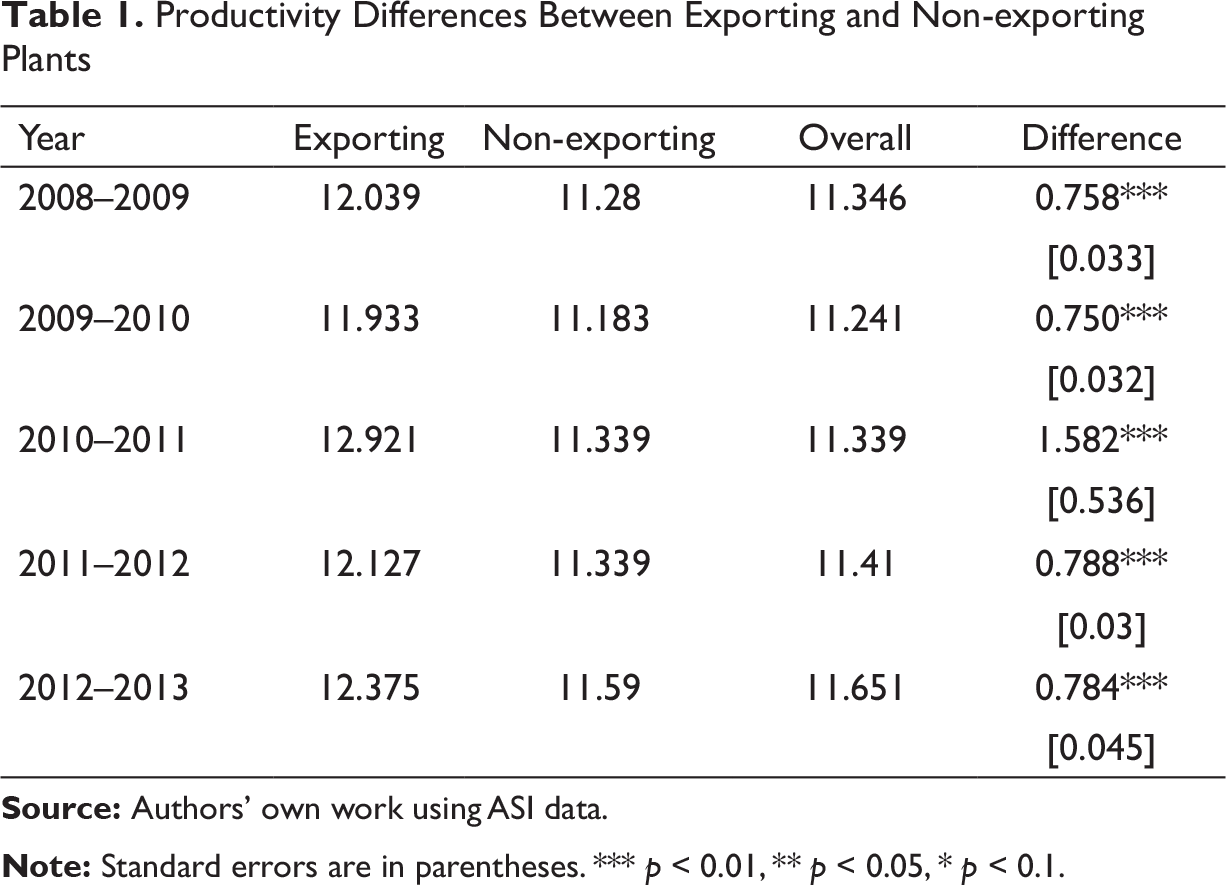
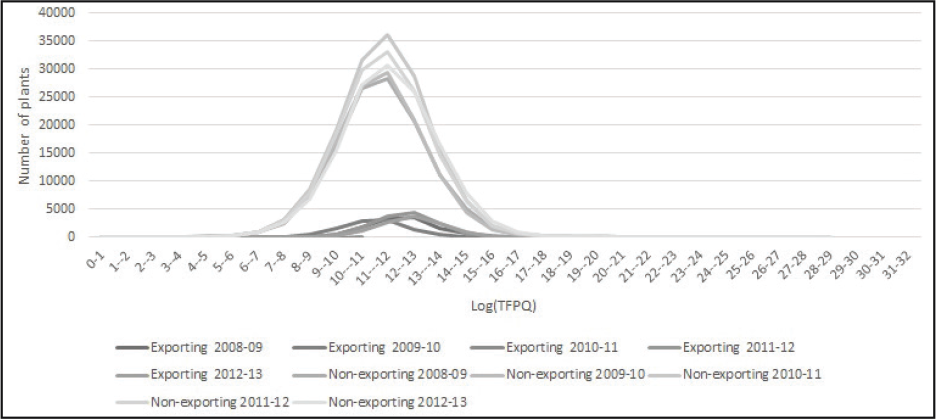
Productivity Differences Between Exporting and Non-exporting Plants
. Productivity Differences Between Multi-product and Single Product Plants
Regression Analysis
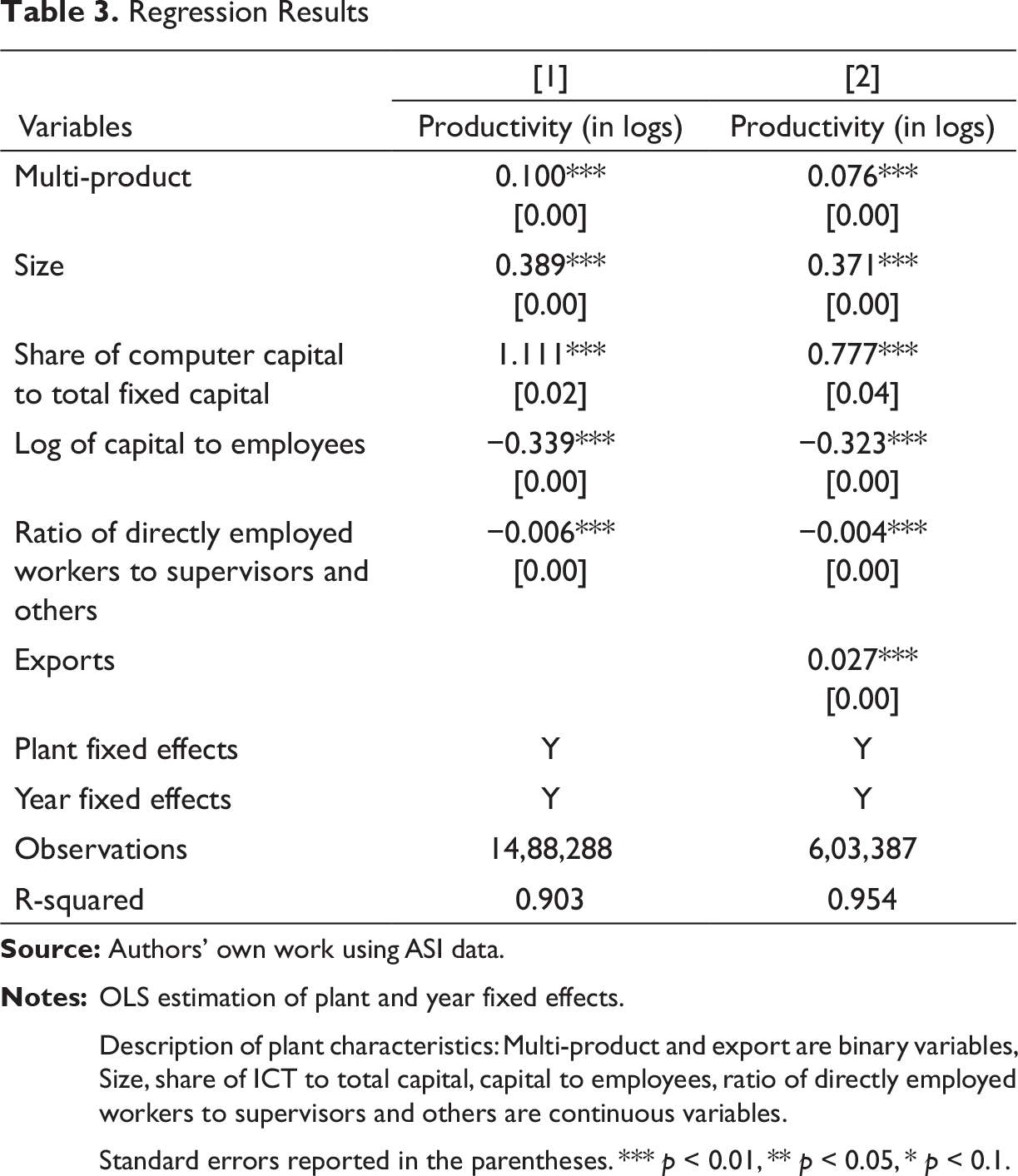
In this section, we examine the relationship between plant-level characteristics and plant-level productivity using Equation 1. The results from this regression are presented in column (1) of Table 3. As discussed earlier, multi-product plants are more productive compared to single product plants. In the regression analysis, we find that multi-product product plants seem to have 10 per cent higher productivity compared to single product plants. This result is consistent with the fact that TFP is positively correlated with number of products produced by firms (Bernard et al., 2006). Further, we find that the size of the firm, measured by the number of employees, is significantly and positively correlated with plant-level productivity. The coefficient indicates that 1 per cent increase in size is associated with 38.9 per cent increase in plant-level productivity.
In the era of digitisation, we consider ICT as one of the factors that can improve productivity. Our data provide the amount of capital invested in the form of computer equipment. Our fixed effect regression analysis shows that an increase in share of investment in computer equipment in relation to total fixed capital seems to improve the productivity by 11.1 per cent.
Next, we look at technology defined by capital intensity—the ratio of capital to total number of employees. The coefficient in Table 3 indicates that the intensity is negatively correlated with the productivity. One per cent increase in capital intensity will decrease productivity by 33.9 per cent. One of the possible reasons for this could be underutilisation of capacity installed in the plants. Underutilisation implies that there is a gap between installed capital, which is measured, and actual capital used in production. Studies have pointed out that there was an investment boom in the 1990s. However, these studies have also shown that capacity utilisation rate is lower despite improvement in capacity utilisation. This is due to the shortage of demand as well as rigid labour laws and it has a negative impact on productivity (Deb, 2014; Dougherty, 2009; Dougherty, Herd, & Chalaux, 2010; Goldar & Kumari, 2003; Uchikawa, 2001).
. Regression Results
Description of plant characteristics: Multi-product and export are binary variables, Size, share of ICT to total capital, capital to employees, ratio of directly employed workers to supervisors and others are continuous variables.
Standard errors reported in the parentheses. *** p < 0.01, ** p < 0.05, * p < 0.1.
In the next specification, we also include ‘Exporting Plants’ as an additional characteristic along with the previous characteristics. Sample size in this specification reduces, as data for exporting plants are available for the period from 2008–2009 to 2012–2013. Results based on this specification are reported in column (2) of Table 3. We find that exporting plants seem to have higher productivity by 2.7 per cent compared to non-exporting plants. Bernard and Jensen (2004) state that efficient plants can charge higher mark-up and overcome the costs associated with export market, thereby increasing their productivity, which leads to productivity differences across firms. The relationship between other characteristics and TFP remains qualitatively unchanged in this specification too.
Conclusion
In this article, we examine the relationship between plant-level characteristics and plant-level productivity in India using ASI data for the period from 1998–1999 to 2012–2013. In our preliminary analysis, we find that there are systematic differences between productivity levels of multi-product and single product plants as well as productivity levels of exporting and non-exporting plants. Furthermore, the number of exporting plants and multi-products plants are less than non-exporting and single product plants respectively.
From the OLS estimation with fixed effects, we observe that characteristic of plants has significant association with plant-level productivity. We find that size, in terms of employees, is positively associated with productivity. In addition, plant-level productivity is higher among plants which operate in export market or produce more than one product or invest in ICT. Moreover, it is negatively associated with capital intensity, implying that capital investment does not improve productivity. Investment in human capital, that is, employing more of skilled labour increases the productivity which is inferred by the negative relationship between the ratio of production to non-production workers and productivity.
Footnotes
Declaration of Conflicting Interests
The author declared no potential conflicts of interest with respect to the research, authorship and/or publication of this article.
Funding
The author received no financial support for the research, authorship and/or publication of this article.