







Abstract
The Scheduled Tribe (ST) population in India is one of the most marginalised and deprived one in the country. The Constitution of India itself mandates exclusive approach, strategies and measures for their development. The Government of India and the state governments, along with other key stakeholders, have been taking very specific policy and programmatic interventions for reducing the disparities between the ST and other social groups for the past 74 years. The impact of these measures is clearly reflected through the improvement in vital development indicators. However, several gaps and challenges continue to persist, implying revisiting the fundamental approaches and planning processes which direct the interventions at policy and implementation level. In this article, an alternative, more focussed approach of ‘virtual region as planning unit’ takes the aspects related to geographical, cultural and developmental heterogeneity into consideration. Concrete strategies for implementation of various policies and programmes adopting the approach of virtual region planning in light of challenges have been presented.
Background
India is home to largest tribal population in the world. There are over 700 Scheduled Tribes (STs)1 forming 8.6% (104.5 million) of total population (Census, 2011), spread over 15% of the country’s area, across different states and union territories (UTs).1 Though the ST population in India is numerically less as compared to the general population, they deserve special attention as they are socio-economically backward and isolated from the general population. Even among the STs, there are large differences between them in terms of numerical strength, history of settlement, geographic location, livelihood pattern, language, culture, human development, political empowerment and developmental aspirations. Further, each tribe is an endogamous group and interaction between groups and outside world is very much limited. While some tribal communities have adopted a mainstream way of life, at the other end of the spectrum, there are certain STs, 75 in number, known as Particularly Vulnerable Tribal Groups (PVTGs).
The Welfare State is enshrined in the Indian constitution with a view to ensure social justice to the most deprived sections of the society, especially the STs. Tribal administration has gained momentum since the Fifth Five Year Plan and to ensure a coordinated and integrated approach for the amelioration of the ST population, area development approach was adopted, known as Tribal Sub-Plan (TSP) area.
The efforts made through TSP strategy have brought out some improvements in tribal living conditions in terms of various indices relating to literacy, health, livelihood, etc. However, there still exists gap in human development indices between ST and other social groups. It clearly indicates that perspective towards tribal development, planning process, strategies, implementation mechanisms and their effectiveness, impact of initiatives so far etc. have to be revisited in light of learnings till date. The redundancies have to be removed so as to make way for more innovative approaches and initiatives that can truly contribute to inclusive development.
Key Challenges in Tribal Development
Key Indicators for ST and Total Population.
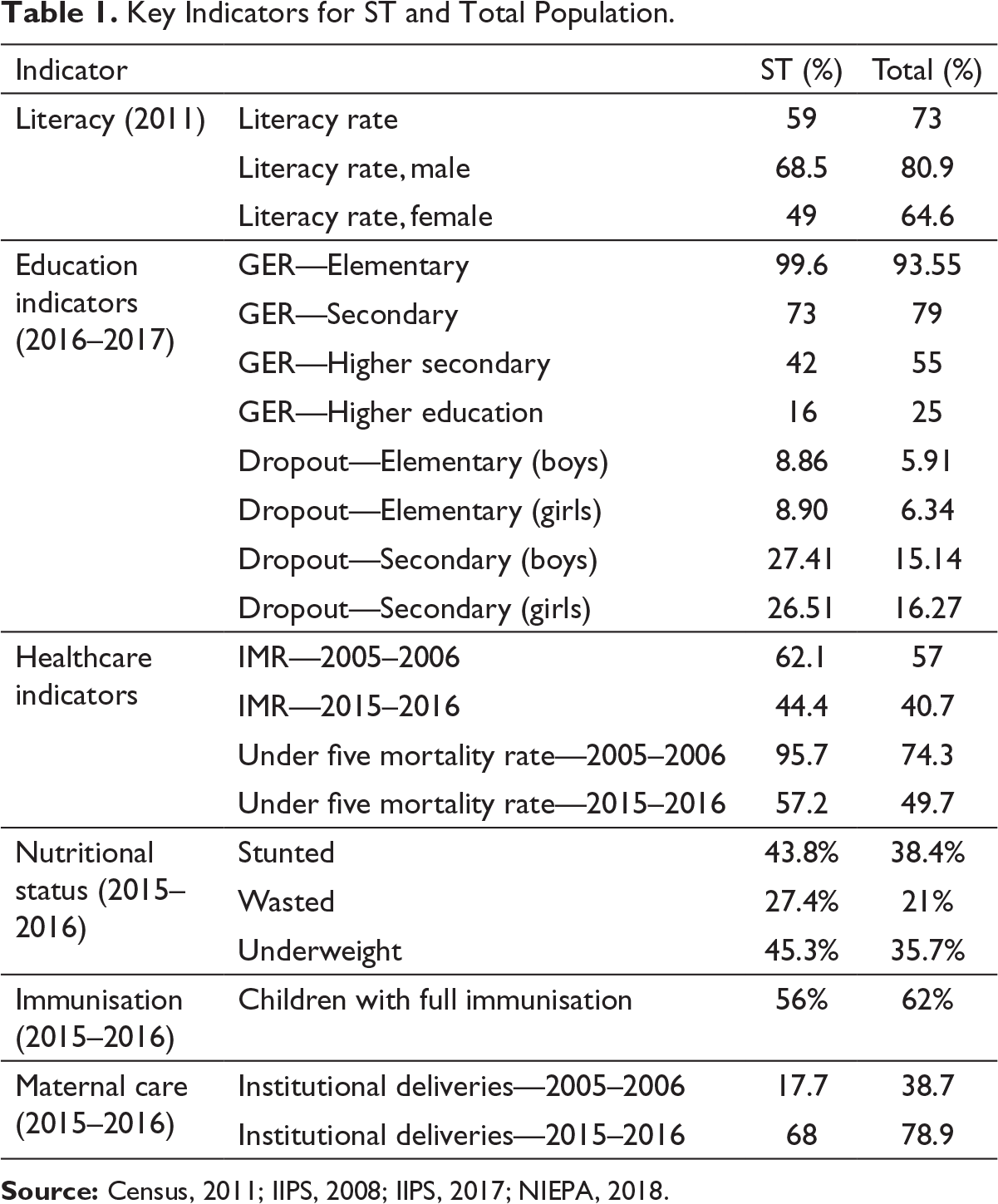
The quality of life of ST, with less than 20% households own basic amenities and have access to basic services, is way behind other social groups (Census, 2011). Regarding the livelihood-related aspects, ST communities (except the small proportion of those residing in urban areas) largely depend on natural resources for their livelihood, comprising of subsistence level rainfed, traditional agriculture with shifting cultivation and agricultural labour as main source of livelihood, followed by livestock rearing, minor forest produce, fishing, hunting etc. But none of these assure food security throughout the year, resulting in seasonal migration, wherein the only alternative livelihood is casual labour in urban and peri-urban areas. These issues are further aggravated by low agricultural productivity, marginal landholdings, land alienation, displacement due to mining activities and declining forest covers. Deprived of opportunities for gainful employment mainly due to the lack of education and employable skills, the communities tend to descend deeper into the spiral of poverty, which also impacts overall quality of life, education, health etc. (Marchang, 2019; Oraon, 2012; Parta, 2018).
Although STs improved as reflected by the various indicators, the gap has widened between STs and total population, since remaining population has progressed comparatively at faster pace. It is indicative of the fact that ST are organised in limited sense and have relatively much lower representation in administration. Also, there has been a clear regional pattern in level of human deprivation as states, namely Bihar, Jharkhand, Chhattisgarh, Uttar Pradesh, Orissa, Rajasthan and Madhya Pradesh, show one of the lowest levels of living conditions and assets for all the households in general and SC and ST households in particular (Biswas & Krishnan, 2017; Makwana, 2017).
Necessity of Virtual Region as Planning Unit
Ever since the introduction of TSP approach over five decades ago, the planning process and programmes for tribal development have been confined to rigid administrative and geographical demarcations. There is limited inbuilt responsiveness to the challenges and changing trends in development of ST vis-à-vis other social groups. The conventional and convenient approach of treating ‘district as basic unit for planning’ takes into account only the ‘presence of ST in Scheduled Areas’. The diversity of natural resources and heterogeneity of the ST communities, which are the most distinguishing and defining factors in developing appropriate strategies in their context, are not taken into consideration. Also, ST communities are broadly categorised as ‘ST’ and ‘PVTG’. The heterogeneity ‘within these two categories’ is unaccounted. The resultant strategies adopted are not effective enough to address the context-specific challenges in development of ST. Moreover, the disparities between the ST and other social groups keep widening, which is a greater concern.
The approach of ‘Virtual Region’ planning can help in overcoming the above limitations of existing planning processes based on rigid administrative and geographical demarcations. First and foremost, the virtual region planning approach can enable identifying and regrouping 700+ tribal communities beyond the conventional measures of population and area. It will be possible to include overall human development indicators as well as qualitative aspects, such as unique culture and heritage, dialect, livelihood patterns and developmental stages, in planning process. It can even allow going a step further to identify and address the ‘inter-community disparity’. The breadth and depth of insights emerging through such process can make the developmental strategies more holistic and inclusive, aligning with the spirit of Constitution in true sense.
Existing Interventions in India with Approach Similar to Virtual Region Planning
The existing schemes and programmes, like TSP and other relevant ones, have adopted an integrated and area-based approach for achieving the target of more inclusive development, so far, closest to aid in virtual region planning. The implementation modality and mechanisms are specific to geographies and administrative units are distributed accordingly, and monitored at the divisional and state levels, respectively, through the Tribal Development Department (TDD), and Ministry of Tribal Affairs (MoTA) at the national level through both off-line and online mediums. Thus, ‘virtual regions’ are more or less already identified.
The TSP strategy was adopted for accelerated development of tribal people. It envisages channelising the flow of outlays and benefits from all sectors of development to ST population. The specific objective of the TSP is to bridge the gap between ST population and others by accelerating the development of STs by securing to them:
human resource development by enhancing their access to education and health services, enhanced quality of life by providing basic amenities in tribal areas/localities including housing, substantial reduction in poverty and unemployment, creation of productive assets and income generating opportunities, enhanced capacity to avail opportunities, gain rights and entitlements and improved facilities at par with other areas and protection against exploitation and oppression.
TSP funds are dedicated source of funds for tribal development. Forty-one central ministries have been mandated to earmark TSP funds in the range of 4.3%–17.5% of their total scheme allocation every year for tribal development. MoTA provides additive to these initiatives by way of bridging gaps. As per Budget 2020–2021, there are 38 central ministries and departments having STC funds catering to specific tribal development in about 300 different schemes, as reflected in the Statement 10B of the Expenditure Profile of the Union Budget 2020–2021. This is complemented by Special Central Assistance to Tribal Sub-Scheme (SCA to TSS), which is 100% grant from the Government of India (GOI, since 1977–1978).
SCA to TSP are released for economic development in the following areas and for the following population:
ITDP/ITDA areas (194 Nos.), which are generally contiguous areas of the size of at least tehsil or block or more in which the ST population is 50% or more of the total population (Maharashtra State additionally created OTSP (Outside Tribal Sub-Plan) area. MADA pockets (259 Nos.), which are identified pockets having 50% or more ST population with a minimum population of 10,000. Clusters (82 Nos.), which are identified pockets having 50% ST population with a minimum population of 5,000. PTG characterized by a low rate of growth of population, pre-agricultural level of technology and extremely low level of literacy. Dispersed tribal population—Those tribals who fall outside the categories at the first and fourth points.
Grants-in-aid under Proviso to Article 275(1) of Constitution of India are 100% annual grant from GOI to 26 states. It is charged to Consolidated Fund of India (except grants for north eastern states, a voted item) and is an additive to state plan funds and efforts for tribal development from Annual Report of Ministry of Tribal Affairs, 2020–21 (Ministry of Tribal Affairs, 2021).
Strategies
For better planning process, the strategy for systematic convergence and integrated planning with participation of all concerned ministries/departments is essential. Focus should also be strengthening the existing mechanisms for implementation of schemes and programmes, increasing effectiveness and enhancing governance at every level of implementation prioritising tribal needs identified by MoTA/TDDs of the respective states. The data available through portals of various departments needs to be leveraged for the purpose.
For strengthening the process, it is essential to group the similar communities, take their context into consideration and thereafter plan the design and implementation of schemes/programmes so that the process is more inclusive and the communities receive the requisite support. The schemes need to be designed and implemented community-wise or for communities having similar culture as cultural aspect plays very important role in tribal development.
The ‘equality of opportunity’ enshrined in constitution could be adopted as an approach to resolve many dilemmas in tribal development process such as culture conservation versus development, forceful migration versus availing urban opportunities and visible versus gradual development. The challenge is to empower tribal population to make informed decisions. Some initiatives have led to important insights in this aspect. For example, PESA empowers gram sabha to say no to any development project within its area and FRA empowers localities to prohibit any initiative within area affecting biodiversity. Thus, process for empowerment has been initiated, but it is not enough for making informed decisions. Contextualised education can serve as an effective tool for empowerment in the long term. But until then, short-term interventions may be adopted in form of regular (preferably community-based) trainings of key influencers within the community, like community leaders and SHGs, with appropriate training methods to disseminate correct information pertaining to schemes, programmes, interventions and entitlements therein.
In brief, to go by virtual region approach, learnings from the exercise done similar to virtual region need to be considered. Key takeaways are as follows:
Existing virtual region for planning purpose is limited to notified area. This needs to be expanded to cover tribal population outside notified areas (which is increasing in number and percentage). Adoption of new points in strategy while planning for tribal virtual region as mentioned in this research paper. The objective would be to provide ‘equality of opportunity’ through informed decision to choose among alternative options/choices and no much stress on visible robust development indicators. Still much thinking needs to go for selecting appropriate methods for making tribal population ‘informed’ about options and their advantages/disadvantages.
The strategies suggested vis-à-vis existing scenario as well as need for change in approach for planning process need to be further refined in consultation with wider stakeholders, and dovetailed in the systems and process. This will not only enhance the effectiveness of on-going initiatives but also pave way for more innovative approaches, solutions and, most important, align perspective of the policymakers and practitioners towards understanding the issues of the ST in the light of emerging challenges.
Footnotes
Declaration of Conflicting Interests
The authors declared no potential conflicts of interest with respect to the research, authorship and/or publication of this article.
Funding
The authors received no financial support for the research, authorship and/or publication of this article.
