







Abstract
Turkey has changed its policy in Africa since 2005 and developed a more active role to cement its political, economic and social relations with African countries. For instance, while Turkey had only 12 embassies around the continent in 2002, it now has 35. Its economic relations with Africa have also increased significantly over the past decade. Although its total trade was 2 billion dollars in 2002, it boomed to 22 billion dollars in 2013. Turkish non-governmental organisations (NGOs) and civil society organisations have also boosted their humanitarian activities in Africa. They have established hospitals, mosques, orphanages, schools and colleges, opened water wells and provided free cataract surgeries. This article will examine why Turkish NGOs and civil society organisations have increased their humanitarian assistance in Africa since 2002. The research will also uncover the main motivations to the increasing role of Turkish NGOs and civil society organisations on the continent of Africa.
Introduction
It is difficult to discuss the role of Turkey in Africa without understanding the part that Turkish non-governmental organisations (NGOs) played in Africa. The role and the scope of NGOs have changed dramatically in world politics after the Cold War era. Changing economic, social and political dynamics in the international arena have played significant roles in evolving the concept of civil society. For instance, the collapse of a bipolar international system, democratisation efforts of states and transitions from authoritarian regimes to democratic systems have had an important impact on the development of the concept of civil society. In this context, there is a strong nexus between the role of Turkish NGOs and economic, social and political development in Turkey. The number of NGOs has increased in Turkey since 2000 and they have played an active role in the fields of education, health care, human rights and social assistance. NGOs have become significant players in world politics and contributed to increasing international prestige of states. Therefore, it is essential to understand and evaluate NGOs critically.
Even though Turkey has increased its political, economic and historical relations with Africa over the past decade, Turkish academicians have not paid adequate attention to Turkey–Africa relations. However, there are some Turkish scholars who have given attention to relationship between Turkey and Africa in recent years. One such Mehmet Ozkan, has analysed in depth Turkey–Africa relations in two academic journals: ‘Turkey’s Opening to Africa’ in the Journal of Modern African Studies in 2010 and ‘A New Actor or Passer-By? The Political Economy of Turkey’s Engagement with Africa’ in the Journal of Balkan and Near Eastern Studies in 2012. Both important scholarly articles have examined political, economic and historical relations between Africa and Turkey, but there are no scholarly articles that analyse the role of Turkish NGOs in Africa in a broader context.
This article attempts to provide a theoretical framework and explore the dynamics of the involvement of Turkish NGOs in Africa. What is the motivation of Turkish NGOs in Africa? Are they working for Africa’s development? Are they implementing Turkish foreign policy objectives in Africa? Are African people supporting Turkish NGOs? What is the role of Turkish NGOs in solving Africa’s problems such as poverty, corruption, conflict and war? The answers to these questions are prerequisite to make a clear definition and clarify the concept of NGOs to answer these questions. This research starts with the explanation and the clarification of the concept of NGO.
Definition and Conception of NGO
The term ‘non-governmental organisation’ has different connotations, such as ‘private voluntary organisation’, ‘international non-governmental organisation’, ‘non-profit association’, ‘people’s organisation’, ‘non-governmental development organisation’ and ‘new social movement organisation’ (Clarke, 2002). It is difficult to define and classify NGOs in a complete way because NGOs work with different organisations and grapple with many difficult, complicated and risky activities. Lewis and Kanji (2009) underline that NGOs exist between states and markets and they have different organisational structures. Bagci (2003) stresses that NGOs should have an autonomous and independent financial structure. In particular, they should not financially depend on governments; otherwise they can be politicised and marginalised in the society. Importantly, NGOs should generate the major part of its financial resources from the members to be able to work independently. Jarvik (2007) argues that NGOs take important responsibilities for political, social, economic and security problems in the society. They have different means to oppress the states such as through sanctions or humanitarian interventions. He points that NGOs have emerged as a ‘new class’ in the discipline of International Relations (IR) and they have displaced traditional government institutions. NGOs fill an important gap in areas where the state fails to provide services to its citizens.
NGOs have five key characteristics, a formal structure, a private institution, non-profit organisation, self-governing and a voluntary system. Importantly, they have three components: first, its implementer role: NGOs deliver services to the poor people; second, its catalyst character: NGOs play a critical role in improving and facilitating social transformation; third, its partnership role: NGOs can cooperate with donor agencies, private sectors and governments on joint projects to help the people to better their conditions (Lewis, 2009). The term ‘non-governmental organisation’ became very popular when the United Nations first used it to denote its Economic and Social Council (ECOSOC) in resolution 288 B (X) of 27 February 1950, which gave it and other such organisations a consultative role. With this resolution, the UN showed its desire to increase cooperation with private and non-profit organisations (Doh and Yaziji, 2009), in order to strengthen its global power. United Nations defines the concept of NGO as follows:
any non-profit, voluntary citizens’ group which is organized on a local, national or international level. Task-oriented and driven by people with a common interest, NGOs perform a variety of service and humanitarian functions, bring citizen concerns to Governments, advocate and monitor policies and encourage political participation through provision of information. Some are organized around specific issues, such as human rights, environment or health. They provide analysis and expertise, serve as early warning mechanisms and help monitor and implement international agreements. (UN, n.d.)
There is no internationally accepted definition of NGO. The meaning and the concept of NGO varies from country to country or region to region. International developments, political and economic changes in a country, and the development of democracy have all influenced the development of the concept of NGO. Chien-Hua (2005) defines it as ‘non-profit, voluntary, private, self-governing and professional organization’. NGOs aim to promote public interest and they ought to be based on a legal framework (ibid., 7). Davenport (2002) underlines that NGOs structure the new diplomacy consisting of the terms ‘participation’, ‘empowerment’, ‘people-centred’ and ‘consensus’. They can shape political agenda, enforce political parties, protest oppressive regimes, implement the rule of law, change the wrong decisions made by policy makers, mobilise people, to do scientific research and advocate basic rights and liberties of people (Mathews, 1997).
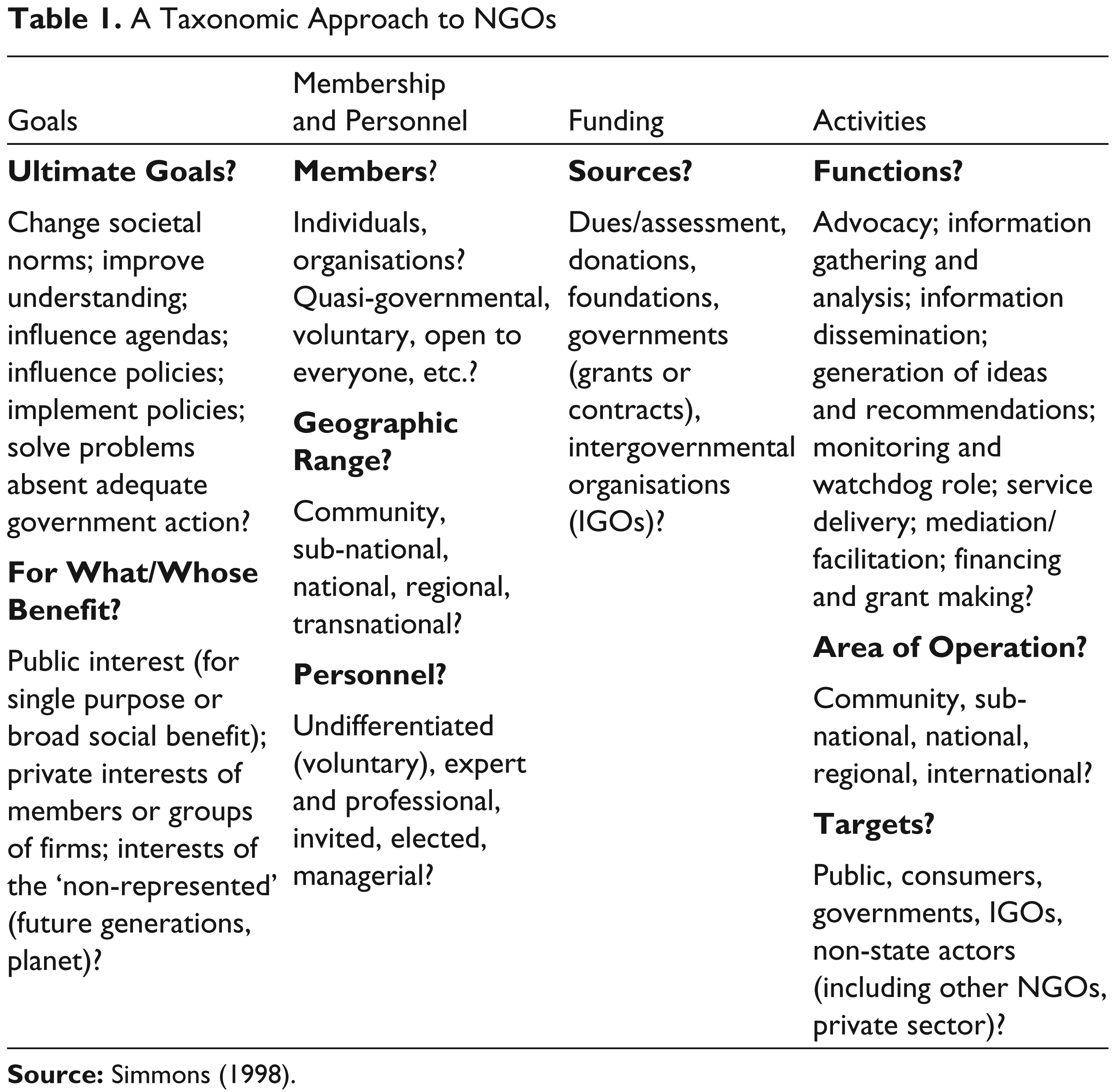
The World Bank defines it in terms of ‘private organizations that pursue activities to relieve suffering, promote the interests of the poor, protect the environment, provide basic social services, or undertake community development’ (World Bank, 2002). Simmons (1998) emphasises that NGOs can be effective in four areas: (a) setting agendas: they can play an important role in changing leaders or policy makers’ decisions; (b) negotiating outcomes: they can play an active role in designing or shaping international treaties. NGOs can also help governments solve international or domestic problems; (c) conferring legitimacy: NGOs can play a critical role in increasing public interest and protecting peoples’ rights; and (d) making solutions work: they can provide services for people in need when governments fail to fulfill their responsibilities (see Table 1).
A Taxonomic Approach to NGOs
Civil society is a platform to discuss problems. It is an organisation that aims to address societal issues and to protect values and interest of the societies. The significance of the concept of civil society has increased after the authoritarian regimes collapsed in Latin America and East Europe and played an active role in strengthening democratic values. In addition, the power of civil society has increased when states or governments failed to fulfil their responsibilities for their citizens (Keyman, 2006). The Republic of Haiti is an important country in terms of having experiences of NGOs. This country is known as a ‘Republic of NGOs’ in the world. When the number of NGOs in the country was 3,000 prior to 2010, it increased to 10,000 after the earthquake in January 2010 (Kristoff and Panarelli, 2010). According to the Government of Haiti, an NGO is a ‘private, apolitical, not-for-profit institution or organization that pursues the objectives of development at the national, departmental, or communal level, and uses resources to realize them’ (Schuller, 2007).
Classification of NGOs
There are three important typologies of civil society (Charles, 1990). The first is that civil society can only emerge in free societies and it never exists when there is an authoritarian regime. The second is that civil society is an organisation that is working for the promotion of the interests of the people. In this model, civil society aims to protect and expand the freedom of the citizens and people organise their social life without state intervention. The third is that civil society influences and shapes the policy makers’ decisions. Civil society is an important tool to solve the problems society faces and help governments promote public interests. Furthermore, civil society encourages citizens to be active rather than passive. Importantly, people of different identities, cultures and social actors can come together and meet through civil society organisations (ibid.).
Schuller (2007) also classifies NGOs under four categories: the first type defines NGOs as humanitarian aid organisations; the second type defines them as organisations making medium-term development projects; the third type are those that make long-term participatory development projects and the last one is that NGOs are organisations dealing with inequalities. There are two important NGO typologies: self-benefiting NGOs and other-benefiting NGOs. The first one is only focusing on protecting the interests of the members, such as unions and business associations. The second one is providing services to the poor people or people who need help due to wars, conflicts, poverty or earthquake (Doh and Yaziji, 2009).
NGOs in theories of International Relations
IR theories provide various views about the role of NGOs in world politics. After the Second World War, the importance of NGOs has increased in the study of international relations. In parallel with the increasing role of NGOs in the international system, IR theorists have tried to understand the role and impact of NGOs on states and global system. In realist thought, states are accepted as the most important actors on the international stage and they always aim to maximise their power to protect their national interests. In particular, increasing military power has been essential for protecting national interests and strengthening the state against potential enemies (Mearsheimer, 1993). The international system is a struggle for power based on a ‘self-help’ system. Hence, states always act according to their own self-interest (Mearsheimer, 1994/5). Realist theory especially focuses on how a state increases its own interests worldwide. The realist scholars particularly contend with security issues. According to the theory of realism, states play major roles in increasing their military capacity and coping with security problems. On the other hand, realist scholars underestimate the significance of NGOs in world politics, underlining that NGOs do not have power to act independently and, therefore, cannot solve security and other important issues states and societies face (Andrew, 2007).
NGOs can only be established by states as a part of self-help system and, therefore, they cannot work for the interests of the public. Realism maintains that states can create NGOs in order to keep and shape their interests in world politics. Mearsheimer states that ‘institutions are basically a reflection of the distribution of power in the world. They are based on the self-interested calculations of the great powers and they have no independent effect on state behaviour’ (Mearsheimer, 1994/5). According to the realist paradigm, NGOs only reflect interests of states; they work dependently on states and serve for the interests of states. In addition, NGOs do not have capacity to sustain peace and security (ibid.). Terry (2002) emphasises that NGOs have been used by states to serve their own interests. For example, the US provided support to the Communist Party of Kampuchea called the Khmer Rouge against the Vietnamese Army.
The end of the Cold War brought important structural changes in world politics. For instance, the multi-polar system has replaced bipolar system and new actors emerged and increased their power against the nation-states, such as private and non-private organisations. Importantly, the distribution of power was redesigned among the states, markets and civil society (Mathews, 1997). In other words, there has been a ‘power shift’ (ibid.) in the international system after the collapse of the Berlin Wall. With the emerging new non-state actors on the international scene, states have lost their autonomy and begun to share their power with them. NGOs have also decreased the central power of states (ibid.) and played an active role as a ‘soft power’.
The most important driving force behind the decline of states and the rise of non-state actors is ‘the computer and telecommunication revolution’ (ibid.). ‘Technology is fundamental to NGO’s new clout’ (ibid.). They force the governments to work in a more transparent and accountable way. Non-traditional threats and challenges, including terrorism, drug trafficking, organised crime, poverty, failed states and political instability have replaced traditional ones. States cannot solve new threats and challenges the states face without working with the NGOs. The Westphalian system is over; therefore, states need to work and cooperate with non-state actors actively, such as businesses, international organisations (IOs), religious and ethnic groups and NGOs in order to provide better services to their citizens. However, states weaken their sovereignty by collaborating with NGOs. It can be said that NGOs moved from the peripheral to a central role after the end of the Cold War era. Particularly, they have increased their power where the IOs lack or fail in providing services to needy people (ibid.).
After the Second World War, the emergence of the new actors, such as the UN, the World Bank, and the IMF strengthened liberal thought and with the collapse of the Soviet Union, non-state actors, including inter-governmental, private, and non-profit organisations have begun to play a more active role in a wide range of activities, such as education, health care, environmental issues, poverty eradication and peace-building in world politics (Geeraerts, 1995). The increasing role of the non-state actors in world politics has also posed serious challenges to the assumptions of the realist thought which accept that states are the most important actors in world politics. Even though liberalism believes that states are the main actors in world politics, they also assume that states have pluralistic perspectives. According to liberalism, non-state actors are important parts of the international system and they fill the gaps in the areas where the states cannot (Karns and Mingst, 2004).
Keohane and Nye (1971) underline that states are not the only actors in the international system; there are also other actors shaping global politics, such as private and non-private organisations. The concept of state has changed over time. While the global politics was described as a state-centric structure in the twentieth century, it has changed with the emergence of the new actors. In the new world, states have become more dependent on non-state actors. According to Keohane and Nye, realism does not explain world politics properly anymore because realist scholars could not see the fundamental changes that occurred in the international system. For instance, the new changes in the areas of technology, transportation, the spread of transnationalism, and the emergence of the new global threats and challenges have enhanced the role of non-global actors. On the other hand, the new global changes in world affairs have decreased the role of the states (ibid.). Liberals assert that states cannot solve the new threats and challenges on their own; they need to work with the non-state actors to provide better services to their citizens. They also believe that non-state actors strengthen the politics of states rather than threatening their sovereignty (ibid.).
Keohane and Nye (2000) also explain the global role of NGOs under the theory of complex interdependence (CI). CI has three important characteristics. The first is that multiple channels which affect relations between states and societies emerged in the post-Cold War period; multinational and transnational organisations have become more strategic actors in increasing social, economic and political relations in the societies. The second is that military force is not dominating international agenda anymore. There are also other important problems that affect the states and international politics outside of the security paradigm. For example, the issues such as international terrorism, political and economic instabilities, drug trafficking, climate change and immigration have become more complex and more dangerous for states. While these issues increased the power of NGOs in world politics, they decreased the political power of states (ibid.). The third is that military force is not enough to solve today’s problems and challenges (ibid.). The realist assumptions have lost significance in world politics with the emergence of the new actors and new issues. The new communication methods reduced international hierarchy which assumes that states are the main actors in world politics but increased the global power of the transnational actors. Furthermore, the new actors have begun to play a more active role in setting international agenda and resolving the complex issues of today. The concept of international politics has changed over time. When military force is the only instrument of states in the realist assumption, interdependence, international organisations, transnational actors have become the new instruments of states in the theory of complex interdependence (Keohane and Nye, 2000).
Constructivism has also significant views on the role of NGOs in world politics. Alexander (1995) argues that international politics is socially constructed. Social structure composed of shared understandings, knowledge, identity, ideas, norms, culture, religion and traditions establishes the dynamics of global politics. The new actors, threats and challenges are shaped by social structure, not given identities. Without identities, states cannot build and define their interests. Material elements get their meanings from human consciousness and states develop their policies and strategies according to their identity (Alexander, 1992). In this sense, social structure plays a significant role in the emergence of the NGOs and the increasing role of non-state actors. NGOs have identity, norms, and religion. The social dynamics gives directions to NGOs about their activities on world affairs. It can be said that social dynamics in Turkey such as religion, culture and identity of people have affected the path of the Turkish NGOs and civil society in Africa.
The Development of NGOs and Civil Society in Turkey
Political, economic and social dynamics in Turkey play a significant role in increasing the number of NGOs and strengthening the concept of civil society. With the establishment of Turkey in 1923, the Kemalist ideology dominated the social, economic and political fabric of Turkey. Importantly, the political system in Turkey was based on the one dominant party system and, therefore, the Republican People’s Party (RPP) was the only political party in Turkey until 1950. The Kemalist elites or the RPP were the most important players in the internal and external politics of the country until Turkey first adopted the multi-party system in 1950. Even though some attempts had been made to transform the Turkish political system from the one-dominant party system to the multi-political party system prior to 1950, it did not succeed. For example, the Progressive Republican Party and the Liberal Republican Party were established in order to advance democracy in Turkey in 1924 and in 1930, respectively. However, these parties were disbanded after a short time by the single-party state as the Kemalist elites believed that the state should be only controlled and governed by them. The RPP or the party of the Kemalist elites in the country did not want to make civil society institutions strong and effective because they surmised that a strong, effective and independent civil society in the country could develop new alternatives to the state which may threaten the survival of the state and the Kemalist ideology. The assumptions of realism became particularly dominant in Turkey in the early years of the new Republic. The notion of civil society remained very weak during the single-party period in Turkey because of the authoritarian character of the dominant party. It can be said that the single party established psychological barriers between the state and the society and undermined the development of civil society during this time (Burak, 2011).
With the beginning of the multi-party system in Turkey in 1950, the concept of civil society became strong. It is a fact that there has always been a strong relationship between the development of civil society and the state’s policies in Turkey. Even though Turkish society witnessed a remarkable change in Turkish political system with the emergence of the multi-party system in 1950, the legacy of the one dominant party system has continued to influence the social, economic and political structure of Turkey for a long time. For instance, The RPP played a significant role in reinforcing the military power or the military bureaucracy during the one dominant party period. The military bureaucracy was given privileged social and economic rights by the Kemalist groups and so Turkish Military became more influential in Turkish society and politics. As a result of these privileged rights given to the Turkish Military, the military bureaucracy considered itself as the ‘guard of the regime’ and got actively involved in Turkish politics. Though the RPP lost its power with the emergence of the multi-party system in Turkey, it continued to keep its power through the military bureaucracy. The Military’s active involvement in Turkish society has damaged the advancement of democracy, human rights and the concept of civil society (Karaman and Aras, 2000). The military saw different ideologies, cultures, identities and the religion of Islam as a threat to the secular regime so that the notion of civil society faced serious problems and challenges in Turkey. More importantly, the Turkish Military organised coups in Turkey in 1960, 1971, 1980 and 1997, which immensely damaged the diversity of the Turkish political culture. For instance, the 1980 military coup seized all the activities of the civil society organisations in the country which eroded the development of civil society organisations.
The concept of state began to transform in the post-1980 period. After the military coup in 1980, Turgut Ozal came to power in 1983 as a democratically elected prime minister of Turkey. He remained in power between 1983 and 1993. Turgut Ozal played an important role in developing democracy, human rights, and civil society, liberalising Turkish economy and integrating it into the global economy. At the same time, he made immense efforts to strengthen economic, social and political ties with the West. As a reflection of Ozal’s liberal policies in Turkey, democracy, human rights and civil society organisations began to get stronger; the number of private TV channels and newspapers and civil society organisations increased (Karaman and Aras, 2000). Keyman and Icduygu (2003) stress that there are four important factors behind the increasing power of civil society organisations in Turkey after the 1980s, particularly in the 1990s. The first is that the new actors and the new thought paradigms emerged in Turkey which criticised the strong-state traditions and called for a more democratised state. The second is that the nation-state faced a crisis of legitimacy due to its authoritarian nature. Third, Turkey’s increasing relations with the EU influenced positively the concept of civil society. Lastly, globalisation agitated the power of the nation-state and had a positive impact on the emergence of the new actors in world politics. During the period of Turgut Ozal, liberalism clearly came into prominence, but the power and role of the military elite on politics paralysed this development.
The first time Turkey organised the International Habitat II Conference in 1996. With this conference, Turkey brought together a large number of high-level representatives of states and governments, NGOs, private sectors, media, research and academic institutions and media. The conference stressed that Turkish civil society organisations have begun to take more active role in developing the society (UN Habitat, 1996). The 1999 earthquake also had a big impact on the increasing number of civil society organisations. Turkish NGOs filled a significant gap in the areas where the state failed during the massive earthquake in 1999 (ibid.).
The 28 February Process was important to understand the history of civil society in Turkey and known in Turkey as a ‘soft military coup’ in 1997. The Turkish military forced the democratically elected government to resign. This process was also a serious obstacle to developing democracy and civil society. The military increased its dominance over the society and played active role in constraining freedom of religion, expression, media and activities of civil society organisations. The Kemalist elites shut down the Welfare Party in 1998 and stopped the activities of some civil society organisations with the 28 February Process took place in 1997. With the emergence of this soft military coup in Turkey, the concept of the nation-state was enhanced; however, they have damaged the pluralist structure of Turkey.
After 2003, the Justice and Development Party (JDP) came to power. Turkish society has undergone a significant change on its economic, social and political development with the JDP. The ruling party has remained in power since 2003 under the leadership of the prime minister of Turkey Recep Tayyip Erdogan. Importantly, the rate of association in Turkey increased by 150 per cent in the last 10 years in parallel with the developments in the fields of democratisation and human rights. According to the Department of Associations, while the total number of the associations in Turkey was 61,000, this increased (Yenişafak, 2012) to 97,578 in October 2013 (Department of Association, 2013). Political and economic stability in the country have strengthened the concept of civil society and increased the number of civil society organisations despite some challenges of the military class. The civil society organisations have begun to play a more active role to reinforce Turkish democracy and take more responsibilities worldwide in a wider range of fields, such as, war, conflicts, hunger, earthquake, health care, education and agriculture. It can be said that political and economic instabilities, the involvement of military bureaucracy in politics, weak coalition governments, coercive force of state over the society and the dominant ideology of the state has all undermined the development of democracy and the notion of civil society in Turkey (Karaman and Aras, 2000). It should be underlined that these factors constrained the capacity, the role and global power of Turkish NGOs.
Importantly, political, social and economic relations between Africa and Turkey have begun to increase significantly since 2005. The ruling party has announced 2005 as the year of Africa. While Turkey had only 12 embassies all over the continent of Africa in 2002, it today has 35 embassies. Economic relations have also boomed. When Turkey’s total trade with Africa was 2 billion dollars, it reached today 22 billion dollars. Turkey has also become member of regional and sub-regional organisations in Africa, such as the African Union, African Development Bank and the Economic Community of Western African States (ECOWAS) (Siradag, 2013). Furthermore, the Government of Turkey has provided scholarships to 2,978 African students between 2010 and 2013 (Başbakanlık Kamu Diplomasisi Koordinatörlüğü, n.d.). The number of scholarship for African students has increased every year. The ruling party’s increasing involvement in Africa has also strengthened and stimulated the role of Turkish NGOs and civil society in Africa.
The IHH
The IHH was officially established as a non-governmental organisation in Istanbul, Turkey in 1995. In particular, the outbreak of the wars in Bosnia and Herzegovina in May 1992 and Chechnya in December 1994 played a significant role in the establishment of the IHH Humanitarian Relief Foundation. With the independence of Bosnia and Herzegovina on 1 March 1992, the Serbs began to commit a big genocide against the Bosnian Muslims in May 1994. The international community and even the Islamic world failed to prevent this genocide in the country. The Bosnian war was known as the largest genocide and the most destructive war happened after the Second World War. During the war, more than 100,000 civilians were killed and two million people had to leave their homes and country as a result of the genocide and became refugees in the country that had a total population of four million in 1994.
A group of voluntary and altruistic people from Turkey started to collect humanitarian aid individually and sent them to the victims of the Bosnian war and the Chechen War so as to mitigate sufferings in these regions. Those people who organised humanitarian assistance programmes for the people affected by the Bosnian and Chechen Wars realised that it was necessary to establish a humanitarian relief foundation to help the victims of the wars more effectively and deliver humanitarian assistance more quickly (IHH-1, n.d.). As a result of this action of those voluntary people, the IHH was created in 1995. Today, the foundation operates in 120 countries and delivers humanitarian help to the regions hit by war, conflicts, earthquake and hunger. It is the largest and the leading Turkish NGO in terms of providing humanitarian relief internationally. Importantly, the IHH not only works globally but also works nationally.
The aims and goals of the IHH have expanded over the years. The foundation has a wide range of activities around the globe. Its activities are classified as follow: (a) emergency aid activities: the foundation is aiming to provide health services, medical equipment aid and deliveries of food, clothing and tents; (b) social aid activities: the organisation is aiming to organise food aid programmes, orphan care programmes, shelter and clothing aid programmes, vocational training programme and drill water wells and canals; (c) educational aid activities: it includes educational facilities and infrastructure aid, educational materials aid and vocational training aid; (d) cultural aid activities: this comprises supporting radio and television broadcasting and building mosques and shrines; (e) sanitary aid activities: this consists of health facilities and infrastructure aid, and health services aid; (f) projects to increase awareness: the IHH organises international conferences, panels, symposiums in order to increase awareness of social responsibility so as to prevent the violations of human rights.
The IHH has worked closely with the international community and has held membership with various international organisations. For example, it has had a Special Consultative Status in the UN Economic and Social Council since 2004 and the memberships of the organization of Islamic Cooperation (OIC)’s Humanitarian Forum, the Council of International Organizations for Relief in Iraq and the Turkish Foundation for Volunteer Organizations (TGTV). The most important character of the foundation is that it provides its humanitarian assistance to everyone affected by human rights abuses, poverty, conflicts, war and earthquake regardless of religion, race, region, sect and nations. At the same time, the foundation works independently despite its connections with the different political parties in Turkey. Meanwhile, the IHH has also received different local and international awards, such as by the Turkish Parliament in 2007, the Pakistani, Somalian and Iraqi General Directorates of Foundations in 2006. Also, it was chosen as a ‘foundation that uses its resources in the most efficient way’ by Turkish General Directorate of Foundations in 2005 (IHH, n.d.).
The IHH has been very influential Turkish NGO in the world politics. For instance, it organised the ‘Gaza Freedom Movement’ on 30 May 2010 to break the Israeli blockade over Gaza and provide humanitarian relief to the Palestinian. On 31 May 2010, Israeli soldiers attacked the ships and the civilians on the international water and killed nine civilian people on the ships. The people from 37 different countries participated in the Gaza Freedom Movement. Turkey froze its political relations with Israel as a result of the Israeli soldiers’ attacks on the ships. On 22 March 2013, Israel made an official apology and accepted to pay compensation to the victims of the attacks. The international community strongly criticised the Israel’s unmoral and aggressive behaviour towards this civilian initiative. Israel softened its blockade over Gaza after the strong condemnations of the international community over Israel’s apartheid policy in Gaza and in Palestine.
The IHH operates in 42 African countries and has a wide range of humanitarian relief programs. The IHH launched a water well project in 2002 to provide clean water in Africa. People in many African countries still lack access to clean water; therefore they use unhealthy drinking water. Due to shortage of water and fatal droughts in Africa, thousands of people die every year. In particular, droughts have been seen at the highest level in Africa in the world. The IHH has so far opened more than 1,000 water wells in different African countries such as 1,146 in Somalia (IHH-3, n.d.) 27 in Cameroon, 24 in Kenya, 5 in Ethiopia. It can be said that opening water wells in Africa have been one of the most significant humanitarian assistance programmes of the foundation in Africa. The foundation is also planning to open 475 more water wells in Africa (IHH-4, n.d.). The number of water wells in Africa is increasing every day opened by the IHH. The IHH not only carries out short-term projects but also implements long-term projects in Africa. For instance, it has opened agricultural schools so as to develop agriculture, alleviate poverty and hunger and mitigate the effects of drought in Africa. The IHH established an agricultural school in Somalia (IHH-5, n.d.) in 2013 in cooperation with Turkish Development and Cooperation Agency (TIKA) and in Gambia (IHH-6, n.d.) in 2012 to train the African people in the field of agriculture.
The foundation has also conducted important health projects since it was established. One of the most important health care projects of the foundation is Africa Cataract Project. The aim of the project is to offer free eye care and to prevent blindness in Africa. About 1.2 per cent of African population of one billion has cataract diseases. In other words, there are 10 million people who are cataract patients across the continent. This number increases every year as a result of malnourishment, poverty and drought. Thousands of people lose their life every year due to the lack of proper health care in Africa (IHH-7, n.d.). The IHH aims to provide 100,000 free cataract surgery operations in ten African countries, including Sudan, Somalia, Ethiopia, Togo, Chad, Niger, Burkina Faso, Ghana, Malawi and Benin. Especially, cataract diseases are very common in the mentioned countries.
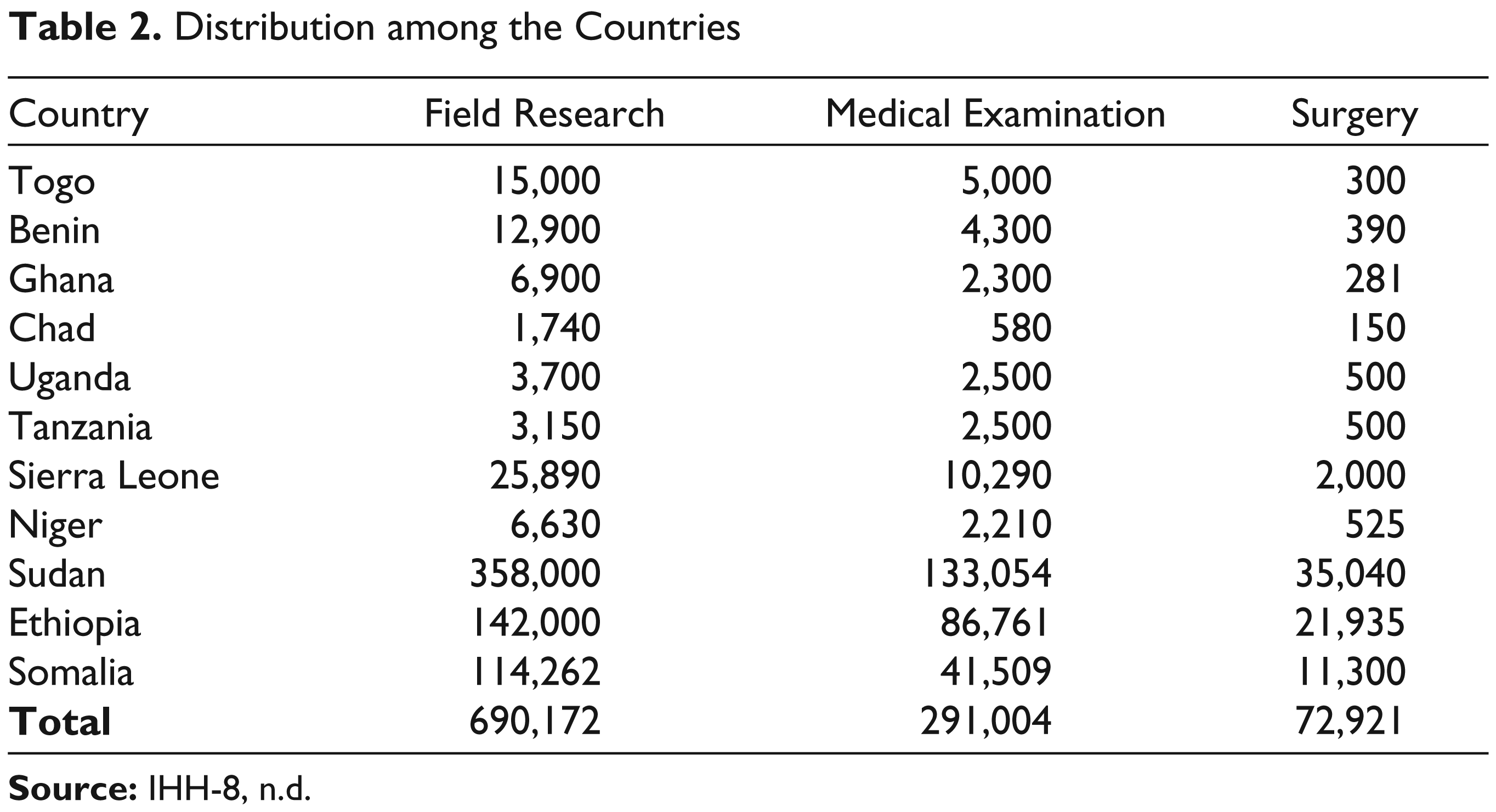
According to Table 2, 72,921 people began to use their eyes after cataract surgery operations through the financial and logistical support of the IHH. In particular, the foundation started to conduct the project of cataract surgery in Africa in 2007. Sudan is the most important country in this project due to having the existence of a large number of blind people in the country. 35,040 cataract patients have had surgery so far in Sudan. More than 30,000 cataract patients had surgeries in Ethiopia and Somalia. In addition, the IHH made a comprehensive medical research on 690,172 people to understand their health problems and 291,004 African people received medical examination with the support of the foundation. The IHH has also carried out various programmes regarding orphans in Africa, such as, building schools, providing financial support and scholarship. It opened the largest orphanage in Somalia in 2013 named as Anatolia Educational Center. There are thousands of orphans in the country due to the fact that ongoing conflict and war has created many problems in the country including the emergence of orphans.
Distribution among the Countries
The education centre consists of school and administrative buildings, a Quran course, sport halls, a mosque, a health centre, and a dining hall. Four hundred students stay in the dormitories in the centre while 1,500 students study (IHH-9, n.d.). The IHH has signed an agreement with the Islamic Development Bank and the Government of Niger in 2013 regarding the cataract project in Africa. According to the agreement, IHH will provide free eye care to cataract patients in Niger. Approximately 6,000 cataract patients in the country are expected to benefit from this project every year (IHH-10, n.d.). The foundation has carried out relief activities during the festivals of Ramadan and sacrifices in Africa. In these festivals, the foundation provides food and clothing aids to the poor. Thousands of needy people have received humanitarian assistance from the IHH during these festivals of the Muslims.
IHH has also launched campaigns against drought in East Africa. More than 12 million people in East Africa have suffered due to deep drought. Every year, thousands of people die of starvation in the region. The IHH donated €22,773,779 for the poor people in East Africa, including in Kenya, Somalia, and Ethiopia. The humanitarian relief activities in East Africa comprised delivery of water generators, delivery of tractors, meat distribution, food delivery, iftar meals distribution, medical examination and setting up educational centres. Meanwhile, the foundation donated €7,752,969 to the orphans in the region in 2011. About 2,640 orphans in Somalia, 1,010 in Ethiopia, and 50 in Djibouti received humanitarian assistance from the IHH in 2011 (IHH, 2011).
An Overview of Activities of Other Turkish NGOs in Africa
There are a number of other important Turkish NGOs that provide humanitarian relief in Africa. Cansuyu Solidarity and Charity Association, Aziz Mahmud Hudayi Foundation, Deniz Feneri Association and Doctors Worldwide are among them. These Turkish NGOs have a wide range of humanitarian relief programmes in Africa, such as drilling water wells, providing health services, orphan care and education. Aziz Mahmud Hudayi Foundation has opened more than 100 water wells in different countries in Africa such as Tanzania, Cameroon and Burkina Faso. It has a training college for teachers where 73 students study and youth centres in Tanzania. The foundation provides free education for college students, supports orphans financially and distributes food and clothing to the poor during the festivals of Ramadan and sacrifices (Rehema, n.d.). The Hudayi Foundation also runs secondary and high schools in Cameroon (Haber 7, n.d.) and Burkina Faso (Gencdergisi, n.d.). It has launched construction of a big and comprehensive educational complex in the centre of Ghana which includes a faculty, a high school, a primary school, student dormitories, health centre, mosque and administrative buildings for religious affairs. The foundation carries the project in cooperation with different partners in Turkey, including the Turkish government, Presidency of Religious Affairs of Turkey and Metropolitan Municipality of Samsun. Ten thousand people will pray at the same time in the mosque and it will be the largest mosque in the country. About 1,000 students will be able to study at the education centre at the Accra Furqan Complex. The complex is planned to be completed in 2014 (Accrafurkan, n.d.). The Aziz Mahmud Hudayi Foundation was established in Istanbul in 1985 (Aziz Mahmud Hüdayi Vakfı, n.d.). The foundation has particularly increased its humanitarian and educational activities in Africa since 2005.
The Cansuyu Association has opened 20 water wells in Chad and Cameroon and provided food and clothing aid to needy people during the festivals of Ramadan and sacrifices. The association is preparing to open more water wells in the countries where drought is very common (Cansuyu-1, n.d.). The Cansuyu Association was established in Ankara in 2005 and it operates in Turkey and abroad. The association works in 62 foreign countries to provide humanitarian relief (Cansuyu-2, n.d.). The Deniz Feneri Association operates in Ethiopia, Niger, Somalia, Sierra Leone, Mozambique, Madagascar, Congo and Ghana. 200 tonnes of food was distributed in Niger in 2005 and a health centre was opened by the association in 2007. More than 1,000 poor people get free medical examination at the health centre. It also opened an emergency assistance hospital in Somalia in 2011 (Deniz Feneri Association-1, n.d.). The Deniz Feneri Association was opened in Istanbul in 1998 and operates in 23 foreign countries (Deniz Feneri Association-2, n.d.). Doctors Worldwide, the other association, focuses on health problems of African people. It opened medical nutrition centres in Somalia and has provided tonnes of food to the needy people in Somalia, Kenya and Niger. Doctors provide free health service and care to thousands of poor people in Somalia (Doctors Worldwide, n.d.). This initiative was created in 2000 and operates in more than 30 foreign countries.
Conclusion
The role and significance of NGOs and civil society has increased significantly after the Cold War; they now play a critical role in a wide range of fields, such as education, health care, human rights, and humanitarian relief. They fill a big gap where the state fails to provide the basic services to its citizens and they also extend humanitarian assistance in the regions affected by war, conflict, poverty, earthquake, human rights abuse and diseases. Even though NGOs and civil society organisations have been influential players in resolving humanitarian problems, they have a very complex structure due to their manifold activities in vast areas.
From the establishment of Turkey to 1950, the concept of civil society had a passive meaning and a restricted role due to the dominance of the single-party system in the country. The single party in Turkey focused especially on the establishment and enforcement of the nation-state and therefore, the concept of civil society organisations remained redundant and Turkey was unable to play any constructive role in developing its society. During the period of the single party system, freedom of religion, media and human rights had been constrained. While the minority group including the military elites and the Kemalists gained economic and political power in the country, the majority of the population faced deep economic, social and political problems. Inequalities and human rights abuses have especially paralysed the development of the notion of civil society in the early years of the Republic. In 1950, with the first multiparty system and the changing political structure, the conception of civil society became very important in developing social, economic and political structures of the country. However, the military bureaucracy and the impact of the single party system restricted the emergence of a strong civil society in Turkey between 1950 and 1960. It should be underlined that there have been two important obstacles in evolving and developing civil society in Turkey. The first is the military elite, and the second is the ideology of the Kemalist Party. The development of the concept of civil society has thus depended on the level of freedom in Turkey.
The period of Turgut Ozal (1983–93) has been very important in that it helped strengthen the concept of civil society. Ozal paid attention to the increasing role of Turkish civil society organisations in resolving social, economic and political problems in the country. He particularly attempted to implement liberal policies and reduce the role of the military elite in politics but the latter had been very powerful in shaping domestic and external politics of the country. Turkish civil society organisations were developed in a limited way in this period. After the departure of Turgut Ozal, weak coalition governments, the impact of the military elite and the Kemalist Party has continued to undermine developing Turkish civil society organisations. The research shows that Turkish NGOs and civil society organisations have increased their activities when there is more freedom and political and economic stability in the country.
After 2002, Turkish NGOs and civil society organisations have more actively involved in providing humanitarian aid and activities in the region hit by war, conflict, poverty, earthquake and diseases. The main motivations behind the changing role of Turkish NGOs and civil society abroad can be summarised as follows:
The changing political structure: Weak coalition governments in Turkey had undermined social, economic and political development. After 2002, the Justice and Development Party paved the way for increasing the global role of Turkish NGOs and civil society. With political stability there has also been growing economic stability since 2002. The ruling Party helped create a dynamic structure for Turkish NGOs to play a more active role in the country and abroad. The changing economic dynamics: In the past decade, Turkish economic structure has changed significantly. It has developed its economic relations with different countries. For instance, while Turkey’s total trade with Africa was 2 billion dollars, it reached 22 billion dollars in 2012. Political stability in Turkey stimulated economic cooperation with different countries. Importantly, the national income of Turkey has also changed considerably over the past decade. While it was 230 billion dollars in 2002, it reached to 799 billion dollars in 2013. Turkish people have in recent times increased their financial support to Turkish NGOs and civil society organisations’ humanitarian activities abroad according to their increasing economic power. Social dynamics: 99 per cent of the population in Turkey is Muslim. According to Islamic religion, solidarity and help for needy people was essential. These elements of Islam construct the essence of the society and the Islamic identity of Turkish people has particularly affected peoples’ decisions towards Turkish NGOs’ humanitarian activities in Africa. Developing a global perception: Turkey has begun to take on more global responsibilities in resolving global problems and increasing its role in international organisations. For example, Turkey first became a non-permanent member of the UN Security Council in 2009–10. The growing role of Turkey in world politics encourages Turkish NGOs and civil society organisations to take more global responsibilities in Africa and in other regions.
Turkish NGOs and civil society organisations’ humanitarian relief activities in Africa play a critical role in enhancing the soft power of Turkey at the international level. There was fear before that if the Turkish governments cooperated with Turkish NGOs and civil society organisations with different identities, it would damage the Kemalist ideology, but such meaningless and visionary fear has gone with the ruling party. Since 2002, Turkey has strengthened its relations with different Turkish NGOs and civil society organisations regardless of their identities and values and encouraged them to take more responsibilities in the different regions hit by poverty, disease, war, conflict and earthquake.
The policy of Turkish NGOs in Africa, which is to provide humanitarian relief assistance to everyone regardless of religion, race, nation and segments, has strengthened the soft power of Turkey in Africa. African people have provided their support to the Turkish NGOs and civil society organisations due to their service to everyone without any discrimination and any conditions. Furthermore, Turkish NGOs have developed a complementary policy which is intended to make comprehensive projects that would reduce humanitarian problems. For instance, they do not only focus on education problems in a conflict area but also health care, agriculture and human rights and liberties. Developing a comprehensive humanitarian aid policy has made Turkish NGOs and civil society organisations stronger, transparent, humanitarian and more effective in world politics compared to other Western NGOs.