







Abstract
India’s engagement with the African Union has been one of its important partnership agreements with Africa. The India–Africa Forum Summit (IAFS) kickstarted the engagement with African countries through the African Union overtaking bilateral relations and partnerships with regional organisations. India has since then remained a unique, request and need-based partner of the African Union. The various capacity-building initiatives taken up through IAFS have shown that India has shown serious commitment to India–Africa partnership. The first three IAFS shows that India committed substantial amounts of funds through IAFS. However, in reality, it could only deliver a very small portion due to the slow implementation of projects. Only 4% of Indian grants in 2017–18 were committed to Africa which improved slightly after 2019. Subsequently, over 40% of funds were committed but implementation had been very slow. There is never a third independent party evaluation of these projects for impact assessment or to suggest a solution for implementation issues. Presently, there is an urgent need to hold the next IAFS which has been delayed for a long time now. There is a need to organise review meetings with AU on a regular basis. India made extra-ordinary efforts to get the African Union admitted in G20 at the New Delhi meeting. However, the Indian expansion of Banjul Formula for IAFS, India’s renewed focus on Global South, bureaucracy-driven implementation of partnership projects and insufficient political-level communications with AU leadership throw new challenges.
The institutionalisation of India–Africa relationship started with India’s engagement with the African Union (AU). It is crucial to highlight that India’s involvement with the continent is collaborative and predominantly shaped by the needs articulated by African nations. India asserts that its collaboration is a fusion of African developmental priorities aligning with the long-term strategies of the AU and the Agenda 2063 for Africa, coupled with India’s own development goals. With the inclusion of AU as a permanent member in G20, India is now being seen as the most reliable partner to take further the ‘Voices of the Global South’. The Indian engagement with the African continent that has been done through the AU in the past also does not show any positive outputs if we look at the numbers. Although, Indian engagement through the AU was furthered through the launch of the India–Africa Forum Summits (IAFS). But despite its sincere efforts there have been visible challenges in its engagement. India has extended almost $12.3 billion to African nations as concessional loans since the first IAFS, but what matters is how much of it has been delivered. It has been estimated that credit lines to Africa have a 40% disbursement rate which is much lower than many other partners (Mullen 2018).
Although, in the recent past, India has tried to make up for its lost time by speeding up the delivery of developmental projects in Africa and done its bit in infrastructure after its mid-term review meetings. Some of the recent projects completed by India include the Presidential office in Ghana, national assembly building in Gambia and Kosti power in Sudan (Mishra 2019). But still India has a long way to go in comparison with the other partners actively engaged in Africa. What is important is to hold these mid-term review meeting as regularly as possible.
Therefore, this article attempts to deal with the India AU relations, while discussing in detail the evolution of this partnership starting from the Bandung formula to its end. The article brings out the evolution of the AU starting from the formation of its predecessor Organisation of African Unity (OAU) and finally the adaption of AU. Another section discusses the Indian engagement with the AU where Banjul formula was followed in the beginning but it failed miserably. The India Africa Summits have been analysed in detail drawing the attention towards their achievements and challenges. The problem of Indian lines of credits and project delivery has also been discussed, finally leading to the possible areas of collaboration between India and AU.
The Formation of the OAU
OAU is the predecessor to the AU that was formed in 1963 after a long struggle by the leaders of the Pan-African movement which started in the nineteenth century as a protest of the black population against racism and their exploitation (Bujra 2002). The AU was formed in the year 2002 after the African leadership realised that OAU as an organisation was unable to achieve a number of objectives important for the newly independent African states, most of them going through political turmoil and economic deprivation. The New Economic Partnership for African Development (NEPAD) was an economic initiative taken up by AU which was aimed at recovery of African states economies. The major objectives of NEPAD have been aimed at reducing the poverty rates throughout the African continent, creating an environment where sustainable development must be promoted, integration of African countries in the world economy and pushing for gender empowerment (Akinbi and Olupayimi 2006).
The OAU was born with an objective to fight against colonialism and apartheid, and it successfully helped African countries to gain independence from colonial rulers by providing financial support (Omoiya 2005). It was an organisation that unified the African nations and could help in resolving many boundary disputes. However, OAU had its own limitations and challenges that can be classified as the following:
Inability to deal with growing political stability. The OAU always vouched for the sovereignty of nation-states and therefore believed in the non-interference in the internal affairs of other member states. This led to various governments of newly independent African countries to do whatever they wished, leading many governments to even turn dictatorial. As a result, Africa witnessed many military coups. As one can remember that it was Ethiopian emperor Haile Selassie who invited the Casablanca,
1
Monrovia
2
and Brazzaville
3
groups to Addis Ababa where OAU was established. But when he was being murdered by Colonel Mengistu Haile Mariam in 1974, none of the leaders came ahead to say anything. Kwame Nkrumah was overthrown in 1966 by General Joseph Ankrah, followed by successive coups. Sekou Toure was toppled in Guinea in 1968 (Edo and Michael Abiodun 2012). Social and economic weaknesses. At the time that OAU was formed, most of the newly independent African countries were in extremely poor conditions. It was not feasible for the countries to contribute to the organisation as they themselves relied on foreign funding. Rather, the organisation aimed at creating regional economic development communities such as Economic Community of West African States (ECOWAS) and Southern African Development Coordination Conference (SADCC) which had different goals specific to their regions (Akindele 1988).
Establishment of the AU and the Indian Engagement
With the establishment of the AU, there was new hope for the African region altogether. At the OAU summit held in Sirte, Libya in September 1999, it was decided that the AU would be established as a replacement of OAU. The evaluation of the work and constitution of the OAU was done at the summit, and the transformation to AU was agreed upon by the leaders through a resolution. This came to be known as the Sirte Declaration. It’s Constitutive Act was then adopted through a resolution in Lome, July 2000, known as the Lome Convention, which finally led to its inauguration in Durban, South Africa in July 2002 (Bujra 2002).
AU Summits have been held regularly since the time of its inception. Indian delegations have previously attended AU Summits, it wasn’t until the 2011 summit that the Indian Minister of State for External Affairs received an invitation to address its ministerial segment. These summits became significant hubs for non-African countries, offering them the chance to engage with numerous African leaders in a single venue. For India, these gatherings provided a valuable platform for engaging with foreign ministers from nations where it lacked diplomatic representation, facilitating discussions on key aspects of India’s Africa policy.
In 2005, India gained prominence during two exceptional AU summits focusing on the reform of the United Nations Security Council. Discussions centred around the Ezulwini consensus, which united Africa in advocating for a more inclusive Security Council (Mbara et al. 2021). These two regional powerhouses (Nigeria and South Africa), with their substantial economic and political clout, could have served as pivotal players in rallying support for a broader consensus on crucial issues.
Observing the diplomatic manoeuvres and power dynamics at play within the AU, India recognised the importance of participating in such forums to advance its own interests on the global stage. The AU summits provided valuable insights into regional dynamics and served as a platform for India to cultivate alliances, forge partnerships, and advance its diplomatic agenda. These interactions paved the way for the IAFS in 2008 which saw overwhelming participation from the African leadership.
During subsequent summits, India actively interacted with the Committee of Ten 4 and fostering more seamless engagements with African leaders and ministers compared to its interactions during United Nations sessions in New York. India spearheaded two significant initiatives in collaboration with the AU during its initial years. First, was the Pan-African e-Network Project (PANEP) was rolled out across 47 African nations, marking a decade of successful operation from 2009. This visionary initiative was first conceptualised by former President A. P. J. Abdul Kalam in 2004. Spearheaded by a joint committee comprising members from the African Union Commission (AUC) and India, the project was formulated and executed. PANEP aimed to bolster capacity building through tele-medicine and tele-education in Africa, thereby empowering the continent’s decision-making capabilities within the AUC itself. Among the universities providing tele-education teaching centres are Amity University, Indira Gandhi National Open University, University of Delhi, and University of Madras. Tele-medicine services are being provided by major Indian super specialty hospitals like AIIMS, Delhi (Mishra 2018).
Executing PANEP presented significant hurdles. As the first major project undertaken jointly by a partner country and the AU, it faced numerous delays and had to navigate through intricate obstacles. However, its importance cannot be overstated; it symbolised a groundbreaking collaboration with immense value for both entities. Notably, PANEP marked the AU’s most extensive endeavour outside the scope of peace and security initiatives at that time. By the year 2017, PANEP had benefitted 22,000 students and conducted at least 770 tele-medicines sessions. However, one of the most difficult challenges for this project is the lack of strong will from the African partners to allocate resources for the sustainability of the project. Given the role that AU has played in the review of the project and its proper implementation, AU will have an important role to play in the future (Mishra 2018).
A significant turning point occurred in 2006 during the Banjul summit when the AU resolved to broaden its partnerships by prioritising engagements with emerging nations, with a specific focus on India, Latin America and South Korea. This strategic decision aimed to expand upon Africa’s existing partnerships with influential entities such as Japan, the European Union, France, China and the Arab League. Notably, India emerged as the primary choice for establishing a new partnership, paving the way for the AU’s initiative to convene an India–Africa summit.
Indian Engagement Through IAFS
In the following years after 2006, the India–AU partnership became strengthened and led to the first IAFS in the year 2008. The first summit and subsequently the second IAFS held in the year 2011 were based on the Banjul formula. This meant that only 15 heads of state or government would be invited to the summit. The Banjul formula is a method devised in the city of Banjul, Gambia which refers to the method used to calculate the voting weight of member states in the AU. There are three criteria taken under consideration in this formula: population size, GDP and financial contributions to the AU budget. This ensures that the member states of the AU are provided a fair and equitable representation of member states in the decision-making process. This kind of method superseded the previous principle of ‘one country, one vote’ (Gieg 2023).
This method of AU’s collaboration with a country like India became the most preferred model for further collaborations with other emerging economies and traditional partners such as South Korea, Turkey, Russia and also the United Kingdom (African Union 2009; Ministry of Foreign Affairs, Republic of Turkiye n.d.). In fact, this model even influenced Africa’s partnership with countries like Japan, which started co-hosting its Tokyo International Conference for African Development (TICAD) along with AUC.
But the engagement of India with Africa through IAFS compelled it to focus with countries where it had least presence. For example, Indian trade with countries like Mauritius was already rising but there were other countries that had the least presence of India. But at the same time engagement through Banjul formula meant that India was engaging with countries where it had the least presence while countries where it was investing more strongly were left out due to the Banjul formula.
The First IAFS 2008: Stepping Stone
The first IAFS held in 2008 was attended by the Chairs and Director Generals of Regional Economic Communities (RECs), five founding members of the NEPAD, the chair of the Heads of State and Government implementing committee of NEPAD, the chair of the AU, the past chair of the AU, and the chairperson of the AUC. It brought together business leaders, artists, academics, editors, journalists and civil society representatives who articulated their hopes and plans for renewing the India–Africa relationship. At the end of the 2008 summit, the Delhi Declaration and the Framework for India–Africa cooperation were adopted with a goal of redefining and reinvigorating the decades-old partnership as well as the historical and civilisational links between the African continent and India. These two historic documents covered a wide range of partnerships from agriculture, trade and infrastructure to energy, science and technology, and cultural exchanges that all have the potential to transform the lives of over 2 billion people who live in India and Africa, as well as the nature of the India–Africa relationship.
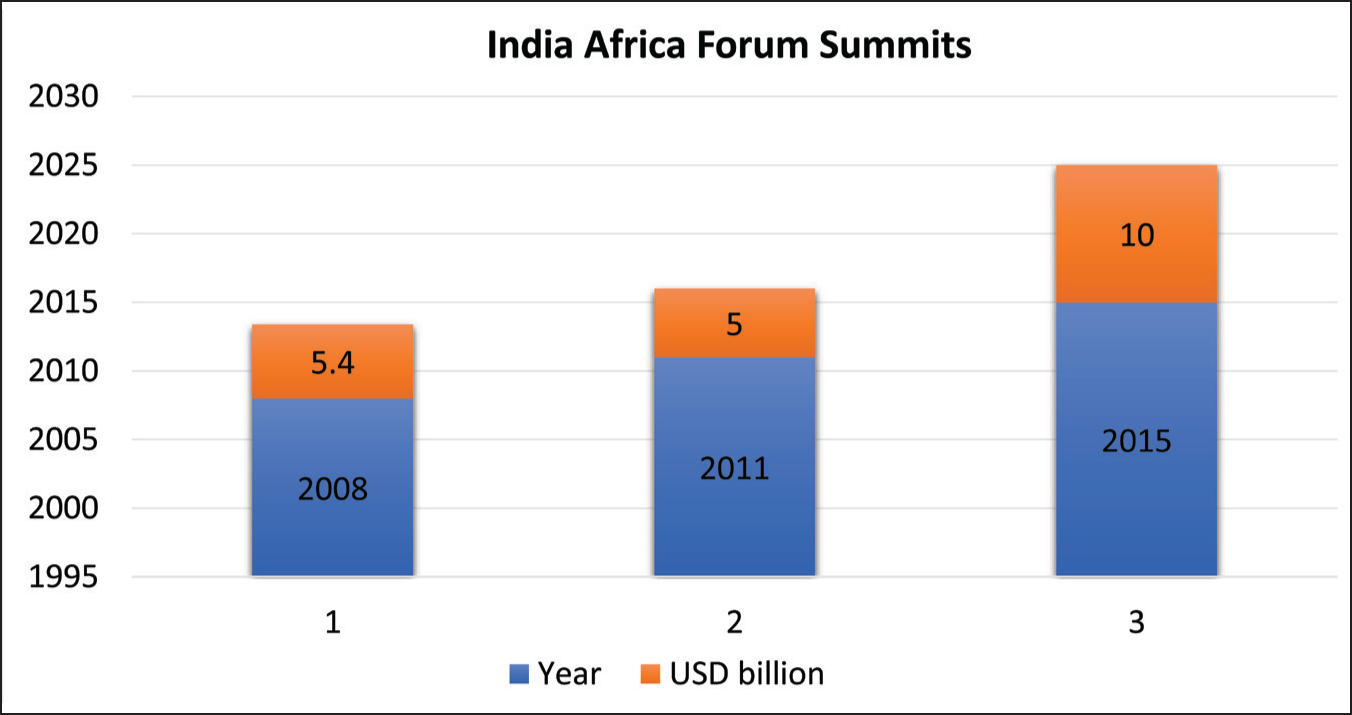
India’s previous Prime Minister Manmohan Singh asserted during this summit that by working together, the two billion plus people of India and Africa can set an example for fruitful South-South cooperation. At the Summit, India announced a series of measures that underlined its approach towards the African continent, focusing on technology transfers and human resource development. These included granting preferential market access to the 34 least developed African countries, more than doubling the lines of credit (LOC) to $5.4 billion over the next 5 years and increasing the ‘Aid to Africa’ budget by investing over $500 million in capacity building and human resource development as well as doubling trade from $25 billion to $50 billion by 2011. As per the Framework Cooperation Document, further commitments were made to support the priority areas identified in the NEPAD programme as well as to promote the development of small- and medium-scale enterprises to encourage industrialisation (Reuters 2010).
To further carry out all these commitments, India and the AU announced a Joint Action Plan, based on the Framework for Cooperation, in March 2010. The action plan sought to develop Africa’s efforts at regional integration and India’s institutional engagement with the RECs. Subsequently, India held the first-ever meeting with top officials of the RECs in New Delhi on 14–16 November 2010.
The engagement through the IAFS created a partnership which could be seen at various fronts. First level was the engagement through AUC that included the Chairperson, deputy chairperson and eight commissioners. The second and the most important is the RECs that are the tools through which the LOCs committed and the developmental projects given can be further facilitated to respective regions. The third level is through bilateral relations with African countries which depends on the historical past relationships with many countries in Africa (Dubey 2011). The LOCs given through the IAFS platform form an important component of this engagement. Recently, it was claimed by Economic Times (2023) that Africa is now the second largest recipient of LOCs from India. This is also being seen as a desperate attempt to catch up China which gives much larger sums of money to African nations. India has given credit to Mauritius for Metro Express equalling an amount of $765 million and to Tanzania for water supply in around 17 towns for a sum of $500 million.
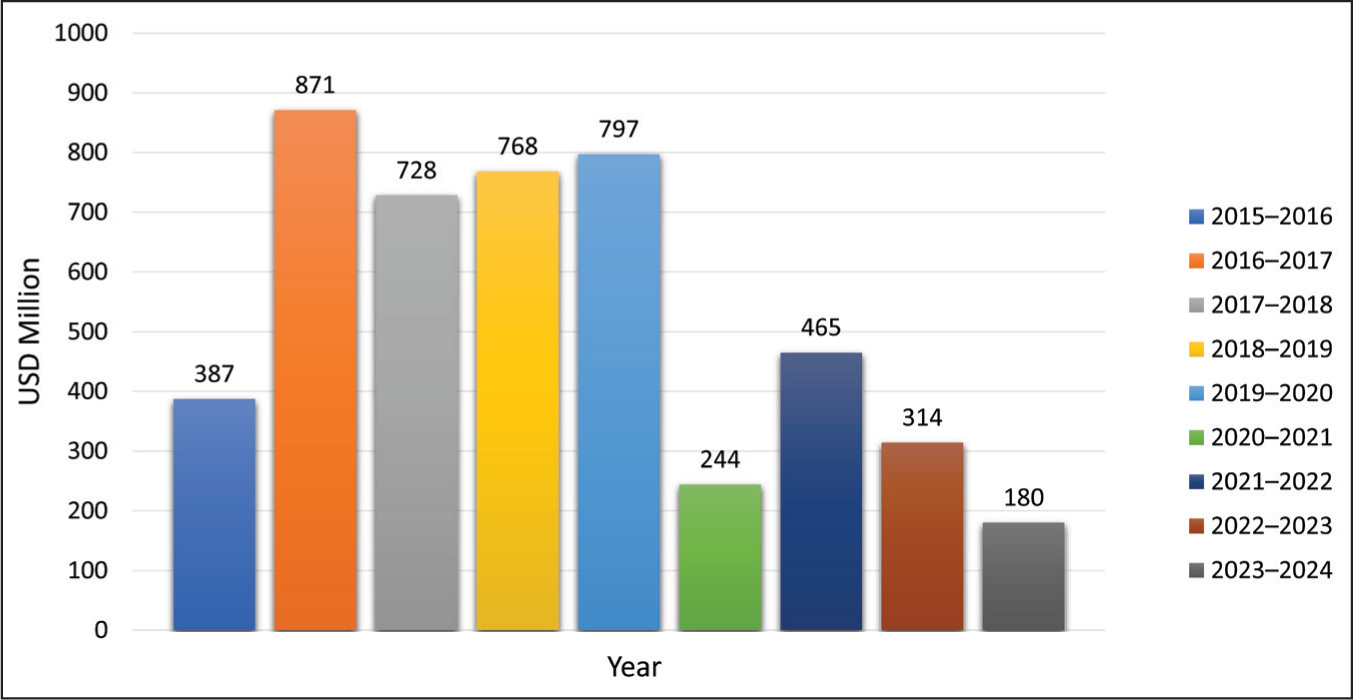
However, some agencies have claimed otherwise, for example, the data from Exim Bank quoted by The Print says that loans to the African continent have gone down since the last pandemic. As can be seen in Figure 1, the year 2018 shows that the Exim Bank loaned $768 million to Africa, while the year 2023 saw only $180 million given as loans to Africa, which shows a downfall in the lending (Krishnankutty 2024). This is also because the IAFS was not hosted after 2015.
The RECs were also known as the ‘building blocks’ of the AU. Nonetheless, the AUC failed to meet the anticipated standard of being an effective implementation partner. Its project awards on a Pan-African scale were often politically motivated rather than grounded in practical realities. Many countries and RECs lacked the motivation to fulfil their commitments, as the AUC struggled to inspire them. Successful execution of projects such as the PANEP and the IAFS initiatives occurred primarily through stronger bilateral engagements. This was because many of the traditional partners of India were left out due to the Banjul formula. Consequently, the AU’s standing as a development collaborator waned. Recognising its own shortcomings, the AU acknowledged that its intricate organisational structure and limited management capacity contributed to inefficient practices, subpar decision-making and a deficit of accountability.
The Second IAFS 2011
Following the second IAFS in Addis Ababa on 24–25 May 2011, India hoped to reinvigorate its existing engagement with Africa by adding greater depth and diversity. India was now looking to transform its relationship with the AU from one of immense political goodwill to a large functional partnership with the help of various projects like the railway line, textile cluster and weather forecasting. As it was visible that India had not been able to achieve most of its commitments by the next summit, India was keen on engaging more productively in this summit. The 2011 Summit highlighted India’s and the African continent’s common understanding of international issues (through AU) today, for example, a balanced outcome of climate change negotiations, reform of the United Nations and increased participation of developing countries in the decision-making process, international security, proliferation of nuclear weapons and so on, and also emphasised the desire of both regions to work together in their economic growth. The then Prime Minister Manmohan Singh aptly described India as a partner in Africa’s resurgence and the current PM Narendra Modi continued to strengthen the partnership further in the next summit.
During the second IAFS, India announced its $5 billion LOC to the African continent to be disbursed over the 2011–2014 period (Figure 2). In an effort to expand its footprint in Africa, India announced a partnership programme equivalent to its own annual healthcare budget, worth $5.9 billion (Ottens 2011). In addition to development projects to be provided through AU, Prime Minister Manmohan Singh also announced $700 million to build new institutions and training programmes as well as another $300 million to construct the Ethiopia–Djibouti railway line. The most difficult challenge that lies in the engagement between India and AU is the disbursal of LOCs. The $300 million given for the Ethiopia–Djibouti railway line could never be disbursed on time and later was completed by China. The Ethiopia–Djibouti railway line is an example of how a development project committed by India was being disbursed. Most of the amount committed could not be sent in time for the projects which then had to go to other partner countries.
Since capacity building has formed the core of India’s engagement with Africa, PM Singh announced the establishment of new institutions at the Pan-African level which included an India–Africa Integrated Textiles Cluster, India–Africa Centre for Medium Range Weather Forecasting and India–Africa Food Processing Cluster. In the education sector, India offered a virtual university with 10,000 scholarships and 22,000 total scholarships for African students from 2011 to 2014. There is a huge presence of African students in India who come through the scholarship programme at the Indian Council for Cultural Relations (ICCR). However, the main concern became the distribution of these grants to Africa. India has been slow on the follow-up and, out of the ₹6,000 crore of commitment, till March 2015 only 10% was utilised. Additionally, the prejudices faced by African students in India have many times led to violent attacks against them (Sikdar 2017). There was an incident of the death of a Congolese student in Delhi in 2016 which made the African Ambassadors announce at that time that African countries will not be sending any African students to India (Bhattacherjee 2016).
India has contributed significantly to the field of education and training programmes within the African continent. After setting up IIFT at Dar es Salaam, Tanzania, another IIFT was proposed for Kampala, Uganda in 2011. However, this IIFT campus could not be set up due to technical difficulties (Kundal 2024). Indian Technical and Economic Cooperation programme has provided India with some positive feedback in African countries, encouraging India to give 900 training slots to African countries for a total of 2,500 training positions from 2011 to 2014. In addition to this, India had also proposed to establish institutes for English language training, IT, entrepreneurship development and vocational training (Singh 2011).
The Third IAFS 2015
The IAFS III which took place in 2015 after the coming in of the newly elected majority BJP government brought together 41 of 54 leaders of the AU in New Delhi (Ministry of External Affairs 2015). By this time, India had realised its mistake of engagement through Banjul formula and started this summit by including all the African countries. This was the first time that India moved away from the Banjul formula and invited all the leaders of the AU. The draft of the ‘Delhi Declaration’ was debated by the African countries and was much delayed because of the disagreement among the members too. The IAFS was seen as an attempt by PM Modi to establish faith in the African countries and not just the powerful economies but all of them that they are not being ignored by India. Despite the criticism of bureaucratic red tape and cumbersome delays, India made a successful attempt to refashion their African engagement. The summit was also appreciated by the global community as a very positive step towards strengthening India–Africa relations. The presence of such a large number of African heads of the states was a message in itself (Bhatia 2015). The LOCs committed in the third summit as can be seen in Figure 2 was again a large amount, but one could get little information about the amount of money disbursed to African countries.
In 2016, the Kagame Committee headed by Paul Kagame, President of Rwanda, pushed for institutional reforms and implemented revised rules. The opinion of the committee was that AU needs to focus on its own priorities rather than the priorities of other partner states or funding agencies to AU. Therefore, granting observer status was cut down in order to make the AU Summits more meaningful. AU decided not to invite any external partners to the AU summits. This included India too, which had been a partner country for a long time. Consequently, Indian delegations ceased attending AU summits. Before this, India was a dialogue partner at the AU Summits.
Although the Indian engagement has now evolved from the first IAFS Summit till now, it is pertinent that it maintains a pan-African engagement which was not possible through the AU. Many issues of the international level need to be discussed and deliberated, and it is not possible to get the African perspective in bodies like the United Nations. The African continent is not untouched by issues such as terrorism, piracy, climate change, blue economy and solar energy and, therefore, the opinion of the African countries must be reflected in any external engagement. International Solar Alliance is an initiative that was proposed by the Indian PM Modi and was announced in the IAFS 2015. It has 120 member countries and a large number of African countries are part of it. India needs to partner more with the new initiatives focusing on particular sectors like agriculture, infrastructure, health and medicine and so on. India can also initiate cooperation through the Comprehensive Africa Agriculture Development Programme (CAADP), which was started by AU to achieve agricultural growth and poverty alleviation (Brüntrup 2011).
India’s Problem of Delivery and Implementation of Projects
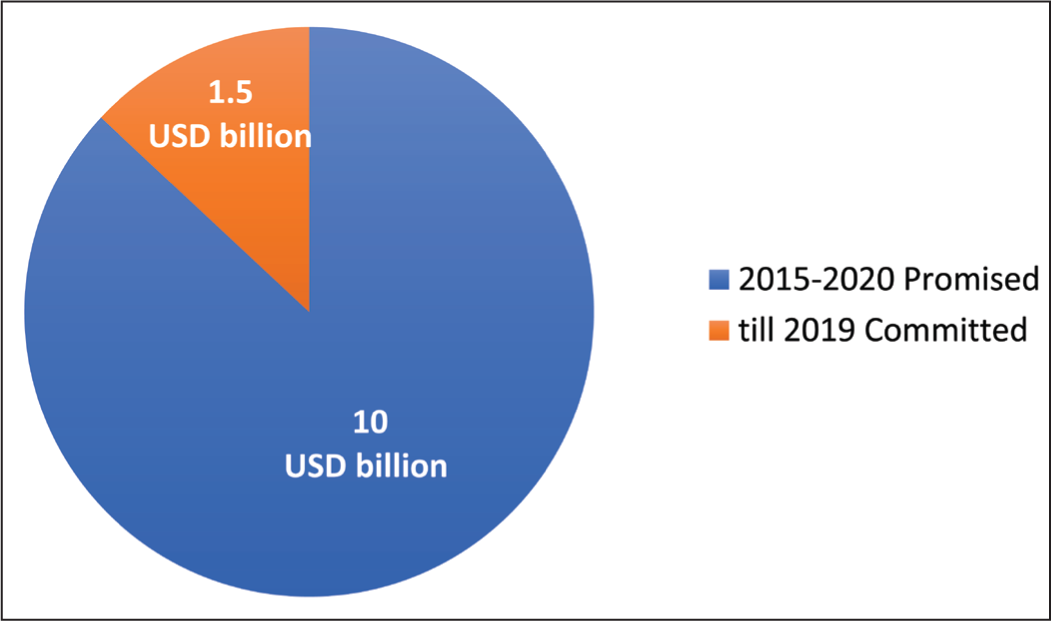
The most problematic factor when it comes to India’s partnership with Africa is its delivery. The Indian companies have a serious challenge of implementation. There are often procedural delays which lead to slow delivery of aid. If India wants to strengthen its partnership with the African continent, first, it needs to deliver its promised LOCs and, second, it must hold the next summit soon. LOCs to Africa have a disbursement rate of approximately 40%. Out of the $10 billion in credit promised between 2015 and 2020, only $1.5 billion had been committed by 2019 (Mullen 2018; see Figure 3). This means that a significant portion of the promised funds have not been allocated, and an even smaller fraction has actually been disbursed, highlighting a gap between commitments and actual financial support. This shortfall underscores the challenges in mobilising and distributing financial resources effectively within the specified timeframe (Mullen 2018). However, there were recent attempts to recover from this drawback by actively focusing on completing some of the projects. The mid-term review of the IAFS III was held in 2019 which took stock of the delivery of projects and gave a promising picture for India (Mishra 2019). But what happened after 2019 also gives a very grim picture of India’s LOCs to Africa: The Exim Bank gave only $180 million in 2023 (Krishnankutty 2024) as can be seen in Figure 1. As one looks at the LOCs given through Exim Bank, the highest was in 2016–2017 after the third IAFS and it has been declining since 2020.
Delayed by the COVID-19 pandemic, the Fourth IAFS could not be held in 2020 and has been delayed after the pandemic and India’s G20 Presidency. It is believed that India is planning to hold the next IAFS very soon with the AU in Kenya. While all the other major partners of Africa have successfully held their Summits after the pandemic, it is the need of the hour to meet all the African leaders in the IAFS and pledge for future engagement.
The India Africa Forum Summits since its establishment has promised large number of projects to African countries. However, there has been no external agency (research institute) assigned for third party evaluation of these projects. Such evaluation could bring out a clearer picture of cooperation through IAFS. One of the examples was the Ethiopia–Djibouti Railway line project for which a credit line of $300 million was committed by India, but it was later completed by China. India faced significant delays in the project: First, there were difficulties in land acquisition and then there were challenges in the acquisition and procurement of land, leading to issues with local contractors (Tarrosy and Voros 2018). Similarly, in some other power generation transmission projects in Sudan, Rwanda and Tanzania, there have been logistical challenges. A third-party evaluation can bring about significant changes in the implementation of these projects.
Opportunities and Challenges for India and AU Collaboration
The inclusion of the AU in the G20 ensured that an ‘important and valuable voice from the Global South is added to an influential institution of global governance and decision-making’ (Afreximbank and Exim India 2018). Until the inclusion of AU in G20, it was a guest international organisation, and South Africa was the only African country that got representation in the G20. The crucial juncture of the ‘Global South’ allowed the G20 leadership to empower perspectives from themselves by making recommendations for significant structural reforms. Before the 2022 G20 Bali Summit, Indonesia had already supported the notion of a permanent seat for the AU during its G20 Presidency. This proposal gained further support from other G20 members such as France, China and South Africa. However, the Bali Leadership Declaration in 2022 diverged from this initiative.
With the inclusion of the AU in the G20, it is also evident that the African countries can negotiate a support from the G20 for Agenda 2063, which has all of its aspirations aimed at the betterment of Africa as well as the world aligning its priorities with the global south (Chourasia 2023). With the help and experience of some of the G20 countries AU can accelerate the implementation of some of its flagship programmes like African Free Trade Agreement as well as its proposal to provide free movement of people within the African continent by providing an African passport, establishing African financial institutions and so on. The call for the AU to become a permanent member of the G20 must provide opportunities for the African continent and for the G20 member countries as well. This will have some areas of collaboration and cooperation between the two.
India and Africa enjoy a partnership that is based on shared values and goodwill. It is important for India to maintain that goodwill in the African countries that might work to its advantage. India has engaged with the African continent in meaningful ways, which is evident through its engagement in IAFS (Chakrabarty 2021). India has never been a traditional partner indulged in mineral extraction from Africa, as compared to other investors in the continent. It is only recently that India started looking for critical mineral resources actively in Africa, driven by its high demand in India, especially cobalt and copper, and is now in the process of signing memorandums of understanding with many African countries (Law 2024). The capacity-building initiatives taken by India have been praised throughout. What India can focus on is increasing investments through private firms in Africa to help set up some manufacturing units in Africa that can increase employment as well as negotiate better conditions for export from the African countries.
There is a need to support African financial institutions and, to do that, India can sort help from some developed G20 countries such as Japan or Germany. India already has a Duty-Free Tariff Preference with the Least Developed Countries, which was started in 2008 for the African countries. India’s trade with the AU is one of the largest after the USA, China and the UAE (Goyal 2023). The trade with Africa is also in deficit which implies that there are more imports for India than exports to Africa. The top trading partner among the AU countries is Nigeria, and there is visibly less diversity seen in the imports from Africa while some diversity can be seen in exports to African countries (Goyal 2023). There are some challenges that India faces while trading with African countries that can be addressed through the continuity of the IAFSs (Gakhar and Gokarn 2015).
The Indian permanent representative to the United Nations also highlighted in one of the speeches in May 2024 that India has always been at the forefront of supporting the voices of the African nations in multilateral organisations in order to make sure that they can raise objections to external interferences. It is this intent of India that made the inclusion of AU in the G20 a successful one. India has also been advocating for the inclusion of permanent African representation in the expanded Security Council (Economic Times 2024).
The Africa Continental Free Trade Area (AfCFTA) provides ample of opportunities for India to collaborate with the African countries at different levels. The engagement through AfCFTA would ensure that the interests of various African countries are not neglected and that there is an equitable distribution of benefits to the African countries (Gebremariam 2020). The Indian side also needs to engage the RECs more than before so that there is wide regional engagement with the African countries. Since, the adoption of the Banjul formula while engaging with the African countries all the eight RECs recognised by the African Union have been an integral part of this cooperation. India has collaborated with the Intergovernmental Authority on Development (IGAD) in the past and will be willing to do so in the future also (Ministry of External Affairs 2011).
One of the major problems with the IAFS framework is that because of its strong focus on bureaucratic and technical aspects, the IAFS may not always provide ample space for high-level political dialogue between Indian and African leaders. So, political leaders might be present, but their interactions are often formalised and confined to set agendas, leaving little room for more open-ended or strategic discussions. This also means that the bureaucracy that has a role in the implementation of projects is the one most involved here. Therefore, in a bureaucratically focused summit, there is less flexibility in addressing new or emerging political challenges. Leaders might find it difficult to discuss issues that fall outside the pre-determined agenda or to adapt to rapidly changing political landscapes.
Another challenge is the obstinate position and non-cooperative attitude of AU in finalising the mutually acceptable venue for the fourth IAFS Summit has pushed India to prioritise Global South and incorporate Africa under that wider framework. For the fourth IAFS, there was a significant disagreement between India and the AU regarding the location of the summit. The AU, wanted the summit to be held in Africa, reflecting a desire to assert its regional influence and ensure that the summit was geographically closer to its member states. The AU’s rigid stance and lack of flexibility in negotiating a venue that both parties could agree upon led to prolonged discussions and eventually reached a stalemate. This was perceived as a non-cooperative attitude by India, which sought a quicker resolution to finalise the summit arrangements.
At the same time, by broadening its strategy to the Global South, India effectively incorporated Africa into a larger framework of South-South cooperation. When India expanded its diplomatic focus to include a wider Global South strategy, it began engaging with a broader set of developing countries beyond just Africa. While this strategy aims to build solidarity among all developing nations, it can sometimes dilute the specific attention that Africa received under initiatives like the IAFS. Africa, with its 55 nations and diverse needs, requires tailored approaches. The Global South strategy, however, might promote more generalised policies that do not always align with Africa’s specific priorities, leading to a sense of neglect.
Why did India Choose to Have a Bilateral Partnership Rather than Through AU?
While India sought to engage with Africa through the AU, its strategic priorities might have shifted towards more direct bilateral engagements with individual African countries. Bilateral agreements often allow for more targeted and effective aid delivery compared to multilateral approaches. India’s engagement with Africa has been shaped by a combination of historical ties, economic interests and strategic priorities. Initially, India sought to engage with the continent as a whole through multilateral bodies like the AU, aiming to support pan-African initiatives and foster a sense of solidarity across the continent. However, over time, India’s strategic focus appeared to have shifted towards more direct bilateral engagements with individual African countries.
AU’s approach required India to navigate a wide range of interests and needs, which made it challenging to implement uniform policies or projects that could effectively address the specific needs of individual countries. While bilateral agreements allowed India to tailor its aid and development programmes to the unique circumstances of each African country. This approach enabled more effective resource allocation, better alignment with the host country’s priorities, and greater flexibility in project implementation.
With the help of bilateral agreements, India had the opportunity to build closer, more strategic partnerships with key African countries. By focusing on individual relationships, India can cultivate deeper economic, political and security ties with countries that are strategically important, such as South Africa, Nigeria, Kenya and Ethiopia. At the same time, India’s interests lie in focusing its resources on specific sectors or projects that are most relevant to the partner country while the engagement through AU didn’t allow that. For example, India has been involved in capacity-building programmes, healthcare initiatives, infrastructure development and educational exchanges in various African countries.
India’s initial approach of engaging with Africa through the AU was driven by a desire to support pan-African solidarity and development, the practical challenges of multilateral engagement, combined with the diverse needs of African countries, led to a strategic shift towards bilateralism. Through direct bilateral agreements, India has been able to deliver more targeted and effective aid, strengthen strategic partnerships and enhance its influence on the continent.
Conclusion
Therefore, one can say that collaboration between India and Africa through AU, must bring about mutual benefits, with India contributing to Africa’s development goals while also strengthening its own strategic and economic interests in the region.
What holds importance right now is proper structural changes in the process of dispersal of developmental projects to Africa. If the LOCs being announced by the PM are not going to be dispersed even after a long wait, then the whole process of IAFS summits would not become successful. Additionally, the timely organising of the fourth IAFS is also of crucial importance right now. If India really needs to catch up with other traditional as well as the new players in the African continent, it will have to hold the summit soon and show its commitment towards Africa. While providing assistance through the AU is a thing of the past, India can still provide partnership to its long-term bilateral partners and contribute to the vision and goals of the Agenda 2063.
In the past AU has been insensitive in letting India choose the projects it wanted to with its engagement partners and if it continues to do the same, India will not be able to engage successfully. India doesn’t identity itself as a donor country but always as a partner country of Africa and if it wants to go ahead with that partnership AU needs to also take into consideration the interests of India.
Therefore, unless there is more focus on political-level communications and talks in the IAFS rather than leaving it completely with the bureaucracy, there are fewer chances of seeing any positive results through this engagement. Third-party evaluation is needed to ensure that the projects are not delayed and are able to deliver what they were meant to without any hassles.
Footnotes
Declaration of Conflicting Interests
The author declared no potential conflicts of interest with respect to the research, authorship and/or publication of this article.
Funding
The author received no financial support for the research, authorship and/or publication of this article.