







Abstract
Vertical housing has been considered an effective way to provide low-income housing in many megacities. As part of an effort to implement contextual architectural design, vertical housing projects in Surabaya, East Java, Indonesia, incorporated shared kitchens and bathrooms as observed in Indonesian kampong (slum) settlements. However, the residents eventually converted their shared kitchen spaces to other uses and constructed kitchens in their individual units. This research study investigated the nature of and reasons for such transformations through quantitative and qualitative data collection among residents of three vertical housing projects in Surabaya. We found that disputes over upkeep and rules of use, along with perceived invasions of privacy, precipitated the abandonment of shared kitchens. Residents could not retrofit their shared bathrooms for structural reasons, but they renegotiated a payment system (based on flat fees rather than actual usage) that they considered unfair. Interviews revealed significant differences in implementation between the shared facilities in vertical housing and the voluntary shared arrangements in the kampongs. The facility and management modifications that occurred in vertical housing, which applied bottom-up contextual design by considering users’ needs and sensitivities, indicate the complexity of applying a contextual design process into practice.
Introduction
The shortage of affordable housing is perhaps the greatest obstacle to urban development and quality of life, and rapid population growth in urban areas around the world is further exacerbating this problem. The limited availability of open urban land and soaring real-estate prices lead to a proliferation of slum settlements, which often become the only viable option for low-income urban residents, offering a severely degraded quality of life.
In response to this problem, many governments have turned to a solution sometimes called vertical housing, adapting an approach that was initially designed to overcome extreme housing shortages after World War II in Europe and the United States (Rowlands et al., 2009). The design was based on a typo-morphological approach (Petroccioli, 1998) so as to maximize efficiency yet remain suitable for users’ basic needs (Leupen et al., 1997) and provide a basis for the development of new forms (Gulgonen & Laisney, 1982). The resulting design is highly generalized, technically straightforward and easy to implement quickly in various locations (Finlay, 2011; Kronenburg, 2007).
Although this approach makes sense in theory, numerous problems can impede its practical use. First, attempting to transfer a housing method from one context to a very different one—in this case, from highly developed to less developed countries—can create new challenges (Lawrence, 1982). For example, Rebano-Edwards (2007) noted the problem of technological capacity, as developing countries may not have sufficient supporting infrastructure. Meanwhile, Sousa and Quarter (2004) identified the lack of end user involvement in the design process as an important contributor to the inadequacy of this approach. Similarly, Chokor (2005) emphasized that various factors can be overlooked as this programme adopts colonial design concepts, standards and planning regulations that may not be compatible with the sociocultural context of the present end user. These researchers have argued that neglecting such factors can lead to poor results, from abandonment or illegal transformation of units to wholesale rejection of the programme.
Douglass (1991) expressed related sentiments, contending that the organization and operation of a home cannot be regulated by the government, because it is dynamically orchestrated through mutual consultation and negotiation among household members and neighbours. Arguments like those of Douglass have reinforced a profound recognition that a house is an artefact and not simply bricks and mortar (Emmitt & Gorse, 2005), as the end users have their own spatial ‘laws’ or code by which they arrange their living spaces (Berenstein, quoted in Fiori et al., 2001, pp. 28–30).
Research Aim
Modern vertical housing designs have adopted one aspect of living that is typical of slum settlements: shared common facilities. Erman’s (1997) research in Turkey demonstrated that such facilities can play a vital role in the emergence of a spirit of mutual sharing among residents. The sharing, mutual support and close neighbourly relations that can result from living in close proximity to and sharing facilities with people who have similar customs and backgrounds contrasts with the individualistic orientation that has become widespread in modern society. However, in such a tightly connected neighbourhood, occupants may also engage in illegal transformations of their units to fulfil spatial needs that are otherwise not accommodated (Mohit et al., 2010; Rapoport, 2005).
In the late nineteenth century, vertical housing with shared facilities was considered an acceptable way of providing accommodations amidst escalating urbanization in North America (Harder Community Research, 2015). Most residents of such high-density settlements share a communal bathroom and kitchen (Grant, 2007). This tendency has been confirmed by numerous studies around the world, such as those of Nguluma (2003) in Dar-es-Salaam, Tanzania; Oluwafemi (2010) in Lagos, Nigeria; Poulsen (2010) in Johannesburg, South Africa; Kassa (2014) in Dire Dawa City, Ethiopia; and Melesse (2015) in Addis Ababa, Ethiopia. In her study in Sao Paulo, Brazil, Opalach (1997) argued that the use of communal bathrooms and kitchens was necessitated by the very small size of slum houses. Dealing with adversities and inconveniences of this type has encouraged community spirit through mutual help and sharing among slum residents (Simon et al., 2013), who collaborate in constructing and maintaining these communal facilities (Sohail & Mack, 2011).
In Indonesia, to reduce the construction and maintenance costs of vertical housing, individual unit sizes are just 18–24 m2. In this setting, it was considered appropriate to provide shared facilities, as has been customary in traditional Indonesian kampong settlements, for vertical housing residents, who were typically displaced by government closure of a kampong. In the case of several such complexes in the city of Surabaya, such as Penjaringan Sari, Sombo and Dupak, each bathroom is designated to be shared by two or three households, who are also obligated to maintain its cleanliness, as stipulated by the Indonesian Ministry of Public Works (MPW) through its Regulation 60/1992. Additionally, all households on each floor are entitled to utilize the communal kitchen but are also required to maintain it according to the rules developed by the community.
Zubaidi (1994), who studied several vertical housing complexes in Jakarta, discovered a difference in the level of social responsibility for maintaining communal facilities between kampong settlements and vertical housing. Studies by Hendratno (2000) at the Kemayoran vertical housing project, Jakarta, and by Ananta (2006) at the Cigugur complex, Bandung, suggested that the main challenge for low-income people seeking to live comfortably in vertical housing is the difficulty of maintaining both communal solidarity and individual privacy. Unfortunately, these two studies did not explain why these units were abandoned or why there was a distinction between kampongs and vertical housing with regard to taking responsibility for facility upkeep. Peponis and Wineman (in Bechtel & Churchman, 2002) argued that the pervasive effects of the spatial structure of environments upon behaviour are indirect and cannot be associated deterministically with design attributes. This insight suggests that the reasons for abandonment of some vertical housing facilities may go beyond issues of physical design.
Darmiwati (2000), who studied the sharing of space in Surabaya vertical housing, indicated that even well-designed shared kitchens and bathrooms did not perform as expected, despite their physical similarities with such facilities in kampong settlements. According to Douglass (1991) and Emmitt and Gorse (2005), the failure of these infrastructure projects indicates the limitations of the typo-morphological design approach, which cannot completely address the spatial needs and desires of end users.
The present study seeks to identify and explain the factors that have led to the abandonment of shared facilities in the context of vertical housing projects.
Methodology
Research Location
Surabaya city is one of the most urbanized areas in Indonesia, with 3.2 million people residing in an area of 326.21 km2. According to the Central Statistics Bureau of East Java Province (2015), the population density of Surabaya increased from 8,246 people/km2 in 2004 to 9,793 people/km2 in 2014. Consequently, vertical housing has become a pivotal programme in the city’s response to increasing housing demands. Since 1983, Surabaya City has developed 20 low-rise complexes to shelter approximately 3,500 residents in 78 buildings. In the upcoming years, the city government proposes to undertake similar projects occupying 78 more buildings in 11 different locations, which would house a total of approximately 3,700 residents.
Vertical housing standards in Indonesia have evolved through three phases since 1983. First, in the 1980s and early 1990s, communal facilities were placed at both ends of a double-loaded corridor system. The second type was piloted from the mid-1990s to the mid-2000s; during this period, the shared facilities were diminished in size and replaced by individual facilities within each unit. Finally, since the mid-2000s the double-loaded corridor system has been replaced by single-loaded corridors, to maximize the natural lighting and ventilation for every unit as well as interaction among residents.
According to the Land and Building Management Agency of Surabaya, the newer types of housing have experienced more maintenance and technical problems than the buildings with shared facilities, because of leaks from the individual bathrooms and kitchens. Since these structures are targeted at low-income residents, vertical housing designs with the least maintenance costs are the most economically feasible option. However, the idea of communal kitchen facilities has become obsolete, as the shared facilities, where they existed, have been transformed by residents to fulfil other functions.
In Surabaya, the Dupak, Sombo and Penjaringan Sari vertical housing projects were built using the earliest type of design. These three were selected as sites for the present study because of the physical similarities in their shared facilities, which limit the introduction of biases into the analysis. All the units are 18 m2 in size, with common kitchen and bathroom facilities located on each floor. Dupak was built in 1992 and consists of six buildings with 150 units in a three-storey building. Sombo, built in 1993, is a four-storey building with 10 buildings totalling 600 units. Penjaringan Sari, also constructed in 1993, is another four-storey building with 240 units in six buildings.
Research Method and Respondents
Rapoport (2005) noted that housing design research cannot be restricted to only quantifiable dimensions, such as the spatial or physical characteristics of design solutions but must encompass context-relevant social processes. Therefore, it is important for housing developments to respond appropriately to contextual circumstances, needs and limitations and to societal desires rather than simply to established design ideals. Consequently, research on such projects must obtain context-relevant empirical evidence (Kohler & Hassler, 2002), by observing how people use designed artefacts to anticipate and address their real and perceived needs (Vischer, 2008). In this research, we adopted a case study, mixed-method approach, combining qualitative and quantitative methods in our data collection, analysis and interpretation.
According to Major Regulation 86/2008 on Surabaya land and building management, these vertical housing units were designated for displaced residents within the area who could not afford a house and who earned a monthly income below the established minimum monthly subsistence income for Surabaya. However, over the years, migrants have moved into these complexes because of loose ownership regulations that permitted asset transfer in the early years of occupancy.
The primary data were gathered from 140 residents who agreed to participate in the study, including 60 from Dupak, 50 from Sombo and 30 from Penjaringan Sari. The sample contained equal numbers of originally displaced residents and migrants. Distinguishing between these two groups is important, because the reasons for the transformation of common facilities may differ depending on the respondents’ backgrounds or their familiarity with shared facilities. The respondents were randomly selected so as to represent the diversity of residents of the complex with regard to their occupation, monthly income and status prior to moving in.
Semi-structured interviews based on an interview protocol were used as data gathering tools to enable an understanding of the ‘what’ and ‘why’ dimensions of user requirements (Bray, 2002). The protocol focused on (a) residents’ characteristics, including sex, status in the household, level of education, income and length of stay; (b) how their facilities were transformed; and (c) the reasons for the transformation. The interview transcripts enabled us to uncover themes and then classify them into categories (Ryan & Bernard, 2003). We employed the in-vivo coding system, which relies on the specific vocabulary used by respondents to create a theoretical framework (Glaser, 1978). The in-vivo codes were tabulated, as a basis for the crosstab analysis, to understand the types of transformations that occurred and the reasons for their occurrence.
The Building Management Unit responsible for each location, as a representative of city government, was also interviewed to obtain information on their awareness and authorization of the facility transformations that took place. We engaged in triangulation to increase the reliability and validity of the findings (Mohammadi, 2010) by holding follow-up discussions with the respondents two months after the initial interviews.
Findings
General Economic Condition of Vertical Housing Inhabitants
Among the 70 respondents who moved into vertical housing as displaced residents, self-employment was the leading occupation category (41.43%), followed by retirees (30.00%), employees of private businesses (21.43%) and civil servants (7.14%) (Table 1). With regard to monthly income, most of the respondents in this group (55.71%) received less than $150 USD per month from their occupation.
Monthly Income of Households by the Original Status of Residents and Occupation of Head of Household
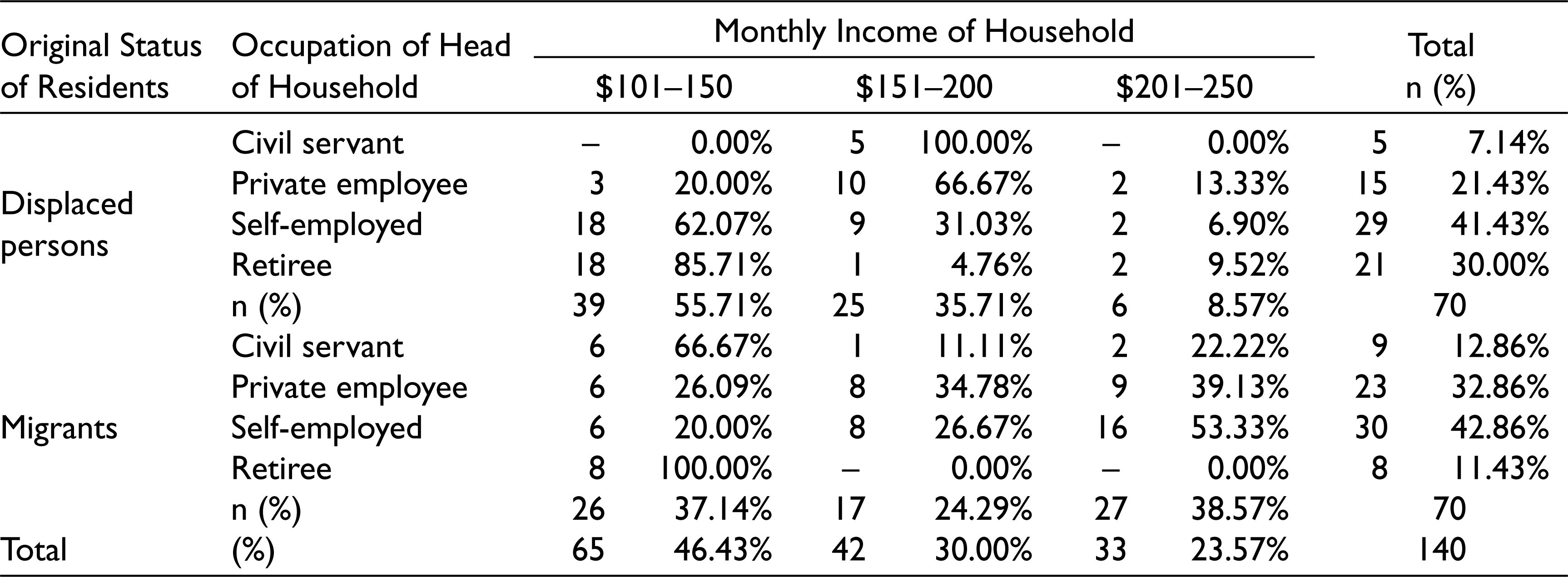
Among the migrant respondents, the breakdown of occupations was slightly different. Although the self-employed were still the largest category (42.86%), private employment was second at 32.86 per cent, followed by civil servants (12.86%) and retirees (11.43%). A substantial proportion (38.57%) of the migrants earned more than $200 USD per month, with 37.14 per cent earning less than $150 and 24.29 per cent between $150 and $200. In each occupational category, the migrants had a higher average income than the displaced group, with the exception of the retirees in each group, who had comparable incomes.
For the displaced residents, proximity to the workplace was most frequently cited (44.29%) as the primary reason for their choice of residence, surpassing affordable price (35.71%) and nearness to public facilities (20.00%). The migrant group gave similar answers to this question, as shown in Table 2. The results indicate that proximity to work, not affordability, must be recognized as the top priority in this population’s housing decisions.
Residents’ Length of Stay and Reasons for Selecting Their Residential Location
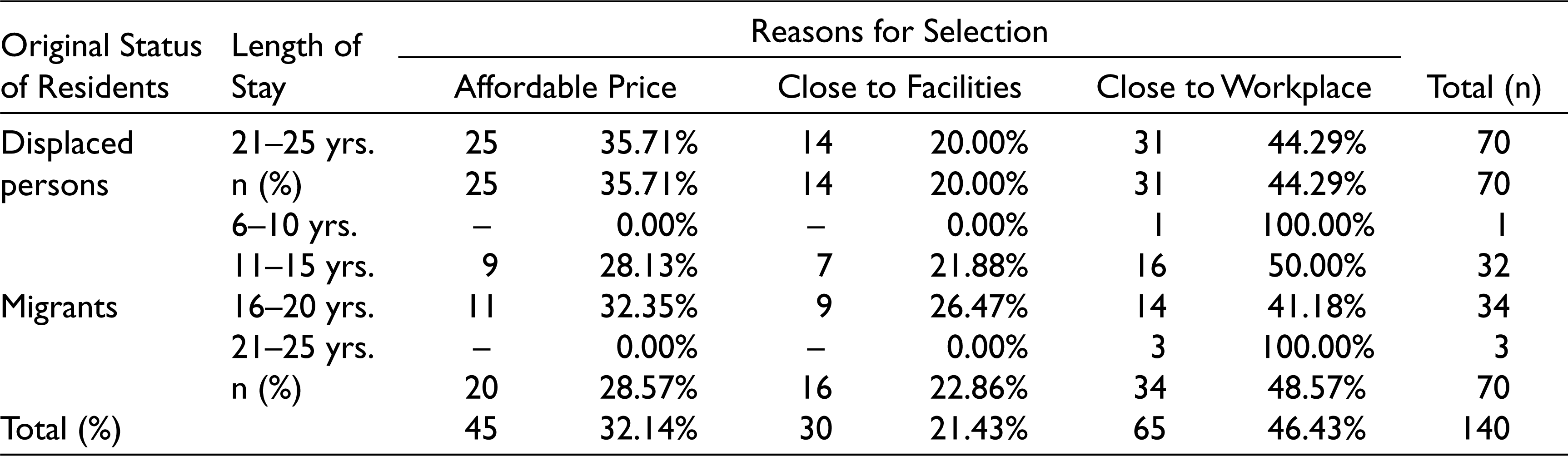
According to the respondents, many kampong settlements offer lower housing costs or rental prices but are more distant from their workplace and public facilities. The cost of travelling from the kampongs to those destinations is seen as outweighing the lower housing cost. Nonetheless, the average rent price in vertical housing ($20 USD per month, excluding water and electricity) is also quite affordable. Therefore, location and rental costs combine to make all three vertical housing complexes suitable for their residents’ needs.
Reasons for Sharing Common Facilities
The residents’ general economic condition indicates their low financial capacity to maintain the buildings and facilities. Therefore, the initial design was intended to reduce building operation costs.
One effective way to reduce operation costs is to reduce the building size, including unit size. The first prototype provided units of 18 m2 in size to accommodate as many units in the building while keeping building costs low. With an average family size of four, the expected density of each unit was approximately 4.50 m2 per person. We found that 61 per cent of all households, regardless of their background, occupied fewer than 4.50 m2 per person on each unit.
The vertical housing concept was intended to solve problems for both the developer (by enabling efficient, low-cost production) and the residents (by giving them affordable housing in an otherwise expensive city centre). Although those promises have been fulfilled, unexpected issues related to sharing a kitchen and bathroom emerged as a major source of conflict among the residents. All respondents acknowledged having had at least one conflict with a fellow resident regarding the use of the shared kitchen and bathroom. As a result of these conflicts, the users have gradually transformed their formerly shared facilities over time.
Issues Related to Sharing a Kitchen
The sharing of kitchen facilities unexpectedly ignited conflicts among residents, even though this is apparently a common practice in kampong settlements. As shown in Table 3 (and similar to the bathroom issues discussed in the next section), upkeep (46%) was the most common complaint. Even though the kitchens themselves were arranged efficiently, failure to clean up or properly dispose of leftover items can easily become a source of conflict. Especially when families have babies or multiple children, the need for kitchen time escalates and the attention given to infants (as well as their messy behaviour) tends to compromise cleanliness, thereby infringing on the interests of other users.
Issues Related to Sharing a Kitchen, by Original Status of Residents and Monthly Income at Each Research Location
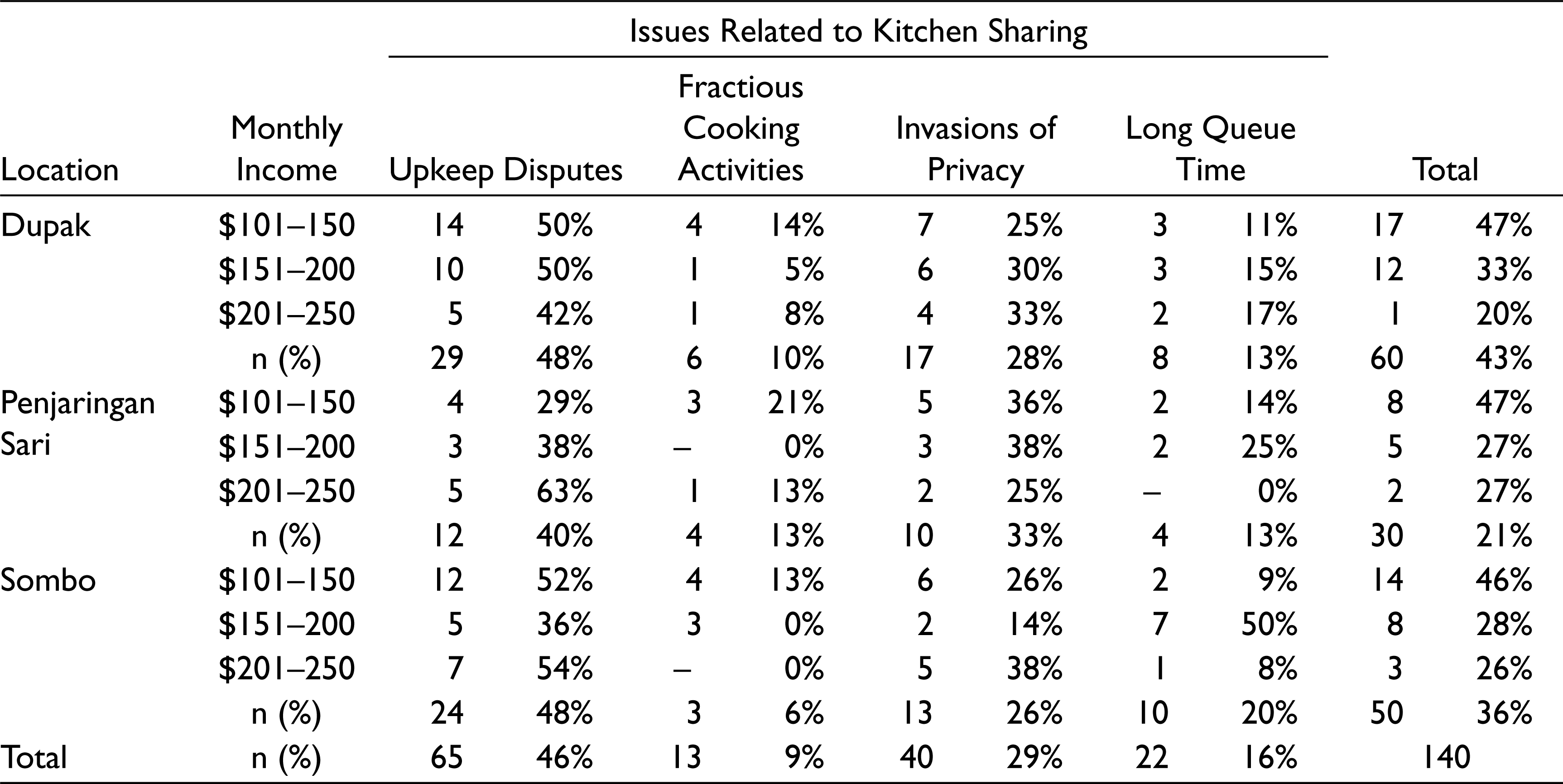
The second most frequently cited issue was privacy (29%). The types of food and ingredients that a family uses are seen as a reflection of that family’s income. As a result, cooking in a public space becomes a way of revealing a household’s welfare and financial capacity as well as the social status of household members, especially the household head.
Additionally, the various types of food used can require long or unpredictable preparation times and thus force others to queue up for kitchen space; 16 per cent of respondents cited this as their leading problem. Users sometimes lost their patience while waiting to fulfil their immediate kitchen needs, thereby creating conflict. Finally, having to move one’s cooking utensils frequently (cited by 9% of respondents) was considered an inefficient and physically burdensome task. Moreover, after some disputes over the sharing of gas, which could pose a fire risk, some users opted to bring their own gas tube to the kitchen to avoid conflict, adding further to the inefficiency of kitchen sharing.
From our interviews, we learned that sharing of kitchen space is commonly practised in kampong settlements, but on a voluntary rather than a mandatory basis. Kampong residents who choose to share their kitchen space and cook foods with their neighbours still control the use of the kitchen and their privacy. The placement of kitchen fixtures is decided by the residence’s owners, and the neighbours who share the space must comply with the rules of use, which can be imposed by the owners or mutually agreed upon. The arrangement typically includes sharing of costs for utilities and the garbage disposal system. Furthermore, participation is flexible rather than permanent, in that neighbours can drop out of the arrangement if they wish.
This description of kitchen sharing in kampongs illustrates the considerable differences in management between facilities with apparently similar characteristics. The mismatch has resulted in major transformations of shared facilities in vertical housing to align more closely with common practices of space management.
Issues Related to Sharing a Bathroom
In all research locations, each bathroom is designated to be used and maintained by two or three households. The groupings are formed by the residents themselves. The government, as building owner and manager, collects a monthly fee of $15 USD per household for water usage and maintenance. Initially, the flat rate was considered the fairest feasible approach, since tracking individual households’ water usage is difficult. However, later this cost-sharing arrangement emerged as a latent source of conflict. In fact, as Table 4 shows, the flat fee was the leading concern among respondents (cited by 65.71%) regardless of the prior living status of a households or its average monthly income.
Issues Related to Sharing a Bathroom, by Monthly Income at Each Research Location
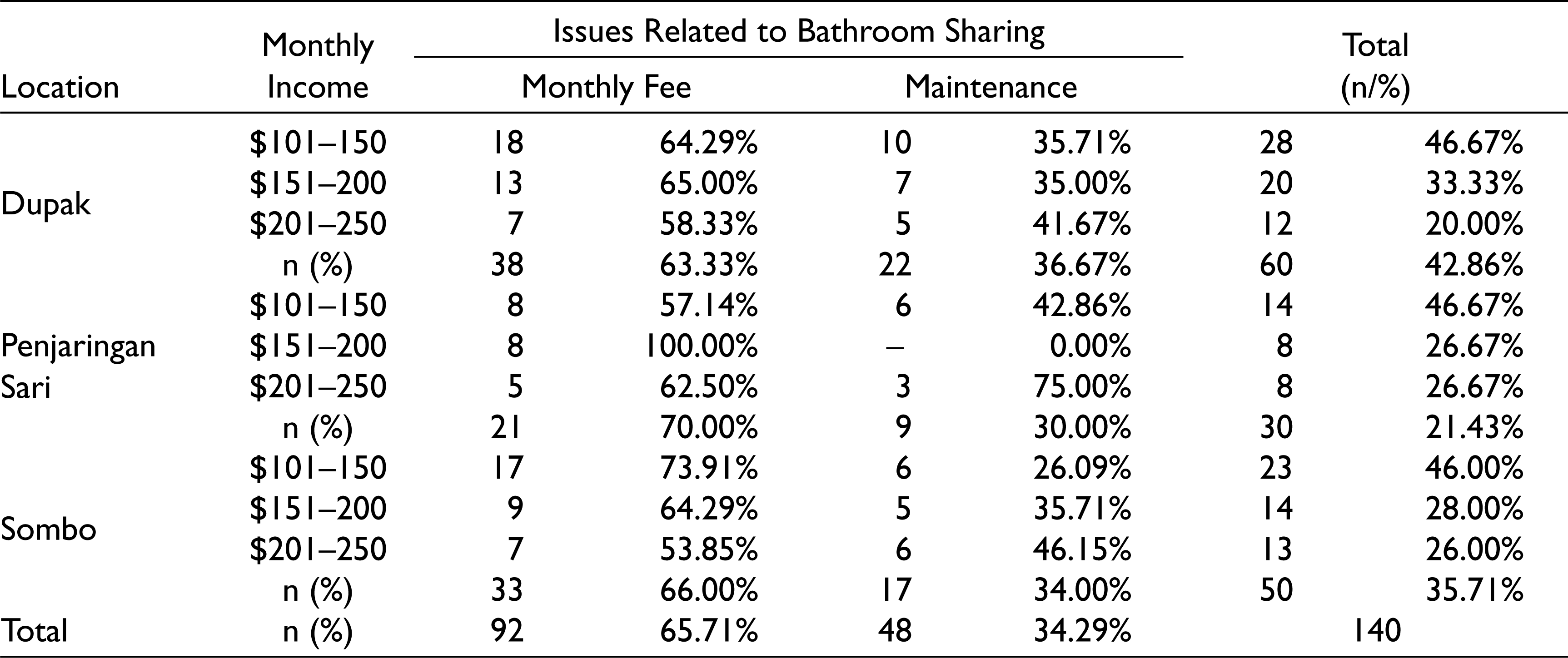
The residents reasoned that the labour they invested in maintaining their bathroom should be counted towards their monthly fee due to their low income. This system usually worked in the context of a kampong settlement, where helping to clean the bathroom became an alternative payment system for those who could not afford the monthly fee. The flat fee affects monthly budget planning and often places a financial strain on residents. In the kampong system, residents could avoid paying money for building and maintenance fees, because their labour was acceptable as an alternative form of payment. Additionally, the amount collected was based on usage; families with more members paid a higher amount than other families since they had higher water usage. To users, this is a fairer approach than imposing a flat fee.
Again, comparing the shared bathrooms in vertical housing to those in the kampong settlement reveals different kinds of systems underlying similar physical structures. The vertical housing system was determined by the city government as the building owner, whereas the kampong system was decided by the residents who turned it into a community-owned facility. Furthermore, vertical housing residents usually address maintenance issues themselves, since city government response is always slow because of budgetary limitations and bureaucracy, as the city government officials themselves admitted. Therefore, from the residents’ perspective, it is rational for them to demand that their labour be counted towards the monthly fee. This unresolved demand frequently arouses conflicts among residents during maintenance activities, especially when people attempt to determine who was responsible for causing damage.
Transformations of Common Facilities
At all three vertical housing projects, the communal kitchen on every floor has been abandoned and transformed into communal storage, laundry drying space or even bicycle parking. Problems with self-management of the communal kitchens were the main reason for abandonment. However, the lack of space for storing belongings, appropriate drying space or secure bicycle storage became another motivation driving these transformations. Consequently, the city representatives responsible for building management had no choice other than to accommodate these transformations so as to avoid escalating conflict among residents.
The huge open area surrounding the shared kitchen was designed to prevent the odours and smoke generated by cooking from travelling through the building. This physical feature has made the former kitchen an attractive place to dry their laundry (as Table 5 shows, 42.86% of the respondents said that their transformations provided a place for drying clothes), as the sunlight and wind entering the space quicken the drying process and as there is very little space for drying clothes inside the units. In 35.71 per cent of responses, the strategically positioned kitchen was slowly transformed into a place for meetings and community gatherings. Also, the large space has also permitted some residents (21.43%) to store their surplus belongings here. On some floors of all three projects, the shared kitchens were transformed into a community bicycle garage, as the available amount of parking space has been overwhelmed by the increasing number of bicycles.
Transformations of Shared Kitchens

Most respondents indicated that they were able, on their own, to construct an individual kitchen inside their unit. Due to the limited unit size, they built an additional cantilevered extension to accommodate their food preparation activities. Even though this work consumes a significant amount of household expenditure and space, it was regarded as the only solution to avoid unending conflict with neighbours. On a few floors where some residents (especially retirees) considered constructing their own kitchen unaffordable, some shared kitchen space was preserved.
Although the sharing of bathrooms has resulted in numerous conflicts among the residents, this arrangement cannot be transformed due to technical barriers. Constructing individual bathrooms inside each unit would be cost-prohibitive due to the complex building utilities and construction systems, which greatly limit retrofitting options. The government’s management unit does not allow bathroom renovations but does permit residents to change how their fees are collected. As a result, the flat fee for bathroom usage has been replaced by a fee based on frequency of used, which is deposited with the management on a monthly basis; any excess amount is reserved for maintenance purposes. This modification allows the management to shift from directly billing each individual household to a communal monthly charge, which is coordinated by the Head of Neighbourhood Association (NA). The new system has gradually improved bathroom facility management and reduced the number of conflicts among residents.
According to existing regulations such as MPW regulation 5/2007, the spatial transformation of vertical housing is considered an illegal act that should be prevented or punished by the city government as building owner. However, vertical housing management has chosen to permit kitchen transformations, in view of the space management issues that have arisen, to prevent conflict among residents. These changes were approved on the condition that residents would maintain friendly social relationships and avoid creating structural collapse hazards to the building. This policy illustrates the government’s flexibility in adjusting building regulations to meet the residents’ immediate needs and preserve social harmony, provided that building safety is not compromised.
Discussion
Limits of Place Making in Planned Architecture
The urgent need for mass housing in the 1980s in Indonesia, combined with limited budgets and the proliferation of slum settlements, called for a creative and effective design solution. The idea of having lower-income citizens share bathrooms and kitchens was a realistic solution at the time. It enabled the state to shelter large number of its citizens in a compact housing complex that was affordable yet still liveable. Not only did this approach help to minimize upfront investments in construction and land acquisition, but it also aimed to reduce resident households’ maintenance expenditures as well as to foster social cohesion among residents.
The establishment of shared kitchens and bathrooms in vertical housing was inspired by the existing practice of low-income residents within kampong settlements. The government sought to provide a new housing system well suited to the way of life of residents impacted by a kampong eviction. This design approach was deemed a best practice resulting from a contextual design process. However, the approach encountered unexpected difficulties, which frequently aroused conflicts among the projects’ residents. As our study results show, concerns about the shared spatial arrangements were prevalent among all residents regardless of their prior living status, household head’s occupation or monthly income, indicating the widespread nature of the problems.
In all research locations, residents perceived the established flat fee for water usage as unfair because of the unequal use of bathrooms. Even though the city attempted to provide a sufficient number of bathrooms for all residents along with equal rights and obligations, the residents had a different conception of fairness. According to them, it is unfair for everyone to pay the same monthly fee despite households’ unequal use of bathroom facilities and water.
Furthermore, the flat fee system also prevented residents from paying by an alternative method, such as providing labour for maintenance. The frequently long response times to facility malfunctions by management have reinforced residents’ belief that sweat equity should be compensated through a reduction of the water usage fee. Residents’ own labour, in the form of collecting needed materials and performing maintenance work on their own, has saved the facility management money; therefore, it is logical for residents to demand that their labour be recognized as an alternative means of paying their water usage fee, especially when a particular resident cannot meet his or her financial obligation due to economic constraints.
Similar problems with shared kitchen facilities arose at all research locations. The main causes of conflicts were disputes about upkeep (due largely to different standards among residents), invasions of privacy related to food preparation activity, long queue times for users and the difficulty of sharing and transporting cooking equipment. These problems were not anticipated when the government implemented what it considered simply an adaptation of residents’ common practice in their previous settlement; accordingly, they emerged as serious and unexpected issues in residents’ everyday lives.
This condition indicates a shortcoming in the adaptation of the shared facilities from the kampong settlements to vertical housing, as the planners lacked a comprehensive understanding of kampong residents’ domestic activities. The success of similar facility sharing arrangements in kampong settlements is due largely to the voluntary nature of kampong systems, which relied on long-term mutual agreements among residents. This reliance on voluntary, mutual agreements differs markedly from how vertical housing is managed.
The failure of the shared facilities in vertical housing demonstrates that the physical forms of such facilities are a result of ongoing contestations, negotiations and formulations of shared space management that occur among residents. The exclusion of these ever-evolving processes has hampered the effectiveness of the newly constructed shared facilities, even when they are physically quite similar to those in the kampong. This result has affirmed the argument presented by Douglass (1991), who emphasized that domestic activities cannot be rigidly regulated by the government because they are a result of ever-changing individual adaptations to household and social conditions. The enforcement of spatial rules governing families’ domestic activities without appropriate adaptation to the actual social condition of residents will result in failure.
Elaboration of the Residents’ Spatial Code
Our research found that the transformation of shared kitchens was inevitable. At all three vertical housing projects, the shared kitchens were transformed into socially acceptable shared facilities, such as space for drying clothes, a meeting place for residents or communal storage. This transformation helped the city government deal with potential conflicts among residents as well as helping residents to improve their life experience in vertical housing.
Although the shared bathroom facilities were not physically transformed, the previously enforced formal management process imposed by city government has gradually change to a bottom-up form of management proposed by the residents. The Head of NA is now responsible for collecting resident fees based on frequency of usage, as well as for making appropriate payments to the city government while reserving any excess for maintenance and unexpected repairs. This system also allows labour as an alternative contribution instead of money if residents cannot pay the monthly fee; any deficit in one month can be covered by the amount saved in previous months. This flexibility allows the facility sharing to function in a way that is more responsive to residents’ needs. In this case, the previous, formal means of spatial management has been vernacularized through its elaboration by a change proposed by residents, and the change has lessened the likelihood of conflict among residents.
This finding illustrates the complexity of contextual place making through social consensus among users. Two identically constructed built environments will not necessarily function in the same way. Such an environment cannot work as intended without a complete elaboration of a bottom-up consensus among users. When this step is neglected, users may well carry out a spatial transformation to accommodate their own needs.
Lessons Learned and Recommendations
Typological design methods focus on the similar characteristics of physical form. However, this approach fails to recognize the distinctive aspects of a particular spatial context that take a given physical form and make it work according to the prevailing social system. The adoption of communal kitchens and bathrooms from kampong settlements to vertical housing downplayed the complexity of contextual design. As a result, failure was virtually inevitable, as the users gradually abandoned the communal kitchens and altered the function and physical form of shared facilities to meet their immediate needs, based on a mutual agreement among them.
Contextual design goes beyond physical, typological association and classification. Housing as a living place is formulated and manufactured based on people’s ever-changing domestic and social activities. The pure transfer of similar physical characteristics from one context to another may work at first, but over time, function erodes and reforms form, as Brand (1994) asserted. A profound comprehension of the user’s activities should be accommodated by means of an adaptable design, as activities evolve continuously across time depending on users’ behaviour and other unpredictable conditions. Users should have a degree of authority with regard to making their living places suitable for them, without compromising safety issues inside or outside the building. Therefore, housing design requires a deeper understanding of users’ possible development scenarios rather than a simplistic replication of an existing settlement.
Further studies of additional cases and locations are required to reach more conclusive results concerning user-centred design in housing provision, especially in the Indonesian context. More detailed ethnographic research methods would be needed to understand fully the considerations that underlie the ongoing contestation, negotiation and formulation of spatial management among vertical housing residents. The findings should be taken into account in future vertical housing design.
Footnotes
Declaration of Conflicting Interests
The authors declared no potential conflicts of interest with respect to the research, authorship and/or publication of this article.
Funding
The authors received no financial support for the research, authorship and/or publication of this article.