






Abstract
This article examines how yoga is mediated as Indian soft power and how practitioners and trainers across eight countries interpret, negotiate or resist those mediated constructions. Rather than treating yoga’s global visibility as automatic evidence of soft power, the article operationalises soft power as mediated attraction: the production of legitimacy, voluntary uptake and favourable association through journalistic framing, official diplomacy, platform visibility and practitioner reception. The study draws on a qualitative, interpretivist design combining a purposive corpus of 70 media texts sampled around the International Day of Yoga between 2015 and 2025 with 18 semi-structured interviews with practitioners and trainers in India, Hong Kong, the USA, the UK, Saudi Arabia, Japan, Singapore and the United Arab Emirates. The theoretical framework places Gramsci’s concepts of hegemony and consent at the centre, while drawing on Nye’s soft power, Schiller’s cultural imperialism, Appadurai’s global cultural flows, and recent platformisation scholarship to explain how attraction, value capture and visibility are co-produced. Frame analysis identifies five recurrent repertoires: Civilisational Gift; Inclusive, Secular Health; Depoliticised Physical Regime; State Spectacle and National Belonging; and Commodified Lifestyle. Interviews suggest a negotiated position described here as careful universalism: support for universal access to yoga and secular, low-barrier staging, combined with origin credit, contextual sensitivity and consent-based devotional practice. The article argues that yoga’s soft-power value is most durable when media and institutional framings combine origin acknowledgement with inclusive access, and most fragile when spectacle, aestheticisation or market capture displaces consent.
Introduction
Each June, the International Day of Yoga (IDY) transforms yoga into a recurring global media event. Established by United Nations General Assembly Resolution 69/131 in December 2014, IDY invites states, institutions, civil society organisations and individuals to observe 21 June in ways that raise awareness of yoga’s benefits (United Nations General Assembly, 2014). The observance has since generated a durable repertoire of images and narratives: mass outdoor practices, diplomatic ceremonies, school and workplace wellness events, social media tutorials, public health messaging and claims about ancient Indian civilisational knowledge. Yoga therefore circulates as a practice, a symbol, a commodity and a diplomatic resource.
This article asks how that circulation is mediated. In public and policy discourse, yoga is often described as one of India’s most visible soft-power resources. Recent scholarship on yoga diplomacy has likewise noted the institutionalisation of yoga through diplomatic events, education, tourism and cultural exchange (Otto, 2025). However, the claim that yoga is soft power requires greater precision. A cultural practice does not become soft power merely because it is globally recognisable. It becomes soft power when mediated representations generate attraction, legitimacy, voluntary uptake or favourable associations among audiences beyond the originating state (Nye, 2004). This article, therefore, treats ‘yoga as soft power’ not as a settled assumption but as an empirical question about how media frames, platforms, institutions and practitioners co-produce meaning.
The problem is particularly important because yoga’s global circulation is not solely state-led. It also unfolds through newsrooms, the wellness industry, teachers, platform creators, algorithmic ranking systems, diaspora networks and corporate brands. The global wellness economy was estimated at $6.8 trillion in 2024, underscoring the scale of the commercial infrastructure through which wellness practices are packaged and valued (Johnston, 2025). At the same time, digital platforms have become central to cultural diplomacy and popular cultural soft power, even though their commercial incentives may diverge from state narratives (Jin, 2024). The mediation of yoga thus sits at the intersection of public diplomacy, platform capitalism, lifestyle journalism and postcolonial debates on cultural ownership.
The article addresses this intersection through three research objectives. First, it examines how media texts frame yoga around IDY as civilisational heritage, public health practice, secular routine, state spectacle and lifestyle commodity. Second, it analyses how practitioners and trainers across diverse national, religious and cultural settings interpret, accept or resist these frames. Third, it develops ‘careful universalism’ as a concept to explain how a Southern-origin cultural practice can be universalised without being either sealed off as exclusive heritage or flattened into a context-free commodity.
Three research questions guide the study:
RQ1: How do media texts frame yoga as soft power, civilisational heritage, public health, state spectacle, secular practice and a lifestyle commodity?
RQ2: How do practitioners and trainers across different cultural settings receive, negotiate or resist these framings?
RQ3: How does careful universalism emerge from the interaction among media representation, platform visibility, cultural ownership and practitioner consent?
This article defines soft power as mediated attraction, created through representational and institutional means that generate legitimacy, positive associations and voluntary acceptance. Empirically, it is recognised in media portrayals linking yoga to India’s global image, diplomatic recognition, civilisational prestige, public health credibility and practitioners’ willingness to embrace or endorse yoga across different cultural contexts. This definition distinguishes visibility from genuine influence and highlights instances when attraction fails or is challenged.
The article contributes to media and communication scholarship in three ways. Conceptually, it integrates soft power with hegemony, cultural imperialism, global flows and platformisation, rather than treating them as separate traditions. Methodologically, it combines media frame analysis with semi-structured interviews to link institutional discourse to lived interpretation. Normatively, it defines careful universalism as an empirical pattern, an analytical concept and a media ethics problem: yoga travels most persuasively when origin credit and inclusive access are held together, and least persuasively when spectacle, commodification or devotional assumption overrides consent.
Theoretical Framework: From Soft Power to Careful Universalism
Integrating the Framework
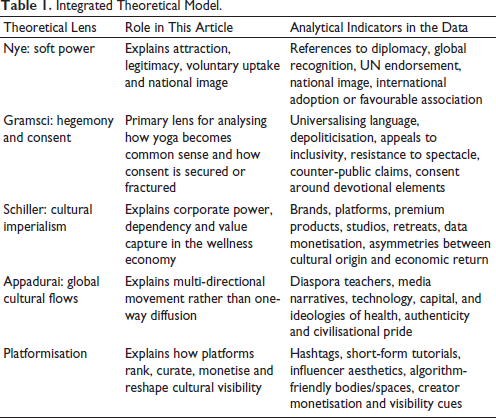
The original theoretical problem in this study is not whether yoga is Indian, global, spiritual, secular, commercial or diplomatic. It is through mediation that these meanings become stabilised, contested and valued. For that reason, the framework places Gramsci’s theory of hegemony and consent at its analytical centre. Nye explains the attraction dimension; Schiller explains corporate and infrastructural value capture; Appadurai explains disjunctive global movement; and platformisation scholarship explains how datafied visibility and monetisation condition contemporary circulation. Together, these lenses enable an analysis of yoga as a mediated struggle over attraction, ownership, consent and visibility.
Table 1 summarises the integrated model used in the analysis.
Integrated Theoretical Model.
Soft Power as Mediated Attraction
Nye’s concept of soft power remains the canonical starting point for analysing culture as a source of international influence. In its most widely cited formulation, soft power is the ability to achieve desired outcomes through attraction rather than coercion or payment (Nye, 2004). Two clarifications are crucial for this study. First, soft-power resources are not the same as soft-power outcomes. A cultural resource may be admired without altering perceptions, behaviour or legitimacy. Second, soft power is not controlled solely by states. Non-state actors, such as corporations, universities, diasporas, news organisations and platforms, help make culture visible and meaningful.
Recent work on digital soft power makes this dispersion more evident. Jin’s (2024) analysis of the Korean Wave shows that digital platforms can function as soft-power apparatuses while also creating tensions between state agendas and private-sector logics. Hedling and Bremberg (2021) similarly caution that digital diplomacy should not be reduced to instrumental projection; it should be studied as a set of evolving practices shaped by agency, visibility, materiality and digital infrastructures. Applied to yoga, these insights indicate that IDY ceremonies, official messaging, news coverage and platform-native yoga content are not merely channels for a pre-existing national resource. They are sites where soft power is produced, measured, commercialised and sometimes contested.
The operational implication is that this article does not ask whether yoga is inherently soft power. It asks when media framing converts yoga into attraction, when it fails to do so and what conditions make consent durable. This focus aligns with Nye’s resource-outcome distinction and grounds soft power in media analysis.
Hegemony, Consent and the Making of Yoga as Common Sense
Gramsci’s theory of hegemony provides the central analytical lens because the paper is concerned with consent. Hegemony is the process by which particular interests and meanings become common sense through cultural and institutional leadership, rather than mere coercion (Gramsci, 1971). In the case of yoga, hegemony operates when yoga is repeatedly represented as universally beneficial, secular, apolitical, healthy, modern, ancient and compatible with national prestige. Such framings need not be false to be hegemonic. Their power lies in what they make obvious and what they render less visible.
A Gramscian approach, therefore, asks how the universalisation of yoga is constructed. Media texts may frame yoga as ‘for everyone’ while downplaying histories of caste, class, gender, religion, labour and market access. Official or civic events may present yoga as a shared public culture while relying on symbols that some participants perceive as exclusionary. Lifestyle journalism may normalise an idealised yoga body, studio aesthetic or premium consumer habit. At the same time, hegemony is never complete. Counter-publics, teachers, community organisers and critical journalists can reinsert history, lineage, accessibility and consent into public discourse.
This is where careful universalism becomes analytically useful. The term is first treated as an empirical pattern in interview accounts: practitioners often support yoga’s universal availability while also seeking credit for its origins, contextual sensitivity and choice over devotional elements. It is then developed as an analytical concept to explain how universalisation can proceed without erasure. Finally, it has a normative dimension, pointing to more ethical forms of mediation in journalism, platform governance, public health communication and cultural diplomacy.
Cultural Imperialism, Value Capture and the Wellness Economy
Schiller’s critique of cultural imperialism offers a political-economic counterweight to celebratory accounts of soft power. Schiller (1976, 1989) emphasised the roles of corporate control, communication dependency and symbolic domination in shaping cultural flows. Although earlier versions of cultural imperialism have been criticised for underplaying audience agency and multidirectional circulation, the concept remains valuable when reframed in terms of ownership, infrastructure and value capture.
Yoga’s global media presence illustrates this relevance. The practice may be associated with South Asian histories and Indian public diplomacy. However, substantial economic value is often captured through platforms, apps, studios, retreats, apparel, certification markets and lifestyle brands. Jain (2014) shows that popularised yoga cannot be reduced to a simple corruption of an authentic original, yet its branding and consumer-cultural forms matter. Fish’s (2006) study of transnational commercial yoga demonstrates how yoga has become a site for intellectual property claims, franchising and contestation over traditional knowledge. Antony’s (2018) analysis of mainstream media discourse further shows how yoga can be detached from its religious origins and rearticulated as wellbeing, flexible spirituality and an elite commodity.
The focus is not to condemn all forms of circulation as appropriation. Rogers (2006) differentiates between cultural exchange, dominance, exploitation and transculturation, providing a clearer vocabulary. This study employs that terminology to explore when media coverage promotes ethical sharing and when it facilitates exploitative appropriation, distinguishing cultural origins from labour, context and benefits.
Global Flows and Platformised Circulation
Appadurai’s (1990, 1996) account of global cultural flows helps avoid a one-way model. Yoga travels through ethnoscapes of teachers, students, migrants and diasporas; mediascapes of news, documentaries, features and platform videos; technoscapes of apps, creator tools, search systems and recommendation infrastructures; financescapes of venture capital, wellness markets, tourism and branded goods; and ideoscapes of health, authenticity, civilisational pride, secular inclusion and self-improvement. These scapes move at different speeds and do not always align. A public-health feature, a diplomatic ceremony, an Instagram sequence and a studio advertisement can all circulate in the same IDY week, yet imply very different meanings.
Platformisation intensifies these disjunctures. Nieborg and Poell (2018) argue that platform markets, datafication, algorithmic ranking and multisided advertising systems increasingly shape cultural production. van Dijck et al. (2018) likewise show that platforms embed public values within privately governed connective infrastructures. Recent work in global platform studies further cautions against treating US-centred platform experiences as universal and calls for greater attention to postcolonial and decolonial perspectives (Poell et al., 2025). This is particularly relevant to yoga: a Southern-origin practice may gain global visibility precisely through infrastructures whose governance, revenue models and cultural norms are often concentrated elsewhere.
The overall framework views yoga’s circulation as a soft-power commodity cycle. Initially, narratives from the state and civilisation portray yoga as ancient wisdom and a global public good. Then, media outlets and platforms convert these stories into frames, headlines, visuals, rankings and metrics. Next, brands and platform owners generate economic value through increased visibility. Repetition then integrates yoga into common sense: secular wellness, national pride and aspirational consumption. Counter-repertoires challenge this by emphasising lineage, accessibility, ethics and consent. Ultimately, metrics and visibility reinforce official claims about yoga’s appeal. This cycle explains how attraction and appropriation can occur simultaneously.
Methodology
Research Design and Rationale
The study adopts a qualitative, interpretivist design because the research questions focus on meaning-making, framing, consent and reception rather than causal media effects. Qualitative media analysis is appropriate when researchers aim to understand how documents and media texts construct social realities, authorise meanings and provide interpretive resources for audiences (Altheide & Schneider, 2013; Bowen, 2009). Semi-structured interviews are appropriate because they allow participants to narrate their experiences while providing the researcher with sufficient consistency to compare themes across cases (Kvale & Brinkmann, 2009). Reflexive thematic analysis is used for interview data because it treats themes as analytically produced patterns of meaning rather than mechanically discovered variables (Braun & Clarke, 2006, 2021).
The design is deliberately explanatory rather than representative. It does not claim to measure global public opinion about yoga or to quantify all media coverage. Instead, it analyses how a purposive set of media texts and practitioner accounts reveals recurring frames, tensions and negotiations. This aligns with critical discourse and frame analysis, in which depth, context and theoretically informed interpretation are central (Entman, 1993; Fairclough, 1995; Wodak & Meyer, 2015).
Data Sources
The study combines two data sets. The first is a purposive corpus of 70 media texts sampled around IDY between 21 June 2015 and 21 June 2025. The corpus includes Indian, Anglo-American and platform-native materials that explicitly frame yoga in relation to at least one of the following: cultural diplomacy, public health, civilisational heritage, secular inclusion, state ritual, lifestyle consumption or platform visibility. Purely instructional how-to items were excluded unless they contained explicit framing of identity, health, diplomacy, lifestyle or culture. The IDY anchor is methodologically useful because it produces a repeated annual media pulse, enabling comparison across pre-pandemic, pandemic and post-pandemic phases.
The second data set includes 18 semi-structured interviews with adult yoga practitioners and trainers from India, Hong Kong, the USA, the UK, Saudi Arabia, Japan, Singapore and the United Arab Emirates. Participants were purposively chosen through venue-based and snowball sampling, ensuring diversity in geography, religious background, practice setting and their role as practitioners or trainers. The inclusion criteria were age 18 or older, at least 12 months of regular yoga practice or teaching experience, and some exposure to yoga-related media via news, features, social media or platform content. The interviews covered topics such as practice history, motivations, views on yoga’s origins and universality, comfort with chanting or devotional practices, perceptions of IDY and reactions to media portrayals of yoga.
All interviews were conducted with informed consent. Participants were anonymised. Interviews were audio-recorded with permission and transcribed; when recording was declined, detailed contemporaneous notes were used. The interview guide was semi-structured, allowing comparability while preserving participant-led emphasis.
Sampling and Coding Procedure
Table 2 summarises the sampling strategy and coding procedure adopted in this study. Coding was iterative. Initial media codes included civilisational gift, UN legitimacy, public health, secular practice, state spectacle, nationalist belonging, lifestyle aesthetics, premium consumption, appropriation, lineage credit and accessibility. Interview codes included motives, health benefits, religious comfort/discomfort, origin recognition, chanting, inclusion, media trust, spectacle, commodification and community practice. Codes were then consolidated into five media frames and four counter-repertoires. Negative cases were retained, particularly those that rejected devotional elements, criticised spectacle or resisted both nationalist and commercial framings.
Sampling and Coding Procedure.
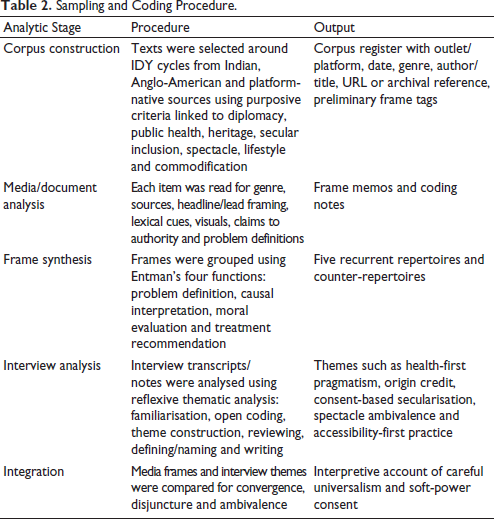
Triangulation was interpretive rather than causal. The aim was to examine where media frames and practitioner meanings converged, diverged and produced ambivalence. For example, interviewees’ health-first motives converged with public-health framing, while their requests for origin credit complicated depoliticised and commodified framings. Credibility, transferability, dependability and confirmability were addressed through triangulation, corpus metadata, coding memos, attention to negative cases and reflexive documentation (Lincoln & Guba, 1985).
Limitations
The study has three limitations. First, the 70-item corpus is purposive rather than statistically representative. It supports interpretive frame analysis but not generalisable claims about global yoga coverage as a whole. Second, the 18 interviews provide cross-cultural depth but cannot represent the full range of national, religious, caste, class, racial, linguistic or disability positions within global yoga communities. Third, platform-native materials were analysed using visible content, captions, hashtags, interface cues and circulation indicators rather than proprietary algorithmic data. These limits are consistent with the study’s interpretivist design, which explains meaning-making rather than measuring population-level effects.
Findings
Overview of Frames
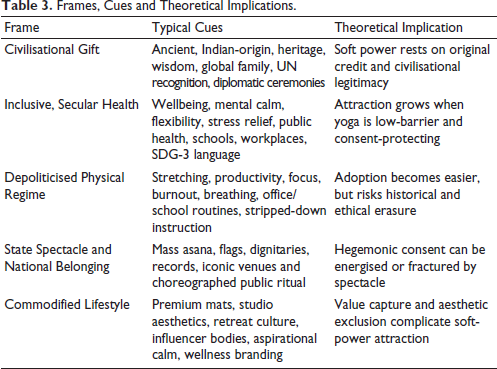
The analysis identifies five recurrent frames: Civilisational Gift; Inclusive, Secular Health; Depoliticised Physical Regime; State Spectacle and National Belonging; and Commodified Lifestyle. These frames are not mutually exclusive. The most common configuration is layering: a text acknowledges yoga’s Indian origin or ancient pedigree and then shifts towards secular health, public participation or lifestyle utility. This layering is important because it allows yoga to travel as both origin-marked and broadly accessible. It also creates tensions, especially when original credit becomes a nationalist spectacle or when secular access becomes a historical erasure.
Table 3 summarises the frames, dominant cues and theoretical implications.
Frames, Cues and Theoretical Implications.
Civilisational Gift
The most durable frame presents yoga as a civilisational inheritance that India offers to the world. It relies on a moral-historical vocabulary of antiquity, wisdom, heritage, unity and global family. UN recognition provides institutional legitimacy, while official and media narratives connect contemporary practice to an imagined long civilisational arc. This frame aligns most closely with soft-power language because it links cultural origin to international recognition and favourable association.
The frame is persuasive when original credit is framed as recognition rather than ownership. Interview accounts suggest that many practitioners accept and even value yoga’s Indian origin but resist the implication that origin should restrict participation. In its empirical form, careful universalism therefore holds two ideas together: origin matters, but universality is not rejected.
The frame becomes more fragile when civilisational credit merges with political symbolism or excludes plural histories. Yoga scholarship complicates simple narratives of authenticity by showing that modern postural yoga has been shaped by colonial modernity, nationalism, physical culture, transnational exchange and consumer culture (Jain, 2014; Singleton, 2010). The implication is not that origin credit is unnecessary, but that origin should be presented historically rather than mythically.
Inclusive, Secular Health
The most widely accepted lived frame presents yoga as a secular, inclusive health practice. Media texts in this repertoire emphasise stress relief, flexibility, mental calm, bodily safety, public health, school or workplace wellness and accessibility for people of diverse ages and abilities. This framing is reinforced by broader public health discourse on physical activity and wellbeing, though responsible coverage should avoid overstating clinical evidence (Hendriks et al., 2017; World Health Organization, 2020).
Interviewees across locations most often described yoga in practical rather than doctrinal terms: stress management, breathing, flexibility, rehabilitation, sleep and mental calm. Trainers emphasised adaptation, consent and safe instruction. In multi-faith or secular settings, participants supported optional rather than compulsory chanting. This does not erase yoga’s origins; instead, it re-stages practice in ways that lower barriers to entry.
This frame explains why yoga’s soft-power value appears to travel most effectively when civilisational credit is paired with accessible health messaging. Attraction is not generated by heritage alone. It becomes durable when people can enter the practice without feeling coerced into adopting a religious, national or consumer identity.
Depoliticised Physical Regime
The depoliticised physical regime frame is closely related to the health frame but more narrowly defined. It presents yoga as stretching, breathing, posture correction, workplace productivity, classroom focus or burnout management. Its key discursive move is abstraction: yoga is detached from religious, philosophical and political contexts so that it can be adopted in institutions where explicit spirituality may be contested.
This frame has pragmatic value. Interview accounts indicate that some practitioners view stripped-down yoga as a useful gateway to breathing, movement and stress reduction. However, teachers and more historically aware practitioners also worry that reducing yoga to stretching can erase ethical traditions, lineages, pedagogical labour and cultural memory. The frame, therefore, produces both adoption and erasure.
A Gramscian interpretation helps explain this ambivalence. Depoliticisation produces common sense: yoga becomes normal, safe, useful and apolitical. However, this common sense is unstable because what is excluded can return as critique. Counter-repertoires of lineage credit and contextualisation challenge depoliticised universalism without necessarily rejecting secular access.
State Spectacle and National Belonging
The State Spectacle frame is most prominent around IDY. It is visual and performative: mass asana, aerial shots, synchronised bodies, iconic venues, dignitaries, flags and record-setting claims. Official discourse often presents these events as evidence of global participation and harmony. The frame, therefore, seeks to convert visibility into legitimacy.
Interview responses were ambivalent. Some participants appreciated the festival-like atmosphere, collective energy and public recognition of yoga. Others were uneasy when events seemed too nationalist, devotional by implication or politically staged. This matters because soft power depends on consent. The same spectacle that provides visibility to one audience can cause discomfort to another.
The analytical point is not that state spectacle is inherently coercive. Rather, spectacle is pedagogically thin and politically risky. It can introduce people to yoga, but it rarely provides the slow, relational, consent-based conditions in which durable practice develops. Careful universalism, therefore, favours smaller, inclusive, opt-in, locally sensitive forms of public practice over highly symbolic displays.
Commodified Lifestyle
The Commodified Lifestyle frame presents yoga as an aspirational habitus: premium mats, curated interiors, retreats, stylish clothing, influencer bodies, morning rituals and images of controlled calm. Lifestyle journalism and platform-native content amplify this repertoire because it is visually attractive and easily monetised. In platform environments, such content aligns with the aesthetics of short-form visibility: clean spaces, ideal bodies, simplified sequences and repeatable routines. This service-oriented treatment of everyday wellbeing and identity also links the frame to scholarship on lifestyle journalism as a serious field of inquiry rather than a merely soft or trivial beat (Hanusch, 2012).
The frame is not solely negative. Some practitioners found the aesthetic content motivating or inviting. However, others experienced it as exclusionary because it associates yoga with classed spaces, expensive products, thin or flexible bodies and an implicitly globalised wellness consumer. Antony’s (2018) findings on yoga’s rearticulation as wellbeing, flexible spirituality and elite commodity are directly relevant here, as are Jain’s (2014) arguments about branding and consumer culture.
The frame also explains why Schiller’s political economy remains useful. Value is not captured solely through direct sales. It is captured through attention, data, affiliation, recommendation systems, premium aspiration and symbolic ownership. A Southern-origin cultural practice can become a global commodity, with its visibility benefiting actors far removed from its origin communities.
Counter-repertoires and the Emergence of Careful Universalism
Across the corpus and interviews, four counter-repertoires complicate the dominant frames. First, lineage-credit repertoires ask journalists, teachers and platforms to name histories, teachers, concepts and South Asian origins without exoticising them. Second, consent-based devotional practice supports optional chanting, silence, translation or secular alternatives, rather than assuming all participants are comfortable with devotional practice. Third, accessibility-first practice challenges premium wellness aesthetics by foregrounding low-cost venues, adapted postures, chair yoga, older bodies, disabled practitioners and trauma-informed cues. Fourth, micro-community repertoires value small, relational sites, such as libraries, community halls, parks, women’s groups, workplaces and clinics, over large spectacles.
These counter-repertoires do not overturn dominant frames. They re-weight them. Together, they produce the negotiated ethic this article terms careful universalism: yoga should be available to all who wish to practise, but universal access should not entail cultural erasure, compulsory devotion, nationalist staging or classed consumer identity. Careful universalism is therefore an empirical finding from interviews, an analytical concept for understanding mediated cultural circulation, and a normative proposal for more ethical media and institutional practice.
The term ‘careful’ is important. It rejects both uncritical universalism and rigid proprietorial claims. Uncritical universalism treats yoga as a generic wellness practice detached from history. Proprietorial universalism risks turning origin into exclusion or state ownership. Careful universalism occupies a middle ground: credit without coercion, access without erasure, secular staging without contempt for devotion and public health framing without commercial reduction.
Discussion
Soft Power as Outcome, Not Possession
The findings suggest a nuanced view. Yoga functions as soft power, yet mere global visibility does not guarantee appeal. Soft power emerges when mediated narratives foster voluntary legitimacy and engagement. It is most effective when Civilisational Gift is combined with Inclusive, Secular Health, acknowledging origins while keeping participation accessible. Its influence diminishes when spectacle politicises participation or when lifestyle aesthetics become commodified, making yoga seem exclusive.
This finding refines Nye’s distinction between resources and outcomes. Yoga is a resource, whereas attraction is an outcome produced through mediation. Newsrooms, platforms, teachers, organisers and audiences all participate in producing this outcome. The state may claim the visibility of yoga, but it does not fully control its meaning.
Hegemony, Consent and the Limits of Spectacle
The study’s primary theoretical contribution lies in its exploration of the relationship between hegemony and consent. Yoga becomes hegemonic common sense when repeated media and institutional framings present it as naturally universal, secular, healthy and apolitical. However, consent is not automatic. It fractures when participants perceive religious assumptions, nationalist staging, class-based exclusivity or historical erasure. This is why the same IDY image can function as soft power for one audience and as an alienating spectacle for another.
Careful universalism identifies the conditions under which consent is more likely to endure. These include origin credit, transparent historical context, opt-in devotional elements, accessible settings, and images of diverse bodies and practitioners. In Gramscian terms, journalists, teachers and community organisers can act as organic intellectuals by thickening common sense rather than merely repeating spectacle or lifestyle aspiration.
Platformisation and Value Capture
The platform dimension complicates both the celebration of soft power and older models of cultural imperialism. Platformisation does not simply impose meanings from the Global North onto a passive South. It creates uneven visibility regimes in which certain aesthetics, bodies, tempos and claims travel more efficiently than others. Short, visually polished, commercially compatible yoga content is more likely to fit platform logics than slower, contextual, community-based or historically dense content.
Schiller’s concern with corporate power still applies today, but in new ways. Today, value is extracted through data, creator economies, recommendation algorithms, brand alliances, apps, subscriptions and platform ads. While a cultural object like yoga might have South Asian roots, the economic benefits and infrastructure are often unevenly distributed. This does not diminish yoga’s soft-power appeal; instead, it illustrates how soft power and commercialisation are interconnected.
Implications for Journalism, Platforms and Cultural Diplomacy
In journalism, the findings suggest that lifestyle and health coverage should not be treated as culturally neutral. Newsrooms can improve coverage by crediting sources, avoiding exoticism, contextualising health claims, diversifying sources, and including teachers and practitioners from different classes, castes, genders, religions, ages and disability groups. Health claims should be phrased cautiously and supported by evidence rather than promotional enthusiasm.
For platforms, the findings suggest recognising that cultural visibility is not neutral. Recommendation systems and creator incentives can privilege visually polished, commodified and decontextualised yoga content. Platform governance cannot solve cultural appropriation on its own, but it can improve labelling, provenance, creator education, and discoverability for context-rich, community-rooted and accessible content.
For cultural diplomacy, the findings recommend a shift from spectacle-first to consent-first communication. Public diplomacy gains durability when it supports local adaptation, multilingual explanation, inclusive practice and non-coercive participation. The most persuasive version of yoga’s universality is not one that asks everyone to perform the same symbols. It allows diverse participants to enter the practice with dignity, choice and knowledge of its origins.
Conclusion
Yoga’s contemporary media life cannot be adequately explained as either simple Indian soft power or simple Western appropriation. It is better understood as a platform-mediated struggle over attraction, ownership, consent and visibility. The study shows that yoga’s soft-power value is strongest when media and institutional framings combine civilisational credit with inclusive, secular, low-barrier practice. It is weakest when spectacle, aestheticisation or market capture crowd out consent.
The article’s central contribution is the concept of careful universalism. As an empirical finding, it shows practitioners’ support for universal access, origin credit and consent-based practice. As an analytical concept, it explains how Southern-origin cultural practices travel through global media and platform systems without being reduced to either exclusive heritage or a context-free commodity. As a normative proposal, it offers guidance for journalism, platforms and cultural diplomacy: credit without coercion, access without erasure and visibility without exclusion.
Future research can extend this study by comparing non-English media systems, analysing algorithmic recommendation patterns, examining caste and class more directly within yoga’s global circulation, and studying how different religious communities interpret participation in IDY. Such work would further clarify when cultural visibility becomes ethical attraction and when it becomes another form of symbolic and economic extraction.
Footnotes
Declaration of Conflicting Interests
The author declared no potential conflicts of interest with respect to the research, authorship and/or publication of this article.
Funding
The author received no financial support for the research, authorship and/or publication of this article.
