







Abstract
Background
Leopoldia comosa is a traditional Mediterranean plant with medicinal and nutritional value. Despite its long history of use, scientific exploration remains limited.
Objectives
This study aimed to provide the first comprehensive bibliometric analysis of global research trends, thematic structures, and emerging topics related to L. comosa.
Materials and Methods
A systematic search was performed in the Scopus database using plant names in the TITLE-ABS-KEY field. A total of 82 documents were retrieved and analyzed using Bibliometrix (R package) and VOSviewer. Performance analysis, co-occurrence mapping, thematic clustering, and trend visualization were conducted.
Results
Italy, Spain, and the USA were the leading contributors. Antioxidant activity, phytochemical characterization, enzyme inhibition, and ecological studies have emerged as the major research themes. Five clusters based on indexed keywords and eight clusters based on author keywords were identified. Recent trends highlight the growing interest in germination biology, anti-microbial activity, and nutraceutical applications. However, research remains limited by the lack of clinical validation, molecular studies, and standardized methodologies.
Conclusion
Although L. comosa is steadily growing, significant gaps persist. Future studies should prioritize clinical trials, pharmacokinetics, genomics, and sustainable cultivation strategies to fully realize their therapeutic and nutraceutical potential.
Introduction
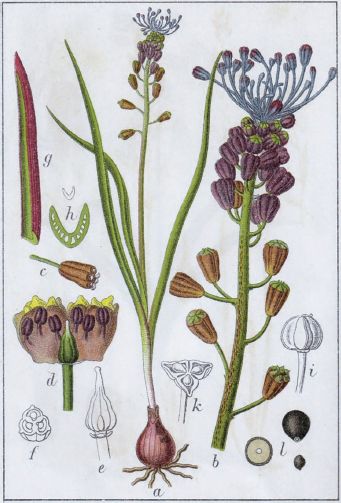
Leopoldia comosa (L.) Miller, commonly referred to as Muscari comosum (Figure 1), is a plant that grows spontaneously in the Mediterranean region, encompassing southern and central Europe, northern Africa, and Southwestern Asia. 1 The bulbs of L. comosa are referred to as lampascioni or cipudizze in Italy and Bassila in Morocco, and have a long history of culinary use. Individuals from Egypt, Greece, and the Mediterranean region have developed a propensity to consume L. comosa bulbs.1–4 L. comosa is economically important because the commerce of plant bulbs serves as a vital revenue source for collectors in Morocco, particularly to Italy, via exports. Currently, bulbs are utilized in diverse culinary preparations, such as boiled bulbs accompanied by sweets; peeled, sliced, and fried in olive oil; served with cheese or eggs; boiled after a 24-h soaking in water; and seasoned with vinegar, oil, salt, and pepper; pickled bulbs from the Benevento region; and in the Murge region, cooked under hot ash and seasoned with oil, salt, and pepper following the removal of the outer layer. Bulbs serve as an alternative to onions and may occasionally be consumed raw; however, this is uncommon because cooking is necessary to mitigate their inherent bitterness. 5 Despite its numerous applications, L. comosa is not typically cultivated because of its prevalence in natural habitats.
This Botanical Illustration of Leopoldia comosa Highlights Its Key Morphological Features. The Bulb (a) With Fibrous Roots Anchors the Plant, While the Flowering Stem (b) Bears Dense, Violet Flower Clusters. Floral Structures (c–f) Show Reproductive Organs, and the Leaf (g) is Narrow And Linear. Fruit Development is Shown in (h) and (i), With a Trilocular Ovary Cross-section in (k). The Seeds (l) Display Typical Shape and Structure. 5
L. comosa has garnered significant scientific interest due to its diverse pharmacological, phytochemical, and ethnobotanical properties. Ethnobotanical surveys in southern Italy documented its traditional use for ailments such as headaches and toothaches. 6 Phytochemical investigations revealed the plant’s rich content of polyphenols, flavonoids, homoisoflavones, and essential minerals such as Fe, K, and Mg, contributing to potent antioxidant, anti-inflammatory, anti-diabetic, and anti-microbial activities.1, 7, 8 Its extracts have shown significant enzyme-inhibitory actions-including lipase, α-amylase, and α-glucosidase-supporting its use in managing metabolic disorders.4, 9 Research on obese rats revealed that L. comosa supplementation improved weight and liver steatosis while reducing phosphoenolpyruvate carboxykinase (PEPCK) and glucose-6-phosphatase (G6Pase) activity, leading to better glucose tolerance. 10 Molecular docking studies have ascertained the presence of homoisoflavones as possible estrogen receptor ligands, signifying important implications for hormone-dependent cancers. 11 Fadel et al., during their research on Algerian populations, uncovered new compounds such as tetrapentacontane and hexatriacontane, which added to the existing chemical characterization of the compounds. 8 Ecological studies documented the enhanced fruit set from sterile flower pollinator visitation and their reproductive success, along with direct and indirect effects of exotic neighbors on the pollination of the plants.12, 13 Quercetin was used as a standard in Pieroni et al.’s research in 2002, where significant radical scavenging and inhibition of lipid peroxidation were observed, confirming the antioxidant properties of the test subjects. Anti-biofilm activity against methicillin-resistant Staphylococcus aureus (MRSA) biofilms strengthens ethnomedicinal claims of skin and soft tissue infection treatment with the plant. 14 Clinical validation aside, L. comosa shows potential value for pharmacological and nutraceutical developments.
L. comosa, known in Saudi Arabia by names such as Hulhul, Al-Zaz, and Basal Al-Misk, holds growing national importance due to its cultural and ecological value. Historically noted by Muslim scholars, it gained modern prominence when Crown Prince Mohammed bin Salman ordered a Neom resort relocation to protect an endangered population, proposing the area as a protected site called “Neom Plant.” This reflects Saudi Arabia’s commitment to biodiversity conservation. This study presents a bibliometric analysis of L. comosa research from 1877 to 2024, highlighting global contributions, trends, and emerging directions. Findings emphasize its pharmacological, ethnobotanical, and ecological relevance, positioning it alongside other historically overlooked yet valuable plant species.
Methodology
Database Selection
Scopus was chosen due to its broad interdisciplinary coverage, robust citation tracking, and high-quality metadata, which are essential for reliable bibliometric and network analyses. Additionally, Scopus includes a wide range of journals relevant to pharmacology, plant sciences, and medicinal research, making it particularly suitable for this study.
Search Strategy
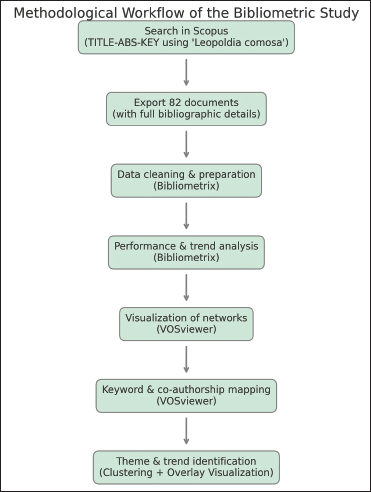
The global scientific output on L. comosa was analyzed using bibliometric methods based on data from the Scopus database. The search used the terms “Leopoldia comosa” OR “Muscari comosum” in the TITLE-ABS-keywords field, yielding 82 documents (Figure 2). These included various publication types and were exported with full bibliographic details. To ensure accuracy, both the accepted name and synonym were included, and verified through databases such as the Plant List, NCBI Taxonomy, and Tropicos. No additional official synonyms or regional variants were found during data collection.
This Flowchart Illustrates the Methodological Steps Followed in the Bibliometric Study of Leopoldia comosa. The Process Begins with a Targeted Search in the Scopus Database Using the Plant Name in the TITLE-ABS-KEY Field. A Total of 82 Documents Were Retrieved and Exported With Complete Bibliographic Data. Bibliometrix Was Used for Data Cleaning, Performance Analysis, and Trend Detection. VOSviewer Facilitated the Visualization of Co-authorship Networks, Keyword Co-occurrence, and Thematic Evolution, Leading to the Identification of Emerging Topics and Research Patterns.
Inclusion and Exclusion Criteria
No language or document-type filters were applied during data retrieval. All documents indexed in Scopus under the search term “Leopoldia comosa” in the TITLE-ABS-KEY field—including original research articles, reviews, conference papers, book chapters, and notes—were included in the analysis to ensure full representation of the available literature.
Bibliometric Analysis
Publication trends, citation practices, productive countries, productive authors, collaboration networks, and thematic development were studied after bibliographic data were processed using Bibliometrix (an R package) and VOSviewer.15, 16 Bibliometrix was used for performance and trend analyses, and VOSviewer was used to create and visualize co-occurrence networks of keywords, authors, and countries, thematic maps, and overlay visualizations. With VOSviewer clustering features, the identification of major research themes and their changes over time was possible. This analysis was conducted to trace the historical progression, present focus, and future direction of L. comosa research.
Results
Scientific Production (1877–2024)
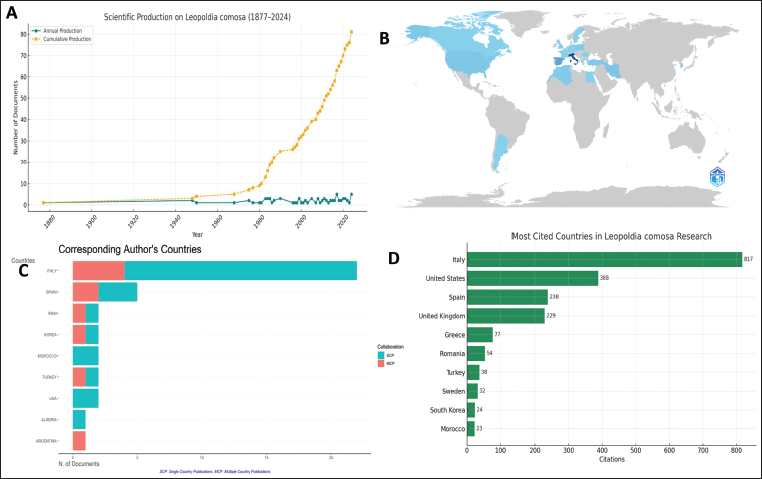
Figure 3A shows that scientific publications on L. comosa were sporadic and infrequent before the 1980s. From the late 20th century onward, there has been a gradual increase in research activity, with a more consistent annual output beginning in the early 2000s. The peaks in 2017 and 2024, each with five publications, indicate recent surges of interest. The cumulative trend highlights a clear upward trajectory, especially over the past two decades, suggesting a growing scientific recognition of the plant’s medicinal, ecological, and nutritional value.
(A) Annual and Cumulative Scientific Production on Leopoldia comosa from 1877 to 2024. The Teal Solid Line Represents the Number of Publications per Year, While the Orange Dashed Line Indicates the Cumulative Number of Documents Over Time. A Notable Rise in Research Output is Observed from the 1980s Onward, Reflecting Increasing Scientific Interest. (B) The Map Illustrates the Geographical Distribution of Scholarly Publications on Leopoldia comosa. Countries Shaded in Blue Represent Those That Have Contributed to the Scientific Literature. Darker Shades Indicate Higher Publication Frequency, With Italy Showing the Highest Output. Data Were Extracted from a BibTeX file and Visualized Using Bibliometrix. (C) This Figure Illustrates the Distribution of Publications on Leopoldia comosa by the Corresponding Author’s Country. Blue Bars (SCP) Represent Single Country Publications-Research Conducted Within One Nation. Red bars (MCP) Indicate Multiple Country Publications Involving International Collaboration. The Chart Highlights Both National Efforts and the Extent of Global Cooperation in This Field. (D) Horizontal Bar Chart Showing the Countries Most Cited in Leopoldia comosa Research. Italy Comes First With 817 citations, the USA Comes Second With 388, Followed by Spain and the UK With 238 and 229 Citations, Respectively, Showcasing Their Substantial Academic Contributions in This Area.
Geographical Distribution of Scholarly Output and Impact
Global interest in L. comosa spans 21 countries, as shown in the Bibliometrix-generated world map (Figure 4). Italy leads with 77 publications, followed by Spain (25), Iran (7), and the USA (6). Other contributors include Turkey and the UK (five each), and countries such as Algeria, Poland, South Korea, Morocco, and Germany, with one to four publications. This pattern reveals a strong European and Mediterranean focus, with Italy as the central research hub. Figure 3C illustrates the distribution of national single country publication (SCP) and international multiple country publication (MCP) research. Italy dominates in SCP, while Spain balances SCP and MCP. Iran, Korea, Morocco, Turkey, and the USA show moderate activity with varying global collaborations. Figure 3D shows Italy leads in citations (817), followed by the USA (388), Spain (238), and the UK (229), confirming Europe’s dominance. Other notable contributors include Greece, Romania, Turkey, Sweden, South Korea, and Morocco.
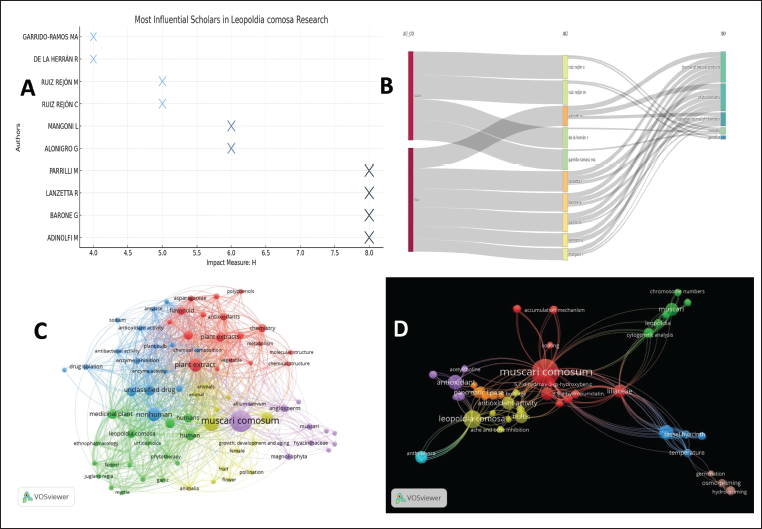
(A) Most Influential Scholars in Leopoldia comosa Research Based on the h-index. The Figure Highlights Authors With the Highest Impact in the Field. Adinolfi M, Barone G, Lanzetta R, and Parrilli M Also Share the Top Position, Having an h-index of 8, Which Indicates Their Steady and Balanced High Citation Activity. Other Important Contributors are Alonigro G and Mangoni L (H = 6) as Well as Ruiz Rejón C and M (H = 5), Demonstrating Their Significant Impact in Developing the Knowledge About This Species. This Metric Illustrates Both Productivity and Citation Impact Within the Scientific Community Studying L. comosa. (B) This Sankey Diagram Maps the Relationship Between Countries (Left), Authors (Center), and Journals (Right) in Leopoldia comosa Research. Flows Illustrate How Leading Scholars From Spain and Italy Publish in Key Journals Such as Phytochemistry and Journal of Natural Products, Highlighting Major National Contributions and Preferred Publication Venues. (C) Thematic Framework and Research Topics in Leopoldia comosa Literature. This is a Co-occurrence Network Map That Has Been Created Using VOSviewer, Demonstrating the Keywords That Pertain to Leopoldia comosa Research. Each Node Corresponds to a Keyword, Which Has Been Assigned a Specific Size Based On Its Use and Color Representing Specific Thematic Categories. The Phytochemistry is Marked in Red, Ethnobotany is Green, Biological Activity is Blue, Ecological Relevance is Yellow, and Taxonomy is Purple; These are the Five Clusters That Were Identified. Stronger Co-Occurrence Relationships Between Terms are Depicted With Thicker Lines. (D) This Co-occurrence Map, Generated Using VOSviewer Based on Author Keywords, Visualizes Thematic Clusters in Leopoldia comosa Research. Each Node Represents a Keyword, With Node Size Indicating Frequency and Color Denoting One of Eight Identified Clusters. Links Represent the Co-occurrence Strength Between Terms. Key Themes Include Phytochemistry (Red), Cytogenetics (Green), Antioxidant Activity (Yellow), Ecology (Blue), and Pharmacological Mechanisms (Purple and Orange).
Impactful Scholars
Figure 4A shows a horizontal bubble chart ranking the top L. comosa researchers by h-index. Adinolfi M, Barone G, Lanzetta R, and Parrilli M lead with an h-index of eight, reflecting strong citation impact. Alonigro G and Mangoni L follow with h-indices of six, while Ruiz Rejon C, Ruiz Rejon M (5), De La Herrán R, and Garrido-Ramos MA (4) show moderate influence. Bubble size and color indicate citation strength. Figure 4B presents a Sankey diagram linking countries, authors, and journals. Spain and Italy dominate, with Spanish authors, like Ruiz Rejón C/M and De La Herrán, and Italian authors, like Adinolfi, Lanzetta, and Parrilli, contributing significantly. Their work appears in high-impact journals such as Phytochemistry and Journal of Natural Products, illustrating Mediterranean leadership in L. comosa research.
Thematic Structure and Research Clusters in L. comosa Literature
Thematic clustering of L. comosa research using VOSviewer based on indexed keywords revealed five distinct clusters (Figure 4C). The red cluster focuses on phytochemistry, including terms like “plant extract,” “polyphenols,” and “antioxidants.” The green cluster covers ethnobotany and pharmacology, including “phytotherapy” and “ethnopharmacology.” The blue cluster includes biological activities like “enzyme inhibition” and “anti-bacterial activity.” The yellow cluster reflects ecological terms such as “pollination” and “flower,” while the purple cluster deals with taxonomy (e.g., “angiosperm”).
Co-occurrence analysis of author keywords (Figure 4D) identified eight clusters. The red cluster highlights phytochemicals like flavonoids and M. comosum. The yellow cluster emphasizes antioxidant and enzyme inhibition activities. Purple and orange clusters involve biochemical pathways such as acetylcholine and pancreatic lipase, indicating therapeutic mechanisms. This classification outlines the breadth of L. comosa research across chemistry, biology, and pharmacology.
Keywords such as “cytogenetic analysis,” “chromosome numbers,” “muscari,” and “leopoldia” denote cytogenetic and taxonomic research, which are represented as the terminals of investigation in the green cluster. “Tassel hyacinth,” “Temperature,” “Germination,” “Hydro-priming,” and “Osmo-priming” are some of the terms associated with the blue cluster that corresponds to ecological and agronomic aspects, suggesting interest toward plant propagation and stress response. Terms such as “anthophora” and “acetylcholine” found in the light blue and pink clusters, which are smaller than the other clusters, connect ecological studies on pollination with biochemistry and pharmacology, thus showing more interdisciplinary insights. From phytochemistry to cytogenetics, in conjunction with the antioxidative mechanisms of plants and cultivation strategies, the analysis goes in-depth into a plethora of multidisciplinary approaches in the field.
Emerging Themes
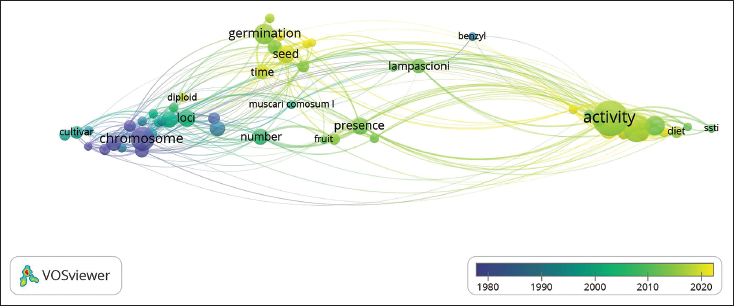
The overlay visualization in Figure 5 depicts the chronological advancement of research themes pertaining to L. comosa derived from phrases included in the titles and abstracts. The mapping of scientific focus over time is covered with a spectrum of darker blue (covering older topics, approximately the 1980s–1990s) to bright yellow (newer topics, post 2015). Darker nodes showcase early research that prioritized chromosomal studies, diploid variation, and loci analysis, underpinning studies that were sacrificed with more emphasis over time. More recent research trends have shifted the focus toward aspects of germination, bulb features, and seed physiology. In recent years, emerging themes are more pharmacological and dietary in nature, with the terms “activity,” “diet,” and “SSTI” (skin and soft tissue infection) surfacing in bright yellow. These bright terms signify abundant therapeutic, dietary, and anti-microbial interest in L. comosa as opposed to basic botanical and genetic explorations in the past years, thus indicating an apparent shift toward applied biomedical and nutritional research.
Trend Topics (Overlay Visualization). This Overlay Visualization Produced by VOSviewer Shows the Development of Various Themes in Leopoldia comosa Studies Over Time, Based on Words Found in the Title and the Abstract. Each Term is Shown as a Node With a Color Based on the Average Year of Publications for That Term. Blue Nodes Depict Older Research 1980s–1990s, While Yellow Nodes Indicate Newer or Emerging Themes After 2015. Generally, More Recent Focus Areas of “germination,” “seed,” “diet,” “activity,” and “SSTI” (skin and soft tissue infections) Exhibit Increased Concern for the Pharmacological Activity, Nutritional Value, and Agronomic Interest of L. comosa. This Map Illustrates the Shifting Research Focuses and Priorities Over the Years.
Discussion
This study attempted to carry out advanced bibliometric research on L. comosa with regard to global research in relation to the key contributors, trends, and emerging scientific directions. The literature from 1877 to 2024 reveals the scientific significance of plants in pharmacology, ethnobotany, and ecology. L. comosa research results are published in a remarkable journal that adds value to other protected plants that somehow remained undeservedly in the shadow of history for both conservational and medical purposes, and engineering efforts relevance to the Mediterranean region.
The L. comosa species has drawn only 82 pieces of literature, which is relatively low compared to other species. There are a few reasons for this finding. First, L. comosa has not been studied, which decreases its applicability in the scientific world. Second, crucial insights into its biological activities, such as genomic information and metabolomic research, 17 are nearly non-existent. Moreover, comprehensive conservation approaches that provide economic efficiency have only recently captured interest, which has stifled further applied research. There is also a lack of L. comosa extract-based isotonic drugs or heavily marketed nutraceuticals, which further limits the research. All of these reasons are why, despite having immense potential in ecological and pharmacological studies, L. comosa is overlooked in scientific research when compared to other medicinal plants.
The high publication and citation counts for Italy and Spain in L. comosa research can be attributed to several interrelated factors. First, L. comosa is native to the Mediterranean region, and both Italy and Spain are part of its natural habitat, which has encouraged sustained ethnobotanical and scientific interest. 1 Second, the plant holds cultural and culinary significance, particularly in Southern Italy, where it is traditionally consumed as “lampascioni,” further motivating local research.18, 19 Third, Italy and Spain have active academic institutions and access to Scopus-indexed regional journals that focus on Mediterranean plant sciences, which enhances both the visibility and citation potential of their publications. 4
Adinolfi M, affiliated with the University of Napoli, Italy, is recognized as the most prolific author of L. comosa research. His work, primarily conducted during the 1980s, focused on the phytochemical characterization of L. comosa. Adinolfi et al. isolated and structurally elucidated a wide range of bioactive compounds from plant bulbs, including novel 3-benzyl-4-chromanones, homoisoflavanones, nortriterpenes, and muscarosides-complex glycosides with unique norlanostane skeletons. His studies employed advanced techniques such as fast-atom-bombardment mass spectrometry and nuclear magnetic resonance (NMR) spectroscopy, significantly enriching the chemical understanding of L. comosa.20–28 These discoveries not only expanded the catalog of natural products associated with the plant but also provided a foundational framework for subsequent research into its pharmacological potential.
Interpreting keyword clusters in bibliometric analysis depends on their source. Author-supplied keywords reflect researchers’ framing and may highlight emerging or detailed topics, while indexed keywords offer a standardized view aligned with established themes. Analyzing both types enriches domain understanding. For L. comosa, five major themes were identified from indexed keywords and eight clusters from author keywords: phytochemistry, ethnopharmacology, biological activity, ecology, and taxonomy. Studies also explored germination, stress responses, and biochemical pathways. However, gaps remain in clinical validation, large-scale cultivation, genomics, and ecological adaptation. Future research should focus on pharmacokinetics, molecular breeding, and conservation to enhance scientific and practical insights.
The antioxidant activity of L. comosa highlights its potential as a nutraceutical and therapeutic agent. Many studies have reported that L. comosa bulbs and extracts contain high levels of polyphenols, flavonoids, and tannins, which are strongly responsible for their radical scavenging activity.7, 17 Studies have shown that both aqueous and organic extracts display strong antioxidant activity, with organic fractions outperforming aqueous extracts.7, 8, 29 Antioxidant activity was assessed and verified in different assays such as 2,2-diphenyl-1-picrylhydrazyl (DPPH), nitric oxide, and lipid peroxidation assays.4, 19, 30 In addition, L. comosa extracts influence the genes involved in oxidative stress and thus induce protective redox signaling. 17 The relatively high antioxidant activity of L. comosa compared to that of other non-cultivated plants 1 highlights its potential role in combating diseases associated with oxidative stress, such as metabolic syndrome, obesity, and cancer.9, 10 These consistent in vivo and in vitro findings support the use of L. comosa as a source of natural antioxidants for multi-health purposes.
Our findings reveal that L. comosa research has primarily focused on antioxidant activity, enzyme inhibition, and phytochemical profiling. While this reflects the plant’s promising pharmacological potential, there remains a striking lack of clinical studies, molecular research, and applied product development. The over-reliance on in vitro and preliminary in vivo studies limits the translational potential of current findings. Furthermore, inconsistencies in methodology across studies, such as variation in extraction techniques and assay protocols, make cross-comparison challenging.
SSTIs have emerged as a trending research theme in L. comosa studies, reflecting their promising anti-microbial potential. Quave et al. (2008) demonstrated that extracts from L. comosa exhibited significant anti-biofilm activity against MRSA, achieving a half maximal inhibitory concentration (IC50) of ≤32 µg/mL for biofilm inhibition. This finding highlights the relevance of L. comosa in addressing antibiotic-resistant infections, which are a critical global health concern. As SSTIs remain a major clinical challenge, further exploration of L. comosa for novel anti-microbial compounds for L. comosa offers a valuable direction for future research, linking ethnopharmacological knowledge with modern biomedical applications. 14
This bibliometric study was limited by the use of a single database (Scopus), which may not capture all relevant publications. Restricting the search to the TITLE-ABS-KEY field could have excluded important studies. Moreover, variations in indexing quality may have affected the completeness of the results. Future research should combine multiple databases, expand search strategies, and apply manual validation to ensure broader coverage and greater accuracy in mapping L. comosa research trends.
Conclusion
This bibliometric study provides the first comprehensive overview of global research trends on L. comosa, highlighting the growing interest in its phytochemical composition, antioxidant properties, pharmacological potential, and ecological relevance. Antioxidant and enzyme inhibitory activities have emerged as major research themes, supported by promising in vitro and in vivo evidence. However, current studies are limited by small sample sizes, lack of standardized protocols, and absence of clinical and pharmacokinetic investigations. Future research should focus on standardized methodologies, molecular characterization, multi-center collaborations, and clinical trials to fully harness L. comosa as a valuable therapeutic and nutraceutical resource.
Footnotes
Abbreviations
Declaration of Conflicting Interests
The author declares no potential conflicts of interest with respect to the research, authorship, and/or publication of this article.
Funding
The author received no financial support for the research, authorship, and/or publication of this article.
Ethical Approval and Informed Consent
Not applicable.
