







Abstract
This study examines the prevalence of obesity and overweight as well as associations between obesity and overweight and demographic, sociocultural, and lifestyle factors among Asian immigrant women in Korea. Data were collected from physical measurements and standardized questionnaires from 287 adult women from China, Vietnam, the Philippines, and other Asian countries. The mean BMI (body mass index) was 22.0 kg/m2; 15.0% of the sample were obese (BMI ≥ 25.0), and 17.1% were overweight (23.0 ≤ BMI < 25.0). The highest obesity proportion was found in Filipino (22.0%) and the lowest in Vietnamese women (7.8%). Adjusted for demographic, sociocultural, and lifestyle variables, individuals with greater length of residence (5+ years; odds ratio = 3.22, P = .010) were more likely to be obese or overweight. For prevention of excess body weight, public health efforts need to be targeted to immigrants starting at arrival in Korea.
Introduction
The worldwide prevalence of obesity and overweight has reached a strikingly high rate. 1 Considering obesity and overweight together, currently, there are more than 1.6 billion adults who belong in these categories. 2 A dramatic rise in the incidence of obesity in the Asian population is rapidly becoming a major public health concern, where some people become obese, whereas others suffer from malnutrition.3,4 The number of people who are obese or overweight in the Asian population has been estimated as 281 million in this region. 5 The adverse health consequences of obesity are well documented and include predominantly cardiovascular diseases, sleep apnea, type 2 diabetes mellitus, osteoarthritis, cancers, and increased risk of premature death.1,6,7
Obesity is associated with varying demographic (age, gender, and number of children), sociocultural (education, ethnicity, and immigration), and lifestyle factors (exercise and diet).8,9 Women are more likely to be overweight or obese as a result of hormonal changes in association with pregnancy and menopause.10,11 The prevalence of obesity is 1.5 to 2 times higher among women than among men in countries with relatively low gross national product, such as those in Central and Eastern Europe, Asia, Latin America, and Africa. 12 With women in particular, there are large racial ethnic differences in the prevalence of obesity.12,13 In the United States, the women-to-men prevalence ratio is highest among non-Hispanic black Americans (ratio 1.76), lower in Mexican Americans (ratio 1.48), and lowest in non-Hispanic white Americans (ratio 1.12). 13 Also, immigrants from poor to well-off countries are found to be at high risk of gaining excess weight. 14 As new immigrants adjust to a host culture, they adopt the diet and other health behaviors of the majority, such as reduced physical activity and consumption of energy dense foods, which have been identified as a primary cause of obesity.1,8,15 Meanwhile, the thrifty gene hypothesis suggests that chronic or intermittent malnutrition selects those who efficiently store energy during periods of nutritional insufficiency, leading to obesity during periods of abundance. 16 Therefore, individuals with a greater acculturation in Western countries with a high prevalence of overweight and obesity may be at greater risk of weight gain.8,16,17
Since the 1990s, because of the shortage of Korean women in the marital age range, particularly in rural areas, the number of immigrant women, mainly from China, Vietnam, the Philippines, and other Asian countries has shown a rapid increase. In 2009, international marriages between Korean men and immigrant brides accounted for more than 10.8% of all marriages in South Korea. 18 Of the 109 221 Asian brides who immigrated to Korea, the largest Asian groups include 30 115 Chinese, 30 014 Vietnamese, and 6157 Filipinos. 19
Most immigrant women who are newly married experience childbirth and become prone to gain of excess body weight. Recently, research found that only 24.1% of Korean women exercise regularly at above moderate levels, compared with 47.5% of women who participate in physical activity at the same level in the United States. 20 In a study of diet changes among Vietnamese marital immigrant women in Korea, it was found that there was a 41.9% increase in fat intake and a more than 50% increase in consumption of protein from meat, fish, and dairy products since immigration. 21 Asian immigrant female groups in Korea may become accustomed to psychical activity and dietary styles that can lead to overweight or obesity.
However, few studies have been conducted to identify the prevalence of and risk factors for obesity and overweight among immigrant women from developing Asian countries who come to Korea through marriage; this population is rapidly increasing and consists of ethnically diverse minority groups. The purpose of this study was 2-fold: (1) to examine the prevalence of obesity and overweight among immigrant women from China, Vietnam, the Philippines, and other Asian countries; and (2) to investigate demographic, sociocultural, and lifestyle factors associated with obesity and overweight in this group.
Methods
This study was a cross-sectional survey of 287 immigrant women in Korea. Formal approval from the institutional review board of Ewha Womans University was obtained prior to recruitment of participants for the study.
Sample
Participants were immigrant adult women from China, Vietnam, the Philippines, and other countries in Asia, including Thailand, Mongolia, Uzbekistan, Cambodia, Japan, Kyrgyzstan, Taiwan, and Nepal. For enrollment in the study, immigrant women had to (1) be married to a Korean man and (2) provide signed informed consent describing the purpose, duration, and procedures of the study. Women who were pregnant were excluded from the study. Surveys were conducted with 302 immigrant women who were recruited using convenience sampling from immigrant women participating in various multicultural family support programs of public health centers and social welfare service centers in both urban and rural areas, including a highly populated metropolitan area, 1 mid-sized city, and 1 rural province. Of the 302 women who participated, 287 who had complete data were included in the obesity analyses; 82 (28.6%) of them lived in cities (14.7% in a metropolitan area and 13.9% in a midsized city) and 205 (71.4%) in rural areas, where international marriages started and where most couples live.
Measures
Physical measurements of height and weight were used for assessment of the body mass index (BMI) of the study participants. Participants also completed structured questionnaires that appraised demographic characteristics and sociocultural and lifestyle factors. The questionnaires were developed in Chinese, Vietnamese, English, and Korean, and trained interviewers and native speaker interpreters assisted with the questionnaires when necessary.
Obesity and Overweight
Height and weight were measured with participants wearing light-weight clothing without shoes. Obesity was defined as having a BMI ≥25.0 kg/m2 in accordance with the recommendations of the World Health Organization Regional Office for the Western Pacific, the International Association for the Study of Obesity, and the International Obesity Task Force on Obesity for classification of obesity in Asians. 3 In addition, BMI < 18.5 kg/m2 was categorized as underweight, from 18.5 to <23.0 kg/m2 as normal, and from 23.0 to <25.0 kg/m2 as overweight.
Demographic and Sociocultural Factors
Participant demographics included age, education, and number of children. Sociocultural factors were measured by country of origin, time since immigration, weight change since immigration, and Korean language proficiency. Korean proficiency was measured on a self-report 4-item index that evaluated speaking, listening, reading, and writing abilities among nonnative Korean speakers on a 5-point response set by Hong et al., 22 rated as 1 = very good; 2 = good; 3 = moderate; 4 = poor; 5 = very poor. A mean proficiency score was computed across 4 language areas with lower scores indicating greater Korean proficiency. Cronbach’s α was .93 for the entire measure in the present study.
Lifestyle Factors
Lifestyle factors were assessed by physical activity and diet questions. For physical activity, participants rated exercise frequency per week. We used 2 questions related to diet—“Eat much of fried or stir-fried foods” and “Eat ice-cream, cakes, snacks, and soda between meals”—from the Mini Dietary Assessment Index for Koreans developed by Kim. 23 The scale uses a 3-point response format ranging from 1 (rarely) to 3 (always).
Statistical Analysis
First, descriptive statistics were used for analysis of participant demographic characteristics, sociocultural and lifestyle factors, and the prevalence of obesity and overweight. Next, we conducted χ2 and ANOVA tests to examine differences in obesity and overweight according to demographics, sociocultural, and lifestyle factors by country of origin. Bivariate logistic regression analyses were then used to investigate the predictors of obesity and overweight by country of origin. In each logistic regression analysis, we used the dependent variable with 2 categories created by combining (1) underweight and normal weight (considered normal weight) and (2) overweight and obesity (considered excess weight). 4 Findings from previous studies have shown that the average BMI of Asians is lower than that of non-Asians, even though the tendency toward abdominal obesity and related health risks is greater among those with a BMI between 23 to 24.9 kg/m2.3,4 Therefore, we adopted the BMI criteria proposed by the World Health Organization for Asians and examined the predictors of obesity and overweight, defining this as BMI ≥ 23 kg/m2. Our final analytic strategy was to examine the importance of each predictor within the 3 domains (demographic, sociocultural, and lifestyle factors) using a hierarchical logistic regression analysis for the sample. Variables were entered in stages to adjust the impact of age and number of children on obesity and overweight (model I). Model II added adjustments for country of origin, education, time since immigration, and Korean proficiency. In the final model (model III), physical activity and consumption of high-fat food and energy-dense snacks were added to model II. All analyses were conducted using SPSS version 17.0 (SPSS Inc, Chicago, IL). The level of significance was set at .05.
Results
Sample Characteristics and Prevalence of Obesity and Overweight
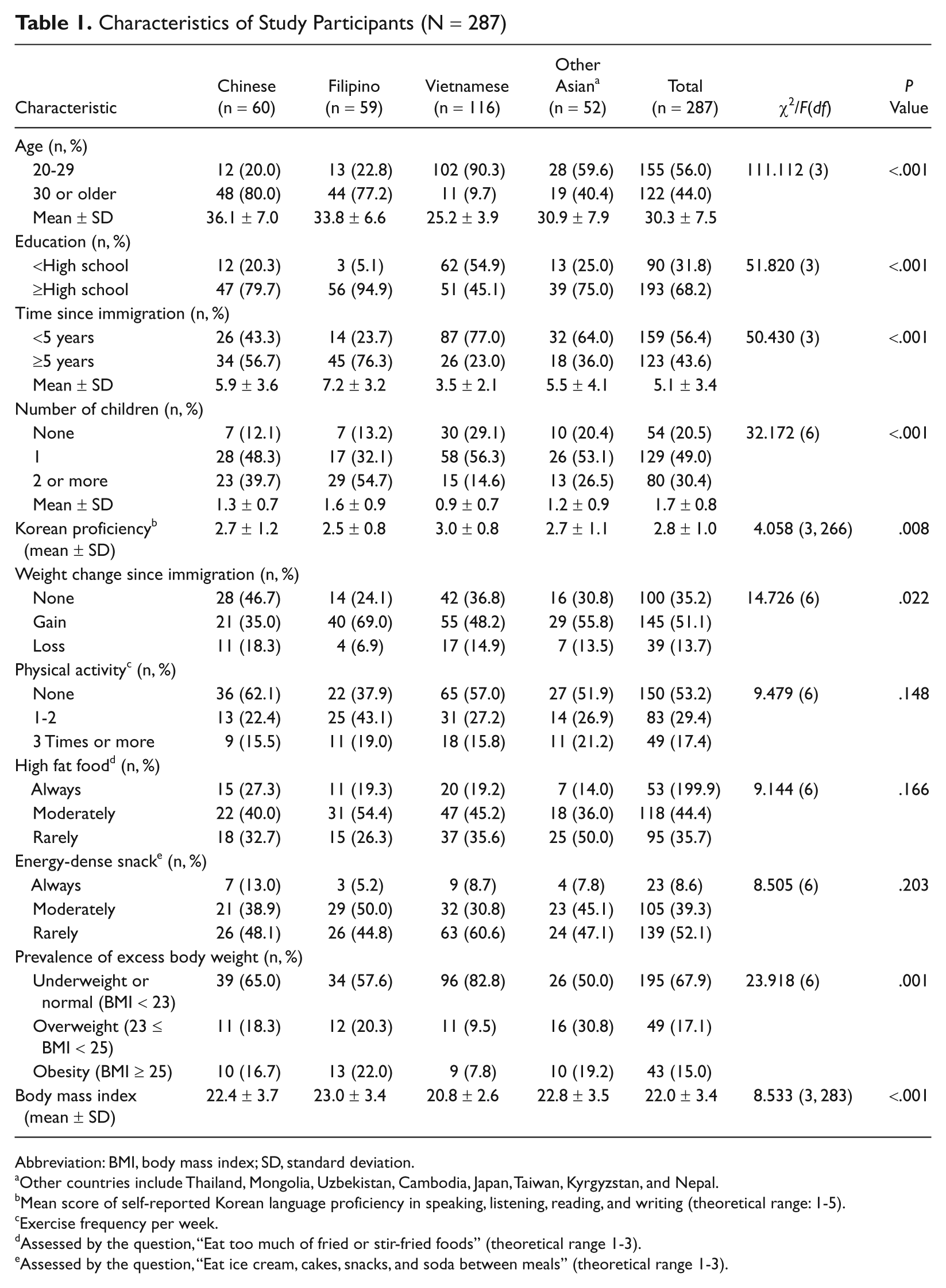
Background characteristics of the sample and the prevalence of obesity and overweight are presented in Table 1. Participants were 30 years old on average (standard deviation [SD] = 7.5); Vietnamese women were the youngest (mean [M] = 25.2), and Chinese women were the oldest (M = 36.1) of the group. Most had received a high school education (68.2%) and had 1 child (49.0%). The mean time since immigration was 5.1 years (SD = 3.4), and the mean Korean proficiency score was 2.8 (SD = 1.0), indicating that the immigrant women in this study had limited command of Korean to manage everyday situations (close to the theoretical range 3 = moderate). As the mean residence time was longest in Filipino (M = 7.2 years) and shortest in Vietnamese women (M = 3.5 years), Korean proficiency scores revealed a similar pattern, with the Filipino women showing the best proficiency (M = 2.5) and the Vietnamese demonstrating the worst (M = 3.0). Of the 287 participants, 51.1% reported weight gain, whereas only 13.7% reported weight loss since their arrival in Korea. About half of the participants did not engage in physical activities at all (53.2%) and consumed foods and snacks that are high in fat (44.4%) and energy dense (39.3%) at a moderate level.
Characteristics of Study Participants (N = 287)
Abbreviation: BMI, body mass index; SD, standard deviation.
Other countries include Thailand, Mongolia, Uzbekistan, Cambodia, Japan, Taiwan, Kyrgyzstan, and Nepal.
Mean score of self-reported Korean language proficiency in speaking, listening, reading, and writing (theoretical range: 1-5).
Exercise frequency per week.
Assessed by the question, “Eat too much of fried or stir-fried foods” (theoretical range 1-3).
Assessed by the question, “Eat ice cream, cakes, snacks, and soda between meals” (theoretical range 1-3).
The mean BMI was 22.0 kg/m2 (SD = 3.4), and 15.0% of the sample were in the obese and 17.1% in the overweight category. The highest mean BMI was found in Filipinos (M = 23.0 kg/m2, SD = 3.4), and 22.0% of the women in this group were considered obese, whereas the lowest BMI was found in Vietnamese women (M = 20.8 kg/m2, SD = 2.6), with 7.8% reported as obese.
Correlates of Obesity and Overweight
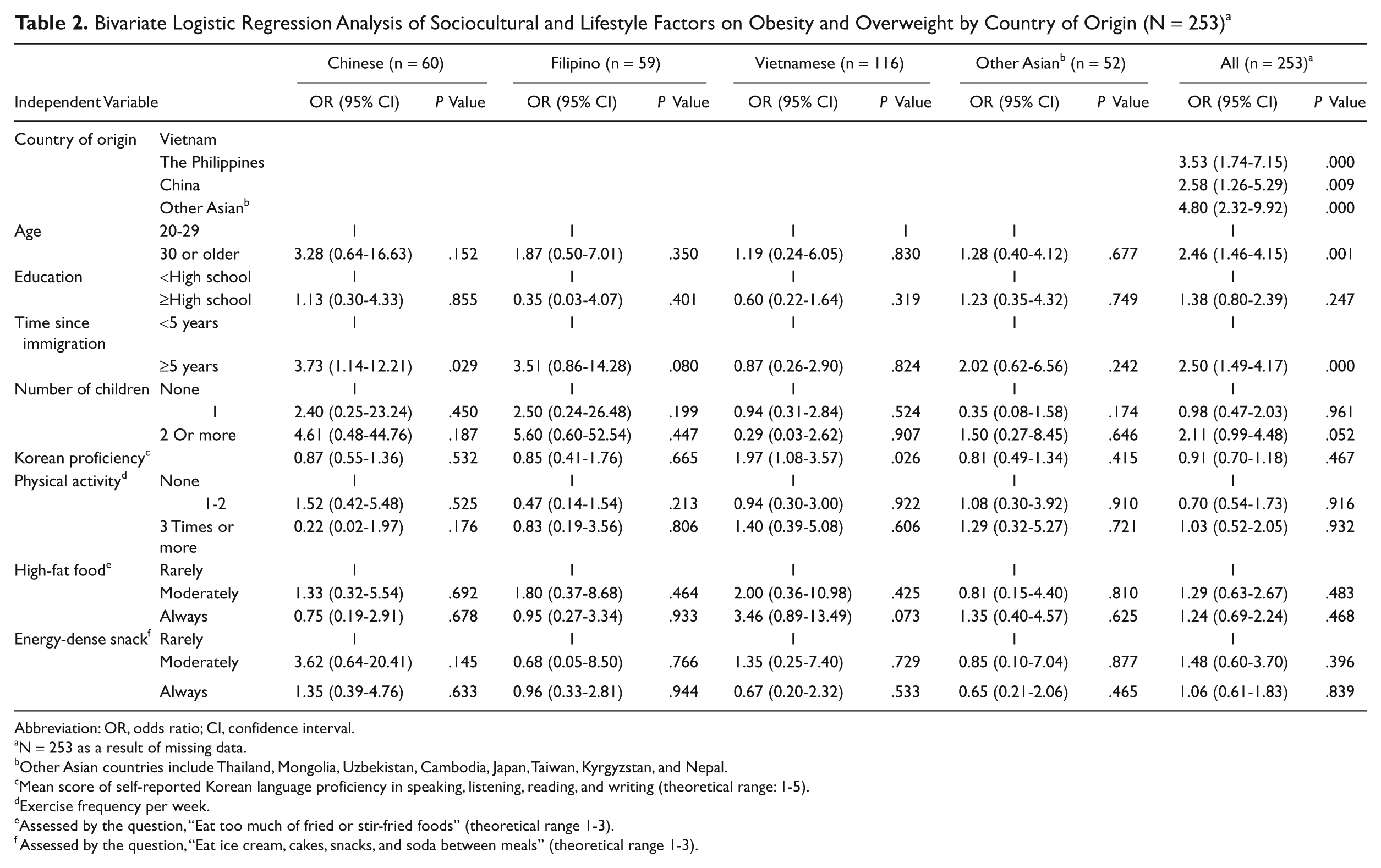
Results of bivariate logistic regression analysis showing the correlates of obesity and overweight (BMI ≥ 23 kg/m2) by country of origin and for all countries are shown in Table 2. Compared with those from Vietnam, the odds ratios of having excess body weight were higher for immigrants from the Philippines (OR = 3.53; 95% confidence interval [CI] = 1.74-7.15), China (OR = 2.58; 95% CI = 1.26-5.29), and other Asian countries (OR = 4.80; 95% CI = 2.32-9.92). Women aged 30 or older had a higher prevalence of overweight and obesity compared with younger women (OR = 2.46; 95% CI = 1.46-4.15). With respect to sociocultural factors, time since immigration (5 years or longer) was a significant risk factor for becoming obese and overweight for Chinese immigrants (OR = 3.73; 95% CI = 1.14-12.21). For Vietnamese immigrant women, Korean proficiency predicted the odds for being obese and overweight (OR = 1.97; 95% CI = 1.08-3.57). Lifestyle factors, including physical activity and intake of high-fat foods and energy-dense snacks were not significantly associated with excess body weight.
Bivariate Logistic Regression Analysis of Sociocultural and Lifestyle Factors on Obesity and Overweight by Country of Origin (N = 253) a
Abbreviation: OR, odds ratio; CI, confidence interval.
N = 253 as a result of missing data.
Other Asian countries include Thailand, Mongolia, Uzbekistan, Cambodia, Japan, Taiwan, Kyrgyzstan, and Nepal.
Mean score of self-reported Korean language proficiency in speaking, listening, reading, and writing (theoretical range: 1-5).
Exercise frequency per week.
Assessed by the question, “Eat too much of fried or stir-fried foods” (theoretical range 1-3).
Assessed by the question, “Eat ice cream, cakes, snacks, and soda between meals” (theoretical range 1-3).
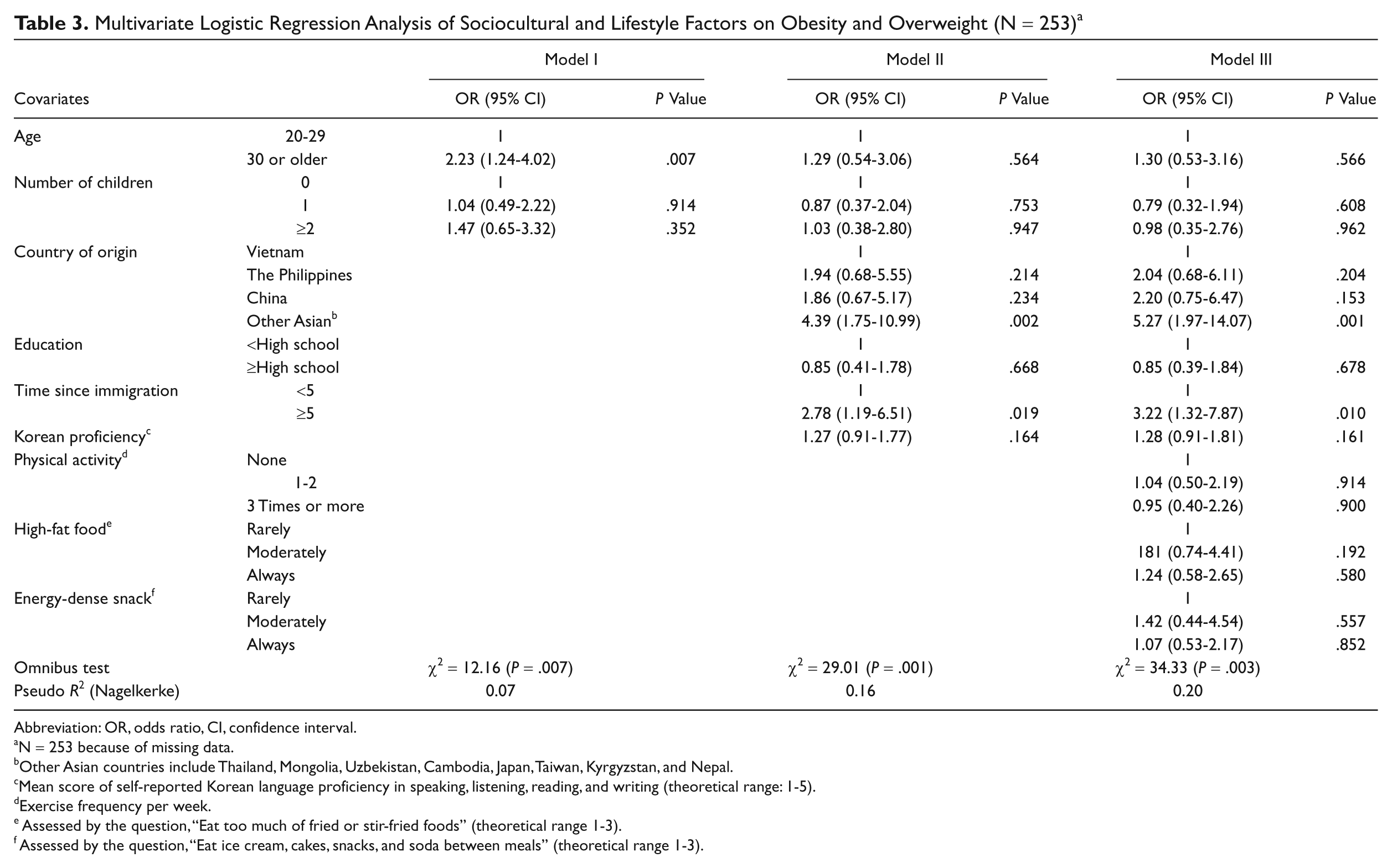
Finally, as shown in Table 3, the hierarchical logistic regression model shows the relative importance of demographic, sociocultural, and lifestyle factors that influence excess body weight among all Asian immigrant women in this study. Although age significantly predicted the likelihood of being obese or overweight in model I (OR = 2.23; 95% CI = 1.24-4.02), it was not a significant factor in model II. After adjusting for age and the number of children, immigrant women from other Asian countries with Vietnam as the reference (OR = 4.39; 95% CI = 1.75-10.99) and those who had been living in Korea for a long time since immigration (5+ years; OR = 2.78, 95% CI = 1.19-6.51) were at a significantly higher risk for being obese or overweight. Likewise, in the final model III, immigrant women from other Asian countries, with Vietnam as the reference (OR = 5.27; 95% CI = 1.97-14.07) and those who had immigrated earlier (5+ years; OR = 3.22, 95% CI = 1.32-7.87) were at a greater risk for being obese or overweight. There were no statistically significant associations of lifestyle factors with the likelihood of being overweight or obese.
Multivariate Logistic Regression Analysis of Sociocultural and Lifestyle Factors on Obesity and Overweight (N = 253) a
Abbreviation: OR, odds ratio, CI, confidence interval.
N = 253 because of missing data.
Other Asian countries include Thailand, Mongolia, Uzbekistan, Cambodia, Japan, Taiwan, Kyrgyzstan, and Nepal.
Mean score of self-reported Korean language proficiency in speaking, listening, reading, and writing (theoretical range: 1-5).
Exercise frequency per week.
Assessed by the question, “Eat too much of fried or stir-fried foods” (theoretical range 1-3).
Assessed by the question, “Eat ice cream, cakes, snacks, and soda between meals” (theoretical range 1-3).
Discussion
The mean BMI for Asian immigrant women in the present study was 22.0 kg/m2, and 15.0% of the sample were obese (BMI ≥ 25 kg/m2), showing a trend similar to those found in their young Korean female counterparts, aged 20 to 39 years, with a mean BMI of 22.0 kg/m2 and 15.9% obesity proportion. 20
The highest obesity proportion was found in Filipino women (22.0%), and the lowest was found in Vietnamese women (7.8%). Likewise, these results are parallel to the WHO Global Database on BMI, in that among women of 18 or 20 to 100 years old in these countries, the obesity proportion is highest in the Philippines (27.3%), then in China (18.8%), and Vietnam (6.2%). 24 Our findings show similar patterns for the obesity proportion by ethnicity in both immigrant women in Korea and adult women in each country of birth. Given the differences between the age categories used in the WHO Global Database on BMI and the age range of immigrant women in our study, comparisons of the obesity proportion in these groups should be interpreted cautiously.
Previous studies of obesity among immigrants have shown relatively low rates of obesity in Vietnamese immigrants. Kumar et al. 25 reported the lowest rate of obesity, with 24.3% in Vietnamese women among immigrants, including those from Turkey, Pakistan, Iran, and Vietnam in Norway. Also, research on obesity among subgroups of Asian Americans in the United States 17 found that Vietnamese women have the lowest BMI, followed by Chinese women, whereas Filipino women have the highest BMI. Consistent with these prior studies, the obesity proportion was low (7.8%) in Vietnamese women in comparison to other Asian immigrants in our study. However, this obesity rate observed in Korea is 3 times higher than the rate (2.3%-2.5%) ascertained from the nationally representative survey of Vietnam, which used data drawn from the same age group of women in their 20s to 30s in Vietnam.26,27 Given our finding that Vietnamese women with a low obesity rate also gained weight since immigration, one important consideration for future research would be to determine factors that influence increasing weight for interventions in the future.
As expected, immigrant women with longer durations of stay (5+ years) in Korea were found to be at higher risk of being overweight or obese. Previous studies have demonstrated that the duration of residence significantly increases the risk for weight gain among immigrants.9,16,17,28 Yeh and colleagues 15 reported that time since immigration is an important correlate of obesity and overweight for women regardless of ethnic origin. Research on immigrants in the United States, including Asians, has demonstrated that their BMI scores increase with time since immigration, in association with a progressive acculturation to a US diet and sedentary lifestyle.9,16 Consistent with this, Gentilucci et al. 16 found that duration of residence in Italy was directly related to both changes in weight and patterns of dietary behaviors. Kolt et al. 29 reported that Asian Indian immigrants to New Zealand have low levels of physical activity and high levels of overweight and obesity and lifestyle-related diseases. Physical activity decreased even further when individuals had resided in New Zealand for a longer period of time, after adjusting for age and gender. Research findings have suggested that the prevalence of obesity among adult immigrants living in the United States for at least 15 years reached that of adults born in the United States.9,28
The data also indicated that excess body weight in Vietnamese women was associated with Korean proficiency, not time since immigration; however, it is unclear why this was the case. Research suggests that language proficiency is likely to be associated with time since immigration. 8 In this study, it is possible that the negative relationship between Korean proficiency and excess body weight was only statistically significant, found by chance. Compared with other immigrants, most Vietnamese women began coming to Korea only 5 years ago 30 ; thus, the length of stay of Vietnamese women in Korea is relatively short (M = 3.5 years) to draw any conclusions with regard to weight gain since immigration. Further research is needed to examine the characteristics of the acculturation process and their associations with weight gain in the Vietnamese immigrant population in terms of duration of residence.
The increase in the prevalence of obesity is primarily a result of an environment that is increasingly obesity inducing rather than failure of metabolism or genetic abnormality within individuals. 3 Obesity is essentially tied to physical activity and diet. Obesity can have a negative impact on participation in physical activity, and conversely, decreased physical activity can influence the development and management of obesity. 29 However, in our study, none of the lifestyle factors, including physical activity, rich fat diet, and eating calorically dense snacks, was associated with the likelihood of being overweight or obese. Instruments for the measurement of physical activity and food consumption used in this study may not have been sensitive enough for assessment of energy expenditure and intake of calorically dense food.
Although Filipino women had comparatively high rates of overweight, our study did not clearly identify factors that explain this. More important, 69.0% of the group has gained weight since immigration. Cohort studies will be needed to identify factors that may be linked to weight gain in Filipinos who have immigrated to Korea.
One limitation of this study is that sample sizes for Chinese, Filipino, Vietnamese, and other Asian groups were too small to permit ethnicity-specific evaluations of nativity. Future studies with more representative samples of Asian immigrant women by country of origin will be necessary.
Conclusions
The present study examines the prevalence of obesity and overweight and identifies risk factors that affect excess body weight among immigrant women from developing Asian countries. Findings suggest that there are ethnic differences in the prevalence of excess weight among immigrant women in Korea. Also, immigrant women were likely to have gained weight since their arrival in Korea, and the prevalence of obesity and overweight increased as the time since immigration increased. However, it was unclear what factors other than a longer duration of residence led to weight gain among the immigrant women in this study. Longitudinal research is warranted to fully understand factors contributing to obesity and overweight in immigrant women with different countries of origin, using larger study samples and culturally appropriate measures to assess trajectories of physical activity and diet change. Consideration of the effect of acculturative stress and depressive mood on excess weight, which may have been caused in the process of adjusting to the mainstream culture, is of equal importance. Public health efforts need to combat obesity in this group starting on entrance into the country.
Footnotes
Declaration of Conflicting Interests
The author(s) declared no potential conflicts of interest with respect to the research, authorship, and/or publication of this article.
Funding
The author(s) disclosed receipt of the following financial support for the research, authorship, and/or publication of this article: The research reported in this article was a grant from the Health Promotion Fund, Ministry of Health & Welfare, Republic of Korea (No. 09-37).
Supported By
The research reported in this article was supported by a grant from the Health Promotion Fund, Ministry of Health & Welfare, Republic of Korea (No. 09-37).