







Abstract
This study aimed to investigate the associations between peroxisome proliferator-activated receptor γ coactivator-1α (PGC-1α) gene Gly482Ser polymorphism (rs8192678) and parameters of insulin resistance in a sample of Korean children. A total of 286 children aged 10 to 12 years old were recruited from local elementary schools. Measured variables included body fat, blood pressures, blood lipids, glucose, insulin, homeostasis model assessment of insulin resistance (HOMA-IR), and accelerometer-based physical activity (PA). Significant differences in percentage body fat (P = .016), insulin (P = .013), and HOMA-IR (P = .007) were found according to Gly482Ser genotype, with no significant genotype differences in the other measured variables. The genotype-specific differences in insulin (P = .136) and HOMA-IR (P = .067) were significantly attenuated when adjusted for age, sex, Tanner stage, body fat, and PA. The findings of the study suggest that the genetic effects of the PGC-1α genotypes on parameters of insulin resistance might be modulated by lifestyle factors, including PA and body fatness.
Introduction
Insulin resistance syndrome (IRS), defined as a clustering of metabolic risk factors, including hyperinsulinemia, dyslipidemia, and elevated resting blood pressure (BP), can result in an increased risk of cardiovascular diseases 1 and type 2 diabetes and some cancers.2,3 A global IRS epidemic already exists in the adult population, and the condition is now emerging, especially in East Asia. Although the exact etiology of IRS is uncertain, both genetic and lifestyle factors are likely to be involved in its development. 4
With the overall Korean lifestyle becoming more like that of Western countries, physical inactivity along with a high-caloric diet is becoming more prevalent in South Korea.5,6 Industrialization and the rapid growth of the technology sector have led to a decrease in workplace-based physical activity (PA), along with a simultaneous decrease in PA outside of the workplace as a consequence of TV watching and using personal computers and the Internet. Consequently, the Korean National Health Examination and Nutrition Survey reported in 2002 5 that compared with data reported in 1998, Korean children have experienced significant increases in body weight and body mass index, along with other risk factors for developing IRS. 6
Peroxisome proliferator-activated receptor γ coactivator-1α (PGC-1α) is a transcriptional coactivator of peroxisome proliferator-activated receptors (PPARs) γ and α, through which PPARs regulate the expression of genes encoding several key enzymes involved in the utilization of fatty acids, 7 adaptive thermogenesis, 8 hepatic gluconeogenesis, 9 induction of glucose transporter 4 in muscle, 10 and formation of slow-twitch muscle fiber in transgenic mice. 11 Decreased PGC-1 expression appears to result in decreased expression of nuclear respiratory factor and thereby insulin resistance as well as diabetes. 12 A quantitative-trait linkage analysis in Pima Indians suggested that basal insulin concentrations, an indicator of insulin sensitivity, are linked to chromosome 4q15.1, 13 where the PGC-1 gene is located. 14 Collectively, the previous findings suggest the PGC-1α gene as a potential candidate molecule for susceptibility to metabolic diseases, including obesity, insulin resistance, and type-2 diabetes.
The PGC-1α gene Gly482Ser polymorphism is associated with type 2 diabetes in Caucasians,15-17 Japanese, 18 and Asian Indians. 19 Yet little is known regarding the genetic effects of PGC-1α on its outcome phenotypes in the pediatric population, especially in Korea. Therefore, the purpose of this study was to investigate the associations between the PGC-1α gene Gly482Ser variants and parameters of IRS in a sample of children of Korean descent.
Methods
Recruitment of Participants
In this cross-sectional study, children 10 to 12 years of age (n = 286) were voluntarily recruited from elementary schools in the vicinity of Suwon, Republic of Korea. The participants were generally healthy and free of medications and had no contraindications to any of the study procedures. Children were excluded if they used any medications or had any chronic growth or development conditions that could affect the study results. Informed consent and assent were obtained from all parents and children, respectively. All procedures were reviewed and approved by our ethical review board, in accordance with the Declaration of Helsinki of the World Medical Association.
Anthropometrics and BP Measurements
Height and body mass were measured using a scale with an attached stadiometer (Jenix, Seoul, South Korea) and BMI was calculated as weight (kg) divided by height squared (m2). Waist circumference measurements were made using a cloth tape and were taken at the level of the umbilicus. Hip girth was measured as the horizontal circumference at the broadest part of the lower body, usually at the level of the trochanters. Percentage body fat was assessed using the X-Scan bioelectrical body composition analyzer (Jawon Medical Co, Kyungsan, South Korea). BP was measured with an automated BP instrument (Jawon Medical Co, Kyungsan, South Korea) with the child in a seated position, with the arm at heart level and resting on the armrest of a chair. Sexual maturation was determined using a sex-specific questionnaire, including a 5-stage scale, ranging from stage I (prepubertal) to stage V (fully mature), as described by Tanner. Using the gender-specific questionnaire, the participants reported their Tanner stage by comparing their own physical development with the 5 stages in standard sets of diagrams. When an individual reported discordant stages of pubic hair and breast or genital development, the assessment was repeated via home visits by a trained registered nurse, using the same gender-specific questionnaire.
Blood Samples
Between September 2009 and April 2010, venous blood samples were drawn with the children in the supine position following an overnight 10-hour fast. The fasting state was verbally confirmed by the child before blood sampling. Fasting glucose, total cholesterol (TC), triglycerides (TG), and high-density lipoprotein cholesterol (HDLC) levels were measured in duplicate by using the Ektachem DT-60 II analyzer (Johnson & Johnson Clinical Diagnostics, Inc, Rochester, NY).
Fasting insulin was also measured in duplicate using a commercially available enzyme-linked immunosorbent assay kit (ALPCO Diagnostics, Salem, NH). Insulin resistance and beta-cell function were assessed by homeostasis model assessment (HOMA); homeostasis model assessment of insulin resistance (HOMA-IR) = [fasting insulin (µU/mL) × fasting glucose (mM)]/22.5; and homeostasis model assessment of beta-cell function (HOMA-beta) = {20 × fasting insulin (µU/mL)/[fasting glucose (mM) − 3.5]}, as described elsewhere. 20 The intraassay and interassay coefficients of variation for insulin were 2% to 5% and 5% to 9%, respectively.
Leukocyte DNA Extraction and PGC-1α Genotyping
Genomic DNA was isolated from whole blood using the QIAmp blood kit (Qiagen, Chatsworth, CA). Genotyping for the PGC-1α Gly482Ser (rs8192678) polymorphism was performed with a 7900HT Sequence Detection System (Applied Biosystems, Foster City, CA) using fluorescent allelic discrimination TaqMan assays (Applied Biosystems), as previously described. 21
Quality control evaluations are regularly conducted for all laboratory procedures. Genotyping was carried out in batches, and each batch contained appropriate and verified allelic controls. Also, 5% of the total samples were repeated at random to verify reproducibility. The estimated genotyping error rate was approximately 1%. To prevent observer bias, the investigators were unaware of sample origin.
Assessment of PA
PA was assessed with the Kenz Lifecorder EX, a uniaxial accelerometer (LC; Suzuken Co Ltd, Nagoya, Japan). All children were asked to wear the device from the time they got up in the morning until they went to bed at night, except during bathing and showering, for the full 7-day data collection period. The activity levels were categorized into 1 of 9 activity classes (levels 1.0-9.0) based on PA energy expenditure. 22 The 9 activity levels were further classified into light PA (LPA), moderate PA (MPA), and vigorous PA (VPA).
Statistical Analyses
All variables were checked for normality and subjected to log10 transformation, if necessary, prior to statistical analyses. Descriptive statistics for raw variables are presented as mean ± standard deviation. Categorical variables, including sex and Tanner stage, were compared using the χ2 test. One-way ANOVA followed by a least-significant difference post hoc test, if necessary, was used to compare mean differences in the other variables across the PGC-1α gene Gly482Ser genotypes. A general linear model was then used to test the independent effects of the Gly482Ser variants on parameters of IRS, with age, sex, Tanner stage, body fat, and PA being entered as covariates in the model. Online software (http://www.changbioscience.com/genetics/hardy.html) was used to verify agreement with the Hardy-Weinberg expectation. Statistical analyses were performed with the SPSS-PC 13.0 software (SPSS Inc, Chicago, IL). A P value of less than 5% was considered statistically significant.
Results
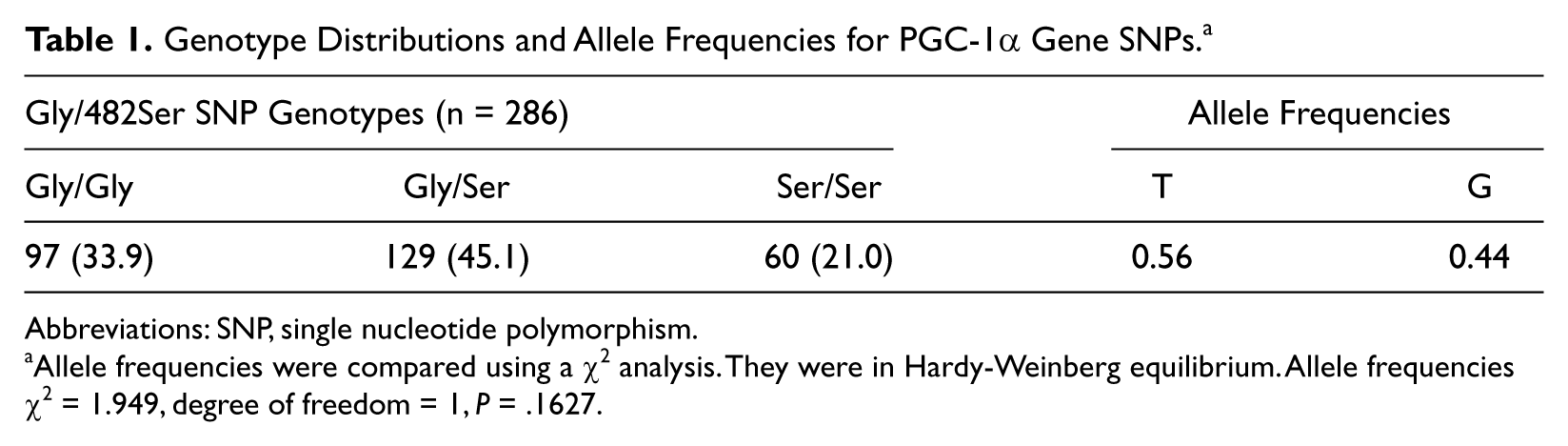
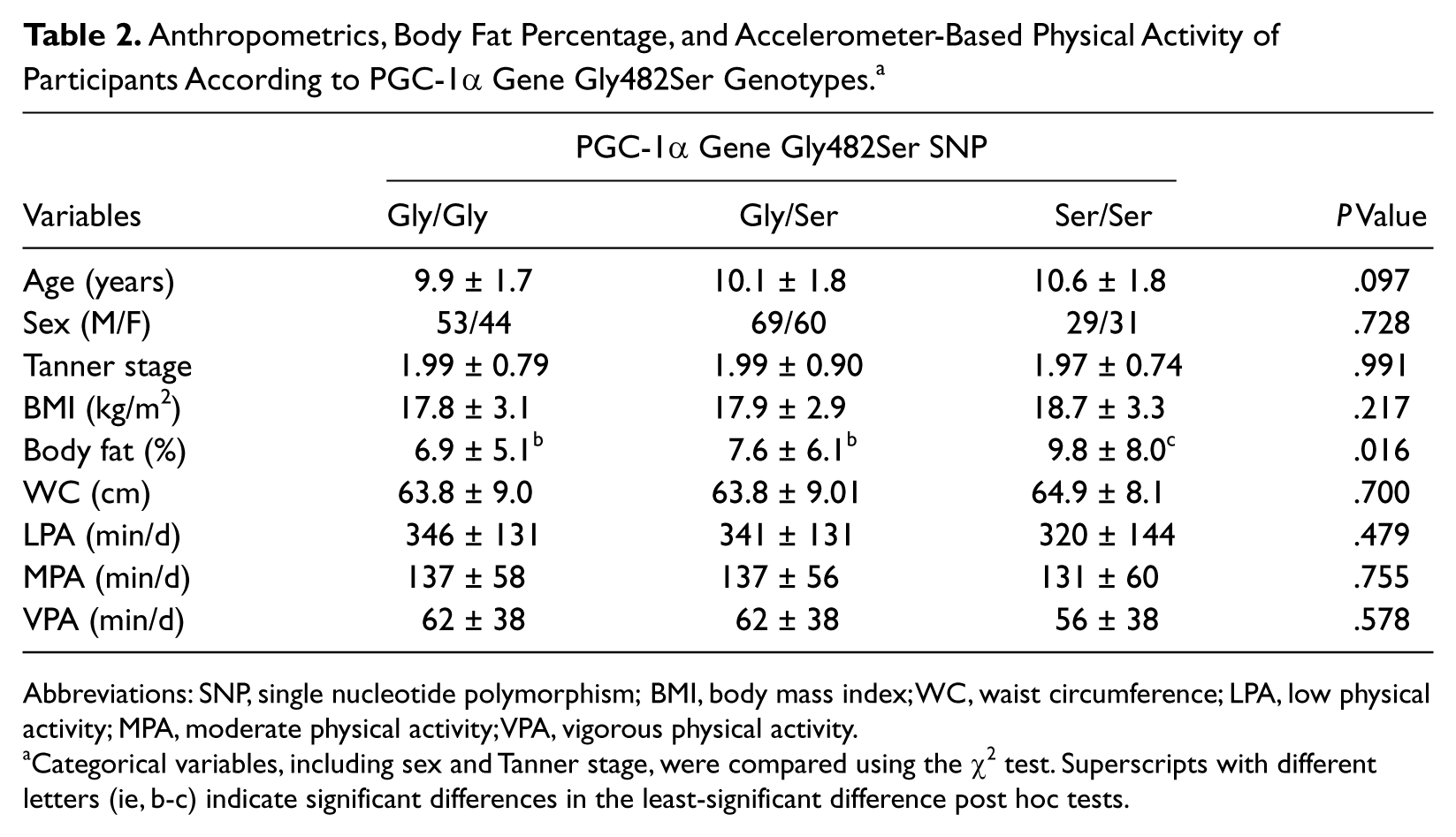
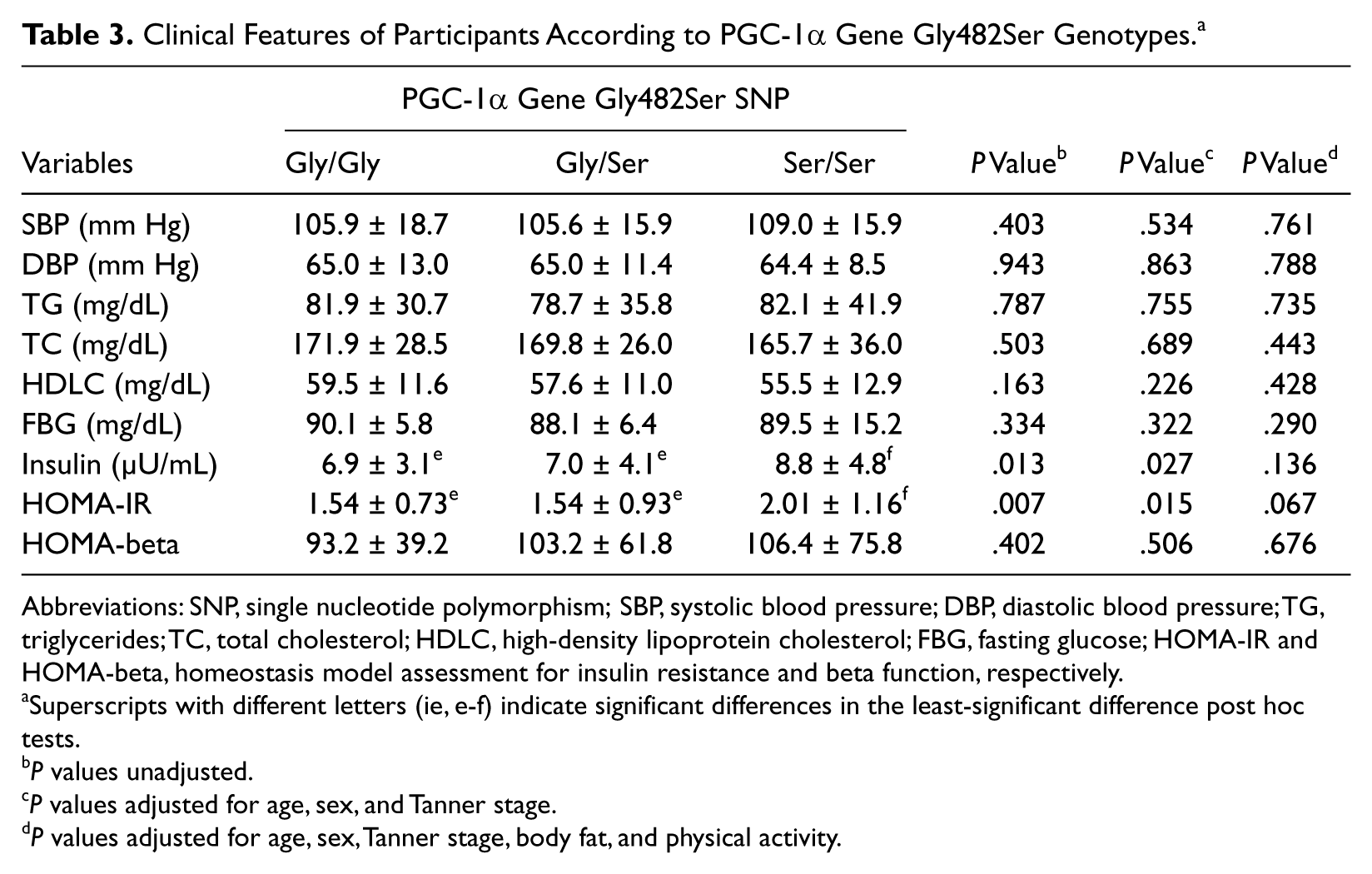
The participants (n = 277 out of 286) in the study were children of normal body weights, except for 9 children (3%) who were overweight and/or obese based on a BMI cutoff of 25.0 kg/m2, The distribution of the PGC-1α gene Gly482Ser single nucleotide polymorphism (SNP) was in Hardy-Weinberg equilibrium (Table 1). A significant difference in percentage body fat (P = .013) was found according to PGC-1α gene Gly482Ser genotype, with no significant genotype-specific differences by age, sex, Tanner stage, BMI, waist circumference, and level of accelerometer-based PA (Table 2). Significant differences in insulin (P = .027) and HOMA-IR (P = .007) values were found according to PGC-1α gene Gly482Ser genotype, with no genotype-specific differences in resting BP, TC, TG, HDLC, or fasting glucose levels, or HOMA-beta values (Table 3). Post hoc tests showed that the Ser482Ser genotype had significantly higher values of percentage body fat (P = .005 and .026, respectively), fasting insulin (P = .026 and .005, respectively), and HOMA-IR (P = .008 and .007, respectively) than the Gly482Gly and Gly482Ser genotypes. The genotype-dependent differences in fasting insulin (P = .027) and HOMA-IR (P = .015) values remained significant after controlling for age, sex, and Tanner stage; however, the genotype differences in insulin (P = .136) and HOMA-IR (P = .067) values were no longer significant when additionally controlled for body fat and accelerometer-based PA.
Genotype Distributions and Allele Frequencies for PGC-1α Gene SNPs. a
Abbreviations: SNP, single nucleotide polymorphism.
Allele frequencies were compared using a χ2 analysis. They were in Hardy-Weinberg equilibrium. Allele frequencies χ2 = 1.949, degree of freedom = 1, P = .1627.
Anthropometrics, Body Fat Percentage, and Accelerometer-Based Physical Activity of Participants According to PGC-1α Gene Gly482Ser Genotypes. a
Abbreviations: SNP, single nucleotide polymorphism; BMI, body mass index; WC, waist circumference; LPA, low physical activity; MPA, moderate physical activity; VPA, vigorous physical activity.
Categorical variables, including sex and Tanner stage, were compared using the χ2 test. Superscripts with different letters (ie, b-c) indicate significant differences in the least-significant difference post hoc tests.
Clinical Features of Participants According to PGC-1α Gene Gly482Ser Genotypes. a
Abbreviations: SNP, single nucleotide polymorphism; SBP, systolic blood pressure; DBP, diastolic blood pressure; TG, triglycerides; TC, total cholesterol; HDLC, high-density lipoprotein cholesterol; FBG, fasting glucose; HOMA-IR and HOMA-beta, homeostasis model assessment for insulin resistance and beta function, respectively.
Superscripts with different letters (ie, e-f) indicate significant differences in the least-significant difference post hoc tests.
P values unadjusted.
P values adjusted for age, sex, and Tanner stage.
P values adjusted for age, sex, Tanner stage, body fat, and physical activity.
Discussion
Using a cross-sectional design, we studied the associations between the PGC-1α gene Gly482Ser genotypes and parameters of IRS in Korean children. To our knowledge, this is the first study reporting significant differences in percentage body fat, fasting insulin, and HOMA-IR values, independent of age, sex, and Tanner stage, according to PGC-1α Gly482Ser polymorphism genotype in this pediatric population. Yet the genotype differences in fasting insulin and HOMA-IR values were significantly attenuated when additionally adjusted for parameters of body fatness and accelerometer-based levels of PA.
The current findings are in line with previous studies reporting significant relationships between the PGC-1α gene Gly482Ser genotypes and insulin resistance in nondiabetic, Japanese adults 18 as well as in nondiabetic Caucasians with obesity. 23 In nondiabetic Japanese adults, for example, Hara et al 18 reported that compared with either the Gly482Gly or Gly482Ser genotype, the Ser482Ser genotype had significantly higher values of fasting insulin and HOMA-IR independent of age, sex, and body mass index. Similarly, Fanelli et al 23 found that the 482Ser variant was associated with higher fasting insulin and HOMA-IR values in obese nondiabetic adults. Andrulionytè et al 24 reported that the 482Ser variant of the PGC-1α gene was a significant predictor in estimating the risk of conversion from impaired glucose tolerance to diabetes in the STOP-NIDDM trial involving various populations. Zhang et al 25 reported that the frequency of the 482Ser variant of the PGC-1α gene was significantly higher in individuals with diabetes than in controls in a southern Chinese population. Hara et al 18 reported that the Thr394Thr-Gly482Ser haplotype was significantly associated with type-2 diabetes in a case-control study consisting of Japanese nondiabetic and diabetic participants. Taken together, these findings suggest that the PGC-1 gene Gly482Ser genotypes are implicated in the pathogenesis of insulin resistance18,23 and thereby type-2 diabetes.18,24,25
Several explanations are possible for the significant associations between the Gly482Ser SNPs and parameters of IRS found in this study. First, the PGC-1α gene Gly482Ser genotypes may influence the interaction between PGC-1α and myocyte enhancer factor 2C, which is an inducible factor of the endogenous glucose transporter for glucose utilization in muscle cells. Zhang et al, 25 using the bacterial 2-hybrid system and site-directed mutagenesis, showed that the 482Ser variant (G→A) caused an impaired binding with myocyte enhancer factor 2C. Second, there is some evidence showing a linkage equilibrium between the 482Ser variant and other loci. For example, in a case-control study involving 537 type-2 diabetic and 417 nondiabetic Japanese adults, Hara et al 18 found a significant difference in the distribution of the Thr394Thr-Gly482Ser haplotype of the PGC-1 gene. Third, PGC-1α is a transcriptional coactivator that plays a key role in mitochondrial biogenesis, glucose and lipid transportation and oxidation, and skeletal muscle fiber-type formation.26,27 Exercise training increases PGC-1α mRNA levels, 28 and transgenic overexpression of PGC-1α induces an increased resistance to muscle fatigue, 27 suggesting that PGC-1α and exercise are part of a coregulatory feedback loop. In a study sample of Danish adults, Ling et al 29 showed that the Ser482 allele was inversely related to PGC-1α mRNA levels and cardiorespiratory fitness, which was measured as the maximum volume of oxygen consumption (VO2max) during a graded exercise testing. Franks et al 30 reported the interaction between PA and the Gly482Ser variant on VO2max. In addition, PA is well known to improve the metabolic risk profile via enhanced muscle sensitivity to insulin-mediated glucose uptake and postprandial fat oxidation. 31 Aerobic exercise results in physiological adaptations that provide a protective mechanism in relation to metabolic risk factors, including an increase in capillary supply to skeletal muscles, 32 increases in the enzymatic activities of the mitochondrial electron transport chain, and a concomitant increase in mitochondrial volume and density. 33 Given the metabolic characteristics of PGC-1α and the manner in which exercise training modulates its expression and metabolic risk profile, therefore, a further study would be necessary to investigate whether the genetic susceptibility of the 482Ser variant to IRS is differently influenced by improvements in modifiable lifestyle risk factors, including PA and body fatness, even in children of normal body weights.
This study has some limitations. Although we believe that estimation of insulin resistance using fasting insulin and HOMA-IR values is acceptable as convenient approximations in nondiabetic and healthy children, interpretation of the results should be made with caution until the findings are confirmed by a euglycemic hyperinsulinemic clamp in a population-based case and control study. In addition, further investigation is needed to study whether modifiable lifestyle factors, including body fat percentage and PA and fitness, modulate the genetic susceptibility of the 482Ser variant to IRS.
Conclusions
This study examined the association between the PGC-1α gene Gly482Ser genotype and parameters of insulin resistance in a sample of Korean adolescents. The findings of the present study suggest that the PGC-1α gene Gly482Ser SNP is associated with fasting insulin and HOMA-IR values in this study sample; however, the genetic effect of the PGC-1α genotypes on parameters of IRS are substantially attenuated by individual variations in both body fat percentage and PA. These data emphasize the importance of incorporating key behavioral and physiological traits in genetic association studies to better understand how interactions between genotypes and nongenetic factors affect multifactorial phenotypes, such as IRS. Results from this study also suggest that PA, along with improved body fatness, may be an important tool for modification of the outcome phenotypes resulting from the PGC-1α gene Gly482Ser genotypes.
Footnotes
Declaration of Conflicting Interests
The author(s) declared no conflicts of interest with respect to the research, authorship, and publication of this article.
Funding
The author(s) disclosed receipt of the following financial support for the research, authorship, and/or publication of this article: This study was supported by a grant from the Korean Research Foundation (KRF-2009-32A-G00046).