





Abstract
A prospective cross-sectional study was conducted at 3 government hospitals over 6 months to evaluate the confidence level of medical officers (MOs) to perform clinical procedure in nonspecialist government hospitals in Penang. An anonymous self-administered questionnaire in English was designed based on the elective and emergency procedures stated in the houseman training logbook. The questionnaire was distributed to the MOs from Penang State Health Department through the respective hospital directors and returned to Penang State Health Department on completion. The results showed that there was statistically significant difference between those who had undergone 12 months and 24 months as houseman in performing both elective and emergency procedures. MOs who had spent 24 months as housemen expressed higher confidence level than those who had only 12 months of experience. We also found that the confidence level was statistically and significantly influenced by visiting specialist and working together with cooperative experienced paramedics.
Keywords
Introduction
Clinical skills are important to patients, and they are clearly important to physicians who desire to be successful professionals. 1 On graduation, each doctor is faced with the task of transforming the theoretical knowledge gained during training into practical and procedural skills of a competent professional. 2
In Malaysia, Section 13(2) of the Medical Act 1971 regulates that fresh medical graduates shall undergo further training for the purpose of obtaining experience and training as a house officer, which includes 4 months posting in surgery, orthopedics, medicine, pediatrics, obstetrics and gynecology, and accident and emergency prior to posting out to nonspecialist government hospital as medical officers (MOs). 3 Since the amendment on the Act, fresh medical graduates have to undergo 24 months training (previously 12 months) beginning January 1, 2008. In these 24 months, fresh graduates will be assigned to 6 departments mentioned above and spend 4 months in each department.
On completion of all the mentioned rotation, a house officer is expected to be well prepared to shoulder the responsibilities as an MO. Therefore, houseman training maybe the last real opportunity to ensure that an MO posted out to the nonspecialist government hospital becomes proficient in performing clinical procedures after graduation.
Junior doctors often face several challenges as they embark on their professional careers, one of which is the need to perform clinical procedure competently. 4 MOs serving in a nonspecialist government hospital are often relied on by their local community to provide them with a comprehensive medical service. They are expected to possess sufficient knowledge and technical skills to provide a high level of acuity of care in a variety of clinical areas in addition to procedural care, and play an important role in public health.5,6
Despite the fact that young doctors should possess certain medical skills as a result of their undergraduate education, there is evidence to suggest that they are inadequately prepared for the beginning of their clinical practice. Mentors of the young doctors working through their internship are of similar opinion,7-9 and despite the continuing emphasis on the importance of clinical skills, these skills do not appear to be improving and may actually be declining. 1
The aim of this study was to investigate the relationship between years, place of training, and post training working experience of the MOs to their level of confidence in performing clinical procedures. Particular emphasis will be placed on the effect of changing the houseman training from 12 months to 24 months on MOs’ confidence level.
Materials and Methods
Participants
The participants of this study were certified MOs (by the Malaysian Medical Council) who are currently practicing in nonspecialist government hospitals in Penang and had consented to participate in the study. The hospital directors, MOs not practicing in nonspecialist hospitals in Penang, and noncertified MOs were not invited to participate in the survey. Based on these criteria, there were 53 MOs who were qualified to participate, and of these only 52 agreed to participate.
Study Site
The study was conducted in Penang, Malaysia, from January 2012 to June 2012.Three nonspecialist government hospitals were chosen, namely, Kepala Batas Hospital, Sungai Bakap Hospital, and Balik Pulau Hospital.
The Questionnaire
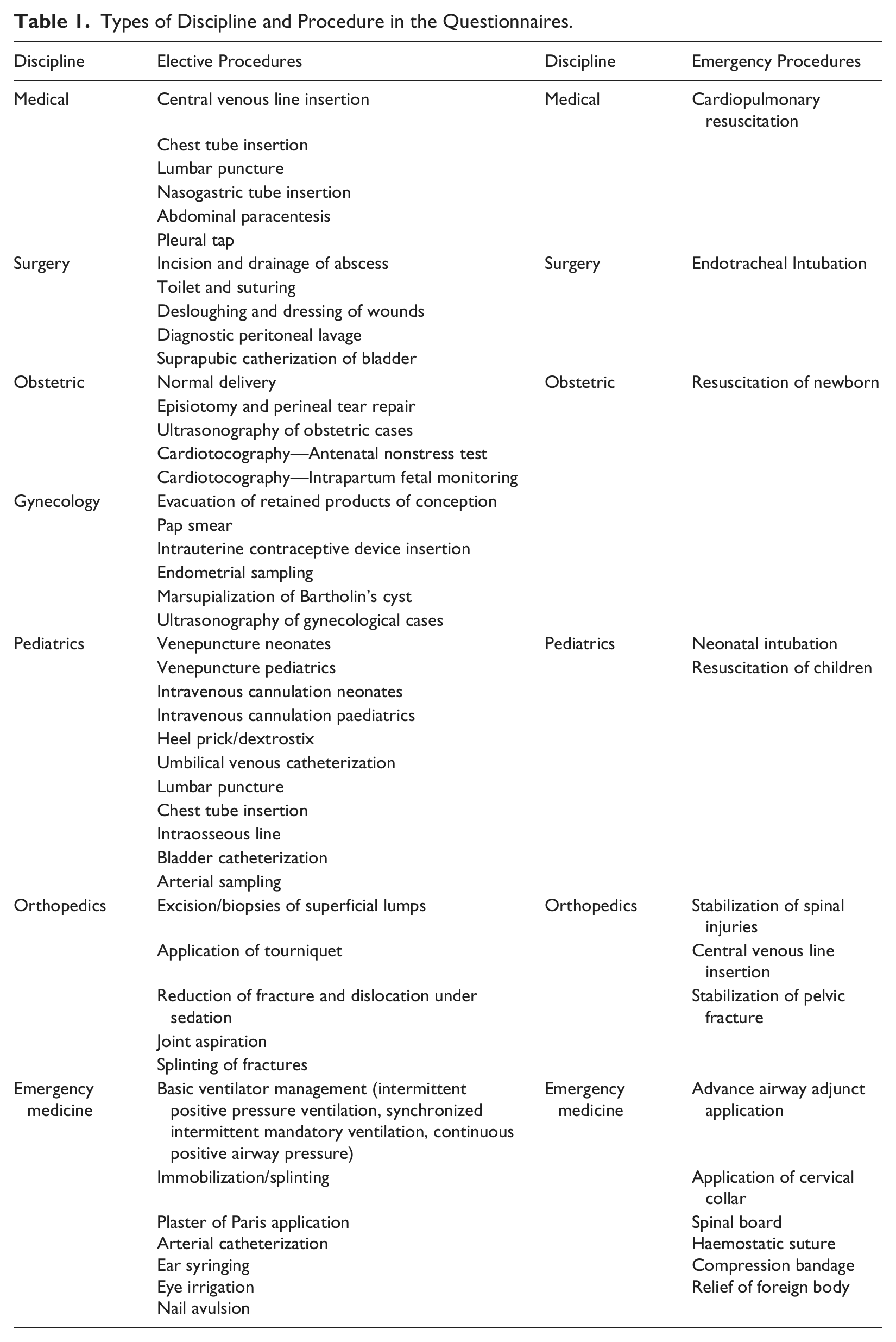
An anonymous self-administered questionnaire in English was designed based on the elective and emergency procedures stated in houseman training logbook by the researchers. The participants had to answer basic questions such as number of months in house officer training, experience as MO, and experience as MO in nonspecialist and specialist hospitals. These questions aimed to categorize the participants according to experience level in our analysis later. Participants also were requested to state their confidence levels on a 5-point Likert-type scale from 1 = not confident to 5 = extremely confident on both elective and emergency procedures. The disciplines for these 2 procedures under study were reported in Table 1. The participants were also asked to state their opinion on the relation between the support from the hospital director, fellow MOs, paramedics, visiting specialists to the hospitals, working hours, and the 7-day compulsory course to the confidence level. The participants simply answered “yes” or “no” whether these parameters can help in enhancing their confidence level in clinical practices.
Types of Discipline and Procedure in the Questionnaires.
Administration of Questionnaires and Data Collection
In the initial stage, Penang State Health Department would ask the directors of the number of MOs currently practicing in his hospital. The questionnaires were then delivered to each hospital’s directors from State Health Department. The participants had to return the filled questionnaires within 2 weeks in a sealed envelope before they were returned to the department. The procedure ensures anonymity of the identity of the subjects.
Prior to the distribution of the questionnaires, the participants were made know that they were free to make the decision whether to participate or not. If they agreed, they would return the questionnaires, and if they did not agree to participate, they did not have to return the questionnaires.
The directors ensured that all MOs in the respective hospitals received the subject information sheet, consent form, and questionnaires. Subjects who agreed to participate in this study signed the information sheet and consent form in the presences of a witness who was selected by the respective hospital directors. A copy of the subject information sheet and consent form was given to the subject. The witness filled subject’s identification log and information collected for this study was kept confidential. Subjects’ responses, to the extent of the applicable laws and regulations, were not made publicly available. Only the investigator(s) had access to the information. The hospital directors then dispatched the documents, the self-administered questionnaires, and subject’s identification log back to the Penang State Health Department after 2 weeks from the date when questionnaires were sent to them.
Ethics
The research proposal was submitted to the Medical Research Ethics Committee and Ministry of Health Malaysia and was approved prior to initiation of the study.
Results
The participants consisted of 42 MOs who have clinical experience less than 1 year, 3 respondents less than 2 years, and 7 respondents more than 2 years. From the total respondents, 6 respondents have undergone 12 months training and 46 respondents have spent 24 months as houseman. Among the MOs surveyed, 15 respondents answered that they have working experience in specialist hospitals and 37 answered that they do not have the experience.
The confidence level among MOs who have been trained for 12 months is compared with MOs who have been trained for 24 months as houseman. The results show that the number of years as houseman plays an important role in confidence level. Figure 1 shows the differences in confidence level among MOs in both elective and emergency procedures according to disciplines. Nonparametric Mann–Whitney 2-sample test reveals that there is statistically significant difference between those who had undergone 12 months and 24 months as houseman in performing elective procedures (Z = −2.549, P = .0108), with MOs who have spent 24 months as houseman expressing higher confidence than those who spent only 12 months. Similar test also shows that spending 24 months as houseman results in higher confidence level in emergency procedures compared with spending 12 months (Z = −1.735, P = .0828).

Reported confidence level in (a) elective procedures and (b) emergency procedures according to disciplines.
We further present additional evidence whether the result that number of years as houseman affects the confidence level is robust. Table 2 reports the results of panel regressions taking into account the factors that might affect the confidence level with subject as random effect. The confidence levels in both elective and emergency practices are pooled average confidence levels from all the disciplines for the respective procedures reported by the participants. Column 1 of the table tests the presence of medical officers’ experience on confidence level. This allows one to investigate the effect of seniority on confidence level before proceeding to test the effect of the number of months in the houseman training program. From the result, the effect of seniority is not statistically significant in determining the reported confidence level. Those who have undergone 24 months of houseman training expressed significantly higher confidence level in both elective and emergency procedures. For example, in column 2, on average, the regression result shows that those who have undergone houseman training for 24 months have a higher confidence level by 0.6608 compared with those who have spent only 12 months in houseman training.
Panel Regressions on Confidence Level in Performing Elective and Emergency Procedures. a
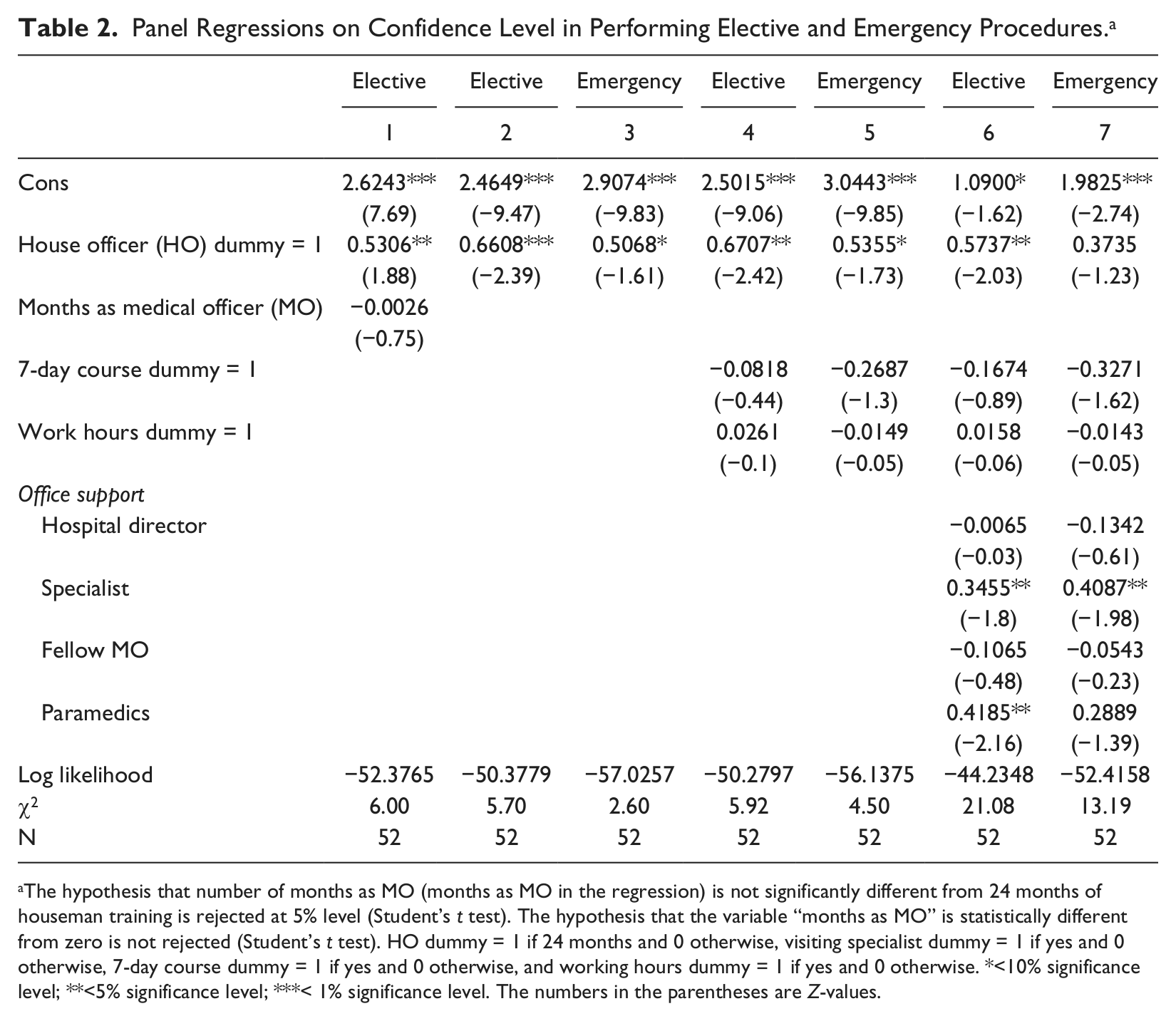
The hypothesis that number of months as MO (months as MO in the regression) is not significantly different from 24 months of houseman training is rejected at 5% level (Student’s t test). The hypothesis that the variable “months as MO” is statistically different from zero is not rejected (Student’s t test). HO dummy = 1 if 24 months and 0 otherwise, visiting specialist dummy = 1 if yes and 0 otherwise, 7-day course dummy = 1 if yes and 0 otherwise, and working hours dummy = 1 if yes and 0 otherwise. *<10% significance level; **<5% significance level; ***< 1% significance level. The numbers in the parentheses are Z-values.
We also find that attending the 7-day compulsory course and working hours do not influence the confidence level statistically. Contrary to the expectation of the organization, the confidence level in performing both elective and emergency procedures has no significant relation to the mandatory 7-day compulsory course and number of working hours (columns 4 and 5). Among the other factors, visiting specialist is the most helpful in boosting the confidence level of the young MOs (columns 6 and 7). Respondents who have answered “satisfactory” on the supporting role played by visiting specialist on their clinical works, also report significantly higher confidence level compared with support given by hospital director and fellow medical officers. The second most helpful factor comes from in-house paramedics.
Discussion
Since the amendment on the Section 12(2) of the Medical Act 1971, fresh graduates have to undergo houseman training for 24 months since January 1, 2008. They have to spend 4 months in each 6 different departments, namely surgical, orthopedics, medical, pediatrics, obstetrics and gynecology, and accident and emergency, or intensive care and anesthesiology. The training covered in 24 months of houseman training, therefore, is more comprehensive than 12 months of training, which covered only 3 disciplines, namely 3 out of surgical, orthopedics, medical, pediatrics, and obstetrics and gynecology departments. Therefore, the study of the effect of the amendment from 12 months to 24 months extension is important. In addition to the training, we also look into how these young MOs interact with work environment, such as with paramedics, visiting specialists, and others, to improve their efficiency at work.
Medical officers who have undergone 24 months of houseman training are shown to have higher confidence level in performing clinical procedures. During the 24 months of houseman training, one is allowed to rotate to the next department after he or she has received approval from their current respective department head. The housemen are believed to have shown sufficient competency level in performing clinical works and procedures before the approval is granted. In November 2011, the Malaysian Health Ministry also made it compulsory for each training hospital to establish a committee to monitor and facilitate houseman training. The State Health Department of Penang also takes the initiative to form a committee to monitor the training needs of houseman. In contrast to the 12-months housemanship, there is no such mandatory rules and facilities. The study has proven empirically the effectiveness of the efforts in helping to increase the competitiveness of the young MOs.
Based on the Malaysian Public Service Department circular in 2005, it is mandatory for all officers of the federal public service to undergo a mandatory 7-days (in total) course per year. However, based on the regression results and the confidence level reported by the participants, the confidence level in performing both elective and emergency procedures are not statistically significantly related to the 7-day course. The negative sign of the 7-day course does not mean attending the course lower one’s confidence level; rather, the insignificance of the variable means that there is no statistically discernible relation between attending the course and the confidence level. This may be because of the courses offered, which cover wide aspects of that topic and are mostly related to knowledge rather than hands-on skills, such as motivational and administrative, which aims to prepare the new officers in the new work environment. Currently, there are limited hands-on courses offered to doctors as it is difficult to recruit patients and volunteers for these courses. Often, courses attended are not even related to one’s own clinical field, and doctors merely attend them to abide by the ruling.
The hands-on skills provided by the visiting specialist are found to be useful by the young medical officers. Apart from performing clinical procedures themselves, these visiting specialists monitor clinical works and procedures carried out by the medical officers. Bedside teaching is also implemented during ward rounds where hands-on skills are taught and monitored regularly. Discussions are held during each visit to address problems faced by medical officers.
Conclusion
The study confirms the effectiveness of new curricular in houseman training by enhancing the confidence level of MOs to perform both emergency and elective clinical procedures. It is shown to be able to produce refined doctors to serve the community. However, courses conducted by the Ministry of Health should focus more on hands-on skills rather than course work to boost doctors’ confidence level in performing clinical procedures. The visiting specialist program is proven to be good and should be continued.
Study Limitation
Our study is limited by sample size and is represented by nonspecialist government hospitals in the state of Penang only. The study was not able to consider individual differences such as personality and learning style, although these did not emerge in the data as attributions for preparedness.
Footnotes
Acknowledgements
We wish to thank the Director General of Health and the Penang State Health Director for encouraging the work and permission to publish the article. We also wish to express our appreciation for the support from the participating Hospital Directors, namely Hospital Kepala Batas, Hospital Sungai Bakap, and Hospital Balik Pulau who assisted us in the investigations carried out in their hospitals. We would also like to thank Penang Clinical Research Centre, Hospital Pulau Pinang for their input and guidance. Last but not least, we would like to express our gratitude to the National Institute of Health Malaysia, particularly the Institute of Health System Research, Malaysia, for the comments and feedback to improve the article.
Declaration of Conflicting Interests
The author(s) declared no potential conflicts of interest with respect to the research, authorship, and/or publication of this article.
Funding
The author(s) received no financial support for the research, authorship, and/or publication of this article.