







Abstract
Dietary supplements use is relatively widespread in some countries but knowledge of supplements consumption in Malaysia is limited, more so among adolescents. This study aimed to investigate the determinants of dietary supplements use among Malaysian adolescents using multiple logistic regressions analysis. Data from the Malaysia School-based Nutrition Survey 2012 based on a 2-stage stratified sampling was used. The prevalence of vitamin/mineral supplements and food supplements intake among adolescents was 54.1% and 40.2%, respectively. Usage was significantly higher among younger adolescents and among boys. Dietary supplements were also taken mostly by those who thought they were underweight. The most common vitamin/mineral supplements and food supplements consumed were vitamin C and bee products. The main reason for taking supplements was parents’ instruction. These findings can be useful for developing health communications on supplement use targeted to adolescents and their parents.
Keywords
Introduction
The use of supplements is relatively widespread in some countries. Among young children and adolescents, reports on prevalence of dietary supplements use in the United States and European and Asian countries range from 20% to 34%,1-4 with multivitamins as the most commonly consumed supplement. In the United States, furthermore, younger age and lower body mass index (BMI) were associated with higher use of dietary supplements. 5
Although several studies have suggested that vitamin/mineral supplements (VMS) may help reduce chronic disease risks,6,7 not all trials have proven supplementation to be beneficial.8-10 In addition, there might be dietary supplement interactions for those who consume 2 or more types or drug–dietary supplement interactions. 11 Consuming a variety of foods is preferred as a source of nutrients. Furthermore, children are in the process of establishing healthy dietary habits; thus, supplementation may disrupt this process. Supplementation is only recommended for children who are at risk of deficiency. 12 However, parents tend to give their children supplements due to perceived imbalances in their children’s dietary intakes, their child’s health conditions, or their own health beliefs.
There are numerous studies on dietary supplement use in children and adolescents from Western countries, but data on Asian countries are limited. To date, no nationwide survey has been conducted on supplements intake among adolescents in Malaysia. This study aimed to bridge the gap in knowledge by assessing patterns of VMS and food supplements consumption and its determinants among a nationally representative sample of school-going adolescents in Malaysia.
Methods
Sampling
The Malaysia School-based Nutrition Survey (MSNS 2012) conducted by the Ministry of Health Malaysia was a representative survey of government primary and secondary school students. A total of 40 011 students from 329 schools were selected systematically with probability proportional to enrolment in Year 4 (10 years old) to Form 5 (17 years old) using a random start. 13 Ethical approval was obtained from the Ministry of Health Research and Ethics Committee. In addition, approvals to conduct the survey in schools were obtained from the Ministry of Education Malaysia and relevant Ministry of Education offices at state, district, and the selected schools authorities. Parental consent was also obtained.
The data collection was conducted throughout Malaysia from February until April 2012.
Definitions of Variables
Dietary supplements were categorized into 2 categories, that is, VMS and food supplements. The response options for VMS consumed were multivitamins, vitamin C, iron, and others. For food supplements, the response options were spirulina, fish oil, bee products, chicken essence, and others. These response options were included based on expert opinion. Students were asked about the frequency of taking the supplements as well as their reasons.
Weight and height were measured by trained data collectors. Body weight was measured using a digital weighing scale (Tanita 319, Japan) to the nearest 0.1 kg, whereas body height was assessed using a Seca bodymeter (SECA 206, Germany) to the nearest 0.1 cm. Measurements were taken twice for each student, and the average value was used. Based on the weight and height measurements, BMI-for-age z score were calculated using Nutstat (CDC 2000) software 14 and classified according to z-score for BMI-for-age as recommended by the World Health Organization (2007). 15
Body weight perception was assessed mainly through the question, “How do you describe your body weight?” with the following single response options: very underweight, underweight, normal weight, overweight, and very overweight.
Physical activity information was collected using the self-administered Physical Activity Questionnaire for Older Children, which consisted of a 9-item questionnaire to assess the physical activity level in the past 7 days. A mean score ranging from 1 to 5 was calculated for yielding a total mean score for the 9 items categorized as follows: 1.00 to 2.33 low activity level, 2.34 to 3.66 moderate, and 3.67 to 5.00 high physical activity level. Those with moderate or high physical activity level were categorized as active, whereas those with low physical activity level were categorized as not active.
Data Analysis
Data were analyzed using the SPSS version 21 (SPSS IBM, New York, NY). Descriptive analyses were done to determine the prevalence of dietary supplements use among Malaysian adolescents by sociodemographic profiles (sex, age group, and ethnicity), weight perception, weight status, and physical activity level. Multiple logistic regression was applied to analyze the predictors of adolescents’ dietary supplements use. The final model was created to include all predictors and interactions that were significantly associated at the level of P < .05. All analyses were done using complex sampling design to account for sample weights.
Results
This study showed that the prevalence of VMS intake among adolescents was 54.1%, while 40.2% took food supplements. The proportions taking supplements were significantly higher among those 10 to 12 years old, that is, 69.0% for VMS and 52.1% for food supplements, than older adolescents (13-17 years old), and among boys 57.0% for VMS and 43.7% for food supplements than girls (51.1% for VMS and 36.7% for food supplements). More adolescents of Indian ethnicity consumed VMS, while other ethnic groups consumed more food supplements (Table 1).
Sociodemographic Characteristics for Dietary Supplements.
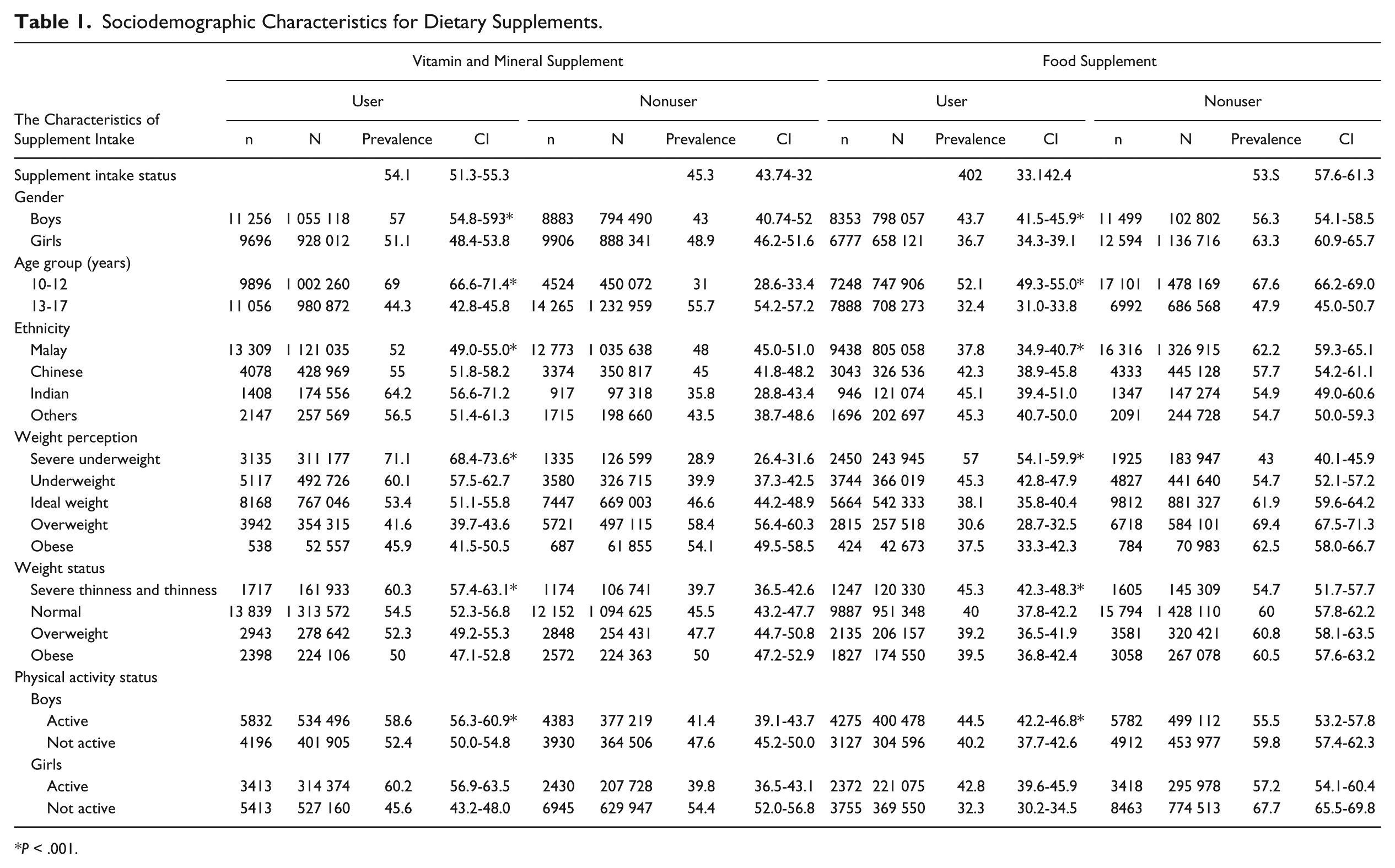
P < .001.
The most commonly consumed VMS was vitamin C (72.4%), followed to a much lesser extent by multivitamin (11.3%) and iron (7.0%); bee products were the most commonly consumed food supplement (25.9%), followed by fish oil (23.2%) and spirulina (16.2%). The main reasons for taking dietary supplements were parents’ instruction, self-awareness, and doctor’s instruction (Table 2).
Reasons for Using Dietary Supplements.
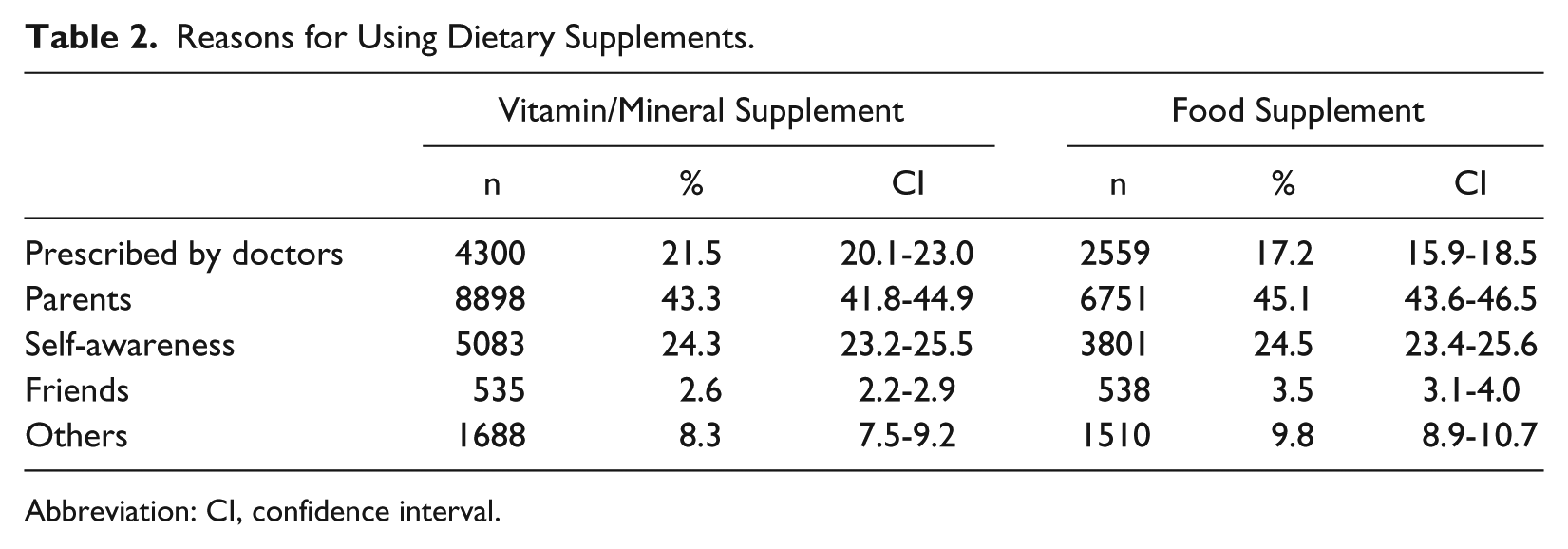
Abbreviation: CI, confidence interval.
Multiple logistic regressions revealed that adolescents in the younger age group were twice as likely to use dietary supplements. In addition, boys, adolescents who perceived themselves as underweight, as well as those active in physical activity were more likely to use dietary supplements (Table 3).
Determinants of Dietary Supplements Use among Adolescents.
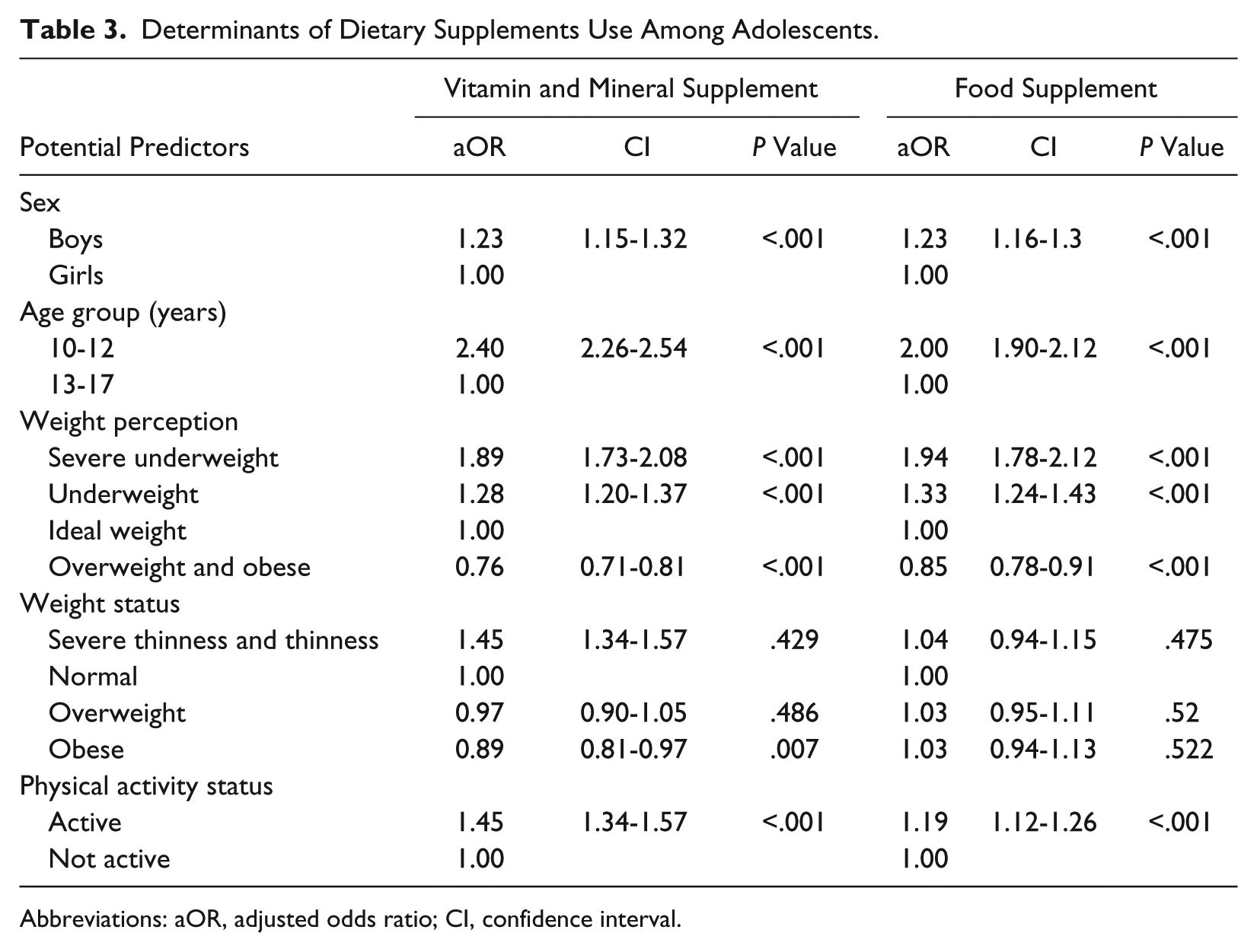
Abbreviations: aOR, adjusted odds ratio; CI, confidence interval.
Discussion
This study revealed that 54.1% and 40.2% of the adolescents took VMS and food supplements, respectively, which were higher than rates found in other studies. The United States’ National Health and Nutrition Examination Survey, 1999-2002, reported a 26% prevalence among 14- to 18-year-old teenagers. 16 In Korea, the prevalence of dietary supplements use from 2007 to 2009 in grades 4 to 6, 7 to 9, and 10 to 12 were 29.5%, 28.0%, and 25.9%, respectively. 3 A study in an urban Japanese city, in 2008, reported that 20.4% of children and adolescents are currently using or have used supplements. 4 Another study in Germany between 1986 and 2003 showed 25.8% of children and adolescents used supplements. 2 The Malaysian Adult Nutrition Survey 2003 reported that the prevalence of VMS and food supplements intake among adults was 23.9% and 24.8%, respectively. 17 However, there was no comparison data for Malaysian children and adolescents.
The higher prevalence from this study may be due to the wide availability of dietary supplements over the counter, such as pharmacies, as there is no regulation on the sale of supplements in Malaysia. There is also no regulation or health policy on the use of supplements. Dietary supplements use might be influenced by commercial advertisements too.
In this study, the use of dietary supplement was higher in the younger age group. This finding was echoed by Picciano et al, 16 who also reported that dietary supplement use was highest among 4- to 8-year-old children and lowest among teenagers aged 14 to 18 years old. Similar results were also shown by other studies in the United States (2003-2006) and Korea.1,2 Furthermore, multiple logistic regressions confirmed that, controlling for other factors, younger age was significantly associated with higher use of VMS and food supplements in the present study. Similarly, Shaikh et al 5 noted significant associations between VMS use and younger children and adolescents. Conversely, Mori et al reported that the prevalence of users in Japanese adolescents increased with increasing age. 4
Our study showed significant higher usage of supplements among boys than girls, while Picciano et al 16 found that there was no significant sex differences in the use of dietary supplement. Physically active adolescents were also more likely to use dietary supplements in this study. This supports the findings by Calfee and Fadale. 18 This result suggests that boys may take dietary supplement for athletic purposes and for muscle building. 19
Other ethnic groups were found to use dietary supplements more than Malays. Picciano et al 16 reported the use of any dietary supplements was highest among non-Hispanic white children and lowest among non-Hispanic black children. The 2007 National Health Interview Survey 20 showed that whites, Asians, and non-Hispanic were more likely to be dietary supplements users. The use of dietary supplements was associated with race, ethnicity, region, and other characteristics of the family’s heath care.21,22
The VMS most commonly taken was vitamin C, whereas bee products were the most common food supplement consumed. Several studies have reported multivitamin and multimineral supplement as the most commonly dietary supplement.21,23,24 The perceived beneficial health effect of VMS in combination might be the motivating factor.
On reasons why they take supplements, our study showed the main reason to be parents’ instruction. This is not surprising as parents are the ones who usually purchased these products and children may have no choice in the matter. In addition, as the number of adult supplements users increases, the effect would also extend to their children. Parents who use dietary supplements themselves are more likely to have their children do so. 23 However, parent’s usage of dietary supplements was not asked in this study.
Dietary supplements were also most consumed by those who thought they were underweight. Consistent with our findings, other studies have demonstrated that underweight adolescents have higher use of dietary supplements.5,16,22 Underweight adolescents may be more likely to receive medical care, and therefore they might also receive recommendations or prescription from their health care providers on supplementation. 25 Conversely, those who perceived themselves as overweight and obese were unlikely to take dietary supplements.
Limitations
There are several limitations in this study. First, the study is self-reported; thus, the students may be under- or overreporting their use of dietary supplements. Understanding of what dietary supplements are, particularly among the younger adolescents, might also affect the validity of the responses. Second, nutrient intakes from supplements were not explored. There is thus a need for further research to assess the adequacy of nutrient intakes from diet between supplement users and nonusers with clinical measures investigation as well as investigating any potential negative effects.
Conclusions
Our study revealed that 54.1% and 40.2% of school going adolescents in Malaysia consume VMS and food supplements, respectively. Any negative or long-term effects have not been evaluated. This action is crucial to ensure the population can make better and safer choices regarding supplements consumption.
Since parents’ instruction was the main reason for adolescents taking both types of the supplements, parents should be informed on proper usage and not be too dependent on supplements to provide adequate nutrients to their children. Education needs to be provided to improve knowledge and correct misperceptions toward healthy dietary habits and appropriate supplements usage.
Footnotes
Acknowledgements
The authors would like to thank the Director General of Health, Malaysia, for his permission to publish this article. We would also like to thank the Ministry of Education, the students who participated and those who were involved in the study.
Declaration of Conflicting Interests
The author(s) declared no potential conflicts of interest with respect to the research, authorship, and/or publication of this article.
Funding
The author(s) disclosed receipt of the following financial support for the research, authorship, and/ or publication of this article. Research was funded by the Ministry of Health Malaysia and World Health Organization (WHO), Geneva, Switzerland.