






Abstract
This study aimed to identify risk and protective factors associated with sexual activity among Malaysian adolescents. Data from the World Health Organization Global School-based Student Health Survey 2012 were analyzed. A total of 23 645 students aged 12 to 17 years responded using self-administered validated questionnaire. The overall prevalence of reported ever-had sex was 8.3%. Logistic regression analysis revealed that ever-had sex was positively significantly associated with ever-used drugs (adjusted odds ratio [aOR] = 7.71; 95% confidence interval [CI] = 6.51-9.13), and to a lesser extent, ever-smoked (aOR = 1.83; 95% CI = 1.62-2.07) and ever-consumed alcohol (aOR = 1.33; 95% CI = 1.15-2.53). Protective factors against ever-had sex were having a close friend (aOR = 0.63; 95% CI = 0.50-0.81), parental bonding (aOR = 0.72; 95% CI = 0.65-0.81), supportive peers (aOR = 0.77; 95% CI = 0.69-0.86), and parental connectedness (aOR = 0.88; 95% CI = 0.78-0.99). Although the prevalence of sexual activity among school-going adolescents in Malaysia is relatively low, identifying the risk and protective factors is crucial toward developing an integrated multiple approach to preventing sexual-related problems.
Keywords
Introduction
Adolescents who engage in early sexual activity are prone to sexually transmitted diseases, unwanted pregnancy, and unsafe abortion. 1 Worldwide, about 2.2 million adolescents are living with HIV and more than half of them are females. 2 The World Health Organisation (WHO) estimates that annually, about 2 million girls younger than 15 years give birth, some of whom undergo unsafe abortion, which may contribute to maternal mortality. 3
Sexual activities among adolescents are considered a sensitive issue in Asian culture. A wide range of prevalence was noted from the Global School-based Student Health Surveys (GSHS) done recently in Asia from as low as 5.7% in Vietnam to 11.9% and 15.4% in Cambodia and Mongolia, respectively.4-6 In Malaysia, a school-based study in 2001, targeted at adolescents aged 12 to 19 years in the state of Negeri Sembilan, observed a prevalence of 5.4%, 7 while a study done in the more urbanized state of Pulau Pinang in 2005 reported a prevalence of 12.6% among those aged 15 to 20 years. 8 More recently, and using a lower cut-off, a nationwide school-based survey in 2010 among 12- to 16-year-olds revealed a much lower prevalence 1.6%. 9
Identification of factors associated with sexual activity among adolescents is vital to formulating effective intervention programs. Globally, various studies have been done to determine risk factors as well as protective factors associated with sexual activity among school-going adolescents.10-12 Substance use (alcohol, tobacco, and/or drugs) has been found to be strongly associated with adolescent sexual activity.7,10,11,13 Having a close friend, peer support, parental supervision, parental connectedness, and parental bonding have been observed to be protective.10,11,14
This study aimed to determine the national prevalence of sexual activity among secondary school adolescents aged 12 to 17 years and to examine selected risk and protective factors associated with sexual activity.
Methods
Sampling
This study used data from the 2012 Malaysia Global School-based Student Health Survey (GSHS). The survey employed a 2-stage cluster sample design. A total of 234 schools were randomly selected from a sampling frame of 2344 government secondary schools in Malaysia. In each state, schools were selected with probability proportionate to school enrolment size. Classes comprising forms 1 to 5 (age-group 12-17 years) in the selected schools were selected using systematic random sampling and all students in the selected classes were invited to participate in this survey. Each student record was attached with a weighting factor for adjustment of non-response. Details of the survey methodology is described in Fadhli et al. 14
Ethical approval was obtained from the Ministry of Health Research & Ethics Committee and Ministry of Education Ethics Committee. Parental consent forms were distributed to all students from selected classes and nonconsented students were considered as nonresponse. A validated, bilingual self-administered and anonymous questionnaire was used. Data collection was conducted from February 23 to April 26, 2012. GSHS data were representative of all students attending forms 1 to 5 in Malaysia.
Based on the literature, the following variables were analyzed in this study as factors associated with sexual activity.
Variable Definitions
Sexual intercourse was defined in this questionnaire as any sexual act involving penetration of penis into vagina or anus. “Ever-had sex” was assessed with the question: “Have you ever had sexual intercourse?” Responses with answer “yes” were coded as positive. Other sexual behavior questions were as follows: “How old were you when you had sexual intercourse for the first time?,” “The last time you had sexual intercourse; did you or your partner use a condom?,” and “The last time you had sexual intercourse, did you or your partner use any other method of birth control, such as withdrawal, safe time, birth control pills, or any other method to prevent pregnancy?” Safe sex was defined as practicing contraception; using condoms or any other methods of birth control, during last sexual intercourse.
“Ever-consumed alcohol” was assessed by the question “How old were you when you had your first drink of alcohol?” All responses other than “I have never had a drink of alcohol” were coded as positive. “Ever-smoked” was assessed by the question “How old were you when you first tried a cigarette?” All responses other than “I have never smoked cigarettes” were coded as positive. “Ever-used drug” was assessed by the question “How old were you when you first used drugs?” All responses other than “I have never used drugs” were coded as positive.
“Have close friend” was assessed by the question “How many close friends do you have?” where all responses other than “0 friend” were coded as positive. “Peer support” was assessed by the question “During the past 30 days, how often were most of the students in your school kind and helpful?” Responses of either “most of the time” or “always” were coded as positive. “Parental or guardian supervision” was assessed by the question “During the past 30 days, how often did your parents or guardians check to see if your homework was done?” while “parental or guardian connectedness” was assessed by the question “During the past 30 days, how often did your parents or guardians understand your problems and worries?” “Parental or guardian bonding” was assessed by the question “During the past 30 days, how often did your parents or guardians really know what you were doing with your free time?” Responses of either “most of the time” or “always” to the 3 questions; were considered as positive. “Parental respect for privacy” was assessed by the question “During the past 30 days, how often did your parents or guardians go through your things without your approval?” Responses of either “never” or “rarely” to the question, were coded as positive.
Data Analysis
Data analysis was done using Statistical Package for Social Science (SPSS) software version 21. 15 Sampling weights, based on the sampling fractions derived from the final sample size and population of eligible respondents for the school form, were applied in the analysis. Complex sampling design was used to produce prevalence estimates and 95% confidence intervals (CIs) for univariate, bivariate and multivariate analyses. Chi-square test was used to determine the statistical significance of differences between variables. All variables of interest were included in the multivariate logistic regression model. The findings are presented as adjusted odd ratios with 95% CI and P < .05.
Results
A total of 23 645 out of 25 507 students responded to the sexual activity component of the GSHS questionnaire, yielding a response rate of 92.7%. By gender, 50.2% of respondents were males. By ethnicity, a total of 60.8% were Malays, 20.2% were Chinese, 6.9% were Indians, and 10.4% were Bumiputra Sabah and Sarawak, with remaining 1.7% from other ethnic groups in Malaysia. Respondents were almost equally distributed by Forms.
The prevalence of ever-had sex was 8.3% (95% CI = 7.5-9.2) which can be inferred to an estimated 172 545 students. Among those who ever-had sex, 50.6% (95% CI = 44.9-56.3) of them had sexual intercourse for the first time before the age of 14 years. A total of 32.2% (95% CI = 27.6-37.1) reported the usage of condom and 43.7% (95% CI = 38.2-49.4) reported using other method(s) of birth control the last time they had sex. By sociodemographic profile, significantly more males (9.6%) had engaged in sexual activity compared with females (7.1%). There was no significant difference by other sociodemographic factors, such as age, ethnicity, or parental marital status (Table 1).
Bivariate Analysis for Factors Associated With Sexual Activity Among Malaysian Adolescents. a
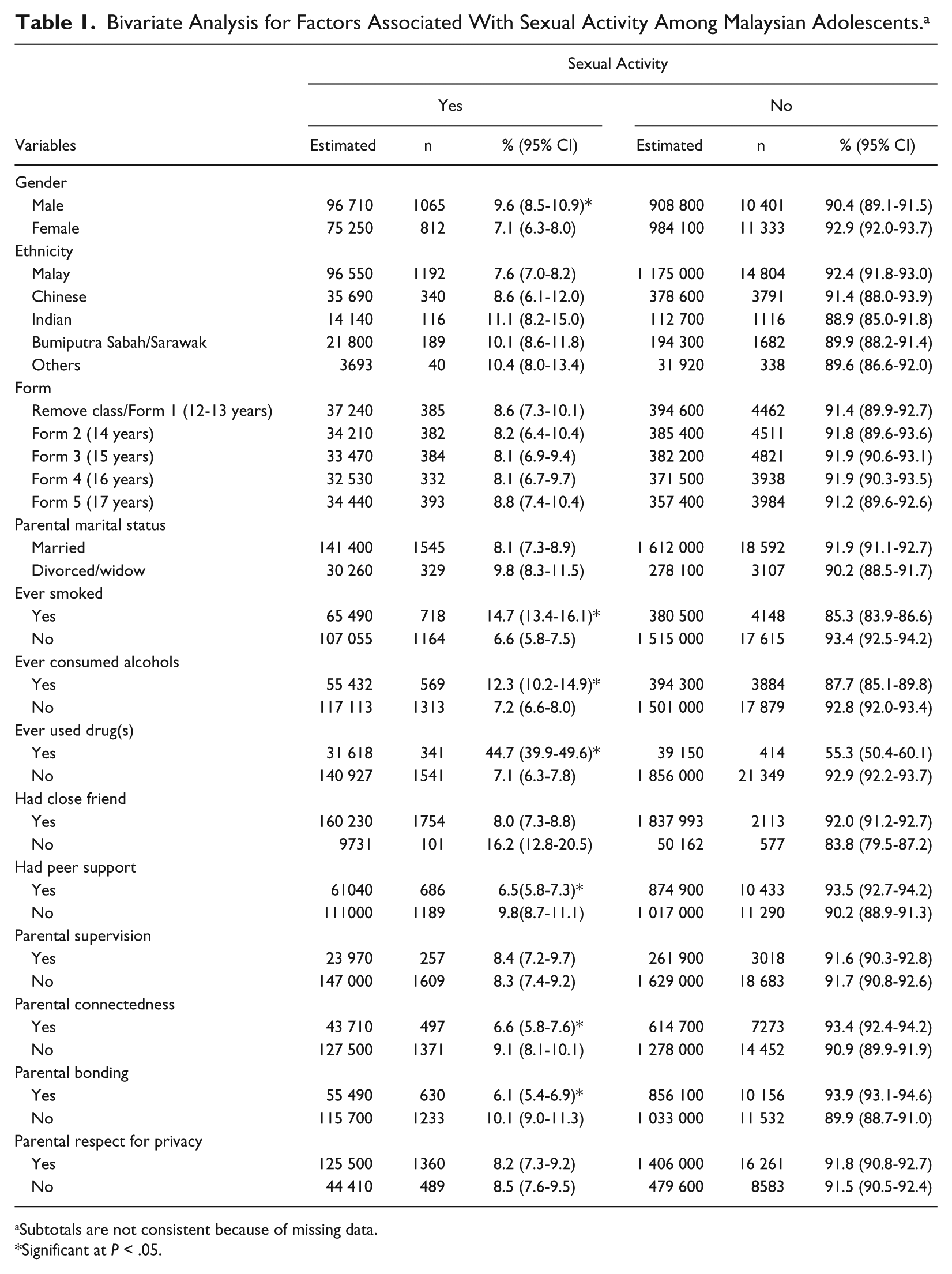
Subtotals are not consistent because of missing data.
Significant at P < .05.
Bivariate analysis revealed that ever-had sex was significantly higher among respondents who had ever-smoked, ever-consumed alcohol, or used illicit drugs. In contrast, ever-had sex was significantly lower among respondents who reported having close friends and supportive peers. Additionally, ever-had sex was also noted as significantly lower among respondents who reported having parental connectedness and parental bonding. There was no significant association between ever-had sex and parental supervision or parental respect for privacy (Table 1).
Results from the multivariate logistic regression indicated that ever-had sex was most strongly significantly associated with ever-used drugs (adjusted odds ratio [aOR] = 7.71; 95% CI = 6.51-9.13). To a lesser extent, other highly significant risk factors were ever-smoked (aOR = 1.83; 95% CI = 1.62-2.07) and ever-consumed alcohol (aOR = 1.33; 95% CI = 1.15-2.53) (Table 2). The analysis also showed that, compared with the Malaysian adolescents of Malay ethnicity, Indians were at higher risk (aOR = 1.32; 95% CI = 1.01-1.65) controlling for other variables. In contrast, ever-had sex was significantly lower among respondents who have parental connectedness (aOR = 0.88; 95% CI = 0.78-0.99), supportive peers (aOR = 0.77; 95% CI = 0.69-0.86), parental bonding (aOR = 0.72; 95% CI = 0.65-0.81), and having a close friend (aOR = 0.63; 95% CI = 0.50-0.81) controlling for other variables. Younger adolescents were also less likely to have engaged in sex.
Multivariate Logistic Regression for Sexual Activity Among Malaysian Adolescents. a

Abbreviations: OR, odds ratio; CI, confidence interval; df, degrees of freedom.
Subtotals are not consistent because of missing data.
1 indicates reference group.
Adjusted for all other variables.
Significant at P < .05 for bivariate and multivariate analysis.
Discussion
The prevalence of ever-had sex among adolescents in Malaysia was observed to be lower than the prevalence among adolescents aged 13 to 17 years in Cambodia (11.9%), Mongolia (15.4%), and Pacific Islands (15.6%-32.4%) but higher compared with those in Vietnam (5.7%) and Thailand (6.1%).4-6,16-18 In comparison to an earlier nationwide survey, this prevalence of ever-had sex is almost 4 times higher, from only 1.6% in 2010 to 8.3% in the current survey. 9 These 2 surveys used similar methodologies and questionnaires. Part of the higher rate might be because of the inclusion of 17-year-old adolescents in the 2012 survey, whereas in the previous 2010 survey, the 17-year-old students could not participate as they were involved in major examinations. In fact, our study revealed that respondents from the lower forms, that is, younger age-group, were less likely to have engaged in sex. Similar findings were noted in Thailand, Kenya, Namibia, and Zambia. Compared with younger ages, adolescents between the ages of 15 and 17 years were associated with an increased tendency toward risk-taking behavior.19-22
Findings from our study highlighted the problem of early sexual exposure and unsafe sex. Half of the adolescents who have ever-had sex initiated sex before 14 years and one fourth of those who ever-had sex did not used condoms or other birth control methods at their last exposure. This situation clearly has public health implications as unprotected sex predisposes them to unwanted pregnancy and consequent risks; of-illegal abortion and maternal death, not to mention the risk of sexually transmitted infections, including HIV.23,24
The association between gender and sexual activity was not observed in our study compared to GSHS findings from other countries. Compared with females, males were found to be positively associated with sexual experience in Thailand, Kenya, and Namibia; aOR of 1.7, 1.9, and 2.4, respectively.19-21 A similar association was noted in the Zambian GSHS where females were significantly less likely to engage in sexual activity than males (aOR = 0.7). 22
In our study, respondents of Indian descent were found to be significantly more likely to have engaged in sex as compared with the Malays. There was insufficient data to explore the possible reasons for this but this factor needs to be investigated.
In the present study, the highest risk factor associated with having had sex was a history of substance use. This association supports an earlier school-based study in Negeri Sembilan. 7 The relationship between alcohol consumption and sexual activity was also found in GSHS done in Thailand and Namibia.19,21 Additionally, GSHS-based studies in Namibia and Kenya also noted that ever-smoked and ever-drug use were positively associated with sexual activity.20,21 This association was also observed in non-GSHS studies on adolescents.13,25 Associations between various risky behaviors have been described as clustering of risky behaviors.7,26
In contrast, this study observed the protective effects of some variables against sexual activity. Similar to other studies, adolescents with positive peers and family environment were less likely to have engaged in sex.19-22,27 A systematic review on the protective effect of parental connectedness further supports this finding. 28 To enhance parental support, parents should be equipped with parenting skills through appropriate parenting skill courses on various platforms such as parent–teacher associations and the work place. At schools, peer support should be promoted to ensure a supportive and positive school environment.
The findings on the protective effect of family and peer support imply that extending support beyond the family and social environment may also help prevent or delay sexual activity. One channel is by strengthening reproductive health education and services. Reproductive health education should be strengthened through innovative and creative approaches. At present, the Ministry of Education and other related stakeholders have already produced an age-specific curriculum for sexual reproductive education at schools. The teachers responsible should deliver the materials effectively and creatively. In addition, healthcare providers should uphold the policy of advocating abstinence to non–sexually active adolescents, while advising the practice of safe sex on those sexually active. For the adolescents themselves, resiliency through moral values, religious education and assertive skills should also be focused. The Ministry of Women, Family and Community Development supported this effort by developing a module called “I’m in Control” with the aim of delivering these skills to young and mid-adolescents. Non-governmental agencies also play their roles in this effort. The Federation of Reproductive Health Associations, Malaysia (FRHAM) has produced a Reproductive Health of Adolescents Module (RHAM) for their peer educators, targeted to empower adolescents in making responsible choices in reproductive health. 29
Providing a supportive environment for the adolescent is vital in ensuring accessibility of care for them. The Ministry of Health, through its primary care facilities, ensures confidentiality in providing sexual-reproductive services to adolescents, while adhering to related laws such as the Child Act 2001. Health care providers should strengthen their services and make full use of their encounter with adolescents such as by providing counseling during consultations for pregnancy tests. Access to appropriate contraceptives, such as barrier methods, should be available based on the current guidelines. 30
The management of adolescents with risky sexual behavior should use a holistic approach, including assessments of other factors, such as substance use and relevant family factors. Counselors at schools, as gatekeepers in the school setting, should be empowered with adequate knowledge and skills to manage and support these adolescents.
Findings from this survey provide evidence of the need for multiple approaches in the planning of interventions focusing on reducing or delaying sexual activity among adolescents through targeting adolescents themselves as well as their environment. These efforts should involve multiple agencies; both government and nongovernment.
Strengths and Limitations
The use of a large nationally representative sample in this survey allowed for reliable inferences to Malaysian adolescents within a similar age-group. This survey also used a standard WHO questionnaire that is advantageous for international comparison, with anonymity for the respondents to encourage disclosure.
The data for this study were cross-sectional, which limits inferences on causal relationships between the identified factors and outcome. In addition, selection bias might influence the findings of this study as the percentage of dropouts among adolescents increased with age as only 78% of adolescents between the age of 16 and 17 years still remained in government secondary schools. 14 As this study used a self-administered questionnaire, the possibility of intentional misreporting is unavoidable. This response bias is possibly because of stigma of sexual activity among unmarried Asian adolescents. Furthermore, this study only assessed ever-had sex and did not capture current sexual behaviors and other possible associated factors.
Conclusion
Ever-used substances, namely ever-used drugs, ever-smoked, and ever-consumed alcohols, was observed to be the main risk factor for ever-had sex among adolescents in this study. In contrast, having a close friend, parental connectedness, parental bonding, and having peer support were protective against sexual activity. The identified risk and protective factors should be taken into consideration in planning intervention strategies to prevent or delay sexual activity among Malaysian adolescents.
Footnotes
Acknowledgements
The authors would like to thank the Director General of Health, Malaysia, for his permission to publish this article. We would also like to thank the Ministry of Education, the students who participated and those who were involved in the study.
Declaration of Conflicting Interests
The author(s) declared no potential conflicts of interest with respect to the research, authorship, and/or publication of this article.
Funding
The author(s) disclosed receipt of the following financial support for the research, authorship, and/or publication of this article: Research was funded by the Ministry of Health Malaysia and World Health Organization (WHO), Geneva, Switzerland.