







Abstract
The objective of this study was to estimate the prevalence and determinants of passive smoking in pregnancy and to examine its association with an earlier age of menarche in offspring. This retrospective study enrolled 751 students 8 to 20 years old in Shanghai selected by stratified cluster sampling. Data were obtained through structured self-administered questionnaires and physical examinations. It was found that daughters with maternal tobacco exposure experienced relatively earlier menarche and had shorter cycle lengths, although both findings were not statistically significant. The unadjusted odds ratio for prenatal tobacco smoke exposure on the relatively earlier onset of menarche was 1.84 (95% confidence interval = 1.05-3.22) compared with no exposure, and the associations remained statistically significant after adjusting for birth weight, birth length, maternal age of menarche, and present height and weight. In conclusion, our study provides limited evidence supporting the hypothesis that maternal passive smoking during pregnancy leads to an earlier age of menarche of daughters.
Introduction
Maternal smoking or passive smoking during pregnancy is not only associated with adverse pregnancy outcomes and long-lasting health consequences,1-3 but also with infertility and subfecundity in the offspring. For example, prenatal smoking exposure has been linked to lower sperm count and quality in male offspring and infertility and subfecundity among female offspring.4,5 Some studies suggest that prenatal exposure to nicotine affects fertility in offspring by disrupting ovarian function and spermatogenesis and by altering production of sex hormones and gonadotropins (follicle stimulating hormone and luteinizing hormone),6,7 all of which are key chemicals in triggering the timing of menarche. The harm of passive smoking on human health is a fact recognized worldwide. Over the years, there has been growing interest in the effects of prenatal exposures on subsequent development. Impaired reproduction and development have been reported in animals exposed to “endocrine disrupters” or compounds that appear to be hormonally active, including earlier puberty.6-9 The hypothalamic-pituitary-gonadal axis plays a core role in the initiation of puberty, and substances that alter the endocrine or central nervous system may subsequently affect the onset of menarche. 10 Exposure to cigarette smoking during pregnancy is common in China,11,12 but few studies have examined the effects of environmental exposures in early human development on later sexual development and other health end points. In this study, we explore the hypothesis that prenatal exposures may affect the reproductive maturation of offspring, as measured by age at menarche, using previously collected data. Our focus is on common exposures, such as tobacco smoke, which are thought to have potential endocrine or reproductive health damage effects.
Methods
Sampling and Recruitment
From October to November 2011, based on the national Puberty Timing and Health Effects in Chinese Children (PTHEC) study,13,14 a total of 2007 school students (grades 1 to 12) were recruited from a suburban district in Shanghai by a stratified multistage cluster sampling method. The sampling was conducted in a randomly selected primary school, 1 junior middle school, and 1 senior middle school, among which 4 or 5 classes were randomly selected in each grade of each school to ensure that at least 150 students were enrolled in each grade depending on the size of the classes. After excluding students with congenital malformations, genetic or metabolic diseases, and chronic endocrine diseases, data on anthropometric measurements, pubertal development status, and related factors were collected. We revisited these students in 2012 after 18 months of the baseline survey, measuring their physical and puberty development status again and asking their parents to fill the questionnaire. During this 18-month follow-up, 158 students were lost to follow-up because the students of grade 5 graduated from the sampled primary school and did not enter into the sampled junior middle school. In this study, by using the data collected in the year 2012, a total of 751 girls, ranging from 8 to 20 years old, were included for data analyses.
Data Collection
A set of questionnaires were completed by the students and their parents, which included questions on perinatal factors, sociodemographic variables, parents’ lifestyle factors, and experience of girls’ menarche.
Parents provided detailed information about their perceived family economic status, educational levels, occupation, paternal smoking habits, maternal age at gestation, pregestational height and weight, maternal age at menarche, presence or absence of maternal passive smoking during pregnancy, previous history of abortions, child’s birth weight, birth length, birth order, and gestational age at birth. Maternal passive smoking was defined as the inhalation of smoke from other people’s cigarettes for ≥1 day a week and ≥15 minutes each time.
The students were asked “How old were you when you had your first menstrual bleeding (in years and months)?” and also “What is the length of your typical menstrual cycle?” By reviewing various studies in the literature, 14 in accordance with the characteristics of our data, we categorized age at menarche as relatively earlier(≤12 years) or relatively later (>12 years).
Anthropometric data such as body weight and height were obtained by physical examination according to World Health Organization recommended methods 15 and were conducted by trained male and female investigators.
Statistical Method
All data were input into Epidata3.1 and analyzed using the SPSS16.0 package. A 2-tailed P value of <.05 was considered statistically significant. We examined bivariate associations between maternal passive smoking status during pregnancy and prenatal and early life variables using ANOVA for continuous variables and the χ2 test for categorical variables. Logistic regression models were applied to examine the unadjusted and adjusted associations between prenatal tobacco smoke exposure and age at menarche in daughters. Because the proportion of participants within each age group who had experienced menarche increased with age (within the age group), the mean age at menarche was calculated using the probability unit regression method. A plot of age versus incidence of menarche revealed an S-shaped curve. When the log of the median age in each group was plotted against the incidence of menarche converted into probability units, the 2 showed a nearly linear relationship. The regression formula can be calculated using the method of least squares and applied to estimate the median age at menarche.
Quality Control and Respondent Confidentiality
All research staff undertook confidentiality agreements. Questionnaires were distributed in class by trained personnel. All students were asked to fill the questionnaire independently and insert their responses into sealed envelopes. Questionnaires for younger students were completed by their parents. Informed consent was well explained for all students and their parents and signed by both students themselves and their parents or guardians voluntarily before participating in the study. The study was approved by the Ethics Review Board of Fudan University (IRB # 2010-11-0242 and IRB # 2011-03-0280).
Results
The mean age of all students was 12.87 ± 3.32 years old, with birth weight being 3.55 ± 2.39 kg and birth length being 50.09 ± 6.98 cm. Out of 751 girls, 350 had experienced menarche, with the mean age of menarche being 12.42 ± 1.10 years.
In total, the prevalence rate of students whose mother had been exposed to passive smoking during pregnancy was 16.4%. The prevalence rates were significantly higher among those who perceived their economic status as “bad,” fathers having lower educational levels, mothers being younger when getting pregnant, and mothers at higher risk of miscarriages. No significant associations existed between passive smoking during pregnancy and maternal educational levels or pregestational BMI (Table 1).
Comparison of Family Characteristics According to Maternal Passive Smoking During Pregnancy.
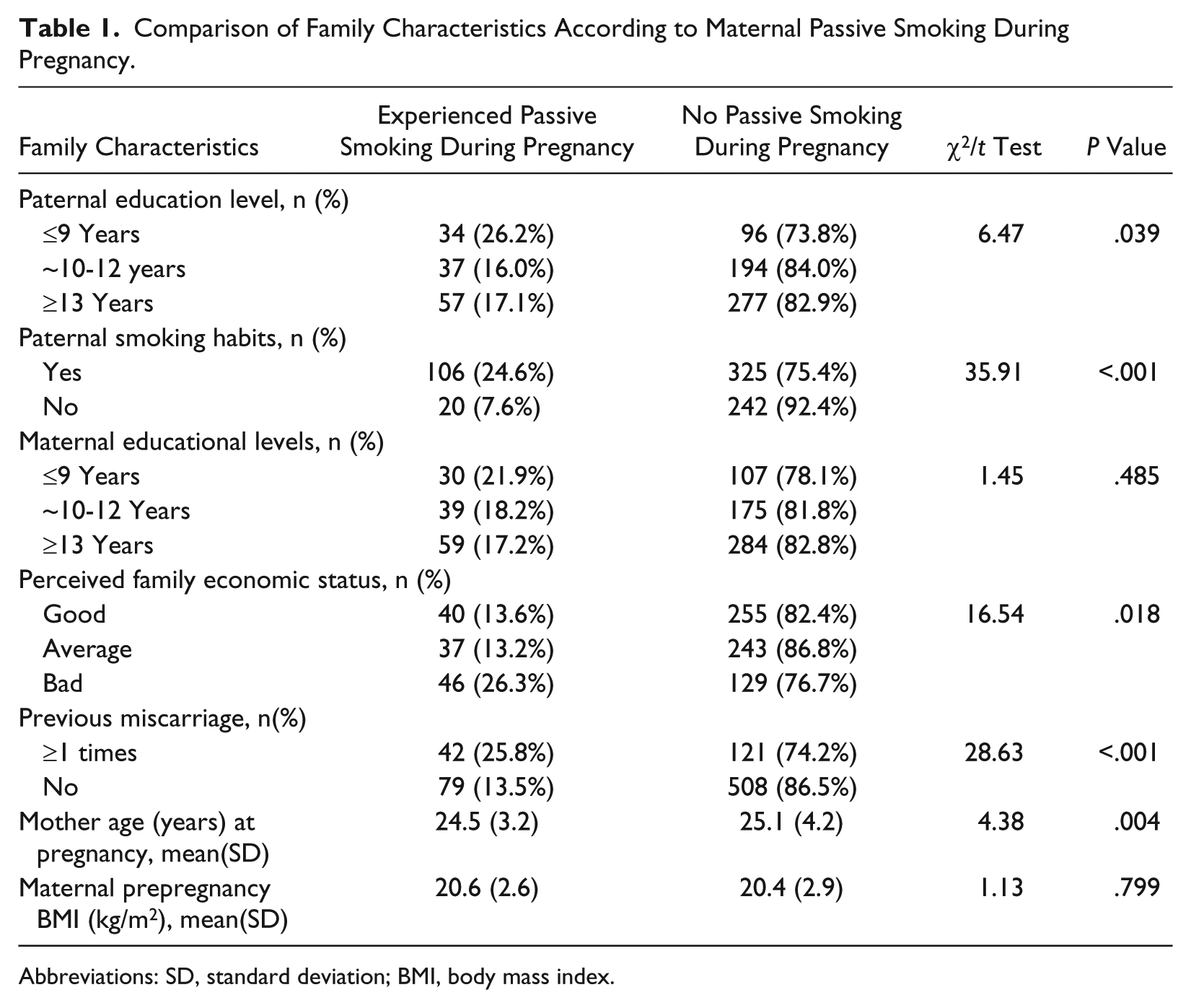
Abbreviations: SD, standard deviation; BMI, body mass index.
The results of binary association of maternal passive smoking during pregnancy with perinatal and current growth indicators showed that passive smoking affected birth weight, but no statistical significance existed between passive smoking and present height and weight or length of menstrual cycle of offspring (Table 2).
Binary Association of Maternal Passive Smoking During Pregnancy With Perinatal and Current Growth Indicators.
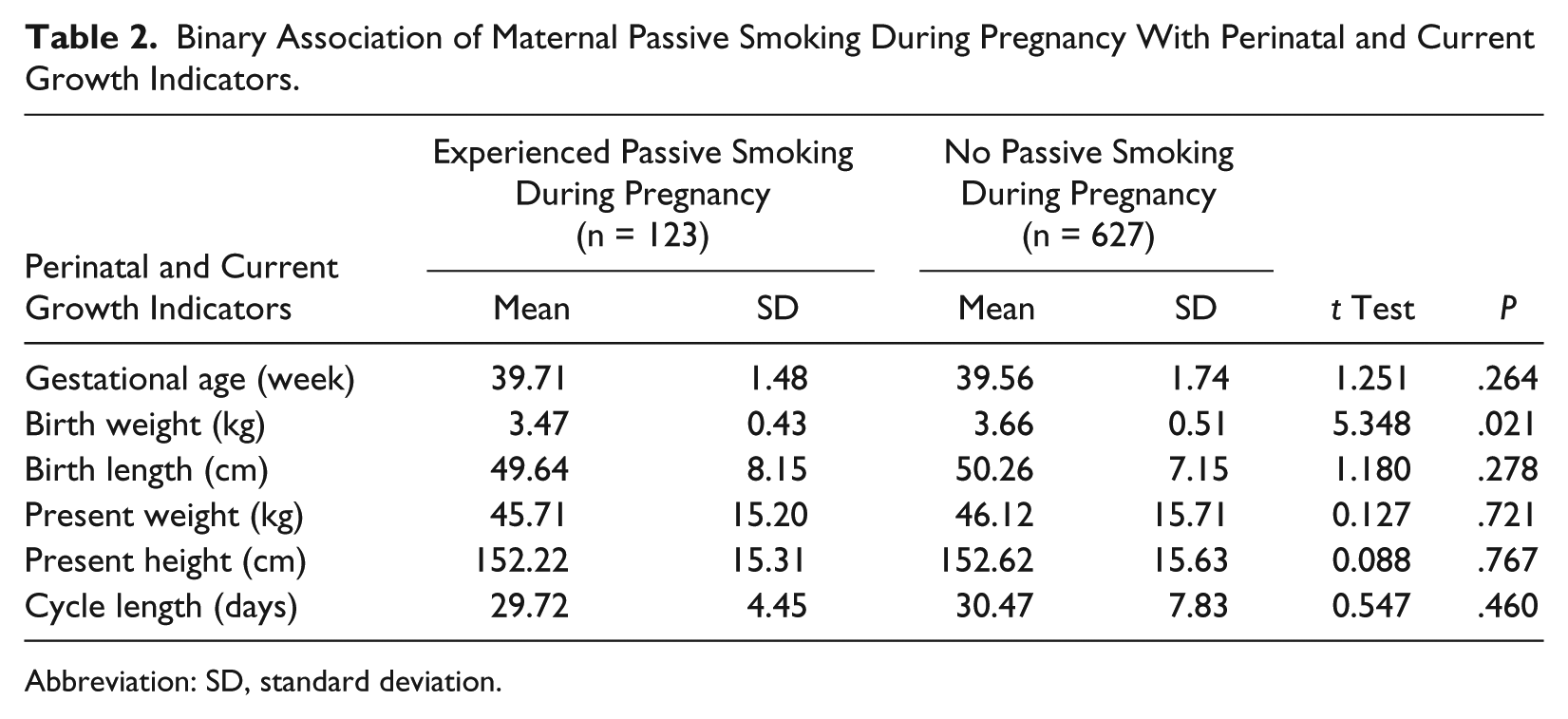
Abbreviation: SD, standard deviation.
The average age at menarche was calculated using the probability unit regression method. The average age at menarche of girls whose mothers were exposed to passive smoke during pregnancy was 13.02 years (95% confidence interval [CI] = 12.66-13.39); and 13.17 years (95% CI = 12.77-13.58) in unexposed mothers. The results reflected some difference of about 2 months in age at menarche between daughters whose mothers were exposed to passive smoking while pregnant versus those who were not; however, this result is not statistically significant.
Table 3 presents results from the logistic regression models of the association between maternal passive smoking during pregnancy and a younger age at menarche (≤12 vs >12 years old). The unadjusted odds ratio (OR) for the effect of prenatal tobacco smoke exposure on the relatively earlier onset of menarche was 1.839 (95%CI = 1.051-3.220) compared with no exposure. The OR after adjusting solely for maternal age at menarche was 1.841 (95% CI = 1.049-3.231), which increased to 2.043 (95% CI = 1.123-3.717) after additionally adjusting for birth weight and birth length. After further controlling for present weight and height, the OR was 2.027 (95% CI = 1.109-3.704). All OR values were close to 2.
Relationship Between Maternal Passive Smoking During Pregnancy and Earlier Age at Menarche of Daughters, Indicated by Coefficients From Unadjusted and Adjusted Logistic Regression Models of Age at Menarche (Years) According to Prenatal Tobacco Smoke Exposure.
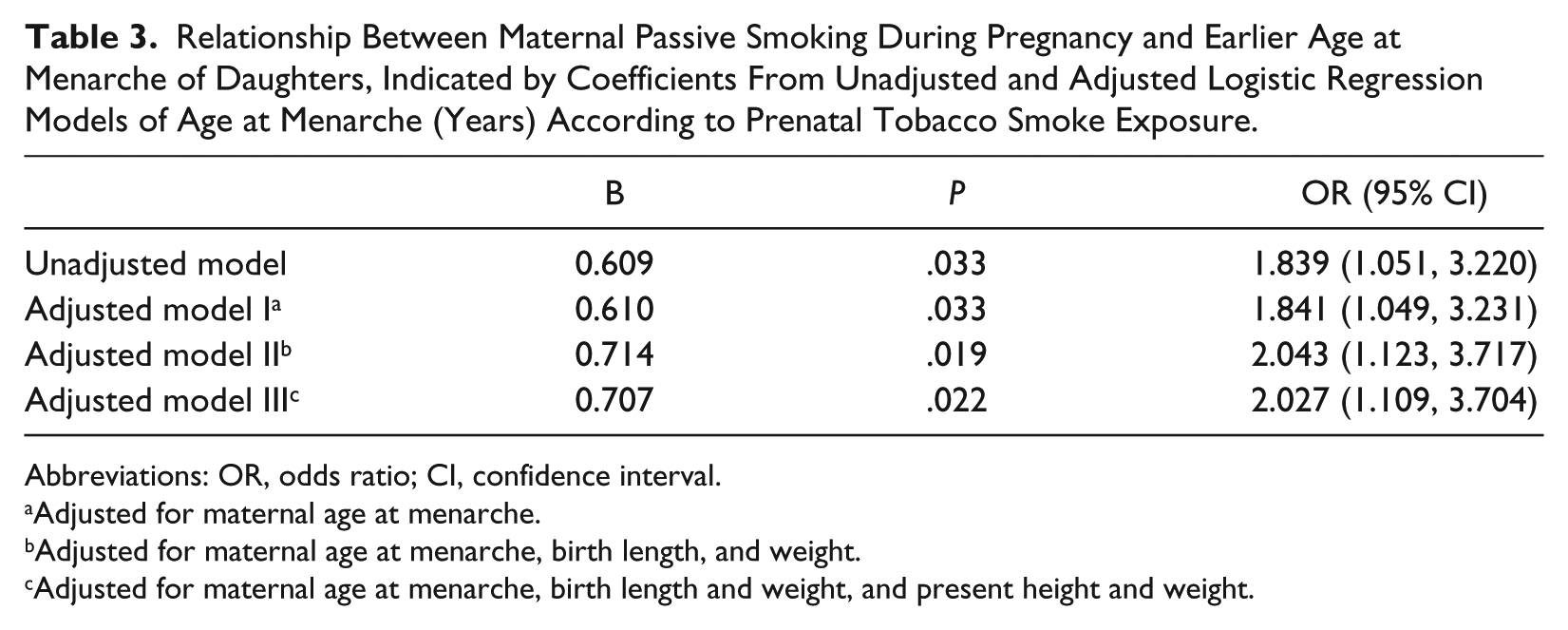
Abbreviations: OR, odds ratio; CI, confidence interval.
Adjusted for maternal age at menarche.
Adjusted for maternal age at menarche, birth length, and weight.
Adjusted for maternal age at menarche, birth length and weight, and present height and weight.
Discussion
In our study, mothers’ passive smoking during pregnancy was associated with an earlier age of menarche in the offspring using an unconditional logistic regression model. This finding remained even after adjusting for birth weight, birth length, maternal age at menarche, and present weight and height, showing that our results were not influenced by body size and growth during these periods. Results from previous research on the association between prenatal smoke exposure during pregnancy and age at menarche have been mixed. A study by Fried et al 16 found no association between passive smoking and age at menarche; however, the study was limited by a small sample size. Windham et al 17 conducted a larger cohort study and found that passive smoking during pregnancy was associated with an earlier age at menarche, but their results were not statistically significant. Ferris et al 18 showed that passive smoking during pregnancy was associated with a later onset of menarche by approximately 6 months. Our results were consistent with those published recently,19,20 in that prenatal exposure to smoking was associated with an earlier age at menarche by about 4 months. The causes and mechanisms by which maternal passive smoking affects the age at menarche of daughters are not known. Several articles have attempted to provide explanations for the mechanisms at play, such as differences in the amounts of toxins entering the body in passive versus active smoking, different lengths of exposure, timings of smoking cessation, and amount of exposure.19,20
Using a logistic bivariate regression analysis model, we chose to evaluate the associations between maternal passive smoking and age at menarche of daughters after adjusting for birth weight and length, present height and weight, and maternal age at menarche, based on evidence provided by earlier studies. Terry et al 21 showed that an earlier average age at menarche of girls was associated with a higher birth weight. Several studies have shown that maternal passive smoking results in a lower birth weight, which in turn leads to menarche at a later age. In addition, growth and changes in adolescence, height, and weight are also associated with age at menarche. Large amounts of data provide evidence for the correlation between age at menarche of mothers and their female offspring.22-24 Hence we have included these variables in our study model.
The mechanism by which tobacco smoke exposure influences age at menarche is still unclear; however, animal and human studies have provided evidence that cigarette smoke and nicotine may affect reproductive developmental biology. Laboratory evidence in both mice and rats suggest that cigarette smoke and nicotine affect the female reproductive system, reducing the number of primordial oocytes in offspring exposed to cigarette smoke in utero and influencing ovarian steroidogenesis respectively. 25 Human studies have shown that cigarette smoking has antiestrogenic effects in women, affecting ovulatory function. In a study by Windham et al, 17 heavy smokers were found to have shorter and more variable cycle and menses lengths. Our study also supports the conclusion that maternal passive smoking is related to a shorter menstrual cycle in daughters.
There are several limitations to this study. In designing our questionnaire, the presence or absence of maternal passive smoking was determined by only 1 question, which did not specifically detail the timing, quantity, and duration of exposure to passive smoke. This may have affected the precision of our study results. Also, our study was limited by a small sample size. Furthermore, the potential confounding from children’s exposure to endocrine disruptors (EDCS, such as bisphenol A, phthalates, pesticides, and so on), which may influence girls’ menstruation, was not accurately assessed.
In conclusion, maternal passive smoking not only harms fetal health, but also affects the timing of daughters’ menarche. Although active cigarette smoking during pregnancy is on a downward trend, maternal passive smoking is on the rise. Most pregnant mothers are unaware of the damage that could be caused, leading to a lack of proactive behaviors to avoid tobacco smoke exposure. As such, there is a pressing need for further studies on the promotion of health education on the harmful effects of tobacco smoke.
Footnotes
Declaration of Conflicting Interests
The author(s) declared no potential conflicts of interest with respect to the research, authorship, and/or publication of this article.
Funding
The author(s) disclosed receipt of the following financial support for the research, authorship, and/or publication of this article: This research was funded by the Natural Science Foundation of China (Grant Number 81172684) and Shanghai Municipal Health Bureau (Grant Number 12GWZX0301).