







Abstract
The Asia Pacific region is regarded as the most disaster-prone area of the world. Since 2000, 1.2 billion people have been exposed to hydrometeorological hazards alone through 1215 disaster events. The impacts of climate change on meteorological phenomena and environmental consequences are well documented. However, the impacts on health are more elusive. Nevertheless, climate change is believed to alter weather patterns on the regional scale, giving rise to extreme weather events. The impacts from extreme weather events are definitely more acute and traumatic in nature, leading to deaths and injuries, as well as debilitating and fatal communicable diseases. Extreme weather events include heat waves, cold waves, floods, droughts, hurricanes, tropical cyclones, heavy rain, and snowfalls. Globally, within the 20-year period from 1993 to 2012, more than 530 000 people died as a direct result of almost 15 000 extreme weather events, with losses of more than US$2.5 trillion in purchasing power parity.
Introduction
The Asia Pacific region (Figure 1) is regarded as the most disaster-prone area of the world. Since 2000, 1.2 billion people have been exposed to hydrometeorological hazards alone through 1215 disaster events. It accounts for 91%, 92%, and 66% of global human exposure to tropical cyclones, floods, and landslides, respectively, on a per capita basis. Almost 2 million people were killed in disasters between 1970 and 2011, representing 75% of all disaster fatalities globally. Between 1970 and 2010, the population exposed to flooding risk had doubled from 29.5 to 63.8 million, while those residing in cyclone-prone areas grew from 71.8 to 120.7 million. 1
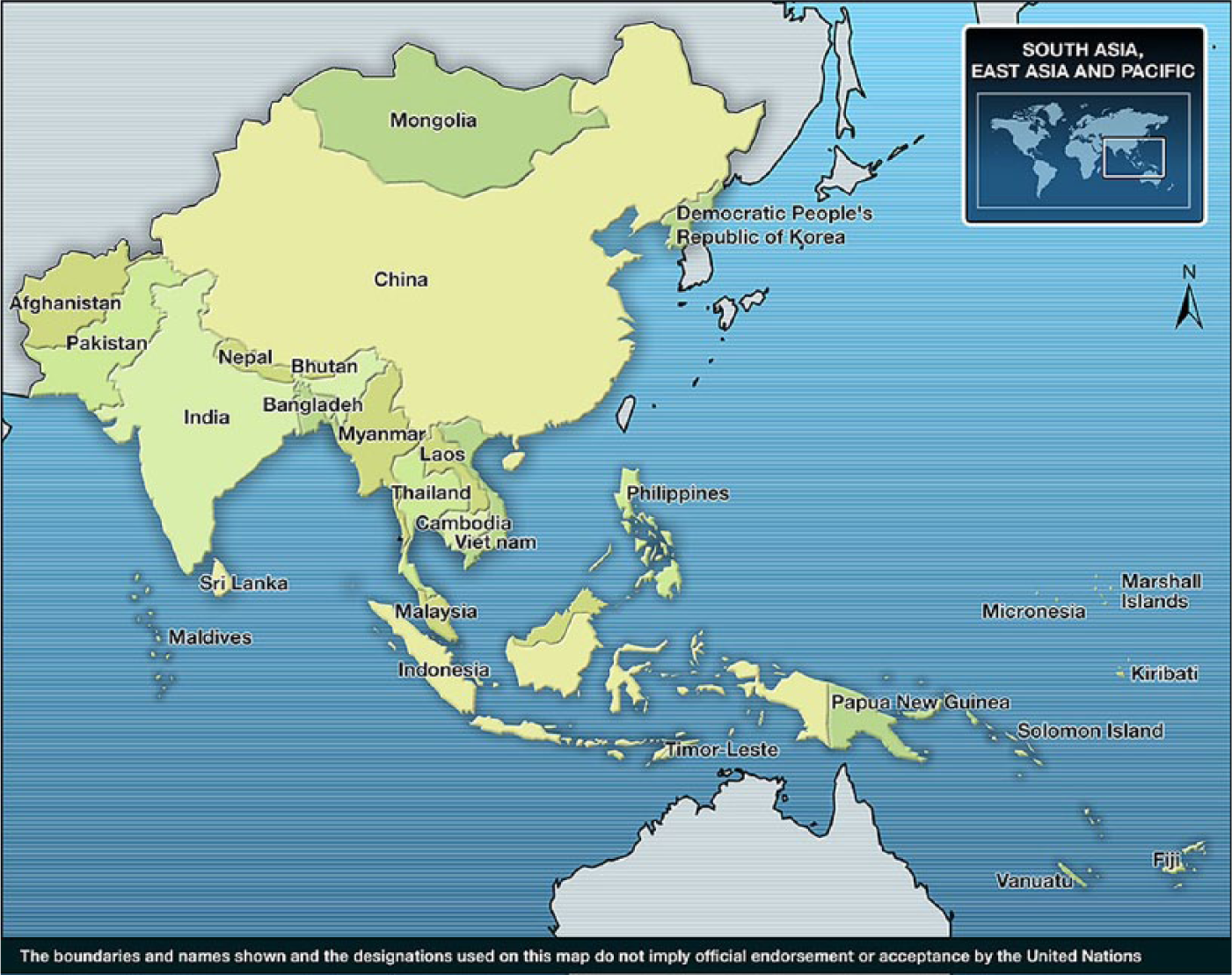
Map of the Asia Pacific region. 2
The question that comes to mind is that how much of these disaster events are attributable to climate change or is it mainly the outcome of natural variability. Climate change impact on extreme weather events is now a well-accepted eventuality, whereby climate change increases the frequency and severity of extreme weather events such as hurricanes and tropical cyclones. However, increased disaster fatalities and the size of population at risk to disasters may be due to other compounding factors. Many nations in the Asia Pacific region have high population growth rates, thus exposing more and more people to natural disasters. Disaster-prone areas such as river deltas are agriculturally productive. These areas are usually densely populated, which means that the populations at risk to natural disasters are large.
The objective of this article is to discuss the complex linkages between climate change, its impact on extreme weather events, and the implications on human health, with a focus on the Asia Pacific region.
Methodology
A literature search was conducted of the PubMed database using the keywords “extreme weather events” and “climate change.” A total of 50 journal publications were listed. Of these, we found a total of 16 to be related to the topic of this article. These publications were reviewed and are referred to in this article. In addition, we also reviewed relevant nonperiodical report publications from the Economic and Social Commission for Asia and the Pacific (ESCAP), the United Nations Office for Disaster Risk Reduction (UNISDR), the United Nations Children’s Fund (UNICEF), the World Health Organization (WHO), and Germanwatch. Among the limitations of this review is that it is not intended to be an extensive literature review on extreme weather events and climate change, but mainly to explore the obvious linkages between climate change, extreme events, and human health, in order to spur further discussion and publication on the subject.
Climate Change and Health
The impacts of climate change on meteorological phenomena and environmental consequences are well documented. However, the impacts on health are more elusive. The environmental impacts from global warming and climate change in the form of global temperature increase, sea level rise, increased or decreased rainfall, will be gradual. Nevertheless, climate change is believed to alter weather patterns on the regional scale, giving rise to extreme weather events. The impacts from extreme weather events are definitely more acute and traumatic in nature, leading to deaths and injuries, as well as debilitating and fatal communicable diseases.
A warmer climate gives rise to extreme weather, which threatens to increase deaths from malnutrition, diarrhea, and air pollution. 3 Changing climate will affect the basic requirements for maintaining health, namely, clean air and water, sufficient food, and adequate shelter. Globally each year, about 3.5 million people die from malnutrition, 1.8 million from diarrhea due to poor sanitation, 800 000 from causes attributable to urban air pollution, and approximately 60 000 from natural disasters. 3
Figure 2 shows the complex linkages between climate change and health effects. In the climate change phenomenon, there are 2 forces at work, namely, positive radiative forcing and global warming due to the accumulation of greenhouse gases, and negative radiative forcing and global cooling due to aerosol pollution. The net effect is global warming due to the dominance of positive radiative forcing. Climate change forces first cause environmental modifications, which then lead to environmental impacts, which finally produce health impacts, as depicted by the differently shaded boxes. 4 Particularly vulnerable subpopulations include children, pregnant women, older adults, impoverished populations, people with chronic conditions and mobility and cognitive constraints, outdoor workers, and those in coastal and low-lying riverine zones. 5
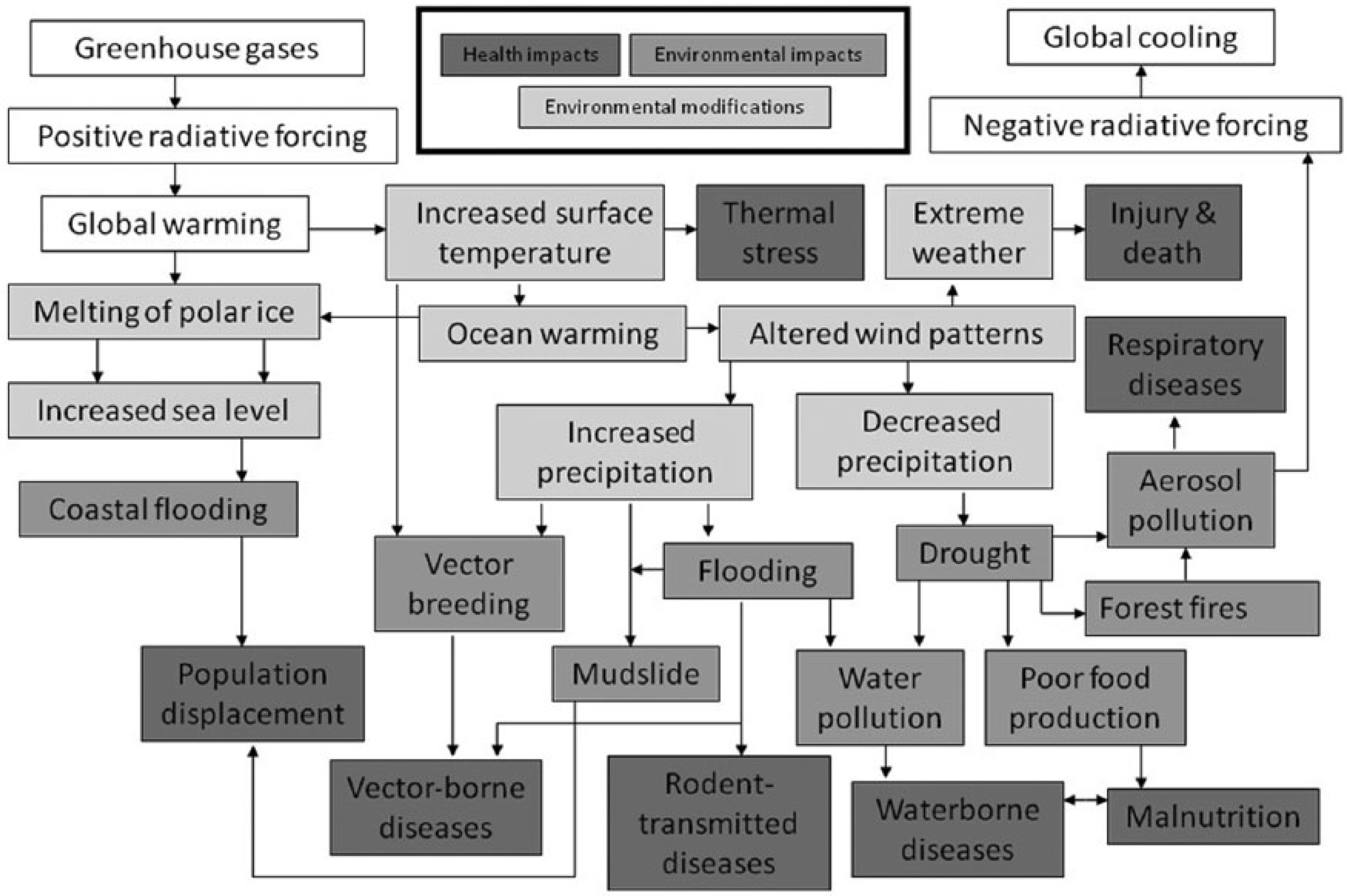
Health effects of global climate change. 4
If we focus on the extreme weather components of Figure 2, we can see that global warming first results in environmental modifications, which increases surface temperature, warms the ocean, and alters regional wind patterns. Altered wind patterns may result in extreme weather events, which culminate in health impacts of injuries and deaths. Altered wind patterns may also cause environmental modifications with respect to precipitation. Depending on whether there is an increase or decrease in precipitation, the resulting environmental impacts can be expressed as vector breeding, mudslide, flooding, or drought. These subsequently lead to water pollution, poor food production, forest fires, and aerosol pollution. In the United Kingdom, 20th century greenhouse emissions are believed to have increased the risk of floods in England and Wales in autumn of 2000 by 20% in 9 out of 10 simulations of the precipitation-runoff model. 6 Climate change in Australia is believed to give rise to extreme air pollution events from bushfires and dust storms, which is associated with mortality in Sydney. 7 The underground karst water supply in the Hungarian city of Miskolc was contaminated microbiologically after heavy precipitation and flooding. 8
The resulting health impacts can be expressed as vector-borne diseases, rodent-transmitted diseases, malnutrition, and respiratory diseases, as shown in Figure 2. Understanding the complex linkages between climate change, environmental modifications, environmental impacts, and health impacts is critical in planning for mitigation and adaptation plans. Heavy rains create insect breeding sites, drive rodents from their burrows, and contaminate clean water resources. The incidences of mosquito-borne parasitic and viral diseases are among those most sensitive to climate. Climate change affect disease transmission by shifting the vector’s geographic range and by shortening the pathogen incubation period. Flooding has been associated with outbreaks of leptospirosis and Campylobacter enteritis in the Czech Republic and cryptosporidiosis in the United Kingdom. 9
Extreme Weather Events
Extreme weather events include heat waves, cold waves, floods, droughts, hurricanes, tropical cyclones, heavy rain, and snowfalls. 10 A single extreme weather event cannot be solely linked to anthropogenic climate change. However, scientists believe that climate change is an increasingly important factor for changing the odds of occurrence and the intensity of these events. According to the Intergovernmental Panel on Climate Change, changes in many extreme weather and climate events have been observed since around 1950. 11 Therefore, climate change makes extreme weather events more severe and frequent than before. According to Germanwatch which developed the Global Climate Risk Index, within the 20-year period from 1993 to 2012, more than 530 000 people died as a direct result of almost 15 000 extreme weather events, with losses of more than US$2.5 trillion in purchasing power parity (PPP). 12
Honduras and Myanmar were the most affected countries in the 20-year period between 1993 and 2012 (Table 1). While Honduras is located in the Caribbean, Myanmar is in the Asia Pacific region. Of the 10 countries most affected by extreme weather events listed in Table 1, 6 are located in the Asia Pacific region, indicating the high climate risk of this part of the world. The Philippines experienced the highest number of extreme weather events (311), Thailand experienced the greatest financial loss (US$5.4 billion PPP), while Myanmar experienced the highest death rate (13.5 deaths per 100 000 population). 12
The Long-Term Climate Risk Index (CRI): Results (Annual Averages) in Specific Indicators in the 10 Countries Most Affected From 1993 to 2012 a .
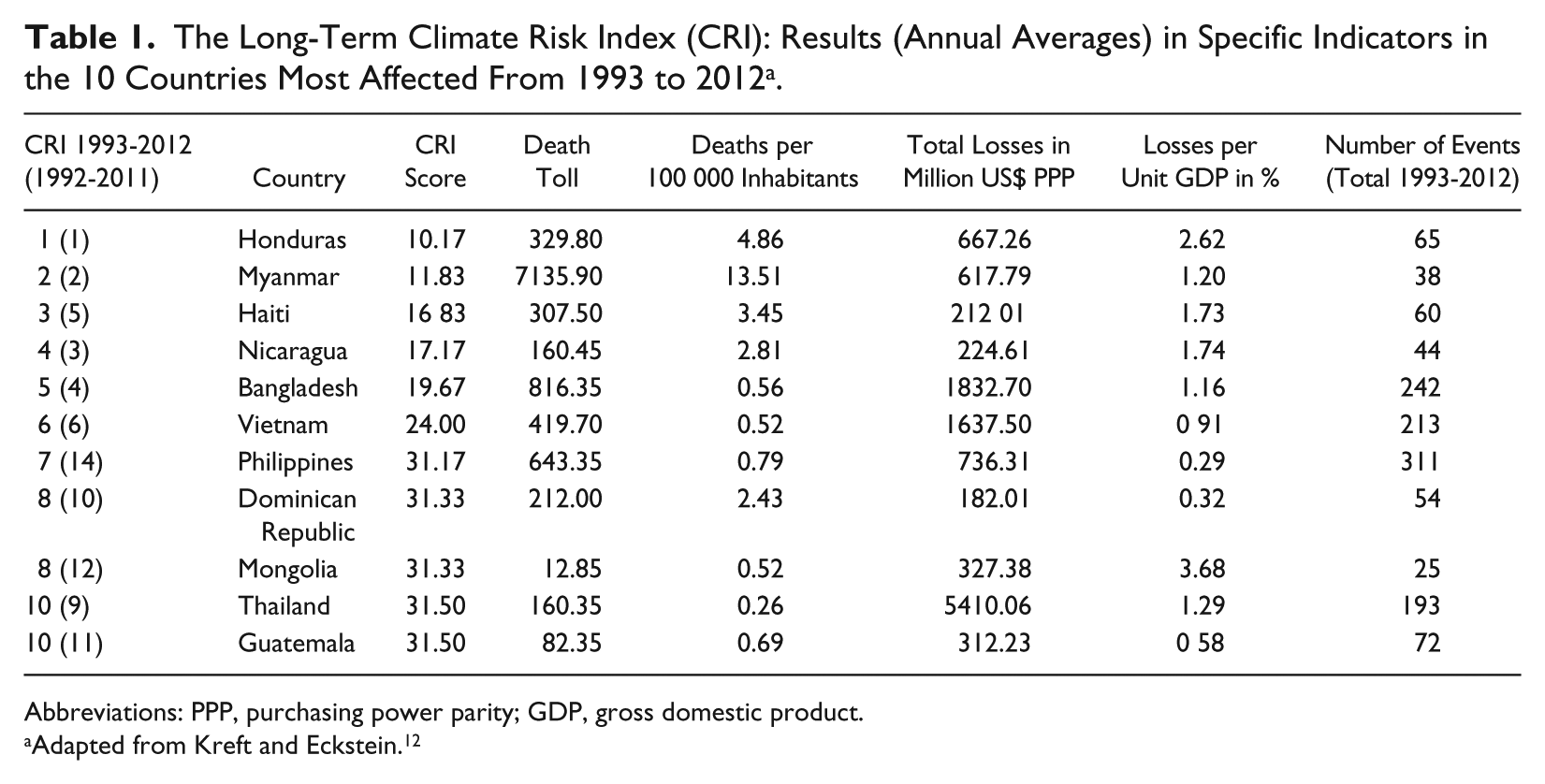
Abbreviations: PPP, purchasing power parity; GDP, gross domestic product.
Adapted from Kreft and Eckstein. 12
How Extreme Weather Events Threaten Public Health
Extreme weather events are a threat to public health. The physical force of the event may cause injuries and deaths. The consequences of extreme weather events may lead to communicable diseases, which can also be fatal. The health impacts of an extreme weather event are not defined by mere occurrence of the event. Instead, they are determined to a large extent by physical factors that define the event and how it is experienced by the exposed populations.
In addition, while there may be general differences between categories of extreme weather events, the differences between individual events within each category are equally important in evaluating the source and nature or the associated health risks and impacts. The health risks or impacts of an extreme weather event are a function of the following factors. 3
Severity: How challenging are the event’s conditions (eg, a category 5 hurricane or cyclone with wind speeds of 157 mph or higher). 13 The greater the physical force, the greater will be the health impacts inflicted on the exposed populations.
Duration: For how long are the extreme conditions experienced. The longer the duration, the greater is the period of exposure to the population at risk and the greater is the health damage done.
Surprise: How much advance warning was available for the event (eg, days, hours, minutes).
There are differences in categories of events. The health risks and impacts will depend on the categories of extreme weather event (eg, drought, flood, tropical storm, or snow storm).
There will be differences between individual events within a category. Each individual extreme weather event within a category can present varying nature and degree of health risks and impacts. For example, floods can present risks related to drowning, electrocution, and communicable waterborne, foodborne, vector-borne, and rodent-infested diseases such as leptospirosis.
One of the more obvious impacts of extreme weather event is heat waves.14-16 Hot extreme temperatures have been shown to be induced by surface moisture deficits following deficit in precipitation. 17 Most deaths from heat waves were due to heat stroke associated with dehydration. 18 A study in Australia found that on days of extreme heat, the risk of emergency hospital admission due to heat-related injuries, dehydration, and other fluid, electrolyte, and acid–base balance disorders increased more than the risk of admission from other causes. The study also found that people with underlying medical conditions of mental and behavioral disorders, nervous and circulatory system diseases, respiratory system diseases, neoplasm, and renal diseases were more susceptible to extreme heat events. 15 During the summer heat wave that hit Europe in 2003, France was most affected with excess mortality estimated at about 14 800 additional deaths, which was equivalent to a total mortality increase of 60% in August. 19
Another consequence of extreme weather events is diarrheal or gastrointestinal diseases, which are usually the result of increased precipitation over a short period of time. A study in Chennai, India, showed that extreme precipitation of above the 90th percentile was consistently associated with a cumulative risk ratio of 6.5 for gastrointestinal-related hospital admissions for all ages. 20
Emergency Preparedness and Response to Extreme Weather Events
As extreme weather events are sudden and often overwhelming in their occurrence, emergency preparedness and response normally determine the magnitude and severity of the physical damage and health impacts. However, cumulative uncertainty in forecasting climate change–driven characteristics of extreme events and adaptation prevents from confidently projecting the future health impacts from hurricanes, wildfires, and extreme precipitation/floods which are attributable to climate change. 21
Poorer developing countries are particularly more vulnerable to climatic risks. The 10 countries most affected by extreme weather events in Table 1 are all developing countries. Haiti, which is third on the list, is the poorest country in the Western Hemisphere. It suffered losses up to US$750 million or 10% of its total gross domestic product from the impacts of Hurricane Sandy. While monetary losses are much higher in richer countries, the loss of life and personal hardship are more widespread in low-income countries. 12
Due to the lack of medical facilities, rural populations may also be more vulnerable even in a developed country like Australia. 22 Therefore, ensuring equity in health care is an important prerequisite to moderate the impacts of extreme weather events. Designing a proper drainage system that can discharge water quickly to the sea, especially in crowded urban areas, can help mitigate flash floods in cities. 23
Conclusion
The Asia Pacific region is regarded as the most disaster-prone area of the world with respect to tectonic and hydrometeorological hazards. The latter, which include extreme weather events in the region like monsoons, tropical cyclones, floods, and landslides, are very much influenced by climate change. While the impacts of climate change on meteorological phenomena and environmental consequences are well documented, the impacts on health are more elusive. The impacts from extreme weather events are definitely more acute and traumatic in nature, leading to deaths and injuries, as well as debilitating and fatal communicable diseases. Much needs to be done to assess the potential impacts of climate change and extreme weather events for this region. As some impacts from climate change are unavoidable, there must also be efforts to help the vulnerable populations in this region to adapt and cope with the impending impacts from climate change.
Footnotes
Declaration of Conflicting Interests
The author(s) declared no potential conflicts of interest with respect to the research, authorship, and/or publication of this article.
Funding
The author(s) disclosed receipt of the following financial support for the research, authorship, and/or publication of this article: Although the writing of this article was not funded, the corresponding author is the principal investigator of the Global Environmental Change and Human Health Project funded by the Asia Pacific Network for Global Change Researh (APN).