







Abstract
Electronic cigarettes (e-cigarettes) are handheld devices that deliver an aerosol by heating a solution made up of propylene glycol and/or glycerol with or without flavoring agents and nicotine. This nationwide cross-sectional survey examined factors associated with e-cigarette usage and reasons for its initiation among 13 162 Malaysian adolescents. Data from TECMA (Tobacco and E-Cigarette Survey among Malaysian Adolescents) were used. Nine percent of adolescents had used e-cigarettes in the past month. Males (adjusted odds ratio [aOR] = 4.08; 95% confidence interval [CI] = 3.36-4.95), 16 to 19 year olds (aOR = 2.64; 95% CI = 2.13-3.26), Malays (aOR = 2.25; 95% CI = 1.79-2.83), Sabah and Sarawak Bumiputeras (aOR = 2.25; 95% CI = 1.61-3.15), and cigarette smokers (aOR = 13.16; 95% CI = 11.14-15.54) were more likely to use e-cigarettes. Three main reasons for e-cigarette initiation among adolescents were its taste and smell, experimentation, and popularity. Sale of e-cigarettes with or without nicotine to people aged younger than 18 years should be banned. Flavored e-cigarettes should also be banned since there is evidence suggesting increased appeal among the younger generation.
What We Already Know
Adolescents who use e-cigarettes may be at greater risk of future cigarette smoking.
Little data exist regarding the usage of e-cigarettes among adolescents in Malaysia.
What This Article Adds
The most vulnerable to e-cigarette usage among adolescents in Malaysia were males; 16- to 19-year-olds; Malays, Bumiputera Sabahans, and Bumiputera Sarawakians; and current cigarette smokers.
Introduction
Electronic cigarettes (e-cigarettes) are handheld devices that deliver an aerosol to users by heating a solution, which contains a liquid made up of propylene glycol and/or glycerol, and often, but not always, flavoring agents, 1 and nicotine. 2 In 2014, it was estimated that there were 466 brands of electronic nicotine delivery system devices, which include e-cigarettes. About US$3 billion was spent globally for electronic nicotine delivery system and its’ sales are forecasted to increase by a factor of 17 by 2030. 3 In a study done in the United States among adolescents aged 12 to 17 years, majority said e-cigarettes are cleaner, safer, and less addictive than cigarette smoking. Its unique packaging, various flavors, and it being trendy were among reasons for e-cigarette usage. 4
A meta-analysis of international studies found an association between e-cigarette use by never-smoking adolescents and young adults with cigarette smoking intentions. 5 This suggests that adolescents who use e-cigarettes may be at greater risk of future cigarette smoking, leading to concerns that an increase in e-cigarette use by young people could adversely impact tobacco control efforts to reduce smoking initiation.
With almost 2000 registered vape shops in Malaysia, it is the second largest market in the world after the United States, and the largest in Asia. 3 The Ministry of Health Malaysia in its press statement on November 4, 2015, has encouraged Malaysians not to start using e-cigarettes/vape and those who are current users to stop using it mainly due to its unknown long-term effects on health. 6
In Malaysia, nicotine is a class C poison regulated under the Poisons Act 1952 and the Control of Drugs and Cosmetics Regulations of 1984 (Malaysia) where it’s use is restricted to medicinal products used by doctors or licensed pharmacists. E-cigarettes without nicotine, however, are classified as electrical appliances and is not considered a tobacco product, therefore making it legal to be sold without restriction. 7 As little is known about e-cigarette use among adolescents in Malaysia, we explored the factors associated with e-cigarette use and reasons for initiation in this population.
Methodology
Data Source
The Tobacco and E-Cigarette Survey among Malaysian Adolescents (TECMA) was carried out in 2016. TECMA was a nationwide cross-sectional survey using a 2-stage stratified cluster sampling design targeting school-going adolescents aged 10 to 19 years. The sampling frame for TECMA was provided by the Ministry of Education based on data of school-going adolescents in 2014. Students from standard 4 to standard 6 (ie, 10-12 years old) and students from form 1 to form 6 (ie, 13-19 years old) were eligible to participate. They were required to be able understand the Malay language or English. Malaysia was stratified into 15 states and by the schools’ location (urban or rural) according to the Ministry of Education’s definition. All schools excluding Special Education Schools formed the primary sampling unit.
The first stage was the selection of the primary sampling unit for each state using systematic probability sampling proportional to the students’ enrolment size. A total of 138 schools were selected comprising 82 schools in urban areas and 56 schools in rural areas. The second stage involved the selection of classes by using a simple random sampling method. The classes formed the secondary sampling unit. All students from the selected classes were recruited. Detailed methodology can be found in the technical report of TECMA. 8
Students younger than 18 years were required to provide a written assent and written consent from their parents/guardian in order to participate in this survey. Those older than 18 years provided their own written consent. Ethical approval was obtained from the Medical Research Ethics Committee to conduct this survey. The Reference Number of the approval letter is (14) KKM/NIHSEC/P16-228.
Data Collection Tools
This survey used a structured self-administered questionnaire (Malay language and English), which was developed with input from researchers and experts in tobacco and smoking from the Ministry of Health and was pretested and validated. It was divided into 3 modules; Tobacco Module, E-cigarette/Vape Module, and Shisha Module. Field data collection was conducted by the trained research assistants.
Variable Definitions
All study variables were categorized and selected including sociodemographic profiles such as sex (male, female), location of school (urban, rural), and age group (10-12 years, 13-15 years, and 16-19 years). We chose this age cutoff for the purpose of monitoring the e-cigarette use behavior between primary school students and secondary school students. Ethnicity was categorized into 3 groups: (1) Malay; (2) Indian, Chinese, and other than specified; and (3) Bumiputera Sabah dan Sarawak. Pocket money received per day was grouped into 4 categories: less than RM2; RM2 to less than RM5, RM5 to less than RM10, and RM10 and above (RM = Malaysian Ringgit). Students who had used e-cigarettes in the past 30 days were classified as current e-cigarette users. 9 For the cofactor related to e-cigarette use, students were asked about their smoking cigarette status in the past 30 days.
Ten reasons for initiation of e-cigarettes were explored. The 10 reasons were the following: (1) I feel that e-cigarettes/vape is safer than tobacco cigarettes, (2) I like the taste and smell of the e-cigarettes/vape, (3) I want to experiment with the e-cigarettes/vape, (4) Offered by friends or family members, (5) I feel e-cigarettes/vape are popular, (6) I follow celebrity/idol trend, (7) I feel that e-cigarettes/vape can help me quit smoking, (8) I feel smoking e-cigarettes/vape is the same as smoking tobacco cigarettes, (9) E-cigarettes/vape are affordable, and (10) E-cigarettes/vape is more economical than cigarettes. The respondents were required to answer (1) Yes, (2) No, or (3) I do not smoke e-cigarettes/vape for each question.
Data Analysis
Statistical analysis was performed using SPSS (IBM Corp Released 2012; IBM Statistics for Windows, Version 21.0. Armonk, NY). Descriptive analysis was performed using complex sampling design, taking into consideration the sample weights and study design. Descriptive analysis was used to determine the prevalence of e-cigarette use by sociodemographic and smoking status variable. Multivariable logistic regressions were used to determine the association between the dependent variable (e-cigarette use) and the independent variables (age, sex, locality, ethnicity, pocket money, and smoking status). A final model was created consisting all the factors associated with current e-cigarette use that were statistically significant at P values lower than .05. Diagnostic testing to assess goodness-of-fit was conducted to ensure the fit of a logistic regression model for individual cases or covariates.
Results
Sociodemographic Characteristics of Respondents
In total, 13 162 students participated in the TECMA with an overall response rate of 86.6%. More than half (58.5%) of the respondents were from schools in urban areas and there was an almost equal representation of male and female students; 50.1% and 49.9%, respectively. Majority were Malays (70.4%), followed by Indians, Chinese, and other ethnic groups (22.1%),and Bumiputera Sabah and Sarawak (7.6%). Most respondents were from the age group 13 to 15 years (40.2%), followed by 12 years and younger (31.5%) and 16 to 19 years (28.3%).
E-Cigarette Usage
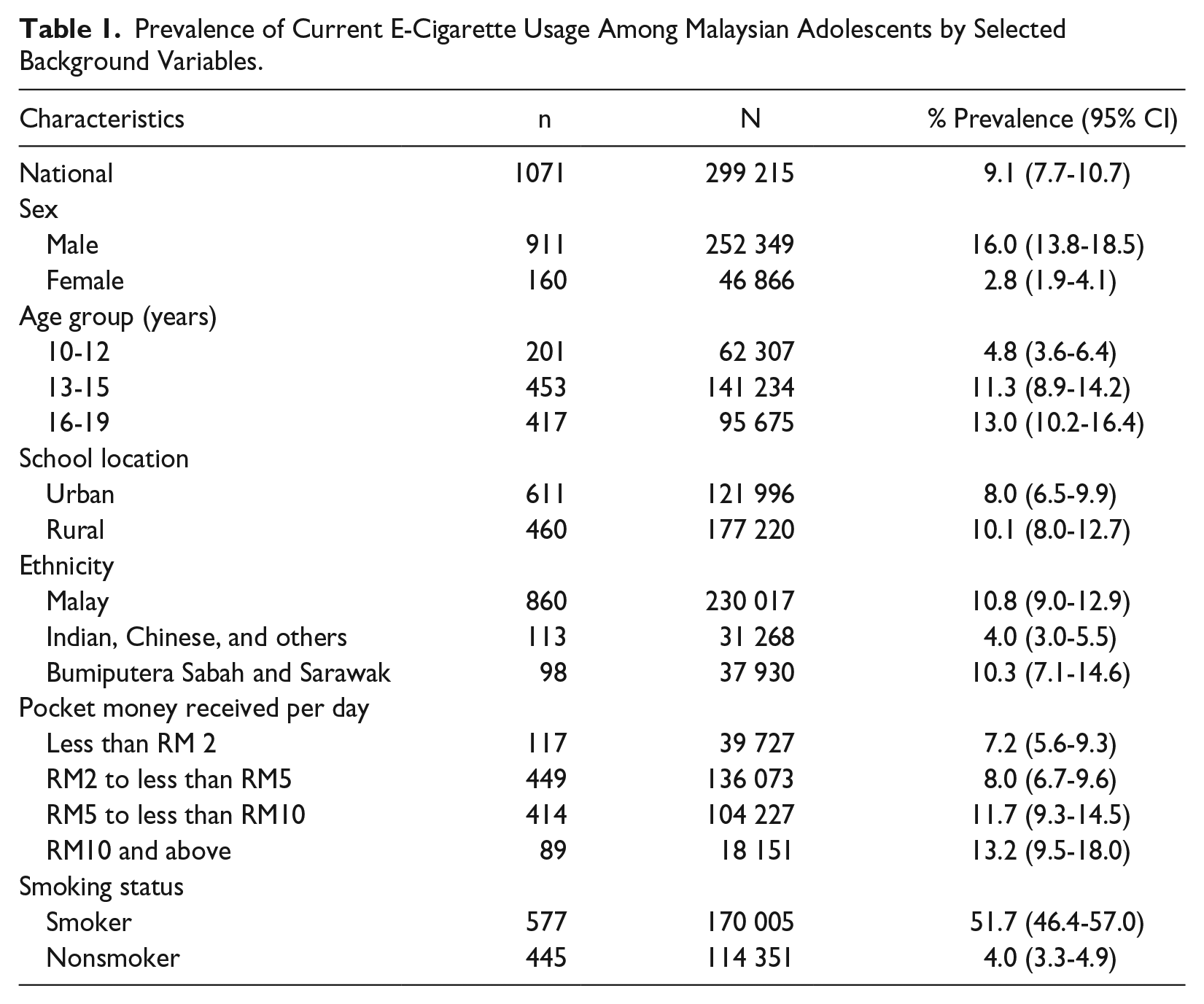
We found that the overall prevalence of current e-cigarette usage was 9.1% (95% confidence interval [CI] = 7.74-10.73). There was a progressive increase of e-cigarette usage with age, with the highest prevalence of e-cigarette usage among 16- to 19-year-olds (13.0%). Alarmingly, almost 5% of students aged 10 to 12 years were current e-cigarette users. Schools located in rural areas reported 10.1% of e-cigarette usage among their students compared with 8.0% in schools located in urban areas. Overall, 13.2% of the students who received RM10 and above per day as pocket money, 11.7% who received RM5 to RM10 per day, 8.0% who received RM2 to RM5 per day, and 7.2% who received less than RM2 per day were current e-cigarette users. A half (51.7%) of students who were cigarette smokers used e-cigarettes whereas only 4.0% of non-smokers used e-cigarettes (Table 1).
Prevalence of Current E-Cigarette Usage Among Malaysian Adolescents by Selected Background Variables.
Multivariate Logistic Regression Analysis on Factors Associated With E-Cigarette Usage
Multivariable logistic regression (Table 2) revealed that males were more likely to use e-cigarettes compared with females (adjusted odds ratio [aOR] = 4.08; 95% CI = 3.36-4.95). Students aged 16 to 19 years had higher odds (2.64) of e-cigarette usage compared with the younger ones. Ethnicity was significantly associated with e-cigarette use where Malays and Bumiputera Sabahans and Sarawakians had similar odds of 2.25 higher than Indians, Chinese, and other ethnic groups. Cigarette smoking was significantly associated with e-cigarette use compared with non-smoker status (aOR = 13.16; 95% CI = 11.14-15.54). School location did not show any significant association with e-cigarette use (Table 2).
Factors Associated With E-Cigarette Usage Among Malaysian Adolescents.

Significant at P < .05.
Reasons for E-Cigarette Initiation
Reasons for e-cigarette initiation among adolescents in Malaysia are as described in Table 3. The top 3 reasons for e-cigarette initiation was liking the taste and smell of the e-cigarettes (81.2%), followed by wanting to experiment with the e-cigarettes (73.4%) and felt that e-cigarettes are popular (67.4%). Almost half (48.4%) of the e-cigarette users felt that e-cigarettes could help them quit smoking.
Reasons for E-Cigarette Initiation among E-Cigarette Users
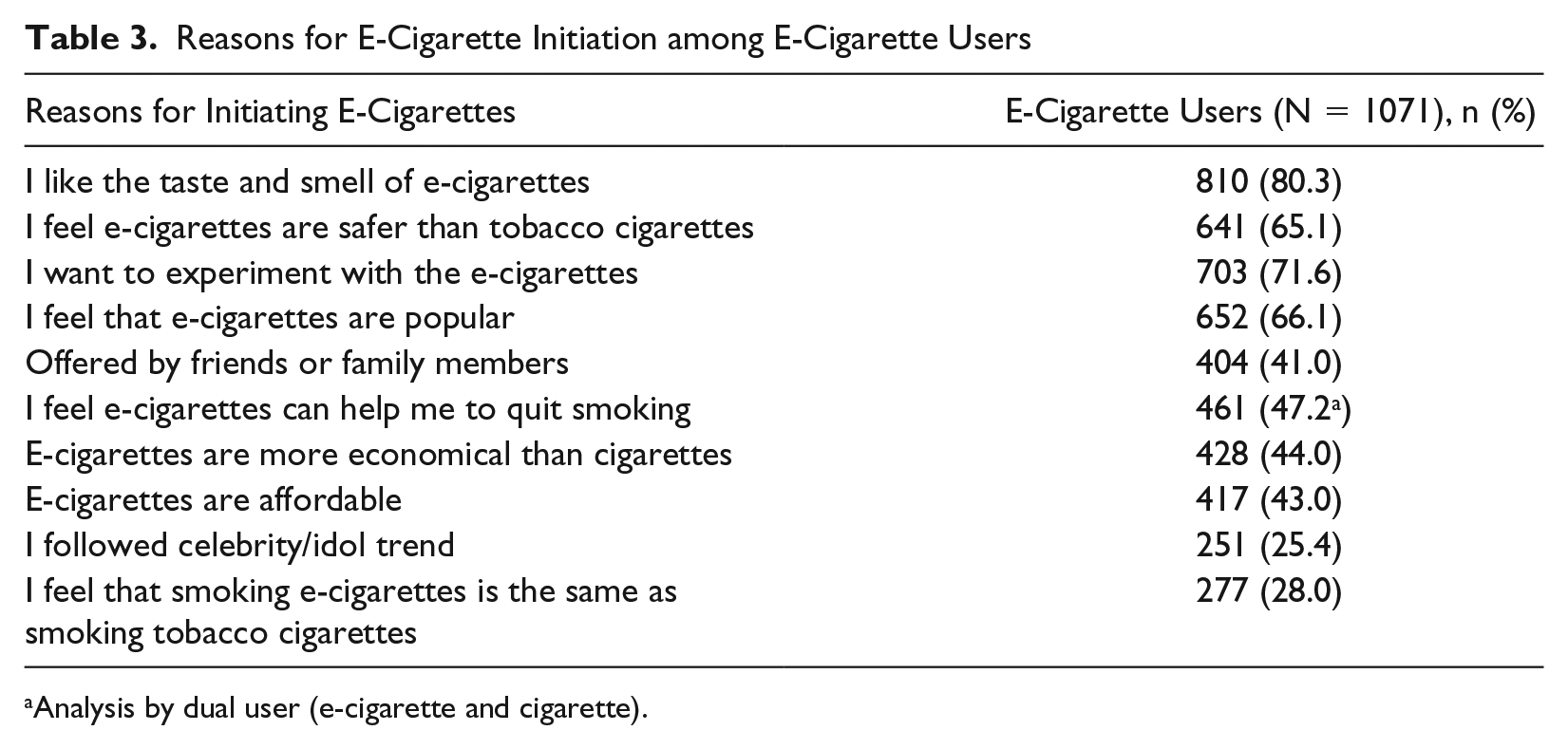
Analysis by dual user (e-cigarette and cigarette).
Discussion
In this nationally representative sample of adolescents aged 10 to 19 years in Malaysia, we have found that the overall prevalence of current e-cigarette usage was 9.1%. A cross-sectional population-based study done in Hong Kong reported a very much lower prevalence of e-cigarette use among adolescents (1.1%). 10
Since little data exist regarding the usage of e-cigarettes among adolescents in Malaysia, a comparison could not be discussed. However, data regarding adult usage of e-cigarettes were found in the Global Adult Tobacco Survey, which reported that the awareness of e-cigarettes among Malaysian adults in 2011 was 21%, and among them, current e-cigarette use was 3.9%. On the contrary, awareness in Indonesia was lower (10.9%) and usage was 2.5%. 11 This is alarming, given the higher prevalence of current tobacco smoking among adults in Indonesia (57%) as compared with Malaysia (40%). 12 In a national survey of 12- to 18-year-old Finnish adolescents, there was significant associations of conventional cigarette smoking with e-cigarette usage, 13 similar to the findings of this study where conventional cigarette smokers were more likely to use e-cigarettes.
The Surgeon General’s report on e-cigarette use among youth and young adults noted that e-cigarette use was higher among males, 14 whites, and Hispanics. 15 This was consistent with our findings where sex (males) and ethnicity (Malays, Sabah and Sarawak Bumiputeras) were found to be associated with e-cigarette usage.
Adolescence is a vulnerable time when experimentation is common and attitudes toward smoking are formed. 16 This is evidently seen in the results of this study where there is a big jump in the prevalence of e-cigarette usage between adolescents in the 10- to 12-year age group and the 13- to 15-year age group. Other studies have shown that adolescents were more likely to use e-cigarettes for experimentation rather than for quitting smoking, 17 and adolescents who have tried e-cigarettes were least likely to consider quitting smoking. 13 This is similar to our study’s findings where 71.6% of the students cited experimentation as the reason to initiate e-cigarettes.
In a study done in Hong Kong, adolescents had favorable perceptions (greater attractiveness, better parental and school acceptance, and less likely to cause accidents or harm to its users) toward e-cigarettes compared with conventional cigarettes.18,19 A number of studies have also found that e-cigarette usage among non-smokers was a predictor for future initiation of cigarette smoking.20-22 If we condone to this, renormalization of smoking may take place.23,24 Strengthening strategies to decrease both smoking and e-cigarette use among Malaysian adolescents is needed.
In our study, we found that the top reason for e-cigarette initiation among the students was an affinity towards the taste and smell of the e-cigarettes. This is supported by other studies where more adolescents compared with adults preferred fruity, alcohol, and/or dessert-flavored e-liquids, and this made them use it more frequently.25,15 It was also reported that adolescents were more likely to be interested in trying an e-cigarette offered by a friend if it was flavored like menthol, candy, or fruit as opposed to tobacco. 26
There might be some hidden dangers in non-nicotine e-cigarettes being legal as there is no monitoring done on the contents of the e-liquids. While the contents of the e-liquid may vary depending on the manufacturer and country, a study in the United States that analyzed flavored e-cigarette liquids, found it to contain at least one flavoring chemical, such as diacetyl, known to be associated with bronchiolitis obliterans and other respiratory problems. 27 This should be a matter of concern as adolescents may perceive these flavored e-liquids to be harmless not knowing the hidden dangers in it. Nicotine might also be added to flavored e-cigarettes, which are known to be appealing to adolescents, and this could lead to addiction15,28 and problems in brain development. 15 Regulations on labeling the e-cigarette liquid should be enforced to ensure that consumers are aware of the concentration of nicotine. Other ingredients if added to the liquid should also be specified.
In Asia, several countries namely, Brunei, Cambodia, Hong Kong, Japan, and Singapore have banned e-cigarettes in view that it imitates that of a tobacco product and also because it contains nicotine. 29 Based on our findings, we recommend that e-cigarettes with or without nicotine should not be sold to those younger than 18 years as an initial step and then to ban e-cigarettes from the market since there is evidence that e-cigarette usage can progress to conventional cigarette smoking. Flavored e-cigarettes, including advertisements about them, should also be banned since there is evidence suggesting increased appeal among the younger generation. 30 Students in schools should be educated on the dangers of e-cigarette usage from an early age to prevent experimentation. This should include education on the dangers of cigarette smoking as well since both e-cigarette usage and cigarette smoking are closely related. Parents too should play an active role in discouraging their children from using e-cigarettes.
There were a few limitations in this study whereby factors that may influence e-cigarette use such as e-cigarette usage among peers or parents, other substance use such as alcohol and drugs were not explored as well. Also, this study was unable to determine the prevalence of cigarette smoking among students who switched to e-cigarette usage and vice versa. We also could not determine whether the students were using e-cigarette liquids with or without nicotine. In addition, this study reported only past month e-cigarette use and no measure of frequent or persistent use was explored.
Conclusion
Our study has found that the most vulnerable to e-cigarette usage among adolescents are males; 16- to 19-year-olds; Malays, Bumiputera Sabahans, and Bumiputera Sarawakians; and current cigarette smokers. This population should be our focus for intervention to prevent further usage of e-cigarettes as they are at a higher risk of a host of diseases associated with smoking. Therefore, trends in e-cigarette usage among adolescents in particular have to be monitored from time to time in order to prevent this phenomenon from going out of hand.
Footnotes
Acknowledgements
We would like to thank the Director General of Health Malaysia for permission to publish this article (NMRR-16-108-28789).
Declaration of Conflicting Interests
The author(s) declared no potential conflicts of interest with respect to the research, authorship, and/or publication of this article.
Funding
The author(s) disclosed receipt of the following financial support for the research, authorship, and/or publication of this article: This survey was fully funded by the Ministry of Health Malaysia including the publication fees.
