







Abstract

Home quarantine has become a common public health intervention during the COVID-19 (coronavirus disease-2019) pandemic, the implementation of which is constrained by limited living space, problem with adherence, and possible negative psychological impacts. 1 In Hong Kong, a 14-day home quarantine order was issued to citizens on return from overseas or Mainland China since February 2020. We conducted an online self-administered survey to examine the degree of restriction and hygiene practice of quarantined persons and evaluate its potential public health consequences, following approval of Survey and Behavioural Research Ethics Committee of the Chinese University of Hong Kong.
Between April 4, 2020, and May 14, 2020, 98 citizens (43% male) with a median age of 28 years (interquartile range: 21-51) who had been quarantined at home or self-arranged accommodation as mandated by law were recruited. For those with co-living household members (n = 77), 66 (86%) dwelled in single bedrooms, the size of which varied (46% <100 ft 2 ). Two out of 16 persons (12.5%) subsequently tested positive for SARS-CoV-2 (severe acute respiratory syndrome coronavirus 2), but none was linked to secondary spread of the virus during quarantine. Ten respondents (22%) reported Impact of Event Scale–Revised (IES-R) score of over 24, a marker for partial posttraumatic stress disorder or having some symptoms. 2
We defined effective confinement as the state of self-isolation in a residence location, or keeping >1 m distance with co-living household members. Only half (49/96) of the respondents were in effective confinement. Hygiene practices including wearing mask (79%) and handwashing before and/or after meal and handling food and after going to the toilet (>88%) were commonly adopted and were not significantly different between respondents in effective and ineffective confinement. The perceived usefulness of wearing masks and handwashing in more than 90% of citizens in a study in Hong Kong 3 echoed the high rate of adoption of hygiene practices at home in our study. The maintenance of social connectivity could be important in ensuring compliance with quarantine, as reflected by the high rates of use of Internet and social media among quarantined persons on effective confinement.
Overall, 80% agreed or strongly agreed that home quarantine was effective for controlling SARS-CoV-2 transmission, could protect one’s health and public health, and that offences should be criminalized with penalties as appropriate. Fifty-eight percent (42/72) indicated they “strongly agreed” or “agreed” to all questions classified as reflecting support to the regulatory measure. There was no difference in hygiene practice or social connectivity between the two groups. Comparing with those not supportive of the regulations, a higher proportion of supportive respondents had IES-R score of >24 (35% vs 9%, P < .05; Table 1). The discrepancy between belief and compliance with quarantine (effective confinement) in our study could be the origin of stress and anxiety. In Mainland China, high prevalence of anxiety and depression was reported in an online study covering 31 provinces and autonomous regions at the peak of the COVID-19 pandemic. 4 Despite general agreement of citizens with the quarantine policy, the overall impacts on mental health is a cause for concern, as reported after the SARS outbreak. 5
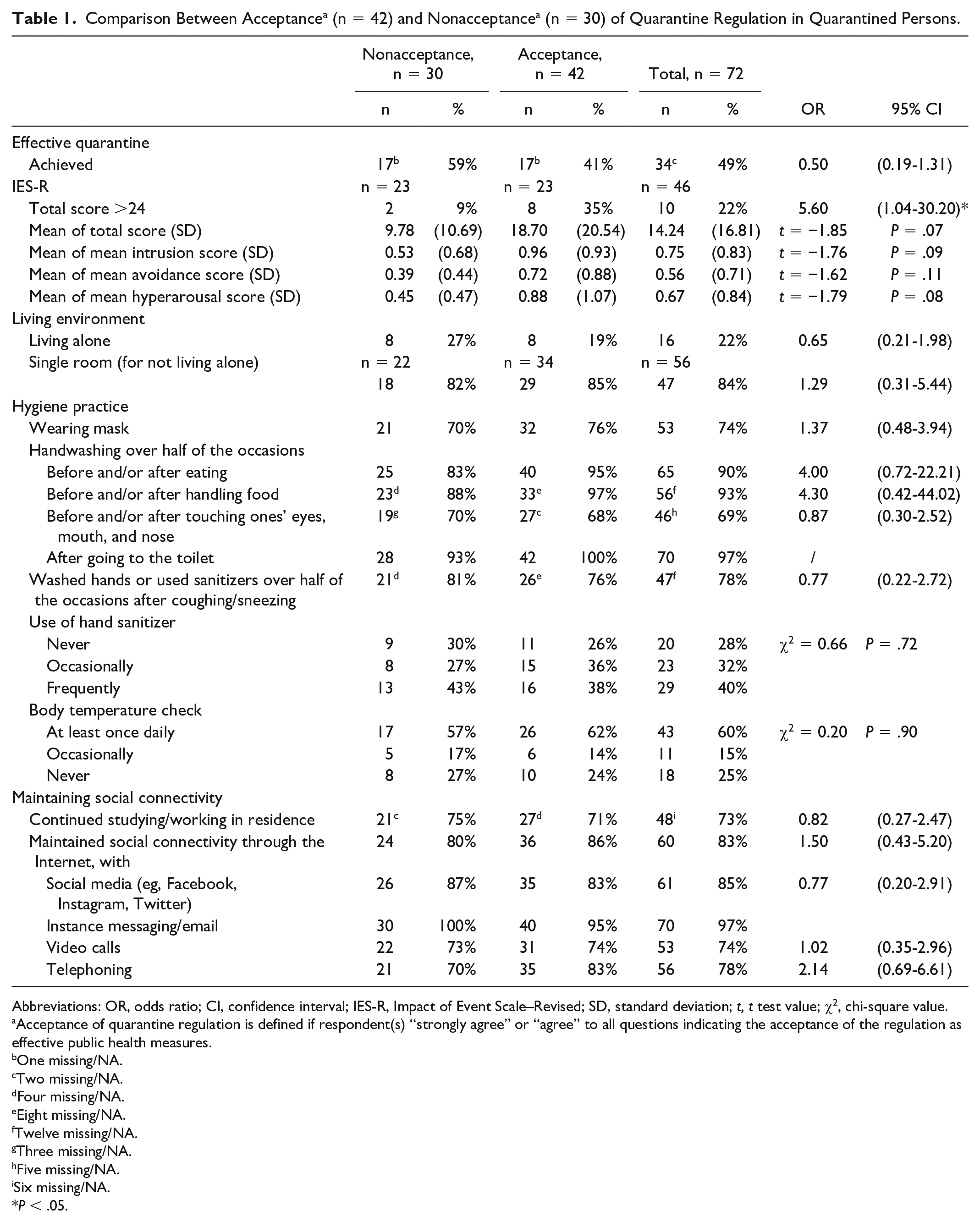
Abbreviations: OR, odds ratio; CI, confidence interval; IES-R, Impact of Event Scale–Revised; SD, standard deviation; t, t test value; χ2, chi-square value.
Acceptance of quarantine regulation is defined if respondent(s) “strongly agree” or “agree” to all questions indicating the acceptance of the regulation as effective public health measures.
One missing/NA.
Two missing/NA.
Four missing/NA.
Eight missing/NA.
Twelve missing/NA.
Three missing/NA.
Five missing/NA.
Six missing/NA.
P < .05.
Footnotes
Acknowledgements
Li Ka Shing Institute of Health Sciences, the Chinese University of Hong Kong, is acknowledged for rendering technical support throughout the conduct of this study.
Declaration of Conflicting Interests
The author(s) declared no potential conflicts of interest with respect to the research, authorship, and/or publication of this article.
Funding
The author(s) disclosed receipt of the following financial support for the research, authorship, and/or publication of this article: This work was supported by the Health and Medical Research Fund (Project Reference No. COVID190102) of Food and Health Bureau, Hong Kong Special Administrative Region Government.
