







Abstract

Introduction
COVID-19 vaccination has become, understandably, an international priority to control the global pandemic. However, vaccine hesitancy and reluctance among communities are delaying the achievement of global herd immunity. Vietnam is a country of approximately 98 million people living in high density with limited resources, and a low health system capacity that faces a high risk of COVID-19 spreading. The principal strategy to control the pandemic in Vietnam has been focusing on public health solutions, including hand sanitization, mask-wearing, social distancing, travel restrictions, and partial or complete lockdowns. 1 However, for long-term strategies, developing effective and safe vaccines remains a priority. Due to limited resources, Vietnam currently has a relatively low vaccine coverage. Accounted to June 19, 2021, only 2.31% of the population had received at least 1 dose, and 0.06% of the population was fully vaccinated. 2 By August 30, 2021, the proportions increased to approximately 20% and 2.5%, respectively. 2 In addition to efforts to ensure COVID-19 vaccines are available and accessible, enhancing public trust and willingness in vaccination is also a matter of the government’s concern. It is crucial to understand the level of acceptance of COVID-19 vaccines and the community’s concerns toward COVID-19 vaccines. For this reason, this study was implemented, aimed to assess the level of COVID-19 acceptance among the general population in Vietnam and associated factors.
Methods
This was a cross-sectional study using an online survey among Vietnamese adults from May 12 to 30, 2021. Data were analyzed using SPSS software (version 24). Both descriptive and inferential statistical analyses were performed. The binary logistic regression analyses with the forward stepwise method were applied to identify factors associated with acceptance of the COVID-19 vaccines. The statistical significance level was set at P < 0.05 (2-sided).
Results
Demographic Characteristics of the Study Participants
In total, 3954 Vietnamese adults participated, with 43.8% aged 18 to 29 years, 47.8% aged 30 to 49 years, and 8.4% aged 50 years and above; 68.9% of respondents were females, 54.2% were married, 73.6% were undergraduates, and 79.3% lived in urban areas. In terms of careers, 32% were students, 24.4% were health care staff, 18.2% were teachers, and the remaining 25.5% had a variety of employments; 22.6% of participants reported that they had at least 1 chronic disease and 21.9% had an allergic history.
Attitudes Toward the COVID-19 Vaccines and Vaccination
Most participants expressed positive opinions about the COVID-19 vaccines and agreed with the statements, “COVID-19 vaccines are safe and effective” (69.7%), “The vaccines can protect people from the COVID-19” (77.3%), and “The more people being vaccinated the sooner the pandemic will end” (89.2%). In addition, 73.1% of participants were willing to pay for vaccination. The 3 most concerning issues about COVID-19 vaccination were safety (92.5%), effectiveness (75.6%), and side effects (68.5%). The 2 most trusted information sources of the COVID-19 vaccines were health care staff (68.8%) and television (47.1%).
Acceptance to Be Vaccinated With the COVID-19 Vaccines and Associated Factors
A high percentage of participants (71.7%) indicated they were willing to get vaccinated, while 25.4% were hesitant, and 2.9% indicated they refused to be vaccinated. The binary logistic regression model was fit for use and could explain 79.7% of the variance of the vaccination acceptance and correctly predicted the 90.8% acceptance for the model (Table 1).
Factors Associated With the COVID-19 Vaccine Acceptance (N = 3954).
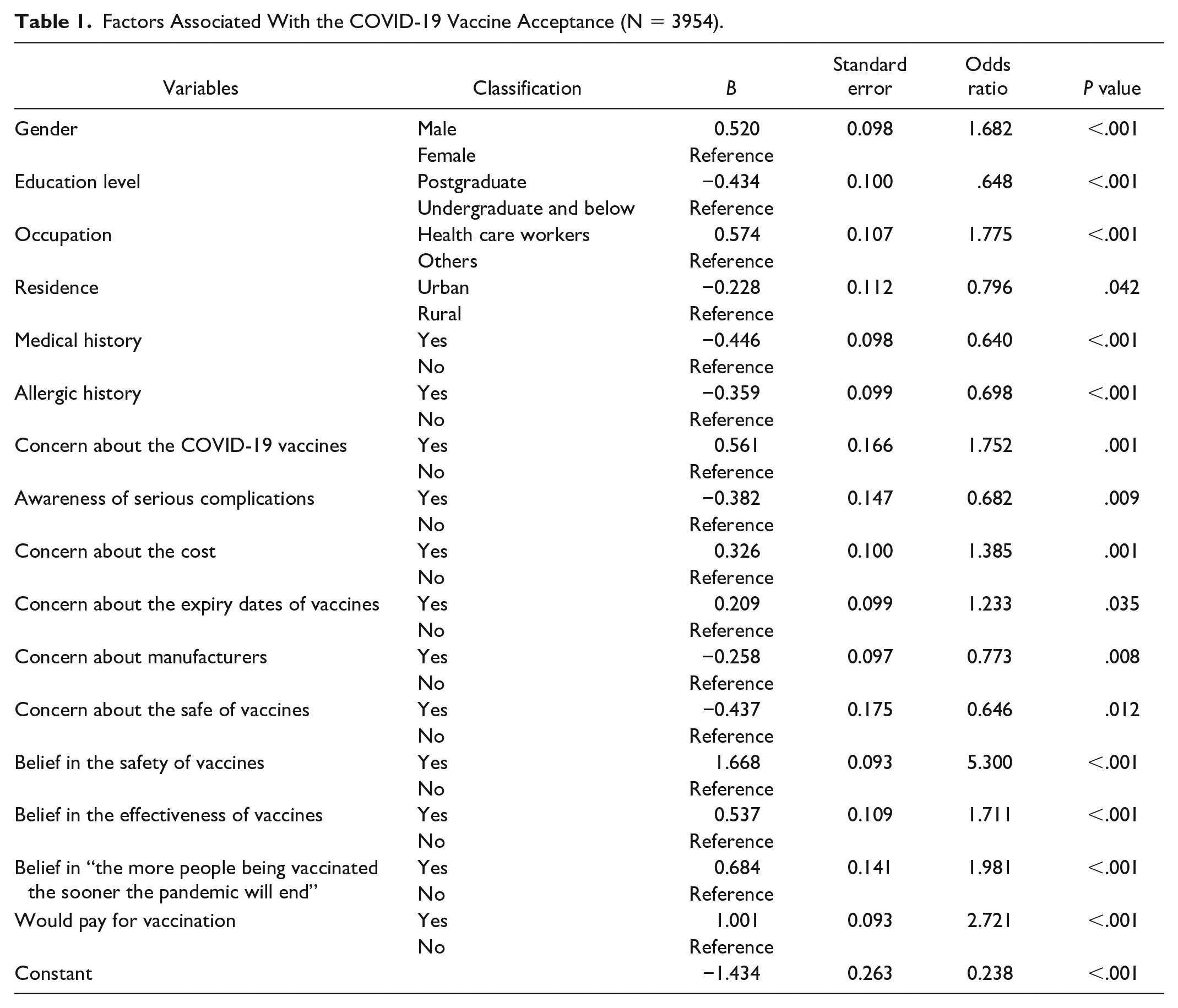
Males and health care staff were more likely to accept vaccination, while people with postgraduate-level education, living in urban areas, with a chronic disease history, or a history of allergic reaction were less likely to accept vaccination. People who were concerned about vaccination cost and the expiry dates, believed in the effectiveness, agreed with the statement “the more people being vaccinated the sooner the pandemic will end,” and would pay for vaccination were more likely to get vaccinated. In particular, people who believed in the safety of the vaccines were 5.3 times more likely to get vaccinated (P < .001). People who were aware of the serious complications of vaccination, people who thought that the United States’s or Europe’s vaccines were better than those produced by other countries, and people who considered the safety of the vaccine were less likely to accept vaccination (Table 1).
Discussion
Vietnam stands among nations as having a high percentage of acceptance (71.7%),3 -6 and the percentage (2.9%) of reluctance to be vaccinated was far lower than many studies.7 -9 The reasons may be because the country is experiencing a new wave of the pandemic with Delta variant and the scarcity of COVID-19 vaccines. This might boost the demand and increase the willingness to use them. In addition, successful vaccination campaigns in many countries may increase the trust among the Vietnamese community. However, someone’s present willingness to get vaccinated is one of the referent predictors and might not ensure they will get vaccinated in the future, because this decision depends on multiple factors and may change over time. The two information sources they most believed in were health care staff and television, which were similar to a US study. 10 This implies that considering the communication channels is very important in national vaccination campaigns. Transparent and accurate information about the effectiveness and safety of vaccines through health experts’ recommendations, health agencies’ Web sites, and official television channels may increase the acceptance rates.
Recommendations
Our results imply that effective public health messaging on the safety, effectiveness, manufacturers, and side effects of the COVID-19 vaccines could be a key in addressing the major concerns of those who hesitate to be vaccinated; therefore, public health messaging should be conducted concurrently with vaccine rollout, to improve acceptance and achieve herd immunity.
Footnotes
Acknowledgements
We express our deep appreciation for all the participants involved in this study. We also acknowledge Leanne McKnoulty, Griffith University, Australia, for her support in English editing.
Declaration of Conflicting Interests
The author(s) declared no potential conflicts of interest with respect to the research, authorship, and/or publication of this article.
Funding
The author(s) received no financial support for the research, authorship, and/or publication of this article.
