







Abstract

Introduction
Vaccination is the most important and successful public health tool for combating infections and epidemics. 1 During the coronavirus 2019 (COVID-19) pandemic, it has once again become clear that vaccination is the most effective way to protect people from infectious diseases and epidemics. The significance and success of vaccination are indisputable; however, vaccine hesitancy and refusal regarding both COVID-19 and other childhood vaccinations have become serious problems in the fight against vaccine-preventable diseases and epidemics. This study aimed to investigate parental attitudes toward COVID-19 and childhood vaccines, causes of vaccine hesitancy and refusal, and effects of the COVID-19 pandemic on parental vaccine attitudes.
Methods
This study used a multicenter cross-sectional design consisting of a face-to-face questionnaire. Ethical approval was obtained from the University of Health Sciences Hamidiye Scientific Research Ethics Committee (date 29.01.2021 and number 5436). Verbal consent was obtained from all parents before the questionnaire was administered.
A questionnaire consisting of 18 questions concerning the demographic characteristics of parents, thoughts on both childhood and COVID-19 vaccines, and reasons for vaccine hesitancy and refusal was administered to 1018 consecutively selected parents with children younger than 13 years who visited to four centers for various reasons between March 1 and April 15, 2021.
Data analyses were performed using Statistical Package for the Social Sciences version 25 program. Continuous variables are presented as mean ± standard deviation, and categorical variables are presented as frequency (n) and percentage (%). A chi-square test was used to compare the categorical variables, and a McNemar-Bowker test was used to analyze the dependent variables. A P value of <.05 was considered statistically significant.
Results
Of the 1018 parents, 809 (79.5%) were women with a mean age of 36.73 ± 6.67 years, mean number of children 2.05 ± 0.88, and mean age of the youngest child 5.52 ± 5.12 years.
Parents in the vaccine hesitancy and refusal group for childhood and COVID-19 vaccines used the Internet, social media, and written, visual, and audio media more frequently than other sources for information about vaccines compared to parents not in the vaccine hesitancy and refusal group (P < .05; Table 1). The rate of vaccine hesitancy and refusal regarding childhood vaccines among the parents was 21.7% and 20.1% before and during the COVID-19 pandemic, respectively.
Relationship Between Parental Sources of Information About Vaccinations and Their Attitudes Toward Vaccinations.
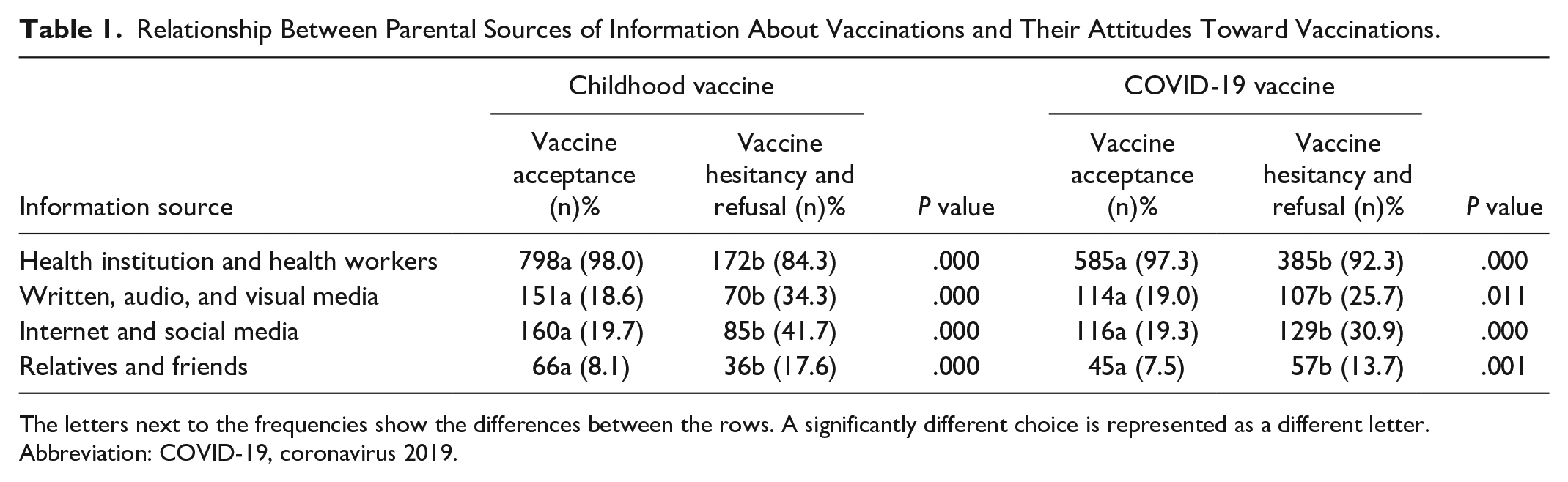
The letters next to the frequencies show the differences between the rows. A significantly different choice is represented as a different letter.
Abbreviation: COVID-19, coronavirus 2019.
Parents’ Opinions on Childhood Vaccines
The number of parents in the vaccine approval group was 814 (79.9%), and 20.1% were in the vaccine hesitancy and refusal group (18% hesitancy, 2.1% refusal).
Vaccine hesitancy and refusal were more common in university graduate parents and vaccine hesitancy and refusal were found to be the least common among health workers (P < .05; Table 2).
Relationship Between Vaccine Hesitancy/Refusal and Sociodemographic Characteristics of Parents.
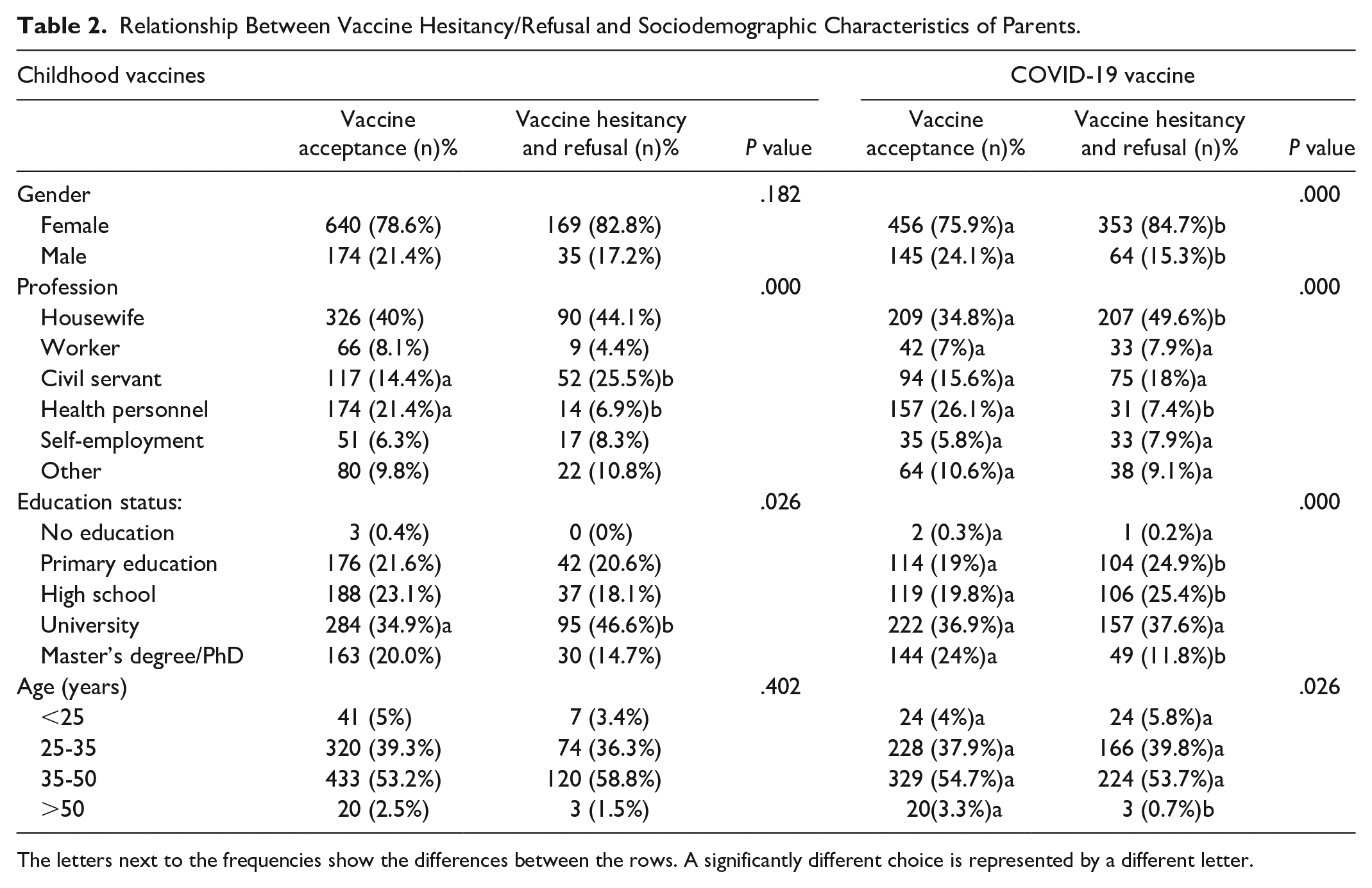
The letters next to the frequencies show the differences between the rows. A significantly different choice is represented by a different letter.
The most common reasons for vaccine hesitancy were concerns about some preservatives in the vaccine that might cause diseases in children (43.6%) and vaccine-related side effects in children (34.6%). The most common reasons for vaccine refusal were that children would be better immunized by becoming infected with the virus (27.8%), and the vaccines would cause side effects (26.9%).
Parental Opinions on COVID-19 Vaccination for Themselves and Their Children
The number of parents in the COVID-19 vaccine approval group was 601 (59%), whereas 417 (41%) of the parents were in the COVID-19 vaccine hesitancy and refusal group (26.8% hesitancy, 14.2% refusal). Of these, 57% had concerns about the side effects related to the vaccine and its contents.
Vaccine hesitancy and refusal regarding the COVID-19 vaccine were more common in females, housewives, and primary and high school graduates (P < .05; Table 2).
Parental attitudes on COVID-19 vaccination for their children; 460 (45.2%) of the parents approved, 361 (35.5%) were hesitant, and 197 (19.3%) refused. In addition, 71.7% parents in the vaccine hesitancy and refusal group regarding for COVID-19 vaccinations had concerns about the side effects related to the vaccine and its contents.
Discussion
Vaccine hesitancy has become an important global problem, especially in Europe.2,3 The increasing trend in worldwide antivaccination has caused the World Health Organization (WHO) to declare antivaccination as one of the 10 factors threatening global health. 4
It has been reported that the vaccination rate in a community should be between 67% and 80% to control epidemics in addition to reducing the spread of COVID-19 disease. 5 In a study that evaluated data from 33 countries, it was reported that the acceptance rates of COVID-19 vaccine were below 60%, which will pose a serious challenge for efforts to control the COVID-19 pandemic. 6 Similarly, in the present study, only 59% parents accepted the COVID-19 vaccine. The acceptance rate of parents (45.2%) was even lower when it came to getting COVID-19 vaccines for their children.
Effective communication to understand the reasons for parents’ resistance to vaccination plays an important role in the fight against vaccine hesitancy and refusal. 7 At present, the Internet and social media are the most important communication tools. Therefore, the rapid spread of incorrect news about vaccination is one of the most influential factors on vaccine hesitancy and refusal. 8 In the present study, it was found that parents with vaccine hesitancy and refusal regarding both childhood and COVID-19 vaccines used the Internet and social media more frequently than other sources for information about vaccines.
Conclusion
Vaccine hesitancy and refusal among parents is a serious problem in general, and it is worse when it comes to COVID-19 vaccines. It has become dangerous in terms of the emergence of vaccine-preventable diseases and epidemics. To combat vaccine hesitancy and refusal globally, effective solutions should be developed and implemented as soon as possible with in-depth studies by analyzing the factors, especially the Internet and social media, that cause parents to have negative attitudes toward vaccinations.
Footnotes
Declaration of Conflicting Interests
The author(s) declared no potential conflicts of interest with respect to the research, authorship, and/or publication of this article.
Funding
The author(s) received no financial support for the research, authorship, and/or publication of this article.
