







Abstract

Introduction
Due to the severity and worldwide reach of the coronavirus 2019 (COVID-19) outbreak, 1 various measures have been implemented to curb the disease. In the beginning of 2021, many countries have granted emergency approval of numerous vaccines to promote the rollout of the COVID-19 vaccine. Unfortunately, vaccine resistance has slowed down the uptake of the vaccine2,3 and has led to a mix of positive and negative attitudes toward the vaccine. A recent study in Malaysia found that the vaccine acceptance rate was high (83.3%), but a majority of the participants were hesitant due to concerns regarding side effects (95.8%) and vaccine safety (84.7%). 4 The impact of the vaccine’s potential efficacy at controlling the spread of COVID-19 could be jeopardized if a significant portion of the population is left unvaccinated. 5
We adapted a conceptual model for COVID-19 vaccine behavior intention, which has recently been proposed specifically for older adults. The model highlighted that factors such as perceived risk of the pandemic, general vaccine belief, political affiliation, individuals’ attitudes toward the vaccine, and their physician’s recommendation are important factors to improve vaccine uptake. 6
This study aimed to examine the influence of attitudes toward the vaccine and general vaccine beliefs on the willingness to accept the COVID-19 vaccine at 90% and 95% effectiveness levels, prior to the national rollout of the vaccination program in Malaysia.
Methods
This cross-sectional study was conducted as part of wave 1 of the International Citizen Project COVID-19 (ICPCovid; https://www.icpcovid.com/en/form/covid-19-vaccine-survey) survey. Malaysians aged 18 year and above were invited to participate in the online survey.
The questionnaire consisted of sociodemographic data, health status, attitudes toward COVID-19 vaccine effectiveness and safety, and their willingness to have the vaccine at 90% and 95% effectiveness levels.
Data for continuous variables were summarized using descriptive statistics. The associations between continuous variables and willingness to accept the vaccine with at least 90% and 95% effectiveness were compared using t tests and Mann-Whitney U tests, whereas χ2 tests were used to assess the association between categorical variables and the willingness to accept the vaccine with 90% and 95% effectiveness. Hierarchical binary logistic regression models with willingness to accept COVID-19 vaccine with at least 90% and 95% effectiveness as outcome variables were fitted. In the regression model, only significant demographic variables (step 1), general COVID-19 vaccine beliefs (step 2), and attitudes toward the COVID-19 vaccine (step 3) were included. The analysis was conducted using IBM SPSS Statistics version 27 (IBM Corp., Armonk, New York).
Results
A total of 1738 participants completed the online survey. Table 1 summarizes the demographic characteristics and the acceptance of the COVID-19 vaccine (Table 1).
Demographic Characteristics and the Acceptance of the COVID-19 Vaccine With At Least 90% and 95% Effectiveness (N = 1,738).
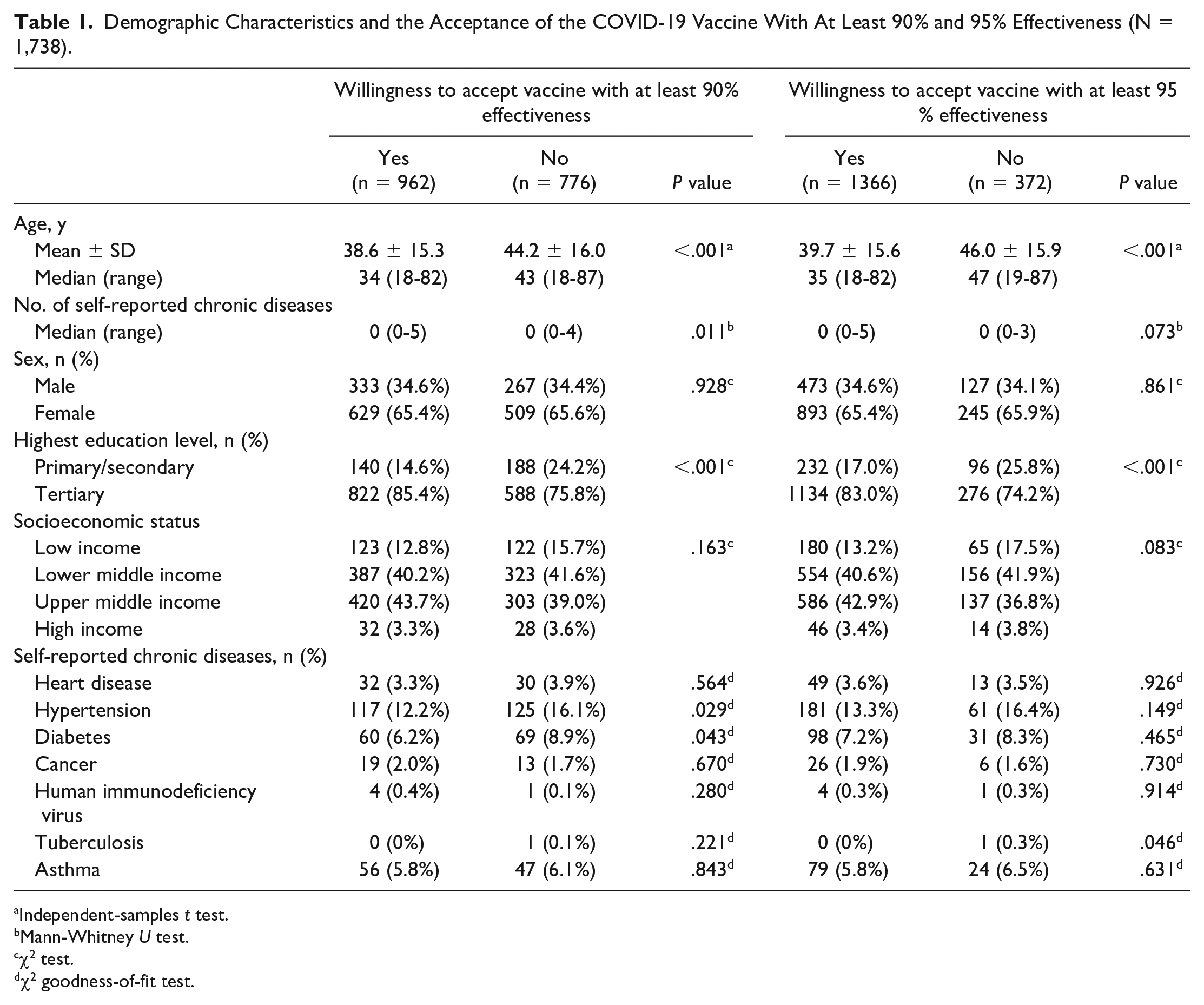
Independent-samples t test.
Mann-Whitney U test.
χ2 test.
χ2 goodness-of-fit test.
There was a significant association between general COVID-19 vaccine beliefs and willingness to accept the vaccine with at least 90%, χ2(2) = 68.85, p < .001, and 95%, χ2(2) = 76.47, p < .001, effectiveness. Furthermore, a significant association was observed between attitudes toward the COVID-19 vaccine and willingness to accept the vaccine with at least 90%, χ2(4) = 269.21, p < .001, and 95%, χ2(4) = 274.66, p < .001, effectiveness.
Table 2 shows the hierarchical regression model with willingness to accept the vaccine with at least 90% and 95% effectiveness as the outcome variables. Overall, the final models including significant factors, such as (1) general COVID-19 vaccine beliefs and (2) attitudes toward the COVID-19 vaccine, were found to be essential in predicting the willingness to accept the vaccine with at least 90% and 95% effectiveness (Table 2).
Hierarchical Regression Models Showing Factors Associated With the Willingness to Accept the COVID-19 Vaccine at 90% and 95% Effectiveness Levels.
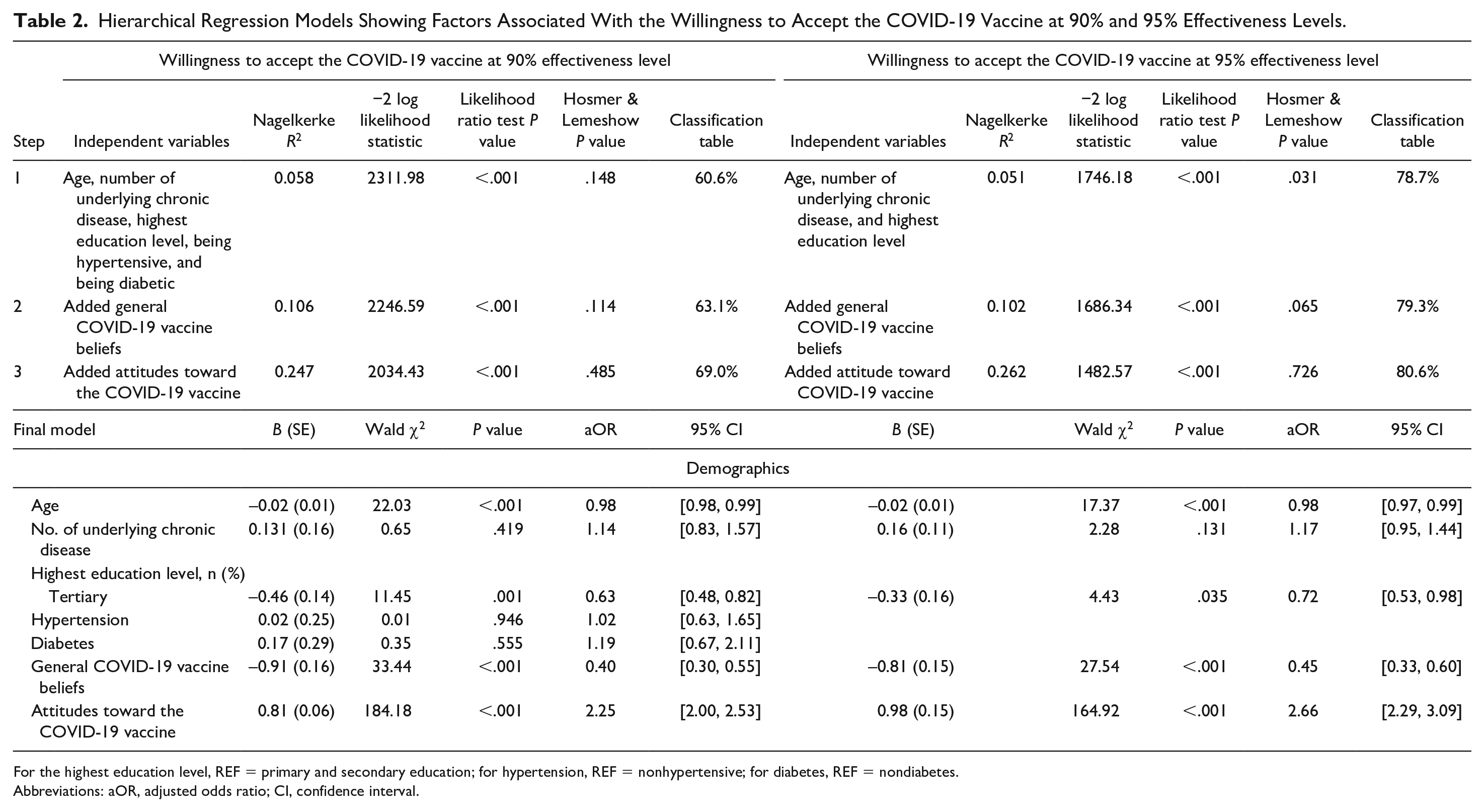
For the highest education level, REF = primary and secondary education; for hypertension, REF = nonhypertensive; for diabetes, REF = nondiabetes.
Abbreviations: aOR, adjusted odds ratio; CI, confidence interval.
Discussion
This study aimed to investigate the influence of attitudes toward the COVID-19 vaccine, particularly in relation to the importance, effectiveness, and safety of the vaccine, and general beliefs about the COVID-19 vaccine in the willingness to accept it.
We found that attitudes toward the vaccine played an important role in influencing the possibility of vaccine uptake. Attitudes toward the COVID-19 vaccine were more influential in predicting the odds of vaccine acceptance after adjusting for the following demographic factors: number of chronic diseases, hypertension, diabetes, and general vaccine beliefs. In another study, the influence of attitudes toward vaccination was found to be more influential compared with demographic factors, particularly regarding the perceived benefits of the vaccines. 7 Another study found that attitudes and beliefs concerning vaccination explained the greatest proportion of variance in vaccination intention. 8
However, general COVID-19 vaccine beliefs, such as belief in conspiracy theories and personal immunity, should not be disregarded, as these beliefs may give rise to vaccine hesitancy and undermine the vaccination program through the spread of fake news and negative messaging. In this study, general vaccine beliefs were still a significant predictor of willingness to accept the vaccine. Another study similarly showed that vaccine hesitancy factors such as distrust of vaccine benefits, concerns of side effects, and preferring natural immunity to vaccines were major contributors to vaccine hesitancy and refusal. 9
This study has a number of limitations. Of note, as a cross-sectional study, the study is of limited utility in imputing causation. As this study was conducted before the rollout of the national vaccination program, there may be a change in vaccine acceptance and the attitudinal factors influencing it.
This study has implications on the type of health campaigns that could be tailored for the Malaysian public. Health messages could increase accurate knowledge about COVID-19 and appeal to the benefits, effectiveness, and safety of vaccination. Clarifying misconceptions that contribute to vaccine hesitancy should go hand-in-hand with these positively worded campaigns.
Footnotes
Acknowledgements
The authors thank all participants for their contributions to this study.
Authors’ Note
The data that support the findings of this study are available upon reasonable request from the corresponding author.
Author Contributions
S.A.B. and W.Y.L. were involved in study conceptualization. W.S.C. and S.C.S. were involved in methodology. W.S.C., S.C.S., S.A.B., and W.Y.L. were involved in drafting the original manuscript. All authors reviewed and agreed to the published version of the manuscript.
Declaration of Conflicting Interests
The author(s) declared no potential conflicts of interest with respect to the research, authorship, and/or publication of this article.
Funding
The author(s) disclosed receipt of the following financial support for the research, authorship, and/or publication of this article: This research was funded by VLIRUOS (Flemish Interuniversity Council for University Development Cooperation).
Ethics Approval
The expedited ethics approval was granted by the University of Malaya Research Ethics Committee, Kuala Lumpur, Malaysia (UM.TNC2/UMREC_1165).
Consent to Participate
Informed consent was obtained from all individual participants included in the study.

Availability of Data and Material
The datasets generated during and/or analyzed during the current study are available from the corresponding author on reasonable request.