







Abstract
To investigate the maternal and neonatal risk factors related to pregnancy and birth affecting the occurrence of neurodevelopmental disorders to their children using the medical claim data for the whole population. The study was conducted on all the babies born in Korea from 2005 to 2009 based on data from the National Health Information Database. All birth records were tracked from birth to December 31, 2015. To analyze factors related to the mother, data related to the mother of the newborn were collected. Increased maternal age was found to increase the risk of cerebral palsy (adjusted odds ratio [aOR] = 1.46) and autism spectrum disorder (aOR = 1.48), while lowering the risk of intellectual disability (aOR = 1.83) and speech and language impairment (aOR = 1.41) compared with the reference group aged 25 to 29 years old. The incidence affected by socioeconomic factors varied according to the types of disorders. Among various risk factors, prematurity or low birth weight, problems associated with amniotic fluid or amniotic membrane, preeclampsia or eclampsia, and cesarean section affect the incidence of neurodevelopmental disorders. To reduce the incidence or severity of neurodevelopmental disorders, a better understanding of the risk factors of neurodevelopmental disorders is important. The results of this study can be used as basic data to help such understanding.
What We Already Know
The rate of high-risk births is increasing along with advanced maternal age at birth.
Various maternal and neonatal factors can influence the incidence of neurodevelopmental disorders.
What This Article Adds
The incidence of cerebral palsy (CP) and intellectual disability (ID) decreased in the more recent years, while that of speech and language impairment (SLI) increased and that of autism spectrum disorder (ASD) was maintained at a similar level in Korea.
The risk of CP and ASD increased (1.46- and 1.48-fold, respectively) in older maternal age and that of ID and SLI increased in younger maternal age (1.83- and 1.41-fold, respectively).
Prematurity or low birth weight (up to 17.11-fold), problems associated with amniotic fluid or amniotic membrane (up to 1.39-fold), preeclampsia or eclampsia (up to 1.47-fold), and cesarean section (up to 1.28-fold) affect the incidence of neurodevelopmental disorders even after controlling other confounding factors.
Introduction
Neurodevelopmental disorders (NDDs) are disorders associated with dysfunctions of the central nervous system, including the brain, and exhibit problems in a variety of areas such as behavior, communication, and cognitive ability. 1 Neurodevelopmental disorders include various kinds of diseases such as speech and language impairment (SLI), intellectual disability (ID), autism spectrum disorders (ASD), cerebral palsy (CP), attention-deficit hyperactivity disorder, decreased vision, and hearing loss. Children with NDDs suffer from various neurologic dysfunctions including language, motor, behavior, memory, and learning. 2 As the child grows, symptoms of NDDs change, but some of them progress to permanent disabilities that require lifelong support, special services, and health care. This constant special care creates social costs and causes economic and psychological burdens for families of children with NDDs, and previous studies have shown that children with NDDs have higher expenditures on health care than healthy children. 3
Various factors influencing the incidence of NDDs such as prematurity or low birth weight, and economic vulnerability are known, and there are some studies on the effect of maternal and perinatal factors during pregnancy on their children’s neurodevelopment outcome. 4 Andersen et al 5 reported an increased risk of CP in children born with moderately preterm or moderately low birthweight. In the meta-analysis conducted by Gardener et al, 6 it was found that advanced maternal and parental age, gestational diabetes, and order of birth were associated with the occurrence of ASD. Bilder et al 7 reported that prematurity, low birth weight, premature rupture of membranes, fetal distress, and congenital infection are related to raising the risk of ID in a study using the birth cohort in a single city. Many studies were mostly localized to one or two regions or small sample size which can lead to random bias. Or, confounding factors are not considered, or the inclusion criteria or outcome measurement of the studies included in the analysis are heterogeneous, so there are limitations in the interpretation of the results.
According to data from the Korea National Statistical Office, the average age of mothers has been steadily increasing in recent years, and this trend of late marriage and older pregnancy was greater in women with higher education. 8 The rate of high-risk births is increasing along with later marriages and multiple gestations associated with the development of assisted reproductive technology. 9 Advanced maternal age increases the risk of obstetric complications such as gestational diabetes, preeclampsia, as well as fetal risks of low birthweight and preterm births. 10 In addition, exposure to environmental pollution and various endocrine disrupting chemicals through drinking water, house dust, and direct contact with household materials or consumer products is also on the rise. Results have been consistently reported that harmful substances such as prenatal air pollution exposure and endocrine disrupting chemicals affect the occurrence of NDDs such as ASD and attention-deficit hyperactivity disorder.11,12 But there are few studies on the effects of these factors on later children’s development and health.
Previous studies have reported that the prevalence of NDDs has been increased in recent years. 13 Considering the personal and social burdens of children with NDDs, medical and social welfare efforts are needed to understand the risk factors of NDDs and to reduce modifiable risk factors among them. Therefore, the purpose of this study was to retrospectively identify maternal and neonatal risk factors for children’s NDDs using nationwide population-based cohort in a situation where various environmental factors affecting the occurrence of NDD are changing.
Methods
The National Health Insurance Service, NHIS, is the only public medical insurance institution operated by the Ministry of Health and Welfare in Korea. The National Health Information Database, NHID, is a public database on health care utilization, sociodemographic variables, and mortality for the whole population of South Korea, formed by the NHIS. 14 The inclusion criteria of this study are as follows: (1) all babies born in Korea from 2005 to 2009 were screened for this study based on the NHID. (2) Of those, only infants whose information could be linked to that of their mothers were selected for the analysis of the factors related to the mothers. All birth records were tracked from the date of birth until December 31, 2015, and the data on the mothers of the newborns were tracked from the one year prior to pregnancy based on the date of birth. If major information related to the mother or baby was omitted, it was excluded from the study subjects.
Neurodevelopmental disorders encompass four diseases: CP, ID, ASD, and SLI. The case of having a disease code of the NDDs was considered, and the disease code refers to code by the International Statistical Classification of Diseases and Related Health Problems (ICD). Conditions related to the mothers include small for gestational age, fetal distress, placental abruption, premature rupture of membranes, problems associated with amniotic fluid or amniotic membrane, infection during pregnancy, gestational hypertension, gestational diabetes, preeclampsia, or eclampsia. In addition, we also considered the methods of delivery and multiple pregnancies. The detail codes are shown in Supplementary Table 1 with only the code of ICD 10th version listed (Supplementary Table 1).
For evaluating socioeconomic status (SES), data about maternal age, family income level, birth region, and category of the insured were collected based on birth information. Maternal age at the time of delivery was divided into six groups. For statistical analysis, comparison between groups was conducted using the 25- to 29-year-old group as a reference, which had the highest fertility rate by age in 2005. Financial revenue of the National Health Insurance of Korea consists of contributions of the insured and government subsidy. Under National Health Insurance, the contributions differ according to the family income level; the higher the income, the greater the contribution. The family income level is divided into a total of 20 quintiles, and for the statistical analysis, the level of income was divided into four categories; the first category included the Medical Aid beneficiaries and the lowest income group and then included progressively higher income groups up to the fourth category.
This study was approved by the relevant institutional review board and research ethics committee (NHIMC 2016-04-006). The need for written consent was formally waived by the ethics committee.
The generalized estimating equation (GEE) was used to determine the effect of various factors on the occurrence of NDDs. The significance level for analysis was 5%. SAS ver. 9.4 (SAS Institute Inc., Cary, NC, USA) was used for statistical analysis.
Results
Among 2 287 114 newborn babies for five years from 2005 to 2009, a total of 1 972 861 cases were analyzed in connection with maternal information. Among them, 4388 (0.22%) were diagnosed with CP, 5886 (0.3%) were diagnosed with ID, 5865 (0.3%) were diagnosed with ASD, and 15 643 (0.79%) were diagnosed with SLI. The overall demographic data is described in Supplementary Table 2 (Supplementary Table 2).
Incidence of NDDs
The incidence of CP was significantly reduced to 821 (0.20%) out of 401 987 in 2009 compared with 891 (0.24%) out of 375 102 newborns in 2005 (P < .05). The incidence of ID continued to decline to 640 (0.17%) out of 378 880 in 2009, compared with 1515 (0.40%) out of 375 102 newborns in 2005 (P < .05). In the case of ASD, the incidence rate remained almost constant from 0.29% to 0.31% for 5 years (P = .41). The incidence of SLI was 0.70% in 2005, but it increased gradually to 0.88% between 2007 and 2009 (P < .05). The number of children for each disease by year is presented in Supplementary Table 3 (Supplementary Table 3). In all four NDDs, the incidence was significantly higher in boys than in girls (P < .05) (Figure 1).
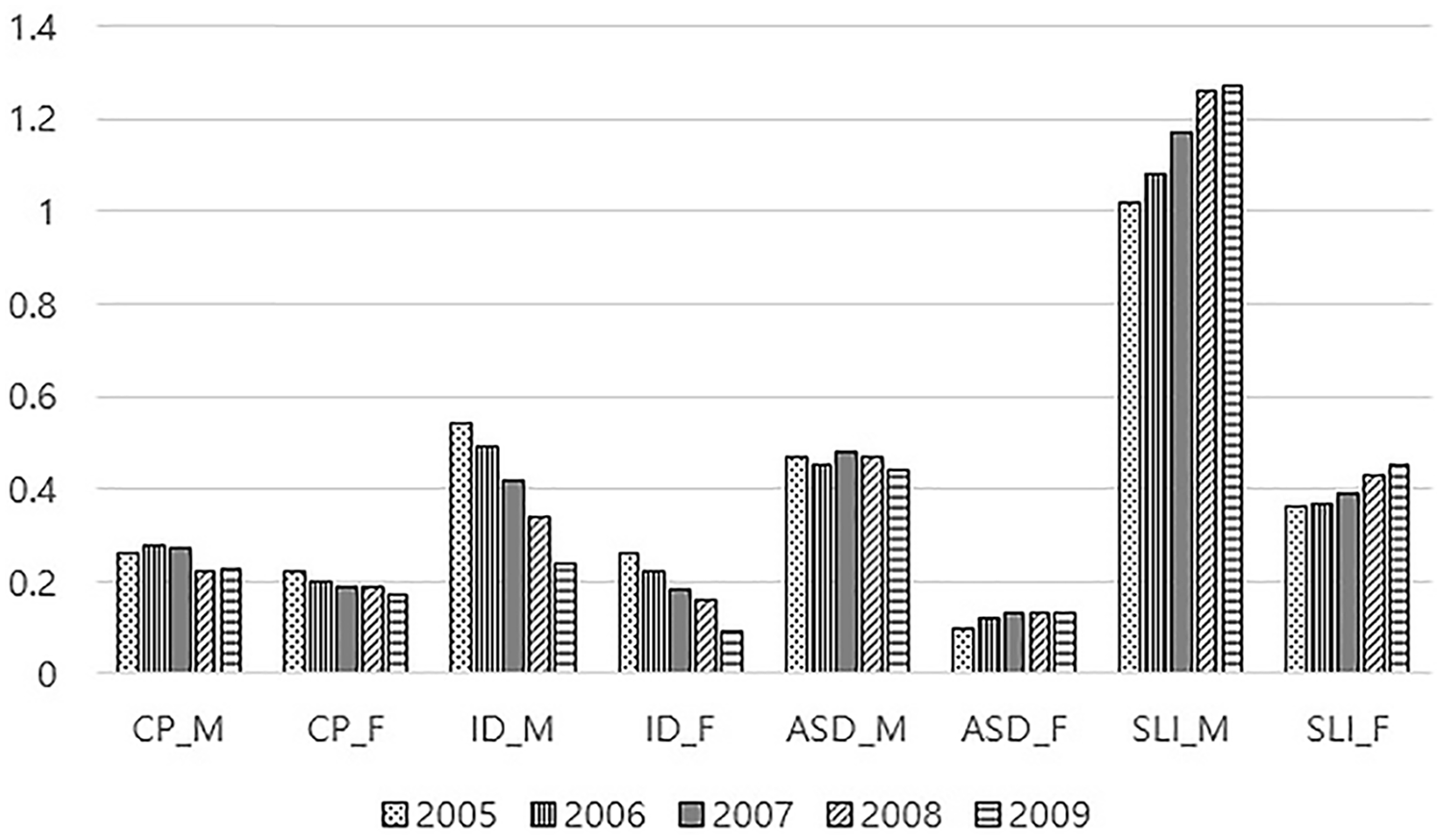
Incidence of neurodevelopmental disorders according to sex by year (unit: %).
Risk Factors of NDDs
Cerebral palsy
Among the factors that may affect the CP, the risk of CP was 0.77 times lower in girls than in boys. According to the maternal age at delivery, the risk of CP was significantly higher in the age group of 30 and over than the reference group aged 25 to 29 years in univariate analysis, but the risk of CP was 1.46 times higher in those aged 40 years or older only in multivariate analysis. According to insured categories, the risk of CP was more than twofold in the Medical Aid beneficiaries than in the self-employed insured. The difference in the risk on the basis of income group was not statistically significant (Table 1).
Risk Factors Associated With Neurodevelopmental Disorders.
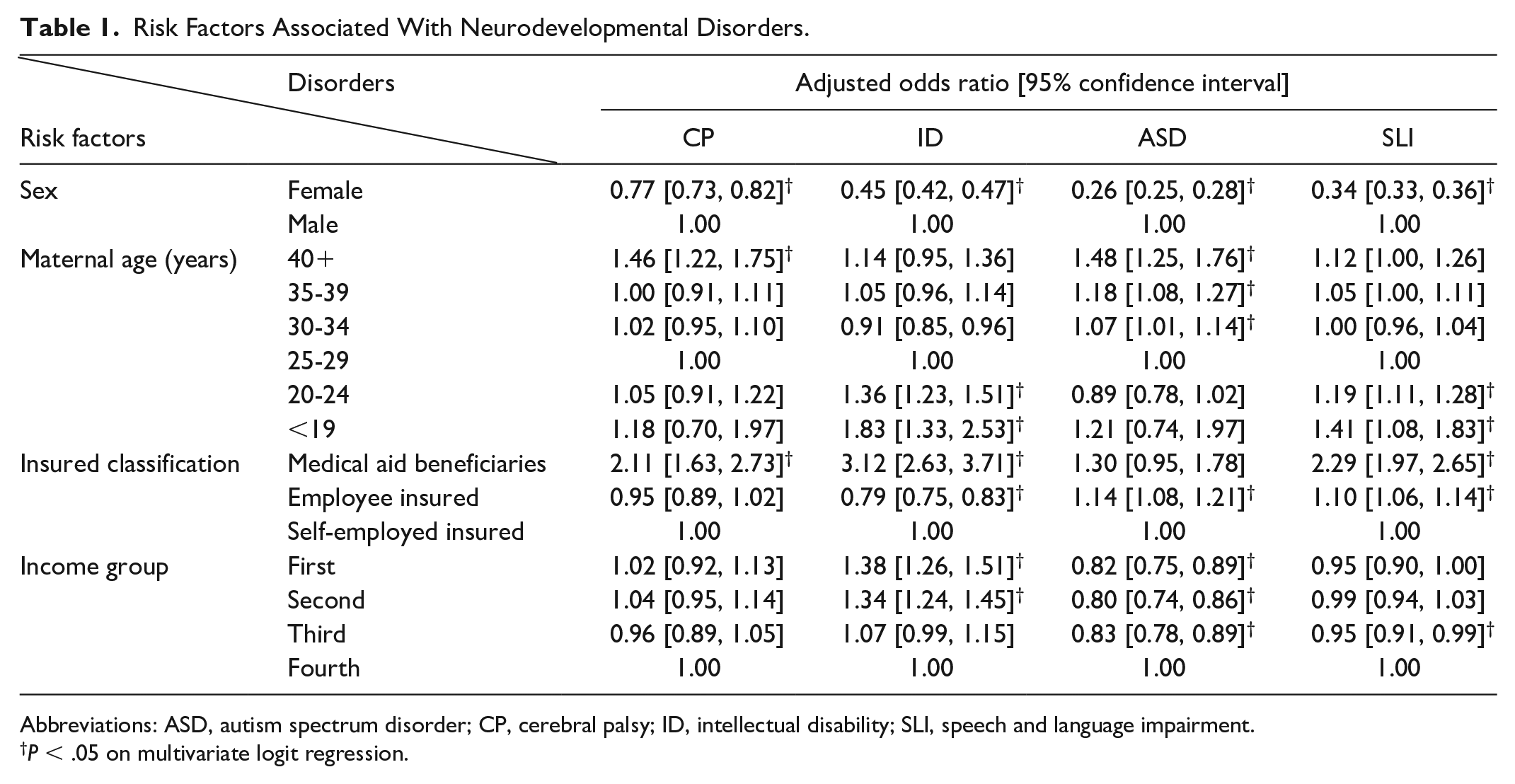
Abbreviations: ASD, autism spectrum disorder; CP, cerebral palsy; ID, intellectual disability; SLI, speech and language impairment.
P < .05 on multivariate logit regression.
According to the delivery methods, the risk was 1.22 times higher in cesarean section than that of spontaneous vaginal delivery. Among various conditions associated with pregnancy, the risk of CP was 17.11 times higher in the presence of prematurity or low birth weight. In addition, CP was more likely to occur by 1.91 times in fetal distress, 1.82 times in placental abruption, and 1.39 times in problems associated with amniotic fluid or amniotic membrane (Figure 2a).
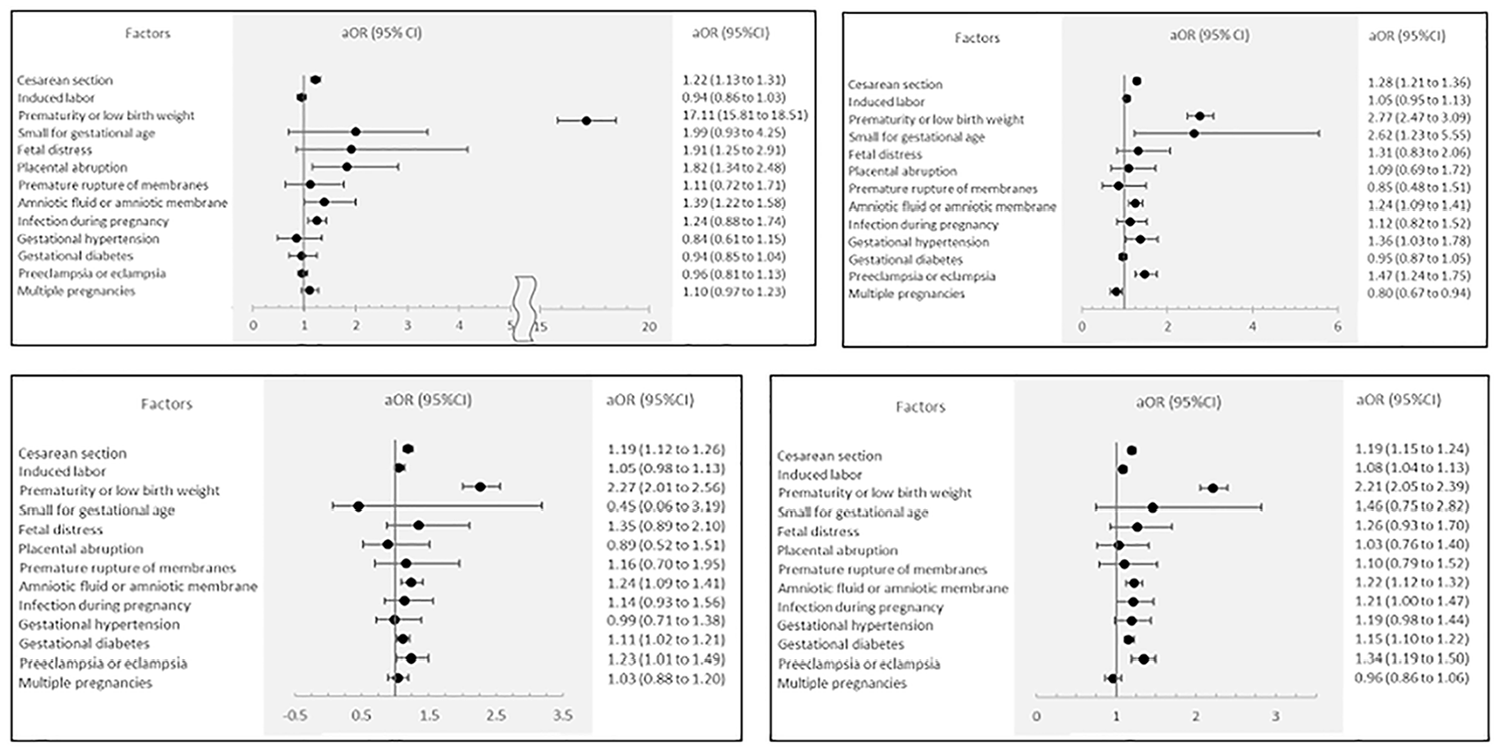
Risk factors associated with neurodevelopmental disorders.
Intellectual disabilities
The risk of ID was 0.45 times lower in girls than in boys and was higher when the mother was younger at birth. Compared with the reference group, 1.36 times in the group aged 20 to 24 years and 1.83 times in the group aged 19 or younger. The risk of ID was more than three times higher in the Medical Aid beneficiaries than that of the self-employed insured. In univariate analysis, there was no significant difference in the risk of ID among the income groups. However, after controlling for confounding variables, the risk of occurrence in the first and second categories were 1.38 times and 1.34 times higher than in the highest income category, respectively (Table 1).
Cesarean section had a 1.28 times higher risk of ID than spontaneous vaginal delivery. Among various risk factors, the risk of ID was 2.77 times higher in the presence of prematurity or low birth weight. In addition, the risk of occurrence increased 2.62 times with small for gestational age, 1.47 times with preeclampsia or eclampsia, 1.36 times with gestational hypertension, and 1.24 times with problems associated with amniotic fluid or amniotic membrane (Figure 2b).
Autism spectrum disorder
The risk of ASD was 0.26 times lower in girls than in boys and was higher when the mother was older at birth. The risk of ASD was 1.07-fold higher in the group aged 30 to 34 years, 1.18-fold in the group aged 35 to 39 years, and 1.48-fold in the group aged 40 or older compared with the reference group. The risk of ASD was 1.14 times higher in the employee insured than in the self-employed insured. According to the income group, the risk was significantly lower in the lower income category than in the highest category (Table 1).
Cesarean section had a 1.19-fold higher risk of ASD compared with the risk due to spontaneous vaginal delivery. The risk of ASD was 2.27 times higher in the presence of prematurity or low birth weight. In addition, the risk increased 1.24 times with problems associated with amniotic fluid or amniotic membrane, 1.23 times with preeclampsia or eclampsia, and 1.11 times with gestational diabetes (Figure 2c).
Speech and language impairment
The risk of SLI was 0.34 times lower in girls than in boys and was higher when the mother was younger at birth. The risk was 1.19 times and 1.41 times higher in the group aged 20-24 years and aged 19 years or younger, respectively, than the reference group. Compared with self-employed insured, the risk of was 2.29 times higher in Medical Aid beneficiaries (Table 1).
The risk of SLI was 1.19 times higher for cesarean section compared with spontaneous vaginal delivery. The risk was 2.21 times higher in the presence of prematurity or low birth weight. In addition, the risk of occurrence of SLI increased 1.34 times with preeclampsia or eclampsia, 1.22 times with problems associated with amniotic fluid or amniotic membrane, and 1.15 times with gestational diabetes (Figure 2d).
Discussion
This study was conducted to confirm the risk factors of NDDs using a large-scale database in a changing environment such as an increase in high-risk pregnancy and an increase in exposure to substances that affect occurrence of NDDs as like endocrine-disrupting chemicals. The results of this study showed that the incidence of CP and ID decreased in the more recent years, while that of SLI increased and that of ASD was maintained at a similar level without significant increase and/or decrease. The risk of developing all four types of NDDs was lower in girls than in boys, which was in the same context as the other papers published in the past. 15 For the relationship between mothers’ age at birth and the incidence of NDDs, CP and ASD increased in older maternal age and ID and SLI increased in younger maternal age. The incidence affected by socioeconomic factors varied according to the types of NDDs.
There are several previous studies on maternal age and risk of NDDs. The strongest risk factor of CP is low gestational age, in addition to preeclampsia, low birth weight, placenta abruption, and multiple births. 16 These risk factors increase in advance maternal age, which is thought to have resulted in an increase in CP risk in older maternal age. Research results on the association between ASD and maternal age show some differences in statistical significance, but generally show that older maternal age increases the risk of ASD. There are several possible age-related biologic mechanisms by which increasing maternal age can affect the development of ASD. These include nucleotide repeat instability, increased risk of chromosomal abnormalities, and cumulative toxic exposures. 17 Looking at the research on ID and SLI, according to a study conducted by Leonard et al, 18 the risk of mild-moderate ID increased in the younger maternal age group compared with the 25 to 29 years group. Sutcliffe et al 19 reported that the higher the maternal age, the higher the language development score was obtained. They explained that this is because older mothers have a good environment for factors associated with greater child well-being, such as higher family income. Taken together, it is thought that CP and ASD, which are related to biological disadvantages such as low birth weight, prematurity, and genetic mutation, increased in the older maternal age, while ID and SLI, which are more influenced by environmental factors, increased in the younger maternal age.
In case of economic status, in the present study, the risk of ID was higher in the low-income group compared with the highest income group, and the risk of ASD was higher in the high-income group. This is in line with previous studies. When the child is young, the brain is actively developing. The enriched environment provides a variety of stimuli that affect brain development, including motor performance and cognitive abilities.20,21 In previous studies that have examined the relationship between economic level and the risk of developing ASD, the conclusions are still controversial. In the United States, the risk of ASD was higher in the high SES group and the authors described that children with a higher SES group had a higher chance of being diagnosed because their parents were more aware of the child’s emotional/behavioral abnormality and visited the specialist earlier. 22 In Denmark, SES was not associated with the risk of developing ASD; thus, the authors stated that the social system in which all citizens, regardless of SES, can use the health care system has affected these outcomes. 23 In Korea, all children, regardless of SES, are eligible for nationwide infants’ and children’s health screening; a referral is made to a specialist if an NDD is suspected based on the screening. However, the process of receiving standard diagnostic assessments after being referred to specialists may incur additional costs, which may lead to a difference in the diagnosis rate of ASD according to income levels.
The risk of developing four NDDs was higher in cases of cesarean section than in cases of spontaneous vaginal delivery, which was in the same context as Taiwan cohort study. 24 In addition, when problems related to pregnancy were seen, factors affecting the incidence of three or more NDDs were prematurity or low birth weight, problems associated with amniotic fluid or amniotic membrane, and preeclampsia or eclampsia. It has already been shown in several articles that prematurity and low birth weight are major contributors to NDDs.13,25 A systematic review conducted by Mwaniki et al 13 showed that preterm birth was associated with several sequelae such as learning difficulties, CP, developmental delay, and hearing and visual impairments. There are reports that cesarean section is associated with fetal hypoxia. 26 Concerning the problems associated with amniotic fluid or amniotic membrane, some studies reported that problems such as meconium-stained amniotic fluid or oligohydramnios were associated with fetal hypoxia and could be the main reason for cesarean section. 27 In a review of the preeclampsia and the risk of NDD, the authors reported that the preeclampsia increases the risk of NDD mainly due to uteroplacental hypoxia. 28 van Vliet et al 29 reported that placental under perfusion can cause fetal hypoxia, which breaks down the blood-brain barrier and damages the premature brain. As reported in several papers, these risk factors are commonly associated with fetal hypoxia, which suggests that fetal hypoxia could affect NDDs.
There are some limitations to this study. First, because this study was based on NHID, the disease code used in the survey was registered for billing at each medical institution, so it may not be fully compatible with the actual clinical significance. Second, a total of 1 972 861 subjects were included in this study, accounting for approximately 86% of the 2 287 114 births reported by the National Statistical Office during the same period. It is possible to think that there are a relatively small number of vulnerable groups of medical use, such as the absence of medical use records or the death of a child before medical use. Considering the possibility that relatively few medical vulnerable groups are missing from the analysis, the risk of developing NDDs in the lowest income group or Medical Aid beneficiaries may be underestimated in this study. Third, due to the nature of the claim data, the duration of follow-up observations was limited, and data tracking was not possible until the peak age of some NDDs such as attention-deficit hyperactivity disorder and learning disability. Fourth, NHID data did not reflect the clinical severity of newborns, such as accurate gestational age, birth weight, Apgar score, and length of hospital stay. Finally, when considering SES, information on other factors that may have an influence such as occupation and maternal education level could not be obtained. In addition, the monthly wage, which is commonly used to classify income levels, could not be used, and income levels were divided based on the contribution that can be found in NHID. In Korea, not only wage but also other factors such as capital gain affect contribution calculation, so it was not possible to differentiate by presenting exact monthly wage for each category. However, the income level using contribution has been used as a criterion for classifying income levels in other studies. 30 To overcome these limitations, it is considered that a national cohort will be needed for more precise analysis of NDDs. Nevertheless, to our knowledge, the present study is the first study to examine maternal and neonatal risk factors associated with NDDs after controlling numerous confounding factors using large-scale database. If modifiable factors are controlled in advance in high-risk population of NDDs occurrence, it is thought that it will help to reduce the incidence or severity of NDDs. To cope with this, a better understanding of the risk of NDD occurrence is important, and the results of this study can be used as basic data to help such understanding.
Conclusions
In conclusion, the present study showed that maternal age, SES, and maternal conditions associated with fetal hypoxia influence the development of NDDs. The results of this study can be used as basic data in establishing for public health policy and medical financing planning for the children at risk by providing a better understanding of NDDs.
Supplemental Material
sj-docx-1-aph-10.1177_10105395211066383 – Supplemental material for Maternal and Neonatal Risk Factors Affecting the Occurrence of Neurodevelopmental Disorders: A Population-Based Nationwide Study
Supplemental material, sj-docx-1-aph-10.1177_10105395211066383 for Maternal and Neonatal Risk Factors Affecting the Occurrence of Neurodevelopmental Disorders: A Population-Based Nationwide Study by Seong Woo Kim, Taemi Youk and Jiyong Kim in Asia Pacific Journal of Public Health
Supplemental Material
sj-docx-2-aph-10.1177_10105395211066383 – Supplemental material for Maternal and Neonatal Risk Factors Affecting the Occurrence of Neurodevelopmental Disorders: A Population-Based Nationwide Study
Supplemental material, sj-docx-2-aph-10.1177_10105395211066383 for Maternal and Neonatal Risk Factors Affecting the Occurrence of Neurodevelopmental Disorders: A Population-Based Nationwide Study by Seong Woo Kim, Taemi Youk and Jiyong Kim in Asia Pacific Journal of Public Health
Supplemental Material
sj-docx-3-aph-10.1177_10105395211066383 – Supplemental material for Maternal and Neonatal Risk Factors Affecting the Occurrence of Neurodevelopmental Disorders: A Population-Based Nationwide Study
Supplemental material, sj-docx-3-aph-10.1177_10105395211066383 for Maternal and Neonatal Risk Factors Affecting the Occurrence of Neurodevelopmental Disorders: A Population-Based Nationwide Study by Seong Woo Kim, Taemi Youk and Jiyong Kim in Asia Pacific Journal of Public Health
Footnotes
Declaration of Conflicting Interests
The author(s) declared no potential conflicts of interest with respect to the research, authorship, and/or publication of this article.
Funding
The author(s) received no financial support for the research, authorship, and/or publication of this article.

Supplemental Material
Supplemental material for this article is available online.
References
Supplementary Material
Please find the following supplemental material available below.
For Open Access articles published under a Creative Commons License, all supplemental material carries the same license as the article it is associated with.
For non-Open Access articles published, all supplemental material carries a non-exclusive license, and permission requests for re-use of supplemental material or any part of supplemental material shall be sent directly to the copyright owner as specified in the copyright notice associated with the article.
