







Abstract

Introduction
Latin America and the Caribbean (LAC) region has recorded more than 1.6 million deaths from severe acute respiratory syndrome coronavirus 2 (SARS-CoV-2) by the end of April 2022, causing untoward social, health, political, and economic burdens to the region. 1 With inadequate social and public services, high levels of poverty and inequality, declining or stagnant economic growth, poor democratic systems, and high dependence on global investments, COVID-19 exacerbated and complicated socioeconomic standards in the LAC region. 2 While LAC governments struggle to access external funding to implement relief programs, revive protracted economies, and advance positive socioeconomic indicators, they now face an urgent waste problem generated by the COVID-19 pandemic.
Discussion
A significant increase in environmental, medical, and solid wastes was generated daily due to the COVID-19 pandemic. Before the global pandemic, some developing countries were already experiencing land, air, and water pollution challenges. 3 The COVID-19 pandemic added to these challenges and eventually made them worse. Although the concentrations of greenhouse gas emissions were significantly decreased due to a reduction in industrial and vehicular emissions resulting from COVID-19 lockdowns, the increase in solid wastes rose significantly due to COVID-19. 4 Similarly, there was a considerable increase in solid waste generation due to excessive use of personal protective equipment (PPE), restaurant takeaways, disinfectant bottles, empty sanitizer bottles, plastic bottles, masks, throat nasopharyngeal swab kits, and tests. 5 In addition, before the pandemic, a growing concern existed over the increase in single-use plastics because they are not biodegradable. Medical test kits, hand gloves, hand sanitizer bottles, protective medical suits, and takeout plastics, though essential in protecting against COVID-19, added to the burden of solid wastes to the environment, with some ending up in the sea, causing an increase in pollution in terrestrial waters. 6 Plastic hand gloves, masks, hand sanitizer bottles, and other COVID-19 pandemic–generated solid wastes have been reported on beaches and seabed, causing potential harm to ocean ecosystems. 7 In addition to harming the environment, COVID-19 wastes from medical facilities pose a risk of infections if improperly disposed of. 8 Furthermore, the stockpiling of masks, PPE, gowns, gloves, hand sanitizers, pharmaceutical products, and other household items led to an unusual increase in solid wastes.9,10
Presently, health disparities, inadequate funding, and poor health care systems in many countries, especially in the LAC region, significantly added to the burden of COVID-19 waste management. 1 Despite the successes of vaccine, the impact of the COVID-19 pandemic is still being experienced, especially as it relates to economic recoveries and waste management. The limitations of mobility, industrial, and commercial activities in a bid to contain the spread of the coronavirus have significantly affected waste generated during the pandemic.
Consequently, the unregulated disposal of biomedical wastes due to land-based anthropogenic activities has been reported as a potential source of infections, and toxic and radioactive pollutants. 11 The record increase in single-use plastics, including gloves, takeout plastics, PPE, and polyethylene goods packages, is a growing concern for the environment and public health, especially in developing countries. 4 The upsurge in the generated waste due to the COVID-19 pandemic has stirred renewed interest among scientists, health care providers, and environmentalists to explore diverse solutions in waste management.
This article presents some of the significant COVID-19 wastes and possible disposal methodologies, especially in developing countries with inadequate resources and disposal systems.
The different types of solid wastes generated during the COVID-19 pandemic are summarized in Table 1. The COVID-19-related wastes include medical wastes, face masks, shields, commercial single-use plastics, PPE, gloves, vaccine vials and syringes, sanitizer containers, test kits, and pharmaceutical products.
Summary of COVID-19 Wastes and Possible Solutions.
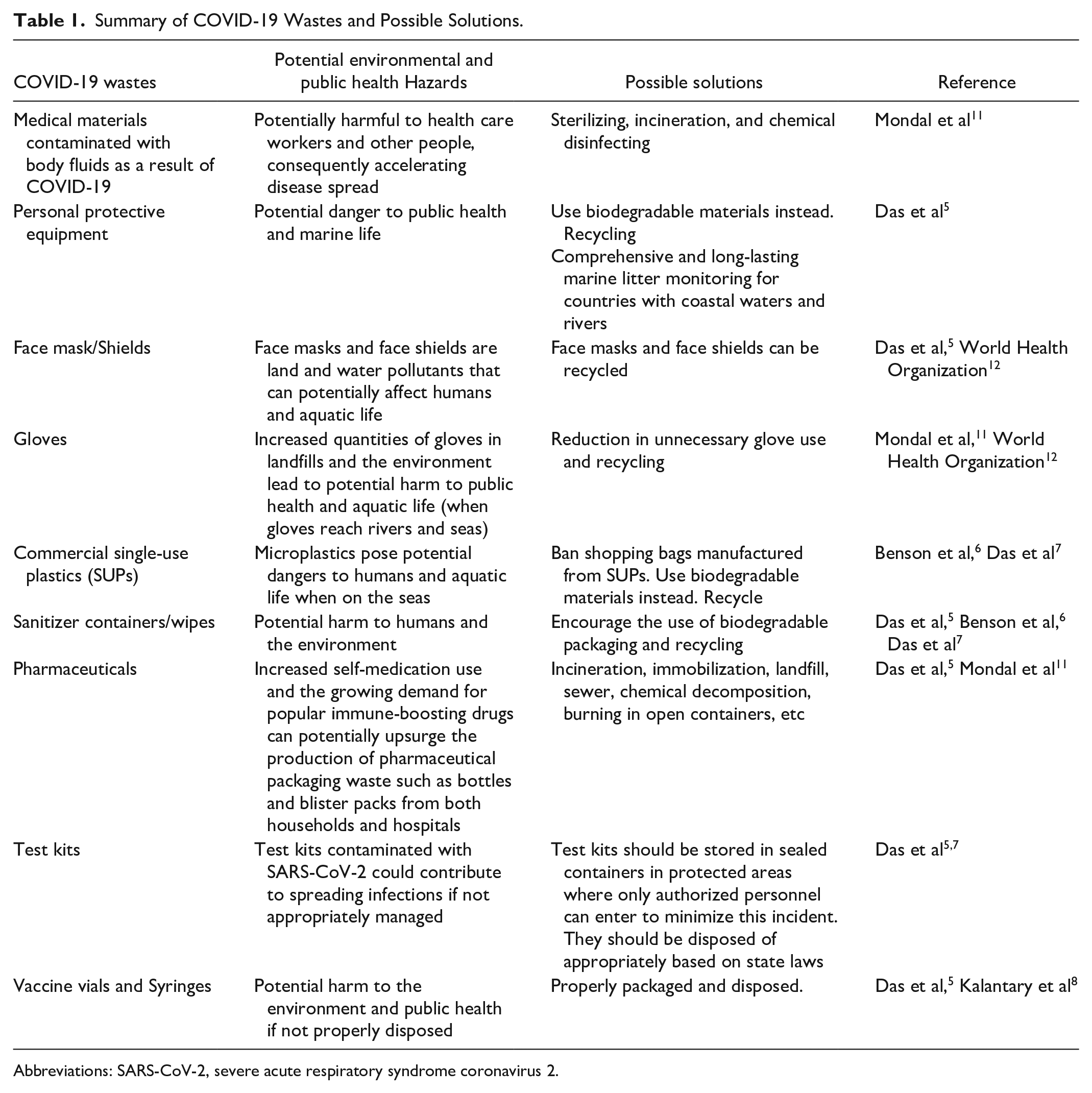
Abbreviations: SARS-CoV-2, severe acute respiratory syndrome coronavirus 2.
Conclusion
The generation of medical wastes, PPE, sanitizer bottles, vaccine vials, syringes, test kits, and pharmaceuticals has added to the burden of waste and pollution, and a threat to marine life. With protracted economies, LAC countries face a “waste-pandemic” from COVID-19. Temporary storage, recycling, open burning, landfilling, and incineration should be considered measures to address the ever-increasing waste generated due to the COVID-19 pandemic. The challenge requires appropriate coordination and support from the World Health Organization to help developing nations deal effectively with the proper management of wastes generated due to the impact of the COVID-19 pandemic.
Footnotes
Author Contributions
DCH: conception, supervising, database search, result synthesis, drafting the work, critical, and final revision. SAL: database search, result synthesis, drafting of the work, and critical and final revision. VNS: database search, result synthesis, drafting of the work, and critical and final revision. All the authors have read and approved the manuscript.
Declaration of Conflicting Interests
The author(s) declared no potential conflicts of interest with respect to the research, authorship, and/or publication of this article.
Funding
The author(s) received no financial support for the research, authorship, and/or publication of this article.
