







Abstract

Introduction
COVID-19 pandemic has impacted on global health and well-being. 1 COVID-19 vaccines availability is believed to relieve the psychologic stressors toward COVID-19, and thereafter improves individuals’ mental health. 2 However, the willingness to receive COVID-19 vaccine and the actual uptake rate may still be low if the individuals had negative attitudes toward vaccines. 3 Barriers on willingness to be vaccinated and the associated mental health problems have been less reported.
China, including Hong Kong, has a high coverage of COVID-19 vaccination.4,5 Government urged the public and private sector employers to require workers’ consensus of COVID-19 vaccination. These mandatory vaccine requirements may pose workers psychological stressors and make them more prone to anxiety and depression. Lacking of studies have attempted to look whether the association between vaccine uptake and anxiety and depression levels varies among workers with different attitude toward vaccination and company’s vaccine requirement. In this study, we examined the association of COVID-19 vaccine uptake, attitude toward vaccine effectiveness, and company’s vaccination requirement with the anxiety and depression levels among non-health care workers in Hong Kong, Nanjing, and Wuhan. We further explored whether the association between COVID-19 vaccine uptake and the anxiety and depression levels was modified by attitude toward vaccine effectiveness and company’s vaccine requirement.
Methods
Details of the study methods have been previously described. 6 We employed the same recruitment approach and conducted the second-year survey during July 2021 to October 2021, incorporating new research elements related to vaccination. Second-year survey recruited a total of 12 956 non-health care workers who were aged ≥18 from Hong Kong (3072), Nanjing (6482), and Wuhan (3400). We used standardized questionnaires to collect sociodemographic information and job-related information.
Participants reported their number of COVID-19 vaccine doses that they had taken, and classified as having COVID-19 vaccine uptake if they had taken ≥1 dose (Yes, No). Participants were further asked to indicate their agreement levels on attitude toward vaccine effectiveness using a 5-point Likert scale for four questions. The attitude is regarded as negative if the overall score ranges 0 to 8, and positive if the score ranges 9 to 20. Regarding company’s vaccination requirement, a score of 1 to 3 indicates company with less/no strong vaccine requirement, 4 to 5 suggests company with strong vaccine requirement.
We used the Chinese version of Depression, Anxiety and Stress Scale—21-item short version (DASS-21) to assess the anxiety and depression levels. 7 Participants with low anxiety and depression scale served as the reference group.
We performed multinomial logistic regression models (adjusted odds ratios [AOR] and 95% confidence intervals [95% CI]) to assess the association of COVID-19 vaccine, attitude toward vaccine effectiveness, and company’s vaccine requirement with the anxiety and depression levels, using workers without vaccine uptake, positive attitude, and company without vaccine requirement as the reference group. Models were adjusted by age, sex, educational attainment, marital status, cities, job status, year of working experience, and company’s nature.
We further categorized our participants according to their COVID-19 vaccine uptake states with attitude toward vaccine effectiveness and company’s vaccination requirement. Regarding the pair of COVID-19 vaccine uptake with attitude toward vaccine effectiveness and company’s vaccine requirement, we classified our participants into four groups, respectively, using participants who were vaccinated and work in a company with less strong vaccination requirement as reference group (classification on Table 2).
Results
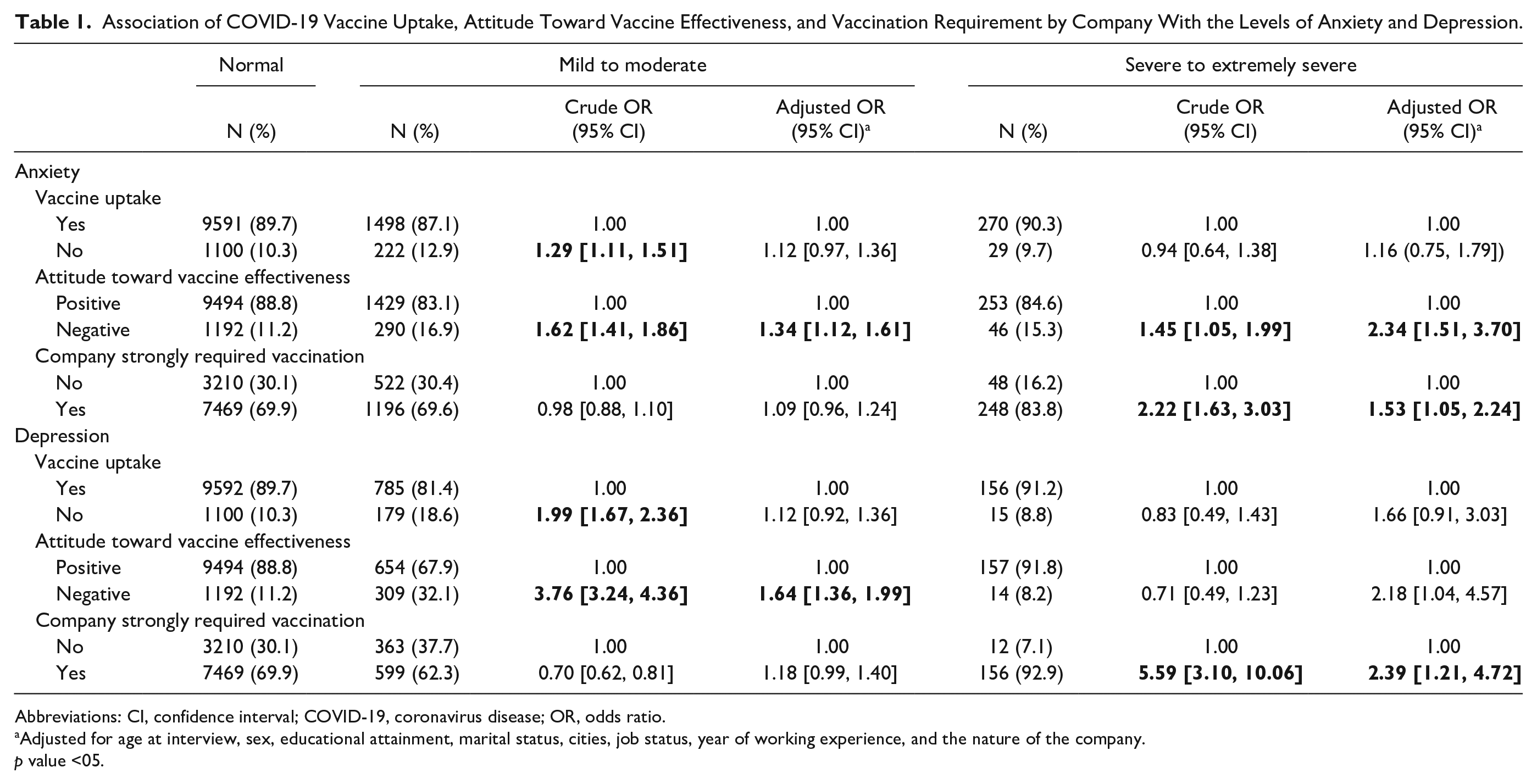
Around 15% (1720 mild-moderate anxiety, 299 severe-extremely severe) and 10% (964 mild-moderate depression, 171 severe-extremely severe) of our participants had anxiety and depression symptoms, respectively. Vaccine uptake rate was 87.6%. Vaccine uptake was not associated with anxiety or depression levels. Negative attitude toward vaccine effectiveness was associated with higher anxiety levels (AOR = 2.34, 95% CI = 1.51-3.70). Participants working in a company with strong vaccine requirement were associated with more anxiety (AOR = 1.53, 95% CI = 1.05-2.24) and depression symptoms (AOR = 2.39, 95% CI = 1.21-4.72) (Table 1).
Association of COVID-19 Vaccine Uptake, Attitude Toward Vaccine Effectiveness, and Vaccination Requirement by Company With the Levels of Anxiety and Depression.
Abbreviations: CI, confidence interval; COVID-19, coronavirus disease; OR, odds ratio.
Adjusted for age at interview, sex, educational attainment, marital status, cities, job status, year of working experience, and the nature of the company.
p value <.05.
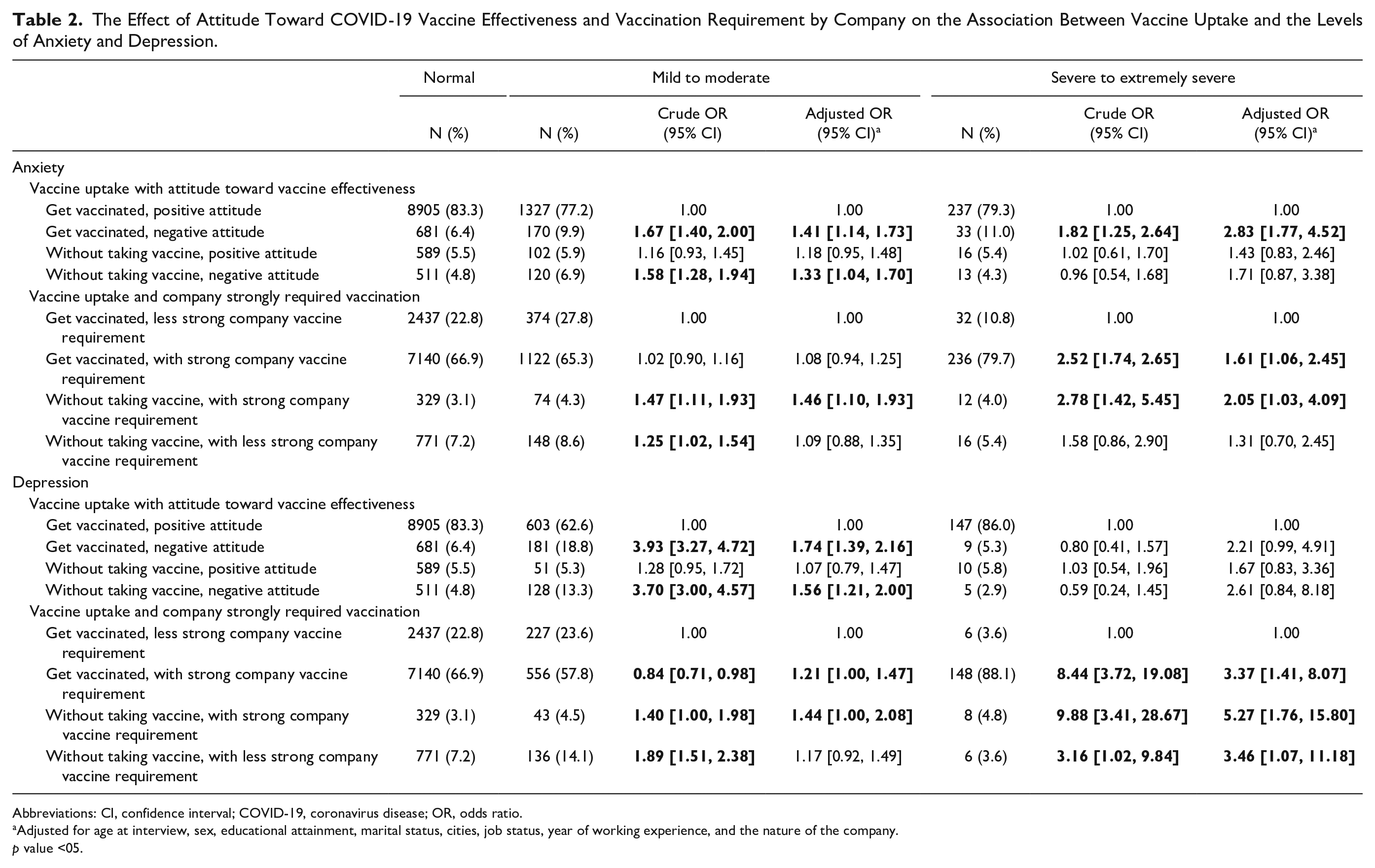
When we examined whether attitude toward vaccine effectiveness and company’s vaccination requirement modified the association between vaccine uptake and mental health states, only those got vaccinated but with negative attitude showed more anxiety (AOR = 2.83, 95% CI = 1.77-4.52) and depression symptoms (AOR = 2.21, 95% CI = 0.99-4.91). Unvaccinated participants without company’s strong requirement also demonstrated more depression symptoms but not anxiety. However, unvaccinated workers working in a company with strong vaccine requirement had an AOR of 2.05 (95% CI = 1.03-4.09) and 5.27 (95% CI = 1.76-15.80) for severe or extreme severe levels of anxiety and depression, respectively (Table 2).
The Effect of Attitude Toward COVID-19 Vaccine Effectiveness and Vaccination Requirement by Company on the Association Between Vaccine Uptake and the Levels of Anxiety and Depression.
Abbreviations: CI, confidence interval; COVID-19, coronavirus disease; OR, odds ratio.
Adjusted for age at interview, sex, educational attainment, marital status, cities, job status, year of working experience, and the nature of the company.
p value <.05.
Discussion
This large population study identified that workers having vaccine uptake but with negative attitude toward vaccine effectiveness or company’s strong vaccination requirement were associated with high anxiety and depression levels. Unvaccinated participants without company’s strong vaccine requirement were also associated with more depression symptoms.
Public concerns toward vaccine safety and effectiveness were consistently associated with the willingness to vaccine uptake. 8 Previous study showed that mistrust of vaccines was determinant of the unwillingness to COVID-19 vaccine. 9 However, to achieve the population immunity and safe working environment toward COVID-19, many governments and companies encourage and require vaccinations for their employees but without providing clear explanations on specific vaccine, which consequently may have negative impacts on mental health of workers. We found that vaccinated workers with negative attitude toward vaccine effectiveness were associated with more anxiety and depression symptoms, while unvaccinated workers with company’s strong vaccine requirement were associated with increased odds of severe anxiety and depression levels. Our study conveys important messages that more precise information on vaccination should be emphasized to persuade those who are on the fence to getting vaccination.
Intriguingly, unvaccinated workers with company’s strong vaccine requirement had more depression symptoms. It may be because participants with high depression levels are more resistant to COVID-19 vaccine. 10 Recent US study reported that participants with depression were more likely to report vaccine-related misinformation and resistance. 10
Conclusion
This large study with 12 956 Chinese non-health care workers revealed that vaccine uptake itself was not associated with anxiety and depression symptoms. However, workers having vaccine uptake but with negative attitude toward vaccine effectiveness or worked in a company with strong vaccination requirement were associated with more anxiety and depression symptoms. Accurate vaccine information and education are crucial in fostering positive attitudes toward immunization among non-health care workers. These efforts are pivotal in enhancing confidence in receiving the vaccine and preventing potential mental health problems.
Footnotes
Declaration of Conflicting Interests
The author(s) declared no potential conflicts of interest with respect to the research, authorship, and/or publication of this article.
Funding
The author(s) disclosed receipt of the following financial support for the research, authorship, and/or publication of this article: This study was supported by grants from the Health and Medical Research Fund, the Food and Health Bureau, and The Government of the Hong Kong Special Administrative Region (COVID-19) (reference number: COVID190104 and COVID1903008). The funder had no role in study design and conduct of the study; collection, management, analysis, and interpretation of the data; and preparation, review, or approval.
Ethical Approval
This study was approved by the Survey and Behavioural Research Ethics (reference no. SBRE-19-792); Ethics and Human Subject Committee of Nanjing Medical University (reference no. [2020]554); and Ethics and Human Subject Committee of Tongji Medical College, Huazhong University of Science and Technology (reference no. [2020]S212).