







Abstract
Introduction
Government measures to contain the COVID-19 virus since 2020, such as school closure, the shift to remote learning, and restrictions on social gatherings that limited socializing with friends, profoundly impacted adolescents’ lives. Children and adolescents showed more depression and anxiety symptoms during the pandemic than in pre-pandemic estimates. On the other hand, European and American studies showed that factors like physical exercise, access to entertainment, and positive or improved familial and peer relationships are helpful for adolescents’ adjustment in different aspects of mental health during the pandemic school closure.1 -5 However, the situation among adolescents in Asia is under-researched.
During the initial phases of the COVID-19 pandemic, the preventive measures adopted by the Taiwanese government effectively contained the virus, enabling students to continue in-school learning during 2020. Unlike most countries that implemented a long school closure period, the Taiwanese government only enacted a 3-month school closure from May 19, 2021, to August 31, 2021. The primary aim of this study was to explore the potential buffering effects of resilience and changes in family relationships on anxiety resulting from a short period of school closure.
Methods
We conducted an online cross-sectional study during the summer of 2021 in elementary schools in Keelung City, Taiwan. In total, 859 primary students (aged 11.5 years), representing approximately 41.6% of the 6th-grade student population in Keelung City, were enrolled. After cleaning the missing data, we included a final sample of 815 students (53.3% female and 46.7% male) in this analysis.
The questionnaire assessed the adolescents’ resilience (Connor–Davidson Resilience Scale, CD-RISC), 6 self-perceived familial economic situation, anxiety during school closure (Six-item State-Trait Anxiety Inventory, STAI-6),7,8 anxiety with the COVID-19 pandemic (COVID-19 Anxiety Scale, CAS), 9 as well as the self-reported relationship changes with parents, siblings, and peers during the COVID-19 lockdown. Adolescents’ sex and self-perceived familial economic situation were considered as covariates.
Hierarchical linear regression models were used to analyze anxiety levels. In Step 1, we included two control variables: sex and family economic status. In Step 2, the resilience variable, the COVID-19 anxiety variable, and three relational variables were added to the model alongside the controlled variables. Ethical approval was granted by the Institutional Review Board of the University of Taipei (UT-IRB No. IRB-2022-067).
Results
Table 1 presents the results of the hierarchical linear regression analysis. In the initial step of this analysis, sex and self-perceived family economic situation were significant predictors of anxiety variance. After accounting for the self-perceived family financial situation, females were found to have higher anxiety scores (β = 0.08, P = .02) than males. Additionally, adolescents who reported their family’s financial situation as “not enough” (β = 0.15, P < .001) had higher anxiety scores than those who described it as “enough.” This model explained 3% of the variance (adjusted R2 = 0.03, P < .001).
Hierarchical Regression of 6-Graders’ Anxiety During a 3-Month School Closure in Taiwan.
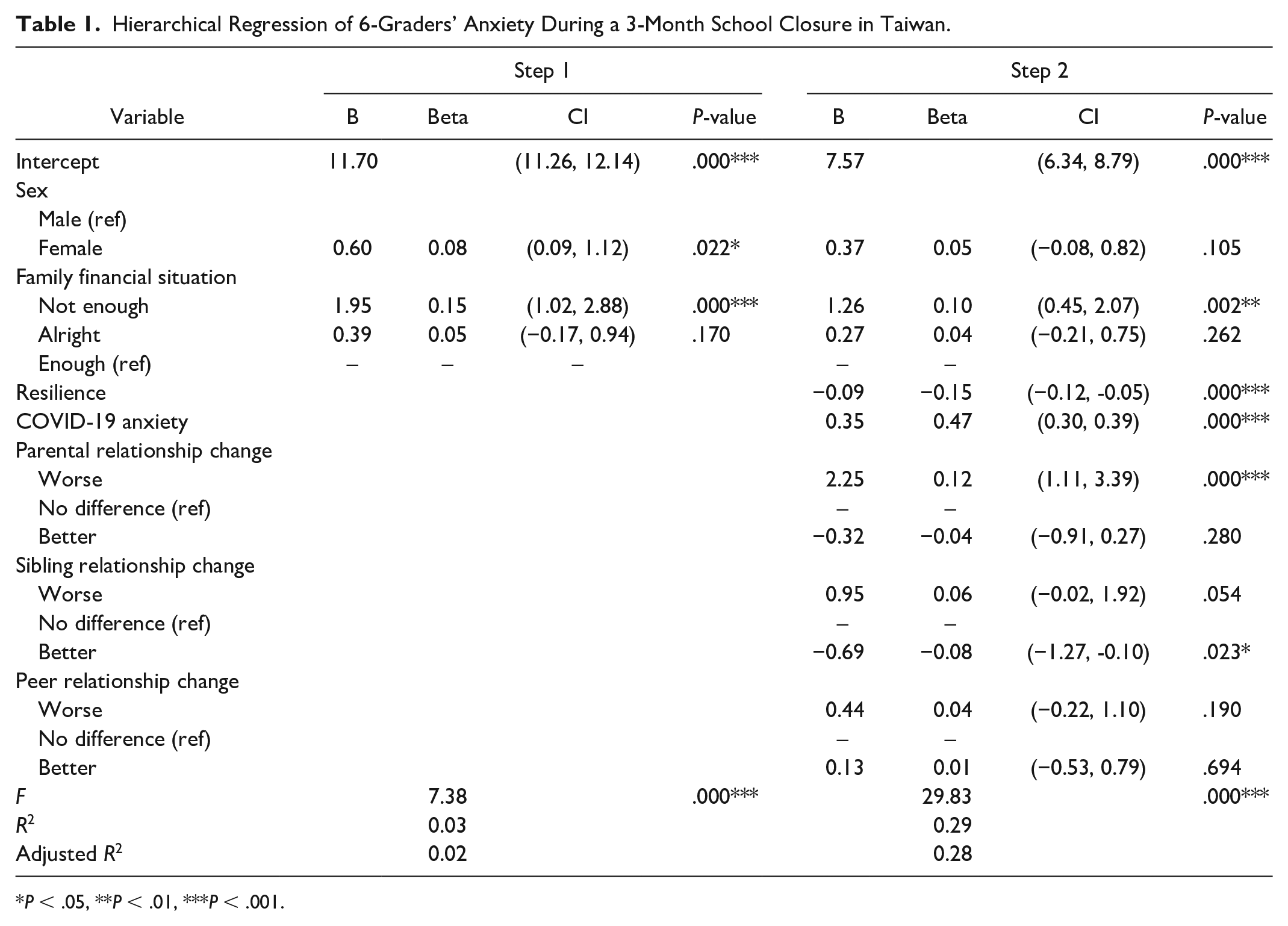
P < .05, **P < .01, ***P < .001.
As predicted, resilience and adolescents’ perceived COVID-19-related anxiety and relationship changes during school closure were confirmed to significantly contribute to the increased variance observed in Step 2 (adjusted R2 = 0.28, P < .001). At the same time, several noteworthy associations emerged along with self-perceived family economic hardship, which remained a significant predictor (β = 0.10, P = 0.002). Specifically, self-perceived COVID-19-related anxiety was the strongest predictor of anxiety during school closure (β = 0.47, P < 0.001) and played a substantial role as a stress source for adolescents during school closure. Resilience was also negatively associated with adolescents’ anxiety during school closure (β = −0.15, P < .001) and served as a buffer against the development of elevated anxiety associated with COVID-19. Worsened parental relationships were positively associated with anxiety (β = 0.12, P < .001); this result suggested that deteriorating parental relationships increased anxiety during school closure. In addition, improved sibling relationships were negatively associated with anxiety (β = −0.08, P = .023). In other words, adolescents who experienced higher COVID-19-related anxiety and deteriorated parental relationships reported higher anxiety, while resilience and better sibling relationships acted as protective factors against anxiety during COVID-19 school closure. These associations persisted after accounting for self-reported demographic factors.
Discussion and Conclusion
This study demonstrates that adolescents’ anxiety toward COVID-19 was intense even during a brief 3-month school closure in 2021 in Taiwan. The findings reveal that lower levels of COVID-19-related anxiety, improved relationships with parental and siblings, and higher resilience were linked to reduced anxiety levels in young adolescents during the short school closure after controlling for demographic factors. These results highlight that resilience and positive family relationships act as protective factors against stressful events, aligning with findings from previous studies.1,2
The results, however, showed that change in peer relationship was not a salient factor affecting young adolescents’ anxiety during COVID-19 school closure, contradictory to the findings from a previous study on older adolescents in the United States. 2 This disparity could be related to age differences between the two studies, as the current study focused on early adolescence (12-year-old sixth graders), while the other study examined late adolescence. Our study suggests that for early adolescence, familial relationships are more critical factors than peer relationships in alleviating anxiety during stressful events.
The Taiwanese Central Epidemic Command Center provided daily health education broadcasts during the COVID-19 pandemic, covering topics such as quarantine policies, quick screening, and proper measures for virus-infected patients. However, mental health of children and adolescents was overlooked by the government. We recommend that the Central Epidemic Command Center place greater emphasis on mental health by promoting health education that addresses pandemic-related anxiety, strengthens family bonds, and fosters resilience. These strategies can help mitigate anxiety among adolescents, especially when school closure policies are implemented. Our study confirmed that resilience play a protective role in maintaining adolescents’ mental well-being, supporting previous findings that mental resilience can buffer against anxiety and depression during COVID-19. Furthermore, resilience training in the classroom can enhance young adolescents’ ability to cope. 10 Hence, the government should integrate resilience-building lessons into the school curriculum to equip adolescents with the skills to handle pandemic-related stress and other challenges in their daily lives.
Footnotes
Acknowledgements
Professor Tony Szu-Hsien Lee’s initiative to launch the project is greatly appreciated. We gratefully acknowledge Professor Joyce Yen Feng’s and April Chiung-Tao Shen’s support. Many thanks to Hsing-Jung Chen, Meng-Jung Lee, Wen-Shan Lin, and Wen-Chi Wu for their insightful discussion. The authors appreciate the assistance with statistics provided by research assistant Guang-Yi Liu. The authors are grateful for the data from the National Taiwan University Children and Family Research Center, and the partial funding from the Population Health Research Center from Featured Areas Research Center Program within the framework of the Higher Education Sprout Project by the Ministry of Education (MOE) in Taiwan (grant number NTU-113L900401).
Author Contributions
Hung-Chieh Chang and Yuwen Chang designed the study framework together, and both wrote the literature review. Hung-Chieh Chang was responsible for the manuscript and Yuwen Chang was responsible for revision. The statistical analysis was supported by research assistant Guang-Yi Liu.
Declaration of Conflicting Interests
The author(s) declared no potential conflicts of interest with respect to the research, authorship, and/or publication of this article.
Funding
The author(s) disclosed receipt of the following financial support for the research, authorship, and/or publication of this article: This study was funded by the National Taiwan University Children and Family Research Center, and the Population Health Research Center from Featured Areas Research Center Program within the framework of the Higher Education Sprout Project by the Ministry of Education (MOE) in Taiwan (grant number NTU-112L9004).
Ethical Approval
Ethical approval was granted by the Institutional Review Board of the University of Taipei (UT-IRB No. IRB-2022-067).
