







Abstract
During Malaysia’s Delta wave in 2021, the island of Labuan faced a surge of COVID-19 cases that overwhelmed its only hospital. In response, a 100-bed field hospital with four transit ICU beds was rapidly established through multi-agency collaboration. Prior to patient admission, seven simulation exercises were conducted with 98 personnel to prepare workflows and identify system vulnerabilities. Scenarios included oxygen outages, patient collapse, fire drills, intubation, specimen transport, and portable x-ray deployment. The simulations revealed gaps in logistics, communication, and role clarity, leading to immediate corrective measures. Over 4 weeks, the hospital admitted 243 patients, 30% aged 60 years or older. Twelve required advanced respiratory support, yet no in-hospital deaths or cardiopulmonary arrests occurred. Staff debriefings highlighted improvements in teamwork, communication, preparedness, and workflow efficiency. This experience demonstrates how low-resource simulation can function as a strategic public health intervention to enhance preparedness in resource-limited settings.
Keywords
What We Already Know
Simulation is widely used in medical education and clinical training.
During the COVID-19 pandemic, multiple field hospitals were established across the world to meet surge capacity needs.
Operational challenges in field hospitals often arise from rapid deployment, multi-agency involvement, and resource limitations.
What This Article Adds
Demonstrates how simulation was applied as a public health intervention to strengthen system readiness in an island-based Malaysian field hospital.
Shows that simulation improved logistics, communication, and inter-agency trust before patient admission.
Provides evidence that low-fidelity, context-specific simulation can improve safety and outcomes in resource-limited, geographically isolated settings.
Introduction
In mid-2021, Malaysia experienced a severe COVID-19 surge driven by the Delta variant. The Federal Territory of Labuan—an island with fewer than 100 000 residents and only one minor specialist hospital—was the first region to face this wave. Rapid escalation in severe cases overwhelmed local capacity, prompting the Ministry of Health Malaysia, supported by multiple agencies, to establish a 100-bed COVID-19 field hospital within Dewan Labuan Corporation.1,2
Field hospitals present unique challenges, including unfamiliar layouts, rapid timelines, and teams composed of personnel with diverse backgrounds. Without structured preparation, these factors can threaten patient safety and system functionality. Simulation, traditionally used for clinical training, can also serve as a
Methods
Design and Setting
This was a descriptive observational report of simulation exercises conducted in June 2021 at the Labuan COVID-19 Field Hospital, Federal Territory of Labuan, Malaysia. The hospital was established through collaboration between the Ministry of Health Malaysia and multiple agencies, with a capacity of 100 beds, including four transit intensive care unit (ICU) beds.
Participants
A total of 98 personnel participated, comprising health care workers, Malaysian Armed Forces staff, NGO volunteers, and logistics and security personnel. Many participants had no prior experience working together.
Simulation Procedures
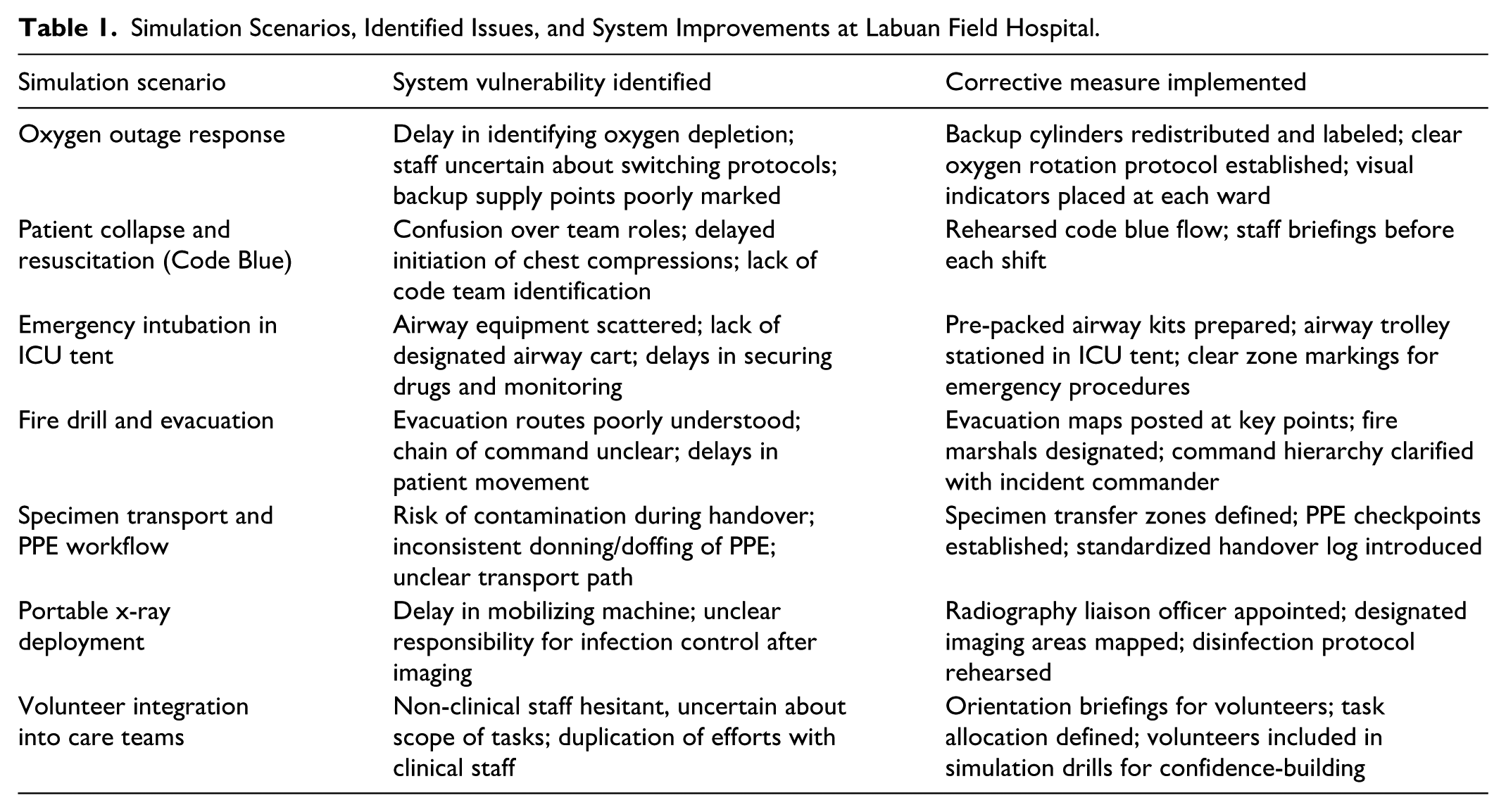
Seven simulation exercises were conducted in the week before the hospital opened. These included fire drills, patient collapse and resuscitation scenarios, oxygen outage response, emergency intubation, specimen transport and infection control, portable x-ray deployment, and volunteer integration. All exercises were conducted in the operational space using actual equipment. Each drill was followed by structured debriefing sessions. Key scenarios and system improvements are summarized in Table 1.
Simulation Scenarios, Identified Issues, and System Improvements at Labuan Field Hospital.
Outcomes
The
Ethical Approval
No patient-identifiable data were collected, and this report reflects a service evaluation of preparedness activities. Formal institutional review board approval was therefore not required.
Results
Primary Outcomes
The Labuan Field Hospital commenced operations on June 27, 2021, after completion of the simulation exercises. Over the subsequent 4 weeks,
A total of 12 patients required escalation to advanced respiratory support, including three intubations, two on noninvasive ventilation, and seven supported with high-flow nasal cannula. Despite the high acuity, there were no in-hospital deaths and no cardiopulmonary arrests. The median length of stay was 7 days.
Secondary Outcomes: Staff Feedback
Structured debriefings conducted after each simulation identified four consistent themes:
Staff feedback suggested that pre-opening rehearsals reduced uncertainty and built trust across previously unacquainted personnel. These perceived improvements were reflected in smoother real-time operations once patients were admitted.
Discussion
This short report demonstrates that structured simulation exercises can strengthen public health preparedness in resource-constrained and geographically isolated settings. The Labuan Field Hospital achieved favorable outcomes—zero in-hospital mortality despite high patient acuity—following pre-opening rehearsals that exposed and corrected latent system vulnerabilities. Similar experiences have been reported internationally, where simulation-based drills improved readiness and coordination in disaster or outbreak contexts.1 -3
The
Importantly, the simulations were
Overall, simulation should be considered not only as an educational strategy but also as a
Conclusion
Pre-activation simulation exercises at the Labuan COVID-19 Field Hospital enabled early identification of system gaps, improved inter-agency collaboration, and contributed to safe patient care during a critical surge. By rehearsing workflows and building shared mental models, the hospital achieved favorable outcomes with no in-hospital mortality despite high clinical acuity. This experience demonstrates that low-resource, functional simulation can serve as a strategic public health intervention to strengthen preparedness in island and resource-limited settings. Integrating simulation into disaster planning frameworks may enhance resilience and operational safety across the Asia-Pacific region.
Footnotes
Acknowledgements
The authors thank the Ministry of Health Malaysia, Malaysian Armed Forces, National Disaster Management Agency (NADMA), MERCY Malaysia, Labuan Corporation, Royal Malaysian Police (PDRM), Fire and Rescue Department of Malaysia (JBPM), Public Works Department (JKR), Sabah Electricity Sdn. Bhd, and all staff and volunteers who contributed to the establishment and operation of the Labuan Field Hospital.

Ethical Approval
Ethical approval was not required as this report reflects a service evaluation of preparedness activities. No patient-identifiable data were collected.
Author Contributions
J.P. served as the main author, collected data, drafted the initial manuscript, and coordinated manuscript development. M.H.M.H. conceptualized the report, led the simulation planning, analyzed data, and was directly involved in field hospital operations. A.L.I. contributed to drafting sections of the manuscript and assisted with editing. M.M. participated in drafting sections and critically revised the manuscript for intellectual content. M.F.B. assisted with editing and contributed to the literature review. L.Z.Z. contributed to the literature review and manuscript revision. F.K. assisted with drafting, editing, and final revisions. All authors read and approved the final version of the manuscript.
Funding
The authors received no financial support for the research, authorship, and/or publication of this article.
Declaration of Conflicting Interests
The authors declared no potential conflicts of interest with respect to the research, authorship, and/or publication of this article.
Data Availability Statement
Data sharing is not applicable as no datasets were generated or analyzed for this report.