






Abstract
Long COVID has emerged as an important post-pandemic health challenge, yet physician awareness in low- and middle-income countries remains limited. This multicenter cross-sectional study assessed the knowledge, attitudes, and practices of physicians in Pakistan regarding COVID-19 and Long COVID using an online survey conducted in 2024. A total of 117 physicians participated. While knowledge of acute COVID-19 was generally adequate, with 74.4% achieving good scores, knowledge of Long COVID was considerably lower, with only 30.8% demonstrating adequate understanding. Although most participants recognized common Long COVID symptoms (94.9%), fewer correctly identified its formal definition (37.6%). Attitudes toward COVID-19 prevention and management were largely positive (86.3%), and most participants reported appropriate clinical practices (97.4%). Female physicians had higher odds of adequate Long COVID knowledge, whereas those with more than 10 years of experience had significantly lower knowledge levels. These findings highlight a substantial gap in physician awareness of Long COVID despite strong preparedness for acute COVID-19. Targeted educational interventions are needed to improve recognition and management of post-COVID conditions, particularly in resource-limited settings.
What We Already Know
Long COVID refers to a chronic condition that develops post-COVID-19 infection and is associated with substantial health and socioeconomic impact.
Symptoms may persist for months and include fatigue, dyspnea, and cognitive dysfunction.
Physicians play a key role in identifying and managing COVID-19 and Long COVID.
What This Article Adds?
Physicians from Pakistan showed strong knowledge of COVID-19 and its management.
However, important gaps remained in awareness of Long COVID and its risk factors with fewer than 40% correctly recognizing the WHO definition.
Targeted education and standardized Long COVID care pathways are needed in Pakistan along with incorporation of post-COVID care into continuing medical education and primary care training in Pakistan.
Introduction
Since the emergence of severe acute respiratory syndrome coronavirus 2 (SARS-CoV-2), coronavirus disease 2019 (COVID-19) has imposed a substantial global health burden. 1 Increasing attention has shifted toward its long-term sequelae, commonly termed Long COVID or post-acute sequelae of SARS-CoV-2 infection, characterized by persistent, multisystem symptoms affecting functional status and quality of life. 2 Long COVID was defined in this study as symptoms persisting ≥12 weeks after acute infection without an alternative diagnosis. 3 Although healthcare systems have adapted to the acute management of COVID-19, recognition and management of Long COVID remain evolving challenges, particularly in low- and middle-income countries where healthcare resources are constrained.
Healthcare workers, especially physicians, play a central role in identifying and managing both acute and post-acute COVID-19 manifestations. While prior studies have demonstrated adequate physician knowledge and preparedness for acute COVID-19, evidence regarding their understanding of Long COVID remains limited. Gaps in awareness may delay diagnosis, referral, and appropriate management of affected patients. 4
This study aimed to assess physicians’ knowledge, attitudes, and practices regarding COVID-19 and Long COVID in Pakistan.
Methods
A multicenter cross-sectional survey was conducted in 2024 among practicing physicians across Pakistan using an online questionnaire. Participants from multiple specialties, including internal medicine, pulmonology, infectious diseases, emergency medicine, and critical care, were recruited through professional networks.
The structured questionnaire assessed four domains: demographic characteristics, knowledge of COVID-19 and Long COVID, attitudes toward preventive measures, and self-reported clinical practices. Responses were collected anonymously.
Descriptive statistics summarized participant characteristics and responses. Associations between variables and knowledge scores were explored using regression analysis, with statistical significance set at P < .05. Ethical approval was obtained from the Aga Khan University Ethical Review Committee (ERC Reference number: 7843), and informed consent was obtained electronically.
Results
A total of 117 physicians participated, with a median age of 32 years; 61.5% were female, and most had ≤5 years of clinical experience. Internal medicine was the most represented specialty.
Overall, knowledge of acute COVID-19 was high, with 74.4% of participants achieving adequate scores. In contrast, knowledge of Long COVID was limited, with only 30.8% demonstrating adequate understanding (Figure 1). While most participants recognized common Long COVID symptoms (94.9%), fewer correctly identified its formal definition (37.6%) or broader clinical context.
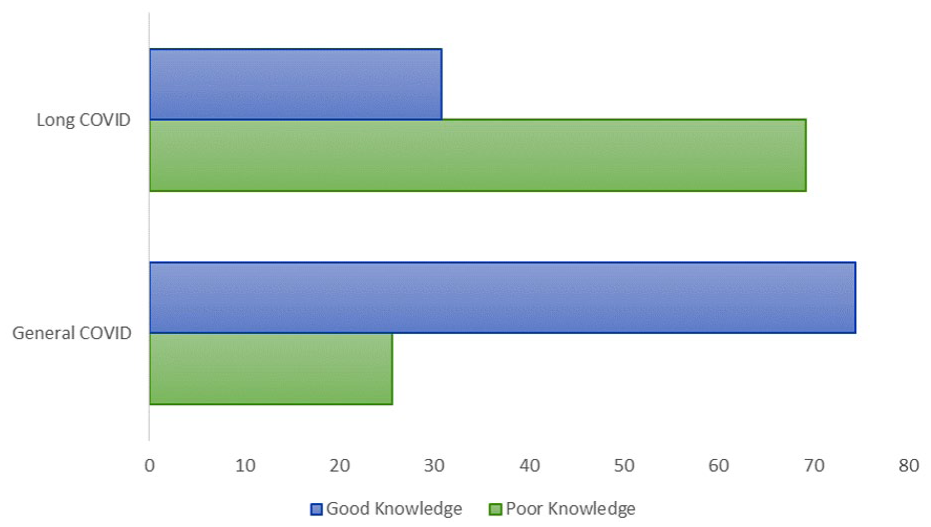
Comparison of general COVID versus long COVID knowledge among healthcare professionals.
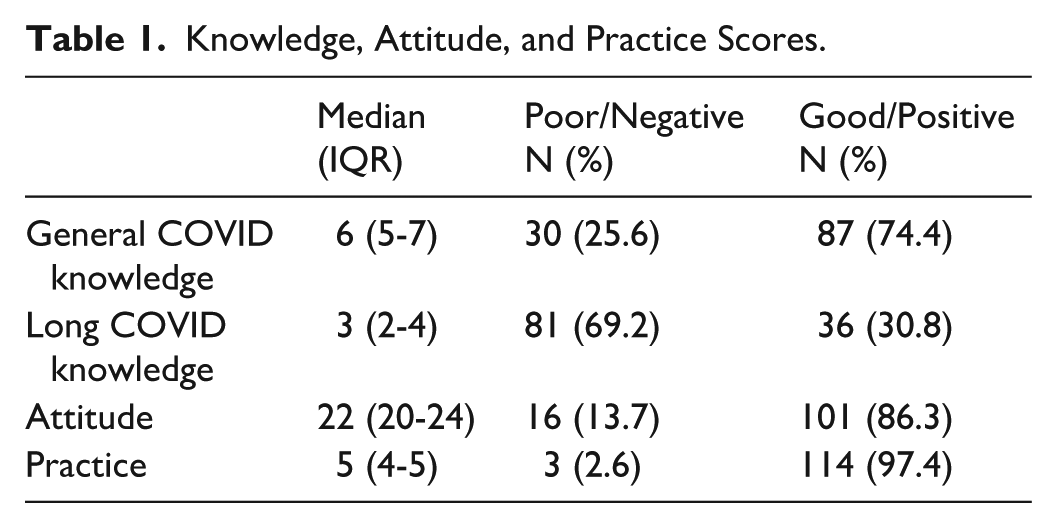
Attitudes toward COVID-19 prevention and management were largely positive, with 86.3% demonstrating favorable attitudes. Similarly, 97.4% reported appropriate clinical practices, reflecting high confidence in managing COVID-19 (Table 1).
Knowledge, Attitude, and Practice Scores.
Regression analysis identified female sex as independently associated with higher Long COVID knowledge (adjusted odds ratio [aOR]: 2.4, 95% CI, 1.0-5.7; P = .04). In contrast, physicians with more than 10 years of experience had significantly lower odds of adequate Long COVID knowledge (aOR: 0.09, 95% CI, 0.01-0.62; P = .01). No significant associations were observed with workplace setting (Figure 2).
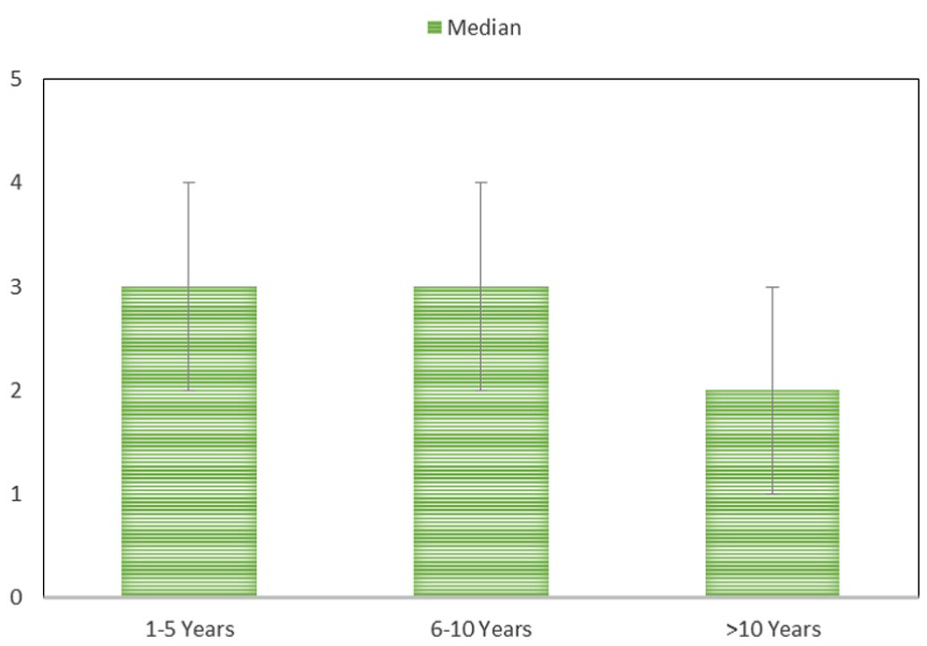
Clinical experience (in years) and Long COVID knowledge score among healthcare professionals.
Discussion
This study demonstrates a clear disparity between physicians’ knowledge of acute COVID-19 and Long COVID in Pakistan. While knowledge of acute infection was generally adequate, understanding of Long COVID was substantially lower, particularly regarding its definition and broader clinical implications. This gap likely reflects the relatively recent recognition of Long COVID, evolving diagnostic frameworks, and limited integration into clinical training and continuing medical education.
Despite limited knowledge, physicians reported positive attitudes and practices, suggesting reliance on general infection-control principles and prior pandemic experience rather than specific understanding of post-acute sequelae. This disconnect raises concerns about under-recognition and suboptimal management of Long COVID in clinical settings.
The finding that more experienced physicians had lower knowledge levels may reflect differences in access to updated information, with younger clinicians more engaged with emerging literature and digital learning platforms. Similar inverse associations between years of experience and knowledge of emerging health conditions have been reported, particularly for rapidly evolving and digitally disseminated topics. 5 Conversely, higher knowledge among female physicians is consistent with prior research demonstrating greater engagement with preventive health information. 6
These findings have important implications for healthcare systems in low- and middle-income countries, where the burden of Long COVID may further strain already limited resources. Targeted educational interventions, including integration of Long COVID into clinical guidelines and continuing medical education programs, are needed to address these gaps.
Conclusion
Physicians in Pakistan demonstrated adequate knowledge and practices regarding acute COVID-19 but had significant gaps in understanding Long COVID. These findings highlight the need for targeted educational strategies to improve recognition and management of post-COVID conditions, particularly among senior clinicians, to strengthen healthcare system preparedness in the post-pandemic era.
Footnotes

Ethical Considerations
Ethical approval was obtained from the Aga Khan University Ethical Review Committee (ERC Reference number: 7843).
Consent to Participate
Informed consent was obtained from all participants who showed willingness to participate in this survey and agreed for publication of results.
Funding
The authors received no financial support for the research, authorship, and/or publication of this article.
Declaration of Conflicting Interests
The authors declared no potential conflicts of interest with respect to the research, authorship, and/or publication of this article.
Data Availability Statement
The dataset generated during this study is shared in the results and supplementary file.
Disclosure of AI Use
Artificial intelligence tools (ChatGPT, OpenAI) were used to assist in language editing and manuscript structuring. All scientific content, analysis, and interpretations were developed and verified by the authors.