







Abstract
Participation in organized sports is considered as a lifestyle characteristic that is dependent on social class and status considerations. It has been argued that each sport, to a certain extent, can be considered as a representative of certain status categories. These social status categories are dynamic and their size, exclusiveness, and even existence are related to the class structures that arise with the development of economic structure. In this article these ideas are given further critical elaboration through the study of the contemporary demographic distribution of participation in different branches of sports in Amsterdam in the Netherlands.
Introduction
Modern sports can be considered as those competitive pastimes that became internationally organized and regulated by national and international sports organizations. Through this organization and regularization, a number of locally varying competitive pastimes became internationally standardized sports. This process of organization, regularization, and standardization began in England at the end of the 18th century. In other countries, organizations to administer these sports were established from the middle of the 19th century onwards. In some branches of sports, such as ice skating, gymnastics, and rowing, international organizations were formed in the 1880s and 1890s. At the local level, in England as well as in many other European countries, young people took the initiative to organize clubs to be able to practice these sports together and to create facilities necessary to perform their sports.
These clubs were voluntary associations. Individuals, in their free time and on their own choice, formed associations to perform their sports. Sometimes, owners of firms, churches, or communal authorities contributed to the finances of the clubs, but most of the financial burdens were covered by the contributions of the members themselves. Being voluntary associations – where people came to meet each other for fun and recreation – these clubs acted as meeting places of people from the same status groups. Social intercourse, in the form of membership in these clubs, was restricted to people who conformed to the same lifestyle. According to Weber, there is a rough relation between social classes in economic terms and the status groupings that correspond to these classes (Weber, 1922/1972). This correspondence is never complete because people who have lost their class position in economic terms might be able to maintain their status position for some time. Furthermore, people from higher status groups are also able to exclude for some time people who have just reached the class position that corresponds most to their status group. However, certainly from a long-term perspective, one can say that the social stratification of people in a society follows its class structure (Sugden and Tomlinson, 2000; Weber, 1922/1972).
Many sociologists (Bourdieu, 1979; Coakley, 1998; Lüschen, 1971; Renson and Careel, 1986; Scheerder et al., 2005; van Bottenburg, 2001; Voigt, 1978) have discussed the socially stratified character of sports participation. However, none has studied the development of sports stratification over a period as long as a century. In this study, the distribution of participation in different branches of organized sports in Amsterdam has been used as an indicator of the changing social stratification of this city.
An attempt has been made to demonstrate that this stratification, as indicated by the distribution of participation in different branches of sports, roughly follows the development of class relations. These class relations depend on the changing economic structure of the city during the 20th century. Furthermore, this study has argued and demonstrated that the distribution of participants in different branches of sports is not just an indicator of class relations, but that these relations determine the distribution of sports participation. The effects of developments in other relations like those between the sexes and between age or ethnic categories also depend on the class positions of these categories.
Methods and data
Combination of a long-term perspective (one century) and a specific locality (Amsterdam) facilitates close observation of the relation between social stratification and sport participation. Description of the economic development of Amsterdam and the accompanied changes in class relations are derived from the standard historiography of the city (Bakker et al., 2000; de Rooy and Carasso-Kok, 2007).
The first inventory of sports participation in Amsterdam was made between 1908 and 1911 by the Nederlandsche Bond voor Lichamelijke Opvoeding (NbvLO) (Dutch Association for Physical Education). This was the first association that tried to embrace all Dutch sports organizations, and as one of its initial tasks attempted to draw up an inventory of Dutch organized sports. The data for Amsterdam in 1911 were derived from this inventory (NbvLO, 1911).
During the 1930s, in order to base its sport policies on empirical data, the city government collected quantitative data on sport participation. First, the government depended for its statistics on the data that were supplied by sport clubs and the local sport association. Later (Table 2, 1962) social scientists were hired for this task (Schonlank and van Schelt, 1954; van der Ham, 1965). They explicitly and systematically took notice of the stratified character of organized sport. Besides the inventory of the NBvLO of 1911 and the two social science reports of 1954 and 1962, data from which one could reconstruct the pattern of sport participation in Amsterdam during the first half of the 20th century are hard to find. Since the 1990s, the statistical research unit (O&S) of the city government published data on sport participation online. In these publications social status data on sports participants disappeared or were reduced to variables such as income or educational levels. In relation with the social health policy of the (city) government sport was defined as physical exercise, independent of its organizational setting, and the subsequent statistics were no longer representative for organized sports. Government statistics on organized sports (sports organized in clubs that are affiliated to national unions, which in turn are part of international federations) became scarce, but did not entirely vanish. This article deals with the development of organized sports.
Forms of social stratification in sports
In the Netherlands, the association of sport clubs with certain status groups arose from two sources: a) branches of organized sports, which acquired certain status images; that is, certain sports attracted members from more or less the same social status groupings, and b) within some branches of organized sport, a hierarchy of clubs came into existence in terms of the social status of their members. This latter form of stratification developed in those sports that were initially introduced by the members of the higher social classes, but subsequently became more democratized because people from lower classes entered the sport and founded clubs for people of their own social status. The relation between the nature of the social stratification of the population of Amsterdam and the distribution of sports participation was already recognized by the authors of one of the first surveys of sports participation. In 1954, they wrote that ‘each sport has its – more or less pronounced – social milieu (in terms of work, income, schooling, and neighborhood), which distinguishes it from other sports’ (Schonklank and van Schelt, 1954: 50). This was at a time when in the Netherlands the boundaries between different status groups were still rather strict. Later these boundaries became more permeable (Dronkers and Ultee, 1995). Consequently, the correlation of sports with status groups became less strong. However, most sports remained dominated by members of certain status groups and kept an image derived from those groups (Scheerder et al., 2005).
Soccer in England was already somewhat democratized when boys with parents belonging to the higher social classes imported this sport to the Netherlands in 1879 (Goldblatt, 2006). They began rather exclusive clubs. By means of ballot, they restricted the membership of their clubs to boys of their own social class. However, just like in England, they could not prevent boys from other social classes to form clubs for themselves. After some conflicts, all these clubs began to play with each other in the same competitions (Goldblatt, 2006). As a result, in a few decades, soccer became the most democratized and practiced sport in the Netherlands. Cricket and golf developed differently. In England, cricket was a sport in which gentlemen played with lower class ‘players’ (Brookes, 1978: 139). This was not a democratic arrangement, but more of a patrimonial setup, which, in the Netherlands, did not attract many townsmen and workers. With regard to golf, this was even more evident (Cousins, 1975). These sports retained their elitist patrimonial image for a long time after being introduced in the Netherlands, and therefore included only few participants, nearly all from the social elites. In a very illuminating article, van Bottenburg (1992) discussed the different growth rates of soccer and cricket in the Netherlands. Both sports were introduced more or less at the same time. Many clubs started as combined soccer and cricket clubs. However, after a few decades, soccer became a popular sport, while cricket remained less popular. The cricket departments of the older clubs were closed down, and while many new soccer clubs were initiated, the number of cricket clubs hardly increased (van Bottenburg, 1992). In general, the status position of a sport as well as its exclusivity in a country that adopts it depend on a) the status position and exclusivity of that sport in its country of origin, b) the status position of the people who brought that sport to the adopting country, and c) the nature of the status boundaries in the adopting country. Usually, the country of origin is or would have been a politically, economically, and culturally central world power, while the adopting countries are those that became involved in the sphere of influence of the powerful countries (van Bottenburg, 2001; Stokvis, 1989). The ideas of Stokvis and van Bottenburg have been formulated to explain differences in the popularity between sports in national states. This contribution elaborates on a local level the effects of changes in social status boundaries on the participation in different sports
The social status dynamics of sports (and other elements of culture)
From a short-term perspective, one can certainly consider that each sport predominantly attracts people from certain status positions and derives its social status image from these people. However, in the long run, one can observe that sports change their social status images. Analytically, one can distinguish between two kinds of social changes that affect the status image of sports. The first is a general rise or decline in the number of people of the same social class in a society as a consequence of changes in the economic structure. This will be reflected in the number of participants in the sports typically for the status categories associated with this class. As a result, though there is in fact no change in the social status of the participants, the sport gains or loses its popularity in terms of the number of participants in a certain society. If its popularity increases, then its image becomes less exclusive. Second, changes in the status aspirations of people in a social class may arise as a consequence of new economic opportunities, and these can have an influence on the sports that they prefer. This latter point takes into account that people from lower status groupings may become conscious of the low social status image of the sport that is most practiced by the members of their group. Thus, when they get an opportunity, they may select a higher class sport. Of course, this second form of change presupposes that these people acquire the material means to pay for these higher class sports. In practice, both these processes often go together.
The second form of change can be analyzed with Fallers’s (1954) concept of ‘trickle-effect’. When more people of the lower classes begin to practice a sport that is practiced by higher class people, the higher class people will look for other sports so that they can maintain their exclusivity vis-à-vis the newcomers from the lower classes. As a result of the entry of the lower class newcomers and the exit of the higher class athletes, the status image of the sport decreases. This interplay of status emulation and status differentiation was painstakingly analyzed by Pierre Bourdieu in his book Distinction (1979). However, Bourdieu only deals with the mechanisms of emulation and exlusion in the short term. In his model, there is no room reserved for long-term economic changes and their consequences for the status aspirations of the people involved. From a long-term perspective, sports can be considered as socially ‘rising’ or ‘falling’ elements of culture (Munters, 1977). Empirically, rise in the social status image of a branch of sport does not occur very often, because in the 20th century, most organized sports had their origins already among the social elites. Thus, their status image could only go downward. The rate of diffusion of these sports among wider, less exclusive social circles is observed to be different for each branch of sport. Though soccer became very popular, at least in the Netherlands, golf remained an exclusive sport practiced by a few people until the end of the 1960s. In a changing society, the social status image of each branch of sport also changes. However, the changes in the status of the participants can be more or less slow. We can illustrate these processes with some examples from the Dutch sports history.
During the 1890s, in the Netherlands, the social status image of competitive cycling fell in a short time. Instead of higher class amateurs, lower class professionals came to dominate the tracks. This downward trend in class position was also observed among the spectators of this sport. Young people of the higher classes abandoned competitive cycling and looked for other more exclusive sports like auto and motor racing (Burkens, 1900). However, these sports were also invaded by lower class professionals in a short time.
Some decades later, this downward trend in terms of the social status of the participants was also noticed in soccer. Soccer had been introduced by boys from higher middle-class circles. However, since the 1890s, this sport quickly diffused among the lower classes, to the chagrin of many of the participants from the higher classes. They claimed that the players of the lower classes took the game too seriously and did not act as real sportsmen. To stop the downward trend in terms of status of the participants, during the 1920s, a special association called the ‘Dutch Corinthians’ was established with the objective to ‘honour the principles of amateurism in soccer among the more civilized circles, who are gradually leaving the sport’ (Miermans, 1955: 151). After this objective was published, because of the protests it aroused, the part of the ‘more civilized circles’ was eliminated; however, everybody knew the actual intention of this organization. Nevertheless, the Corinthians were unable to stop the entry of lower class people into the sport. As a result, after the 1930s, soccer acquired the image of a lower class sport, and for a long time, it predominantly attracted boys from the lower classes. Among the boys of the higher social classes, other sports like hockey and rugby became more popular (Miermans, 1955).
With regard to tennis, the combined effects of status emulation and the numerical growth of the members of a social class could be observed. Before the 1950s, tennis was considered an elite sport in the Netherlands. However, during the 1950s and 1960s, members of the middle classes, men as well as women, slowly began to participate in this sport. This can be interpreted as a form of status emulation; slowly, tennis became a less exclusive sport. However, during the 1970s and 1980s, participation in tennis exploded. After soccer, far outnumbering other sports, tennis became the second sport in terms of the number of participants. Soccer remained a sport dominated by males. In tennis, men and women participated in more or less equal numbers. Tennis courts were built in the environment of older middle-class areas of the big cities and in the newly built areas of villages in the neighborhood of the big cities, where many people of the vast growing middle classes migrated. Not only did the number of clubs and members per club increase, but many people could also play tennis on commercially exploited courts. The explosion of tennis participation during this period was clearly a result of the vast growth of the middle classes. This growth of the middle classes was a result of the turnover of the industrial economy into a service-based economy (van Bottenburg, 2001). Similar processes can explain the rise in the number of golf players during the 1990s and the beginning of the present century. Since many years, golf has been the fastest growing sport in the Netherlands. Though there are no studies on the new golf players, many of them are presumed to be connected with firms that became successful in the process of globalization.
Sports, and especially organized sports, owing to the social selective character of clubs, can be used as indicators of the development of social stratification of a town or country. The rise and fall of social classes and the accompanying emulation and protection of social status is found to be directly connected to the pattern of sports participation.
Sports participation in Amsterdam around 1911
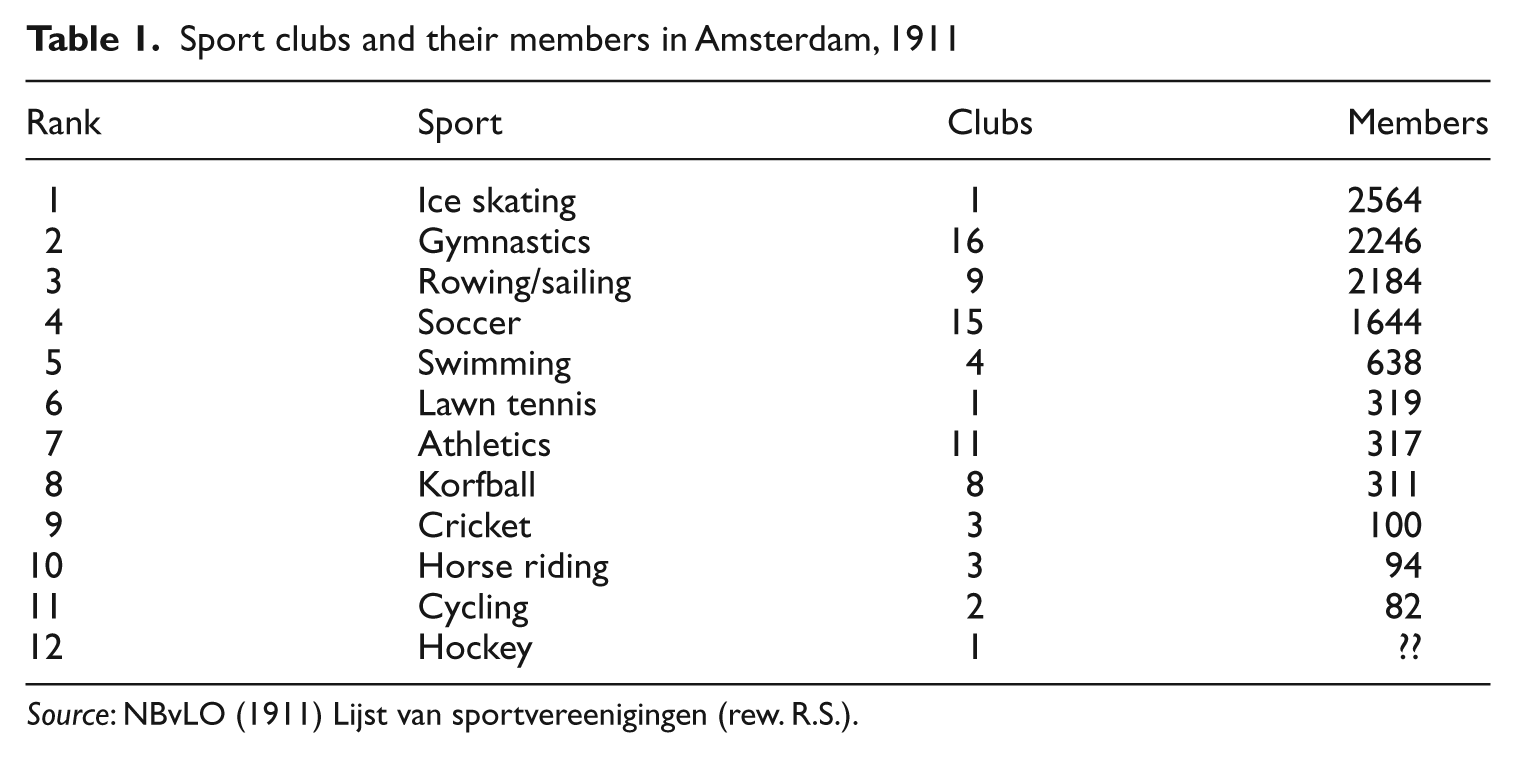
The sports pattern observed in 1911 (Table 1) clearly reflects the upper part of the social stratification of the population of Amsterdam. At that time, sports were not yet generally practiced.
Sport clubs and their members in Amsterdam, 1911
Source: NBvLO (1911) Lijst van sportvereenigingen (rew. R.S.).
People from the lower middle and lower classes were practically absent. The relative large ice sport club was the Amsterdamsche IJsclub (A.IJ.C). This was an organization that had been set up according to a model that existed in many other Dutch towns and villages. Members of the local elites organized ice clubs as a kind of philanthropic activity. The care for the quality of ice tracks offered employment to the unemployed poor. The clubs also organized skating races. The most athletic poor were able to win prizes in the form of money, food, or golden ornaments, which they could eventually sell. Besides these activities, members of the elites also skated themselves and some of them participated in the races. Many of the club members lived along one of the main canals of the town, and there was a big overlap in the membership of the ice club and that of the rowing and sailing clubs that took a third place in the rank order. These were the people who belonged to the traditional trading and banking elites, who, in the 18th and 19th centuries, used to dominate the economic, political, and cultural life in the town. Some of them probably could also be found among the players of lawn tennis, cricket, hockey, and horse riding. Furthermore, as sports had not yet been adopted at a large scale among the lower classes, some of them also participated in other sports (Mooij and Stokvis, 2000). It is interesting to note that the position of gymnastics is second in the rank order. Its prominent place is related to the efforts of teachers in physical education. They shared the mission to strengthen the mental and physical characteristics of young people through physical education. They tried to introduce gymnastics as a part of the school curriculum, and besides school, they encouraged the establishment of clubs. Within these clubs, gymnastics slowly evolved from physical exercises without competition to a competitive sport. However, the physical educators were unable to attract the elite youth to these clubs. Gymnastics became an activity that was dominated by members of the middle classes (Staal, 1968). A well-known Dutch novel personage ‘Kees de Jongen’ (Thijssen, 1923), aspired to become a member of a gymnastics club. His ailing father owned a small shoe shop and could not afford the money that was necessary for his son to become a member of the club. In Holland, gymnastic teachers particularly developed korfball, and a little bit later, handball, as alternatives for soccer that was considered as too violent and too elite-oriented. Similarly, they also introduced baseball. Around 1911, soccer was still largely a sport for the high-class young people. However, clubs were also established by middle- and lower-class boys. The high-class boys who practiced soccer tried to keep their sport exclusive for their class; yet, they were unable to resist the establishment of clubs in other milieus and were prepared to meet these clubs on the field to see who played best. Furthermore, some of the older soccer officials actively tried to promote soccer as a sport for all. However, this was different with respect to cricket. In England, this sport was already dominated by high-class people, and thus, in Holland, its practitioners were able to continue the exclusive character of the sport. It became a sport for somewhat older young people who could afford the leisure necessary for a game of cricket. Clothing prescriptions and the strong barriers between high-class amateurs and lower-class professionals furthered the social exclusivity of the sport (van Bottenburg, 1992). Around 1911, lower-class people were visibly present in cycling, where they could aspire to become professionals. In addition, they were also present in athletics, which at that time was predominantly defined as wrestling, weightlifting, and tug-of-war.
Sports and industrialization in Amsterdam (1911–1962)
According to the available 1962 data, the social division of sports was based on the social status of the Amsterdam neighborhoods where most of the sport practitioners came from. The social status of neighborhoods was measured on the basis of possession of a telephone, educational level, percentages of firm owners, professionals, and higher managers.
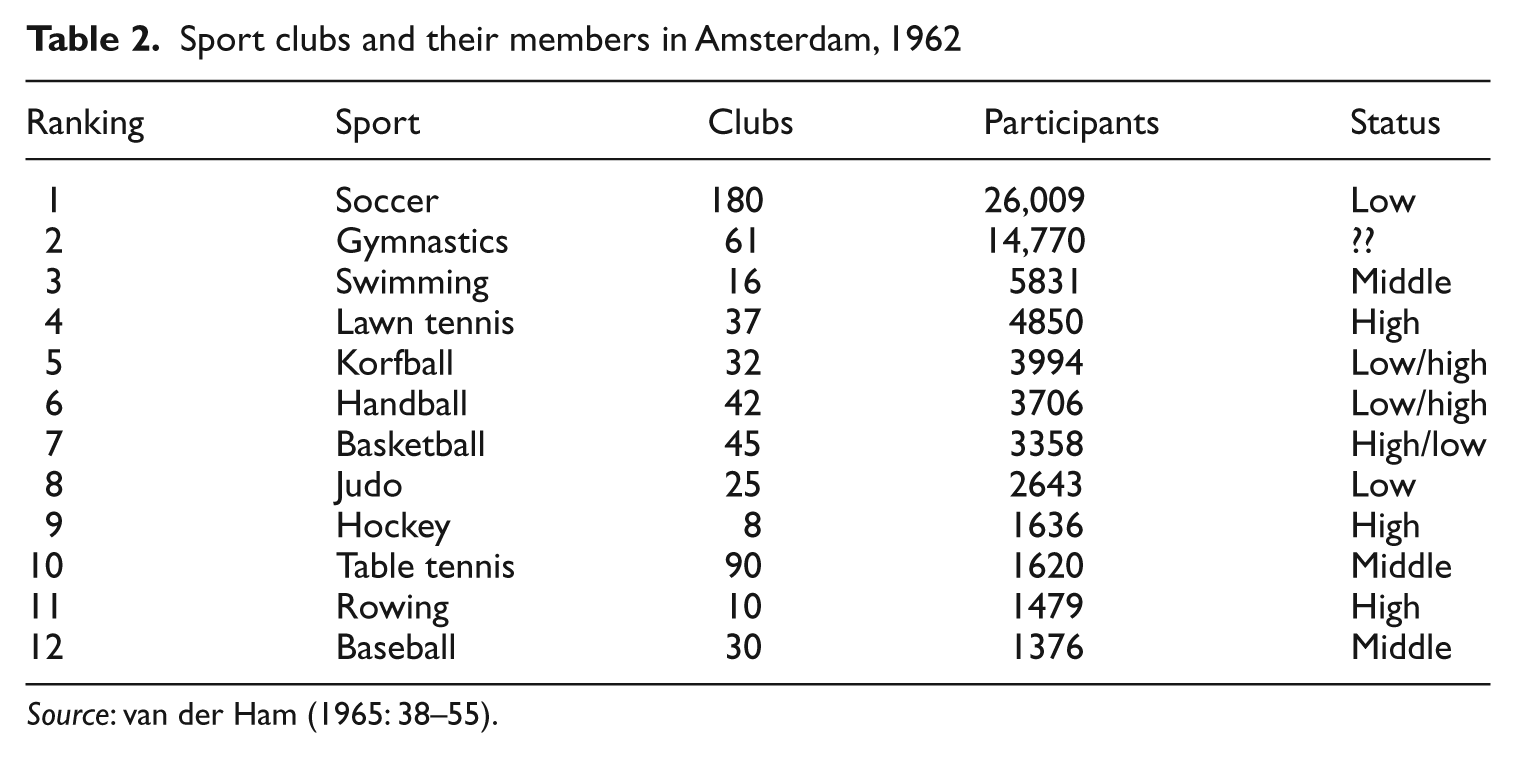
High-class sports included hockey, cricket, tennis, rowing, ice hockey, and horse riding. Sports with more high-class than lower-class participants were badminton, basketball, volleyball, fencing, ice dancing, and skating, while sports with as many high- as lower-class participants were athletics, baseball, softball, judo, table tennis, and swimming. More lower class than high-class participants could be found in handball, korfball, and canoeing. Predominant lower class sports were soccer, boxing, weightlifting and wrestling, judo, and cycling (van der Ham, 1965). On the basis of less complete data from the 1930s, we can assume that some main outlines of this popularity rank order, especially the popularity of soccer, had already been reached by that time (Mol, 1998).
The most conspicuous change, when compared with the ranking of 1911 (Table 1), was the annihilation of the traditional canal-girdle-based Amsterdam elite from the field of sports. The ice club nearly disappeared. Sailing continued, but the new clubs were based outside Amsterdam. The remnants of the traditional elite probably could be found in the most elite-oriented rowing, hockey, and tennis clubs. Soccer had become the most practiced sport, well established in the working-class neighborhoods of north, west, and east Amsterdam. In fact, it was practiced in all the neighborhoods of Amsterdam, both the high class as well as lower class. However, in the lower class neighborhoods, soccer players were overrepresented in the total number of sport practitioners, and in the high-class neighborhoods, they were underrepresented (van der Ham, 1965). School-related middle-class sports, such as gymnastics, korfball, handball, basketball, and to a certain extent swimming (school swimming) had obtained a central position in the rank order. Sport participation of this period was dominated by boys and girls of high school-going and college-going ages (Rijsdorp, 1957). Hockey and tennis became the sports for the higher-middle classes, with hockey being more popular among the young people from these classes and tennis among the somewhat older population. Judo was successfully propagated as a sport for young children.
During the first six decades of the 20th century, Amsterdam acquired a mixed economic structure with employment in trade, industry, and (financial) services (De Vries, 2000). The development of sports as an activity for young people is found to be associated with the extension of public education to larger segments of the population. As a result of the increase in economic activity and the political initiatives of representatives of the lower classes in the community council to subsidize sport facilities, many working-class parents were able to pay for the sports activities of their children (Mol, 1998). The northern part of Amsterdam along its harbor became a typical workers’ area with employment in the harbor, shipyards, and other industries, and this was also the reason for the dominance of soccer in this neighborhood. One of the members of the board of the largest soccer club in this neighborhood, the Volewijckers, was also a prominent leader in the Dutch communist party. The west and east sides of Amsterdam also predominantly had a working-class character, but not as dominant as in the north side, which may be one of the reasons for the participation of the youth of these areas in soccer and other sports like handball, netball, and gymnastics. Gymnastics lost its character as a typical mixed middle-class sport and became the sport for girls from the lower and middle classes, similar to soccer for the boys. Sports such as tennis, hockey, rowing, and horse riding were practiced in the south side of Amsterdam, the area with neighborhoods for people of the higher and higher-middle classes.
While in 1911 sports were mainly practiced by the young people of the higher classes, in 1962 the rank order of sports in terms of the number of participants presented a very different distribution (Table 2). Sports participation had become possible for people from all social classes. As a result, we could observe a rather one-sided popularity of soccer, which had become the sport of the lower class people, and has clearly been a ‘falling cultural element’. The sports in which most of the members of the higher and middle classes participated had considerably fewer participants. This was most obvious just before the Second World War. At that time, 66 percent of all sports participants played soccer (Mol, 1998). However, in 1962 (Table 2), the share of the middle classes, as expressed by the number of participants in the middle-class sports, had risen. The proportion of soccer players had diminished to 35 percent. An important cause for this decrease is the strong increase in the number of middle and lower class girls, who began to practice gymnastics in the 1940s and 1950s. Together, these boys and girls had a share of 55 percent in sports participation in Amsterdam (Table 2). Furthermore, the proportion of the working class in the employment structure in Amsterdam at this period was still large. Because of the increase in participation of lower- and lower middle-class children in sports during this period, the relative numerical importance of people of the higher- and higher middle-classes in sports diminished.
Sport clubs and their members in Amsterdam, 1962
Source: van der Ham (1965: 38–55).
Sports, globalization, and the participation of immigrants (1962–2005)
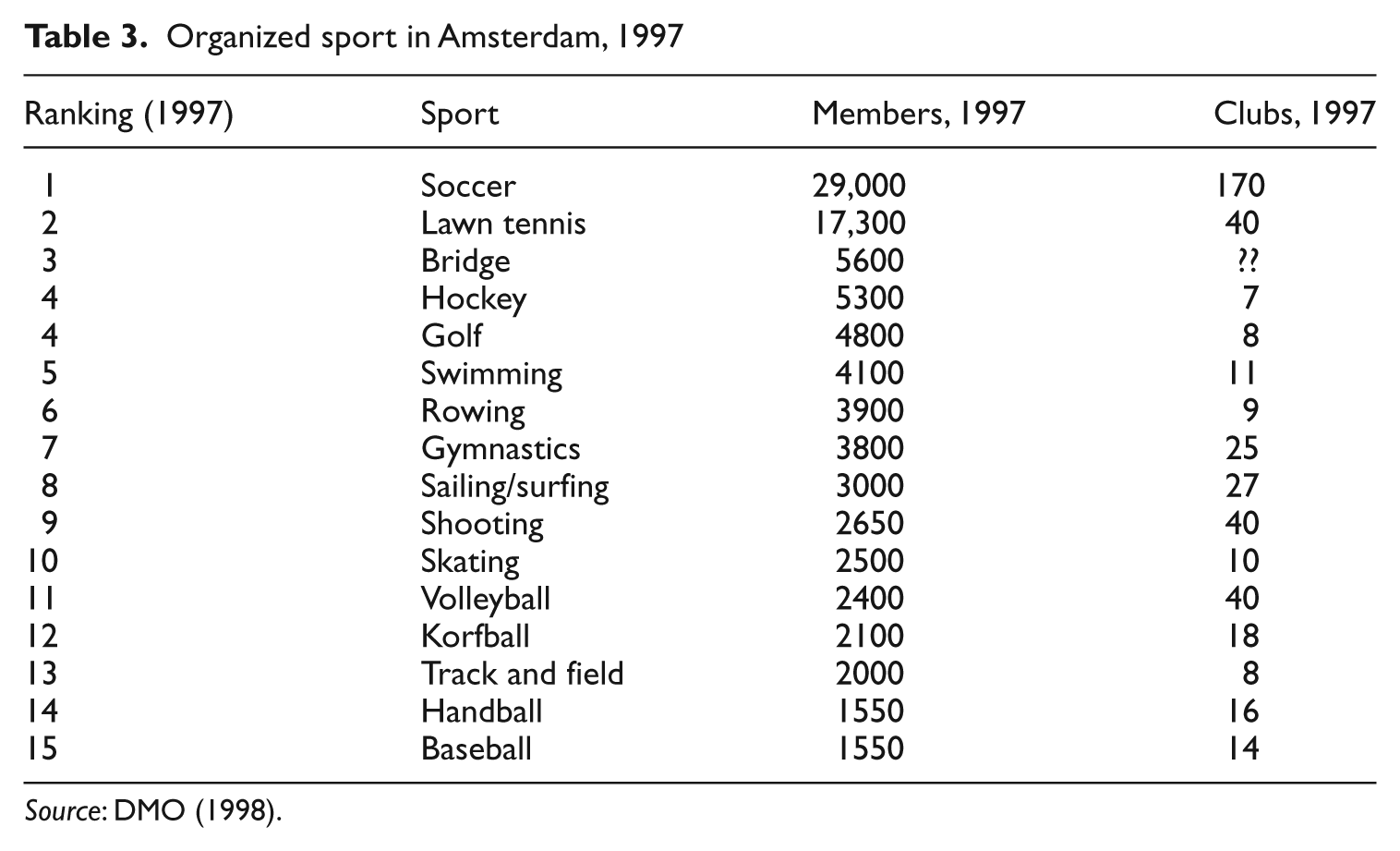
The change in the sports pattern between 1962 and 1997 (Table 3) is intriguing. Higher middle-class sports, such as tennis, bridge, hockey, golf, and rowing, gained a greater share in the total sports participation. This occurred at the cost of the so-called ‘school sports’, namely basketball, volleyball, handball, korfball, gymnastics, and, to a certain degree, swimming. At the same time, in Amsterdam, soccer retained its top position in organized sports, though its share among the first 12 sports decreased a little from 35 percent in 1962 to 33.5 percent in 1997.
Organized sport in Amsterdam, 1997
Source: DMO (1998).
In this period, the composition of the population of Amsterdam and the lifestyles of its inhabitants have changed considerably. With regard to the social stratification, major changes during this period were: a) the arrival of many migrants from developing countries, mainly from Turkey and Morocco, and from the former Dutch colonies, such as Surinam and the Dutch Antilles, as well as from many other countries with political and economic problems and b) the positioning of the town in the global economy as a center for banking, insurance, law, and accounting, and as a center for culture and education. As a result, we could observe a tendency towards growth at the top and bottom of the stratification pyramid at the cost of the middle ranks (O&S, 2009a). At the top, there was an influx of highly educated professionals with high or middle-high incomes, and at the bottom, the share of mostly low-income migrants with low education levels increased. In 2009, migrants constituted 50 percent of the inhabitants of Amsterdam, of which 35 percent came from non-Western countries and 15 percent from Western countries (O&S, 2009a). In both these categories, the majority of the migrants were poorly educated and had low income levels. They came to form the majority at the bottom of the social stratification of the city. Amsterdam shares this tendency towards polarization of the social stratification in the final decades of the 20th century with many other cities that obtained important positions in the global economy. This tendency has been described and analyzed by Saskia Sassen (1991) in her book on the global city. To understand the sports pattern of Amsterdam at the end of the 20th century, we have to consider this polarization.
To analyze how this polarization has affected the distribution of sports participation, we have to disentangle its effects from another important development that might have affected this distribution, namely the increased participation of older people in sports. In the 1970s, sports ceased to be ‘a young people’s activity’ (Rijsdorp, 1957). Though we do not have any long-term statistics of sports participation according to the age for Amsterdam, the data that we have confirm the long-term statistics for the Netherlands as a whole. Between 1983 and 2007, in the Netherlands, the percentage of people under 35 years of age, who participated in sports clubs decreased by 2 percent, and that of people over 35 years of age increased by 6 percent. The older sports practitioners predominantly came from higher social status groups (SCP, 2008). This might be a reflection of the proclivity for sports among the members of what Florida (2002) called the ‘‘creative class’, a category that partly coincides with the top end of the stratification pyramid in globalized cities.
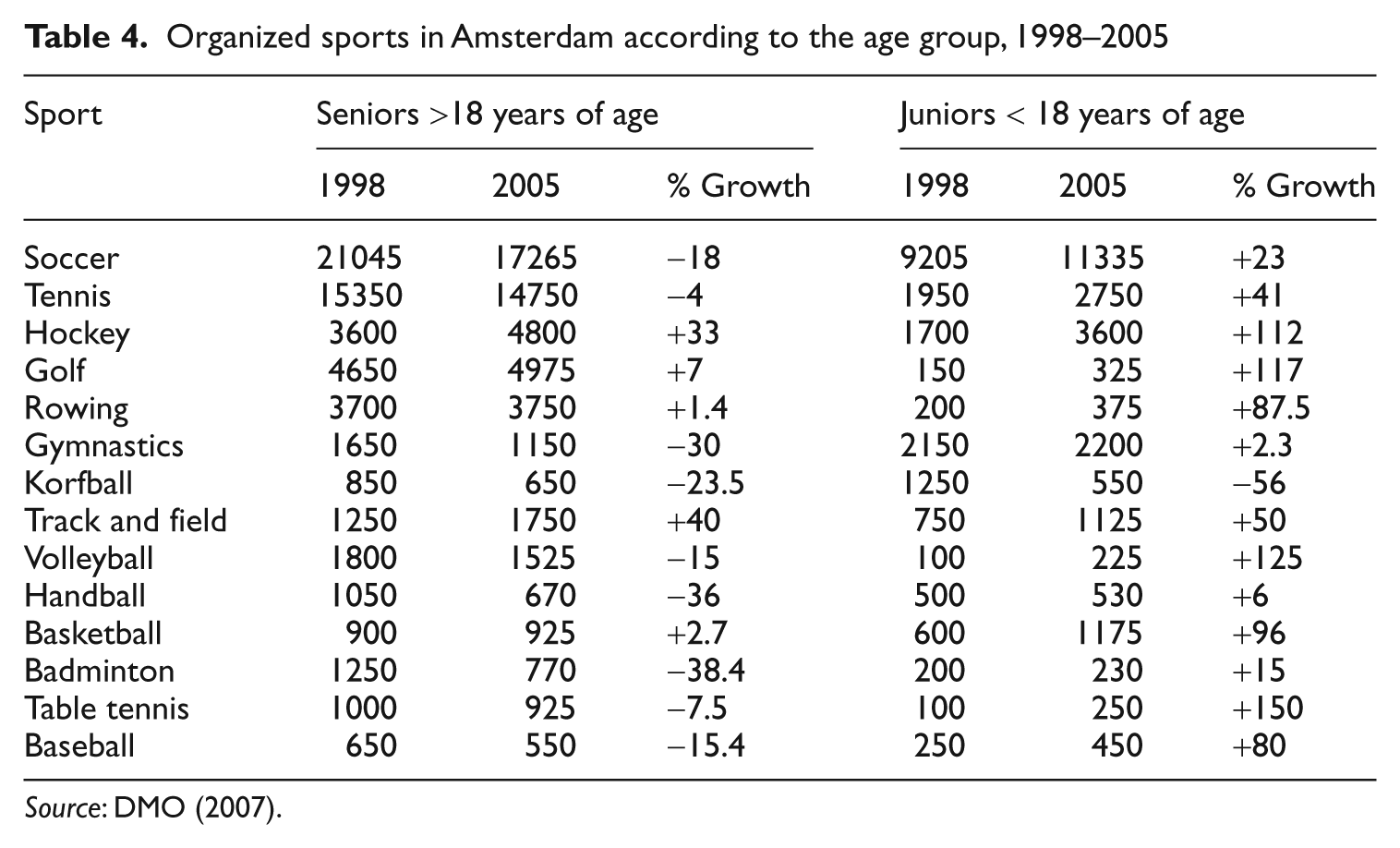
We have no data split according to age for the period between 1962 and 1997. However, on examining the data for the period between 1998 and 2005 from another report, which were roughly specified according to age, we observe a similar trend toward a preference of higher middle-class sports among the young as found among the older sports participants (Table 4).
Organized sports in Amsterdam according to the age group, 1998–2005
Source: DMO (2007).
Among the younger age group, high middle-class sports such as tennis and hockey gained more participants in absolute numbers than other sports, and korfball that used to be dominated by young people from the lower and lower middle class lost most of the participants. The small loss among the senior tennis players may be a result of the competition from hockey and golf. Probably, high status tennis players looked for a more exclusive social environment in golf and hockey. The increased participation in track and field among the seniors as well as the juniors must be related to the enormous increase in the popularity of long-distance running among people from the middle and higher classes. As the changes in the development of the distribution of participants in different sports among older people are more or less similar to those among the young participants, with some caution, we can consider that the changes in the distribution of sports participation between 1962 and 1997 have not been caused by the changes in the age of the participants.
The most striking and, in absolute numbers, most significant difference between the seniors and juniors are the changes in the participation in soccer between 1998 and 2005 (Table 4). Among the seniors, soccer lost 18 percent of its participants, and among the juniors, it gained 23 percent. What happened to this sport, which, since the 1930s, had become the sport for the lower classes? To answer this, we must carry out a closer inspection of the statistics for the sports participation of migrants, who, during the period after 1962, became the majority among the lower classes.
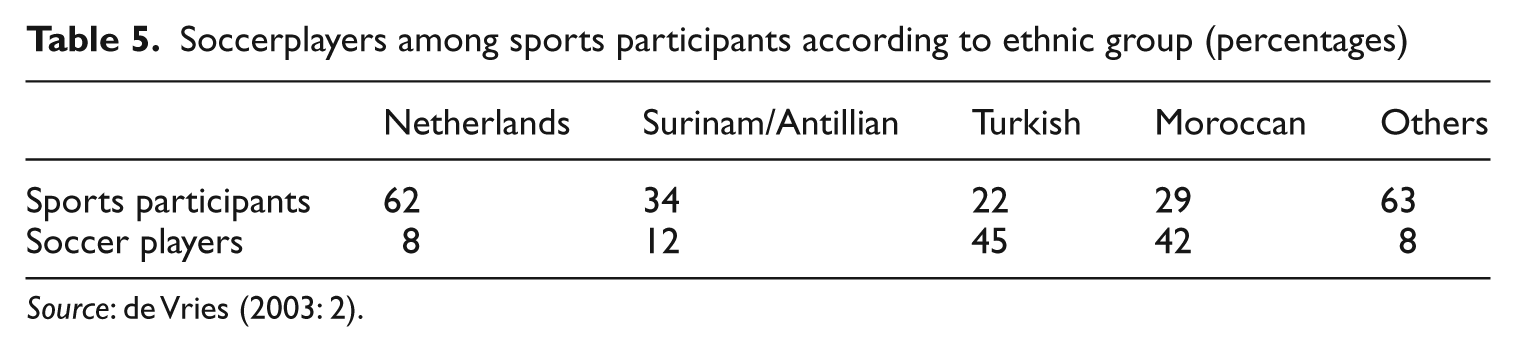
According to data from 2005, 70,446 people of Surinam descent, 64,000 people of Moroccan descent, and 38,000 from Turkey lived in Amsterdam (O&S, 2009b). If we combine these absolute numbers with the percentages given in Table 5, we can calculate that 14,426 of the soccer players in Amsterdam were of Surinamese, Moroccan, or Turkish descent. This was 50.4 percent of all the soccer players in Amsterdam in 2005 (see Table 4). This preference of men and boys from Surinam, Morocco, and Turkey for soccer is not very surprising. Soccer is a world sport. It is, in terms of sports participation, the most popular sport in Surinam, Morocco, and Turkey. Migrants were able to enter this sport, because already since the 1930s, soccer in Holland had become a very open sport with low social thresholds.
Soccerplayers among sports participants according to ethnic group (percentages)
Source: de Vries (2003: 2).
Soccer maintained its position as the largest sport in Amsterdam with approximately one-third of all sports participants, owing to the in-stream of players from the migrant groups. As we can see from Table 4, the in-stream of these migrant players in soccer happened among the junior players. This signifies that soccer lost many of its young non-migrant Dutch participants. As they kept active in sport, one can only conclude that they began to participate in other middle- and high-class sports, which increased their numbers. At the senior level, we can observe a decrease in the number of soccer players. This has to be studied closer. It is possible that young Dutch soccer players left the sport when they became seniors. Another possibility is that the migrant players stopped playing soccer when they became seniors.
Just on the basis of statistics one cannot be completely sure that this out-stream of Dutch seniors from soccer and their influx into more high-class sports represents a ‘white flight’ away from the migrant sport practitioners. However, it would not be a surprise if this idea of a ‘white flight’ is confirmed. It is a characteristic of the development of class relations in sports. The most prominent historical example of a similar flight happened, as already alluded to, during the 1920s and 1930s. At that time, players from the high classes left football for hockey and rugby because of the influx of lower class players into football (Miermans, 1955). At present, it might be that migrants act as a new lower class who have acquired an important presence in soccer. Now again, like in the 1920s and 1930s, many players from the established classes enter other formerly more exclusive sports.
Conclusion
A disadvantage of Bourdieu’s theory on distinction is that it focuses on the class relations in France during the 1960s, and is not able to explain the long-term dynamics in the relations between status groupings and the development of their lifestyles. His theory can be enriched by combining it with Weber’s theory on the interplay of class and status relations under conditions of economic development. From a long-term perspective, tendencies towards status emulation and status exclusion have to be interpreted in terms of the changing threats and opportunities for the status aspirations of people from different classes because of changes in technology and economy.
Modern organized sports do offer an ideal field to study the long-term development of processes of status emulation and exclusion. People come together voluntarily in sports clubs. Most of the time, people who form a club belong to more or less the same social status category. People who want to become members of the existing clubs look for clubs that suit their own social status aspirations. Depending on the social history of each branch of sport, the practitioners differ in their ambitions and capabilities to keep their sport exclusive for their own status category.
When we look at the long-term development of the distribution of participants over the different branches of sports, we can observe the social-economic development of Amsterdam. In the initial years of the 20th century, Amsterdam was a town in which the traditional financial and commercial elites, who had acquired their positions already in the 18th century, dominated in the social life of the town. Many of them were members of the ice club and also from clubs in other sports. We also noticed the influx of a more modern middle class among the participants in gymnastics.
During the first part of the 20th century, the town became more industrialized. The traditional elite vanished as a recognizable social category. An emancipated working class developed, as can be observed from the important place of soccer. Further, we observed the growth of the middle classes, especially the middle-class youth who went to high schools and universities and practiced sports that were often related to the schools.
During the latter part of the century, the working class became more differentiated. Migrants filled the lower layers of the pyramid of social stratification. Many of them started to play soccer. A part of the established Dutch working-class population left soccer and began to practice sports with a more middle-class status image. At the same time, because of the involvement of Amsterdam in the global economy, we could observe a growth of the higher-middle classes. In the field of sport, this resulted in the growth of former elite sports, such as golf and hockey. Tennis became a sport where men and women of the lower and higher-middle classes came to meet each other. Many people started to play tennis, and exclusivity in this sport was maintained only at the level of clubs with restricted admission policies. This was also observed in golf, but at a somewhat smaller scale.