







Abstract
This paper focuses on spectators’ alcohol use at a regional community football (Australian Rules) club in Victoria, Australia, in the context of a season-long trial to sell only mid-strength (and not full-strength) beer at the ground during home games. Both quantitative and qualitative data were collected on spectators’ alcohol choices and preferences together with experiences and attitudes towards the trial. A minority (31%) usually drank alcohol while watching the game and 75% of all supporters agreed with the supply of alcohol at football grounds. Full-strength beer was the drink of choice for 70% of drinkers and faced with a restricted choice of alcohol for purchase (that did not include full-strength beer), 44% reported they would choose full-strength mixed drinks as an alternative. Choosing higher alcohol content drinks if the usual choice was not available was also found in the case of mid-strength beer drinkers, half of whom would choose full-strength beer if mid-strength was unavailable. In bivariate correlations, women, those aged 30–39 years, home supporters and those who did not drink alcohol while spectating were significantly more likely to support the trial. In a regression model the significant predictors were refined to being: female, a non-drinker and aged 50–59 years. Qualitative data supported the idea that the trial had been successful in terms of supporter acceptance of the move to cease the sale of full- strength beer and indicated that the club’s relatively supportive and ‘family friendly’ culture was a key in overcoming earlier opposition to the trial. While the results of this evaluation are mainly positive, the club’s particular culture and leadership suggest that its experience may not be transferred in any automatic sense to other clubs both within and without its league where more ‘traditional’ patterns associated with masculinity and alcohol use may be more persistent and prevalent.
Introduction
Palmer (2009, 2011) pointed to the contradictory aspects of the sport–alcohol nexus in relation to ideas of sport being linked to positive health and social cohesion outcomes on the one hand, and to countervailing tendencies associated with exclusion and disruption on the other. Part of the inhabitation of sport by wider societal structures has become crystallised in the historical association(s) with alcohol (Collins and Vamplew, 2002; Crawford, 2009; Dunning and Waddington, 2003; Horne and Whannel, 2009; Poortinga, 2007; Wenner and Jackson, 2009). Clearly, alcohol in and attached to sport links economic, social and behavioural practices within both elite (Dietze et al., 2008) and community levels of sport (Duff et al., 2005).
Sport spectator drinking has been linked to a ‘culture of intoxication’ (Measham and Brain, 2005) and evidence of increasing ‘binge’ drinking at sport events was noted as part of a study into alcohol-related harm in major public and social event settings in Victoria, Australia (Lloyd et al., 2011). As sport events have also become arenas for alcohol advertising and sponsorship, research has linked exposure to alcohol advertising targeted at sport audiences to increased levels of alcohol consumption at the associational level (Ellickson et al., 2005; McDaniel and Heald, 2000; Madden and Grube, 1994; Pettigrew et al., 2013; Stacy et al., 2004).
Alcohol company sponsorship and advertising now form a significant economic base underlying large tracts of the sport landscape and over time the construction of what comes to be seen as commonsensical and normal in relation to the role of drinking and sport has arguably developed to the point at which the divisions appear almost seamless (Anderson, 2007; Atkin and Gantz, 2009; Munro, 2000). The need to act against these developments and minimise harms caused by the association of alcohol with sport has increasingly been acknowledged (Australian Drug Foundation, 2012; Commonwealth of Australia, 2009), with community sport identified as a promising vehicle for health promotion interventions in this area (Casey et al., 2009; Duff et al., 2005; Smith and Waddington, 2004). However, both Eime et al. (2008) and Casey et al. (2009) outlined critical issues for using sport and recreational organisations as vehicles for health promotion; in particular, the limited capacities of many community level organisations that can prevent optimum health promotion outcomes and/or have created unintended negative consequences (Mentha and Wakerman, 2009).
Palmer (2011: 179) called for more studies of sport-related drinking that can contribute to wider debates including public health and policy. In an earlier work (Thompson et al., 2011) she drew attention to the meanings and contextual practices constructed around alcohol use in Australian Rules football spectating. This article takes up both these leads via a quantitative and a qualitative methods stage in reporting the results of an evaluation of a season-long trial of reduced strength alcohol provision at an Australian regional football club.
Design and methodology
A twin focus on meaning construction and contextual practice around alcohol and sport spectating is more likely to achieve both deeper and more reliable data than either method pursued singly and prompts mixed method designs that typically combine qualitative and quantitative measures.
The paper is based on attitudinal and behavioural measurement research undertaken during the 2012 playing season of the Australian Rules football club ‘Silvertown’ (pseudonym), which is based in a regional city of Victoria, Australia. During the 2012 season, Silvertown trialled a system of selling mid-strength beer rather than full-strength beer between midday and 5.00pm on football match days at their home ground. This was the first such trial held in any regional league in Victoria and received local publicity via newspapers.
According to recent research (Australian Bureau of Statistics (ABS), 2010), the most popular sport in Australia attended by people aged 15 years and over was Australian Rules football (16% of the ABS sample generalised to 2.8 million Australians annually). This figure comprised spectating at both the elite professional level of the game (AFL) and the community based football level, of which Silvertown is an example. The club is among the largest and most successful in its league, which is classified second tier (the highest standard of non-professional clubs), with on-field success being measured in several grand final wins (premierships) in the last 10 years. Silvertown is based at a purpose-built enclosed ground close to the centre of the city that allows for paying spectator access on match days. There are options available to spectators to purchase food and drink in the ground which has both general admission and member areas.
The research design was based on two stages and took advantage of the trial in being able to direct questions specifically to spectator drinking patterns and attitudes in the context of a change in alcohol (type) availability. The first stage comprised cross-sectional intercept surveys (quantitative data) with football spectators at four Silvertown home matches between June and August 2012 (n=379). The second stage was focus group research (qualitative data) with a sub-set of the spectators who responded to the intercept surveys (four focus groups). The main questions related to the ways the trial was conducted and experienced (through the measurement of which alcohol types were purchased and in what quantities in the survey) and the responses to the trial in terms of the attitudes and behaviour of the spectators. Quantitative data were analysed using SPSSv.21.
Participants
The method consisted of administering a quantitative questionnaire survey to spectators present at one of four selected Silvertown home games (n=386) followed by a separate stage of four focus group interviews three to four months after the survey.
Measures
Stage 1
A questionnaire was developed that focused on eliciting data in the following areas:
Demographic profile of match attendees;
Beverage consumption patterns – questions designed to assess attitudes towards the sale of alcohol at community football together with self-reported alcohol drinking amounts and frequencies while attending community football;
Alcohol choices and preferences – questions designed to measure alcoholic drink preferences for example, presenting a list of branded products and asking respondents to choose their first and second choice of drink from the list;
Knowledge of, and attitude towards, the trial – questions specifically eliciting the degree of knowledge of the trial and the level of agreement with it.
Self-reported alcohol use: The intercept self-completion survey design necessarily relied upon self-reporting of alcohol use as a measure of drinker status and consumption level. We used standard question wording of the kind used in the Health Survey for England (Department of Health, 2011) that simply asked ‘how many [small/medium/large] drinks [did you have]?’ adapted for the context: ‘How many alcoholic drinks would you usually have at the ground while watching football here (from first arriving at the ground to the final siren)?’ While self-reported alcohol use has been found by some studies to underestimate actual consumption in the cases of heavy drinkers (Boniface et al., 2013; Northcote and Livingston, 2011; Parker et al., 1996), it is nevertheless recognised as an accurate and useful measure overall and particularly in the case of moderate to low drinking levels (Del Boca and Darkes, 2003; Midanik, 1988; Northcote and Livingston, 2011).
Procedure
The questionnaire was administered via iPad as a self-completion intercept interview at the Silvertown ground on four match days between June and August, 2012. Both the home team and the visiting team (as well as neutral) football spectators were surveyed. A team of three interviewers elicited responses between midday and 5.00pm on those days. In terms of sampling, full census type coverage of football spectators was attempted. For example, on the first survey day (9 June 2012) the estimated crowd size at the ground was 300. Of these it was estimated by the researchers that about 100 were spectators at the netball matches being held concurrently at the adjoining courts within the ground. Netball spectators were not surveyed. Approximately 50 of the football spectators were under the age of 18 years and were not surveyed. 150 questionnaires were completed. On subsequent dates non-responses included people who had already answered the questions on a previous visit. The averaged non-response rate (refusals by potential new respondents) across the collection periods was 6% (based on interviewer records). The number of home supporters successfully surveyed declined in absolute terms over the four collection dates: n=81 on 9 June; n=50 on 30 June; n=22 on 4 August; and: n=18 on 18 August. Visiting supporters were more evenly distributed across matches as would be expected: n=55 on 9 June; n=64 on 30 June; n=29 on 4 August; and n=34 on 18 August. Seven returns were unusable leaving a final sample size of 379. This can be considered a good representation of the people attending the ground to watch football over the course of the four survey dates given the attempt at census-like administration and the overlying effect of the four time points. As the administration of each survey round took place across the period of noon to 5.00pm while the football was being played, comparability of responses was achieved by asking respondents about their alcohol consumption and choice on the basis of what was ‘usual’ for them while attending football.
Results
The survey
Description of sample
The largest age category was 18–29 year olds representing 34% (n=129) of the total sample, followed by 40–49 years (26.9%, n=102), 50–59 years (20.3%, n=77), 60 years or older (10.3%, n=39) and 30–39 years (8.4%, n=32). Slightly less than two-thirds (63.9%, n=242) of the respondents were male and 36.1% (n=137) were female.
The primary reason given for attending the game for more than half the respondents was because they were family or a friend of someone playing (52.8%, n=200). Being a supporter of one of the teams was the second largest category, representing 21.9% (n=83) of the sample. Officials of the league or club, general football supporters, players in other teams and people who were attracted to the game because they live close by, wanted a good day out or were attracted to an exciting event, accounted for the remaining 25.3% (n=96).
Silvertown supporters comprised 45.1% (n=171) of the total sample, while visiting supporters comprised 48.0% (n=182). An additional 6.9% (n=26) of the sample supported neither Silvertown, nor the visiting team. It can be assumed that these people were attending to simply to watch a game of football, or were supporters of one of the other teams in the league.
The majority of the spectators surveyed found out about the game they attended because they were regular attendees of matches (67.5%, n=256) or through family and friends (22.7%, n=86). These two categories accounted for more than 90% of the spectators surveyed. The remaining (n=27) comprised spectators who had found out about the game via the league website, the local newspapers or other media or through other forms of advertising.
The majority of the sample (52%, n=197) attended football games every week in the regional football league of which Silvertown is a part. A further 30.3% (n=115) attended most weeks, while 17.7% (n=67) attended once or twice during the season. As such, more than four in every five of the sample can be considered regular attendees or committed football followers of the league.
Alcohol-related behaviours
Whole sample
This section relates to alcohol-related questions that were asked of the entire sample; it is followed by a section that examines questions that were asked only of those spectators who identified themselves as drinkers.
Just under one-third (31.1%, n=118) of the sample reported that they usually consumed alcohol while watching football at the ground. A minority of 5.8% (n=22) of the sample reported that they had drunk alcohol on at least one occasion before entering the Silvertown home ground to watch a football match.
75 percent (n=249) believed that alcohol should be sold in regular season matches in the league, with the remaining spectators split between answering ‘no’ (12.7%, n=48) and ‘not sure’ (12.4%, n=47).
The sample was split evenly between those that were aware Silvertown was conducting a mid-strength only trial during match days (49.3%, n=187), and those that were not (50.7%, n=192). It is likely that many of the ‘away’ supporters were unaware of the trial as they were visiting the Silvertown ground for the first time in the 2012 season.
Almost half reported that they thought Silvertown’s move to sell mid-strength beers on match days was a good idea (49.3%, n=187), while an additional one in five thought that it was quite a good idea (21.9%, n=83). Only 12.2% (n=46) of spectators surveyed though that the move to mid-strength was a bad or very bad idea. The remainder (16.6%, n=63) were unsure.
Drinkers
This section reports results of questions asked only to those respondents that reported drinking alcohol while attending as a spectator (31.1% of the sample, n=118). This sub-set of drinkers was asked additional questions relating to their usual drinking habits while watching Silvertown home games. These questions were designed to elicit answers that reflected their pre-trial drinking behaviour, that is, when full-strength beer as well as other strength options would have been available.
A quarter of the sample of drinkers reported drinking every time they watched football at the ground (25.4%, n=30), another fifth reported drinking most times (19.5%, n=23) and more than a third reported drinking sometimes (35.6%, n=42). Fewer reported drinking rarely (12.7%, n=15) or very rarely (6.8%, n=8) at the ground while watching football. Therefore, 44.9% (n=53) of drinkers in the sample could be considered ‘regular’ drinkers in the sense that they reported that they drank every time or most times they watched football.
Drinkers were also asked, on average, how many alcoholic drinks they usually consumed during an afternoon watching the football, from arriving at the ground until the final siren. The question specifically asked in terms of how many (alcoholic) drinks rather than ‘standard drinks’ or other standardised measure. The reasoning behind this was three-fold. First, there is a possible validity issue in respondents being asked to convert their self-reported drinking amount to the more abstract measure (standard drinks); second, the context of the interview (time-pressured and competing with the respondent’s primary reason for being there) could be reasonably thought to exacerbate the first reason; third, the range of alcoholic drinks sold at such venues is limited to cans of a standard size (375ml). When the respondents answered in ‘numbers of drinks’ it therefore corresponded to that number of cans. Asking for the number of ‘drinks’ consumed therefore had the advantage of being both expedient and the most valid measure available.
Two in every five supporters who reported that they drank at the football reported consuming 1–2 drinks (39.8%, n=47). More than a third of drinkers reported having 2–4 drinks (35.6%, n=42), while one-quarter of the drinking sample had 5–9 drinks (14.4%, n=17) or 10 or more drinks (10.2%, n=12). These figures are comparable with broader AFL Victoria research into alcohol consumption conducted by the authors(Hoye et al., 2012).
Drinkers were also asked what type of alcohol they ‘usually’ drink while watching the football and specifically related to their reported drinking behaviours prior to the trial. The majority (86.4%, n=102) reported drinking beer. A further 12.7% (n=15) reported drinking spirits or mixed drinks, while only one respondent reported drinking wine.
Spirit drinkers
The respondents that identified themselves as spirits or mixed drink drinkers in the sample were subsequently asked whether, if mid-strength spirits or mixed drinks were the only spirits or mixed drinks available, how likely was it that they would purchase one or more. Among the 15 spirits and mixed drink drinkers, opinion was split fairly evenly: eight of the 15 reported that were very likely (three) or likely (five) to purchase one of more mid-strength spirits or mixed drinks, while seven of the 15 were not likely (five), not likely at all (one) or not sure (one).
Beer drinkers
The respondents that identified themselves as beer drinkers were also asked a range of subsequent questions in order to determine their drinking preferences and how they would respond to mid-strength initiatives. Three in every five drinkers reported usually buying ‘Carlton Draught’ (a full-strength beer) while watching the football at (pre-trial) Silvertown (60.8%, n=62). A further quarter (23.5%, n=24) of the sample of drinkers reported drinking ‘XXXX Gold’ which is a mid-strength beer. Other products of first choice for this group were ‘VB’ (a full-strength beer) (7.8%, n=8), ‘VB Gold’ (a mid-strength beer) (2.9%, n=3), ‘Carlton Mid’ (a mid-strength beer) (2.9%, n=3) and ‘Hahn Light’ (a light strength beer) (2.0%, n=2).
Therefore, slightly less than seven in every 10 beer drinkers in the sample usually consumed heavy beer (68.6%, n=70), and almost three in every 10 consumed mid-strength beer (29.4%, n=30). Only two in 102 beer drinkers reported usually drinking light beer.
Heavy beer drinkers’ choices
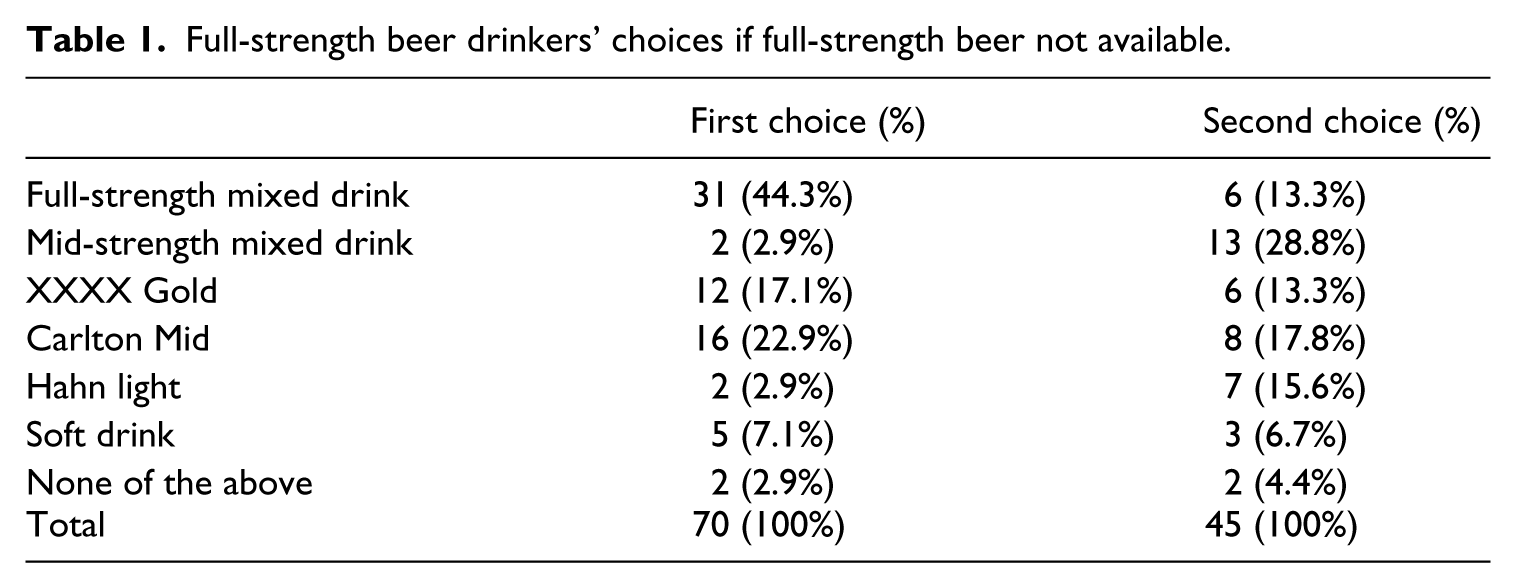
Heavy beer drinkers (n=70) were asked to nominate their first and second choice of alcoholic beverage, if their first preference, heavy beer, was not available. Table 1 shows that 44.3% (n=31) of heavy beer drinkers selected full-strength mixed drinks as their first choice if heavy beer was not available. A further 22.9% (n=16) selected ‘Carlton Mid’, which suggests some degree of product loyalty, given that the majority of beer drinkers selected ‘Carlton Draught’ as their preferred product, while a further 17.1% (n=12) selected ‘XXXX Gold’. No other products represented more than 10%. Mid-strength spirits or mixed drinks were the most popular second choice (28.8% n=13), followed by Carlton Mid (17.8%, n=8), ‘Hahn Light’ (15.6%, n=7)), full-strength spirits or mixed drinks (13.3%, n=6) and ‘XXXX Gold’ (13.3%, n=6).
Full-strength beer drinkers’ choices if full-strength beer not available.
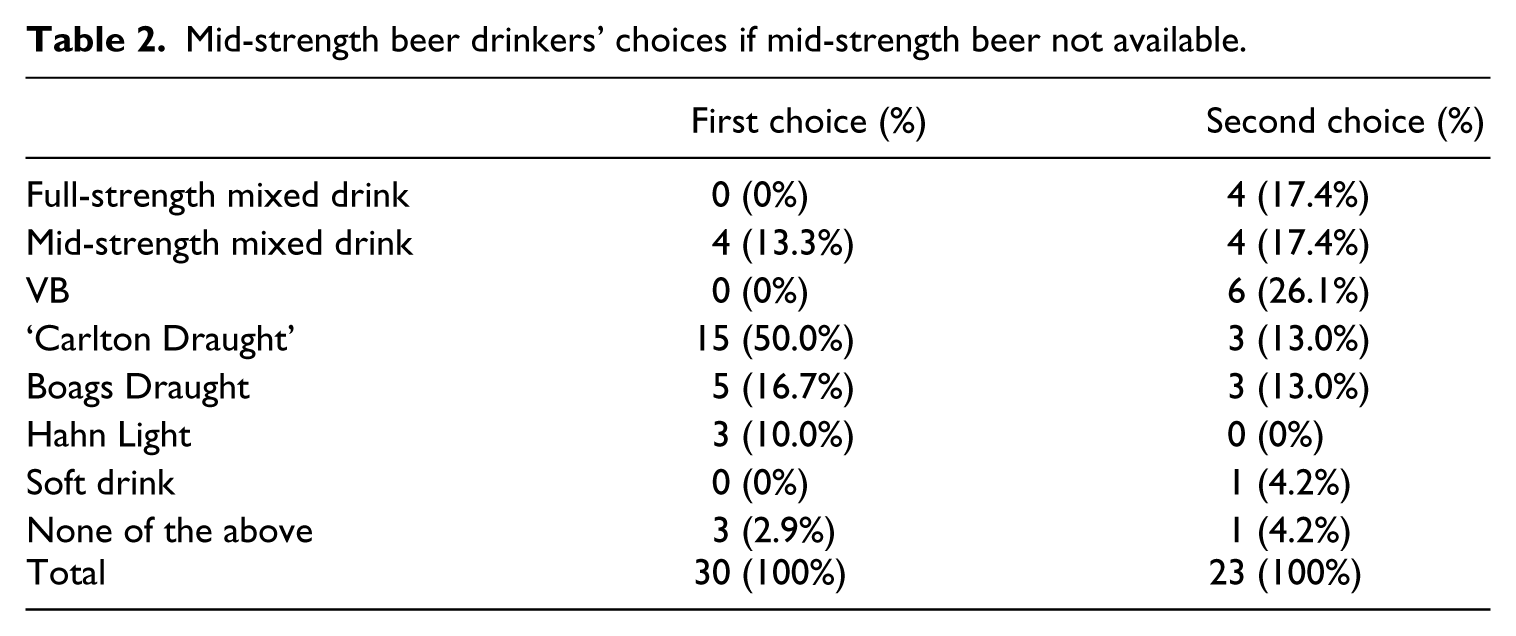
Mid-strength beer drinkers were also asked about their alcoholic beverage preferences if their first choice was not available.
As shown in Table 2, the first choice of 50% (n=15) of the mid-strength beer drinkers was ‘Carlton Draught’ (full-strength beer) while a further 16.7% (n=5) chose ‘Boags Draught’ (full-strength beer), 13.3% (n=4) chose a mid-strength mixed drink and 10% (n=3) chose ‘Hahn Light’. This potentially indicates that confronted with a compromised set of choices, two-thirds of mid-strength beer drinkers will choose to consume full-strength beers rather than light beer or other beverage alternatives.
Mid-strength beer drinkers’ choices if mid-strength beer not available.
Knowledge of the trial
The knowledge of the mid-strength beer trial at Silvertown was split almost evenly in the sample with 49.3% (n=187) stating that they were aware of the trial (that is, the sale of mid-strength only beer during match days) and 50.7% (n=192) being unaware.
The majority of Silvertown supporters in the sample (68.4%, n=117) reported being aware of the trial whereas a minority (31.9%, n=58) of visiting supporters in the sample were.
Awareness of the trial differed little depending on the age. Those aged 40–49 years in the sample had the greatest awareness (54.9%, n=56), while those aged over 60 had the least awareness (41%, n=16).
Males were far more aware of the trial; 56.6% (n=137) of males in the sample were aware of the trial, compared to 36.5% (n=50) of females.
Those spectators who watched a game every week in the league were more aware of the trial (53.3%, n=105), compared to those who watched ‘most’ weeks (48.7%, n=56) or those who watched once or twice during the season (38.8%, n=26).
Those in the sample who drank alcohol while watching the football were far more aware of the trial; 67.8% (n=80) of those who drank were aware of the trial, while 41% (n=107) of those who did not drink were not aware of the trial.
Attitudes towards the trial
The attitude of spectators towards the trial was also assessed via the surveys, principally through the question: ‘Do you think Silvertown’s move to sell mid-strength beers and not full-strength beers on match days is a good idea?’ More than 70% of the sample thought that the selling mid-strength beer and not full-strength beer on match days between 12.00pm and 5.00pm was either a good idea (49.3%, n=187) or quite a good idea (21.9%, n=83). A minority considered it a bad idea (7.7%, n=29) or a very bad idea (4.5%, n=17). 16.6% (n=63) were unsure.
Significant differences between groups in their attitudes towards the trial were found in relation to team support, age, gender and drinking behaviour.
Silvertown supporters were significantly more supportive (χ2 =9.27 [df=4], p=0.049) of the trial (74.9%, n=128 answered either ‘good’ or ‘quite a good idea’) compared to visiting supporters (67.0%, n=122, ‘good’ or ‘quite a good idea’). There was almost no difference between home and away supporters who considered it a ‘bad’ or ‘very bad’ idea (12.3%, n=21 of Silvertown compared to 12.0%, n=22 of visitors).
There was a significant difference between age groups and support of the trial (χ2 =35.97 [df=16], p=0.003). Spectators aged 30–39 were most supportive of the trial (84.4%, n=27, either ‘good’ or ‘quite a good idea’), while spectators aged 18–29 were least supportive (62%, n=27, either a ‘good’ or ‘quite a good idea’). There was no significant difference between the 40–49, 50–59 and 60 or over age brackets in terms of attitudes towards the trial.
Female spectators were significantly more supportive (χ2 =11.31 [df=4], p=0.023) of the trial (79.5%, n=109 either ‘good’ or ‘quite a good idea’) compared to male spectators (66.5%, n=161 either ‘good’ or ‘quite a good idea’).
Those who reported ever drinking alcohol while attending football games were significantly less supportive of the trial than those spectators who did not drink (χ2 =19.53 [df=4], p=<0.001); 58.5%, n=69 of those who drank though it was a ‘good’ or ‘quite a good idea’. By comparison, 77%, n=201 of non-drinkers thought it was ‘good’ or ‘quite a good idea’.
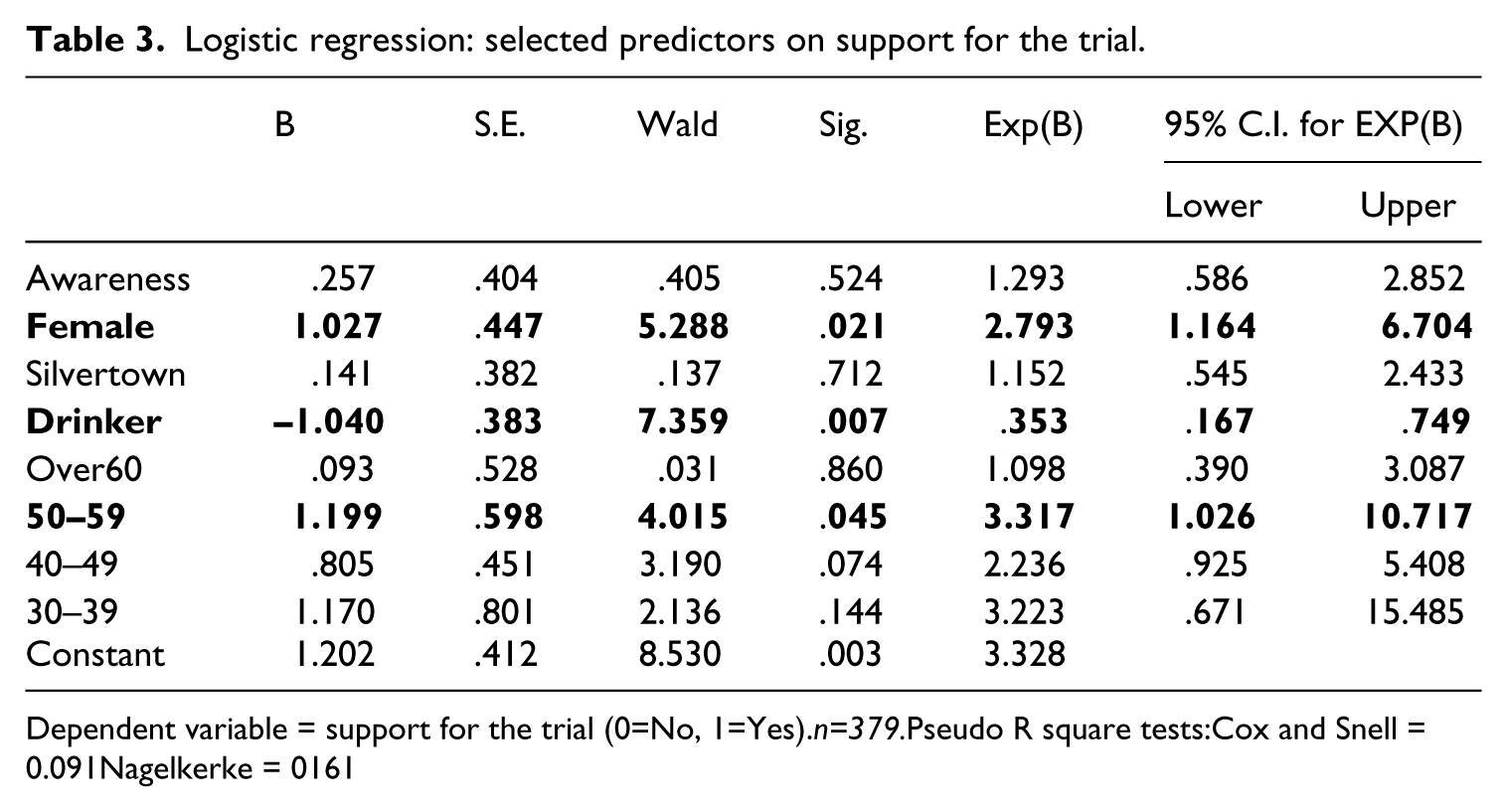
In order to assess the unique contribution of possible predictors of support for the trial, a logistic regression was performed with support for the trial as the dependent variable (transformed to a dichotomous variable 0=not in support, 1=in support and with unsure responses deleted) and awareness of trial, gender, age (entered as a dummy variable), team supported and drinker status as the predictors. The results are given in Table 3.
Logistic regression: selected predictors on support for the trial.
Dependent variable = support for the trial (0=No, 1=Yes).
n=379.
Pseudo R square tests:
Cox and Snell = 0.091
Nagelkerke = 0161
Logistic regression measures the unique predictive capacity for each independent variable (IV) in relation to support of the trial when all other IVs in the model are held constant. Overall model fit was good (χ2=27.9, [df=8] p=<0.001) and between 9% and 16% of variance in the DV was explained by the model using pseudo R square values. The significant (p=<0.05) predictors of support for the trial in order of predictive power were: age between 50 and 59 years (p=0.045), Female (p=0.021) and Drinkers (at football games) (p=0.007). Awareness of the trial, the team supported and other age groups did not contribute significantly to the model. The relative strengths of the significant predictors are assessed in the column headed ‘Exp(B)’ in Table 3 which reflects the odds ratio. As support for the trial was coded as 0=no support or reduced and 1=support, then odds ratio (Exp (B)) scores greater than 1.0 indicate a positive contribution to the predictive effect. Positive odds ratios were obtained for being between 50 and 59 years (3.32) and being Female (2.79). Negative odds were obtained for being a Drinker at football games (0.35). Therefore, when all other predictor variables were held constant, those aged between 50 and 59 years were 3.32 times more likely to support the trial, females were 2.79 times more likely to support the trial and the odds that drinkers would support the trial decreased by a factor of 0.35.
The focus groups
The focus group interviews conducted with Silvertown supporters were designed to capture opinions on the efficacy of the trial and to explore issues that were revealed in the surveys in more depth. A final question in the intercept survey reported above asked respondents if they would be willing to participate in a further stage of the research that would involve a focus group to be held immediately after the football season had ended in October/November 2012. Contact details were provided by 71 respondents for this purpose and all were invited to participate in one focus group held in the city of Silvertown. The 19 participants (15 males and four females comprising six with an organisational connection to Silvertown [committee member, coach, chaplain] and two league umpires with the remainder supporters) took part in one of four focus groups at the conclusion of the 2012 season. The range of discussion was centred on three main areas: opinions and experiences of the trial itself; broader issues relating to football clubs, their operation and links to the wider community, and finally the participants’ views about the general and specific nature of the Silvertown club.
The trial
The focus group interviews were instructive in terms of assessing the impact and efficacy of the trial according to the Silvertown supporters. First, several participants and group conversations focused on the existence of some opposition to the trial when it was first proposed, both within the club’s committee of management and the broader Silvertown membership. However, it was generally agreed that this opposition was short-lived and that once the trial was agreed to, the ‘entire club’ got behind the initiative.
Second, the focus group interviews indicated that Silvertown supporters and league umpires noticed an improvement in the quality of crowd behaviour between 2012 and previous years. Some of the research participants commented that this was evident as soon as they entered the ground during 2012. In particular, it was noted that the area of the ground known as The Hill at Silvertown was noted as being ‘quite rowdy’ in previous years, but was ‘nothing like the same problem’ in 2012. One respondent commented that this area ‘was a lot safer in 2012’ than it had been previously and these perceived changes were understood to be an effect of the trial.
Third, the focus group participants were in general agreement that, although the trial was conducted up until 5pm, after which spectators could purchase full-strength beer, the atmosphere after 5pm would still be categorised as being ‘family friendly’. Indeed, some of the supporters commented explicitly about having always been ‘amazed’ by the number of families around the club after the conclusion of the senior game both in the past and in the present season, and that the club atmosphere resembled that of ‘a good family restaurant’.
Broader themes
Some wider ranging discussions in the focus groups revealed several themes that are pertinent to the evaluation of the Silvertown trial, as well as the issues surrounding the culture of alcohol consumption within community and country football. First, the participants were of the belief that clubs (such as Silvertown) with ‘positive’ and ‘healthy’ cultures (understood as relating to inclusiveness especially towards juniors and women and the absence of elites or cliques based on player prestige) were in a better position to lead change in the area of alcohol management and fewer alcohol choices, rather than clubs with perceived negative and unhealthy cultures having to be ‘dragged kicking and screaming’ into line through mandatory or compulsory alcohol policies.
Second, it was strongly felt by participants that football clubs with a high number of junior members, such as Silvertown, are in a position to capitalise on policies that promote fewer alcohol choices. The sustainability of clubs with a large number of junior teams is dependent on the development and maintenance of a culture that supports and nurtures junior players. The focus group interviewees revealed that they believed that Silvertown had been proactive in dealing with the behaviour and attitudes of junior players, such as bringing the local police in to the club to talk with juniors about life choices. One father of a junior player commented that he did not believe that other clubs in Silvertown’s regional league would have taken as much care with his son as had Silvertown. This type of feedback bodes well for a club that seeks to maintain its number of junior players and teams, as well as have access to the most talented and elite junior footballers in the region. In this respect, community and country football clubs seeking to survive in a competitive environment might consider altering their alcohol culture to attract families and juniors, rather than prioritise a culture in which alcohol consumption supports purchasing senior players or coaches in a quest for on-field success.
Third, the research participants felt strongly that while the regional football league to which Silvertown was affiliated was ‘professionally run’, the same could not be said of other leagues in the areas surrounding Silvertown. In essence, the research participants were of the view that most of the clubs in Silvertown’s league exhibited reasonably good alcohol management practices, with some notable exceptions, but that in the so called ‘bush leagues’ there was a stronger culture of alcohol consumption and much worse spectator behaviour as a result. As a specific example, the participants noted that in these ‘bush leagues’ it was commonplace for the second team players (who play their game before the first team at the same ground) to get drunk while watching the seniors play often by drinking ‘a couple of slabs [a pack of 24 cans] from the back of the utes [utility vehicles]’. It was clear that this type of behaviour was not evident at Silvertown according to either the focus group participants or from observations made by the researchers during the administration of the spectator surveys on four separate occasions.
Fourth, the participants were of the opinion, despite their relatively negative comments about ‘bush leagues’ that the culture of country football was nevertheless changing for the better and the football–alcohol link was weakening somewhat, albeit slowly. The rate of change was seen as being uneven, however, with some pockets of tough resistance being a strongly held perception. Some of the participants spoke about their playing days in the 1970s and 1980s and remarked that the alcohol ‘can in hand’ culture that was an accepted and expected part of country football was no longer evident in Silvertown’s league, and particularly not at Silvertown itself.
Fifth, the focus group interviews suggested that, in order to influence alcohol culture in country football, attention needed to be first, or also, directed towards changing the wider club culture itself. It was the opinion of many participants that simply changing the regulations pertaining to alcohol availability and consumption would likely have unintended consequences. For example, making mid-strength alcohol mandatory would simply encourage spectators who did not agree with the regulation or policy to smuggle their own alcohol into the ground. Rather, it was strongly felt that change would need to be incremental (introducing one or two clubs at a time, rather than league-wide, for example) and that an emphasis on creating boundaries of behaviour through developing club cultures would be an important part of the overall strategy.
Silvertown Football Club
The focus group interviews revealed that Silvertown was regarded by the participants as being special in many respects. It is clear that the club has been a winner, ‘both on and off the field’, a phrase often repeated in the focus groups. The club has been very successful on the field in recent times, winning several premierships, but the participants noted that it was nevertheless not known as a ‘paying club’. This means that the club has not been seen to be buying success via a policy of paying to bring higher standard players to the club from elsewhere regardless of any other quality of that player. Rather, the club has had a ‘cultural policy’ of recruitment that has placed high importance on whether a potential recruit had values that are aligned to those of the club. The club has also had to develop other reasons apart from high player payments in dollar terms for players to come to and then stay at the club. The focus group participants attributed this competitive advantage to the club’s culture. Although the phrase ‘family friendly’ is often used by people associated with community football, the focus group participants were clear that, in their opinion, Silvertown was indeed a family friendly club for them, with a large number of juniors and a supportive environment. Furthermore, the participants stressed that Silvertown had a large following (supporter base) and as such would not be greatly disadvantaged if it lost some supporters at the ‘fringes’ who did not support initiatives such as the lower alcohol trial.
Discussion and conclusion
There are a number of conclusions that may be drawn from the study. As reported above, almost seven in every 10 Silvertown supporters were aware of the trial, compared to only three in every 10 visiting supporters. This is perhaps not surprising given that 2012 was the first year of the trial. Any continuation of the trial will likely mean that awareness will increase among the Silvertown supporters. The awareness of away supporters is more problematic, given that each team’s supporters only visited the Silvertown ground once in 2012. The trial received media coverage in general regional city media, as well as the regional league-specific media; however, it is likely that more communication and exposure to the trial at the Silvertown home ground was required for the awareness levels of away supporters to have increased. This raises the question of the limits of such interventions when they are confined to one club rather than being league-wide. Clearly, a single club trial may expect to need a longer establishment time (longer than one season) in order that possible behavioural changes can occur. Awareness of the trial also raises a methodological point of the existence of possible social desirability bias from respondents with knowledge that the club was under scrutiny in relation to alcohol. While it was not possible to measure such an effect accurately, there were no significant differences between the aware and the unaware groups in relation to answers given to attitudinal questions. In addition, Table 3 demonstrates that awareness was not a significant predictor of support for the trial, which tends to sustain the idea that answers were not significantly shaped by any reflexive bias produced by knowledge that spectators themselves were also ‘on trial’.
More than seven in every 10 supporters thought that selling mid-strength only beer between 12 noon and 5pm on match days was either a good or quite good idea. While this indicated general support for the trial, those who were supportive were more likely to be Silvertown supporters, female and non-drinkers. Under one-third (31.1%) of the sample indicated that they drank alcohol while watching football at Silvertown. In similar surveys conducted by the authors in other Victorian Australian Rules football leagues in 2010, 2011 and 2012, the average percentage of drinkers in the crowd was 37–38% (Hoye et al., 2012). Silvertown was, therefore, at the lower end of the range of measured crowds in terms of the numbers of drinkers, but how far this indicated a difference in overall crowd attitudes and behaviour towards alcohol is unclear as the difference may simply be a function of the sample size in the Silvertown study. Nevertheless, further work is required to investigate differences between clubs in these terms and, if reliable differences are found, then valuable insights might be gained from qualitative work that could uncover different forms of meaning construction across differing club types.
Of those spectators who indicated that they drank alcohol while watching the football, 75.4% reported that they drank between one and four drinks per afternoon, while 24.6% indicated that they consumed five or more drinks in an afternoon, equivalent to seven or more standard drinks if the beer is full-strength. While these figures mean that one-quarter of the Silvertown home game drinking population reported usually (non-trial) drinking at high risk levels, the proportion of drinkers consuming five or more drinks was less than in larger studies carried out by the authors in other leagues. For example, in the 2012 research conducted by the authors, the split was 56% (1–4 drinks) to 44% (five or more drinks). Thus, it can be concluded from this data that in 2012 there was less drinking among the spectators at the Silvertown home games than other measured leagues. However, it is unclear how much of this was attributable to the trial and/or was a function of sample size and further work would be required to establish any connection.
The survey showed that beer was the alcoholic beverage of choice for the vast majority of drinking spectators (86.4%), and that seven in every 10 beer drinkers would normally consume heavy beer. It is clear from these results that a mid-strength only beer policy until 5pm has the potential to curtail or alter the drinking behaviours of the majority of spectators that drink alcohol while watching the football in that period.
The survey showed that 44.3% of heavy beer drinkers would select a full-strength mixed drink (spirits) if heavy beer were not available. In many respects this is a concerning finding, given that the mid-strength trial was designed to reduce alcohol consumption. It is possible to conclude, using these figures, that for a significant proportion of the drinking crowd, the mid-strength trial might serve to increase alcohol consumption if mid-strength spirits are not also used as a substitute for full-strength spirits and mixed drinks. This suggests that if mid-strength trials are to be successful then mid-strength mixed drinks must also be offered in place of full-strength mixed drinks. Offering full-strength mixed drinks and mid-strength beer only is likely to increase rather than lower alcohol consumption for almost half the drinking crowd. As such, this finding points to a possible unintended consequence of, in this case, a trial policy (c.f. Mentha and Wakerman, 2009). Given the complexities of the relationship between sport and alcohol noted in the introduction, it is likely that any health promotion policy in this area will need to fully account for possible associated and unplanned negative costs.
The qualitative data supported the idea that the changes in the club as a result of the trial were experienced as ‘something real’ to a number of supporters and league umpires, particularly those that had experience of the behaviour of spectators on The Hill in previous seasons. It is reasonable to conclude conservatively at this stage that, on the basis of the research, Silvertown can be characterised as a country football club with some important and distinctive features that may not currently be found in other similar clubs. A ‘strong’ leadership and a club culture that has stressed elements of ‘family friendly’ values are likely to have contributed markedly to the relative success of the mid-strength beer trial. Clearly, the fact that the club was the first (and to date, only) Victorian club to elect to run such a trial sets it apart from its peers. Certainly, the club’s emphasis on nurturing a large number of junior members appears in part to explain a club culture that facilitates less reliance on alcohol sales and consumption for its revenue and success. Again, further work is needed to both establish the extent and nature of cultural differences between clubs and to investigate the mechanisms of such possible disparities.
While the research sheds light on the nature of an AFL community football crowd’s drinking behaviours and attitudes in the context of a trial designed to reduce alcohol consumption on match days, the study has limitations that must be recognised in regard to the findings. First, the validity of answers about amount and type of alcohol is subject to the usual issues around social desirability. It is therefore possible, or even likely, that the answers given in the survey may be underestimations of actual drinking practices. Second, the survey relied on memory questions in relation to what was ‘usual’ for the respondent in terms of their drinking and this by necessity involved answers that took into account that a trial was being conducted (if that knowledge was possessed). Generally, however, the results for types and amounts of drinks ‘usually’ consumed while spectating accorded with data from other AFL spectator research conducted by the authors (Hoye et al., 2012). Third, the method relied on quick completion of the questionnaire in order to achieve a good response rate from respondents who were being asked to divert attention from the primary reason they were at the football ground. Because of this, more in depth examination of reasons for drinking behaviour and attached meaning constructions were necessarily absent. For example, while the distinction between non-drinkers and drinkers was easily measured on a self-reported basis, measurement of more nuanced ideas such as ‘deferrers’ (Thompson et al., 2011) was not possible in this study. Last but not least, there was no opportunity to study Silvertown prior to the trial commencing and so the chance to establish pre-implementation data (as was achieved by Mentha and Wakerman, 2009) against which the trial data could be compared was not possible. This would have been particularly interesting in the case of comparing pre- and post-trial alcohol sales figures at the club and further work along these lines is recommended in future research.
Despite these limitations, the research has provided original data on the nature of spectator choice and attitude in relation to alcohol consumption. It has also pointed to evaluations of the reduced alcohol trial and highlighted elements of success as well as possible unintended outcomes. This therefore adds to the existing literature on the capacities and limitations of sport and recreational organisations to deliver health promotion outcomes (Casey et al., 2009; Duff et al., 2005; Eime et al., 2008; Smith and Waddington, 2004). Silvertown provides an interesting example of a successful regional Australian Rules football club that has attempted to intervene in the area of match day drinking. To what extent Silvertown is representative of similar clubs is a question open to supplementary research. There were aspects of Silvertown’s club culture that were demonstrably conducive to the trial succeeding and which may be compared to the findings of earlier studies that found patterns of ‘positive’ meaning construction and behaviour in regard to alcohol and community football (Thompson et al., 2011). On the basis of this work, further investigation into the differences and similarities between sport club cultures is recommended in order to better understand the specificities and range of sporting contexts within which policy initiatives designed to reduce harm from alcohol need to operate.
Footnotes
Acknowledgements
This work was supported by AFL Victoria.
Funding
This work was supported by the Australian Football League Victoria (AFL Vic) and the Victorian Health Promotion Foundation (VicHealth).