







Abstract
This study examines the politics and policy implications of alcohol sponsorship of sport in New Zealand. Specifically, it draws on the recommendations of the 2010 New Zealand Law Commission report titled Alcohol in our lives: Curbing the harm, which called for the gradual elimination of all alcohol sponsorship from New Zealand sport. Using a multi-method approach, the paper examines the contested terrain of the alcohol–sport relationship, that is, the nature of the relationship and its potential impact on the nation’s binge drinking culture, how it is regulated by both states and sport organisations within the international community and, finally, the perspectives of key stakeholders in the debate. The views of key stakeholders offer insights into the nature of competing interests at play within the alcohol–sport sponsorship relationship. Overall, the findings highlight the challenges of social change and the need for more research and a community-based, multidimensional approach that is reinforced through regulation.
In April 2010, the New Zealand Law Commission released a report titled Alcohol in our lives: Curbing the harm. The report was driven by public concerns about the nation’s relationship with alcohol and was developed in conjunction with wide-ranging scientific research, consultation with health and social agencies, and a review of nearly 3000 public submissions. Highlighted within the report were some startling statistics, both global and local, about the social costs and harm of alcohol, including the following:
the World Health Organization (WHO) estimates that alcohol causes 2.5 million deaths annually, accounting for 3.7% of global mortality (2011);
in economic terms the WHO (2008) estimates the global cost of the harmful use of alcohol to be between US$210 and US$665 million;
locally, and keeping in mind that New Zealand’s population is only 4.4 million, 1000 people die every year from an alcohol-related illness (Anderton, 2009; Hunt, 2010);
a Ministry of Health (2008) survey noted that over half a million (551,300) New Zealand adults had a high risk of future damage to their physical and/or mental health due to drinking alcohol and one quarter of all New Zealand adults identified themselves as binge drinkers.
In response to these and other concerns, the final report concluded with some specific recommendations concerning the availability, promotion, sale and regulation of alcohol.
Notably, such is the strength of the relationship between alcohol and the sponsorship of sport and other cultural events, that Chapter 19 of the Law Commission’s report is devoted to this alliance. Chapter 19, which is titled Advertising, sponsorship and the promotion of alcohol, makes reference to a range of public submissions with the general consensus calling for stricter regulation of alcohol sponsorship and warnings about the products’ detrimental health risks.
2
Consider the following submission from the New Zealand Drug Foundation (27 October 2009): Alcohol brands sold in New Zealand are increasingly being marketed via sponsorship of music and sporting events. Alcohol sponsorship of clubs, sports events and rock concerts helps embed alcohol brands and products into the everyday lives of young people.
However, while there is almost unanimous acknowledgement of the extent of New Zealand’s alcohol problem, the causes, effects and potential solutions remain contentious. Consider the comments made by Prime Minister John Key on New Zealand’s Breakfast television programme: ‘We’ve got a binge drinking culture in New Zealand – I think we need to accept that. But the point is legislation to change that is difficult. We all have to want to buy into that as a community’ (TVNZ, 2010, 16 August). With respect to regulating alcohol sponsorship of sport, the challenge of gaining community-wide support is clearly evident. For example, contrary to the Law Commission’s recommendations, advocates of the free market, and in particular the alcohol industry, challenged the rationale and benefits of regulation: The purpose of liquor advertising is to influence brand choice. While we understand that placing restrictions on liquor advertising is populist and easy to implement, there is no evidence that such measures will make a contribution to addressing the problem of youth drinking or risky drinking behaviours amongst adult New Zealanders. (Lion Breweries Submission, 29 October 2009)
However, it is important to note that it was not just the alcohol industry or business people who were against tighter regulation of the alcohol sponsorship of sport, as noted in the following submission from Tony Woodcock, a member of the Steinlager-sponsored New Zealand All Blacks national rugby team: There is no reason why responsible producers of alcohol should be restricted from sponsorship. In fact many sports clubs in New Zealand rely heavily on the support of these sponsors. (T Woodcock submission, 30 October 2009)
3
Woodcock was one of many from the sport sector who challenged, or at least expressed concerns about, the Law Commission’s recommendations. This is likely because the final report not only called for stricter regulation but a three-stage phase-out period that would conclude with a complete ban of all alcohol sponsorship of sport. Such alcohol-related legislation would be one of the most dramatic in New Zealand’s history and comparable to the introduction of Loi Evin in France in 1991 – the implications of the French initiative will be discussed later in the paper.
Given that both sport and alcohol are defining features of New Zealand culture and identity, as captured in the popularised mantra of ‘rugby, racing and beer’ (Law et al., 1997; Philips, 1987), it is little surprise that the Law Commission’s report attracted a lot of attention. Moreover, given its economic, political and social implications it was almost inevitable that the debate over the regulation and prohibition of alcohol sponsorship of sport would serve as a contested terrain. According to Jackson and Scherer (2013: 888–889): We can think of a contested terrain as a site of struggle not unlike a battlefield. Sometimes these struggles are small differences of opinions and perspectives, sometimes they are minor philosophical disagreements, but sometimes the result is major conflict……Ultimately contested terrains are about power struggles over physical, symbolic, ideological and moral/ethical principles, spaces and policies.
The heuristic value of the concept of contested terrain is that it helps identify, in part, what is being contested, by whom, for what purpose and in whose interests. While it is beyond the scope of this paper to offer a comprehensive analysis of the positions of everyone involved in the debate, we have endeavoured to denote, compare and contrast the views of key stakeholders, including representatives of the government, the alcohol industry and sport organisations.
As such the aim of this paper is to examine the contested terrain surrounding alcohol sponsorship of sport in New Zealand in order to illustrate the complexity, politics and contradictions involved. More specifically, the paper: (a) offers a brief international perspective on both state and sport organisation regulation of alcohol sponsorship and advertising in sport – this section is important as it helps illustrate the global nature of the ‘contested terrain’ of alcohol–sport regulation and how it might inform policy in New Zealand; (b) overviews current alcohol regulation in New Zealand; (c) outlines the multi-method approach used; and (d) examines, through the voices of key stakeholders, the implications of the 2010 Law Commission’s strategy to change New Zealand’s drinking culture. Specifically, stakeholders were asked about two key issues: (1) their perspectives on the nature, causes and effects of New Zealand’s drinking culture, including the role of sport; and (2) the implications of additional regulation of alcohol sponsorship of sport. Collectively, the responses provide insights into the motivations, challenges and tensions associated with particular interest groups with respect to the alcohol sponsorship of sport debate. We begin by offering an international perspective on the regulation of alcohol sponsorship and advertising, including the position of the WHO, the established policies of various European and other nation-states and, finally, the initiatives of selected sport organisations.
International regulation of alcohol sponsorship and advertising in sport
The WHO has recognised that targeting advertising and marketing is an important consideration in reducing the harmful use of alcohol, particularly amongst adolescents: ‘The transmission of alcohol marketing messages across national borders and jurisdictions on channels such as satellite television and the internet, and sponsorship of sports and cultural events are emerging as a serious concern in some countries’ (WHO, 2011: 19). However, regulation of media broadcasts is increasingly challenging given that global free trade agreements continue to undermine the nation-state’s ability to control alcohol-related marketing, monopolies and tax policies (Zeigler, 2006). This is another reason why sport is such a strategic site for analysis for alcohol sponsorship policy. High-profile sport events, including alcohol-branded teams and athletes, are broadcast globally and across a range of media platforms. Therefore, to ‘counterbalance the globalisation of alcohol trade; we need international agreements that protect public health’ (Room et al., 2008: 1248). Calls for global regulation are echoed by Zeigler (2006), who argues that alcohol and tobacco should be excluded from free trade agreements and dealt with as separate entities. In light of these recommendations, a global Framework Convention on Alcohol Control (FCAC) emerged as a counterpart to the established Framework Convention on Tobacco Control (FCTC) (Casswell and Thamarangsi, 2009; Room et al., 2008; Zeigler, 2006).
Following on from the FCAC, the WHO’s survey of 106 countries notes a significant shift towards more restrictive measures (2011). For example, the survey results indicate that the regulation of alcohol sponsorship of sport, as a percentage of all member states in 2008, equated to 31.8% – which included the categories of: total ban (14.4%), 4 partial ban (12.8%) and self-regulation (5%). Nevertheless, as of 2011, 44% of countries still have no regulations regarding alcohol sponsorship of sport (WHO, 2011).
As previously noted, in 1991 France implemented the Loi Evin – one of the most comprehensive attempts to restrict the advertising and promotion of alcohol and particularly alcohol sponsorship of sporting and cultural events (Casswell and Maxwell, 2005). This policy places advertising bans on all alcoholic beverages containing over 1.2% alcohol by volume (WHO, 2011). Riguad and Craplet (2004) summarise the key aspects of the regulation in relation to sport and alcohol as follows:
no advertising should be targeted at young people;
no advertising on television or in cinemas;
no sponsorship of cultural or sporting events is permitted.
The effect of this legislation was swift and dramatic, including the cancellation of several international television transmissions of football matches into France (Rigaud and Craplet, 2004). This was because the rules forbid French broadcasters from showing any alcohol-related brands – including those on team uniforms and sport stadia hoardings – effectively banning the broadcast of many major foreign sporting events where such marketing techniques are common (Casswell and Maxwell, 2005).
The Loi Evin also made it impossible for American brewer Anheuser-Busch to sponsor the 1998 FIFA World Cup in France, despite heavy lobbying towards the French government (Riguad and Craplet, 2004). Notably, countering the oft-posed argument that sport could not survive without alcohol sponsorship, Casio worldwide took over as the major sponsor of the tournament. The Loi Evin has also placed restrictions on other global events. For example, a Paris court ordered Dutch brewer Heineken to remove all print advertising linked to the 2007 Rugby World Cup that was staged in France (Kevany, 2008; Leveque and Antonovics, 2007).
Other countries, particularly in the European Union, have also regulated alcohol sponsorship of sport. Denmark’s policy (2000) stipulates, amongst other regulations, that advertising and sponsorship may not be combined with sport teams, events, venues or magazines (Ősterberg and Karlsson, 2002). In Norway the Alcohol Act of 1997 forbids all advertising aimed at consumers if the content exceeds a particular threshold of alcohol (Ősterberg and Karlsson, 2002). During the late 1990s this law was challenged by several Norwegian breweries who wanted to sponsor sports teams and events. Lengthy court battles resulted in an initial win for the brewing industry, but the decision was soon overturned by the Supreme Court (Karlsson, 2001). The Norwegian alcohol marketing restrictions include a ban on alcohol logos on the uniforms of visiting sports teams, a policy designed to protect children from highly visible marketing (Casswell and Maxwell, 2005).
In southern Europe, Portugal and Spain both have restrictions on alcohol sponsorship of sport. Portugal uses a self-regulation code which states that advertising will only be allowed when it does not associate the consumption of alcoholic drinks with sports activities. Highlighting the unique place of sport in society, Portugal’s law on alcohol advertising distinguishes between sport and other cultural activities (Ősterberg and Karlsson, 2002). Spain’s 1976 Code for Advertising stipulates that advertisements must not occur in association with sporting activities or be associated with sport programmes (European Alcohol Policy Alliance, 2012). In addition, alcohol consumption is forbidden in areas where sports events take place, such as arenas (Ősterberg and Karlsson, 2002). In the UK regulations stipulate that advertisements cannot imply that the consumption of alcohol can enhance mood, confidence, popularity, personal qualities, performance or sporting achievements (Gordon et al., 2009). The UK regulations are relevant to this study given that they are similar to current New Zealand policies.
Beyond state regulation it is worth noting that some international sporting bodies have developed their own regulations. For example, the Fédération Internationale des Sociétés d’Aviron (FISA), the world governing body of rowing only allows alcohol sponsorship if the product contains less than 14% alcohol (Day and Juncar, 2010) and does not involve youth events (under 18 years). The world body for basketball (Fédération Internationale de Basketball – FIBA) has similar views to FISA, allowing restricted alcohol sponsorship but prohibiting hard liquor and sponsorship of youth events (Day and Juncar, 2010). FINA, the international governing body of swimming, states in rule 6.3 of its ‘general rules’ section that advertising for tobacco and alcohol is not allowed (FINA, 2011).
Where alcohol sponsorship of sporting events or teams has been allowed, some organisations have placed regulations against the sale of alcohol within live sporting fixtures. For example, the Football Association (FA), England’s governing body, allows alcohol companies to sponsor teams but strictly regulates how alcohol is sold – it cannot be purchased, served or consumed within sight of the pitch from 15 minutes prior to the match until 15 minutes after its conclusion – unless in a corporate hospitality box (Fuller, n.d.). This case highlights the social class dimensions of the contested terrain of alcohol consumption within the context of sport – those with the financial resources have access to alcohol whereas others do not. In a slightly different form of self-regulation, 16 National Sport Organisations (NSOs) in Australia have signed up to the ‘Be the Influence’ campaign. 5 These NSOs have agreed to keep all levels of their sport – from grassroots to elite, free from alcohol promotion. Notably, some major sports where drinking is a strong part of the culture and where the vast majority of sport-related alcohol sponsorship is channelled in Australia (Australian Rules Football, Rugby League, Rugby Union and Cricket) are not yet advocates of the campaign, likely because of the huge financial implications. The previous examples, particularly those from Europe and Scandinavia, indicate that regulating alcohol sponsorship of sport is possible. While we do not yet know the long-term effects of various forms of regulation, it is clear that neither sport nor alcohol has disappeared in any of these nations. Having offered an international contextualisation of the regulation of alcohol sponsorship of sport we next overview the situation in New Zealand.
Alcohol regulation in New Zealand
As previously noted, the New Zealand Law Commission drew upon a wide range of evidence and perspectives, including international experience, in developing its recommendations. With specific reference to sport, some of the local research that informed the Commission’s report indicated that there is evidence that receiving alcohol industry sponsorship increases hazardous drinking (Kypri et al., 2010). In one study described as providing ‘some much needed evidence in an ideological discussion’ (Rehm and Kanteres, 2008: 1967), O’Brien and Kypri (2008) examined the relationship between alcohol industry sponsorship and hazardous drinking among sportspeople. They assert that ‘a potentially effective method currently used by alcohol industries to encourage drinking in sportspeople is the provision of free or discounted alcohol products and/or monetary support directly to sportspeople at an individual, team or club level’ (O’Brien and Kypri, 2008: 1962). Based on a survey of 1279 athletes across various sporting codes and levels, they reported that 47.8% of the sample had received alcohol-related sponsorship. Of this number, a further 47% reported receiving free or discounted alcohol products. Using the Alcohol Use Disorders Identification Test (AUDIT), 6 which measures the degree of individual harmful drinking, the authors concluded that participants receiving alcohol sponsorship had AUDIT scores 2.4 points higher than those who did not.
Two other research studies (not including the 2010 Law Commission report) have reported on alcohol sponsorship of sport in New Zealand. The first was compiled by the Foundation for Advertising Research (FAR) in 2006. The FAR commissioned a consortium of academics to produce a literature review and conduct interviews to assess the impact of alcohol sponsorship (both local and global) on communities (Day and Juncar, 2010). While the results indicate little evidence that alcohol promotion contributed directly to alcohol consumption, the authors did acknowledge that the uptake of alcohol by adolescents and its abuse by some drinkers is a multidimensional problem and requires further research.
The second study was undertaken by consulting firm PS Services (2010) on behalf of SPARC (now SportNZ), which is the New Zealand government agency responsible for the funding and delivery of sport. They conducted interviews and an online survey of 211 sport clubs, finding similar results to FAR. Notably, one specific focus of the PS Services study was to obtain feedback on the impact of a potential alcohol sponsorship ban on sports clubs. While not unanimous, the results did indicate that any such ban was perceived as a threat to some sports clubs and would potentially erode the social, economic, environmental and cultural capital of New Zealand communities (Day and Juncar, 2010). Notably, in both research studies (FAR and SportNZ) the focus was less on the issue of the potential social harm emerging from the alcohol–sport relationship, and more on the implications of increased regulation and/or decreased funding for sports. This should not be a surprise given the particular interests that these agencies serve, but it does highlight the challenges of a community-based approach to addressing New Zealand’s drinking culture. This study extends previous research by exploring a range of perspectives on the alcohol–sport sponsorship relationship in order to illustrate the contested terrain of competing interests.
Methodology
Research to date has noted a lack of sociological inquiry into the culture of alcohol and sport (Palmer, 2011). Recently, there have been some attempts to provide scholarly analysis of the topic from a ‘culture of intoxication’ perspective (McEwan et al., 2010; Parker and Williams, 2003), including studies with a sport focus (Palmer, 2009, 2011; Wenner and Jackson, 2009). However, there is much less research focusing on policy-related issues. This study is part of a larger project that uses a multi-method approach, including socio-historical contextualisation, document analysis and semi-structured interviews with key stakeholders. Although it is admittedly limited in this analysis, the contextualisation of the overall debate is important because the alcohol–sport relationship has become ‘a social rather than a sporting issue’ (Collins and Vamplew, 2002: 112). Document analysis was undertaken to gain an understanding of the current regulations, along with an in-depth analysis of the New Zealand Law Commission report, including public submissions.
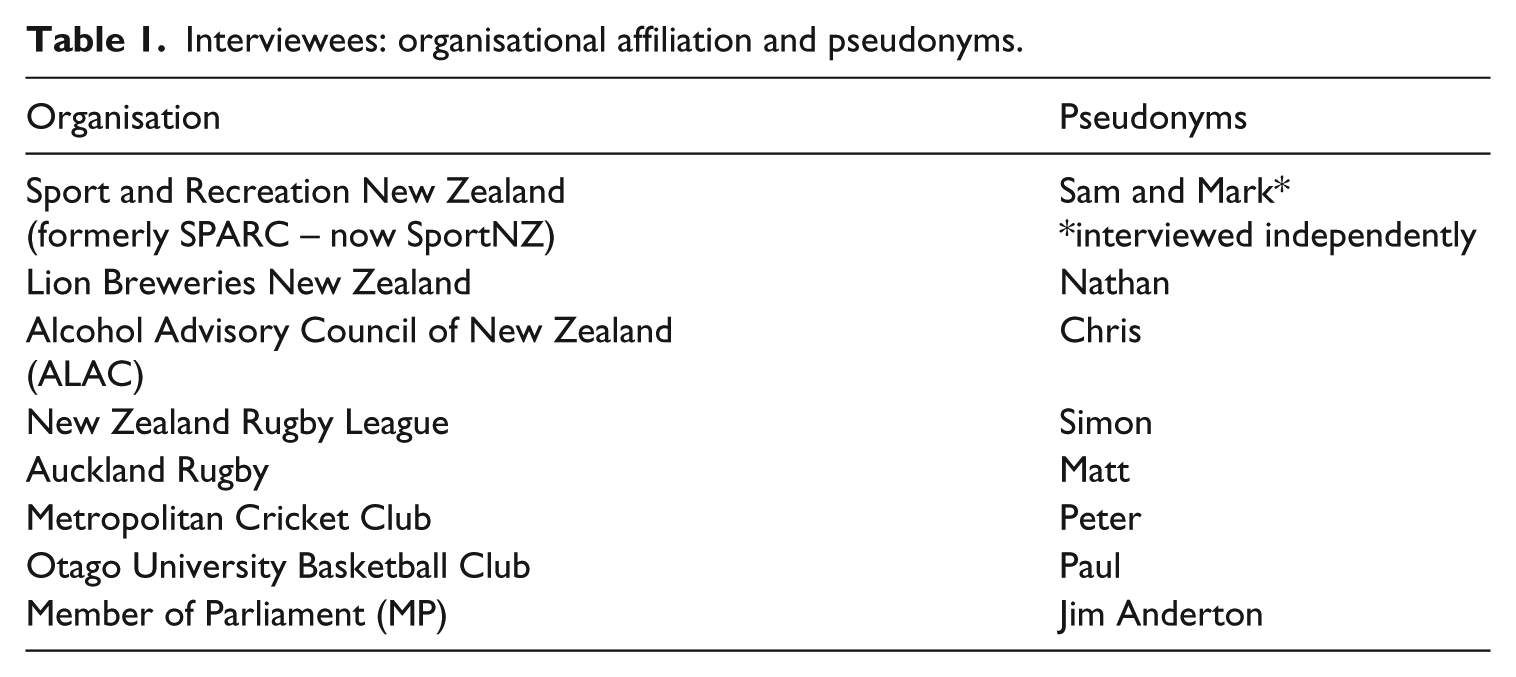
Highlighting the contested terrain of the issue, Casswell (1997) notes that there are a range of perspectives and interests at play in the public discourse on alcohol and the task one faces is ‘to attempt to reconcile the conflicting views of those who, coming from different sectors, have different primary goals to achieve’ (p. 251). As a starting point this study conducted eight semi-structured interviews with key stakeholders located throughout the alcohol–sport sponsorship ‘nexus’ (Palmer, 2011). More specifically, interviews were held with two employees of SPARC (now known as SportNZ – New Zealand’s national sport agency), a representative from a beer company (Lion), a member of the national alcohol advisory agency (ALAC), two employees of prominent national sporting organisations (New Zealand Rugby League (NZRL) and the Auckland Rugby Union) and two relatively minor club sport representatives (see Table 1 for a list of interviewees, their organisational affiliation and pseudonyms). Although Member of Parliament (MP), Jim Anderton, was not interviewed face to face (due to various commitments his comments were offered via email), given his prominent role in anti-alcohol sponsorship advocacy we included him in the table. Although pseudonyms are used, where confidentially is not relevant we have identified the agency and/or position of the person being interviewed. Interviews were held between September and December 2011 and ranged in length from 20 to 90 minutes.
Interviewees: organisational affiliation and pseudonyms.
Results and discussion: perspectives of key stakeholders
As previously noted, this study is part of a larger project examining the socio-historical and socio-cultural aspects of the alcohol–sport relationship in New Zealand. The focus of this section is on the perspectives of key stakeholders in the alcohol–sport sponsorship relationship. More specifically, we outline the views of stakeholders with respect to two key points: (1) their perspectives on the nature of New Zealand’s drinking culture, including the role of sport; and (2) their perspectives on the potential impact of further regulation and/or banning of alcohol sponsorship of sport.
New Zealand drinking culture and sport
Chapter 2 of the NZ Law Commission report, titled The Context for Reform, outlines various social and demographic variables identified as playing a role in the nation’s volume of alcohol consumption. The Commission states that: ‘cultural attitudes around drinking are a further factor that can influence per capita alcohol consumption’ (New Zealand Law Commission, 2010: 65). The dominant cultural attitude, supported by a plethora of evidence and confirmed in our interviews, suggests that New Zealand has a general cultural tolerance for drunkenness, a lack of individual concern about wellbeing in relation to drinking, and a reluctance to limit alcohol intake to avoid negative consequences (ALAC, 2010). This drinking culture is reproduced through sport where historically it has become naturalised through links with war, masculinity, national identity and Kiwi ‘lifestyle’ (Casswell, 1997; Law et al., 1997; McEwan et al., 2010; Phillips, 1987). The ‘culture’ of drinking in New Zealand certainly resonated with the interviewees:
One consequence of what some have described as a ‘culture of intoxication’ (McEwan et al., 2010: 18), and as admitted by the Prime Minister, is that New Zealand’s binge drinking culture has become normalised. Here, normalisation refers to the process through which cultural attitudes and practices associated with drinking become naturalised or taken for granted through both formal and informal forms of punishment and reward (Foucault, 1990). The normalisation of a drinking culture in New Zealand has emerged historically due to a number of factors including (but not limited to): (1) strong links between alcohol, sport and masculinity (Collins and Vamplew, 2002; Gee and Jackson, 2010, 2012; Law et al., 1997; Palmer, 2009; Phillips, 1987; Wenner, 2009); (2) the strong association of alcohol with university student culture; (3) liberal liquor laws – the 1989 Sale of Liquor Act permits fairly laissez-faire, including Sunday, sales – providing for cheap and readily available alcohol in supermarkets; (4) the media’s (particularly electronic media) ability to bypass laws surrounding the time alcohol advertisements are permitted on television (after 8.30 pm in New Zealand); and (5) the marketing of alcohol and, in particular, the close association of alcohol and alcohol brands with sporting events and teams (McEwan et al., 2010). The latter factor has been a major concern, given the strong links between alcohol and lifestyle. For example, Morgan (1988: 194) states that alcohol companies have placed an ‘increasing emphasis on “lifestyle” factors which is aimed to increase the occasion when one drinks’. The culture of lifestyle drinking has filtered down into the sporting arena – a very popular lifestyle practice in New Zealand. ALAC’s (2010) Guidelines for managing alcohol at large events is testament to the value sport holds as a lifestyle factor for the alcohol industry. According to the Alcohol Advisory Council (ALAC, 2010), alcohol in sport in New Zealand is pervasive and its abuse has been identified as a major public health concern at large events (Jones et al., 2006). In addition, McEwan et al. (2010) suggest that this culture of lifestyle drinking can be put down to, among other things, the international/national marketing of alcohol products, particularly within the context of advertising and sponsorship of sport.
There is, therefore, an opportunity for key stakeholders in sport to advocate for change in New Zealand drinking culture by calling for further alcohol sponsorship restrictions. Former MP Jim Anderton, who was instrumental in banning tobacco sponsorship of sport in New Zealand and is now leading the charge against alcohol, believes that if you want to reduce the harm caused by alcohol then you need to change the culture. Indeed, he acknowledges the historical place of alcohol, prior to major marketing initiatives related to sport, in New Zealand stating that: ‘We already HAD a drinking culture’ (Anderton, 2009 [emphasis added]). Acknowledging the importance of sport and the media, Anderton advocates for change through initiatives such as the regulation of alcohol sponsorship of sport: Most young Kiwi boys watch those games; they grow up dreaming of being just like the stars they see on TV. So what do they do when they see those games dripping in beer sponsorship? They learn that saturation in beer is part of the game. Beer marketers like Steinlager know that. That is why they sponsor the All Blacks… Administrators, media and talkback callers act surprised when athletes like Jimmy Cowan or Jesse Ryder get into trouble for drinking too much. But I don’t blame those players for making mistakes. I blame the culture that associates alcohol with their sporting brilliance as a way of making money out of selling more beer [emphasis added]. (Anderton, 2011a, 10 February)
Furthermore, Anderton notes that as long as brewers spend millions of dollars associating alcohol with sport, there is little chance of changing New Zealand’s heavy drinking culture. Anderton believes the culture needs to change because the goal of beer companies is to ‘normalise the association between sports and alcohol, so that as those little boys will grow up they will understand beer and rugby go together like bread and butter’ (2011a, 10 February).
Many argue that this normalisation process has been orchestrated by the alcohol industry, which has a long history including ‘the underlying support of a political and economic system that places a higher value on profit than on the overall health and wellbeing of its citizens’ (Morgan, 1988: 195–196). However, a number of interviewees argued that sport is not ‘the’ primary factor in New Zealand’s binge drinking culture. In their view, although acknowledging that its popularity makes it a vehicle for alcohol promotion, sport is simply one of many social settings where alcohol consumption occurs:
Thus, according to Chris, a representative of ALAC, New Zealand is simply playing out a binge drinking culture within a (sporting) culture. This is where one key contradiction emerges. Most interviewees argued for a change in culture, yet when questioned about whether sport was a part of that culture (and hence part of the problem), the messages were mixed. A majority held the view that accusations of alcohol sponsorship of sport driving a binge drinking culture were an exaggeration. Here again, defenders of alcohol sponsorship argued that sport is a social setting, and like many other settings, there will always be a select few who will drink to excess. However, while they may acknowledge an ‘association’, they generally reject the idea that alcohol sponsorship reinforces binge drinking. The interview with Nathan from national alcohol distributor Lion Breweries highlighted this justification: I think (alcohol sponsorship of sport) certainly draws an association. The Speight’s Coast to Coast is known as the ‘Speight’s Coast to Coast’. What I would say though is that it would be very difficult for anyone to extrapolate from that association that that is somehow encouraging problem or binge drinking and that’s the question. So the difficulty I have with the statement that alcohol sponsorship draws a link between brands and sport – my response would be ‘and what’s wrong with that?’ I think the association with youth binge drinking and alcohol sponsorship is a very long bow to draw. That you could blame sponsorship of sport by alcohol brands for young people’s propensity to drink, I think that is rather over-simplifying the origins of youth binge drinking and I think it is worth pointing out young people have been binge drinking for decades, well before sport sponsorship by alcohol was actually allowed to be advertised or be allowed on the scale that it is now. (Personal Communication, 17 November 2011)
The Lion Breweries representative is correct in arguing that binge drinking is a complex and multidimensional problem and that it would be unfair to blame sport as a single cause. However, it is problematic that he seems unwilling to acknowledge that there is any potential link, despite at least cursory evidence, that alcohol sponsorship of sport has some propensity to increase drinking (O’Brien and Kypri, 2008). Next, we examine how key stakeholders view and manage alcohol sponsorship of sport along with their perspectives on the NZ Law Commission’s recommendations to further regulate and even ban alcohol sponsorship of sport.
Regulation of alcohol sponsorship of sport
One of the major tenets of the NZ Law Commission is that if research necessitates that regulations are warranted they need to be in proportion to the potential harm done: It is important that additional regulation does not unduly inhibit the ability of the liquor industry to contribute to further economic growth, or impose costs that are not in proportion to the harm being mitigated. (New Zealand Law Commission, 2009: 219)
In effect, the burden remains on those who wish to control and regulate the production, distribution and promotion of alcohol to prove the nature and extent of harm done – something quite remarkable given all the evidence available. Indeed, the evidence must have been quite compelling given that the New Zealand Law Commission not only recommended additional regulation, but that consideration be given to a staged phase-out of all alcohol sponsorship of sport. The NZ Law Commission met with a wide range of key stakeholders, including some of those interviewed for this study, many of whom offered public submissions. Within these submissions, organisations outlined their current practice and stance on various themes associated with alcohol in New Zealand (for example, advertising and sponsorship, purchase age, liquor licenses). These submissions, combined with interviews, provide valuable insights into a range of attitudes, rationales and justifications and even suggested alternatives to the alcohol–sport sponsorship relationship. Arguably, all of these illustrate various aspects of the contested terrain.
To begin it is important to consider the position of New Zealand’s national sport governing body on the place of alcohol in sport. SPARC (now SportNZ), as a government crown entity, has enormous power over how NSOs are structured and operate, despite claiming relative autonomy. However, as the following two representatives from this national sport agency admit, when it comes to alcohol regulation in sporting organisations, they have no specific policy:
It is easy to see why NSOs think they are receiving mixed messages. SPARC (Sport NZ) argues that they do not prescribe what sport organisations do, but encourage them to manage alcohol responsibly and would support any decisions to clean up their sport if facing an alcohol problem. However, this really avoids two key issues: (1) the absence of a national alcohol–sport policy in New Zealand; and (2) how clubs, particularly those associated with minority sports, seeking alternatives to alcohol sponsorship can survive financially in order to meet the established standards for fiscal sustainability. Ultimately, many NSOs are left in a very difficult position – they may wish to change the drinking culture of their sport but are often very dependent on the alcohol sponsorship funding.
With respect to the first issue noted above, Chris, the ALAC representative interviewed, described how his alcohol agency had been approached by sport organisations seeking assistance with alcohol policy: We had the CEO of New Zealand Cricket, the New Zealand Sport Federation of Athletes, Softball, Netball and Rugby League call us. We didn’t initiate any of them; they all approached us and said ‘look can we meet with you? We want to see what we can do about the issue of alcohol’. (Personal Communication, 2 November 2011)
While alcohol sponsorship funding remains important, Chris (ALAC) noted that the amount of funding available from alcohol companies had decreased significantly over the past few years. This point was confirmed by the New Zealand Rugby Union (NZRU), who stated that a far higher percentage of their revenue was obtained from community trusts and gaming societies. 7 Consequently, there is ‘concern’ about the impact of any emerging regulation of the alcohol sponsorship (PS Services, 2010). At the same time, however, the NZRU and other NSOs are reviewing where alcohol sponsorship fits with their core values and are looking at alternative options.
Consider the strategy adopted by the NZRL – a sport organisation with a relatively long and lucrative association with beer sponsors but that also confronted public concerns over its alcohol-driven culture. The NZRL has taken the strongest direct stance in opposition to alcohol sponsorship through its ‘More than just a game’ model. Similar to Australia’s ‘Be the Influence’ initiative, the NZRL was one of the first NSOs to regulate the promotion and consumption of alcohol. This was not an easy decision when budgets are tight and particularly when alcohol companies express strong interest and make substantial offers for sponsorship. As Simon (NZRL representative) indicates: We have garnered plenty of interest from alcohol companies, wanting to associate themselves with the Kiwis,
8
and it is tough because there are large sums of money at play. But we have said no for now…it is about being more professional than before. (Personal Communication, 15 November 2011)
Thus, while alcohol sponsorship of sport has been described as the ‘lifeblood’ of New Zealand sport, some organisations are exploring other avenues of sponsorship.
A key factor in the overall alcohol–sport sponsorship issue is the philosophy and practice of alcohol companies. With respect to advertising and promotion they largely operate within a self-regulatory system. Nevertheless, the alcohol industry usually argues that they conduct business within the law, that they are already heavily regulated, and that they go to great lengths to encourage people to use their products responsibly. Consider this quote from Nathan (the representative from Lion Breweries), with respect to how the industry not only conforms to formal regulations but are proactive in establishing their own codes of practice in order to minimise the harm associated with alcohol:
The Lion Nathan code for marketplace responsibility sets out guidelines suggesting that the company does not seek to promote their products at events or in association with events that are designed to target underage or at risk groups. However, despite claims by Lion Nathan that the promotion of alcohol is heavily regulated, this must be understood within the context of a nation where the drinking age is 18 years, alcohol is not only relatively cheap but is also often available 24/7 from grocery stores, and where almost every cultural event, including sport, appears saturated in alcohol (Gee et al., 2013).
Returning to Lion Breweries it is worth considering how their codes of practice guide their general expectations with respect to their sponsorship of sport. According to Nathan: In terms of our association with any groups that we provide support to in the way of sponsorship, there are certain expectations we have of them and that we would expect them to display in terms of the service of alcohol in our brands. We work with liquor retailers to ensure they are meeting their legal requirements in the service of alcohol and also that they are not irresponsibly promoting our brands. (Personal Communication, 17 November 2011)
No doubt beer companies wish to avoid being associated with negative publicity arising from the harmful use of alcohol. However, let us consider this issue from the perspective of a relatively elite sport club. In this case management of alcohol sponsorship is certainly possible but often complicated. For example, Matt (Auckland Rugby Union) explains how they try to handle promotions associated with the ‘Speight’s’ beer brand: Certainly with regards to replica apparel on any children’s clothing the Speight’s logo is removed. With regards to any offers we might push out – it might be a ticket offer that the first 500 receives a free Speight’s at the park. That certainly goes to the over 18 age group. If we push an alcohol message out to our members we will avoid sending that message to family members… In our hospitality lounges there is always a bar manager present and we have a supervisor from our own side.
Here, efforts are clearly being made to operate responsibly and within the regulations but ultimately every opportunity to promote (and consume) the brand is taken.
At a lower level of club sport more complications arise, as Peter from a local cricket club and Paul from a local basketball club attest. As they both observe, as sporting minnows within a large pool seeking sponsorship, clubs generally respond positively to anyone who is willing to offer financial support. The fact that alcohol was the source of funding rarely appeared to be a consideration, perhaps in part because they do not have the luxury of adopting a particular ethical/moral stance (Cody, 2013). Both club representatives struggle with making decisions based on not only what is best for the club in the short term, but also long-term stability. Notably, both Peter and Paul had similar ideas about balancing sponsor loyalty with meeting regulatory standards. They noted that their sponsorships were from local bars and hence there were strong incentives to go there after the matches to demonstrate their consumer loyalty. However, while there was informal pressure, both representatives acknowledged that a ban on alcohol sponsorship would not mean the end for their sport clubs:
These two positions reflect the reality of the new alcohol–sport sponsorship environment within a small market like New Zealand. Sport teams face the challenge of trying to balance the need for sponsorship with the social pressures to develop a responsible drinking culture not only to maintain a positive social image, but also for performance. One of the stated reasons government argues that it has chosen not to reform the alcohol advertising and sponsorship laws is because alcohol sponsorship of sport is the ‘lifeblood’ of many club sports in New Zealand and helps fund high-priority sports such as Rugby Union (PS Services, 2010). Our findings suggest that, at least for some lower level sports, the threat of financial disaster in the wake of withdrawal of alcohol sponsorship may be more perceived than real. Yet, it would be unfair to jump to any conclusions for a number of reasons, including the following: (1) at this point it is largely unchartered territory – we simply do not know what the real impact of a banning of alcohol sponsorship would have on sport; (2) as noted above, New Zealand is a small nation with a small market and this limits the number of sponsorship opportunities; and (3) within the current economic climate even high-profile sports with large budgets, such as rugby union, are seeking every possible source of funds including alcohol sponsorship, community trusts and gaming trusts – the latter raising a different set of concerns linked to gambling addiction and sports match fixing.
Conclusion
Despite being the focus of major social policy debates, alcohol sponsorship of sport has received very limited scholarly analysis. This study contributes to the literature through its analysis of the responses to the 2010 New Zealand Law Commission’s report, which recommended unprecedented changes to the regulation of alcohol sponsorship and advertising of sport. Using the concept of the contested terrain, the results confirm that different individuals and interest groups have different perspectives about the nature and implications of alcohol sponsorship of sport. It is no surprise that the alcohol industry and its promotional partners, including media and advertising, challenge any new forms of regulation while highlighting the positive contributions they are making to sport. Likewise, it is no surprise that many sports, and in particular those with limited sources of funding, feel dependent on alcohol sponsorship for their survival. However, it is surprising that the national sport governing body (SPARC/Sport NZ) has largely avoided taking a strong position on the debate, which sends mixed signals to sport organisations. Clearly, some sports, such as the NZRL, have successfully (at least to date) been able to transition away from a dependency on alcohol sponsorship. However, based on our analysis, while some sports support a shift away from alcohol sponsorship, in the absence of alternative funding from government or other sources it is too risky.
Ultimately, if there was any consensus of opinion amongst key stakeholders in our analysis it is that any strategy for systematically moving forward must begin by acknowledging New Zealand’s binge drinking culture – a culture that ‘normalises the abuse of alcohol’ (Anderton, 2011b). As the 2010 NZ Law Commission report notes, ‘cultural attitudes around drinking are a further factor that can influence per capita alcohol consumption’ (p. 65). In addition, heavy drinking and drinking to intoxication remain ‘persistent features of New Zealand’s drinking culture’ (p. 66).
Jim Anderton asserts that there are many contributing factors to New Zealand’s drinking culture. While some factors, such as previous history, are difficult to change, others such as the influence of alcohol on sport can be transformed (Anderton, 2011b). He makes it clear that rather than placing responsibility on individual players for alcohol-fuelled indiscretions, it is the culture that associates alcohol with sporting excellence that is to blame: ‘as long as brewers spend one hundred thousand dollars a day associating alcohol with sport, we will have no chance of changing the drinking culture’ (Anderton, 2011b).
The evolution of alcohol sponsorship of sport in New Zealand has occurred over a long period of time and is related to a range of political, economic and social factors. What originally began as a form of support by pubs for sport equipment, grounds and clubrooms, turned slowly into alcohol sponsorship of sport. Today, the relationship has been further transformed to the extent that multi-national, global alcohol conglomerates use their power to invest in sport as a way to successfully ground themselves in the culture of a society without the strict regulations attached to other advertising mediums. While the public health and social harms of alcohol are clearly noted by the government, the role and impact of alcohol sponsorship of sport has been largely ignored. The recent decade of alcohol harm in New Zealand society has seen the pendulum swing and as a result sport has become one target for implementing change.
Clearly, a multi-faceted approach, backed up by regulation, is required if New Zealand’s binge drinking culture is to be addressed. However, given its central role in defining New Zealand culture and identity, and its strong links with the alcohol industry, it would be short-sighted not to include sport in any discussions of alcohol reform. In addition, while advocates for change, such as Jim Anderton, are calling for urgent action, it is important that any new policies are informed by research that ideally spans quantitative, qualitative, longitudinal and cross-cultural approaches. With this in mind we recommend a number of key questions that might be addressed in future research. (1) What effects do different forms of regulation (e.g. restrictions or bans on alcohol advertising and/or sponsorship) have on the operations of both elite and grassroots sport organisations and clubs? (2) How do sport-related regulations of alcohol sponsorship work in conjunction with other forms of alcohol regulation? (3) What is the potential impact of globalisation for limiting the ability of nation-states to establish and regulate alcohol-related policy in light of free trade agreements? (4) What role can states and private enterprise play in helping sport organisations transition from alcohol sponsorship to other sources of funding? These are just a few of the important questions that may help negotiate the complex and enduring contested terrain of alcohol sponsorship of sport.
Footnotes
Funding
This research received no specific grant from any funding agency in the public, commercial or not-for-profit sectors.
1.
The author is a Visiting/Honorary scholar at the University of Johannesburg, South Africa.