







Abstract
The purpose of this paper is to use the theoretical standpoint of sociology of childhood to enhance understanding about how children’s rights, as outlined by the United Nations Convention on the Rights of the Child, are experienced by child athletes and adult coaches in the context of sport clubs in Sweden. Data were gathered through semi-structured interviews with children and coaches in floorball and equestrian sports during the years 2011 and 2012. The results showed that neither child athletes nor adult coaches were aware that the United Nations Convention on the Rights of the Child has been incorporated into Swedish sport policy; they also lack knowledge of the convention’s content. After interviews about selected rights were conducted, it was evident that children and adults both considered the themes of those rights to be of utmost importance. However, they did not find the convention meaningful as a policy document, and no systematic, deliberate or preventive work with regard to the rights of the child was experienced in the sport clubs. This paper discusses some challenges in the children’s sport context, including children’s rights, the social ordering of children and adults and the goal of making children’s sport a safe activity for children.
Keywords
Introduction
Tom, a children’s sport coach interviewed in this study, noted, ‘Human rights and such things are no big deal here’. This statement shows how a rights-based perspective seems to be absent in children’s sport in Sweden. What does this mean for the children, and how do they understand their formalised rights in sport? These are relevant questions to raise. The purpose of this paper is to enhance understanding of how children’s rights, as specified in the United Nations Convention on the Rights of the Child (UNCRC; United Nations, 1989), are lived and experienced by child athletes and adult coaches in the context of sport clubs in Sweden.
When children’s rights ‘are taken as a starting point for evaluation of the social spaces and activities that adults provide for children, many traditional cultural practices are called into question’, according to Hartill and Lang (2015: 192). Sport is one of these areas where cultural norms of discipline and intensive training have been emphasised; this might pose a risk of physical or emotional violence towards child athletes in the name of sport (David, 2005). Now and then, the media reports on severe child abuse in sport. For an example, the Swedish former high-jump star Patrik Sjöberg made public in 2011 that he had been sexually abused by his highly respected coach from the age of 11 (Salö, 2011). This led to other athletes speaking about their own experiences of abuse in sport. However, most of these were adults, discussing events of long ago. This media case may have been the catalyst for the Swedish Sports Confederation (SSC) to undertake economic sanctions against a sport federation for the first time. In 2012, the Swedish Gymnastic Federation had its state funds withdrawn for not following the ethics and regulations of the ‘What Sport Wants’ policy (Centrum för idrottsforskning, 2013).
As sport is a highly child-populated domain, one might assume that empirical research about child athlete protection would exist in large numbers, but the opposite is true (Kerr, 2010). However, a growing body of research shows evidence of infringements of children’s rights in sport. Alexander et al. (2011) showed that even though many children viewed sport as a positive experience, they also reported negative experiences in the form of, for example, emotional, physical and sexual abuse. Evidence of sexual harassment and abuse in sport has grown over the years (Brackenridge, 1994, 1997, 2001; Brackenridge and Kirby, 1997). This evidence includes experiences of both female (Brackenridge, 2001) and male (Hartill, 2009) victims of sexual abuse in sport. Lately, emotional abuse has been addressed by researchers and has been shown to be widespread in children’s sport (Gervis and Dunn, 2004; Stirling and Kerr, 2009). Scholars also argue that adults’ perspectives dominate the practice of children’s sport, which makes children’s voices less likely to be heard (Brackenridge et al., 2007; Pitchford et al., 2004).
This study draws on two evident problems: that children’s rights are violated in sport, and that children have a subordinated position relative to adults in that context. Furthermore, a lack of research exists about how policies such as the UNCRC are implemented and experienced at the local sport club level; in particular, children’s voices are missing here. A starting point is that a children’s rights perspective and the UNCRC were explicitly included in the Swedish sport policy document ‘What Sport Wants’ in 2009, approximately two years before this study began (Riksidrottsförbundet, 2009). Two main research questions are posed. First, how can child athletes’ and adult coaches’ attitudes towards, and knowledge of, children’s rights in the sport club context be described and understood in relation to the construction of childhood? Second, how do children and coaches experience and give meaning to the following rights in the sport clubs: that children’s best interests must be a primary consideration (Article 3); that children have the right to express their views in all matters concerning the child (Article 12); and that children have the right to be protected from all forms of maltreatment, abuse and violence (Article 19)? These issues are of the utmost importance for understanding the significance and the potential impact of a formalised policy such as the UCNRC for children and adults in sport in the real world.
Background
Adult domination and violation of rights in children’s sport
When discussing elite youth sport, David (2005: 5) stated, ‘Far too often, however, it exists largely to satisfy adults . . . and … children involved in competitive sports grow up in a world dominated by adults who have their own set of interests’. Evidence of discipline and imbalance in power relations in Swedish children’s sport has also been found (Eliasson, 2015; Hertting, 2010; Karp, 2000). As sport coaches have more power, being adults, and sometimes see different values of sport, the risk is that the adult’s preferences will have a greater impact than the children’s needs and wishes (Eliasson, 2015). Sport faces difficulties in putting a child’s perspective in focus due to the superior position of adults, as is evident in Sweden (Eliasson, 2011; Fransson, 2009) and other industrialised countries (Pitchford, 2007; Pitchford et al., 2004). Sometimes, the rights of children are overlooked by adults who think they know what is best for children (Eliasson, 2011).
Most – but far from all – children in Sweden and in Swedish sport clubs seem to be quite safe and fortunate, at least compared to children in countries where war and poverty are widespread. However, according to David (2005), there are some areas of major concern in terms of children’s risk of negative experiences in sport: these include health-related problems due to intensive training; physical, psychological and sexual abuse; discrimination; violence; and economic exploitation. There is also a significant and growing body of research within this area regarding violation of children’s rights in sport. I intend to give a description of a selection of important studies and of the research progress over time; however, a full review of the results is beyond the scope of this article (for reviews, see Brackenridge et al., 2010; Brackenridge and Fasting, 2002; Brackenridge and Rhind, 2010; Lang and Hartill, 2015).
During the 1970s, young athletes were increasingly seen as champions and as future elite athletes, and they were therefore involved in intensive training, which led researchers to turn their attention to abusive situations in sport. By the 1990s, child sexual abuse in sport had been recognised, and cases of sexual violence and victimisation began to appear in the media (Brackenridge and Fasting, 2002; Brackenridge and Rhind, 2010). In the 2000s, the welfare of elite child athletes and the children’s rights perspective came to be more commonly addressed in sport studies. Only recently has a concern for relational forms of abuse been raised in the research on children’s sport (Stirling and Kerr, 2009).
Celia Brackenridge has been the main advocate among researchers; for a long time, she has recognised an urgent need to research the violation of rights within sports. Brackenridge and her colleagues have closed some of the research gaps, especially regarding sport and sexual abuse (Brackenridge, 1994, 1997, 2001; Brackenridge and Fasting, 2002; Brackenridge and Kirby, 1997). Earlier research includes qualitative studies which explored the experiences of both female and male victims of sexual abuse in sport (Brackenridge, 2001; Hartill, 2009). Lately, researchers have also examined different forms of emotional abuse found in youth sport (Gervis and Dunn, 2004; Stirling and Kerr, 2009).
To assess the prevalence of abuse in sport, quantitative methods have been employed. Rhind et al. (2014) reported on 652 cases of abuse in sport in the United Kingdom, where more than 90% of the perpetrators were found to be male. A large prevalence study of more than 6000 young people, carried out by Alexander et al. (2011) in the United Kingdom, showed that while many children viewed sport as a positive experience, they also reported negative experiences in the forms of emotional abuse (75%), sexual harassment (29%), physical abuse (24%) and sexual abuse (3%). Especially at risk for rights violations are children in elite sport, which can involve serious, work-like sport activities (Brackenridge and Rhind, 2010; Gervis and Dunn, 2004; Grenfell and Rinehart, 2003; Weber, 2009). Rhind et al. (2013: 258) noted, ‘In general, we do not fully know the degree to which violence and abuse against children takes place within the sport environment’. The need for more research in the area has been stressed, as it is fundamental for ensuring the sound monitoring of children’s rights in sport.
The UNCRC: A policy for protection in sport and the Swedish Context
The UNCRC is by far the world’s most widely agreed-upon international treaty, setting out rights for children up to the age of 18 years. The UNCRC was opened by the United Nations (UN) for ratification in 1989. Human rights are defined as ‘universal legal guarantees protecting individuals and groups against actions and omissions that interfere with fundamental freedoms, entitlements and human dignity’ (UN, 2012: 10).
Sweden ratified the UNCRC in 1990; however, it was explicitly included in Swedish sport policy for the first time in 2009. The SSC policy document ‘What Sport Wants’ stated, ‘Sports for children and young people up to 18 years should be conducted from a child rights perspective and follow the United Nations Convention on the Rights of the Child’ (Riksidrottsförbundet, 2009: 22). This was a result of the Swedish parliament’s decision to strengthen the Swedish sport policy regulation with a child rights perspective, in accordance with proposals in a report on state aid for sport (SOU, 2008). The main purpose was to strengthen the orientation to children in Swedish sport as an answer to evident adult domination and increased focus on the logic of competition. Another purpose was to highlight the Swedish state’s increased responsibility for children and young people in sport, as state funding for sport had grown markedly over the previous 10 years. In 2015, it was stated that ‘State subsidy will be given to activities which are conducted from a child right perspective, inter alia by increas[ing] children’s and young people’s influence over and responsibility for their sporting activities’ (SFS, 2012: para. 4.2). This has led to mandatory monitoring of aspects related to a child rights perspective, which is performed by the Swedish National Center for Research in Sports (Centrum för idrottsforskning), commissioned by the Swedish government. It was concluded in the 2013 yearly monitoring that there is a conflict between the Swedish sports movement’s decentralised governance model of autonomy for membership organisations and the ability of the SSC to sustain the child rights perspective in Swedish child and youth sport. While the SSC has historically used soft forms of governance, such as education and dialogue, increased economic governance is discerned by, for example, withdrawing funds from sport organisations – which was done for the first time in 2012, when funds were withdrawn from the Swedish Gymnastics Federation (Centrum för idrottsforskning, 2013).
In 2010, the Swedish parliament also approved a new strategy to strengthen the rights of the child in Swedish society as a whole, which stated: Children must receive information about their rights and what they mean in practice, parents must receive information about the rights of the child and be offered parenting support, decision-makers and relevant professional groups must have knowledge of child rights and put this knowledge into practice. (Ministry of Health and Social Affairs, 2009)
What role can policies like the UNCRC be expected to play in empowering children in sport? For more than 20 years, Sweden has been required by international law to implement the UNCRC. During these years, laws have been enacted, policy papers have been written and action plans have been developed and implemented within the national government, municipalities and county councils. According to Stern and Jörnrud (2011), one problem is that all these measures are not sufficient to implement the convention effectively and thus ensure that children’s rights are respected in practice. The realisation of human rights requires, according to the UN (2012), a continuous effort on the part of the duty bearer, primarily the state, to respect, protect and fulfil human rights and for rights holders to stake their claims. ‘Rights’ can be seen as inherently political and located in philosophical and social questions, which means what should constitute ‘human rights’ in sport is debatable (Kidd and Donnelly, 2000).
Sport clubs and organisations are sometimes ill equipped to respond to the demands of policy delivery due to their autonomy, self-governance, economy, voluntary staff, etc. (Donnelly et al., 2014; Fahlén, Eliasson, and Wickman, 2015; Nichols and James, 2008). One study of sex abuse and policy procedures showed a considerable amount of reluctance to work with strategies to deal with these problems in sport (Johnson, 2014). May, Harris, and Collins (2013) discussed how far voluntary sport clubs can comply with policy aspirations when they have a muddled understanding of the policy objectives. Often, researchers of policy implementation have failed to take adequate account of norms and attitudes of implementers at the sport club level (Skille, 2008), as well as of their organisational identity (Stenling and Fahlén, 2014). Redelius (2012) also pointed to the independence of the Swedish sport movement and argued that the ‘What Sport Wants’ policy has no formally binding function for clubs at the local level. The Swedish sports movement is clearly autonomous from the state as it is mainly based on nonprofit organisations, with democratic organisational structures of the sport associations, but is still dependent on financial government support (SOU 2008:59, 2008: 59). Donaldson et al. (2011: 757) concluded that there is a need to match policy intent to the ‘real-world’ context of sport clubs and argue that policy implementation will only be successful if ‘those who will be affected by or required to implement the policy view it as a meaningful symbolic object’. Finally, children are still missing in research; according to Messner and Musto (2014), the sociological research has failed to study how sport is meaningful to children in a larger childhood perspective.
Theoretical foundations
This study takes its standpoint from the perspective of social constructionism (Patton, 2002), which means it is built on the thesis of ontological relativity. Foundational questions from this standpoint were illustrated by Patton (2002: 96): ‘How have the people in this setting constructed reality; what are their reported perceptions, truths, explanations, beliefs and worldview; what are the consequences of their constructions for their behaviours and for those with whom they interact?’ Further, this standpoint means that different experiences and perceptions among the participants are expected; all deserve attention and to be experienced as ‘real’, but should not be valued in the sense of one being seen as more ‘right’ or ‘true’ than the other. In this qualitative approach, phenomena can only be understood within the context in which they are studied, which means it is not possible to generalise findings from one context to another. From the standpoint of social constructionism, Patton (2002) argues the focus of interpretation should be in deeply understanding human dimensions regarding some specific phenomenon under examination. Designing research for the social construction of reality and knowledge should also turn attention to not only what is constructed, but also how it is constructed (Patton, 2002). The knowledge from this study is seen to have been socially constructed in the interaction between interviewer and interviewee by questions and answers, and through transcription, analysis and reporting (Brinkmann and Kvale, 2015). Rigorous methods used in the fieldwork, as well as regarding the analysis and interpretation, are important for the credibility of the research, which will be further described in the method section.
Another theoretical standpoint is based on the (new) sociology of childhood. There is a strong link between children’s rights as a phenomenon and the most important themes in the (new) sociology of childhood studies, which is why it was deemed suitable to take this view. First, the sociology of childhood emphasises the child as a social agent who actively participates in the social construction of childhood (Mayall, 2003). When including children as participants to make the children’s views a unit of analysis, the perspectives of children involved in sport can be delineated clearly and the result can provide a basis for deeper understanding of how children themselves contribute to making sense of rights in sport and of how adults in children’s sport organisations may better respond to children’s participation, situations and wishes.
Boundaries between childhood and adulthood exist to different extents in different cultures; because of these boundaries, children have long been seen as ‘humans-to-be’ or future adults and there has been a strong view of children and childhood as distinctly set apart from adults and adulthood, marked by children’s dependency and vulnerability (Ferguson, 2013; Lee 2001; Mayall, 2002; Prout and James, 1997). Central elements of the (new) sociology of childhood have weakened boundaries between childhood and adulthood.
By linking practice to policy, children’s own accounts of their childhoods are situated within the larger context of Swedish society. As an important step forward for the sociology of childhood, Mayall (2000: 247) proposed recognising the relationships between knowledge and policy; when studies on the social order of children are designed, Mayall stated that they have ‘to include the social condition of childhood, and the contributions of children to it’. Prout (2011: 8) argued that understandings of childhood and adulthood benefit from a more complex, fluid, and changeable view of the construction of childhood rather than an ‘almost unchangeable pattern’ of generations. He explained that ‘behind every actor, whether an individual child or the state, lies a complex, more or less held together network of people and things’ (Prout, 2011: 10).
Connecting to agency or power between generations, adults’ and children’s behaviour and thinking can be analysed to further our knowledge about the impact of the evident imbalance of power between children and adults (Alanen, 2009; Mannheim, 1952). Mayall (2015: 83) stated that when thinking about relations between generations, we think ‘about the social structures, norms and practices that influence how people called children and adults are expected to live their lives’. The power between, and within, generations is seen in the study as an important socially constructed ‘structure’ of relations in networks of children’s sport (Alanen, 2009; Prout, 2011), which might put constraints on the ambition to have children’s rights implemented in sport. Children in Nordic countries do have a higher status than those in England, for example, according to Mayall (2003), but the longstanding culture of education and upbringing of children as less competent and educated than adults is found both in Sweden in general and in different sports’ coaching cultures specifically.
How should children’s rights be viewed theoretically? There is certainly a lack of a theory of children’s rights that increases the likelihood of improved outcomes in legal practice. Ferguson (2013) expressed doubts regarding the potential of a rights-based framework to improve outcomes for children, mainly because evidence is lacking and it ‘remains to be tested’ (Ferguson, 2013: 188). Ferguson also argued that there is confusion about what it means to say that children have rights, which has led to judicial approaches that fail to realise the aspirations of the UNCRC. This makes it complex to directly research and understand the question of the fulfilment of rights. However, this study is not an evaluation of the UNCRC’s impact on children’s sport. It is instead intended to understand how children’s and adults’ perceptions, beliefs, experiences and meanings related to children’s rights are constructed in children’s sport, in line with the social constructionist perspective (Patton, 2002). Several scholars, including Mayall (2015) and Quennerstedt (2011), have argued that it is relevant to combine the sociology of childhood and research regarding children’s rights. The ambition, due to the above arguments, is to approach questions of children’s rights in sport from a perspective of ‘sociology of childhood’ (Mayall, 2000, 2015; Prout, 2011).
Method and research design
The methodological approach is empirical and qualitative, to analyse the experiences and meaning of children’s rights expressed through people’s voices. Data were gathered through interviews with 12 children and six coaches from one team sport and one individual sport, namely floorball and equestrian sport. The data were gathered during the autumn of 2011 and spring of 2012.
Participants
The participants were four male floorball coaches, two female equestrian sport coaches, seven younger children (12 years) and five older children (16 years). Four girls and four boys played floorball in two sport clubs, and four girls participated in equestrian sport in one sport club. It was taken into account during the research process that the UNCRC is a policy construction and it could not be assumed that the informants were aware of its content. The tools for data collection were based on questions using language suited to the sporting and cultural context and the informant’s age, and included written descriptions of the text of selected rights (Kvale, 2007). The study was guided by the Swedish Research Council’s ethical guidelines for humanities and social sciences (Vetenskapsrådet, 2002). The research design was carefully developed to reduce the risk of any negative consequences for the informants. This means that the nature and purpose of the research were explained to the participants in advance and at the outset of the research. The children’s parents were informed through a letter. All of the participants were given verbal information about anonymity. The children, parents and coaches gave informed consent to participate. The participants have been given pseudonyms: the floorball coaches are named Peter, Fred, John and Tom, and Sophie and Kate are the equestrianism coaches. The children in floorball are named Patrick, Felix, Sarah and Clara (12 years old) and Victor, Paul, Annie and Wilma (16 years old). For equestrianism, the children are named Frida, Karen and Tanja (12 years old) and Tess (16 years old).
Selection of sports and rights to examine
The sports were selected to include both a team sport and an individual sport that are well established among children and youth in Sweden. For this research project, the sports of floorball and equestrianism were selected. In 2012, the Swedish Floorball Association had 187,460 members and the Swedish Equestrian Association had 151,000. Floorball and equestrian sport are two of the five most common sports for children and youth in Sweden. If we compare the number of participants among girls and boys, floorball takes second place, after football, and equestrian sport ranks fifth. The gender distribution for floorball is 30% girls and 70% boys, while equestrianism’s distribution is 96% girls and 4% boys (Centrum för idrottsforskning, 2014). The sample of participants was chosen from coaches and children who had been involved in the specific sport activity for at least two years. The participants were selected by making contact with the three sport clubs’ administrative managers to ensure acceptance of the study and then to determine relevant coaches and children as candidates. Younger and older children, as well as their coaches, were selected in order to allow the research to construct data with children of different ages.
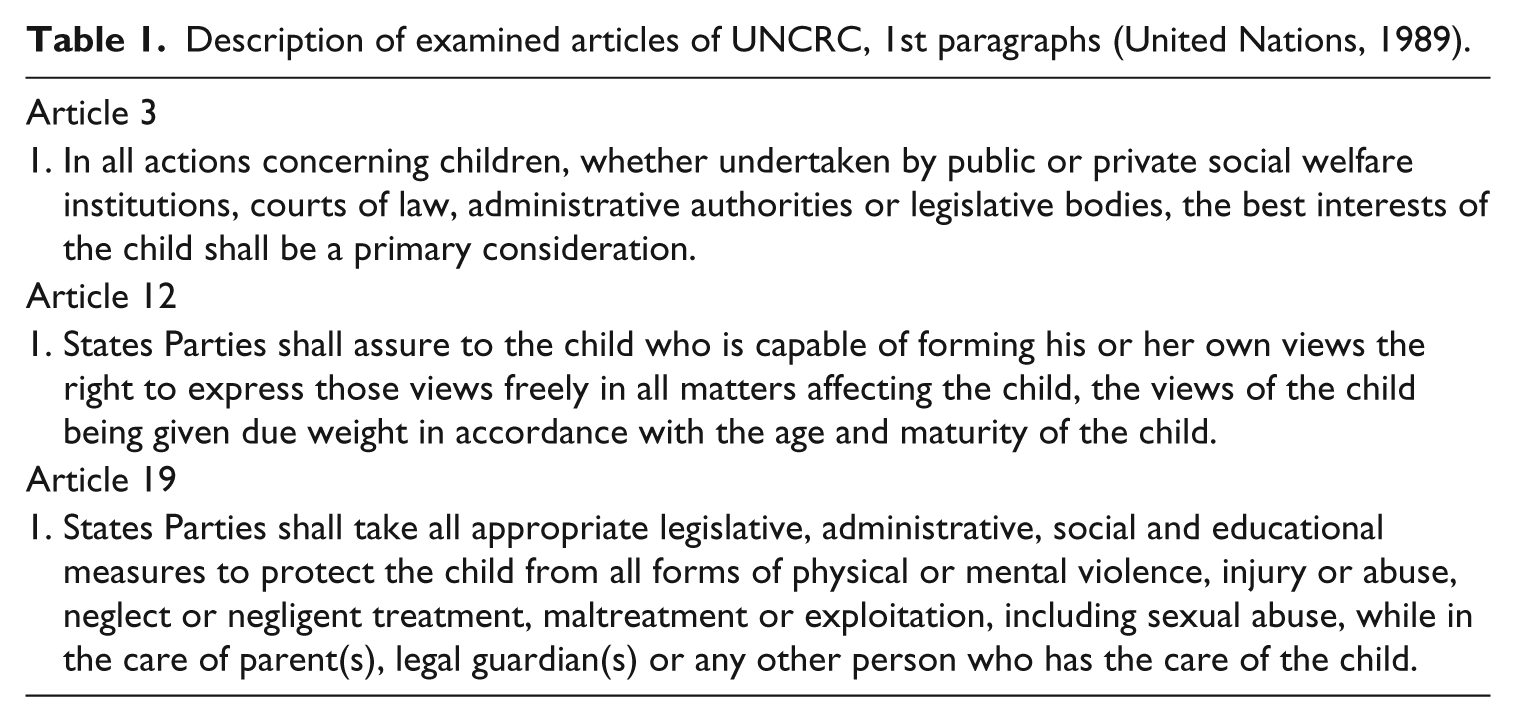
The rights in the CRC are written in the form of articles with differing designs. The five articles in the overall study were chosen because four of them are defined as guiding principles (Articles 2, 3, 6 and 12) and are therefore highly relevant (United Nations, 1989); furthermore, Article 19 was added due to the knowledge of violence and abuse that has been shown to occur in sport contexts. The themes of these articles are also seen as important aspects of the relationships between children and adults in sport and make it possible to examine these themes and make them understandable for children. One limitation of this research study is that it only covers five out of the more than 50 rights in the CRC. For the purposes of this paper, I have chosen to present the results from the study in relation to three out of the five articles considered (Table 1).
Description of examined articles of UNCRC, 1st paragraphs (United Nations, 1989).
Conducting interviews and analysis of data
The interviews were semi-structured in form and covered relevant topics to answer the aim of the research. Most of the children were interviewed in pairs, which Graue and Walsh (1998) say is a valuable strategy when interviewing children, especially younger ones (Kellett and Ding, 2010); the coaches were interviewed individually. Collecting data directly from the children was preferred in order to gather information about their views first-hand. However, research with children raises methodological issues that need to be overcome if we are to gain a credible and deep understanding of children’s lives and attitudes. One is to deal with the imbalance of power between an adult and a child in the research situation, which might be more acute in individual interviews. To lower the pressure on each child to answer every question and give them the possibility to reach answers with help from another child in a more relaxed way, group interviews with two children were chosen to decrease the acquiescence bias (Kellett and Ding, 2010). This was possible in all interviews, with two exceptions: interviews conducted with three younger children in one group and with one older child alone. However, there are also issues to deal with in group interviews with children (Kellett and Ding, 2010). To decrease the risk of social desirability bias in the answers, children were informed that there was no expectation that they should deliver one ‘right answer’, but that different opinions were possible and welcomed. Further, children were interviewed near the sports grounds to create a feeling of being safe and relaxed in their familiar surroundings, as well as to minimise any difficulty of taking part in the interviews for each participant; the adult coaches, meanwhile, were interviewed in a place of their preference. Therefore, the interviews with coaches were conducted mainly on the sports grounds, but also at their workplaces.
The questions raised were related to the participants’ knowledge and opinions about the UNCRC as a whole; deeper questions were related to the content of five articles in the UNCRC, of which this paper focuses upon the following three rights: that children’s best interests must be a primary consideration (Article 3); children’s right to express their views in all questions concerning the child (Article 12); and children’s right to be protected from all forms of maltreatment, abuse and violence (Article 19) (Table 1).
More explicitly, the interview guide was ordered from initial questions about what the participants thought about the sport in which they were involved. After this, the participants were asked whether they knew that their sporting activities were required to comply with the UNCRC and children’s rights according to the SSC. Further, there was a question about what they knew about the child rights convention, and then a piece of paper was given to each participant to read the five rights, described in one sentence each – abridged, but close to the reading of the original text of the articles’ first paragraphs. The interviewer also read each sentence aloud and explained what some of the words meant. Hereafter, questions were asked in relation to each of the articles (rights) in the following order: Articles 12, 6, 2, 19 and 3. The questions were designed in similar ways, with relevant adjustments regarding the expressions of each article and whether children or adults were interviewed. Examples of questions included: ‘Children are entitled to the right of. . . What do you think about this right?’ ‘How important is it that this is noticed in sport?’ ‘Do you think this is fulfilled in practice? How?’ ‘Is there a need to protect children and young people in sport?’ ‘How can children be protected from negative experiences in children’s sport?’ ‘Do you think that children are exposed to something negative in this sport?’ ‘How are adults working with this in your sport?’ ‘Are your views taken seriously? How?’ ‘What is the best interest for children and young people in the sport for you?’ ‘How important is it to you that children’s best interests are a primary consideration and put first?’ Finally, the following question concluded most of the interviews: ‘What do you say about the fact that the Swedish Sports Confederation has introduced a requirement that the sport should follow children’s rights?’ The interviews lasted for 40–60 min with the adults and 30–40 mins with the children. The interviews were recorded with a digital recorder and transcribed verbatim.
The data analysis was based on meaning condensation and meaning interpretation, in line with Kvale (2007). The analysis involved five steps. First, the complete interview transcripts – with numbered rows for easy back-tracing to the original expressions – were read through to get a sense of the whole. Then, the ‘natural meaning units’ of each sentence were assessed, compressed and written into shorter statements in order to rephrase the main sense to the right of each paragraph of transcripts. The children’s and adults’ interpretations of the convention, what is done and what is needed to fulfil the investigated rights, and expression of relations, structures and norms regarding how children and adults are expected to behave in sport were marked in the data (Mayall, 2015). Third, for each interview, all of these shorter statements were restated and thematised, according to the interview questions, on large mind maps (A3) to get an overview of further meaning interpretation. The fourth step was to conduct deeper interpretations and interrogate the units of meaning in terms of theory and the research questions. The views of children and adults provided evidence of the power relations in the actor network of children’s sport between and within generations (Alanen, 2009; Prout, 2011). In this phase, I returned to the original statements to test the conclusions and find suitable quotations for evidence. Fifth, relevant but not non-redundant themes in the data were tied together into descriptive results.
Discussion of findings
Attitudes towards and knowledge of children’s rights
To answer the first research question, children and coaches were asked to start by stating whether they knew that a ‘child’s rights perspective’ and the UNCRC had explicitly been included in the Swedish sports policy ‘What Sport Wants’ about two years ago and should apply to all sports for children. Almost all of the children and coaches clearly responded ‘no’ when answering the question. The result shows that neither the children nor the coaches were aware of the incorporation of the UNCRC into Swedish sport policy from 2009. They had not received any information on children’s rights in the sport club or elsewhere, and accordingly they had very limited knowledge of how they were expected to work in relation to the policy ‘What Sport Wants’ and UNCRC. This is illustrated by the following quotes. Karen, a 12-year-old equestrian girl (12eq.), asked a counter-question: ‘What is a convention? No, I may have heard of it, but I do not know what it is.’ The children hardly seemed to know what a convention or a child right was. A boy from a floorball team, Victor, 16 years old (16fl.), showed overall but unspecific knowledge about the UNCRC when he said, ‘It must be about safeguarding the children, I guess, and looking after them so everyone has the same rights in all countries’. Clara (12fl.) said, ‘I do not know. Is it children’s rights in society?’ She did not know what the UNCRC in sport was really about.
A similar lack of knowledge about the UNCRC and its incorporation into the Swedish sport policy was shown by the adult coaches. Floorball coach Tom (coach, fl.) said, regarding the incorporation of the UNCRC in ‘What Sport Wants’, ‘No, not like that. I have not; not much, really. Human rights and such things are no big deal here.’ Equestrian coach Kate also clearly stated, ‘No. I must say, I have not.’ Similarly, John (coach, fl.) explained, ‘You might have heard the word [children’s rights] on TV sometime, when they talk about the third world and so on’.
One point to be made is that John’s and Victor’s answers show an attitude of placing children’s rights in an international context, far away from the local sport context. The participants’ answers illustrated a view of UNCRC as not especially relevant for children and coaches in local sport clubs in Sweden. One interpretation of this is that the limited knowledge of the UNCRC and lack of awareness about the revised sport policy in Sweden also led to this attitude towards human rights as ‘no big deal’ in children’s sport, because they do not know much about it.
From the results it is evident that, despite generational category, children and adults are not well informed about UNCRC or its place in the ‘What Sport Wants’ policy of the Swedish Sports Confederation. Of particular concern is the children’s lack of awareness of UNCRC and their rights to claim and demand that adults take responsibility to provide information and relevant forms of work to ensure compliance with the stated rights (Riksidrottsförbundet, 2009). Nothing seems to have been done deliberately in these sport clubs to either inform the members about children’s rights or work consciously towards implementing the UNCRC. This means that neither coaches nor children were prepared to assess, prevent or follow up on violations of children’s rights, as required by the UNCRC (UN, 1989); furthermore, the children therefore do not have the reliable protection in sport to which they are entitled. This follows earlier research by Brackenridge (2002), who found an unwillingness among sport club personnel to challenge their own assumptions, which she argued was linked to a ‘culture of complacency’ regarding child protection. This point is supported by the coach who talked about human rights as ‘no big deal’ in children’s sport.
The low level of knowledge, I would therefore argue, is an apparent hindrance for the children in being able to claim their rights, and for the adults as well as sport organisations to effectively ensure respect for children’s rights (Mayall, 2000). Furthermore, it can be said that if the local actors in children’s sport do not have knowledge about the formalised policy, it will not significantly impact real life for children or adults in sport (May et al., 2013). From these results, the 2010 strategy by the Swedish government (Ministry of Health and Social Affairs, Swedish Government Bill 2009/10:3), which includes the statement that children and parents as well as different professional groups must receive information about the rights of the child and what it means in practice, seems highly relevant when it comes to children’s sport.
However, more knowledge and education is not a guarantee of fulfilment of rights. Interestingly, the participants lacked knowledge about UNCRC and its incorporation in sport policy, but still could argue that they do not need it. Sarah (12fl.) said, ‘We don’t need [the UNCRC] so much because I think our coach agrees with it’. This comment also showed evidence of a ‘culture of complacency’ among the children. When an individual is satisfied and pleased with the current situation, the view that there is no need for a policy seems to be reinforced. Similar views were found among the coaches. Tom (coach, fl.) questioned whether the UNCRC as a policy really could make any difference: ‘I don’t think it has any significance. You see abuse by ‘extreme’ coaches, the guidelines do not matter in that case. Obviously, you have to say it is this or that will apply . . . but it has no bearing on how it is in practice.’ Instead of a policy, he expressed a need for ‘real action’: ‘What they would do more actively is to fire coaches who clearly behave incorrectly.’
Even if they did not find any meaning in having a written policy with UNCRC included, Tess (16eq.) expected her sport context to be a good environment nonetheless: ‘You should not be bullied, and everyone should be equally worthy . . . but not because it’s written somewhere. . . . it should be so anyway.’ She thinks good behaviour is important but this is expected to be developed without reference to certain written rules, such as policies. Tom (coach, fl.) also said ‘the guidelines does not matter, this is common sense’. In the participants’ opinions, the value of the policy as formalised rights is denigrated; however, they emphasised their expectation of good behaviour coming naturally by itself. The results show some ‘naïve’ thinking among the respondents, especially the children, in their views of people as good human beings and sport as good and fun activities for children, which led the children to take the fulfilment of these rights for granted. This is evidence of the construction of childhood: on one hand, children put their trust in adults; on the other, coaches rely on thinking about good ethical behaviour as natural and common sense (Mayall, 2000, 2015). This leads them to think that nothing bad can happen in sport or that if it does, one cannot do anything about it, and therefore no preventive work is needed. On the contrary, Alexander et al. (2011) and Rhind et al. (2014) have recently showed that children’s sport is not free from victims of various forms of child abuse. Children and coaches place no trust in the state, government or SSC as a responsible actor for implementing UNCRC in sport (Prout, 2011).
The experience of and construction of meanings of children’s rights
Even though the children and coaches showed apparent scepticism towards the meaning of formalised written policies as such, I can conclude that most of them found the themes of the three investigated rights discussed in interviews to be important in different ways, which I will now show and discuss in order to answer the second research question.
The best interests of the child (Article 3)
Article 3 makes it clear that the best interests of the child shall be a primary consideration in all actions concerning the child. There were no unitary answers from the children or coaches about what this really meant in their sport context. In particular, the children had difficulty pinpointing what ‘best interest’ meant, as most of them had not really thought about it in this way before, according to my interpretation. However, both the children and coaches gave suggestions, during the interviews, on how to understand the child’s best interests.
Evidently, from the children’s explanations, the best one could do to meet their ‘best interest’ when participating in sport is to make them ‘feel happy and secure,’ and to ensure that sport activities are characterised by an inclusive and friendly environment in which they are able to develop their sport skills without being hurt or injured. Karen (12eq.) painted this image clearly: ‘I think the best thing is when you come to the training, then you should be happy because “this is fun”, “everyone is nice”, and “it goes well”.’ ‘One should not be afraid to be hurt … but have fun’, she added. The best interests of the child mentioned also related to the mere possibility of participating in sport and that children would be able to give their views and be allowed to make decisions regarding things that concern them, which I elaborate more deeply in the next section regarding Article 12.
Children’s points regarding a fun and friendly atmosphere were supported, regardless of sport, by the coaches, who also emphasised that the most important factor was that the children ‘have fun; otherwise, they will quit’, as Fred (coach, fl.) stated. Similarly, Sophie (coach, eq.) explained: ‘Children should feel welcomed, that they feel comfortable and want to be here. That they are seen and have a feeling like, “This is our world”.’ This is an important statement, though not always taken sufficiently seriously. Wellard (2014) argues that fun and enjoyment are more central to the experience of sport than is generally acknowledged and should not be seen as trivial. At the same time, Wellard also points out the complexity and subjectivity of the term fun. I would therefore argue that one way to reach a deeper understanding about how to meet a child’s best interests is for coaches to seriously examine and take into account each child’s values regarding what makes sport fun and what they appreciate in sport. Eliasson (2015: 206) has shown that adults and children sometimes act from the perspective of ‘different sports worlds which are based on different predominating behavioural logics’. Adult coaches often use a sporting logic in their interactions and children a social logic, due to their evaluations of what is most important and meaningful with sport, developing high-performance athletes or developing friendship and have fun. Therefore, it seems that the children’s social logic need to be upgraded to put the child’s best interests first in the social network of children’s sport.
One specific aspect of equestrian sport put forward was the importance of taking the horses’ ‘best interest’ into consideration, sometimes even before the children’s best interests. Here, it becomes clear that a network of actors who are placed in a certain position in relation to the children affects whose approach should be counted first (Prout, 2011). The question is not only one of actors as children and adults; it might also include animals, which shows that the network of important actors varies between sports. In equestrianism, the best interest of the child is clearly related to safety with animals, according to both coaches and children. It may be about adjusting the size of the horse so that children can control the horse in a safe way. Kate (coach, eq.) explained: ‘A child’s best is to do just what feels safe. If I do not like to jump, then I can ride dressage. There is something for everyone . . . I never force someone who is afraid.’
Furthermore, in floorball, children’s best interests were linked to the importance of developing all of the children’s sport performance. Fred (coach, fl.) said, ‘We must not forget those who are less skilled. We need to raise them to a minimum level and focus on them.’ Fred (coach, fl.) further added that variations of playing position in the team are a part of the children’s best interests, ensuring that they do not play in the same place for years. Early specialisation seems, therefore, not to be in the best interest of the child.
However, some of the coaches also had trouble pinpointing exactly what the best interests of the child might be. Tom (coach, fl.) explained, ‘Nobody can say what is best for the child, for me or for anyone else, but time will of course show that “this” was probably not the best’. In line with this argumentation, the coaches could only react to the decisions’ outcomes, and the result of this way of thinking might be low priority placed on proactive work. Adopting the perspective of children seems to be a problem for adults. Peter (coach, fl.) explained the difficulties he experienced as an adult in putting the best interests of the child at the forefront: ‘… sometimes you might forget that they still are children.’ This seems to be more difficult as they grow older and into their teens.
In any case, some different opinions were put forward regarding who knows what is best for the child. Coaches and children agreed that the children know more about what they want and feel at the moment, but the coaches added that they know what is best for the children in the long run. John (coach, fl.) explained the complexity in understanding whether rights are met in ‘real life’ in children’s sport: ‘The goal is their best [interest], but it might not seem to be the best for the players at the moment, if it is a tough exercise or something – but the results are for their best in the future.’ This means that a coach can have one opinion and children another, because they relate their thinking differently in relation to time frame. Children think about their future life less than adults do.
Peter (coach, fl.) argued the need to force children who might not know what is in their best interest and explained what he as a coach might say: ‘“You should try to play in the defence.” And the player says: “that will not work, it will not work” and you make them play there and they understand: “Oh that really worked well.”’ Adults view their forcing of children as part of the child’s empowerment, which might be true, but is also evidence of how adult power over children is constructed and maintained between generations (Alanen, 2009; Mayall, 2002). Adults can justify the child’s lower status and legitimise the exertion of adult power to decide over children because adults are credited with having more knowledge of what’s best for the children, which Mayall (2000, 2002) found troublesome. In the same vein, Tom (coach, fl.) said, ‘You must have some requirements too [on the children] . . . They also “feel good” with this.’ Tom also explained what he could tell children if they had opposite opinions: ‘This is actually best for you and for the group. Now we should do like this, you have to trust me, this is good.’ According to David (2005), this constitutes a risk when adults have other interests than the children, when sport is so clearly dominated by adults. Mayall (2000) explained that when adults propose that they are the one to decide what’s best for the child, they are denying the child’s right to participate in the structuring of their own childhood. Such thoughts might lead to problems with taking children seriously as contributors to their own situation, and it is a challenge to know how to act towards fulfilment of the child’s best interests. On the other hand, when asking the children if their best interests were met in their sport, the children in floorball clearly said ‘yes’, with the argument that it is an inclusive environment in which everyone can participate and where they develop their sport skills and have fun together.
Children’s right to express their views (Article 12)
Article 12 is about children’s right to express their views, which should be given weight according to the child’s age and maturity. This seemed to be an important aspect of rights for most of the children. However, some children in this study stated that opportunities to express opinions are limited and rarely happen. One thing the coaches asked the children to have an opinion about was the training’s content. Tess (16eq.) liked it when they got the chance to decide what to do for training, but this seldom happened: ‘More jumping lessons, but it is almost only the last lesson in the term when we can decide what to do.’ This quote highlights the power of adults to take decisions, and that children’s views are not given weight on a regular basis.
The coaches, as well as children, expressed that this is an important theme of rights. However, at the same time, they did not seem to work with this deliberately or systematically but instead saw it as something natural, as the following quotes show. Sophie (coach, eq.) said, ‘This is something we think is very good and important in general within equestrianism. You should have respect for each other but also for the horses.’ Children’s expression of their views is instead thought of as a matter of course and takes place through a natural dialogue, as John (coach, fl.) expressed: ‘It’s not something we work openly with. That’s something that you are brought up with in Sweden. We have the attitude that everyone gets their say.’ Tom (coach, fl.) explained how they do it: ‘We often have a dialogue before the training and we get feedback after training on how they experienced it.’ At the same time, the case can be reversed: younger children must sometimes be silenced because they talk so much, according to Tom: ‘“Now you must be silent … for now I have to talk” … They are a bit younger too, but a guy who talks all the time… one has to draw the line somewhere.’
In equestrianism, the coaches also have a short evaluation of the lesson together with each child at the end of the lesson. But this seemed to include more feedback from coaches than vice versa. Tess (16eq.) explained, ‘In riding, you ride and they tell you how to improve. I don’t think there is anything that you can say.’ The evaluation at the end of the lesson was conducted more from a coaching perspective, ‘about [how] to improve [the sport performance] next time than any comments about what we think’, said Tanja (12eq.). This indicates that even when the adults tried to involve the children, the adults decided what should be open for discussion, which was not always what children thought of as most important (Eliasson, 2015; Pitchford, 2007).
However, the children had different opinions about their possibilities and satisfaction with their involvement. Children also expressed that they were able to voice their views in natural dialogues with coaches, and many of the children felt their views were taken seriously by the coaches. Patrick (12fl.) explained: ‘If I say I don’t want to play in a certain position, [the coaches] try to arrange it.’ Many of the children also thought they had a right to decide sometimes, especially on issues concerning themselves in line with UNCRC; however, it became clear that this was not always what they experienced. Tanja (12eq.) explained: It’s important. Thus, I think it’s pretty obvious that you should be involved and speak up, even though you will not get to decide everything, but you can be involved. But it is usually adults who think they should decide, perhaps because they are older.
Here it becomes obvious that children try to understand the imbalance of power with arguments that can be related to Alanens’ (2009) concept of generational ordering of children as subordinated to adults due to their age. Another girl highlighted her interest in changing the power to take decisions that adults have over children in sport. Tanja (12eq.) explained how children could be given more influence when describing what she thought could be better for children in sport: It would be great to have as a board meeting, almost, so you can join in and say what you think, and you can improve everything at the riding school, sort of, so that those who want to say something may be involved, so it is not just the adults.
However, one child, Paul (16fl.), stands out in the data for having a clearly different perception compared to the other children, explaining that he didn’t want children to be part of the decisions: ‘In a team, it is the coaches who are the coaches [who should decide] and you have to adapt to them; otherwise, there will be chaos. So, I don’t know if it should be so much democracy in team sports.’ For children to have a viewpoint and be a part of decisions seems to disturb the order of the activity, according to Paul. Further, it was argued that subordination in relation to adult coaches favoured the sport’s performance targets. Paul continued: ‘I have given up a lot of my views because I want the team to be better.’ It was unclear in the interview just what he has given up, but he maintained the adult coaches’ power by even saying: ‘it is better [that] it is like a dictatorship that one can decide, the coach or the cap.’ This might be interpreted as finding that the more the result of sport performance is focused on, the more the risk of neglecting children’s rights increases. This is also shown by Brackenridge and Rhind (2010) to be the case in elite sport.
At the same time, the data gives deeper insights into interaction between generations, which need to be reflected on. The coaches explained they believe the children found it difficult to say what they think and sometimes do not dare to express their views. It is therefore sometimes also difficult for the coaches to find out what the children were thinking, even if they want to: ‘They are very timid and may have difficulty expressing themselves sometimes . . . what they feel and what they think’, said Peter (coach, fl.). In a similar vein, Kate (coach, eq.) explained that her experience was that children are sometimes shy, unobtrusive and afraid to voice their opinions to adults, and that some children have an attitude of not wanting to be any trouble. Some children also explicitly stated that they do not dare express their opinions to adults: ‘Sometimes, it’s like we do not dare tell them. You don’t know how [the coaches] will respond if I say what I think’ (Patrick, 12fl.).
Another argument from the coaches is limited time, which makes it a challenge to fulfil the right stated in Article 12. Kate (coach, eq.) explained: ‘There is limited time. It is obvious; they have their lessons for 60 mins and don’t want to stand for half an hour and talk. They want to ride when they have their riding time.’ The coaches don’t seem to want to give more priority to conversation and dialogue to find out children’s thoughts and wishes, which is an indication of Pitchford’s (2007) conclusion that the voices of children are effectively marginalised across all areas of sport.
The participants’ views can be understood as derived from the experiences of constructing the relationships and milieus of which they are a part (Mayall, 2003), in which the social order between adults and children is normalised but at the same time continuously constructed and reconstructed. It seems that some children in sport are used to the fact that adults determine most of the decisions, and have ‘almost’ accepted it, even if they say it is important for children to be able to speak up and be listened to. Some children also contribute, as active social actors, to their subordinated position, for example by saying that children should not be able to decide, as this is the coach’s right. According to Mayall (2000), children know they inhabit a domain as children under the control of adults.
There is, thus, no ‘either/or’ when it comes to children’s right to express their views; it is more about the extent to which adults involve children and how children’s views are handled in relation to adults’ view of what is important or in their interest. According to these results, children’s voices could be said to be weak in the social ordering of childhood and adulthood (Prout, 2011), which has also been shown in British youth sport (Pitchford et al., 2004). However, the imbalance of power between the child and adult is also evident in the CRC, when rights explicitly express that children might not always be reliable and entitled to a right due to their age and maturity (Article 12), which further complicates the power relations and the understanding of UNCRC in the real life of sport. I suggest from the results that participants need knowledge about children’s rights, as well as an understanding of how to arrange good situations for serious dialogue with children to achieve appropriate exchange of views between generations and, in the end – through different priorities – ensure that children’s views are given sufficient weight and influence.
Children’s right to protection against maltreatment, abuse and violence (Article 19)
Article 19 describes the right to be protected from all forms of physical or mental violence, as well as any form of maltreatment, abuse or exploitation by the person who has the care of the child. When the children were asked what they thought about this right in relation to children’s sport, the children seemed averse to link this with sport at all and the question seemed to surprise them. Quite the opposite, Tanja (12eq.) said, ‘If you are riding, then you “get” health out of the sport activity.’ Karen (12eq.) said, regarding violence, ‘that it is not apparent in a sport context but perhaps more if you are downtown or so’. These views might be understood as the participants have not been subjected to any violence in sport. Tess (16eq.) said, ‘I can’t think of anything bad that happens in the sport’. She likes to be in the stable, and she thrives. The children expressed that they were not afraid of anything like violence happening to them. Annie (16fl.) said, ‘It might be [an issue] in other countries where they push more’. It seems to be taken for granted among children that sport should be fun; they were not used to talking about the right to not be subjected to violence in sport, and even less about the risk of it happening.
Similarly, the coaches expressed that they had no experience of violence in their sports or sport clubs, and nothing like physical or sexual violence. ‘I don’t see it as something big, “the violence”; I can just talk to my teams and no such thing [as sexual abuse] has ever happened’, said Tom (coach, fl.). Coach Peter (coach, fl.) did not think this right regarding violence was needed either, because, as he explained: ‘I myself have never been in the vicinity of such things.’ It was also taken for granted among coaches that children’s sport should be, and is, fair and positive. This lack of negative experiences is in itself satisfactory, but seems to lead the coaches to a conclusion that there is little need to work with children’s rights regarding violence and abuse. This, I would argue, is misleading, or a dangerous delusion, because we know from cases in Sweden that severe criminal sexual abuse of children has occurred in sport, and from research that different kinds of violence against children exist in sport cultures all over the world (Alexander et al., 2011; Brackenridge and Rhind, 2010). These attitudes based on ‘unnecessary’ rights, due to a lack of severe negative experiences, might be one explanation why proactive work preventing child abuse in the sport clubs is missing. It may be related to the evidence that sexual abuse is shown to exist to a small extent – 3% of children, according to a study by Alexander et al. (2011) in the United Kingdom. The problem is that no one knows where and when this severe abuse is going to take place. This means that all children need to be protected, and all in the social network of child sport, from the state to the coach who cares for the child, should take all appropriate measures to fulfil Article 19.
Another problem, as Donnelly et al. (2014) discuss, is the conceptual confusion pertaining to the terms abuse and harassment, which constrains the possibility to determine prevalence or incidence rates of maltreatment. This, together with the comprehensive UNCRC perspective regarding forms of abuse, can explain the participants’ ambivalent stance to Article 19 shown in the interviews. When children and coaches were asked about the importance of this kind of right, many of them still concluded that there was a need for it, particularly in relation to bullying, negative feedback and social interactions specifically related to children’s sport performance, but not in relation to violence or sexual abuse. What can be defined as emotional abuse is something they can relate to in another way, which indicates that this is something they have probably experienced to a greater extent. Alexander et al. (2011) show that emotional abuse is experienced by 75% of children in sport. It is evident from the results that children’s as well as coaches’ definition of the meaning of children’s rights and policies in terms of UNCRC are linked to whether or not they had experienced these specific negative aspects before in ‘real’ sport life.
Most significant for the children seemed to be handling of the social relations between children, or, expressed in another way, within the generation of children. Karen (12fl.) explained: ‘Bullying is if you do not get praised but only get criticised and such.’ Felix (12fl.) said that this kind of right ‘is pretty important’, while Paul (16fl.) expressed: ‘It would be boring if you’re doing a sport and you don’t get protection from bullying. It would be a shame if you quit because of that.’ It was seen as important that the coaches supported children, ‘as they do now, and never talk negatively about us’, said Victor (16fl.). He also discussed whom negative comments come from and continued: ‘Often, it is the teammates who are negative after a game.’
The coaches also pointed out, like some of the children, that the most negative experiences for the children were related to social relationships between the children. Fred (coach, fl.) said, ‘Well, the most serious thing is mental, the mental beating you can get . . . If [the team members] do not respect each other and are not kind . . . I think the mental torture is the worst.’ This is, according to the coaches, especially related to the level of sport performance in these both sports. Quite recently, researchers have noticed and paid attention to the existence of emotional harm among teammates and peers. As much as 79% of children report being criticised about their performance, 77% report being embarrassed and humiliated, 66% report being teased and 51% report being shouted or sworn at (Alexander et al., 2011).
Kate (coach, eq.) explains how the conversations between children can develop: ‘“How high do you jump?” and “Aha, she doesn’t jump higher than that”; then, they become afraid that others will think that they are not good enough.’ In equestrianism, there is also a special connection to the horses, which can be used for bullying. If they own their horse, children can say ‘bad things about others’ horses’, as Kate explained. Sophie continued: ‘they compare themselves with each other … because unfortunately, it is a fact that the riding is quite expensive, and there may not always be those that can buy the newest helmets or the newest boots.’
However, the coaches also talked about negative comments originating from coaches’ instructions. John (coach, fl.) said these could include ‘psychologically unhealthy comments’ related to performance, but he also said that children should be able to listen to coaches’ ‘constructive critiques, but not wrong or unjustified criticisms’. Coaches talking about the children’s performance seemed to be acknowledged as a risk for violating rights: as Fred (coach, fl.) described, ‘You can tell the whole team to be better, but when you talk to an individual with advice about how to improve their play, you can reduce the individual and the individual’s self-esteem pretty strongly as a coach’. Kate (coach, eq.) also related Article 19 to coaches’ behaviour: It is more about how you as a coach talk to children and how you say to them ‘this is what you need to improve’ so they don’t become sad and feel offended, it’s more like that. One does not need any preventive work for that.
Coaches also talked about physical violence, which is related to injuries in the sport. ‘It’s horses and all that, so we are careful about security. There are great risks with horses. Horses are animals, and you can never predict everything’ (Sophie, coach, eq.). In floorball, the children receive education on how to decrease knee injuries, such as on-knee stabilisation exercises, and how to take care of acute injuries. The physical seems taken care of, but ‘it is less about how children work mentally’, as Fred commented (coach, fl.).
Finally, how can children be protected from negative sport experiences? When asking the children this question, the coaches seemed to be important for dealing with the problem. One example was by being ‘fun’ and building up a positive atmosphere, which is especially important when sport results or performance go ‘bad’. According to Sarah (12fl.): ‘Others should not be negative and say, “You can’t do it like that, it’s bad”. Instead, you should be positive and say, “You will make it next time”.’ Developing positive relations between children is therefore key to strengthening children’s feelings of safety in sport. This is in line with Eliasson (2015), who showed that children greatly value sport for friendship. At the same time, these children expressed that they felt quite safe in their sport today as it is, and they were not afraid that anything negative would happen.
To protect children in sport, the coaches talked about having rules to prevent the children from being subjected to negative comments, feeling badly treated or being injured – but at the same time, they explained, there are risks with everything. Accidents can always happen and must be expected. However, ‘no one should be psychologically harmed [by] negative comments’, said John (coach, fl.). Further, the coaches mention the importance of relevant coach education and developing the relationships between coaches and children. As Peter (coach, fl.) emphasised, ‘You need to have educated coaches and have more individual talks with every player’. ‘You need education about how children work and develop’, Fred (coach, fl.) underlined. In equestrian sports, there is in part another situation, as Sophie (coach, eq.) highlighted: ‘In equestrian sports, it can be difficult to know what is happening in the stable, so you need to be together with the children in the stable, which is difficult for us.’ When the coaches are not together with the children all time, it makes it hard for them to notice or observe the children’s interactions, so the risk of negative harm might go unnoticed by coaches.
The results indicate that the coaches and children had not experienced any severe violence or sexual or physical abuse. A reluctance to work with prevention of violence or sexual abuse in sport is also shown by Johnson (2014) and Brackenridge (2002). Instead, this study revealed that the interactions in sport brought about emotional abuse, especially in relation to sport performance. Emotional abuse was found between, but expressed more as occurring within, generations. This evidence gives strength to the recent research by Stirling and Kerr (2015), which found emotional abuse to be part of violations of children’s rights. Emotional abuse is much less documented than, for example, sexual abuse (Brackenridge, 1997, 2001; Brackenridge and Kirby, 1997; Hartill, 2009); however, it seems to be much more common (Alexander et al., 2011). Analysis of content addressed in sport policies shows that emotional abuse is discussed to a much lesser extent than sexual abuse (Donnelly et al., 2014). Emotional harassment seems not to have previously received attention at different levels of the social actor network of children’s sport, though discussion of it is obviously required and relevant for the child athletes’ experiences and well-being in sport life.
Conclusions
This research has given a voice to Swedish child athletes and adult coaches regarding how children’s rights are given meaning and are experienced in their ‘real lives’ of sport. First, I concluded that there was a great lack of knowledge and information among the children and coaches about the UNCRC and how it is supposed to be used to safeguard children in sport, which is certainly one major challenge for the implementation of UNCRC in Swedish children’s sport. The coaches and, especially, the children whom I interviewed were not used to thinking from a ‘child rights’ perspective; thus, this was something unfamiliar and new to them. A second major challenge was highlighted when the children and coaches saw the UNCRC, some incisively, as a ‘useless’ piece of paper that they did not need. ‘Formalised’ rights were shown, when discussed with the interviewees, to have a very low status in the network of children–adults–state in sport (Prout, 2011). This is completely contrary to the strategy of the Swedish government (Ministry of Health and Social Affairs, 2009), in which children are expected to be informed about their rights and adults must be knowledgeable about the UNCRC in order to have the desired impact.
From a childhood and generational perspective (Alanen, 2009), there is another contradiction in thinking about children’s rights, because the UNCRC contains assumptions that the child is more or less a universal, free-standing, individual child and human being, which is not the case. Children are evidently restricted by limitations in relation to how the social order between children and adults works (Lee, 2001; Mayall, 2000). Children have learnt to be subordinate to adults due to having less status; therefore, children will have problems with claiming their formal rights. Children do not want to be any trouble and cannot think of themselves as charged with power over adults. They are evidently socialised by the dominant order between generations which must be understood to be able to change the power relations and empower children to claim their formalised rights in their real lives of sport (Eliasson, 2015). This generational relation creates the third major challenge in fulfilling Articles 3, 12 and 19 when both children and adults are constrained by their dependence on and possession of different statuses (Alanen, 2009; Mayall, 2000).
So, does it benefit children in sport to think of children’s rights? The answer is both yes and no – ‘yes’ in real life, if you make the rights known and transform them into ‘real’ action, but not in forms of ‘formalised’ policies, as the meanings of rights are constructed in these sport clubs. Mayall (2000) stated that working towards a better understanding of children’s social conditions and childhood can provide a firm basis for the implementation of rights. If children should be given more influence in sport, they need to be given more power; adults need to appreciate children’s views in the development of children’s sport as a safe, sound and empowering milieu in which to grow up. However, transferring power to a marginalised group such as children is a difficult task, and with less power, children depend on adult support for the chance to reach out with their voices (Stern and Jörnrud, 2011).
It is not the policy or guidelines themselves that are important, but rather finding ways to transform the content from words on paper to a way of making the essence of rights known and integrated in ‘real’ life. Terms like ‘the best interest of the child’, ‘the children’s right to express their views’, ‘the right not to be subjected to physical or psychological violence, maltreatment or abuse’, and so forth need to be brought to life in the ‘real’ life of sport, which is a shortcoming in the discourse found in these Swedish sport clubs today. This is not only typical for sport but is in line with the research into other areas for example carried out by Stern and Jörnrud (2011), who say they had hoped for more after 20 years of CRC in Sweden. According to Stern and Jörnrud, this is a sign that the requirements of the convention are not being taken seriously enough. I will also add that the situation might be more complex than it seems.
The all-embracing UNCRC and its level of abstraction can also be part of the resistance to working with policies. Many of the articles comprise different and large fields of topics, encapsulating deep societal and political issues and problems (Kidd and Donnelly, 2000). Therefore, the respondents’ reluctance regarding the UNCRC is understandable, even though they ascribe the contents of the articles with meaning and importance. According to Reynaert et al. (2015), the lifeworlds of children and how rights are given meaning are part of a broader societal order, which makes this complex and complicated to deal with.
According to my assessment, about half of the UNCRC’s articles are of direct relevance in a Swedish children’s sport context. This means working with around 25 complex and sometimes deeply embedded societal issues in order to ensure that children’s rights are fulfilled to the utmost possible extent. This is a demanding task, however expressed in the Swedish sport policy since 2009, but the responsibility could not be put on the voluntary child sport coaches alone. The need for cooperation between sport organisations on different societal levels and professional support to voluntary sport clubs is obvious.
Part of the lack of interest in the UNCRC also relates to the lack of resources, knowledge and infrastructure in voluntary sport clubs in order to fully engage with policy objectives, as May et al. (2013) have argued. Yet it is of significance that professional national government sport bodies and their affiliates cooperate in appointing responsibility for fulfilment of children’s rights and support sport clubs in developing high-quality ‘action’ plans, in terms of knowledge-based, societally integrated and legally sustainable actions that are applicable in ‘real’ children’s sport lives. To equip sport organisations to deal with issues of children’s rights, Donnelly et al. (2014) argue for a need for independently trained, arm’s-length ‘harassment officers’ to manage potential allegations of maltreatment, which have long been required in Canada through policies, though not achieved fully in practice. The UN (2012) states that, in invoking rights, it is important to identify the elements that are considered to be entitlements as well as to specify the actors with the duty to bring about the enjoyment of those entitlements.
Implications
Today, children are emerging more strongly than ever before as competent social actors. At the same time, they are still heavily controlled and subordinated in relation to adults. Therefore, children’s rights become of crucial importance, as well as problematic to deal with, according to Mayall (2000). In order to honour children’s rights, adults must establish conditions in which they can be honoured, according to Mayall (2000: 248), who stated: ‘We adults have to carry out the work of protecting children and providing for them so that they have a securely based arena within which they may participate in working through issues that affect them.’ According to Alanen (2009), it is also important to recognise the generational ordering of children and adults as one distinct organising principle of social relation. Adults have much of the responsibility for implementing UNCRC, but we should not forget to include children as active social actors. One advantage of this study – including children as participants – can be seen as having shed light on how children contribute to shaping the understanding of rights in Swedish children’s sport in relation to adults.
However, there is no easy solution to close the gap between formalised children’s rights and children’s real lives in sport. According to the result of this study, a necessary precondition is increased knowledge and awareness about UNCRC among children and adults: what the rights mean and how it is possible, and legally required, to be handled within the specific sport and by the sport club. However this is not enough when trying to decrease the gap between policy and practice because, as shown in this study, both children and coaches consider it most useful to work with themes of rights that could be related to negative experiences that they have already had, to a certain extent, in sport practice. This means that they select the entitlements of children’s sport worth implementing in real life. It means that those involved in the direct practice will not give priority to working with prevention of severe abuse, if that is not already happening. Much greater interest seems to exist among coaches and children regarding working with maltreatment or abuse of which they have direct experience. To speak with Donaldsson et al., (2011) policy implementation in autonomous sport organisations will only be successful if coaches and children view the policy as a meaningul symbolic object, which is not yet the case. Due to this knowledge, and the view of rights as inherently political (Kidd and Donnelly, 2000) and difficult to govern (Centrum för idrottsforskning, 2013; Fahlén et al., 2015), I argue that there is a need to share responsibilities on different levels in the network for the implementation of children’s rights as stated in policies and for development of action plans: from the state, national, regional and local sport governmental and nongovernmental bodies to municipalities, local boards of sport clubs and further to coaches, children and parents.
This is a comprehensive task, and I would on the other hand argue that in many areas there is a further need for more research, monitoring and evaluation to understand the state regarding the all-embracing content of UNCRC in different sports, and about how the relations of social order between children and adults are constructed and influence fulfillment of formalised children’s rights, to in the end make sport a safe activity for children to grow up with. We do not yet have useful theories or even a legal system that can clarify what a children’s rights framework really means for children (Ferguson, 2013). However, specific and practical guidance regarding implementing rights have been developed internationally; see, for example, the comprehensive handbook ‘Every child’s right to be heard’ from UNICEF and Save the Children (2011) about suggestions for implementing Article 12.
Limitations and further research
The study was limited insofar as participants gave their responses regarding only a few of many rights included in UNCRC, and the data was gleaned from experiences with only two sports. These limitations suggest that other rights could be studied within various sports as well as in comparison to other cultures. For example, the implementation of and views towards a child rights perspective within children’s sport could be compared in cross-cultural analysis among countries in Europe and elsewhere. I would also suggest that future research should place greater attention upon examining the phenomenon of emotional abuse or maltreatment that is found between and within generations in the child sport context and which children and coaches find meaningful to work with.
Due to the methodological limitations and issues regarding research with children, some reflections are made herein. The strategy of conducting interviews with children in pairs meant that children could listen to each other when answering the questions. Commonly, all of the children had something to say in response to each question; however, they seldom expressed opposite views. Whether this is a sign of the research’s limitation in terms of decreasing the children’s social desirability bias in the answers or not, it is difficult to say (Kellett and Ding, 2010). However, before the interviews, the children were informed that different opinions were possible and welcomed; during the interviews, every child was given an opportunity as well as reasonable time to answer each of the questions. I do, therefore, think they gave honest answers, and that sufficiently reliable data for analysis could be created.
One important aspect to deal with in qualitative research, which I carefully took into consideration while designing the interview questions and while interpreting the data, is that the research situation itself might have an impact on the participants’ perspective and knowledge (Brinkmann and Kvale, 2015; Patton, 2002). One evident example of this was when, at the end of the interview, I asked: ‘What do you say about the fact that the Swedish Sports Confederation has introduced a requirement that sport should follow children’s rights; do you think this is needed?’ Fred (coach, fl.), who did not know what the Convention on the Rights of the Child was about at the beginning of the interview, answered, ‘Yes, children live in the world and floorball is part of the world, so it should apply there too; it is crystal clear!’ Finally, I conclude that after these interviews, there are some children and coaches in Swedish children’s sport who now knows a little bit more about children’s rights, which feels satisfying, in a way.
Footnotes
Funding
The research was funded by the Swedish National Center for Research in Sports, and financial support for publication was received from Umeå School of Sport Sciences