







Abstract
The aim of this article is to enrich theoretically the analysis of processes of policy implementation through sport clubs. Subsequent to reviewing previous theoretical contributions on this topic, we make the case that available conceptualizations are marked by an inside-out perspective and that they conceptually and empirically stop short at the end implementer, i.e. the sport club. Consequently, analyses of policy implementation through sport clubs have not taken into account the fact that sport clubs are distinctly local phenomena. As such, past, current and potential future participants, volunteers and local inter-organizational relationships are found in a sport club’s local community. Because of this, there is a need for a concept that provides analytical coverage of an outside-in perspective, i.e. a concept that takes into account outside actors’ conceptions of the implementing sport club and the impact their views have on the implementation process. In relation to this need, we propose the application of the concept ‘convention’. In addition to describing the concept, we exemplify the methodological and analytical implications of its use in sport policy implementation analysis.
Keywords
A decade ago, hardly any research attention was paid to voluntary sport clubs as organizations – the social systems that are the base of federative sport systems. Even though government spending on voluntary sport was rising steadily (e.g. Coalter, 2007) and even though sport clubs, as the main or only organizers of voluntary sport activities, were the natural targets for such government funding, even less notice was taken of sport clubs in their ascribed capacity as government policy implementers (see Kay, 1996 for an exception). Research on public policy implementation through sport had instead focused on national sport organizations from the vantage point of processes of organizational change connected to government programmes (e.g. Slack and Hinings, 1992, 1994; Stevens and Slack, 1998). However, Skille’s (2008) proposition that sport clubs should be understood as policy implementers set off a stream of research that explored how, why, and with what consequences sport clubs are used in the political programming of sport (e.g. Adams, 2011; Fahlén, 2015a; Fahlén, Eliasson and Wickman, 2015; Fahlén and Karp, 2010; Garrett, 2004; Harris et al., 2009; May et al., 2013; Nichols et al., 2012; O’Gorman, 2011; Skille, 2008, 2009, 2010; Stenling, 2013, 2014, 2015; Stenling and Fahlén, 2009, 2014). During this period of expansion, several conceptual contributions have furthered our understanding of processes of policy implementation through sport clubs. Skille (2008) initially suggested that neo-institutionalism (DiMaggio and Powell, 1983; Meyer and Rowan, 1977) combined with the concepts of bricolage and translation (Campbell, 2004) be put to work in analysis of such implementation processes. A few years later, O’Gorman (2011) criticized top-down perspectives and proposed the use of Matland’s (1995) conflict and ambiguity model. Most recently, Stenling (2014, 2015) suggested the application of the organizational identity (Glynn, 2008) concept in combination with a translation perspective to further the understanding of policy implementation from the perspective of sport clubs, a suggestion already made by Skille in 2008.
We acknowledge the importance of these concepts for the analysis of policy implementation through sport clubs but, nevertheless, we still see research in this area as in need of further conceptual enrichment. A review of the available literature reveals that it is marked by an inside-out perspective and that conceptually and empirically it stops short at the end implementer, i.e. the sport club. This means that the concepts used in research concerned with analysing policy implementation through sport clubs do not take into account the group of stakeholders that has the potential to actually make up the sport club: the citizens of the club’s local community. Thus, there is a need for a concept that takes into account the fact that sport clubs are ‘distinctly local phenomena’ (Stenling, 2015: 64). Indeed, this is why the term ‘grassroots organization’ is often used to label sport clubs. It is at the level of local sport clubs that the system of policy implementation intersects with the local community in which the sport club is embedded and operates. Thus, while sport clubs may gain national or even international recognition, the majority of sport clubs’ activity demand is local and their recruitment bases, comprised of participants, voluntary helpers and inter-organizational relationships (e.g. local authorities, local sponsors, local media) are found in their local communities. Citizens of a sport club’s local community are simultaneously the (potential) participants and practical providers of that activity (as voluntary coaches and leaders). Sport clubs are characteristically member-based organizations and this factor separates them from other types of voluntary or semi-governmental sport organizations such as national and provincial sport organizations. Additionally, sport clubs are the principal deliverers of actual sport activities in the sport systems of many countries.
We recognize that sport organizations other than clubs, such as national sport organizations (e.g. Slack and Hinings, 1992, 1994; Stevens and Slack, 1998), provincial/regional sport organizations (e.g. Edwards et al., 2009), local authorities (e.g. King, 2009), schools (Flintoff, 2003) and sport delivery networks (e.g. Harris and Houlihan, 2014) implement public policy as well as play instrumental roles in the processes of policy implementation through sport clubs. However, because of the specific features of sport clubs, for the sake of argument and due to limitations of space, we restrict our focus to sport clubs as implementing organizations. Consequently, our purpose with this paper is to conceptually enrich research on policy implementation through sport clubs. We do this by proposing the concept convention (Enjolras, 2006) as a fruitful perspective for the analysis of how local community actors’ perspectives on sport and, in particular, on sport clubs may impact policy implementation through sport clubs. In this sense, while the perspective of the implementing actors (i.e. the sport clubs) – the inside-out perspective, as captured by the translation and organizational identity perspectives – is important, we seek conceptual coverage of the local community’s perspective on the sport clubs: the outside-in perspective. Convention, similar to other concepts such as habitus or neo-institutional accounts of action, claims a reciprocity between actor and social structure. However, and to the concept’s advantage for the present purpose, convention refers to both individual cognitive and social structures with the interplay between them developed and unfolding in local communities. Because of this, the concept is well suited to the analysis of how the local embeddedness of sport clubs impacts the policy implementation process. We elaborate our argument in two main parts before presenting our conclusion. First, we sketch three former theoretical approaches to the analysis of policy implementation through sport clubs (O’Gorman, 2011; Skille, 2008; Stenling, 2014, 2015): the model of conflict and ambiguity, neo-institutional perspectives of translation, and organizational identity. This review is restricted to those works that have most clearly set out to make a theoretical contribution to the area and should thus not be interpreted as exhaustive to all perspectives used in research on the present topic. Partly building on an understanding of these perspectives, but also stemming from criticism of them, we develop our perspective for analysing policy implementation through sport clubs as locally embedded processes. Hence, in the second part of the paper we present the theory of convention as our proposal to further develop the understanding of policy implementation through sport clubs.
Former theoretical approaches to the analysis of policy implementation through sport clubs
In this section, we examine the works of four scholars who have attempted to theoretically enrich sport policy implementation research. In our ensuing conceptual proposition, we build especially on two of them. We treat them more or less in pairs despite all of them being autonomous works. This is because in each of the pairs the latter, at least partly, builds on the former in the development of perspectives. First, we examine Kay (1996) and O’Gorman (2011). Second, we consider Skille (2008) and Stenling (2014, 2015). As we review previous works, we underline the fact that while our proposition most certainly has methodological implications, our main focus is the theoretical and conceptual elements of the analysis of policy implementation through sport clubs.
From the top-down/bottom-up debate to O’Gorman’s model proposal
In 1996, Kay studied ‘Women and Sport: A Consultation Document’ published by the Sports Council (GB), and emphasized how implementation was influenced by a number of organizations. These organizations all had their specific tradition and culture, as well as interests and priorities. This made it difficult to develop a common and coherent agreement with regard to the policy goals that should be achieved. Despite a bottom-up emphasis on consultation and partnerships during the implementation of the defined policy, the British sport policy system was actually top-down when it came to practice. According to Kay (1996: 242), ‘the sports policy process has the structural characteristics associated with … the rational model of policy’. Moreover, when moving into the implementation phase of the process, it seems that policy is viewed as:
something which takes on a set form (usually expressed in a formal policy statement) at the top of the structure, and is then translated into actions to be implemented by lower levels. Particular importance is attached to the administrative structure through which policy is put into practice after the formulation stage: effective policy implementation is seen as something which is achieved through a good ‘top-bottom’ system for delivering the policy as intended (Kay, 1996: 242).
In Kay’s (1996) study, policy is conceived of as a concept which is interpreted differently by different actors. That is because each individual actor is embedded within a specific context recognized by its tradition, history, values and norms; these provide the individual with specific beliefs and interests. In this respect, the interpretation of a sport policy (‘usually expressed in a formal policy statement’, Kay, 1996: 242) in order to put it into practice, as O’Gorman (2011: 92) later stated, ‘requires thought, invention and adaptation. Differing interpretations therefore precede an inevitable contestation within or across sports organizations during the implementation processes.’ Kay lacks, however, conceptualizations for how these processes of implementation in a local sport club were influenced more directly by individuals in its local contexts.
As the last quotation indicates, O’Gorman (2011) partly builds on Kay’s (1996) study when he develops an approach for analysing policy implementation through sport clubs. O’Gorman sets out, first, to give the sport policy researcher an overview of the general implementation literature, including sketching ‘a number of implementation theories, models and concepts’ (O’Gorman, 2011: 87). Second, O’Gorman (2011) reflects upon various approaches of implementation considered relevant to sport policy analysis; and third, he offers ‘a potential model for future analysis of specific sports policies and programmes’ (O’Gorman, 2011: 87). In other words:
the notion put forward here [is] that analysis of policy implementation must recognize the particularity of the policy under investigation and that the search for dependant and independent variables is a futile one, which must be replaced by the identification and analysis of processes (O’Gorman, 2011: 94).
O’Gorman (2011) continues the debate between the top-down and bottom-up paradigms, first by discussing a potential synthesis of them, and then by proposing a model which – instead of claiming that one is better than the other – ‘offers an explanation of when top-down/bottom-up approaches are most appropriate, rather than a model that combines them simultaneously’ (O’Gorman, 2011: 96). Moreover, he calls for a more agency- and process-oriented approach (rather than one that focuses on gaps between policy goals and implementation outcome). In relation to this call, he proposes the use of ‘Matland’s (1995) conflict and ambiguity model’ (O’Gorman, 2011: 95), which is a four-cell matrix in which each cell represents different political climates or circumstances under which implementation can take place.
Moving on from O’Gorman’s (2011: 94) call for a model – or should we say theoretical approach for sport policy implementation analysis – for understanding specificity, we now explore Skille’s (2008) and Stenling’s (2014, 2015) contributions to the analysis of policy implementation through sport clubs. It is noteworthy that unlike Kay’s and O’Gorman’s approaches, which are based on classic implementation theories, Skille’s and Stenling’s works are grounded in organization theory. They both, albeit with somewhat different theoretical approaches, underline the fact that because organizations implement sport policy, the implementing organizations need to be analysed and understood. To be able to do this, there is a need for concepts that provide conceptual coverage of organizational phenomena.
Neo-institutionalism and organizational identity
Skille’s approach to the analysis of policy implementation through sport clubs was to apply several generations of neo-institutionalism. Despite taking as a point of departure the fact that the first generation of neo-institutionalists (DiMaggio and Powell, 1983; Meyer and Rowan, 1977) take into account both external influences and internal strategy pertaining to organizations, Skille acknowledged that the theory had received criticism for prioritizing externally induced reproduction over change and homogeneity above heterogeneity within organizational fields (Skille, 2008). According to Skille, the homogeneity thesis was falsified by the empirical observation that organizations are heterogeneous, while the external pressure thesis fails as long as there are actually strategically thinking and negotiating individuals in the focal (local and implementing) organization. Drawing on a number of researchers, from general sociology as well as from the sociology of organization and from sport organization research in particular, Skille (2008) suggested the translation perspective of neo-institutionalism as an apt approach to the analysis of policy implementation through sport clubs. Following Skille (2008), the translation perspective is a framework whose analytical scope is change within organizations, and change is considered to be a process driven by the active involvement of thinking and acting people. In Skille’s case, when studying local sport clubs as policy implementers, change relates to policy made in superior or umbrella organizations, public or private/voluntary. The point of applying translation theory, claims Skille, is that even if policy is initially constructed at the central (e.g. government) level (as Kay, 1996 remarked) it is nonetheless translated within the focal organization prior to any policy impact being visible. Based on Campbell’s (2004) criticism of older versions of institutionalism that did not identify criteria for the analysis of institutional change, two change mechanisms are identified (Campbell, 2004: 28). These are ‘bricolage’ and ‘translation’.
While ‘actors often craft new institutional solutions by recombining elements in their repertoire through an innovative process of bricolage whereby new institutions differ from but resemble old ones’ (Campbell, 2004: 69), translation is about importing new elements from outside the focal organization and combining them with existing institutional elements. Hence, they ‘are translated into local practice in varying degrees’ (Skille, 2008: 193). Skille, following Campbell (2004), stresses that the concept of translation is distinguished from ‘diffusion’ which is a metaphor taken from chemistry referring to a passive process dependent on different pressure on different sides of a membrane. On the contrary, ‘translation implies that the new element is actively imported and … actively treated to fit into the receiving context (institution)’. This process ‘involves an important translation step, which has serious implications for applicators of neo-institutionalism who claim that diffusion leads to homogenous outcomes after processes of isomorphism’ (Skille, 2008: 193).
Translation thus ‘comprises what exists and what is created; the relationship between humans and ideas, ideas and objects, and humans and objects – all needed in order to understand what in shorthand we call “organizational change”’ (Czarniawska and Joerges, 1996: 24). Most importantly, regarding the critique of former perspectives of institutionalism, is that the perspective of translation comprises agency of individuals’ behaviour in local and everyday contexts. Skille cites Rottenburg’s (1996: 214–215) ball game metaphor when referring to how translation may take place in local sport clubs. It is considered ‘accurate to imagine this process as a kind of ball game. Only if the actors catch the ball and pass it on, i.e. they collaborate, can the game continue.’ Furthermore, and vitally important, theoretically, ‘in this way, we move from the trans-mission … to the trans-formation of a thing’ (italics in original). A point for Skille is that when he studied the implementation of sport policy through grassroots organizations such as local sport clubs, any policy issue (Skille exemplifies with health) influences the work of sport club representatives ‘through the sport clubs’ representatives’ interpretation of the phenomenon of health’ (Skille, 2008: 193).
Leaning on Spyberg (1996), Skille examines the everlasting sociological question about structure and agency with an institutional perspective and claims that it is the human agency which actually reproduces and changes social institutions. Individual agency, despite often being routine based or habitual, thus has ‘the capacity to translate [institutions] in the course of day-to-day activities’ (Spyberg, 1996: 189). In other words, ‘Translation aims at the appropriation of the external thing, which is then given another function, an altered meaning, and often a new shape in the new context’ (Rottenburg, 1996: 214). Moving on, Stenling (2014, see also Stenling, 2013, 2015; Stenling and Fahlén, 2014) build on Skille’s (2008) work when suggesting a combination of the translation perspective and the organizational identity concept (Glynn, 2008) in order to further the understanding of how and why sport clubs as designated policy implementers interpret and act upon top-down sport programmes. Stenling noted that Skille (2008) had called for implementation analysis that takes the perspective of the implementing actor (i.e. the sport club) and proposed that a concept whose analytical scope is an organization’s self-labelling processes is well suited for such an analytical venture. Stenling, 2013 and Stenling and Fahlén, 2014 also noted that while analysts of club-level policy implementation pointed to the character of the implementing organization as an explanatory variable for the outcome of implementation processes (e.g. Garret, 2004; Harris et al., 2009; Skille, 2009, 2010, 2011), a theoretical conceptualization of the character of the implementing organizations was nonetheless lacking. Such a conceptualization of the internal processes of sport clubs, Stenling claimed, would provide a theoretical grounding for the analysis of the direction that translation processes take during sport policy implementation processes. This is where it was suggested that the organizational identity concept was a good fit.
While the multifaceted organizational identity concept takes on somewhat different meanings in various research orientations, Stenling built on Glynn’s (2008) and others’ (e.g. Glynn and Watkiss, 2012; Navis and Glynn, 2011; Wry et al., 2011) institutional takes on organizational identity. From this perspective, organizational identity is the organization-internal answer to the identity defining questions: ‘Who are we as an organization? What do we do – what is our core purpose and practices?’ Because Stenling takes an institutional approach to organizational identity construction processes, the answers to these questions are viewed as products of the legitimized cultural meaning categories that constitute organizations’ institutional contexts (see Stenling and Fahlén, 2014 for examples of such legitimized organizational identity categories). By extension, this implies a view of action as following a logic of appropriateness (March and Olsen, 2014 [1981]). In other words, actors in organizations act in accordance with what is institutionally prescribed as legitimate for organizations of their perceived ‘type’. Stenling’s (2014) merger of the translation and the organizational identity concepts resulted in a notion of the translation processes of focal organizations as ‘based on and part of an OI [organizational identity] construction process’ (Stenling, 2014: 60). In the context of sport policy implementation, this means that the interpretations and actions (i.e. translations) of sport organizations in relation to sport programmes are intertwined with self-labelling processes.
Critique of former approaches and proposal of the convention concept
All the theoretical perspectives for the analysis of policy implementation through sport clubs presented above share a scepticism with regard to top-down, rationalistic models of implementation. O’Gorman (2011) emphasizes the importance of individual agency and processes when the aim is to understand implementation, and Kay (1996), Skille (2008) and Stenling (2014) express this scepticism by focusing on how different actors – from external and collaborating organizations as well as from internal political and bureaucratic layers of the implementation – that represent different interests and priorities affect the implementation process. In this sense, Matland’s model and the concepts of translation and organizational identity, by focusing theoretically and methodologically on the sport clubs, each help us escape the notion of the sport club as an implementing ‘black box’. The translation perspective does this by focusing on the active import and editing of institutional elements, while the organization identity perspective does it by conceptualizing how ideas are actively created within organizations in order to build and sustain common ground for their appearance and work.
Central to Skille’s (2008) argument was studying implementation from the perspective of the implementer, and central to Stenling’s (2014) was doing so by taking into account the implementing organization’s character as influencing the implementation process and consequently the outcome (Berger and Luckmann, 1966; Glynn, 2008; Hall and Taylor, 1996; Schütz, 1967). Regarding agency in organizations, Bodemar and Skille (2014: 87) have suggested that the translation perspective could be further developed by adding institutional entrepreneurship to the theoretical framework, as it highlights individual initiative and creativity. However, building on Cooper, Ezzamel, and Willmott (2008) and Willmott (2011), Stenling (2015) argues that by applying institutional entrepreneurship to compensate for institutionalism’s focus on reproduction, an important principle of institutional theory is overlooked: that actors, including their characteristics and interests, are institutionally productive and produced (Meyer and Jepperson, 2000). There is, thus, no sphere in which ‘agency’ is ‘pure’ and unaffected by institutional processes, and in claiming so, Cooper et al. (cited in Stenling, 2015) state, ‘there is a lurch to methodological individualism where institutional entrepreneurs somehow evade or escape the rules, routines, and norms of institutional fields’ (Cooper et al., 2008: 687).
Taking into account the above critique of institutional entrepreneurship as the solution to the agency problem, we maintain an institutional approach in proposing future conceptual directions for the analysis of policy implementation through sport clubs. However, what the classic top-down implementation theories – the conflict and ambiguity model, and the concepts of translation and organizational identity – lack, is the perspective of the local community in which the implementing club operates. As stated in the introduction, it is important to consider the locally embedded nature of clubs because the local community harbours current and potential members, volunteers and other stakeholders (including critics). In this respect, with the aim of providing a concept that provides analytical coverage of the local embeddedness of processes of policy implementation through sport clubs, we propose here the use of the convention concept in the analysis of such processes. We proceed by first presenting the concept of convention. Second, we discuss in more detail what the theory of convention implies concerning policy implementation through sport clubs.
Conventions
The term convention is probably first and foremost known in relation to treaties on international policy and/or law (for example the European Convention on Human Rights and the United Nations Convention on the Rights of the Child). These are written agreements on how things should be and what is allowed/forbidden and/or appropriate. Hence, they give an idea of the understanding of convention that we employ here (Skille, 2011). In social science, more precisely in institutional theory, convention shares with a number of other terms (such as, but not limited to, values and norms, actions and practices, cognitive and cultural) an understanding related to appropriate behaviour (March and Olsen, 2014 [1981]; Scott, 2010 [1995]). If we consider various theoretical approaches on a continuum between cultural- and organizational-oriented approaches at one end, and individually based approaches at the other, the vague, hence indicative use of convention in institutional theory approaches the cultural end. At the other end, Bourdieu’s (1990) notion of habitus (internal structures for interpretation and action) is an example of an individual concept; however, in order to be useful, it needs a social field or social space for the individual to operate within. What we propose here, is an understanding of convention as the core of an action theory, representing both the agency and the structure. Thus, convention here refers to both internal (individual, brain/mind schemas) and external or shared actions and interactions and understandings of appropriate actions and interactions.
The understanding of conventions advanced here is the one proposed by Enjolras (2006) and previously applied by Skille (2011) in a sport policy implementation context, although in a different way from what we are suggesting here. For Enjolras (2006: 11) and us, conventions encompass a double-sided conception of social reality, where double-sided refers to two kinds of structures. On the one hand, cognitive structures (understood as internal schemas developed through socialization) are applied when individuals act in the world and interpret its surroundings in order to create meaning for and apply value to specific elements of social reality, for example sport participation or the very conception of sport. On the other hand, social structure is created by actions and interactions of individual actors. The concept of convention thus shares with Bourdieu (1990) and (neo-) institutionalists DiMaggio and Powell (1983), Meyer and Rowan (1977) and Scott (2010 [1995]) an ontology of social science that claims reciprocity between social structure and agency. Social structures are made up of individual actors’ behaviours; the established structures provide opportunities and frameworks for new actions; hence, new actions reproduce and change the structures in a never-ending process (Bourdieu, 1990, 1997; Giddens, 1984). However, while sharing theoretical heritage with Bourdieu’s notion of habitus and Giddens’ theory of structuration, Enjolras (2006: 2) claims that ‘convention considered as cognitive and social structure is less rigid than the Bourdieusan habitus that has something immutable and that functions following a quasi-unavoidable determinism’ and that his convention theory ‘also differentiates itself from Giddens’ structuration theory that presents a very general and abstract character and thereby is difficult to operationalize and test empirically’. Conventions, created during the social construction of reality (Berger and Luckmann, 1966), are consequently about social practice and beliefs (Lewis, 2002 [1969]) and regularity in behaviour.In this respect, conventions – shared understandings and beliefs – structure the behaviour of a population.
Instrumental for the present argument is the fact that conventions are developed in social contexts. Some conventions – the formally agreed ones in a national culture – are taught intentionally through the education system, while others are the object of tacit socialization over generations and among peers. In this respect, social contexts provide opportunities as well as limitations for individual action and individual interpretation of meaning. Social context creates a regularity for members of the same context, and in the case of policy implementation through sport clubs, the social context in question is the local community in which the implementing sport club is embedded. As proclaimed in the social construction of reality, the social regularity is often taken for granted by the social actors because it appears as objective; it is ‘internalized as a fact on the social reality whose origin is unquestioned’ (Enjolras, 2006: 12). The double-sidedness of conventions consequently leads to stable patterns of reality interpretation and social actions. For example, when it comes to policy implementation through sport clubs, a number of issues are implicitly negotiated, determined and acted out in the local community through the recursive relationship between individual interpretive schemes and external shared understandings and regularities of behaviour. Examples of such schemes and understandings are what sport is and should be, reasons for playing sport or who the legitimate funders and governors of sport ought to be. Conventions in the context of policy implementation through sport thus refer to locally (re)produced and expressed individual and shared understandings and regularities of behaviour pertaining to such issues. Nevertheless, any community simultaneously comprises inhabitants with various social and cultural attributes and, thus, a multiplicity of conventions. We return to this point at the end of the next section.
Conventions of sport clubs and surroundings/community
The work of Tangen (1999) and Tangen (2007) provides an illustration of the impact of conventions among decision makers in sport. Drawing on Luhmann’s (1995) idea of silent expectations, Tangen (1999) shows how representatives of (larger and richer) sport organizations actively lobby the decision makers in public organizations. While Tangen (2007) may seem deterministic when claiming that decision makers create mental models according to which organized competitive sport is the blueprint, we take a detour via the parlance of convention theory. The cognitive structures of persons with power lead to social structures (materialistically manifested in sport venues) which, in turn, influence other peoples’ cognitive structures. A very materialistic effect of such advocacy work is, therefore, that all sport pitches need to be measured and designed according to the standards required by competitive sport (see also Fahlén, 2011, 2015a). All kinds of sport pitches, and especially those for football, handball and basketball, are marked according to technical specifications supplied by the relevant government department (which has the money) and the sport federations (which govern the rules). In this sense, the convention of competitive sport has ‘model power’ in decision-making processes regarding the arenas in which sport takes place. The physical structures of sport facilities are, thus, shaped by a shared understanding of sport and by the fact that they reflect both cognitive and social structures. As the facilities fit the expectations in the minds of individuals, they are not remarked on. The work of Tangen (1997) and Tangen (2007) is an illustration of how conventions, here exemplified by the convention of competitive sport, are at work in decision-making processes.
Our claim, however, is that conventions of sport go beyond decision-making processes in which policy makers and sport organization representatives are involved. The citizens of a sport club’s local community, the club’s past, current and potential future participants and leaders, are also affected by the conventions of sport and, therefore, in turn, affect the policy implementation process. A criticism of Skille’s (2011) application of the convention theory is that he stops at the end implementer, as he does in his theory article about translation (Skille, 2008), as does Stenling (2014) in her article about organizational identity. Here, the concept of convention is fruitful exactly because it makes it possible to go beyond the implementing organization as an actor (see figure and examples below). It offers the possibility of analysing how local community actors’ conceptions of a sport club affect their relationship and interchange with that club during the policy implementation process. Most importantly, the theory of convention offers a possibility of studying factors that impact the relationship and interchange between the sport club and the community. For example, when Stenling (2014, 2015) studied the organizational identity of sport clubs, it was limited to the internal answer to the self-defining identity question: ‘Who are we as an organization?’ Convention, to a larger degree, also conceptualizes how groups external to the organization answer what might be termed identity-ascribing questions, such as ‘Who are they as an organization?’ In this sense, convention helps us direct attention to how external stakeholders’ answers to such identity-ascribing questions influence their approach to a focal club during a policy implementation process, e.g. are citizens of the local community willing to volunteer as leaders in a sport policy programme?
With a focus on convention and community, we are able to analyse how the local embeddedness of a club influences implementation processes through that club. Moreover, the concept of convention is socially relevant when it comes to sport, because sport is omnipresent in the world and, therefore, everybody relates to it. In this respect, a convention analysis of sport clubs and the surrounding communities contributes to a broader sociological discourse.
To sum up, the main arguments for the convention concept are, first, that the concept in itself represents both cognitive and social structures and, second, that the local (re)production and expression of conventions allows an outside-in perspective of sport clubs and thus a perspective on the locally embedded nature of the processes of policy implementation through sport clubs. The concept, therefore, takes into account the reasons why the term ‘grassroots organization’ is such a fitting one for sport clubs; it takes into consideration the fact that the laypersons in a sport club’s community are simultaneously the past, present and potentially future members and leaders of the club as well as the potential critics and disinterested parties. In short, it takes into account the fact that there are numerous relationships between the sport club and its surrounding community. All these may directly or indirectly influence the functioning of the local sport club and hence the possibility of the club being a sport policy implementer. In this sense, a sport club as a social phenomenon of community also influences that community and its inhabitants, whether the people are members of the sport club or not.
Relationships here refer to several types of interaction between the sport club and community actors. First, and most obvious, a sport club is observable in a community and distant to the community members (box 1 in Figure 1). Second, individuals (mostly children) participate in sport clubs as athletes (line 2 in Figure 1). Third, individuals undertake voluntary (although often experienced as compulsory) work in order to fulfil their (children’s) contract with the club as a voluntary organization (line 3). Fourth, the individual (most often but not necessarily the parent of a sport participant) is involved in the sport club as a coach or leader (paid or unpaid) (line 4). Fifth and last in our little model of example is the rest, including potential members, critics and potential critics, as well as disinterested members of the community (line 5 in Figure 1). In other words, a voluntary sport club, a particular type of organization that is comprised of individuals recruited from the local community, has a rather complex relationship with its community because the community is simultaneously the club’s inside and its outside. The relationships could easily be made even more complex than they are here (for example, differentiating between volunteer versus paid representative), and made more numerous (adding local media, local sponsors, etc.), but in order to get an overview, we have used a more simple analysis in Figure 1.
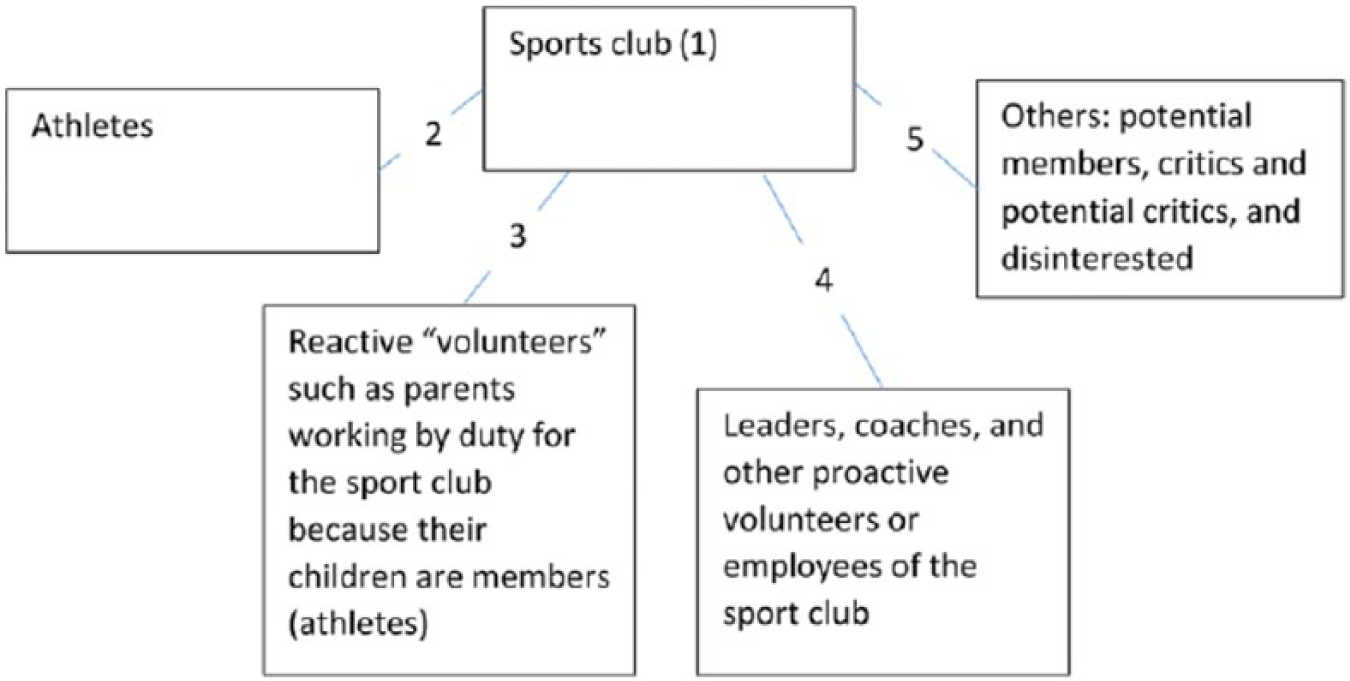
Different relationships between the sport club and the local community, where there are social and cognitive structures referred to as convention in the understanding of sport and the sport club.
Let us elaborate, with some examples stemming from our former research, which – as stated at the outset of this paper – stopped due to a lack of concepts dealing with how the community outside of a sport club influences the functioning of such a club and, thus, potentially sport policy implementation. When Skille (2010) studied sport clubs as potential health providers, he found that they were primarily a context for youth (and parents) interested in serious training and sport competitions. Working against the sport and health schema, the interpretations and actions from various actors inside and outside the sport club probably reproduced the convention of sport as competitive. Children join the club to compete in sport (line 2 in Figure 1) and adults contribute in order to organize training sessions preparing the children for competition and to organize the competition itself (lines 3 and 4). Even potential critics (line 5), by stating that the ‘problem’ (if the aim is to fulfil other social goods, i.e. health and integration) is the competitive focus (Skille, 2009, 2010; Stenling, 2013, 2014, 2015), repeat and confirm the convention.
The various relationships between the sport club and the community all depend on social and cognitive structures. The social structures are shared beliefs that lead to regulated behaviour among the citizens of the community, while the cognitive structures are only present in the minds of individuals. The point is that, if for example, everybody (or at least a majority) in a local community believes that the community sport club has, say, a very competitive focus, it is hard to behave otherwise. It is so because the sport policy implementers (representatives of the sport club) also represent the community. One way for change to take place in a club that acts as a policy implementer is, therefore, through change in the composition of the club representatives. As Stenling and Fahlén (2014: 15), in the context of organizational identity, hypothesized:
the substitution of a large part of the membership cadre of the club, the election of a new board with a different orientation than the previous, spin-offs or mergers with other clubs; these are all situations in which the identity construction process can start from a relatively clean slate.
The point is that policy implementation depends on the focal sport club and its place in the local community. Following on from this, the change of a sport club convention depends in turn on the traffic between the outside and the inside.
Conclusion
We support and build on Kay’s (1996) and O’Gorman’s (2011) approaches to the analysis of policy implementation through sport clubs, especially their criticism of top-down perspectives (Kay, 1996) and proposal of a more nuanced model (O’Gorman, 2011). We also build on Skille’s (2008) idea of understanding club-level policy implementation from the perspective of the club, and on Stenling’s (2014) emphasis on conceptualizing and empirically exploring the character of the implementer when analysing sport policy implementation. However, while the above reviewed approaches stop with the implementer, our contribution to research on the topic of policy implementation through sport clubs is twofold. First, with the concept of convention we argue for including the local community surroundings of the sport club in the analysis of sport policy implementation. The community comprises young athletes and other youth, parents of athletes and other adults, volunteers and paid people in the sport club and representatives of local and/or central sport authorities, etc. Consequently, and second, our contribution is the fact that we focus upon the relationship between the implementing sport club and its surrounding local community. The point is that club-internal conventions overlap with and are highly influenced by club-external conventions of sport, and vice versa and that the members of a local community are the members or potential members of sport clubs.
While this paper is primarily conceptual, we provide a few notes on issues of method related to the proposed perspective. In order to gain a deeper and broader understanding of policy implementation through sport clubs, we call for empirical research employing the convention concept and covering both the inside and the outside of the sport club as well as the relationship between them. Put differently, we call for research that takes both an inside-out and an outside-in perspective of sport clubs as policy implementers. Specifically, future research into sport policy implementation via sport clubs that includes the application of convention theory should draw on samples from both inside and outside sport organizations. Regarding the former, representatives from sport clubs, and representatives from other sport organizations, as well as from non-sport organizations in the community, could be put under scrutiny. Regarding the latter, a number of subgroups could be sampled for study: parents who are also representatives of sport clubs, parents of children playing sport who are not participating in club activities themselves and parents of children not playing sport. Moreover, a variety of types of sport clubs could be studied in order to find (potentially) comparative perspectives and conventions.
We suggest that the convention concept could be employed in sport sociological analysis in many contexts and layers other than local sport clubs. It could be used in the analysis of other types of implementers (than sport clubs), such as national or international sport organizations, or even combinations of national and international bodies. Furthermore, it could be used in the study of various kinds of sport policy topics. For example, research shows differences in implementing world anti-doping policy across countries (Hanstad et al., 2009), probably due to contextual variations of NADOs (national anti-doping organizations). With the convention approach, there could be an examination of how local or national contexts influence the operating organization (the NADO), instead of just a report on differences between organizations in various countries. Nevertheless, for reasons stated in the introduction, we have maintained a focus on sport clubs as policy implementers throughout our presentation.
Primarily, when aiming at broadening our conceptual understanding of sport policy implementation, the premise from the outset – that clubs and their surrounding communities are mutually constitutive – is an important starting point. The people in the community, citizens, so to speak, are, at varying times, consumers or producers, social clients or service providers, governors or implementers, interpreters and often just tacit legitimating actors in the operation of local sport clubs or in the implementation of sport policy. Ultimately, the community is as much the ‘implementer’ as the organization charged with formally carrying out policy. To our knowledge, this view of the dialectic – between the inside and outside of local sport organizations in the implementation process – is rarely (if ever) explicitly acknowledged. In this way, the paper offers new insight and suggests a way forward, by investigating sport policy implementation at the lowest level, where organizations meet target groups, and even taking into account the non-target forces or anti-forces that may influence the functioning of sport clubs and, therefore, the possibility of sport clubs operating as sport policy implementers. The double-sidedness of conventions (inside-out, outside-in) is an important consideration for understanding the mutually constitutive nature of cognitive structures (values, meanings, ideas, beliefs and interpretations), the social structures (written rules, shared values, and the like) and the practices operating in between.
Footnotes
Acknowledgements
The authors would like to thank Mike Sam as well as the anonymious reviewers for constructive feedback which helped improve the article.
Funding
The authors received no financial support for the research, authorship, and/or publication of this article.