







Abstract
Sport scandals have attracted significant interest within and beyond the sociology of sport. However, developing a theoretical understanding of sport scandals has so far been neglected. Therefore, the two-fold purpose of this conceptual paper is to outline a theoretical model for understanding the form of a sport scandal, and to construct two typical sport scandals that can assist us in theorizing and differentiating how sport scandals may have varying effects on society. In our work, we rely on insights on form formulated by the German sociologist Niklas Luhmann combined with notions of ideal types derived from Max Weber. Accordingly, scandals are described as examples of paradoxical forms where excluded meaning re-enters to create spaces of temporary liminality. Despite their common characteristics, we are able to construct two ideal types of scandals – bureaucratic fallacy and charismatic failure – to understand why scandals may have varying impacts on the environment.
Introduction
Sport scandals reflect tensions and controversies that can have implications for several spheres of modern society, such as mass media, politics, law and the economy. As pointed out by Palmer (2015), scandals inevitably fascinate audiences and represent ‘empirical gold’ (p. 558) for academic inquiries as they expose power elites and shady interpersonal networks (Doidge, 2018). In addition, they raise basic questions about power and legitimacy (Neckel, 2005) and the impact on organizational dynamics (Grolleau et al., 2021). Although a growing body of research (e.g. Abeza et al., 2020; Ludwig and Oelrichs, 2020) confirms that sport scandals are thoroughly and empirically investigated, the sociology of sport community also has an obligation to counteract the uncritical and often sensational approach used by mass media and in some areas of social research. Despite a few attempts to deepen our theoretical understanding of sport scandals, the vast majority of social scientific research still explores them in a non-theoretical way. There are, of course, exemptions (e.g. Brown et al., 2013; Doidge, 2018): for instance, Rowe (1997) analyses sport scandals in relation to celebrity culture and the role of the sport star in post-modernity, and thus – more than 20 years ago – directed our attention to how mass media communicate scandals. More recently, Baker and Rowe (2013) elaborate on how social media intertwine with emotions to accelerate the momentum of scandals, while Tangen and Gils (2020) use the Therese Johaug scandal to conceptualize it as a modern tragedy.
Hence, in this paper, we do not make a general claim that sport sociologists have not critically investigated sport scandals. Instead, we emphasize that the majority of research (beyond a narrow body of sport sociology studies) has prioritized empirical research as a method. Although this research, on the one hand, comprises a rich body of information on the individual and social consequences of sport scandals, on the other hand, it is clear that it has overlooked the theoretical understanding of the phenomenon. Following Swedberg’s reading of Weber (Swedberg, 2018), we need theoretical constructs that provide meaning to social science to transcend the ordinary (mass-mediated) use and understanding of for instance scandals. Once we have developed constructs, we are able to analyse the individuality of a single scandal and compare them. According to Palmer (2015: 560), ‘… sporting scandals can be analysed through a number of other theoretical lenses from the social sciences which can extend our understandings of them and their relevance for the sociology of sport’. Therefore, the aim of this paper is two-fold: first, we intend to outline a theoretical model for understanding the form of a sport scandal. We do so by drawing on the works of German sociologist Niklas Luhmann, whose work has rarely been applied to the sociology of sport outside of Germany (Bette, 1999; Cachay, 1988; Schimank, 1988; Stichweh, 1990) and Scandinavian contexts (Tangen, 2004a, 2004b; see also Thiel and Tangen, 2015 and Wagner et al., 2010). Second, adding to this model, and with inspiration from Max Weber, we construct two ideal types of sport scandals that help us theorize and differentiate how sport scandals may have varying effects on society.
We consider this piece as a conceptual paper and therefore refrain from conducting an in-depth empirical analysis. First, we briefly start by reviewing recent literature on sport scandals to argue for the need for and to pave the way for a theoretically informed understanding. Second, we introduce the theoretical foundations of Luhmann’s systems theory, which we subsequently link to Weber’s methodology. This enables us to construct two ideal types of sport scandals which are briefly linked to our conception of moral communication and the function of scandals. Based on the existing literature, we – third – engage with three examples of sport scandals that illustrate how our framework can be utilized. Rather than presenting a fully fledged model, we then outline three proposals for how scandals impact their environments. Finally, in our conclusion, we argue that our paper can be regarded as a starting point for future sociologically and theoretically informed research on sport scandals and thereby invite researchers to a future dialogue and deeper empirical investigations on the issue.
Recent research on sport scandals
Modern scandals seem to be unthinkable without taking the importance of mass media into consideration (Tumber and Waisbord, 2004). Much of the literature on political scandals (Dziuda and Howell, 2021; Entman, 2012; Lull and Hinerman, 1997; Thomson, 2000) departs from public revelations through mass media. According to Lull and Hinerman (1997), scandals differ from a moral panic approach as ‘… scandals must be traceable to real persons who are held responsible for their actions’ (p. 4). Although this personalization approach might seem logical to political scandals, we nevertheless problematize that scandals and a typology based on this assumption are limited to traceable real persons’ actions. We need to go beyond and look at the peculiarities of sport scandals for instance that sport garners enormous media coverage, while it is simultaneously governed by impersonal global bureaucracies, and balance and embed an ancient mythology derived from Greek Olympism and British amateurism with hyper-commercialization of athletic bodies (Rowe, 2019). This complexity urges us not to reduce the sport scandal to a media scandal triggered by individual actions per se.
The idea that scandals are mediated to a wider audience in combination with the increasing commercialization of sport (Connor and Mazanov, 2010) might explain why scandals hold prominent positions in sport marketing: they influence consumers’ behavior (Abeza et al., 2020; Lee and Kwak, 2016; Sato et al., 2015; Stanton and Johnson, 2012), have an impact on sponsors’ perceptions (Chien et al., 2016; Hughes and Shank, 2005, Kelly et al., 2018; Solberg et al., 2010), can weaken or dissolve business-to-business partnerships (Westberg et al., 2011) and illustrate how educational organizations such as universities are affected by athletic scandals (Hughes and Shank, 2008). Accordingly, the studies that primarily investigate the potential impact of scandals on business are less interested in sport scandals as social and cultural phenomena per se.
Sociologically oriented research has expanded the scope beyond a narrow business context by pointing to the complex interrelations between the business of entertainment, natural bodies and government policy (Carstairs, 2003). Researchers have examined the representation of scandals in mass media to gauge how gender-based violence enters a male-dominated discourse on gender (Toffeletti, 2007), how scandals actualize racism (Douglas, 2014), and to raise discussions about nationality (Laine, 2006) and national bias (Stepanova et al., 2009), or to reveal the uncritical approach of sport journalism towards powerful sport organizations (Rowe, 2017). Several contributions have investigated how crises are managed through counter communication (Brown et al., 2013; Frederick et al., 2021) and how interactions between a team and audience are undertaken to ensure credibility (Plassard et al., 2021), thus contributing to our knowledge about the dynamic and contested character of a sport scandal (Storm and Wagner, 2015). A significant stream of research has sketched out how sport scandals have led to organizational and regulatory changes, thereby confirming that sport scandals are more than temporary mass media phenomena: the 1998 Festina drug scandal created the momentum for the establishment of the World Anti-Doping Agency (WADA; Hanstad et al., 2008), the International Olympic Committee (IOC) bribery scandal led to governance reforms (MacAloon, 2011), and drug-related scandals such as the recent Russian crisis persistently sparked inter-organizational tensions between WADA and the IOC (Ohl et al., 2020). As shown in the study of unforeseen consequences of match-fixing, Tak et al. (2018) note that while countermeasures to a scandal can have comprehensive political impacts on power relations, they may also lead to normalization of a betting industry involved in a scandal.
The literature reviewed above confirms the notion of ‘empirical gold’ identified by Palmer (2015) when we examine sport scandals. It also underlines the predominant emphasis on investigating the impact and effect of scandals rather than elaborating theoretically on scandals as social and cultural phenomena. Baker and Rowe (2013), in their study of the Sepp Blatter racism scandal, deviate from this pattern by outlining how power and emotions are intertwined with new social media, showing how this unique feature of modern media ecology helps us understand why contemporary sport scandals accelerate with hitherto unseen ramifications in society. Recent attempts to develop typologies of scandals acknowledge that sport scandals cannot be viewed as uniform. Abeza et al. (2020) differentiate between 13 types of scandals to measure impact on consumption, whereas Ludwig and Oelrichs (2020) only distinguish between three categories. However, these classifications suffer by being constructed as real types that lack a solid theoretical foundation. Nevertheless, it is these typologies, as well as the few efforts to deepen our theoretical understanding of sport scandals that have motivated this conceptual paper, because they have taken the first steps towards understanding the form of a scandal, from which theoretical underpinnings can be explored.
Observing the form of a scandal as an analytical strategy
Most studies of scandals (e.g. Kantola and Vesa, 2013; Storm and Wagner, 2015) agree that they entail observations of an act of transgression and an event that signifies disruption and deviation from expectations. Thus, observing the form of a scandal as a sociological methodological approach is at the core of this analysis. In the latter stages of his career, Niklas Luhmann dedicated much theoretical attention to form as a unity of a difference (Luhmann, 2006), but as his sociology still remains unknown to large parts of the Anglo-Saxon community our paper departs from a short introduction to his oeuvre (see also Thiel and Tangen, 2015).
Luhmann redefined systems theory as formulated among others by Talcott Parsons. A central claim in this approach is that social systems consist of communication and nothing but communication (Luhmann, 1995). Whereas Parsons became notoriously reputed for functionalism, Luhmann’s theory adds a general perspective of conflict and tension (adopting various sources of inspiration such biology, mathematics, post-structuralism and symbolic interactionism) while simultaneously trying to describe how society is possible in a modern era despite the functional differentiation. Accordingly, his theory points towards how society is polycentralized and uncontrollable as societal systems such as politics, law, economy, and mass media, and – some will argue (Bette, 1999; Tangen, 2004b) – sport develop into autonomous systems operating according to their own self-referential logic and yet remain interconnected to society. Thus, for instance, the political system catalyses communication based on its own binary logic power superior/power inferior that becomes the lens through which the system observes its environment and orders its’ communication. Put differently, a social system, science, for instance, observes a phenomenon (e.g. sport) by distinguishing it from what it is not and subsequently integrates its observation in its own communication on its own scientific premises. Similarly, other societal systems such as the economy, law, politics or mass media integrate sport (and its scandals) into their own internal logic, which Luhmann describes as the system’s autopoiesis (Luhmann, 1995). This concept explains how for instance mass media once observing a scandal is able to integrate it, even produce, extend, vitalize, twist and emotionalize it according to its own communicative logic (Luhmann, 2000). Functional differentiation also illustrates the poly-contextuality of modern society. Each societal system views scandals according to its own premises and over time develops its own semantics on scandals. For instance, one can argue that scandals on doping in sport gradually become trivial in a context such as cycling whereas in a Norwegian context of Nordic skiing permeated by a proactive anti-doping policy it is the opposite (Tangen and Gils, 2020).
The theoretical assumption that modern society is functionally differentiated and that each system enacts a partial communication has an epistemological consequence, that is, that every observation has a blind spot, which also leads to an implication of how we apply Luhmann as a source of inspiration for analytical strategies. According to Andersen (1999), there is not only one but many ways to apply Luhmann’s theories. Depending on the distinction chosen, you will be able to see something – but not everything – based on his complex framework. In his magnum opus, Luhmann only dedicated a short opening remark to methodology, mostly drawing his critical approaches from existing methods applied in sociology (Luhmann, 1997: 36–43). Fundamentally, Luhmann transcends a theory of agency where a subject investigates objects. Instead, systems are defined as the difference (Luhmann, 2006) in which the systems observe and distinguish themselves through a difference between the system and its environment. According to Luhmann (1995, 2006), and inspired by the mathematician George Spencer-Brown (1969), this operation as a form can be defined as the unity of a difference. The form of observation thus contains two sides because every observation contains the distinction of a marked and an unmarked space. It is a distinction (a vertical difference) and a direction (horizontal orientation to indicate one side and not the other). Therefore, we must understand form relationally as constituted by the unity of this difference (Luhmann, 2006). In this way, sport as a social system is operationally closed as it vertically differentiates itself from other social practices (e.g. science or reading literature) by indicating horizontally what it is (e.g. competitive embodied practice).
However, formulating a general theory of society must also encompass ideas of scientific methods, that is, how scientists can study empirical reality, grounded in a theoretical framework. In the systems theoretical context, what Luhmann calls a second-order observation (Luhmann, 2002) makes up what other scholars such as Andersen (1999) have called an ‘analytical strategy’. Following from this idea is the notion that every observation of phenomena in a social system has a blind spot – the system cannot see what it cannot see (Luhmann, 2002). Only a second-order observation can reveal the blind spot of a first-order observation, but this second-order observation too has a blind spot. Thus, observations are fundamental operations of drawing distinctions. For instance, it can be argued that some social practices frequently appearing in sport like doping and overtraining are not observed by the sport itself as problems due to its internal win/lose logic. However, once observed by others (e.g. mass media, health care or politics) the problematics are articulated. From this perspective, performing a second-order observation represents an analytical strategy in which you observe how other observers observe. Applied to the context of this paper, our endeavour represents a second-order observation in which we observe how sport scandals are observed by other systems and how they are used in the communication of societal subsystems such as politics, mass media, law, and economy.
Therefore, we first use the distinction of ‘form’ and ‘medium’ (Luhmann, 1997: 190) to illustrate how we can theoretically grasp a sport scandal. We do so particularly in relation to Luhmann’s central conceptualization of meaning (Thiel and Tangen, 2015), as we argue that scandals temporarily disrupt the form of meaning. Although the medium is defined by Luhmann as a loose coupling of elements, form represents the strict coupling of elements. The form makes particular communication emerge and become observable for additional communication, while the medium guides it. If we define the medium called ‘meaning’ as a distinction between the actual/possible, and scandals as a distortion of the existing form of meaning (thereby creating transgressions), the form analysis enables us to observe how scandals are forms that collide with existing expectations of sport communication: You expect a winner to be decent, but s/he turns out to be a cheater; you expect an honest organization, but bribery or corruption is taking place, which dislocates the former stabilized social order. These distortions of meaning forms affect how other societal systems such as business, mass media or politics observe and integrate scandals into their respective communication. Accordingly, scandals create a temporary space of liminality (Kantola and Vesa, 2013) where a normal order is absent. Thus, the form of a scandal reveals a meaning paradox, as the excluded possibility suddenly enters on the marked side of the form (as actuality), disturbing existing meaningful distinctions. The form of a scandal will therefore look like this (Figure 1)
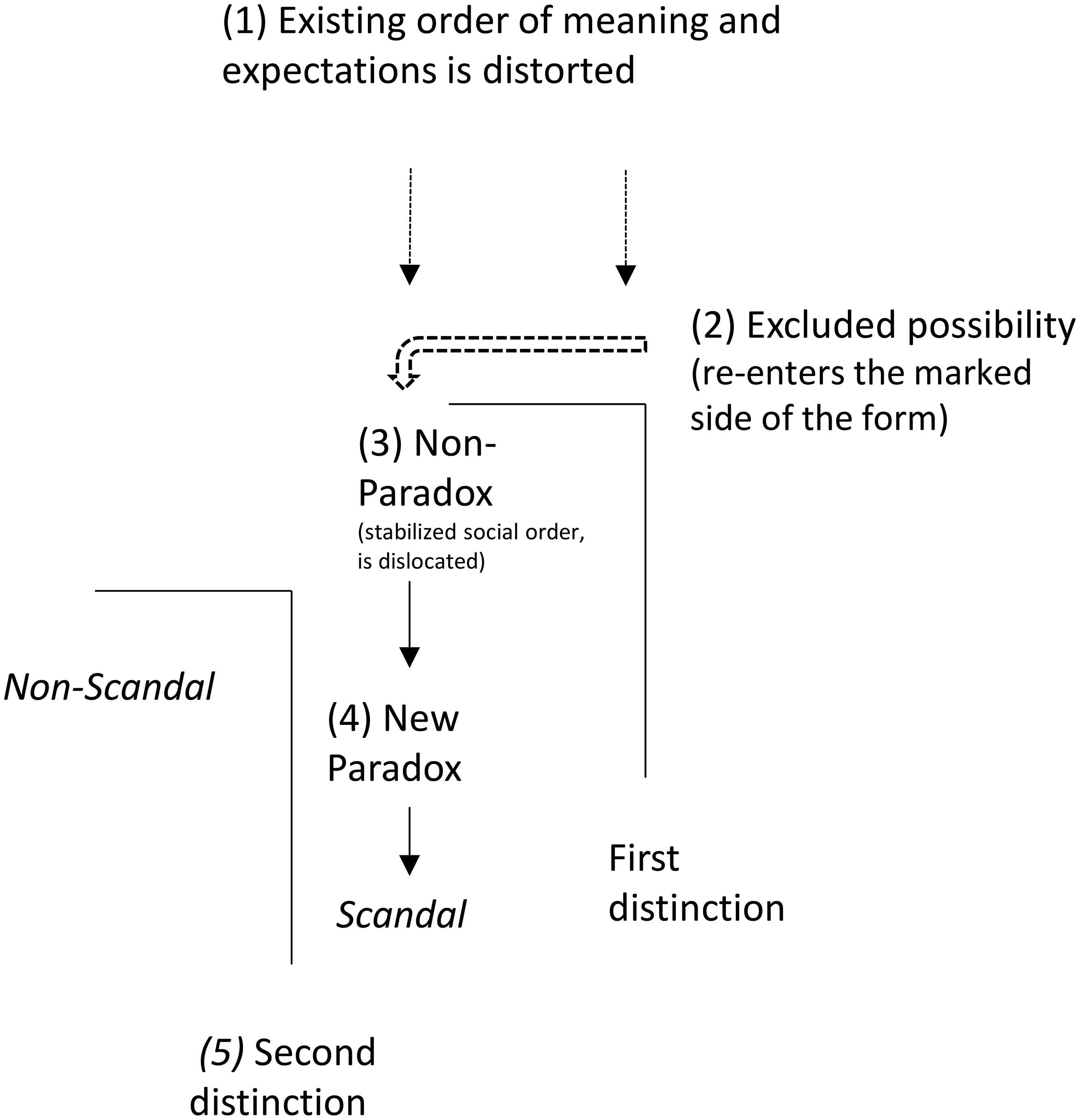
The establishment and form of a scandal.
To address our second aim of the paper, we need to ask the question: why do some scandals have a huge impact on society, leading to substantial organizational changes, while other scandals have limited impact despite attracting massive media attention? To answer this, we need an analytical tool that enables us to subcategorize various sport scandals away from their common features. Variations of form affect additional spheres of society, such as mass media, law, politics and the economy, in different ways. This takes us in the direction of Weber’s ideal types. Our main critique and additional contribution are that the systems theory formulated by Luhmann encompasses a rich and fruitful theoretical understanding of society; however, when it comes to empirically based analyses, it is still in embryonic form.
The second analytical strategy derived from Luhmann is his distinction between system and environment (Luhmann, 1995), that is, how systems in the environment of sport observe scandals. Hence, we will combine two possible analytical strategies derived from Luhmann (form/medium and system/environment analyses, respectively) and develop the latter further by introducing Weber (2003). In this way, we will outline how scandals – once they are observed – have an impact on other parts of society.
Understanding ideal types
For some, it may seem far-fetched to combine Weber and Luhmann. Scholars have criticized Luhmann’s conceptualizations for lacking comparability (Greshoff, 1997), and one must also be aware of crucial differences. Weber represents methodological individualism, emphasizing causality and individual action as points of departure (Swedberg, 2018). Luhmann, however, strictly excludes a psychic dimension/subject category from his communication theory, explicitly arguing for a structural approach (Bjerg, 2005). In contrast to Luhmann’s work, the Weberian legacy is rich in methodological issues, which, for instance, has made Weber a central figure in a methodological discipline such as the comparative social sciences. Similarly, Weber never claimed to outline a general theory of society despite his attempts to explain macro-phenomena such as the rise of capitalism (Weber, 1995 [1904]). Despite these differences, we will argue that there are similarities that enable us to combine the works of these two scholars. One can argue that both Weber and Luhmann consider meaning as a core concept of social science, whereby ‘action’ in a system’s theoretical context becomes a meaningful system provided ascription (Heidenescher, 1992). In this way, both scholars outline their theories beyond the structure/agency dichotomy. For Luhmann, meaning is a central category in sociology and serves as a medium shared by both psychic and social systems (Luhmann, 1990a, 1997). Weber applies meanings to denote their effects (restraining as well as directing) on other meanings and on action (Lindbekk, 1992).
Furthermore, both Luhmann and Weber distance themselves from positivistic approaches that have led social scientists to the conclusion that you are able to analyse reality per se (Bruun, 2008). Fully in line with his fundamental assumptions of autopoiesis, Luhmann (2002) stresses that scientific observations that tend to describe ‘reality’ are nothing but self-descriptions of the social system itself. As formulated by Bruun (2008), with reference to Luhmann: ‘We have to acknowledge the inbuilt circularity in our epistemological reflections’ (p. 114). Weber also distances himself from an objectivity claimed by the natural sciences, 1 but insists that objectivity should be what social sciences strive for (Weber, 2003). What becomes an important (meaningful) object of study is a matter of values infused by the researcher (Swedberg, 2005).
One can argue that Weber’s methodology is based on a paradox, which becomes clear once we turn to his ideal types. On the one hand, he describes ideal types as a construction made distinct from empirical reality. Thus, ideal types represent subjective constructions made by the scientist (thought images) to describe a phenomenon in its pure form, and not how it occurs once it is confronted with empirical reality. In that sense, it represents a one-sided exaggeration and is dependent on the elements used for this construction (Burger, 1976). On the other hand, Weber argues that once you have constructed ideal types as a means for analysis, they will contribute positively to a perception of concrete cultural phenomena, their causal dependency and their significance (Weber, 2003). This oscillation between imagined conceptual constructs and applied analysis can be characterized as a ‘methodological ambivalence’ (Oakes, 1982).
We acknowledge that ideal types are based on a paradox. You want to see the true reality but you do so by subjectively constructing and applying ideal types distinguished from empirical reality. Ideal types become ‘…neither truly general concepts nor individual ones’ (Burger, 1976: 121). Nonetheless, according to Luhmann, paradoxes are productive (Luhmann, 1990a); and based on this approach, we decide to use the paradoxical ideal types in a productive manner.
We admit that scientific observation does not grasp reality in its totality. It represents a partiality and has its blind spots, but at the same time, we strive for a comprehensive framework that enables us to categorize sport scandals. As summed up by Lindbekk (1992: 289): ‘Cultural research derives from value-related commitments on the part of the researcher, and has meaning complexes as its most important subject’. Our observations must be anchored in empirical findings, and we must constantly reflect on the paradoxical balance between subjectivity and objectivity, between partiality and totality. By doing so, we apply ideal types as thought images that enable us to observe various sports scandals in relation to their impact. We do this by constructing two ideal types of sport scandals. From an analytical perspective, we briefly outline how scandals in their pure form conflict with and diverge from expectations engendered by the sport system. Therefore, the ideal types represent scientific constructs that seek to categorize forms of scandals – although we are aware that these scandals should be seen in their unique singularity.
Ideal types are not a normative perception of trying to figure out the ‘best’ or the ‘real’ scandal. We describe ideal types as if sport scandals can be defined solely in this pure form. In reality, parts of the pure form will be represented and/or it will be made up of combinations with other forms. In our construction of the ideal types, we are inspired by how Burger (1976: 160–167) lists the principles of their use. First, we create the ideal type by imagining its pure form (1). Subsequently, we specify the key features that are characteristic of a given ideal type. These key features are dichotomized to allow for better categorizations (2). We are then able – by referring to the ideal type – to outline how a given scandal fulfils the features provided by the various ideal types (3). In turn, this enables us to compare the scandals and analyse how they either exclude or combine features. In this way, we aim to get closer to an adequate description of various individual sport scandals despite their common features. On the basis of the two ideal typical scandals, our next step is to introduce three-sport scandals and show how they are situated within our analytical framework.
Since this is a model in spe, our empirical knowledge is not derived from in-depth empirical studies (such as large text analyses, interviews, or field observations). Instead, we base our knowledge on existing scientific and mass media literature on sport scandals, despite the fact that this body of literature, of course, bases itself on other theoretical and methodological approaches than those presented here. Finally, we turn to a discussion of the scandals’ impact. This is what we previously defined as our system/environment analysis, that is, how a given scandal is able to influence specific systems in the environment of sport. As part of the conclusion, we present suggestions for future research pathways.
The ideal types of sport scandals
Using Weber in sport science is not unique. The historical roots of modern sport have been analysed through a Weberian lens (Guttmann, 1978), and the use of ideal types is not an unfamiliar approach in contributions to the sociology of sport (Christiansen et al., 2017; Giulianotti, 2011; Kelly and Waddington, 2006; Mullan, 1995). On the other hand, constructing ideal types is perhaps not fully established as a method within social research (Hadorn, 1997; Swedberg, 2018). Nevertheless, as argued above, we believe this methodology adds a fruitful dimension to the theoretical underpinning inspired by Luhmann because it enables empirical application rather than only building an abstract theory.
We construct two ideal types that enable us to categorize how scandals deviate from existing expectations in sport and society. Seen from this perspective, the ideal types of scandals outlined below represent displacements of meaning where the excluded possibility suddenly appears as the actuality – on the marked side of a form. 2 From both of these two ideal types we construct three key features, which, for the purpose of the application, we dichotomize (by asking whether they are present (yes) or not (no)). While recognizing that such dichotomization represents a reduction of otherwise complex phenomena, we do this to end up with the two ideal types and the following scheme (see Table 1, which outlines the characteristics of the two ideal types), which can be applied to analyses of a sport scandal’s impact. We are, of course, also aware that maybe two ideal types do not adequately comprehend all sport scandals. Thus, we see this as a starting point for future extensions rather than a fully fledged model.
Operationalization of ideal types.
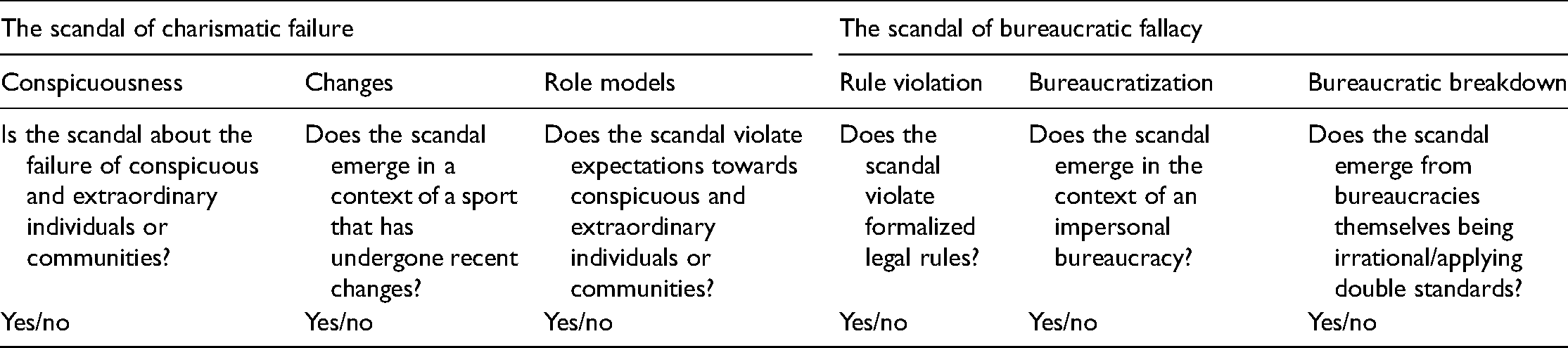
The scandal of charismatic failure
This ideal type is defined as a sport scandal that arises due to the failure of high profile individuals, such as role models or superstars, or of a particular community within a sport. Through their performance or extraordinary skills, the charismatic individual or community contributes to the meaningfulness of their sport. Their achievements create certain expectations and regimes of domination that are violated once the scandal emerges. Charismatic success personified by an entrepreneurial athlete is often related to (continuous) changes of existing traditional patterns within the sport. This kind of evolutionary dislocation is characterized by an intensified focus on individual or community failure, on persons to whom the significant agency is ascribed as drivers of change.
The scandal of bureaucratic fallacy
This ideal type encompasses the fallacy provoked by rule-breaking behavior. It can either be the bureaucracy itself or the athletes that violate explicit, written rules. It emerges in sport settings with a high degree of rule management, professionalization and bureaucratic organization. Rational–legal domination provides meaningful expectations that, once violated, lead to scandals. In its ideal form, bureaucracy is an impersonal apparatus serving efficient rational goal achievement developed over a longer period of time. This kind of scandal is often related to bureaucracies that suddenly apply double standards and/or behave irrationally by not following their own rules.
Moral communication and the function of sport scandals
Despite their genuine differences, these two ideal typical scandals share the characteristic that moral communication emerges in the early scandal phase which is generally acknowledged across the spectrum of scandal research (Adut, 2008; Storm and Wagner, 2015; Thomson, 2000). We follow Luhmann (1990b) here that moral communication is ambivalent. On the one hand, a functionally differentiated society is not constituted by a higher universal morality. This implies that scandals in our view are not conceptualized as ‘events wherein moral boundaries are transgressed’ (Lull and Hinerman, 1997: 16) as if a higher-level moral order guides how meaning structures are created. On the other hand, this, however, does not imply that moral communication is non-existent, rather the opposite seems to be the case. Moral communication guided by a distinction between esteem/disdain occurs closely related to tension and conflicts (Luhmann, 1990b). Our argument is that exactly because scandals represent a temporary distortion of the expected form of meaning, moral communication constitutes the liminality in the early phases of a scandal. It initiates an emotional engagement beyond the sport itself for instance in mass media, business and among political actors (Storm and Wagner, 2015; Tangen and Gils, 2020) once meaning structures get blurred. It is a period of time where existing orders and meaning structures break down in which systems such as business, politics or mass media apply moral communication in addition to their existing communication.
A hasty conclusion could then be that scandals endanger communication on sport from systems perspectives of business, politics and mass media. We claim the opposite: moral communication and scandals function as a means for temporary actualization of the excluded side to emphasize how sport should be observed and integrated into their respective autopoietic communication. For instance, under normal conditions, mass media benefit from sport by using it as relevant information about athletic performance and by conserving a myth sport that contains what Rowe (2019) defines as a ‘cleavage between its idealised past and its prosaic present’ (p. 327). Paradoxically, scandals become a sudden reminder of how mass media under normal circumstances prefer sport to be by highlighting its excluded otherness (what it is not). Mass media’s own logic guides that it is able to create sports heroes but also to tear them down (Wenner, 2013). Accordingly, scandals become a matter of boundary definitions. Athletes’ transgressive behavior for a while actualizes how business communication does not expect for instance a sponsor object to behave, or how sport is not able to stimulate political communication on power superiority/inferiority. Thus, scandals function as temporary incidents where systems are able to reflect upon their own communication by observing the system boundary guided by a moral code. But as societal systems are not constituted by a higher morality the esteem/disdain distinction is (or at least tried to be) recoded back into an existing distinction once scandals are stabilized in an after-phase. In that sense, sport scandals are conserving societal systems’ communication and re-establishing meaning structures rather than fundamentally threatening the order. Accordingly, we do not necessarily see scandals as a ‘reset button’ to change an organizational culture as discussed by Grolleau et al. (2021), but more and inspired by Brenton (2019) as temporary incidents that – rather than undermining – function to reinforce the collective beliefs in sport as an institution (or more precisely in sport as a societal system).
Three scandal cases
Case A. Tonya Harding versus Nancy Kerrigan
Prior to the Olympic Winter Games in 1994, the two rival American figure skaters, Tonya Harding and Nancy Kerrigan, were expected to compete at the US trials. In the days leading up to the event, a gang of three men, led by Harding’s ex-husband, attacked Kerrigan. Kerrigan was unable to compete due to her injuries and was thus no longer able to qualify for the Olympics. Tonya Harding, though not accused of being directly involved in the attack, was declared guilty of being aware of the conspiracy (Mayas, 1995). In March 1994, Harding pleaded guilty to hindering prosecution by a disciplinary hearing carried out by the United States Figure Skating Association (USFSA). The case attracted massive mass media attention. Tonya Harding’s lower-class background was a major issue (Foote, 2003) and ‘white trash ethnicity’ also became debated (Krause, 1998: 35). Harding was well known for her powerful and athletic (masculine) style in a sport discipline where gender roles were traditional and anchored in middle-class ideals. Thus, Harding represented a conspicuous figure skater who had added innovative elements to a hitherto conservative discipline underpinned by traditions and tacit rules. In contrast to Harding, Nancy Kerrigan, who also had a working-class background, fit better into the traditional gender stereotypes. The charismatic nature of the individuals involved and the dramatic nature of the incident indicate that this scandal would score highly as an example of ‘charismatic failure’.
Harding did not violate any sports laws per se, so the scandal has a low score on a bureaucratic fallacy. The case was one of off-field criminal misconduct, which, although motivated by sporting competitiveness, did lead to a debate about civil laws in relation to sports laws (Lassiter, 2007). But it did not lead to lengthy debates about new sporting regulations and legal procedures. In June 1994, a USFSA panel stripped Harding of the titles she won in January (Krause, 1998). This boundary issue also restricts the extent to which sport-governing bodies can pose sanctions.
Case B. Festina drug scandal
The Festina drug scandal emerged prior to and during the 1998 Tour de France, revealing systematic drug use in professional cycling (Mignon, 2003) and subsequently leading to the creation of the WADA (Houlihan, 2002; Hanstad et al., 2008). Prior to the investigation initiated by French public authorities, international sport-governing bodies such as the Union Cycliste Internationale (UCI) and the IOC had gradually introduced anti-doping measures and intensified their rhetoric against prohibited drug use (Wagner and Petersen, 2014). The drug scandal accelerated in momentum to the point where implementing measures to combat doping in sport became an important political topic and an issue of global legislation (Houlihan, 2004). Thus, despite the scandal emerging in professional cycling, it had ramifications for all kinds of sport due to the perceived political and administrative need to create a uniform set of rules for all disciplines. We characterize this scandal as ‘major’, as it has had a huge impact on its environment, first and foremost with the creation of WADA through legislation enabled by the ratification of the 2005 Paris treaty under the United Nations Educational, Scientific and Cultural Organization, and through the emergence of new bureaucratic efforts.
Until 1996 professional cycling was not a part of the Olympic program: several of its events were run by the commercial organizer ASO, and the majority of teams did not belong to clubs or national federations but were instead run by sponsors and/or industry-related companies, such as cycling equipment manufacturers. In addition to scoring highly in bureaucratic fallacy, this case also has elements of charismatic failure. The use of performance-enhancing drugs was a widespread practice that was integrated into professional cycling throughout the 20th century (Dimeo, 2007), but the sport was largely socially isolated from other disciplines. Yet the prevailing, outward narrative of cycling was about the dedicated individual’s struggle, with great effort and willpower, to conquer mountains and win spectacular races or stages. Accordingly, the discourse of systematic and organized substance abuse that suddenly emerged led in addition to a scandal of charismatic failure.
Case C. Federation Internationale de Football Association and the Havelange/Joseph Blatter era
Federation Internationale de Football Association (FIFA) has been associated with various corruption scandals over the years, particularly during João Havelange and Joseph Blatter’s terms of presidency. João Havelange was FIFA’s president from 1974 to 1998. Joseph Blatter succeeded him in 1998 and left the position in 2015 (Rowe, 2017; Tomlinson, 2000, 2014). However, it was not until May 2015, when the Swiss authorities arrested 14 football officials and executives on charges of corruption, that the existing external pressure evolved to such an extent that FIFA president Joseph Blatter was forced to leave the organization (Storm and Solberg, 2018). Previous scandals linked to the organization had been successfully swept under the rug without having implications for how the organization functioned (Tomlinson, 2014).
The incidents in 2015, however, must be seen as ‘major’ in the sense that they had a huge impact beyond mass media mentions. FIFA is a very powerful organization that is capable of making decisions that determine how billions of dollars are allocated (Meier and García, 2015). Therefore, these scandals had huge consequences and we see them as an ideal type of scandal representing bureaucratic fallacy. First, it can be argued that the practices that led to the 2015 incidents involved violations of legal rules (rule violation). According to Sugden and Tomlinson (2017), corruption was part and parcel of FIFA’s organizational practices for years before being finally investigated by the public authorities in 2015. Second, it can be argued that the 2015 incidents emerged in the context of an impersonal bureaucracy (bureaucratization), because it seems clear that Havelange and Blatter both used the bureaucracy established in FIFA as a means to further their own interests (Sugden and Tomlinson, 1998a). Clear breaches can also be found in relation to our third subcategory on irrationalities/double standards (bureaucratic breakdown). FIFA’s externally communicated aim to spread football globally ‘for the good of the game’ was a stark contrast to the organization’s reliance on illegitimate and corrupt practices internally (Tomlinson, 2014).
Furthermore, it can be argued that an impact can be identified with regard to charismatic failure where we see scores in all three subcategories. First, the FIFA scandals emerged from the practices of dominant and conspicuous sport leaders in one of the world’s most popular sports. Second, FIFA had initiated various good governance practices over the years to prevent scandals from emerging. However, all these were bogus measures to cover illegal practices, thus showing clear breaches of this subitem. Third, the FIFA practices clearly violated external expectations of powerful sport organizations to operate legally and follow general good governance procedures. Therefore, the FIFA scandal scores highly when it comes to both bureaucratic fallacy and charismatic failure (Table 2).
Overview of the three-sport scandal cases.
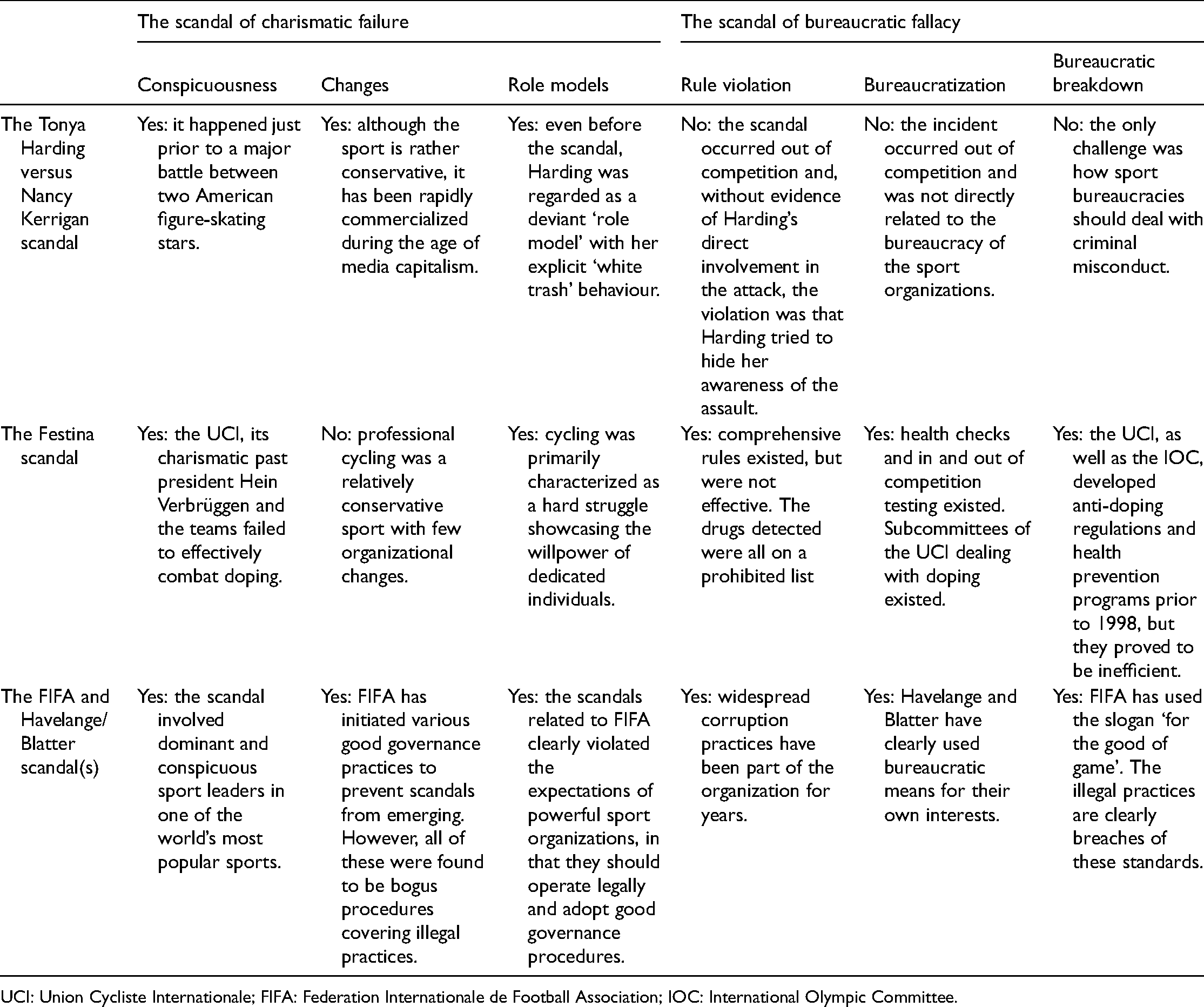
UCI: Union Cycliste Internationale; FIFA: Federation Internationale de Football Association; IOC: International Olympic Committee.
Scandals’ impact on their environment – three proposals
This section discusses how various societal systems such as the law, politics, economy and the mass media observe sport scandals and the extent to which they incorporate these observations in their subsequent communication. The discussion leads to a number of proposals, which (in their preliminary form) are outlined below. A basic precondition is that to be defined as a scandal per se, there has to be a significant impact on the mass media (Kantola and Vesa, 2013; Storm and Wagner, 2015; Tumber and Waisbord, 2004). Impact on the mass media acts as a kind of precursor for impact on the law, politics and economy. This is not surprising given the integrated sport–media nexus (McGaughey and Liesch, 2002; Rowe, 2004) – or, to use a concept put forward by Luhmann (1995), the relationship represents a particular structural coupling that enables mass media to be sensitive towards and stimulated by sport to reproduce mass media communication. The following proposals should be seen as an invitation for further research and debate rather than a fully fledged hypothesis derived from numerous empirical studies.
Proposal 1
Scandals that score highly in terms of charismatic failure have a huge and enduring impact on the mass media, but not necessarily on political and legal systems. Individual athletes with charismatic features or stories attract mass media attention and evoke emotional responses on social media (Baker and Rowe, 2013). The Tonya Harding scandal led neither to new political orientations nor to new legislation. But scandals like hers can have a powerful impact on business economies (Tak et al., 2018), because businesses are more sensitive to scandals of charismatic failure (see review above). This may explain why investigating the effects of scandals has gained momentum in sport marketing research. Scandals of charismatic failure often result in celebrity-endorsing sponsors being forced to withdraw from their agreements with disgraced sporting stars. Sometimes the scandal does not only raise moral questions for the sponsor but can also come into direct conflict with the sponsor’s brand. For example, when South African para-athlete Oscar Pistorius (aka. ‘The Bladerunner’) shot and killed his girlfriend, his sponsor Nike’s slogan ‘I am the bullet in the chamber’ suddenly had eerie connotations in face of the tragic situation.
Proposal 2
Scandals with a high score related to bureaucratic fallacy have a huge impact on politics and the legal system in addition to their mass media impact. Bureaucratic fallacy seems to have a much greater impact on politics, and subsequent legislation, than charismatic failure – perhaps because the political and legal systems’ own self-description relies on the idea of bureaucracy. Sport bureaucracies such as the Olympic movement have always emphasized their autonomy, implying their ability to govern and legislate in sporting domains with little direct political interference. Once these bureaucracies are revealed to be operating in an inappropriate or inconsistent manner, politics – backed up by state bureaucracies – threatens to take over. The Festina scandal is a good example of how sport, and the IOC in particular (Hanstad et al., 2008; Wagner and Pedersen, 2014), defended its autonomy; but as its inability to follow good governance principles became evident, the political system interfered, leading to new legislation.
The economic system may also be affected by these kinds of scandals, thus turning the case into a financial issue too, for instance by negatively affecting sponsors or initiating a public debate on whether public money should be spent on sport. However, the power of the bureaucracies affected by scandals can alter their impact. FIFA has for decades been able to resist interference from the political system, thus avoiding any legislation against its endeavours. Bureaucratic fallacy does not automatically have an impact on the political system when powerful and global bureaucracies such as FIFA occasionally outmanoeuvre the political apparatus.
Proposal 3
Mass media attention is a precondition for both types of sport scandals to develop into scandals. However, we propose that due to the innate relationship between celebrities/high profile figures and scandals (Rowe, 1997), and the intertwinement of emotions and social media (Baker and Rowe, 2013) scandals of charismatic failure will persist in mass media contrary to scandals of bureaucratic fallacy. The recent study by Ludwig and Oelrichs, based on German media coverage of scandals (Ludwig and Oelrichs, 2020), concludes that high celebrity status results in a higher number of articles per case compared to scandals involving less known celebrities. Accordingly, modern mass media are sensitive to and easily integrate charismatic failures into their communication streams. In 2017, the mockumentary-style movie ‘I, Tonya’ revisited this case in mainstream cinema, indicating the prevalent emotional fascination about charismatic failure in mass media.
Conclusion and future research
Sport scandals represent empirical gold (Palmer, 2015) and are well documented in social scientific studies beyond the sociology of sport. But our theoretical sociological understanding of sport scandals and how they differentiate has been less developed, which was the motivation for this conceptual paper. Through a Luhmann-inspired understanding of meaning as a form that distinguishes between actual/possible, we argue that sport scandals represent paradoxical forms where excluded possibilities suddenly actualize. This creates spaces of liminality that blur existing expectations towards sport and paves the way for temporary moral communication that allows systems to reflect upon their boundary and actualize how sport should be observed by other systems. Using ideal types, as proposed by Max Weber, in combination with concepts from the German sociologist Niklas Luhmann enables us to describe two different forms of scandals. Ideal types are conceived as thought images that provide the basis for categorizations, thus fostering a model that can be empirically tested in future studies on the subject. Hence, we construct two ideal types of sport scandals – the scandal of bureaucratic fallacy and the scandal of charismatic failure. Applying Weber’s theory to the sport scandal contributes further to developing the empirical application of systems theory.
Despite being a conceptual paper, we briefly provide examples of how this methodological design can be applied to three cases of sport scandals. Subsequently, it allows us to outline three proposals on how different sport scandals have different impacts on societal systems. We invite other scholars with an interest in the subject at hand to apply, modify, criticize and even reject these proposals.
A question connected to our theorizing – which is outside the scope of this paper to answer – is why some organizations involved in huge scandals remain relatively uninfluenced by other spheres/subsystems of society (see Grolleau et al., 2021). Our study thus far has elaborated on scandals from a meta-perspective (societal systems) whereas Luhmann’s theory operates with organizations and interactions as social systems too (see Thiel and Tangen, 2015). Inevitably, this raises questions on interpersonal and organizational levels about the power to resist or change that other studies on sport scandals have explored (Baker and Rowe, 2013; Doigde, 2018; Tak et al., 2018). The argument is that our theoretical elaboration can be enriched by a future dimension on power, which paves the way for organizational and interpersonal studies of how to manage and cope with sport scandals. To extend the discussion on power and governance, this perspective also raises the question of the possibilities and constraints of the nation-state towards sport. Many sport organizations are truly global and some were even founded prior to any notions of globalization. Many of them are also umbrella organizations that can be viewed as powerful meta-organizations (Ahrne and Brunsson, 2008) built upon other organizations. As such, they become embedded in a complex global–local network with different layers of interdependencies. They can also be seen as International Non-Governmental Organizations that have the capacity to foster top-down institutionalization processes (Boli and Thomas, 1997). Therefore, large organizations such as FIFA or the IOC, which operate at a global level, also have the resources to circumvent nation-state policies (Meyer et al., 1997).
Extending our theoretical understanding of sport scandals is a first step towards exploring the question of why – and how – some of the bigger scandals leave sport organizations relatively unaffected while others experience significant impacts in relation to legal and political systems. Our suggestion is to distinguish between charismatic and bureaucratic scandals as a starting point if we want to understand the varying effects on society.
Footnotes
Declaration of Conflicting Interests
The authors declared no potential conflicts of interest with respect to the research, authorship, and/or publication of this article.
Funding
The authors received no financial support for the research, authorship, and/or publication of this article.
