







Abstract
Private football academies challenge the monopoly of Norwegian voluntary and democratic sport. Using field theory and framing approach as analytical perspectives, this article presents a media analysis that reveals that, first, association football and private academies agree on the fact that Norwegian football is not good enough and must improve. Second, they disagree on whether to improve it within association football exclusively or supplemented by private actors that are inspired by the international football field. Third, there is a negative popular view of private academies as too expensive, unconcerned with children's best interests, in violation of Norwegian sport's regulations for children's sport, and—in sum—thus being accused of destroying ‘sport for all’. However, by employing the analytical concepts of habitus and fields, the article also shows how actors partake in several subfields—often on both sides of the private—association border.
Football (soccer) is the most popular sport of our time (Florio and Miller, 2022). As such, football as an organized social practice can act as a litmus test for broader processes of change in sport. That is, if taken-for-granted doxic arrangements (Bourdieu, 1990) are challenged in football, they can stimulate discussions with implications for changes on a broader scale. In Scandinavia, such discussions have come to the fore, as sport as a voluntary and democratic phenomenon (Green et al., 2019) and the “Norwegian model” comprises specific regulations for children's sport and guidelines for youth sport that aim at providing sport for as many as possible and for as long as possible (Skirstad et al., 2012). However, although faced with an increased competition from international counterparts and actors in the private sector, Norwegian sport in its current form, still holds a unique position as a strong (and possibly end-stage) bastion of organized sport and retains a doxic monopoly on training and competition. In this paper, we focus on a relatively recent trend in Norwegian football that challenges this monopoly, namely private football academies.
Change—especially change that challenges the values of an established model or the public opinion about popular phenomena, propels media debates in which multiple actors articulate views on how problems should be understood and addressed, and predict the consequences of different courses of action. In turn, such strategic communication carried out in the public sphere may stimulate field-internal transformations (Stenling and Sam, 2019) and provide an opportunity to discuss phenomena and processes such as monopolies, professionalization, and doxa. Some empirical observations indicate that the established model of Norwegian football is currently being challenged. One example is the increased professionalization of football clubs, in response to which the national football association (Norges Fotballforbund; NFF) has initiated the “quality club” project that has as its prime focus the administrative standardization of football clubs (Seippel, 2019). Another example is the burgeoning trend of establishing and developing football academies in football clubs, intertwined with the elite football association's (Norges Toppfotball; NTF) introduction of an “academy classification” system (Lürssen, 2017). Significantly, the establishment of private football academies further challenges the established practice of athlete development within federated clubs (Bjørnskau, 2017). Taken together, these processes have initiated a media debate about the values that apparently confront the dominant actors in the field: clubs in the NFF.
In theoretical terms, private academies (PAs) challenge the doxa of Norwegian sport as a field and create heterodoxy, a state in which established organizations assume an orthodox attitude to protect established values and practices (Bourdieu, 1990). Given the public interest in football, a media analysis is an apt approach for unveiling the power struggles that have ensued when a new actor (PAs) enters the football field dominated by association football (AF), an umbrella term for mainstream football organizations from football clubs to the NFF. We do this by exploring the arguments for and against PAs put forth in media debates, the subject positions of argument conveyers, and the tensions in underlying values revealed by debates. To this end, we investigate how private football academies are depicted in the Norwegian media; for example, are they seen as supplementing, developing, disturbing, or threatening “Norwegian football”? Specifically, we are guided by the broad open question How is voluntary organized sport challenged by private actors? The concept of framing (Benford and Snow, 2000) allows us to operationalize this question in the following manner: How are arguments regarding private football academies framed in Norwegian media?
In the following, we elaborate on the rationale for the study and provide additional context. Thereafter, we present the theoretical perspectives of fields (Bourdieu, 1990) and framing (Benford and Snow, 2000). This is followed by a description of the details of our qualitative media analysis, presentation of results, discussion, and concluding remarks.
Context and rationale
AF is “the world's game” (Murray and Murray, 1998), in terms of both active participation and passive consumption. According to Bennike et al. (2020), in 2026 “FIFA suggested that over 265 million people played the sport at some level, 5 million participated as officials or referees at matches, and several previously under-represented groups’ participation, such as women, was increasing” (p. 2; Nielsen, 2018). Since football reached Norway in the late 1800s, it has expanded rapidly, especially after the establishment of the NFF in 1902. Today, there are 1765 football clubs in Norway (NFF, 2020). As described by Goksøyr and Olstad (2002), Norwegian football's development has undergone three historical phases: educative, popular, and commercial. Since Goksøyr and Olstad's (2002) text 20 years ago, commercialization has moved beyond the internal development of sport organizations. We suggest that this indicates the establishment of a hybrid fourth phase characterized by the emergence of actors within and outside AF who offer individualized player development services in exchange for a fee (Antwi and Hauso, 2018; Trikalis et al., 2014).
For decades, large European clubs have sought to develop young players “in-house” by enrolling them in academies owned and run by the clubs (ECA, n.d.). However, research covering this phenomenon so far has not included topics in line with and of relevance to a sport sociological inquiry. Instead, focus has been placed on topics such as injuries (Deehan et al., 2007), technical skills, and testing (Kelly et al., 2020), to name but a few examples. Somewhat closer to our field, but still not within the scope of the primary interest of the sociology of sport, there is also some research on player development from sport psychology (e.g., Harwood, 2008; Harwood et al., 2010) and coaching science perspectives (Mills et al., 2012, 2014). In addition, Darby (2012) has investigated football academies in a critical anthropological way, focusing on academies’ role in moving labor from Africa to Europe.
Most relevant to the present study is Platts’s (2012) investigation of welfare and education in professional football academies. He explored whether, in such academies, players gain a skill to fall back on (given the fact that not all succeed in getting a professional contract and drawing a salary from football after their time in the academy time). Platts's findings indicate that socialization within the academies is primarily related to football skills and that academic competence is not prioritized. In turn, he pointed to the relevance of investigating football academies through a sociological lens but did not cover the academies’ role and position in broader contemporary debates about the legitimacy of their very existence and how they, as private actors, may challenge existing ideologies and organizational models.
Contextually, Norwegian sport organizations’ based on individual memberships and non-profit and non-governmental characteristics place them in the voluntary sector (Ibsen, 2021). Furthermore, their reliance on volunteers means that tasks (for example, coaching), are often performed by people without specific education (Petersen et al., 2017; Skille and Säfvenbom, 2011). In terms of organizational structure, sport organizations are part of a federative system based on representation, where structures and practices ensure that organizations are governed by their members (Enjolras and Waldahl, 2010, 2010; Ibsen, 2021; Sam and Ronglan, 2018; Warren, 2000). As such, sport is viewed as democratic, but also thanks to its aura of egalitarianism and accessibility (Stenling et al., 2020, 2022, Skille et al., 2021).
Based on the above-described features, the Norwegian sport model consists of a system that aims to gather community sports and elite achievements under the same umbrella. As a result, the Norwegian model is regulated to keep the threshold for participation low. One very concrete manifestation of the model is found in the children's regulations for athletes up to the age of 12 (Skirstad et al., 2012), which dictate that football organizations (like any other sport organization) are obliged to provide every child with the right to train and compete (NFF, 2017). The NFF's vision, “football excitement, opportunities and challenges for all!” (NFF 2016), implies that football is to remain open to anyone, independent of skill level, until the age of 13 (NFF, 2018, n.d; NIF, 1987). Internationally, the Norwegian model, including its children's sports regulations, is considered a success at both the mass and elite levels (Ellingsen and Danielsen, 2017; NIF, 2017; Skirstad et al., 2012). For players above the age of 12, there is an elite system in place with national teams for all age groups and both genders (NFF, n.d.). For the most talented youth, there is a “national team school” where players aged 12 to 16 are monitored in cooperation with the regional units that are closer to the clubs and players’ everyday lives (NFF, n.d.).
Regarding international achievements, the women's national team has been successful since the 1980s, winning a gold medal in the European championships in 1987, securing a victory in the world championships in 1995, and becoming Olympic champions in 2000. The story of the men's team is chronologically somewhat similar (but with more modest success), qualifying for the world championships both in 1994 and 1998, and for the European championships in 2000. The male national team ranked second in the FIFA ranking in 1995. However, Norway currently struggles to qualify for championships. In this context, football academies—serving both genders—have developed within two institutionally distinct contexts: (i) within football clubs and with the support of the NTF (an interest organization for the elite clubs and partner of the NFF) that launched the “academy qualification” in 2017; (ii) outside football clubs and the NFF, in the form of private actors operating on commercial grounds.
Analytical perspectives
As PAs represent a different solution for football development than AF offers, we consider Norwegian football to be a field defined as a relatively autonomous gathering of actors sharing an interest and competing for similar rewards (Bourdieu, 1990). In turn, the Norwegian football field is part of an international counterpart and a national sport field (Skille, 2008, 2014; Strittmatter et al., 2018), and PAs and AF are subfields of the overarching football field. Ideologically, PAs are imbued with ideas of professionalization that are at odds with traditional ideas of volunteerism and democracy within sport organizations. Their grounding in such professionalization and efficiency ideals means that they have the potential to drive transformations of the meaning of volunteering and democracy (Stenling and Sam, 2020a, 2020b; Strittmatter et al., 2019). 1 This is because the introduction of new ideals introduces new standards of judgment that place the taken-for-granted (doxa) in a new and less favorable light.
In order to function in a field, individuals need the right dispositions, or habitus: learned abilities that influence how we interpret fields and subfields and act within them (Bourdieu, 1990). Thus, the background of our meanings is often unreflectively internalized and even embodied. Sport is an instructive example, because it is as a practical and physical exercise—and simultaneously a societal phenomenon loaded with values (Bourdieu, 1990). More specifically, a field refers to shared conceptions of the nature of reality that create a frame through which meaning is created (Benford and Snow, 2000). In our analysis, we combine Bourdieu's field theory with framing, which focuses explicitly on how values are expressed in the media.
The concept of framing implies an understanding of meaning-making as a strategic endeavor that draws on cultural understandings to create persuasive lines of argumentation. For us, such cultural understandings are available in fields (Bourdieu, 1990), meaning that framing processes are situated within distinct social and cultural spaces. The shared and contested interest within a field requires actors that are perceived—by themselves and others—to have the competence necessary for participation in that specific field: the right habitus (Bourdieu, 1990). Bourdieu suggests that fields can enter a state of heterodoxy when confronted with ideas that challenge deeply established ways of thinking and doing (doxa) (Bourdieu, 1990). One way in which such heterodoxic state may come about is through the voicing of opinions that link ‘specific practical problems to more general ideological master narratives’ (Seippel et al., 2016: p. 442). In such politicization of sport (Seippel et al., 2016; Stenling and Sam, 2017), arguments pertaining to Norwegian football may draw on the ideological base of Norwegian sport more generally and the social and cultural space that is international football.
Snow and colleagues, who draw on Goffman (1974: 21), refer to frames as “‘schemata of interpretation’ that enable individuals ‘to locate, perceive, identify, and label’ occurrences within their life space and the world at large” (Snow et al., 1986: 464; see also Linström and Marais, 2012). In the study of football academies, this implies an analysis of how various actors consider, understand, and—not least—represent newcomers in the football field. As different opinions are expressed, we analyze how such expressions connect with each other and align with the political cleavages of Norwegian sport and football. To structure our findings below, we employ Benford and Snow's (2000) three tasks that are central to framing. The first task is to provide a
The second task is to propose
Qualitative media analysis
While organizational analysts often take on an overarching field-level approach and apply quantitative methods (David et al., 2019; Robertson et al., 2021), we place our work within a social constructivist paradigm, which includes exploiting the fact that researchers are active participants in society. This paper, employing qualitative analysis and focusing on one phenomenon of change, evolved out of the first author's encounter with a media debate series published by the broadcaster TV2 from May to June 2022. Hence, the first data collection was based on the online resources of TV2: 10 traditional articles and two so-called “opinion and analysis” articles authored by TV2's sports anchor. The series title was The Fight for the Football Talents, while the titles of the separate articles distinguish between opinions for and against private football academies, as per Table 1.
Tv 2's serial published under the umbrella heading: ‘The fight for the football talents’. The ‘opinion and analysis’ articles by the TV2 sports anchor are marked with *.
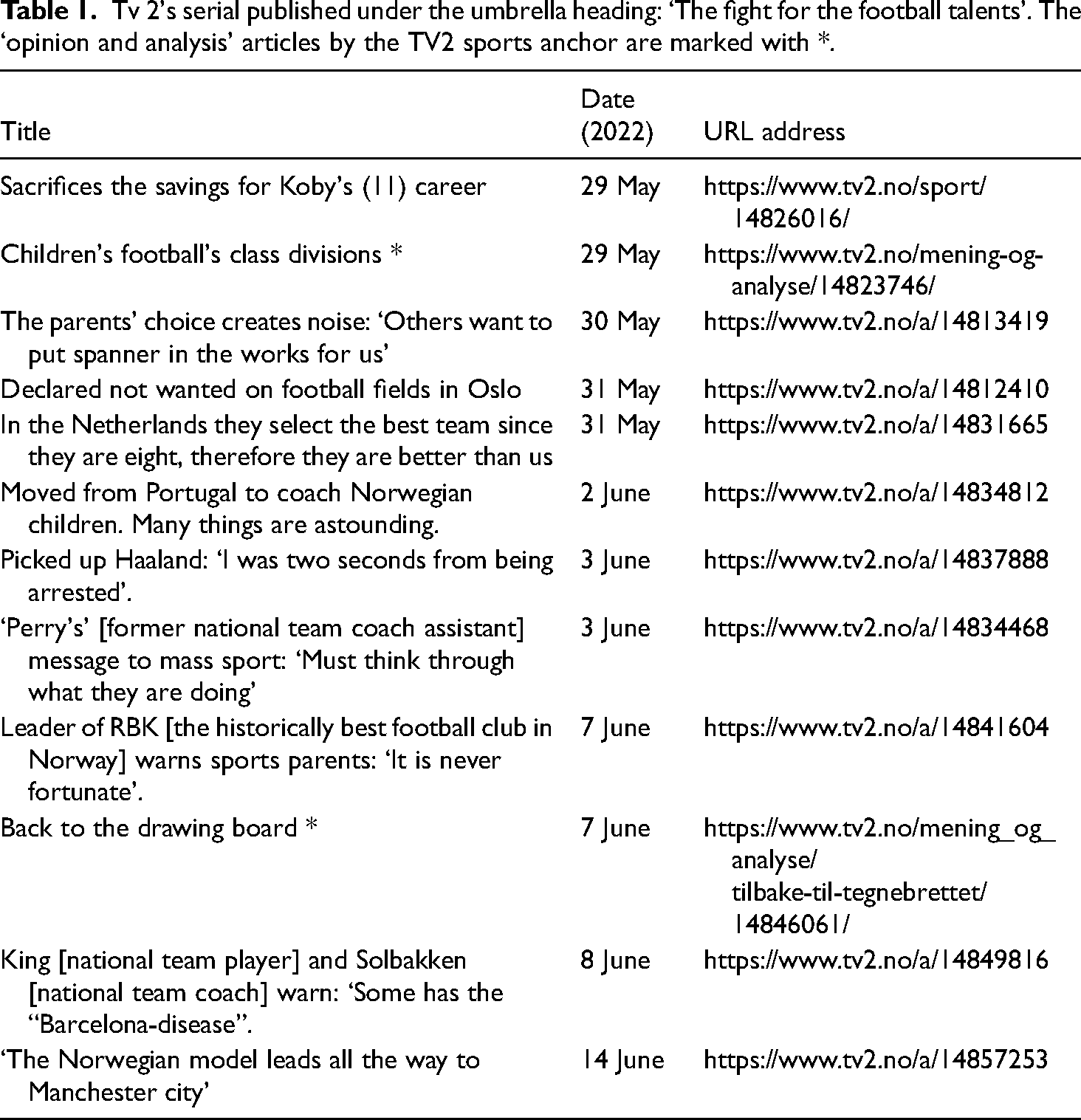
Thereafter, we conducted a more systematic data collection, which comprised two sets of documents. We reviewed the online resources of the NFF, the NTF, and 12 private football academies (all the PAs in Norway, to our knowledge). Table 2 gives an overview of the PAs identified. Despite few points of comparison and no historical context to lean on, the list of PAs appears long, given the strong voluntary tradition and ideology both in Norway and in other Scandinavian, Nordic, and even European countries (Breuer et al., 2015; Green et al., 2019); and considering Norway's small population (appr. 5.4 million) and relatively scattered and rural demography.
Names of and internet address for private football academies in Norway. academies presented in the results section are indicated with *.
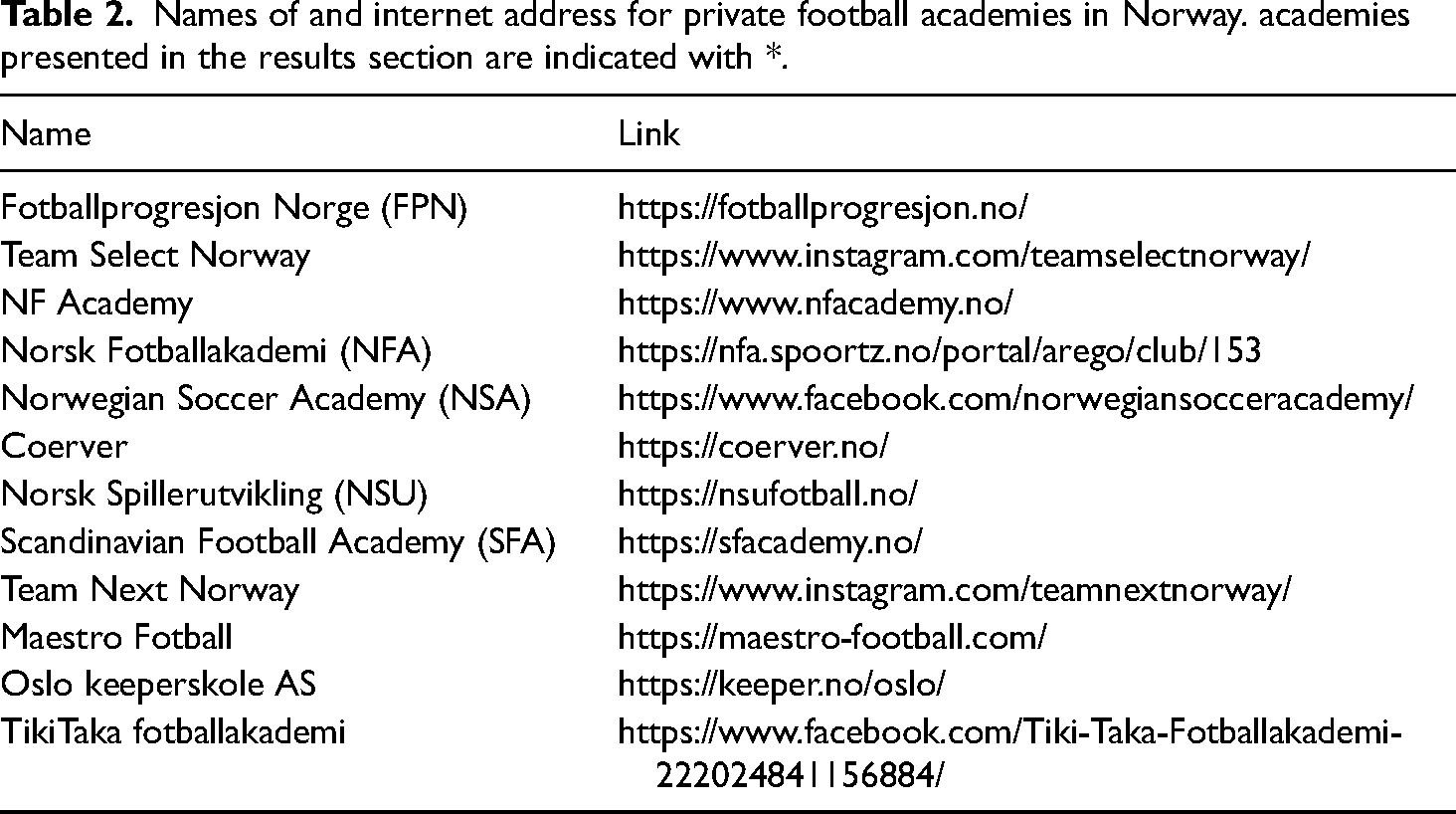
The next step of the main data collection was to search Retriever (a database used at Norwegian universities for conducting media searches), for media articles containing the terms “private” AND “football academy” that were published in the last 20 years. 2 There were 57 such newspaper articles published during that time: several years with zero or just a couple of articles, a small peak from 2006 to 2007 (14 articles in total over those two years), and a modest boost since 2020 (16 in 2020, 7 in 2021, and 7 until July 2022).
The analysis was hermeneutic-phenomenological and threefold. First, the TV2 articles (Table 1) created a prejudice (Gadamer, 2004), indicating a conflict of interest between, on the one hand, traditional or mainstream football as organized in sport clubs and federated in the football association and in the confederation of sports and, on the other hand, PAs. Second, the various football organizations’ internet resources provided general information about AF and PAs. Third, although we had a relatively clear idea about the tensions between AF and PAs, we aimed to remain open-minded and conducted a five-step phenomenological analysis, as suggested by Giorgi (2012), of the 57 newspaper articles from 2002 to 2022.
Through step 1, the first author familiarized himself with the data by reading through the 57 articles and taking notes. In step 2, the first author searched for meaning-units by marking relevant phrases in the newspaper articles. Moreover, step 2 consisted of discussing patterns in the data with the other authors (thus representing a fluent transition to the next phase, where drafting started). In step 3, the patterns emerging in the former phase formed the basis for drafting the results. In step 4, the first author selected quotations from the articles to be included in the manuscript and drafted the results before meeting again for discussions and subsequent revisions. Step 5 can be described as a back-and-forth between the first author and the other authors, who engaged more directly when moving to the process of contextualizing the findings within extant research and theoretical perspectives. After a phenomenological analysis of results, the write-up process was based on structural hermeneutics (Alexander and Smith, 2001).
Results and discussion
We structure our presentation of the media debate according to the three tasks of framing of argumentation as proposed by Benford and Snow (2000), applying Bourdieu's (1990) concepts alongside. However, we emphasize that debates regarding change and challenges are intertwined. First, there seems to be a relatively large degree of agreement regarding the diagnosis across subject positions in an otherwise diverse Norwegian football field. There are, nevertheless, nuances that can be related to different subfields (PAs vs. AF). Second, regarding proposals of solutions—to fix the problem(s) identified during the diagnosis—there seem to be large differences across actors and subfields, reflecting various habitus and influences from higher level fields. The analysis reveals a distinction between AF and PAs as well as differences across PAs. Third, the motivations behind the solutions reveal ideological differences between AF and PAs, reflecting the Norwegian football field's more dominant actors’ attempts to protect the field's doxa.
Diagnosis
Most of the actors investigated seemed to agree that Norwegian football underperformed at the beginning of the millennium. In that respect, the NFF and the NTF focused on the international level of football, comparing the national teams’ results to the results of other nations. The NTF realized a need to take action: “Our competitors have improved their player development work tremendously since our heydays during the 1990s. [They] have… revealed new recognition: ‘we are not good enough anymore… we must change the way we develop players’” (NTF, 2019: p. 7). Self-reflectively, the NTF report continued with a focus on the future: Instead of hunting scapegoats, both the football association, many regional football organizations and elite clubs have during recent years put up mirrors and started looking into them. We in Norwegian football stand in the middle of our collective process of recognizing where we are and an increasing number of people dare to raise their hands and say that it is oneself that has not been good enough (NTF, 2019: 7).
Solutions
Apparently, a comprehensive united Norwegian football field exists because AF and private actors agree both on the diagnosis and that one possible solution is to establish academies. However, the term “academy” is imprecise and the leader of the national team school (a development ladder system in the NFF) acknowledged, “to be honest, I do not know what it means, because everybody uses the term now. I am unsure about what it means” (TV2, 28 May 2022). Nevertheless, AF proposed a specific solution based on a requirement made by NTF that elite clubs must employ player developers. This initiative first emerged in 2005 and since then has developed into a more comprehensive academy classification program. This program further demands that elite clubs define clear goals and strategies regarding recruitment, cooperation with other clubs, and their own development processes; that they have an ample staff of professional coaches (how big depends on the level of classification the club aims for); and that they establish an organizational structure that makes clubs less vulnerable to the departure of specific individuals (NTF, n.d.).
Around the same time (2005), the first PAs were established. Overall (and along similar lines as in the diagnosis section), media framing of the PAs (and their self-presentation) indicate a focus different from AF clubs’ take on the problem: (i) an individual perspective on football development, (ii) that ideas for solutions would come from abroad, and (iii) some PAs deliberately challenged the competition monopoly that is traditionally held by non-profit, voluntary, membership-based sport organizations in Norway (including the football association). In other words, there were outspoken tensions between the AF and PA subfields of Norwegian football. In the following section, we detail some differences between their positions.
The PAs endorse an intentional individualized perspective in which young athletes (or, rather, their parents) pay for and get personal trainers for individual development. For example, Norsk Fotballakademi emphasizes “quality in a tailored training program with qualified coaches and good training conditions… . The football academy focuses on development of the focal age group's motor abilities and technical skills” The football academy's goal “is to exploit the opportunities to refine the players’ development in a playful and positive way with the right coaching.” (NFA, n.d.). In its promotional materials, the academy continues with a list of elements on which its training focuses: technical skills, tactical and team-related skills, motivation, and mental elements (NFA, n.d.). Another private actor, NF Academy, focuses more upon a cognitive understanding of the game. Acknowledging that the game of football demands competence in many areas, “NF Academy has identified one trait as the most important: to be able to read the game and make the best decisions in different phases of the game” (NF Academy, n.d.). Yet another private actor, Fotballprogresjon Norge (FPN), aims to become “the best actor within organized personal training and specialized player development for young footballers.” It formulates developmental goals for each player, based on a holistic ideology of player development which includes “technical skills, tactical skills and football intelligence, physical skills and mental skills” (FPN, n.d.). Thus, various actors prioritize differing elements to develop in young footballers. Overall, then, the actors’ specific football habitus seem to vary with the field in which they are positioned, in turn producing varying argumentative underpinnings.
Thus, one aspect where many private actors find agreement in general but diverge on specifics is that ideas for the solution originate outside Norway. For example, “Norsk Fotballakademi is based on and built up by the same principles as for the French football academies” (NFA, n.d.), while NF Academy emphasizes its reliance on a Portuguese development model and cooperates with FC Porto (NF Academy, n.d.). All in all, that several PAs endorse ideas from abroad reinforces the blame placed on the Norwegian player development model for Norwegian football's lackluster performance. Therefore, correction must be sought in the superior international football field, which is itself diverse.
The PAs also diverge in their embrace of scouting and bringing athletes to international competitions. In other words, some PAs challenge the competition monopoly of AF and Norwegian sport more generally. For example, NF Academy runs trial sessions; its staff travel around the country and organize local camps—where young footballers pay to participate—to select players for international training camps and tournaments. In contrast, FPN does not participate in international tournaments because it aims only to supplement the training of local and voluntary football clubs in Norway. In other words, the various heterodox actors of the subfield of PAs relate differently to the subfield of AF. Moreover, FPN intentionally adapts to the competition monopoly of Norwegian sport and, to a large degree, accepts the power of the NFF. Before we move to the subsection “Motivation,” where we will return to the interaction of international approaches with the competition monopoly, we will first discuss the complexity among PAs as a group and between PAs and AF. The complexity highly depends on a habitus compatible with both the PA and AF subfields.
The complexity of solutions stems from the overlap and drift of people—and a dynamic football habitus—across an increasing portfolio of subfields of and related to the Norwegian football field. Actors continuously reshape their habitus, which apparently is compatible with transcending the field's boundaries. Many PAs were established by former AF coaches. One academy is run by parents, who bring in children from various football clubs across local communities for extra and more professional training sessions. The founder is a father who used to be a coach for a local club (TV2, 2022) and who represents a group of parents that has long existed in Norwegian sport, but who felt restricted by the Norwegian regulations for children's sport. Thus, “the Norwegian football development system can be a source of frustration for parents with children who are more interested in football and motivated to develop their talent” (Antwi and Hauso, 2018: p. 3). Another approach is going from academy to football club; Norsk Fotballakademi started an ordinary football club to participate in AF competitions.
PAs have taken different approaches to their relationships with AF—and vice versa. Some football clubs expel coaches if they are involved in PAs (Fædrelandsennen, 21 April 2020), while others start academies outside the club and, as a reaction to the fee-paying PAs, open them for all players independent of club membership (Lierposten, 5 November 2020). All these solutions have incurred reactions from AF for various reasons. Interpreting these initiatives as heterodoxic disturbances to the historical order in the Norwegian football field, the next section outlines and explains how the established actors respond to threats to the field's doxa, including their own positions of power. Through this tension, we propose, change develops.
Motivation
Following Bourdieu (1990), protectors of doxa see no benefits in proposed alternatives. In this instance, protectors are representatives of the AF—both in terms of elected leaders and association employees. When the PAs were newcomers to the football field, AF representatives considered them superfluous, and there was apparently a belief that AF would not lose terrain against PAs. In answer to a direct question concerning this, the football president at the time answered “No,” and continued, “The clubs and the regions [of the association] have offers of a totally different dimension” (Aftenposten, 28 March 2006). Similarly, the person responsible for development in the association at the time, Andreas Morisbak, had no faith in the new academies.
Confronted with private offers for 10–12-year-olds, based on French philosophy and run by a Frenchman, Morisbak responded that the focal academy and its owner had no understanding of Norwegian football and that the Norwegian model takes care of both mass and elite in a sufficient manner: “Morisbak has been in France himself and is well aware of the system there. He holds that there is a super tough selection among players, where only a few are cultivated. He believes that the Norwegian model is better” (Aftenposten, 28 March 2006). Notably, Morisbak had held his position in the football association for three decades. He represented the “right” habitus and a position to legitimately define others as wrong. At the same time, some considered him outdated and accused him of employing a simple framing of motivation.
Later, the arguments against PAs became more substantially framed in terms of expenses, children's best interests, and sport for all. Expenses related to participation in private football academies were emphasized in a way that connects costs to democracy or openness in the sense that football should be accessible for all, independent of social class and economic resources. The overall narrative here is that PAs create class differences due to high economic costs for participation and accelerate the dichotomization of a gaping class structure in sport. Early on, warnings were framed with headings such as “Selling extremely expensive trainings to small children” (NTB, 28 March 2006) and “Selling training sessions to 8-year-olds” (Aftenposten, 28 March 2006). The article with this heading continues by reporting high prices for participating in PAs and indicating that the football association was worried. The person in the association responsible for mass sport shares, “To start a private initiative for such young players makes me skeptical. I disagree with charging thousands of kroner [Norwegian currency] to offer children training outside their clubs” (Aftenposten, 28 March 2006). It is clear that PAs are simply considered wrong by the AF actors.
Presenting private football academies as “sales” and “business” frames them in a commercial logic that challenges the voluntary and egalitarian ideology of Norwegian sport. This is made explicit by referring to concrete expenses associating extra training sessions for a high price with class divisions (Bergensavisen, 30 May 2020). One newspaper calculated in detail how much parents pay for a child to train once a week at a PA (Kaspersen, 2014), and football was referred to as a business rooted in financial mindsets (BT Sport, 2018). As a consequence, the line of argument goes, performance development and possibilities to excel in sports would be reserved for the wealthy families, which contradicts the equality ideology that used to characterize Scandinavian sport, especially football. Thus, the self-framing is striking when a PA ends its online presentation with: “… having fun with football! Our bank account number is: [xxxx]” (NFA, n.d.). Unlike any football club in the voluntary sector (that we know of), the NFA presents itself as a business company by announcing their bank account number. This distinguishes it from what doxic actors are used to in non-profit football.
In addition, PAs are depicted by doxic actors as overlooking what is best for the child (safeguarding of children, children's rights and regulations). PAs are not part of AF or the confederation of sports; consequently, they do not need to follow the voluntary sport system's laws and regulations, such as regulations for children's sport. A representative of the football association shared, “We are not against the private academies, as long as they follow rules and guidelines. There are a lot of good football people out there. But we want the clubs to manage this themselves” (VG, 22 August 2021). According to representatives of AF, a potential consequence of the lack of regulations within PAs is a risk of early specialization. Early specialization into one specific sport is a contested issue in this context, as it opposes one of the more central ideological elements of Scandinavian sport—to have a relatively wide sporting repertoire. In turn, this is believed to increase physical activity levels later in life and thus contribute to public health (Skille and Säfvenbom, 2011) per the idea of the Norwegian model aiming at both “as many as possible as long as possible” and elite sport achievements.
Moreover, given that sport for all is the vision for all sport policies in this context, AF sees a risk of losing players through dropout. An advocate for the association model, the former national team player Tom Høgli, held that the Norwegian model comprises sufficient features to develop elite players. According to Høgli, the Norwegian football association should pursue an elite development model that facilitates and focuses on togetherness and community (Aftenposten, 9 November 2014). Apparently, association representatives consider PAs’ downplay of sport for all as a threat to the Norwegian model for sport. In that respect, media depictions of PAs indicate differences between association clubs and private football, often based on association advocates’ negative view of private initiatives due to an ideological understanding of sport as part of the (non-commercial) welfare state. Thus, we can not only observe two subfields of Norwegian football, but two subfields that are oriented toward rather contradictory influences from superior fields.
Subfields and superior fields
By using Benford and Snow's (2000) division of motivational framing into severity, urgency, efficacy, and propriety, we can see how the concepts play for and against each other interestingly. The negative framing of private football academies in Norwegian media—voiced by representatives of AF and assisted by mainstream media—is severely critical of the doxic power. The new phenomenon is considered a threat, carrying the wrong values for the Norwegian sport field, but the phenomenon was not seen as urgent when it emerged. It has, nevertheless, built brick on brick for almost two decades. Consequently, the slow resistance never helped, or as Benford claimed, “Framing efforts which focus on the severity and the urgency of the problem can have demobilizing effects” (1993: 204). Whether that is the case with Norwegian football, is an empirical question. However, there is no indication of this in the data analyzed here.
While the framing of PAs and AF indicates a power balance—a heterodox situation providing potential for change because the doxic power is at stake—Bourdieu's field theory further emphasizes the importance of subject positions: Who said what? The data reveal various framings of private football academies’ ability to deliver a good product (efficacy) and regarding the process leading to the product (propriety). Although PAs are considered competent, they are not necessarily perceived as (morally) good; according to AF actors, the product (of PAs) is produced in an inappropriate way. However, the relationship between efficacy and propriety is difficult to pinpoint due to the drift of individuals across subfields, a diffusion that indicates unfaithful servants within AF (Bergensavisen, 9 May 2020; Bergensavisen, 18 May 2020), based on a habitus compatible in both subfields (PAs and AF).
3
The dual roles are considered problematic for representatives of the establishment. For example, the leader of sport competence and value work in the Norwegian Confederation of Sports (Norges Idrettsforbund; NIF), an umbrella for all sports associations in Norway (including NFF), holds: Norsk Fotballakademi is a commercial provider of football for children that consciously offends the children's regulations for sport. They select children from the age of 8, to compete against ‘world's best’ 12-year-olds. At the same time, the leader (TL) of such activities is also functioning as a leader of a sport club, which has to follow the same rules as the private person TL violates [when being in the academy]. This is ethically worrisome. Both the Norwegian football association and the Norwegian confederation of sports mean that the regulations are important and will protect them (VG, 29 April 2020).
Theoretically, heterodoxy requires a power base; a mass of some sort must have judged the traditional sport field as insufficient. While this leader openly violates children's regulations within the academy, the NIF suspects that he can do so also when coaching an AF club. Thus, one interpretation is that representatives of PAs are “infiltrating” AF (VG, 22 August 2021).
The theoretical idea of subfields is based on the notion that actors in a field share some values and differ on others (Bourdieu, 1990). Similar private initiatives are treated differently across regional units of the NFF. A football club that was an extension of NF Academy (as Fornebu FK extends Norsk Fotballakademi) was rejected when applying for membership in the Norwegian football association. The official reason was that “there is a sufficient supply in the existing clubs in [the region]. We will not access more youth if we get more clubs,” but rather that new clubs “will have to recruit from already existing clubs” (Bergensavisen, 20 January 2022). The applicant represents a private football academy, which made the association suspicious “that the initiator of the club is a commercial business, and that there does not appear to be an athlete basis, the application distinguishes from other club establishments” (Bergensavisen, 20 January 2022). Considering the process as a commodification of football, there seems to be a “market” among young footballers and their parents, who desire something else (or something more) than “old fashioned” sport.
As indicated in the literature on Norwegian football history (Goksøyr and Olstad, 2002), Norwegian football is in a hybrid phase in which professionalization takes place both inside and outside the establishment of AF. In that respect, it is interesting that the media frames PAs so negatively as market-based and how the costs of participation increase the risk of social inequality among children and adolescents in Norway. It could as well have been interpreted as a natural development in a society with strong individualization trends and an unprecedentedly wealthy private economy. Nevertheless, the development includes new patterns of sport development and achievement, which seem to go hand in hand with even stronger patterns of inequality.
Concluding remarks
All in all, the distinction between how AF and PAs are framed in Norwegian media reflects various ways to analyze problems and propose solutions for the challenges Norwegian football faces regarding player development (and subsequently international performances). While most actors share one view on the problem (Norwegian football needs improving), the variation in solutions and motivation reflect different cultural preferences (Norwegian sports versus international football). Even though the coaches within AF and PAs share educational backgrounds and even sometimes are the same individuals, there seem to be cultural or motivational differences. There is also an element of sector belonging, market versus voluntary, in which actors in the market sector do not need to follow the regulations of the voluntary sport sector (especially the children's regulations). The various solutions and motivations of framing efforts reflect underlying value systems inherent in societal fields and individual habitus: habitus that sometimes crosses subfields.
While commercial interests exposed the conflict lines in Norwegian football, stakeholders sensed a market niche for accommodating extremely motivated young footballers and their increasingly demanding parents. The popularity of private actors offering extra training and customise sessions for young players on the supply side stems from a demand side with parents who have experienced frustration with the Norwegian model; hence, the services provided by commercial actors are often considered missing in non-profit activities in grassroots football clubs of the AF. “Although several football clubs are investing in youth development, the professionalization of football in Norway has triggered the commercial aspect of the game [which] seems to attract a tail of other commercial actors” (Antwi and Hauso, 2018: 3).
In that respect, future research should investigate the retrospect experience of former academy players and scrutinize the habitus of players who apparently employ commodified football in both the AF and PA subfields. Nevertheless, two intertwined features—of academies both inside and outside conventional club sport—and departures for subsequent investigations and discussions include that they focus on individual competencies and are relatively expensive. Moreover, further research should investigate whether the (often negative) framing of private football academies in the media actually leads to any slowing or halt in their development as a social phenomenon. Given the apparent patterns of inequality due to economic costs, future research should scrutinize class divisions in Norwegian sport after the emergence of private football academies.
Footnotes
Declaration of conflicting interests
The author(s) declared no potential conflicts of interest with respect to the research, authorship, and/or publication of this article.
Funding
The author(s) received no financial support for the research, authorship, and/or publication of this article
