







Abstract
This study aims to examine the fandom experiences of Ankara-based individuals who support one of Istanbul's Big Three football clubs (Beşiktaş, Fenerbahçe, and Galatasaray) from a socio-political perspective. Conducted using a phenomenological design, the study involved interviews with 18 participants, and the data were analyzed using template analysis. The findings revealed that non-local fandom is a multi-layered social phenomenon constructed through early socialization processes, spatial hierarchies, asymmetric media structures, and hegemonic relations. Fandom, which begins in childhood, particularly through the father figure, evolves into an unquestionable habitus. Ankara's hybrid position as a political center and cultural periphery introduces elements that hinder the establishment of belonging to local football clubs and reinforce an orientation toward Istanbul as a symbolic center. Media ecology plays a significant role in reproducing hegemony by normalizing the dominance of the Big Three. Although participants are aware of structural inequalities, they maintain their fandom practices and transmit them to their children, thereby sustaining the hegemonic cycle. The research demonstrates that non-local fandom is a micro-level reflection of center-periphery dynamics, cultural hegemony, and symbolic hierarchies in Türkiye.
Introduction
Football functions as a contested arena for identity construction, cultural representation, and the reproduction of spatial hierarchies, transcending its role as a mere sporting activity (Crawford, 2004; Giulianotti, 2002; Jackson and Sam, 2025; Sandvoss, 2003). While globalization and digital media have transformed fandom into a trans-spatial and identity-oriented phenomenon (King, 2003), the Turkish context offers a unique case of non-local fandom shaped by historical center-periphery dynamics.
Historically, Turkish football emerged as an Istanbul-centered field, transforming from an Ottoman legacy into a tool for modern national identity, where the Big Three (Galatasaray, Fenerbahçe, Beşiktaş) established a sporting and cultural hegemony (Emrence, 2010; Fişek, 1985; Gökaçtı, 2008; Koç et al., 2016; Murray and Murray, 1998; Talimciler, 2016). This structure mirrors Mardin's (1973) center-periphery model, positioning Ankara, the political capital, as a hybrid intermediate space. Despite its rational construction as the center of the Republic, Ankara remains a sporting periphery, ceding cultural dominance to Istanbul (Başkan-Yurdakul, 2021).
This paradox renders visible the effort of individuals identifying as Ankaralı (natives of Ankara) to articulate themselves to the center through non-local fandom (Kozanoğlu, 2002). Although local clubs like Ankaragücü and Gençlerbirliği possess strong identity codes ranging from working-class resistance to republican intellectualism (Bora, 2021; Hacısoftaoğlu et al., 2012; Hatipoğlu and Aydın, 2007), they often fail to compete with the macro-social identity and prestige offered by the Big Three. In Türkiye, the Big Three collectively claim approximately 86% of football fans (Gazete Duvar, 2025), rendering non-local fandom a structural norm rather than an exception. Consequently, for individuals identifying as Ankaralı, supporting Istanbul clubs transcends sporting preference, functioning as an identity strategy for symbolic identification with the center (Andrijiw and Hyatt, 2009; Hyatt and Andrijiw, 2008; King, 2003).
Unlike the existing literature, this study examines the socio-political construction of non-local fandom in Ankara's hybrid position as a political center and sporting periphery. This research addresses a critical gap by demonstrating how structural inequalities are internalized and actively reproduced through the manufacturing of consent, revealing how spatial hierarchies in centralized nations persist beyond geographical proximity. Adopting a reflexive sociological approach (Bourdieu, 1990; Wacquant, 2012), this study analyzes how individuals interpret, legitimize, and reproduce their orientation towards Istanbul's hegemonic clubs.
Theoretical framework
Belonging, identity, and the transformation of fandom
Fandom functions as a robust form of belonging that integrates deeply with an individual's self-definition (Tajfel, 1982); it operates as a form of devotional leisure that structures everyday life through routines, rituals, and social bonds (Stone, 2025). According to the literature, fan identity is typically constructed through early socialization processes, often internalized as an unquestioned habit through family guidance and peer influence (Wann and James, 2018). This early formation renders fandom a durable, non-rational choice that is difficult to reconstruct later in life. However, modern football fandom has evolved significantly; it has transitioned into a trans-spatial, consumption-oriented practice in which media relations and psychological connections supersede physical geographical proximity (Giulianotti, 2002; King, 2003; Reifurth et al., 2019).
In the specific context of Türkiye, this transformation disproportionately favors the Big Three. Drawing on Bourdieu's (1984) notion of symbolic capital, supporting these hegemonic clubs offers Ankaralı fans a pathway to social visibility and prestige, resources that are often lacking in the local sphere. Consequently, non-local fandom ceases to be a mere sporting preference; it becomes a strategic compensation for the limited symbolic value associated with peripheral local identities, allowing individuals to articulate themselves to the center's prestige.
Center-periphery dynamics and Ankara's hybrid position
The structure of Turkish football creates a distinct spatial hierarchy (Lefebvre, 1991) that mirrors Mardin's (1973) center-periphery model. Although Istanbul is not the political capital, it functions as the absolute center of the football ecosystem, monopolizing the accumulation of mediatic, cultural, and economic capital (Emrence, 2010; Gökaçtı, 2008). This structure manifests as internal colonialism (Hechter, 1975), in which the metropolis extracts not only material resources, such as athletic talent and capital, but also symbolic allegiance from the periphery.
Within this framework of structural inequality, Ankara assumes a unique hybrid position as the political center but a sporting periphery. This paradox places local fans in a dilemma where they may perceive local values as inadequate or provincial. Thus, rationalizing their orientation towards Istanbul clubs serves as an integration into a dominant national culture rather than a betrayal of their city (Harvey, 1989; Koç et al., 2016). By internalizing the cultural superiority of the center, Ankara fans navigate this hybrid spatial identity through non-local fandom practices.
Media, hegemony, and the manufacturing of consent
The dominance of Istanbul clubs is sustained not merely by historical sporting success but by the manufacturing of consent through the media (Gramsci, 1971). With the Big Three commanding approximately 31% of broadcasting revenues and dominating the vast majority of media representation (TRT Spor, 2024), the media acts as a hegemonic apparatus. This disproportionate visibility positions these clubs as the normative reference point for success and national representation, legitimizing the structural inequality in the eyes of the masses (Murray and Murray, 1998; Rowe, 2004; Talimciler, 2016).
Digitalization further consolidates this hegemony rather than challenging it. By deterritorializing fandom, digital media platforms provide continuous, legitimizing spaces for non-local fans to perform their identities (Guschwan, 2015). Through virtual communities and social media interactions, the physical distance between Ankara and Istanbul becomes irrelevant. This digital environment allows non-local fans to maintain constant bonds with the center, reinforcing the perception of the Big Three's dominance as natural and inevitable (Giulianotti and Robertson, 2009).
Synthesizing these perspectives establishes a multi-layered analytical framework in which structural, dispositional, and systemic levels of fandom converge. Lefebvre's (1991) spatiality defines Ankara's hybridity as a produced spatial hierarchy, while Bourdieu's (1984, 1990) habitus and symbolic capital explain how this structure is internalized, converting spatial dislocation into a quest for social prestige. Gramsci's (1971) hegemony theory offers a systemic interpretation of why this cycle persists despite acknowledged structural injustices, as individual practices are woven into a broader socio-political mechanism of consent.
While existing studies have examined Turkish football fandom through supporter cultures (Doğan, 2019; Nuhrat, 2017; Turan and Özçetin, 2017; Zelyurt, 2019) and media dynamics (McManus, 2018; Talimciler, 2006; Ünal and Dağtaş, 2025), this framework addresses a critical gap by revealing how non-local fandom operates as the reproduction of spatial hegemony. This study asks: How do individuals in Ankara's paradoxical position construct, legitimize, and reproduce their orientation towards Istanbul's hegemonic clubs?
Methodology
Research design
This study employs a phenomenological design grounded in the interpretive paradigm, utilizing template analysis as its analytical framework to explore how individuals attribute meaning to their lived experiences (Creswell and Poth, 2023; King, 2012; Van Manen, 2016). Rather than treating non-local fandom as a static phenomenon, the research focuses on the lived meanings and socio-political contexts of Ankaralı individuals who support Istanbul's hegemonic clubs.
Participants
The study group consisted of 18 participants who met four criteria: being born in Ankara and self-identifying as Ankaralı
Participants were selected using maximum variation and snowball sampling to capture diverse, non-local fandom experiences (Patton, 2015). Maximum variation sampling ensured representation across age, gender, educational attainment, occupation, and socio-economic status, enhancing the analytical scope and transferability of the findings. Snowball sampling was applied strategically: each participant was asked to recommend individuals who met the inclusion criteria but differed in their background characteristics. As the interviews progressed, the participants were encouraged to suggest contacts with alternative profiles to prevent sample homogeneity. This approach ensured that emerging themes reflected the experiences of diverse Ankaralı fan groups rather than a singular social stratum, strengthening the study's capacity to illuminate non-local fandom as a socio-politically constructed phenomenon. The interviews were terminated upon reaching data saturation. To ensure analytical balance, an equal number of fans from each club was included. The demographic characteristics of the participants are shown in Table 1.
Findings regarding the socio-political construction of non-local football fandom in Türkiye.
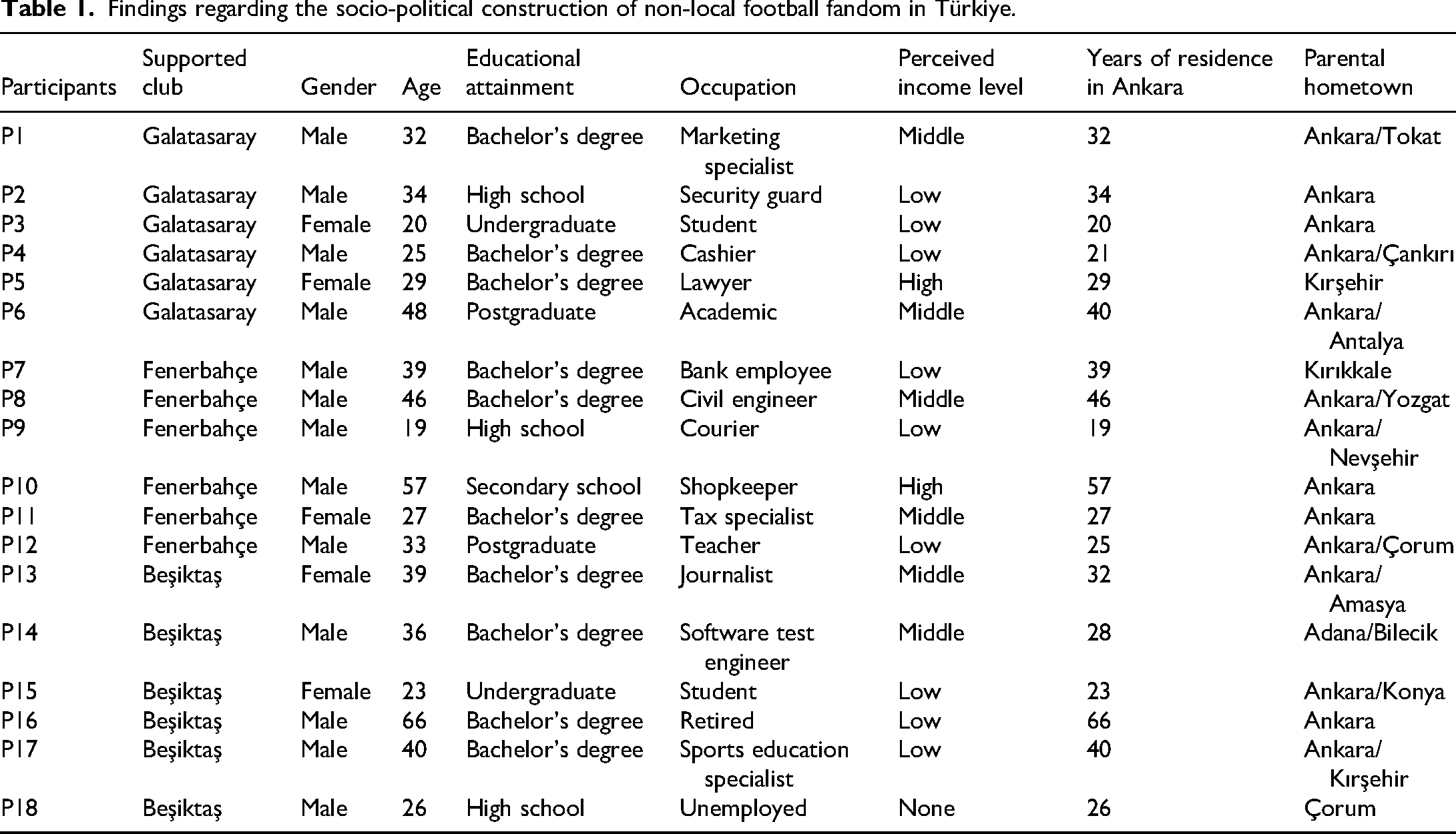
The 18 participants varied in age, gender, educational attainment, occupation, and socio-economic status. Educational backgrounds ranged from secondary school to postgraduate qualifications, while occupational diversity spanned students, professionals, civil servants, and manual workers. Self-reported income was categorized into low, middle, and high levels. Parental hometowns ranged from Ankara to various Anatolian cities, reflecting Ankara's role as a migration hub.
Data collection
Data were collected between 14 November 2025, and 3 January 2026, through face-to-face semi-structured interviews. The interview form, refined after pilot studies, included questions on social identity, spatial belonging, hegemonic culture, and media consumption. Interviews were conducted at venues preferred by participants, with an average duration of 46 min. All sessions were audio-recorded and transcribed.
Data analysis
The analysis proceeded in three stages: the construction of an initial coding template through a hybrid approach, its iterative refinement across three successive phases, and the assessment of data saturation.
Transcribed data were analyzed using template analysis (Brooks et al., 2015; King, 2012), chosen for its compatibility with phenomenological inquiry and balance between theoretical sensitivity and interpretive flexibility (King and Brooks, 2017). This combination was particularly well suited to the present study because it accommodated both theoretically derived a priori codes and inductively emerging categories within a single analytical procedure, thereby allowing the theoretical framework to guide the analysis while remaining responsive to the meanings participants themselves attributed to their fandom experiences. The initial coding template was developed through a hybrid approach: a priori categories were deductively derived from the theoretical framework (e.g., spatial hierarchy, media influence, habitus formation), and then refined inductively through pilot interviews to ensure attentiveness to emergent themes (Fereday and Muir-Cochrane, 2006).
As data collection proceeded, the template underwent iterative refinement in three phases. In the early phase, codes demonstrating thematic overlap were merged to strengthen the conceptual coherence. For instance, separate codes on father figure influence and family transmission were combined into “Intergenerational transmission and the father figure.” In contrast, codes on rejection of local clubs and weakness perception were merged into “Perceived inadequacy of local clubs.” In the middle phase, refinement shifted to the categorical level: the initially separate categories “Hegemony” and “Production of Consent” were combined into “Hegemony and the Production of Consent,” as analysis revealed their inseparable interconnection. In the final phase, the template was stabilized with no further structural adjustments. All subcategories and codes emerged inductively from the data, while the theoretical framework yielded four overarching categories. This refinement process was documented through peer debriefing sessions during each phase.
Data saturation was assessed using thematic and informational criteria (Saunders et al., 2018). Saturation was reached after the 15th interview when no new codes emerged. Three additional interviews confirmed this and ensured representational balance across clubs. Trustworthiness was enhanced through member checking, in which a subset of participants verified the interpretations.
Validity, reliability, and reflexivity
Beyond the analytic procedures described above, trustworthiness was further established based on standard qualitative criteria (Denzin et al., 2024). Credibility was ensured through a two-stage member-checking process, in which transcripts and interpretations were verified with participants. Transferability was achieved via thick description of the Ankara socio-political context. Dependability was maintained through transparent reporting and peer auditing of the coding process. Finally, confirmability was addressed through researcher reflexivity. The researcher, who also shares a non-local fan identity, utilized a reflexive journal to distinguish personal presuppositions from field data, treating this insider perspective as an interpretive advantage rather than a source of bias (Wacquant, 2012).
Ethical considerations
Ethical approval was granted by the Van Yüzüncü Yıl University Social and Humanities Publication Ethics Committee (Date: 13.11.2025, Decision No: 2025/23–22). Informed consent was obtained from all participants, with emphasis on voluntary participation and confidentiality. Identities were anonymized using codes (P1‒P18).
Findings
This research examined the non-local fandom experiences of Ankaralı individuals supporting Istanbul's Big Three. The analysis revealed four socio-political categories: Construction of Identity and Belonging; The Spatial Dimension of Fandom; Media, Visibility, and Digitalization; and Structural Inequality, Hegemony, and Manufacturing of Consent (Table 2).
Findings regarding the socio-political construction of non-local football fandom in Türkiye.
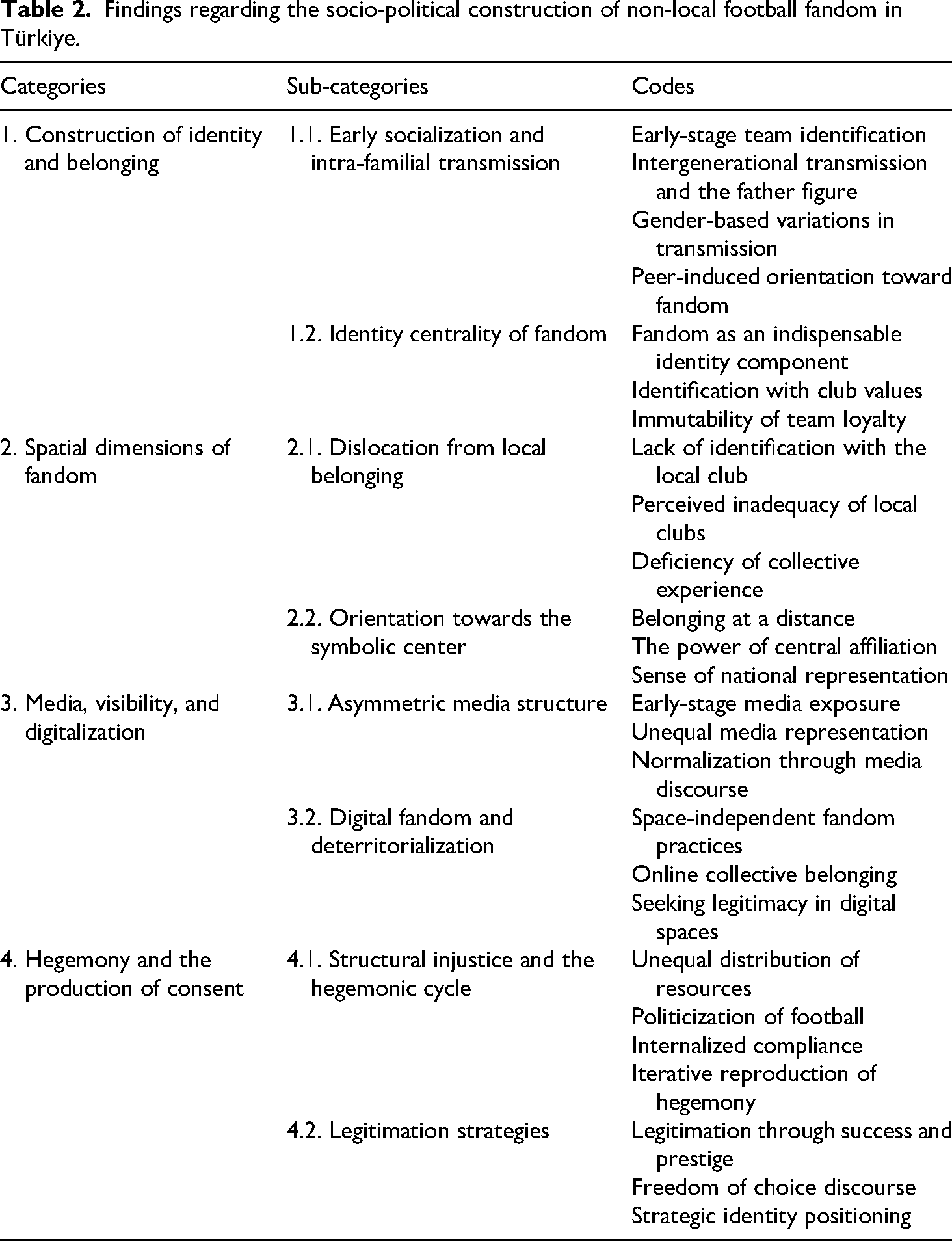
These categories are dynamically intertwined, revealing a process where fan identity originates in early socialization (habitus), evolves through spatial reorientation, and is reproduced within legitimized structural inequalities. Spatial dislocation from the local is not merely geographic but a Bourdieuian strategy for acquiring symbolic capital, stabilized through Gramscian mechanisms of consent. This cyclical process reveals non-local fandom as a multi-layered socio-political product rather than individual preference.
Category 1: Construction of identity and belonging
Early socialization processes, which play a determinative role in the formation of fan identity, hold a significant place. In light of participant narratives, it is observed that the belonging established with the team is a phenomenon that begins in childhood and is internalized unquestioningly, rather than being a coincidental preference.
Early socialization and intra-familial transmission
A critical threshold in the formation of fan identity is early team identification. A significant number of participants reported that the identification they experienced with their teams occurred during primary school or earlier. One of the prominent consequences of this situation is that fandom cannot be experienced as a conscious choice. Fandom, the beginning of which is often not remembered, is therefore perceived as a form of belonging that is difficult to question. P4: I’ve been a Galatasaray fan for as long as I can remember. Actually, I must have been one even before I knew myself because when I look at my baby photos, all I see is me wearing a yellow-red towel, a yellow-red beanie, a yellow-red t-shirt. P17: I became a Beşiktaş fan thanks to my dad. My dad wasn't home much, I'd see him very rarely…But on match days, we'd go to the coffeehouse together to watch the game. I probably learned my first curse words there from him…Then, on the way back home, we’d talk about the match, the team, the players. Those were good days. P6: In my childhood, the only team I saw from my dad, my uncle, and my brother was Galatasaray. That was our team. Other teams were rivals, or if they beat us, they were enemies…Their love for Galatasaray naturally passed on to me. Besides, in that environment, it was impossible for me to stand up and say ‘I'm going to be a Fenerbahçe fan’. P11: Both of my older brothers are Fenerbahçe fans. I used to love watching matches with them, but I could never quite please them. I couldn't understand football as much as they did, I couldn't be as ‘die-hard’ a Fenerbahçe fan as they were…In their eyes, a girl plays with dolls, she doesn't understand football. That's why, when a goal was scored, I felt obliged to celebrate more than them, to curse at the opponent more than them, just to prove myself. P2: No one at our home was really into football, but most of my close friends in childhood were Galatasaray fans. It was exactly the period when we won the UEFA Cup. We used to play football on the street, at school all day, and talk about Galatasaray…We wouldn't let Fenerbahçe or Beşiktaş fans into our group. Sometimes we'd even fight with them just because they weren't one of us.
Identity centrality of fandom
Fan identity formed in the early period became an indispensable element of participants’ self-perception in the subsequent process. Thus, fandom appears not as a temporary whim or interest, but as a fundamental element defining the individual. This identity, which sits at the center, permeates various areas of social life. The team's success makes the individual proud, while its failure leaves them disappointed, directly affecting their emotional state. P14: If they asked me ‘who are you’, I'd say ‘I'm a Beşiktaş fan’ before saying my name…If the team won, there's no one happier than me. But if we lost, my next 1–2 days are ruined. Of course, this reflects on my wife too. At first, she used to get offended, but she's used to it now; she doesn't mess with me for 1–2 days when we lose. She accepted me like this. P18: You know we have the Çarşı group (Beşiktaş supporter group)…If there's an earthquake somewhere, we are the first to go help; if the government is protested, we are at the very front; if someone is wronged, we are the first to object. We have a famous slogan, ‘Çarşı is against everything'…That anarchic spirit of the team, of the fans, that is exactly who I am. P9: I was born a Fenerbahçe fan, I will die a Fenerbahçe fan…Is it even possible to change teams? It never crossed my mind, and it never will. I swear, they would excommunicate a man…In my circle, those who change teams aren't taken seriously, they aren't counted as men.
Category 2: Spatial dimensions of fandom
Participant statements indicate that the phenomenon of fandom carries a spatial dimension. The fact that Ankaralı individuals support Istanbul clubs reveals that sporting and geographical affiliations do not overlap. This situation involves two simultaneous processes: dislocation from local belonging and orientation towards the symbolic center.
Dislocation from local belonging
Participants’ relationship with Ankara clubs indicates a distinct lack of identification with the local club. Despite knowledge of Ankaragücü, Gençlerbirliği, and other Ankara clubs, participants have not developed an identity or emotional bond with them and have remained indifferent to their sporting activities. P12: Ankara teams don't spark any feeling or excitement in me…For example, I feel something even for Liverpool from far away England; I can find something of myself in them, but Ankaragücü or Gençlerbirliği doesn't appeal to me with anything. P1: Gençlerbirliği has become a ‘yo-yo club’. Ankaragücü has dropped to who knows which league…Besides, they constantly go bust, go up, the management changes, they don't pay the players. No success, no excitement, plus a lot of disgrace on top of it…If I were a fan of one of them, I’d get ulcers, I’d age prematurely. P8: I love football, but I love it more when I watch matches with my friends and family and talk to them. Let's sit together, eat and drink while watching the match, get happy or sad, get hyped or angry; that's what I love…But now, I don't have a single friend around me who supports an Ankara team…What am I supposed to do all alone?
Orientation towards the symbolic center
Orientation towards Istanbul's hegemonic clubs is the other side of the coin of dislocation from local belonging. Participants can identify with a team from a city they have never visited or rarely visited. This sense of belonging at a distance and space-independent affiliation does not weaken participants’ feelings of loyalty. P7: I've been a Fenerbahçe fan since childhood, but I could only go to Istanbul when I was 30…I haven't watched a match at Saraçoğlu (Fenerbahçe's stadium) yet. Of course, I'd love to watch a match there one day, but if not, it's no problem because Fenerbahçe is much more than that to me. P9: We often chat about football with friends. We also banter with each other on social media…A friend says ‘we have a UEFA cup’, I say ‘we beat you 6–0’, another says, ‘we became champions undefeated'…Being a fan of the ‘Big Three’ gives such an advantage. If I were an Ankaragücü fan, for instance, who am I going to brag to about what? P2: Yes, I am Ankaralı and Galatasaray isn't an Ankara team, but I don't look at it that way. Ultimately, it's a Turkish team. Plus, it's a team that represented our country best in Europe, made us proud, waved our flag…No other team in Türkiye could provide this pride.
Category 3: Media, visibility, and digitalization
The media has a determinative effect on sustaining participants’ fandom preferences. The asymmetry in media visibility between Istanbul and Ankara football clubs shapes fan identity. According to the findings, digitalization reinforces rather than transforms this structure.
Asymmetric media structure
One concrete output of the asymmetric structure is the media effect in the early stages of fandom. Participants stated that they only saw the Big Three on television during their childhood, and this experience affected their perceptions of football and fandom. P7: In my teenage years and even before, I used to see news about Istanbul teams all the time on TV and in newspapers. Of course, there must be selective perception too, but there used to be a lot of news especially about Fenerbahçe's transfers…Alex is at Fenerbahçe, Ortega signed with Fenerbahçe…News like ‘Fenerbahçe added world star Roberto Carlos to its squad’ used to excite me a lot, I used to feel very proud. P13: In my childhood, there wasn't widely used internet like today. We used to follow football from TV and newspapers. And the only ones I saw there were the ‘Big Three’. Maybe a little bit of Trabzonspor too…I mean, now that I think about it again, I don't remember Ankara teams in the media at all. We would only hear about them if they were playing against one of the ‘Big Three’. P12: On TV, in the newspaper, on the radio, on the internet, it was always Istanbul teams, nothing else. Their transfer news, match results, replay positions, discussions, fights, etc., were always about the same three teams…It's still like that. And naturally, since I am a Fenerbahçe fan, I actually never questioned why it is like this. I guess I thought it's because these are the teams with the most fans.
Digital fandom and deterritorialization
Media, transformed by digital technologies, has radically transformed fandom practices. At this point, the space-independent fandom experience emerges. Participants stated that not living in Istanbul does not limit their fandom experiences and that they can access any content they want about their teams via digital media. P3: Our generation is a bit luckier because now everything is on the internet, on social media…A guy starts a live broadcast during the match, I watch him and feel like I'm in the stands…What's the status of the team, what was discussed in the locker room, what happened in training, who earns how much, where they hung out at night, who they are dating…I can learn everything about the team from the comfort of my bed. P18: I probably follow countless accounts related to Beşiktaş on Twitter (X), YouTube, Instagram, TikTok. Some share posts about our history, some discuss current developments…I comment there, state my opinions…I disagree with some, I fight with them; I become friends with others…I even made Beşiktaş friends from Germany recently. P4: There are loads of fan group accounts for our team on social media. I either follow or am a member of most of them. We have WhatsApp groups where we are constantly in touch…And these aren't just from Istanbul or anything. Fans from all over Türkiye, even the world. There are some from Sivas, some from Diyarbakır. From Germany too, from England too…So what I'm saying is, Galatasaray isn't a club you can just call ‘an Istanbul team’ and move on.
Category 4: hegemony and the manufacturing of consent
Socio-political processes consisting of structural inequalities, hegemonic relations, and consent manufacturing mechanisms have a significant impact on the construction of non-local fandom.
Structural inequality and the hegemonic cycle
Participants recognize the structural inequality in Turkish football, acknowledging that Ankara clubs cannot compete with the Big Three. They attribute this disparity to the unequal distribution of resources, specifically regarding sponsorship agreements, transfer budgets, and broadcasting revenues. P10: Everything is in Istanbul. First of all, big companies are there. The big money circulates there. And television channels and newspapers are there too…In fact, if they could, they would make Istanbul the capital again, but they don't dare…Anyway, naturally, these money barons go and sponsor Galatasaray or Fenerbahçe. They reach millions of people. They're not going to sponsor our poor old Ankara Demirspor…This order has always been this way, and it will always go this way. P16: Is there football without politics? No. It was like this in the past, and it is like this now because these ‘Big Three’ are very strong in every field…First off, they are strong as non-governmental organizations. We are talking about millions of fans. So what do governments do? They say, ‘Let me look cute to their fans so they vote for me.’ They build stadiums for these clubs, wipe out their tax debts, allocate treasury lands…Ministers, mayors put on team scarves and go watch matches…These are all shows put on for political rent. P8: In this so-called democracy of ours, everything means votes. It means protecting the seat. That's why I think this government sees us not as humans but as votes…As a government, taking on Fenerbahçe means losing millions of votes…But today, for instance, I'm speaking hypothetically, if the President said ‘I don't like Gençlerbirliği, I closed it down’, who would care? P6: In many respects, Ankara teams are disadvantaged, of course. Compared to Istanbul, their money and opportunities are very few. Their fans are few in number, and they don't have lobbies within the state. That's how things work; if you don't have a lobby in the state, you can't achieve lasting success…You can't overthrow the establishment. Am I a part of this establishment? Yes, I am…Considering all this, they are not competing under fair conditions, of course, but I'm not going to change teams just because of this. My life has passed with Galatasaray. I'm not going to leave it and support Gençlerbirliği after this age, for instance. P14: I named my son Kartal (Eagle - Beşiktaş symbol). I don't know if I need to say anything else…He had no choice but to be a Beşiktaş fan like me. I say it's a good thing I didn't have another choice, my son will say the same when he grows up.
Legitimation strategies
Despite their awareness of structural inequality, participants legitimize their fandom of big clubs with different discourses and strategies. Foremost among these is legitimation through success and prestige. Participants associate their teams with success, prestige, and quality. P1: You know there is the title ‘Conqueror of Europe’ attributed to our club (Galatasaray). There is nothing beyond this in Turkish football anyway…I'm not even counting the world stars who have played in the team from past to present…Okay, Ankaragücü, Gençlerbirliği, these are the teams of my hometown, but I want the team I support to have quality, to play for the top every year…For example, could Gençlerbirliği bring Icardi, Osimhen to Türkiye? P12: There are Ankaragücü fan friends in the neighborhood, they sometimes mess with me. They say things like ‘An Ankaralı man supports Ankaragücü…You support the team of rich snobs, you take the easy way out’. And I tell them, ‘What is it to you, brother?’ The team is mine, the pleasure is mine, who cares…Let everyone support whichever team they want. P17: My life has passed in Ankara. My family, friends, memories, everything belongs here. I love Ankara and its spirit very much too…But despite all this, I don't feel obliged to support an Ankara team…My love for Beşiktaş is one thing, my love for Ankara is another.
Figure 1, as a summary of the findings, shows how early socialization (habitus) shapes spatial orientation, how this is reinforced by media hegemony and legitimized through consent, and ultimately how it leads to intergenerational transmission.
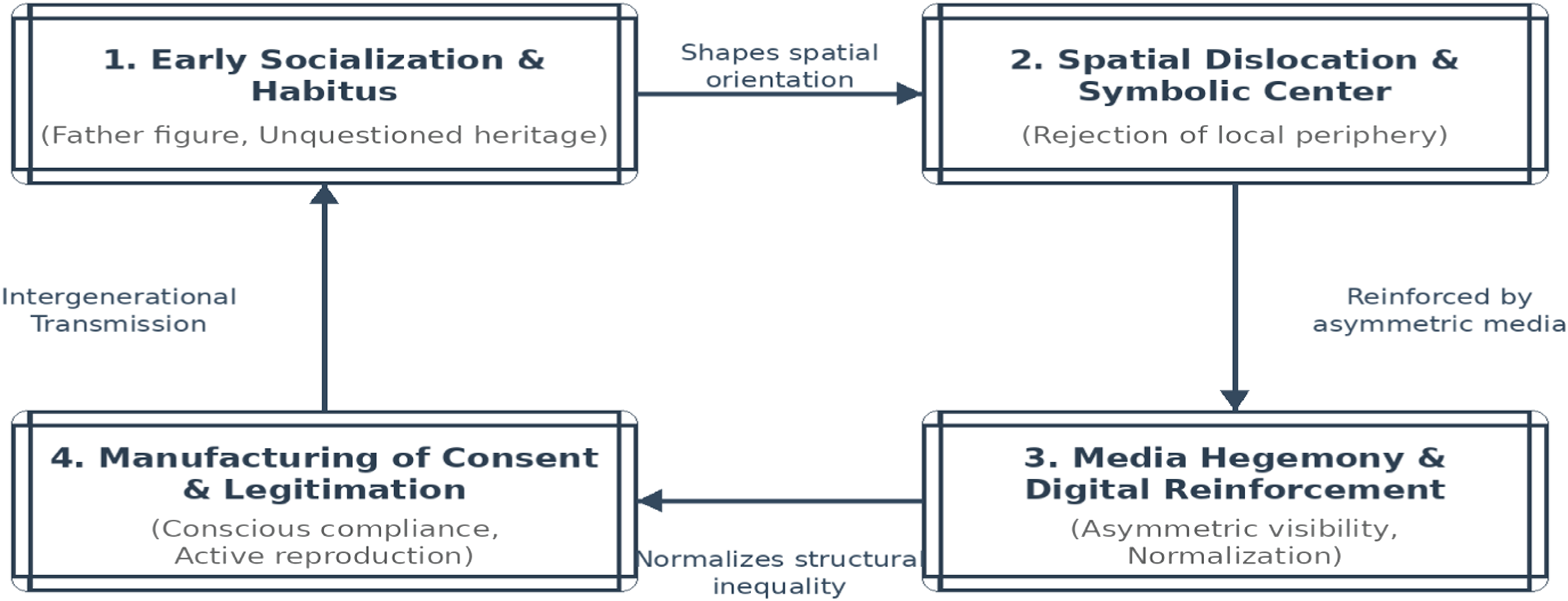
The cyclical model of the socio-political construction of non-local fandom.
Discussion
The findings reveal that non-local fandom is not merely a coincidental occurrence or individual preference, but a multi-layered social phenomenon constructed through early socialization, spatial hierarchies, media ecology, and hegemonic systems. Participant narratives demonstrate that fan identity begins as an early socialization process, transmitted mainly through the father figure. This aligns with literature emphasizing intra-familial dynamics (Hyatt et al., 2018; Tinson et al., 2017; Wann et al., 1996) and evolutionary perspectives on children mimicking primary caregivers (Butler et al., 2025). However, unique to the hybrid spatial context of Ankara, this transmission operates differently than in other contexts; unlike Tamir's (2019) findings in Israel, where supporting a different team is seen as a breach of loyalty, Ankaralı fathers ensure the intergenerational reproduction of structural hegemony by passing on their non-local fandom as an unavoidable heritage. This process reflects Bourdieu's (1977) concept of habitus operating within spatially structured fields, where early dispositions become naturalized across generations, extending beyond the Turkish case to any nation-state in which political and cultural capitals diverge.
Bourdieu's (1977, 1990) theorization of habitus as durable, transposable dispositions formed through early socialization illuminates why participants described fandom as an identity “born into” rather than chosen. The recurrent discourse of “I have been a fan for as long as I can remember” indicates that fandom operates as a pre-reflexive embodiment rather than rational deliberation. This unconscious acquisition is critical in Ankara's context: habitus does not merely reproduce class positions (Bourdieu, 1984) but also internalizes spatial hierarchies, making the symbolic dominance of Istanbul clubs feel natural and unquestionable. Gender dynamics further complicate this transmission, revealing how habitus intersects with hegemonic masculinity in sports (Connell, 1995). Consistent with studies on Turkish football's masculine structure (Nuhrat, 2017; Orta, 2014), female participants felt compelled to prove their fandom, unlike their male counterparts, constantly. This gendered dimension demonstrates that habitus formation operates through multiple axes of power simultaneously, suggesting that in patriarchal sporting cultures globally, spatial and gender hegemony are mutually reinforcing rather than independent phenomena.
While Lianopoulos et al. (2020) found no significant difference in identification levels between local and distant fans in Greece, this study observed that participants felt no belonging to local clubs, gravitating instead towards the Big Three as a symbolic center. This divergence can be attributed to Türkiye's Istanbul-centered hegemonic structure, which operates as what Lefebvre (1991) termed the production of space: not merely geographic but a socially constructed hierarchy assigning differential value and power to territories. Ankara's position as a political capital and sporting periphery creates a spatial contradiction that participants resolve by symbolically relocating their allegiance to Istanbul, suggesting that symbolic centers can override geographic proximity when spatial hierarchies are sufficiently entrenched (Shils, 1975). The deterritorializing effect of digital media (Reifurth et al., 2019) allows participants to maintain a strong identification despite geographical distance. However, this technological capacity does not disrupt spatial hierarchies but enables their reproduction across distances. This finding raises questions about localist assumptions in the sports geography literature, suggesting that in highly centralized nation-states, symbolic geography may matter more than physical geography.
A critical finding is the “identity compartmentalization” strategy. Although the literature suggests that individuals typically gravitate towards local teams that reflect their home (Tainsky and Stodolska, 2010), participants who strongly identified as Ankaralı did not belong to local clubs. Notably, the discourse of the second team was absent. Local and fan identities were internalized as separate dimensions. This compartmentalization can be understood through Anderson's (1983) concept of imagined communities, where national or symbolic belonging can be sustained independently of territorial attachment. Participants appeared to construct dual imagined communities: one rooted in Ankara's urban identity and the other in Istanbul's football supremacy, without perceiving contradiction. Conversely, the political stance and actions of Istanbul fan groups strengthened participants’ bonds with their non-local teams (Irak, 2019; McManus, 2019; Turan and Özçetin, 2017), suggesting that ideological alignment can substitute geographic proximity in identity formation. This mechanism represents an original theoretical contribution to sports sociology, revealing how individuals in peripheral contexts negotiate structural inequalities not through resistance but through strategic psychological separation, thereby maintaining local pride while deriving symbolic capital from hegemonic centers. This finding extends beyond Turkish football to contexts in which peripheral populations navigate cultural hierarchies, from regional identities within federal states to diaspora communities maintaining dual allegiances.
Ankara's paradox of being the political center but cultural periphery creates a unique case of structural inequality (Kalaycı, 2021; Yarar, 2005). In this environment, supporting Istanbul clubs provides Ankaralı individuals with national recognition and social visibility, which can be explained by symbolic capital (Bourdieu, 1984). An asymmetric media structure heavily reinforces this orientation. Participants consistently recalled seeing only the Big Three in their childhood, reflecting the 1990s media landscape in which the “godfathers” of Turkish football used Istanbul teams for economic and political gain, reinforcing structural inequality (Emrence, 2010). This finding suggests that spatial hierarchies in sport operate through the unequal distribution of symbolic resources, with implications for understanding center-periphery dynamics in other centralized contexts.
Digitalization has not disrupted this establishment; instead, it has reinforced it (Talimciler, 2006). By rendering geographical distance irrelevant, digital media has made non-local fandom practices more feasible and attractive (McManus, 2013; Woods and Ludvigsen, 2022). This finding challenges techno-optimist assumptions in media studies that position digital platforms as inherently democratizing forces. Rather than disrupting spatial hierarchies, digital deterritorialization operates as what can be termed “virtual centralization,” where symbolic centers extend their reach across physical boundaries without redistributing power. Most strikingly, although participants are aware of the structural inequalities in the media-politics-capital triangle, they display conscious compliance. They do not seek to transform their practices but instead internalize the existing order as legitimate, illustrating the cyclical maintenance of the manufacturing of consent (Gramsci, 1971). This mechanism reveals that hegemony in the digital age operates not by restricting access to information but by shaping the desires and identifications of peripheral populations. The implications extend beyond Turkish football to any context where digital connectivity intersects with pre-existing spatial inequalities, from regional media consumption patterns in federal states to global cultural flows between metropolitan and peripheral regions.
At the individual level, this hegemonic structure is sustained through active legitimation practices. Participants employ strategies of success and prestige, psychologically distancing themselves from the instability of local clubs (Cialdini et al., 1976; Wann and Branscombe, 1990). The contradictory discourse of freedom of choice, which presents fandom as both an immutable heritage and an individual right, masks structural inequalities through the rhetoric of neoliberal individuality (Andrews and Silk, 2012). This reveals a critical theoretical insight: hegemony operates most effectively when individuals perceive themselves as autonomous agents making free choices, even when those choices are structurally constrained. While diverse socio-cultural motivations shape the sustained orientation toward and allegiance to the Big Three, it remains undeniable that sporting success is one of the most significant factors reinforcing the hegemonic cycle at each stage, particularly given that 59 of Türkiye's 68 league championships have been won by the Big Three (Turkish Football Federation, 2026).
Ultimately, the intergenerational transmission observed in this study (Tamir, 2022) indicates that, beyond mere team preference, spatial hierarchies and hegemonic acceptance are being passed down to the next generation. This cyclical reproduction demonstrates that non-local fandom is not simply a consumption preference but a mechanism through which spatial inequalities are naturalized and sustained across the generations. Conceptually, this study reveals that in contexts of high spatial centralization, peripheral populations may actively participate in reproducing their marginalization through identity practices seeking symbolic capital from hegemonic centers. This has implications for understanding how cultural hierarchies persist despite awareness of inequality and is applicable to any context in which peripheral populations legitimize hierarchies through perceived autonomy.
Conclusion
This study reveals that Ankaralı individuals’ support for Istanbul's Big Three is a socio-political construction rooted in early socialization, spatial hierarchies, and asymmetric media structures. Non-local fandom, internalized as habitus and often transmitted through the father figure, emerges from Ankara's hybrid position as a political center yet a cultural periphery. This structural disadvantage prompts fans to orient themselves towards Istanbul as a symbolic center, a process normalized by media hegemony and reinforced by digitalization. Ultimately, Ankara serves as a theoretical model for understanding how cultural hegemony is maintained in geographically and politically centralized nations. By demonstrating that non-local fandom is not merely a preference but a structural reproduction of spatial hierarchies, this study offers critical insights into international sports sociology by exploring how peripheral identities navigate and legitimize the dominance of symbolic centers through the manufacturing of consent.
Limitations
Due to its qualitative and phenomenological design, the generalizability of the research findings is limited. Although interviews with 18 participants provide an in-depth understanding of non-local fandom experiences, they do not permit definitive inferences. Focusing solely on Ankara as the local element, the research does not examine the dynamics of cities that play a significant role in Turkish football, such as İzmir, Bursa, Adana, and Trabzon. Intergenerational differences were not systematically examined. The orientation from the periphery to the center was addressed unidirectionally; a reverse dynamic was not included in the research.
Theoretical contributions
This research conceptualizes non-local fandom as a process involving hegemonic relations and socio-political construction, extending beyond explanations that attribute the phenomenon to singular factors such as geographical distance or digitalization. The original contribution to international scholarship is the conceptualization of identity compartmentalization within sports fandom. The findings indicate that in contexts characterized by high spatial centralization, individuals can separate their local pride from sporting allegiance, thereby perpetuating a hegemonic cycle that transcends geographical boundaries. This mechanism elucidates the impact of Ankara's hybrid spatial position on fan identity formation. This demonstrates that hegemony is not merely an imposition from above but a process actively reproduced by individuals through strategic identity positioning and daily social practices. Furthermore, the study reveals that football fandom intersects with gender dynamics and is influenced by early socialization, while digital media reinforces these structural hierarchies, rather than transforming them.
Implications
The findings indicate that football fandom, presented and perceived as an individual preference, is essentially a normalized outcome of a structural-inequality environment. The asymmetric distribution of power and resources between the center and the periphery is legitimized through the media and becomes unquestionable. The fact that Ankaralı fans, included in the research, continue their practices despite being aware of the unjust structure reveals that the mechanisms of hegemonic consent operate effectively. The fact that the current structure is reproduced through intergenerational transmission suggests that short-term interventions will remain ineffective and that radical structural changes may be needed.
Recommendations
The Turkish Football Federation (TFF) could adopt a more equitable, solidarity-based model for distributing broadcasting revenues. Broadcasting policies that ensure a fairer representation of local clubs in the media could be regulated by relevant institutions. Ankara's local clubs and local administrations could develop governance and communication policies that prioritize social values and urban identity alongside sporting success. Football clubs could support female fan groups by adopting a more inclusive approach in fan cultures and increasing gender sensitivity.
Future research should employ quantitative methods to address the nationwide prevalence and socio-economic determinants of non-local fandom, while comparative ethnographies in different Anatolian cities could reveal regional variations. Longitudinal designs are essential to examine intergenerational transmission, particularly regarding the digitally shaped practices of Gen Z and Gen Alpha, as well as the potential impact of policy changes. Furthermore, investigating the spatial mobility of non-local fans visiting Istanbul, alongside a reverse perspective on Istanbul-based support for Anatolian clubs, would deepen the understanding of center-periphery relations. Future comparative research could also explore analogous political center-sporting periphery dynamics in other national contexts, such as Brasília's position relative to Rio de Janeiro and São Paulo in Brazilian football. Finally, big data analysis could elucidate the role of social media in identity construction, while future studies should also consider socialization agents beyond the father figure.
Footnotes

Ethical considerations
Ethical approval was granted by the Van Yüzüncü Yıl University Social and Humanities Publication Ethics Committee (Date: 13.11.2025, Decision No: 2025/23–22).
Consent to participate
Verbal consent was obtained from 18 voluntary adult participants.
Funding
The author received no financial support for the research, authorship, and/or publication of this article.
Declaration of conflicting interests
The author declared no potential conflicts of interest with respect to the research, authorship, and/or publication of this article.
Declaration of AI-assisted technologies
The author utilized AI-assisted technologies to improve the language quality and readability of the manuscript during the translation and editing stages, including the formatting of references according to the SAGE Harvard style. In addition, Figure 1 (The cyclical model of the socio-political construction of non-local fandom) was designed with the aid of AI tools.
Data availability
The datasets generated during and/or analyzed during the current study are available from the corresponding author on request.