







Abstract
This study unpacks the conditions for, characteristics of, and consequences of employed ‘background’ work/ers in grassroots sport. Contrary to existing knowledge on ‘off-field’ sport staff, it applies an organisational sociology lens to address paid work as a basic yet neglected form of professionalisation. Drawing on institutional role theory and semi-structured interviews with sport club staff, we show the distinctiveness of paid work in otherwise volunteer contexts. Specifically, we demonstrate how paid professionals occupy a paradoxical position as employees primarily governed by a democracy/volunteering logic. Ironically, it is precisely because paid staff understand their work through this lens that their everyday ‘muddling through’ harbours potential for ‘downwards’ professionalisation effects vis-à-vis member/volunteer roles. Our analysis suggests the significance of extending sport sociology's premise (i.e., that sport matters) to include those that work ‘in the shadows’ of sport.
Professionalisation is a persistent theme in sport sociology, management and policy research. Although a shift from volunteer to employed staff is included in most conceptualisations, research on the causes, contents, and consequences of organisational and systemic professionalisation greatly exceeds the sociological interest in foundational issues linked to the purest form of professionalisation in sport: paid work (Dowling et al., 2014). Interest in players, coaches and other ‘frontline’ staff is gaining traction (e.g. Purdy and Kohe, 2025; Roderick et al., 2017) in the sociology of sport. However, there is a particular lack of sociologically informed research on what Baer et al. (2025) call ‘background’ sport workers. This term refers to staff that operate (and in some cases run) the organisational machinery of sport, and whose work is arguably distinct with respect to competence requirements, task domains, lines of accountability, and not least visibility to the public eye, and the risks/rewards this entails. Instead, inquiry into the everyday working life of sport employees who ‘work in the shadows’ (Baer et al., 2025: 44) yet are crucial for the operation of sport systems worldwide, has largely been the domain of (primarily North American) sport management scholarship. Much of this work is therefore framed by a ‘positive organizational scholarship paradigm’ (Cameron et al., 2003). This has generated a focus on the interrelation between various aspects of worker well-being and productivity, the ultimate goal being enhanced organisational efficiency and effectiveness (e.g. Oja et al., 2022).
From a sociological standpoint, the ‘prospect that [the human experience] can be designed and managed’ (Kleiber, 2020: 618) is cause for critical examination, rather than an impetus for the study of ‘development of effective designs’ (Oja et al., 2022: 1). This is particularly so in relation to paid work in the federative sport arrangements in place in numerous countries worldwide. In many ways, Swedish sport, the empirical setting for this paper, epitomizes such arrangements. In this context, as in other federative sport systems, paid work in the 18,000 sport clubs potentially impacts democracy and volunteering, which is their foundation for societal legitimacy as well as a governance ideal and operational necessity (Fahlén and Stenling, 2016). Indeed, approximately 800,000 Swedish volunteers govern sport via boards elected at general assemblies (in clubs and federations) and handle the day-to-day operations as coaches, referees, event organisers, etc. (Riksidrottsförbundet, 2025). To our knowledge, there are no available statistics on the number of paid staff in Swedish sport clubs or Swedish sport in general. Nonetheless, voluntary clubs are sites for paid work, even though the volunteer working hours greatly exceed those carried out by staff, forming one key condition for paid work. For these reasons, inquiry into the everyday working lives of background sport workers in these systems, although unexplored, is sociologically significant for at least two reasons.
The first concerns sport workers themselves and sport work itself. Like any other domain of labour, the sport workplace structures life chances, shapes identities, and serves as an arena where power dynamics play out, fundamentally affecting those who spend the majority of their waking hours there (Burton et al., 2016). Put differently: If the justification for the sociology of sport lies in the premise that sport matters, then surely this must also apply to the people that earn their living working in sport, and to the work they are paid to do? In that sense, there is inherent cause for a sociological study of the everyday lives of paid sport work/ers – one that goes beyond productivity and efficiency (Kohe and Purdy, 2024).
Regarding paid work within otherwise voluntary systems specifically, the phenomenological nature of work and its impact on the day-to-day lived experience of those who carry it out is particularly important because it speaks to the potential uniqueness of sport as a place of work. Particularly relevant is the expectations concerning (in)appropriate conduct that surround paid roles, because they reveal the logics providing meaning and direction to role incumbents, thus offering insights into the potential distinctiveness of paid work in such systems (cf. Stenling and Fahlén, 2025). To illustrate, such insights may include how employees interpret the work expectations they face with regard to mandate, influence, and responsibilities vis-à-vis the volunteer workforce, their placement in the (in)formal work structure of organisations, and, more broadly, the meaning ascribed to their work (by themselves and others), as well as the support structures, requirements and governance provided by their de facto volunteer employers (i.e., elected boards).
A second reason why the sport work life is sociologically significant stems from its embeddedness and potential to generate broader transformative consequences (e.g., Burton et al., 2016), not least in relation to the ongoing professionalisation of sport. Because work takes place in organisations that are in turn nested in institutionalised systems, a sociological approach necessarily involves situating work in a meso (organisational) and macro (institutional) context. Indeed, situating the study of work within such an approach enables an analysis that unpacks ‘critical links from micro to meso to macro’ (Burton et al., 2016: 12). Specifically, placing focus on the expectations around (in)appropriate role conduct that surround work is significant due to the inextricable link between such role constructions and continuity and change of the institutional order (Berger and Luckmann, 1966). In other words, role expectations provide a window into the institutional system in which work is embedded, while at the same time revealing emergent changes in that system. With regard to such institutional transformation in the realm of sport, we know that the professionalisation of sport involves transitions from volunteer to paid roles (e.g., Kikulis et al., 1992), as well as the emergence of new professional roles (Stenling and Fahlén, 2025). Swedish sport too shows signs of professionalisation and its eroding effects on democracy and volunteering as operational necessity and longstanding ideal and practice. Research has noted this trend in, for example, the systemic guarding of integrity and the development of an integrity officer role (Stenling and Fahlén, 2025), but also in the everyday lives of sport clubs (Fahlén and Stenling, 2019).
In civil society as well as sport research, the prevailing assumption is that professionalisation shifts role expectations in a way that displaces democratic practices and undermines volunteer engagement (McAllum, 2018). However, recent research (e.g., Terzieva et al., 2024) suggests that this assumption is perhaps too sweeping and negligent of what it is that paid staff actually do, and how their work is carried out. From an institutional vantage point, the meso-level expectations pertaining to (in)appropriate conduct that script these central elements of work roles stand in a recursive relationship to macro-level institutional ideas around what paid work should entail, and equally taken-for-granted, but potentially conflicting, notions around the legitimate means and ends of voluntary sport. However, role constructions are also consequential for the micro-level work experiences of role enactors. This suggests that ‘the devil is in the details’ when it comes to the link between paid work and the reshaping of volunteer sport systems. Expectations regarding work tasks and performance constitute a key meso-level mechanism through which professionalisation is translated into everyday life.Such expectations simultaneously shape the micro-level experiences of role incumbents, who must navigate potentially ambiguous and competing role prescriptions (Stenling et al., 2025) and therefore provide an empirical entry point into the ‘devil in the details’ of paid work in volunteer sport systems.
Purpose and specific aim
This paper seeks to introduce a sociological focus on sport as a place of paid work/ers operating ‘in the shadows’ in otherwise voluntary systems. This ambition should not be taken to reflect a disregard for paid ‘on-field’ sport workers (e.g., Purdy and Kohe, 2025), volunteering as a form of work, or, notably, the insights concerning background paid staffs’ work and working conditions produced by sport management scholars. Our purpose instead reflects an ambition to accentuate what has somehow escaped the attention of sociology of sport scholars: professionalisation qua paid work ‘out of the limelight’, and in the context of otherwise voluntary systems.
We pursue our overall purpose by addressing the more specific aim of unpacking the conditions for, characteristics of, and consequences of paid (background) sport work/ers in voluntary sport clubs via the concept of organisational roles (cf. Barley and Tolbert, 1997; Berger and Luckmann, 1966; Ocasio, 2023; Schütz, 1967). Empirically, we focus on grassroots organisations in Sweden as a volunteer-based and federative sport system, because they are sites where the unique nature of sport work is arguably made particularly salient due to the context in which it takes place. The following research question guides our analysis: What expectations around (in)appropriate conduct (i.e., work tasks and work performance) surround background staff's everyday professional life?
The article is structured as follows. Following this introduction is a review and critique of extant research on paid work in sport, as well as an introduction to our conceptual lens. This is followed by a section on research design and methodological approach. Thereafter, we account for our findings on the expectations concerning paid work in voluntary clubs. These are discussed in a separate section, and the paper closes with notes on limitations and suggestions for future research.
Approaching the study of paid (background) sport work/ers
Sport is a domain where multiple logics are reconstituted and played out. Although paid work is fundamentally an expression of a professionalisation logic (Dowling et al., 2014), staff roles are bound to be shaped by and shape ‘broader cultural-political struggles’ (Burton et al., 2016: 4) between conflicting logics. From sociologically informed professionalisation research, we know that in many sporting contexts, a central tension is between professionalisation and the institutionalised voluntary and democratic ideals, structures, and practices in which it takes shape (e.g., Nagel et al., 2015; Thibault et al., 1991). This is illustrated, for example, by Kikulis et al.'s (1992) notion of a sport organisation's transition between Kitchen Table, Boardroom, and Executive Office governance frameworks, illustrating paid staff's gradually increasing influence on democratic decision-making. Yet, paid work as a distinct form and precipitator of professionalisation remains a nascent theme in the sociology of sport, with existing studies focusing mainly on ‘frontline’ staff (e.g., Purdy and Kohe, 2025; Roderick et al., 2017). Meanwhile, scientific inquiry into ‘background’ sport workers (Baer et al., 2025: 44) has largely been the purview of North American sport management scholars, meaning it is produced in a sporting context that is vastly different from the federative and volunteering-based systems of interest here. Nonetheless, as explained in the following, both these bodies of literature variously inform our work.
Sport as a distinct site for work?
Sociological research tells us that athletes, coaches, and other ‘frontline’ professionals in the ‘high-stakes’ context that is elite sport are required to invest significant physical, mental, and emotional dedication in their work (e.g. Way, 2021). This body of literature draws attention to the possible gains with applying a sociological perspective on paid work in sport. It furthermore tells us that, although there are overlaps with other areas of the labour market, for example in creative or cultural industries (e.g. Hesmondhalgh and Baker, 2010), sport offers distinct sites for work and needs to be approached as such for the origins, features and effects of the work carried out to be analytically distinguishable.
At a general level, it appears as if working as background staff, although distinct with respect to, for example, competence requirements and visibility, demands the same dedication as that required from on-field staff. From sport management research by, for instance, Huml et al. (2021) and Weight et al. (2021), we know that background sport jobs can be so-called ‘high demand vocations’ where ‘overwork climates’ (Huml et al., 2021: 597) breed in the workplace. Sport jobs carried out in the background can furthermore be ‘boundaryless in nature’ (Huml et al., 2021), requiring staff to have ‘work grit’ (Kim et al., 2023) but simultaneously being on guard against the risk of developing ‘workaholism’ (Huml et al. 2021). Similarly, Weight et al.'s (2021) study of work experiences across the career span suggests that senior leadership in sport is gained through ‘outlasting others’ (375) by enduring the sacrificial culture and long hours of the early career years and managing to cope with family–work conflicts and the inflexible circumstances of the mid-career stage. However, those who are ‘able to stick it out’ (275) to earn a senior leadership position sometimes regret having prioritised work over family in the past.
In the face of these harsh working conditions, why do people seek employment opportunities in sport? Research by Oja et al. (2020) shows that sport employees have a high integration between sport and their sense of self. That is, staff understand sport, the organisation they work for, and work itself as an extension of the self, meaning they feel a ‘kinship with sport in the abstract’ (277) and a ‘“shared fate” with the organization’ (278) they work for. This includes linking the organisation's performance to their own achievements and efforts in the workplace, which is facilitated by background staff's interpretation of their work as ‘a calling’ (Huml et al., 2025), their passion and love for sport, and sense of pride in being part of it (Anagnostopoulos et al., 2016).
Background staff thus appear to strongly believe in the individual and societal benefits of sport, and they view their work as meaningful because it can be conceptualised as serving others and making a societal and economic impact through sport (Baer et al., 2025). Baer et al.'s findings align with previous studies in terms of the challenging working conditions of the sport workplace (Huml et al., 2021; Kim et al., 2022; Weight et al., 2021). However, it additionally highlights high levels of trust from supervisors and great autonomy to ‘craft’ task performance as instrumental for navigating these challenges and for staff's ability to recognise their work's impact at individual, organisational and societal levels.
An organisational sociology lens to background sport work/ers
As shown above, sport management research has provided valuable insights into the general working conditions of background staff, but its orientation towards supporting more rationalised and ‘business-like’ HRM practices produces knowledge that does not fully explain the institutional embeddedness of sport work/ers. Sociologically informed research from across the northern hemisphere (e.g., Purdy and Kohe, 2025; Roderick et al., 2017), on the other hand, unpacks the socio-cultural embeddedness and power-imbued nature of sport as a place of work. However, this lens has yet to be applied to the ‘background staff’ whose everyday work creates the conditions for athletes’, coaches’, referees’ and other staff's work at ‘the frontline’ and whose work arguably stands in a recursive relationship to the otherwise voluntary context in which it is carried out.
Leveraging an organisational sociology lens to the study of background sport work/ers is necessary to fully appreciate and explain the (re)constitutive nature of paid work in otherwise voluntary systems. Fundamentally, work impacts the lives of those who carry it out, but it needs to be understood as standing in a recursive relationship to intra- and interorganisational dynamics. Work, then, becomes viewed as ‘inhabited by individuals’ but ‘embedded within and across organizations, social systems, and institutions’ (Burton et al., 2016: 12).
Theoretically, we therefore expect the potentially conflicting logics of volunteering and professionalisation to constitute ‘institutional raw material’ (Glynn, 2008) in constructions of expectations surrounding the oxymoron paid work in voluntary clubs. Specifically, we draw on an institutional understanding of organisational roles (Barley and Tolbert, 1997; Berger and Luckmann, 1966; Ocasio, 2023; Schütz, 1967) to unpack the conditions for, characteristics, and consequences of paid work in sport clubs. Our interest thus lies in the ‘shared patterns of role pre- and proscription regarding (in)appropriate conduct’ (Stenling and Fahlén, 2025: 3) surrounding paid work in clubs, with a particular focus on expectations regarding tasks and performance in club employee role enactment. Roles, in this conceptualisation, gain their shape, legitimacy and meaning from broader systems of meaning that ‘identify categories of social actors and their appropriate activities or relationships’ (Barley and Tolbert, 1997: 96). In that sense, role pre/proscriptions both inform incumbents of (in)appropriate conduct and locate roles’ relative position in an interaction order. Because of the often multiple logics that inform this process, role occupants may experience role ambiguity. And yet, they have no choice but to ‘muddle through’ (Fahlén and Stenling, 2019) their everyday life, thus contributing to institutional reproduction and change, often inadvertently. This conceptual approach allows an analysis that links everyday work practices to their institutional origin and transformative potential.
Research design
Data collection
Our conceptual outlook implies an interpretive approach to organisational research, meaning we wanted to capture the ‘social stock of knowledge’ (Schütz, 1967) at play in institutional role constructions. We relied on semi-structured interviews due to their potential to prompt meaning-rich accounts. Our interview guide sought to elicit detailed responses regarding interviewees’ everyday professional lives yet allow us to use these responses as a window into the broader institutional context in which they are carried out. As such, it was structured around four main themes: (1) Everyday work practices (e.g. ‘How would you describe an ordinary day at work?’), (2) Boundaries in professional practices (e.g. ‘How do you know which tasks to perform?’), (3) Conditions and performance (e.g. ‘What does it mean to “do a good job” in your work?’), and (4) Potentially unique facets of paid work in voluntary sport (e.g. ‘Is there any other line of work that you would consider similar to yours? If so, in what ways is it similar?’).
Prior to data collection, we attained an ethics waiver from the Swedish Ethical Review Authority (Dnr 2023-05616-01) and thereafter followed the Swedish Research Council's ethical guidelines (Vetenskapsrådet, 2017), as well as institutional guidelines and routines for secure data handling and storage. This means that potential interviewees were given all information necessary to provide informed consent. Regarding sampling, because we were interested in shared role expectations (rather than how they may vary with club size, geographic location, sports played, etc.), we sought club variety. However, to keep our focus on paid work in voluntary clubs, we only recruited interviewees who worked full-time for the club and were ‘regular’ employees, as opposed to part of a labour market programme.
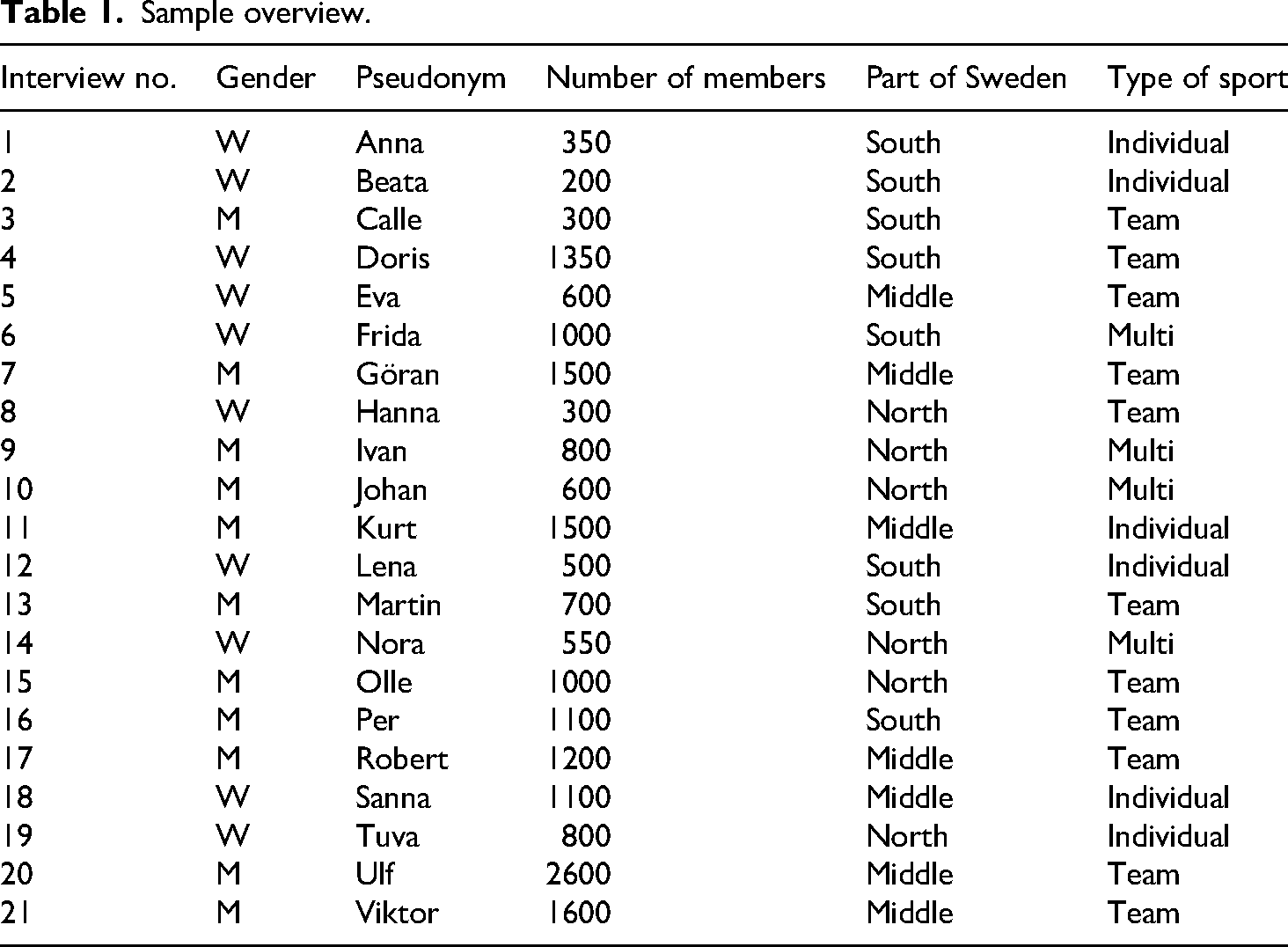
Through screening the websites of sport clubs across Sweden and approaching clubs with staff, we managed to recruit 21 (10 women and 11 men) club employees in administrative roles. The interviewees work in clubs located in just about every corner of Sweden. The clubs have 300–2600 members and a wide-ranging sport offer (e.g., figure skating, track and field, football, basketball, bandy, ice hockey, floorball). A portion of the clubs are so-called multi-sport clubs, meaning they offer more than one sport. Interviews ranged between 25 and 53 min, with an average length of 40 min. They were all carried out via Zoom and subsequently transcribed verbatim to prepare for further analysis (Table 1).
Sample overview.
Data analysis
We subjected the interview transcripts to a four-step analytical process that aligned with the Gioia method (Gioia et al., 2013). First, the authors individually read the interview transcripts and conducted an initial sorting of the material to identify data of relevance for the analysis. Second, we independently constructed data-driven codes through a line-by-line reading of the identified material, applying the compare-and-contrast tactic. These were thereafter checked for consistency, and the few unclarities were resolved through dialogue between coders, where interpretations and ways to conceptualise the content were discussed, to finalise a list of first-order codes. The third step involved collaborative construction of more abstract codes and in a final step, these were clustered into three overarching but interrelated themes: (1) the fundamental conditions that shape interviewees’ work, (2) the expectations concerning work tasks and performance and (3) the consequences of operating within these roles for sport workers themselves and sport work itself. An example of this process was how first-order codes such as ‘friendly’, ‘having a good tone’ and ‘positive’ were clustered into the second-order category Friendly and enthusiastic, which was further abstracted into the theme Expectations Concerning Paid Staff's Work Tasks and Performance.
Whereas our conceptual outlook shaped our analysis already at the data collection stage (i.e. via interview guide construction), our final step of the analysis consisted of a more purposeful and intense leveraging of this lens to unpack the institutional shaping and system-level transformative consequences of seemingly mundane, everyday work in voluntary sport. This enabled us to interpret how normative expectations, and their associated practices shape the institutional role of paid staff in Swedish sport – an archetype of federative sport systems and their defining characteristics (Fahlén and Stenling, 2016).
Findings
Guided by our focus on typified institutional roles, the section is organised to address the central question: What expectations around (in)appropriate conduct surround background staff's everyday professional life? To this end, the findings are structured into three interrelated themes that, individually and together, illuminate how institutional norms and organisational arrangements converge to define the contours of everyday professional life in otherwise volunteer contexts.
Fundamental conditions shaping paid work in voluntary sport clubs
The work of paid background staff in Swedish sport clubs is fundamentally shaped by a strong sense of commitment to the ideals of voluntary sport. Across interviews, participants consistently described their motivation in terms of dedication to the club, its members, and the broader values associated with Swedish sport. This normative grounding in volunteerism both legitimised their professional presence and defined their responsibility: to support, sustain and uphold the system.
Interviewees frequently described themselves as having a central and multifunctional position within the club. As in many cases the only paid employee within an otherwise volunteer-run organisation, they were expected to carry the weight of operations across a broad spectrum of tasks. This expectation stemmed in part from their paid status, the fact that you are ‘working with 1000 members, but everyone else is a volunteer’ (Olle). Being the one who ‘gets paid’ rendered interviewees ‘the go-to person for a lot of people’ (Per) – the default point of contact for virtually all issues, big or small. One interviewee articulated this logic concisely: As an administrator I kind of feel … I’m paid to facilitate for the members, and they work in their leisure time. Because of that I want to make their participation as easy as possible, so I don’t ask for help much, just keep working as best possible. (Nora)
The idiomatic expressions used to describe their function reinforced this expansive, enabling role. Interviewees variously referred to themselves as ‘the spider in the web’ (Beata, Calle, Johan, Nora), ‘engine of the club’ (Lena), the one that ‘keeps the wheels turning’ (Johan), or the ‘club afloat’ (Ivan) and ‘leads the way’ (Olle). These expressions illustrate a perception of their work as not only essential but also integrative in that they bind the various elements of the club together.
Having this central function translated into a work role characterised by significant variation in type, scope and degree of complexity. Tasks ranged from highly mundane and physical duties, such as doing laundry or setting up equipment, to conceptual and strategic work focused on developing the club's long-term direction. Interviewees thus described their role as ‘broad [and] involving a wide range of tasks’ (Martin) that are ‘high and low’ (Robert), ‘very varied’ (Sanna), ‘scattered’ (Ulf) and that of a ‘jack of all trades’ (Johan). In other words, as a club employee, ‘you need to be prepared to do just about anything. Any and all work assignments can land on your desk’ (Nora). The range of responsibilities required both long-term planning and the ability to respond immediately to emergent issues, whether raised internally by members, parents and coaches, or externally by federations, sponsors or the broader community. The ability to alternate between proactive planning and reactive service is a consistent theme in the accounts of daily work.
Interviewees framed the underlying purpose of their work in relational and enabling terms. Their role was primarily seen as one of making others’ involvement possible, particularly coaches and other volunteers. This orientation was seen as consistent with the broader value placed on voluntary engagement in sport. Olle reflected this when they said that their role is to, ‘allow as many volunteers as possible to engage in their passion […] in the best of worlds, the sole purpose of my job is to enable [volunteer] engagement’. Interviewees thus described their central aim as ‘making things work’ (Johan, Lena, Martin, Robert,) or ‘making it easier’ (Frida, Nora, Per) for others to participate and contribute as a coach or other volunteer.
In this view, the quality of their performance was not assessed by traditional key performance indicators but through indirect, relational markers such as whether members were satisfied, whether the club felt inclusive and welcoming, and whether engagement was sustained or increased. Robert illustrated this notion of a job well done when he said that, ‘If the members are satisfied and happy, the club grows, people come to us, they stay – that's kind of a yardstick for if the administrative office is doing a good job, if we’ve got everything in order, everything works’. The interviewees also frequently emphasised the importance of maintaining structure, order, and predictability within the club–not as bureaucratic imperatives but as necessary foundations for enabling and sustaining voluntary involvement.
Expectations concerning paid staff's work tasks and performance
When asked to describe how their work was evaluated or what tasks were seen as especially important, interviewees pointed to several recurring expectations related to service, administration, and communication. Although their job descriptions were often loosely defined, they identified a shared set of responsibilities tied to the smooth operation of the club and the support of its members.
The interviewees framed a first major area of responsibility as providing service to members, akin to running a ‘customer service’. Responding to inquiries, whether via phone, email or in person, was described as a continuous and demanding part of the role. Beyond this service function, a second significant dimension of the work involved maintaining internal order and administrative continuity. They operated as the ‘janitor’ of administration, where they keep up with continuous system-generated tasks. Interviewees described a range of ongoing administrative tasks that included registering members, processing reimbursements, compiling statistics and reporting to national or regional sport federations. These activities required attention to detail, procedural accuracy and effective time management. The expectation was not only to complete these tasks, but to do so proactively and in alignment with relevant deadlines and formal requirements. In parallel, a third cluster of tasks can be described as curating information flow. Participants were expected to manage the flow of information within and beyond the club. This included adapting communication from external actors to the local context and relaying internal decisions from the board to the broader membership. Olle described it in the following manner: But then there is a lot of focus on the relationship building, trying to have time for and understanding of their situation as volunteers, simply be sensitive about it, be quick with the emails then, be quick with the conversations, be clear about what is expected. (Olle)
These processes demanded a high degree of audience awareness, as the same information needed to be tailored differently depending on whether it was directed at parents, youth interviewees, coaches or external partners. Clarity, timeliness and accessibility with respect to audiences preconditions and needs were viewed as central in this regard.
To meet these expectations, interviewees identified several personal qualities and forms of conduct that were implicitly required. They felt they needed to be ‘friendly’ (Eva) and enthusiastic in their interactions, presenting a ‘positive and welcoming face’ (Martin) to members and external actors. Agility and responsiveness were equally important, as the work was fast-paced and rarely predictable. The ability to adapt quickly, re-prioritise tasks and respond constructively to unexpected requests was seen as essential. Solution orientation and helpfulness were also emphasised as core elements of good professional conduct. Ivan explained: Be kind, be happy. Well no but, you have to be a little solution-oriented. There are many different types of people [among members] and different levels of ambition, so you have to be a little solution-oriented, a little creative, find solutions, because that's not, we don't have all the resources in the world, neither money nor personal resources, so then you have to be a little solution-oriented and communicative to avoid misunderstandings. (Ivan)
Interviewees viewed themselves as facilitators rather than gatekeepers, responsible for finding ways to make things work rather than enforcing rules or limiting action. Similarly, they described the need to be consistently available, approachable and sensitive to the needs of others. Many framed their work in terms of ‘relationships’ (Calle, Johan, Lena, Olle), underlining the importance of trust, humility and presence in building productive exchanges with members and volunteers. Finally, the ability to be diligent, stable and reliable was described as a baseline requirement. Doing the job well meant doing it thoroughly, consistently, and with a high degree of conscientiousness. Precision and seriousness were not perceived as bureaucratic virtues, but as expressions of respect for the voluntary contributions of others.
Consequences of operating within these roles for sport work/ers
Despite the centrality of their role, interviewees reported limited opportunities to formally evaluate or validate their performance. While some clubs had structured feedback systems, such as annual performance reviews or member satisfaction surveys, most relied on informal and often ambiguous signals. Robert stated that their everyday life is ‘quite difficult to measure because we do not get quick answers’. A common understanding was what we would describe as a ‘no news is good news’ approach, indicating that the absence of complaints was often interpreted as a sign that one was doing well.
The combination of diffuse evaluation criteria and high self-imposed expectations resulted in a work experience that was often marked by ambiguity and unpredictability. Interviewees described their work as fundamentally reactive and urgency-driven. No two days were alike, and long-term planning was frequently disrupted by emergent issues that required immediate attention, as Hanna described: People call with their problems they want fixed and you deal with it then. That's why I say that no day turns out the way you have imagined, because what I've planned to do often comes second when you get a phone call five past eight in the morning. (Hanna)
As a result, opportunities for more developmental or strategic work were often postponed or deprioritised, according to the interviewees. The boundaries of the role were also experienced as permeable. Working hours regularly extended beyond formal schedules, and there was often uncertainty about which tasks fell within the scope of their responsibility. This led to an expanded sense of duty that was not always reflected in organisational support or recognition. As an illustration, one interviewee pinpointed the exceeding expectations of being available: If more than a couple of hours go by without a response [to a question], then it can be difficult. If we start talking like the next day, then you’re in trouble, then’ll they wonder where you've gone. No, but [you need to] keep a good tone and really answer everything and if you can't answer, ask to get back. And then be available on the phone and email all day like that. (Eva)
Moreover, several interviewees spoke of the loneliness that could accompany their position. Being the only employed person in the club meant carrying a significant operational burden without the benefit of collegial support or task-sharing. The absence of peers made it more difficult to reflect, delegate or innovate collaboratively. As one of the interviewees phrased it: ‘It gets very lonely to bounce ideas with yourself sometimes, you get stuck with your own ideas’ (Frida). At the same time, some interviewees noted that the presence of even one colleague could significantly alleviate this burden and enhance the overall work experience. A notable paradox emerged in interviewees’ descriptions of their everyday work: while they were actively trying to build structure, clarity and boundaries within their clubs in order to facilitate voluntary engagement, they themselves often lacked those very conditions. Their professional lives were shaped by diffuse expectations, unpredictable demands and a constant imperative to ‘make it work’, even in the absence of clear directives or evaluative frameworks.
Discussion and concluding remarks
Premised on the sociological significance of paid sport work/ers, this paper sought to unpack the conditions for, characteristics of, and consequences of paid ‘background’ work/ers in otherwise voluntary contexts. Thus, although our data is limited to the Swedish context, our insights are generalisable to other contexts to the extent that they display the same systemic and organisational conditions that shape work in Swedish sport (cf. Larsson, 2009). We asked the following research question: What expectations around (in)appropriate conduct (i.e. work tasks and work performance) surround background staff's everyday professional life? The study showed that the role is broadly defined and expectation-heavy, requiring paid staff to handle diverse, complex and often unpredictable tasks across service, administration and communication, while maintaining reliability, diligence and strong relational competence grounded in trust and respect for volunteers. Consequently, the work becomes boundaryless and urgency-driven, making it difficult to assess performance and often resulting in a sense of isolation and professional loneliness. So far, our theoretical and empirical focus has been on the expectations around (in)appropriate conduct that surround grassroots sport work/ers. This provides us with the basis to move on to a discussion focused on the two interrelated but neglected aspects of professionalisation. These aspects formed the justification for our broader aim of introducing a sociological focus on sport as a place of paid work/ers operating ‘in the shadows of otherwise voluntary systems: the distinct nature of voluntary sport as a site for work, and, second, its transformative potential vis-à-vis the system that embeds it’.
(Voluntary) sport as a distinct site for paid work!
In line with previous sport management research (Huml et al., 2021; Weight et al., 2021), our analysis demonstrates that working ‘in the shadows’ involves meeting expectations of a level of dedication comparable to that of on-field staff. However, the ways in which sport club employees create meaning around their work have significant implications for both individual experience and organisational structures. The interviewees articulate a strong passion for sport (Anagnostopoulos et al. 2016; Huml et al., 2025), loyalty to their specific club, ‘kinship with sport in the abstract’ (Oja et al., 2020: 277), and, notably, a profound commitment to voluntary sport per se. This goes beyond Baer et al.'s (2025) findings around staff's belief in sport's general societal and economic impact, and it suggests an institutionally shaped faith in Sweden's volunteer-run and democratically governed federative sport model.
Sport, like all sites of employment, fundamentally impacts the everyday lives, identities, and sense of purpose of the people who work there (Burton et al., 2016). Paid staff's belief in the Swedish sport model gives rise to a sense of their work as indispensable in ensuring the continuation of this model. Put differently, workers feel a ‘shared fate’ (Oja et al., 2020: 278) with their club as a concrete manifestation of the broader system in which it is embedded. This sense of being a paid linchpin in an otherwise voluntary context is not necessarily tied to personal status, but to the expectations that constitute the role itself. This role-based identity imbues staff's everyday work with purpose, even when tasks appear mundane or invisible.
However, similar to background work in North American contexts, this meaning-making process also nurtures a problematic form of boundarylessness (cf. Huml et al., 2021) that risks normalising an unsustainable level of personal commitment as an organisational necessity. Specific to work in federative and voluntary systems, the combination of urgency, moral obligation, and the perceived asymmetry between paid staff and unpaid volunteers makes it difficult for these employees to refuse additional responsibilities or even consider that they ought to try. This may be interpreted as a case of paid staff assuming power without formal mandate (i.e. an undue influence of paid staff in voluntary contexts), as demonstrated in sport professionalisation research (e.g., Kikulis et al., 1992). However, our findings around staff's understanding of their primary task being the creation of conditions that make member participation and volunteering possible paint a rather different picture, one which raises the critical question of who makes their work possible?
Furthermore, the paid positions of the interviewees in our study appear to have emerged in response to organisational needs rather than planned professionalisation. Consequently, job crafting, considered as an exercise of autonomy and freedom in the workplace sport management research (Baer et al., 2025), becomes their first order of business. In the absence of onboarding and ongoing governance of their work, employees are left to define and continually reshape their responsibilities on the basis of their interpretation of the role's purpose and expectations. This reflects a broader organisational reality for paid staff in that the logic of volunteering shaping this purpose also seems to prevent voluntary boards from exercising their de facto role as employers. We mean this both in the sense of boards potentially failing to consider it their responsibility to provide guidance and support structures for paid work, and their insufficient capacity and competence to exercise such responsibility. This apparent lack of HRM practices demonstrates that paid work in otherwise voluntary clubs is distinctive in more ways than one, but one prime indicator is that it is carried out in contexts lacking many of the elements usually expected from a place of paid work.
As expected, we thus see a tension between the logics of volunteering and professionalisation, but it plays out in a somewhat unexpected way. Paid work in voluntary systems does represent professionalisation in its most basic form (Dowling et al., 2014) and therefore carries significance in its own right. However, paid professionals occupy a paradoxical position as employees primarily governed by—and understanding their work through the prism of—a volunteering logic, rather than ideas, structures and practices associated with professionalisation.
Interviewees frequently described themselves as ‘the spider in the web’. However, this metaphor requires careful interpretation. Much like the spider diligently weaving its web in solitude, despite the countless (sometimes overwhelmingly so) interactions they have with members and volunteers on a daily basis, staff consider their everyday work as marked by loneliness. Staff's central position creates potential for influence, but this power is rarely exercised. Instead, their role remains largely precarious, with the spider itself hanging on a fragile thread. This suggests that the term ‘background staff’ (e.g., Baer et al., 2025) is somewhat misleading. As evidenced by their position as the main point of contact, paid staff do not ‘work in the shadows’ (Baer et al., 2025) but are highly visible to club stakeholders because they are paid. In that sense, in the context of voluntary sport clubs, paid staff are more akin to the ‘backbone’ that provides the essential infrastructure for ‘frontline’ activities. Notably, being the backbone implies walking a tightrope with heavy weights on your shoulders.
The transformative potential of paid work in otherwise voluntary contexts
That staff's work is shaped by expectations grounded in a democracy/volunteering logic should not be taken to mean that it does not harbour transformative potential vis-à-vis professionalisation. Indeed, the very existence of paid staff appears to create expectations related to what it means to be a member or volunteer. Staff conceive of themselves as indispensable in an indispensable system, but they are arguably also made indispensable via the way work is ascribed meaning and carried out. Indeed, our findings show that whereas boards neglect to create fundamental conditions of professional practice, staff see as their raison d’être the creation and maintenance of structure, order and predictability—key elements of organisational professionalisation (Dowling et al., 2014)—to enable member participation and volunteer engagement. In that sense, as staff go about their daily core tasks (i.e., fulfil the expectation to run the ‘customer service’, operate as the ‘janitor’ of administration and curate the information flow), making sure that ‘things work’ and are ‘easy’ for others, they provide the ‘HRM support’ for others that they themselves lack. The professionalisation associated with their work therefore does not originate from ‘above’, but it does have ‘downwards’ impacts. This is due to the potential for ‘everyday muddling through’ (Fahlén and Stenling, 2019) to inadvertently generate two ‘ripple effects’ relative to the expectations that surround member/volunteer roles.
The first is a disengagement and passivity on the part of members/volunteers that may follow from staff's well-meaning attempts to achieve ‘member satisfaction’ by absorbing responsibilities (i.e., living up to the expectation to do everything because they are paid), even though the nature of these tasks does not preclude volunteers from carrying them out. A second potential ‘ripple effect’ is related to how the very attempts to facilitate for others by formalising and standardising voluntary role expectations. Crucially, such efforts embed role features that are intended to nurture engagement, but that may come to be interpreted as obligations by their audience due to the requirements they create and the standards they introduce (e.g., Stenling et al., 2025). At the very least, role descriptions, for example, create additional elements that current and potential role incumbents may find hard to escape.
Thus, paid staff may be an expression of professionalisation only in the sense of being paid, but their work introduces a professionalisation logic that nurtures professionalised member/volunteer roles. Viewed in tandem with the potential for paid work to create a passivity, this has great implications for volunteer and member recruitment, and it speaks to the significance of the overlooked perspective of volunteering as shaped by the organisational context (Schlesinger and Nagel, 2018). Ironically, the volunteer logic that informs their work aside, it may be precisely because of staff's lack of support in the professional practice that these effects may arise. In that sense, we join recent research (Terzieva et al., 2024) in suggesting that examinations of civil society professionalisation need to pay close attention to what it is that paid staff actually do, and how their work is carried out.
Limitations and suggestions for future research
Our study has two limitations that, on the flip side, open up new avenues for fruitful research in the areas of sport work, governance and HRM, and the interrelation between the logics of volunteering and professionalisation.
First, interviews carry the benefit of eliciting the ideational element of role expectations, but they are naturally limited in detailing staff's work practices ‘in situ’ (e.g. via observations). It is clear from our analysis that, although we do not capture them directly, both these elements are significant in relation to how meso-level institutional roles and the work they pre-/proscribe have micro- and macro-level linkages (cf. Burton et al., 2016). This speaks to the value of applying a multi-method research design in future research. The methodological limitations of our study aside, our analysis highlights the need for more research on the career sustainability of paid work/ers in otherwise voluntary systems. Equally important are studies on voluntary boards’ understanding of their employer role, including what this can and ought to entail in terms of HRM practices associated with places of paid work (e.g. recruitment, onboarding, professional development, support/governance, feedback, etc.). On this, the available knowledge produced within the ‘positive organisational paradigm’ (Cameron et al., 2003) comes some way, but it falls short in recognising how boards (that consist of volunteers themselves) also carry out work that may harbour transformative potential vis-à-vis professionalisation in a way that further undermines the volunteering logic.
A second limitation of our study concerns its analytical focus on institutional roles. As previously stated, paid staff find themselves feeling lonely, even though they are likely to be the person who interacts with the most people in the club. Recognising that the ‘devil is in the details’ when it comes to the impact of paid staff on voluntary work, an interesting avenue for future research is how understandings and requirements related to who is responsible for what tasks and why in sport clubs are negotiated in interactions between paid staff and volunteers/members. Here, the concept of boundary work, meaning the ongoing establishment, reinforcement or downplaying of social, symbolic and material distinctions between roles (Langley et al., 2019), might help conceptualise how interactions among paid staff, volunteers (e.g., boards and coaches) and rank-and-file members create distinct and consequential role responsibilities, mandates and requirements, ultimately impacting their sense of obligation, desire and capacity to take on and fulfil volunteer roles. Such studies may also be able to draw attention to and produce knowledge on the ambiguous character of a role that seems both indispensable for and a potential threat to volunteering.
Footnotes
Acknowledgements
The authors wish to thank Felicia Nilsson and Jenny Rönnblad for their diligence and thoroughness in collecting the data.

Funding
The authors received no financial support for the research, authorship and/or publication of this article.
Declaration of conflicting interests
The authors declared no potential conflicts of interest with respect to the research, authorship and/or publication of this article.