






Abstract
The aim of this article is to highlight possible concerns linked with the sporting experiences of dependent older people by drawing connections to their individual social trajectories. In an environment favourable to the promotion of sport in France (i.e., the Paris 2024 Olympic Games), the dormant sporting habitus seems to have been reactivated. This thesis was put to the test in an ethnographic survey of 33 dependent older people in eight residential care institutions in the Alsace region, in eastern France. The results show the different adaptations of bodily habitus in institutions for older people. Everyday behaviours were refocused to preserve a bodily identity undermined by advancing age. During preparation for a local Olympics event, physical activities reactivated the athletic part of the bodily habitus. This was integrated by some participants through competitive or recreational experiences.
Introduction
The aim of this article is to highlight possible concerns linked with the sportive experiences of dependent older people by drawing connections to their individual social trajectories. This is done to underline the malleability of the bodily habitus within particular social conditions (Wacquant, 2014b, 2016). More specifically, we show how the sporting habitus, although a competitive view of the world developed through sporting activities during youth, can be regenerated through the introduction of a sporting Olympiad for dependent older people, within a context conducive to ageing well or ageing in good health. Indeed, health in older ages is a major concern for the World Health Organization (WHO), which calls on nation states to implement ‘healthy ageing’ policies aimed at ‘developing and maintaining functional capacities to enjoy a state of well-being’ (2016: 33).
In France, since 2003, national plans for healthy ageing have not only been developed to limit the loss of functional autonomy, but also to develop well-being among older people (Collinet and Delalandre, 2014, 2015). The promotion of physical activity is gradually becoming more important, leading residential care homes for dependent older people to offer sports or physical activities by adapting them for their residents.
According to the National Institute for Statistics and Economic Studies or INSEE (2022), there are over 14.4 million people aged over 65 years and over 6.7 million people aged over 75 years in France. However, only 8% of older people over the age of 60 years, and one in five over the age of 85 years, are officially considered as being dependent. The average age at which independence is purported to be lost is 83 years, and by 2022, 730,000 people were estimated to be living in residential care homes.
Moreover, since the COVID-19 pandemic, vulnerability of care-dependent older people has been identified as a great concern. The ageing body has become the focus of much attention, particularly in terms of functional autonomy (e.g., loss of mobility and sedentary lifestyles), mental health (e.g., depression) and reduced social ties (e.g., withdrawal and isolation). Faced with these worrying trends, in 2021, an Olympics for older people was launched in the region of Alsace, located in eastern France, with the aim of preserving the functional autonomy of its residents. This Olympic event included weekly physical activity sessions, with inter-facility sports meetings to select teams to participate in a one-day finals event at the beginning of the month of June. It should be noted that these sporting events were being proposed at a time when preparations were underway for the 2024 Olympic and Paralympic Games in Paris, a major event for the French government. Consequently, our team of sociologists, including two university students, one research assistant, and two earlycareer and established researchers, was able to collect ethnographic data over a period of almost 5 months (i.e., from March to August 2021) with 33 older men and women in eight care homes for dependent older people in Alsace.
Literature review
This literature review examines the shift from a biomedical paradigm of ageing that focuses on functional decline to sociological approaches, by situating physical practices within socially and gendered life-course trajectories. Drawing on research in sports socialisation, embodied habitus and identity reconfiguration, we highlight the diversity of relationships with the ageing body and the different forms of resistance to the norms of ‘active ageing’.
Finally, we emphasise the importance of investigating bodily experiences in institutional settings where physical activity can provide a sense of agency and continuity, even in situations involving dependency.
From biomedical perspectives to a sociology of ageing bodies
Research on physical activity in later life has largely been dominated by a biomedical approach that views ageing as a linear physiological decline (Delalandre and Collinet, 2018). This physiological decline can be slowed through preventive health behaviours. In this context, regular, moderate, and non-competitive physical activity is considered an essential lever for ‘healthy ageing’ and ‘functional health’ (Collinet and Delalandre, 2015). This is in line with the recommendations of the WHO (2020), where ‘healthy ageing’ establishes physical activity as the norm for self-management, at the crossroads of public health policies and neoliberal governmentality (which highlights individual responsibility strategies).
‘Healthy ageing’ is, thus, seen as a means of preserving physical abilities, preventing dependency and improving psychological well-being (Gayman et al., 2017). This biomedical paradigm has strongly inspired national and international public policies, which have made physical activity a universal norm for ageing well. However, this perspective tends to standardise ageing bodies, downplaying the diversity of social and gender-based life stories or trajectories that shape relationships with physical activity (Dumas and Laberge, 2005; Tulle, 2018). From a sociological perspective, physical ageing is not a purely biological process; it is part of differentiated life courses, at the intersection of sports socialisation, embodied capital and social contexts (Henaff-Pineau, 2009; Tulle, 2018). Our approach is also in line with critical sociology of ageing which, faced with the ‘paradox of the absent body’ in gerontological studies, seeks to put the ageing body back at the centre of analysis (Hartmann-Tews, 2015: 454).
Ageing, disengagement and biographical reorganisation
From a sociological perspective, ageing cannot be reduced to a linear trajectory of decline (Cumming and Henry, 1961). On the contrary, it constitutes a phase of biographical and physical reorganisation, in which physical activity plays an ambivalent role. For some individuals, particularly those who have had a strong sporting socialisation, physical activity ensures continuity of identity and physicality (Henaff-Pineau, 2009). For others, it corresponds to a health-motivated engagement, often at the time of retirement or after significant life events (Fougner et al., 2019). These two different ways of approaching physical activity in later years are part of a normative context, saturated with injunctions to active ageing, prevention and autonomy, where ageist representations continue to associate old age with withdrawal and frailty (Collinet and Delalandre, 2014).
Bodily habitus of resistance and the reconfiguration of ageing masculinities
Although Tulle's (2008) study focuses on veteran endurance athletes rather than frail older adults, their work shows how some older people can develop what is termed a ‘bodily habitus of resistance’. The 21 participants (48–86 years, 14 men and 7 women) were long-standing athletes who had aged within their sport and structured their daily lives around maintaining physical competence. Their disciplined routines illustrate how ageing bodies can remain sites of agency and self-definition. However, such forms of resistance are socially situated and rely on lifelong dispositions, resources and opportunities rarely available in very old age (Tulle, 2008). This contrast highlights the importance of examining how agency is differently shaped in institutional contexts such as care homes.
For instance, older men are overrepresented in competitive sport and performance studies (Dionigi, 2006; Phoenix and Grant, 2009). Their trajectories often extend masculine sporting identities built around strength, endurance and confrontation. More recently, Allain (2021: 4) observed a break with hegemonic masculinity among older hockey players, who adopted a ‘hybrid masculinity’ (loosely translated) centred on the ethics of care and inclusion. Older women, on the other hand, have had more discontinuous sporting careers, shaped by restrictive norms, unequal access to infrastructure and significant family responsibilities (Abourna et al., 2025; Litchfield and Dionigi, 2012). Women's involvement is more often oriented towards health, socialising or self-care, rather than competition (Van Uffelen et al., 2017). Among women from working-class backgrounds, for example, engagement in physical activity may appear later in life, motivated by health-related reasons (Dumas and Laberge, 2005). Thus, the ‘double standard of ageing’ can have a more negative impact on women, whose commitment to sport is more focused on anti-ageing and health, while men often prolong identities built around performance and competition (Hartmann-Tews, 2015: 456). In situations of dependency, physical activity becomes a symbolic lever for self-preservation and identity continuity, despite fragility in later years (Feillet, 2012).
Finally, as Collinet and Tulle (2018) point out, although research on physical activity and ageing is expanding, it remains limited in the social sciences and tends to focus on people who are less dependent, leaving issues specific to care homes for dependent older people rather under-explored. These observations, thus, invite us to shift our focus from the effects of physical activity to the social conditions that enable its adoption. A critical sociology of ageing helps us understand the tensions between injunctions to autonomy and social differentiations in the bodily experiences of older people.
Dependency, institutions and identity preservation
While recent studies have criticised the social exclusivity and ideology of ‘successful ageing’ (notably by Collinet and Delalandre, 2014), promoted by master athletes (Tulle, 2008), our study shifts the focus to older people in care homes. For this population, the demand to engage in physical activity takes on a different meaning. Indeed, for the older dependent person, physical activities serve specific functions (Feillet, 2012). They can help preserve identity and biographical continuity, even when physical abilities decline (Feillet, 2012). In residential care homes for dependent older people, or the EHPAD in France, adapted physical activities are often offered to combat sedentary lifestyles, isolation, and functional decline. Building on this perspective, our earlier published study on the Olympiads organised in Alsace highlights how these sporting events mobilised the biological, phenomenological and social dimensions of the ageing body (Lefèvre and Vieille-Marchiset, 2024). This study revealed the bodily experiences of the body in itself, for itself and for others. Indeed, it demonstrates how the competitive, convivial or existential logics of commitment and self-transcendence can exist among older dependent people (Lefèvre and Vieille-Marchiset, 2024). Extending these observations, the current study, described in this article, examines how physical activities can reactivate a dormant sporting habitus, demonstrating the malleability of embodied dispositions, even in people of older age in care homes. In such institutional contexts, physical activities can become an opportunity to experience their benefits, allowing the ageing body to be restored. It can then become an object of individual pride and a symbol of agency (Salandini, 2020).
However, the majority of studies conducted in institutional settings still take a biomedical or psychological approach, focusing on measurable effects, like mobility and cognition, often at the expense of a sociological interpretation of physical dispositions. Gendered dimensions are particularly under-explored. For instance, physical activities can reactivate dispositions related to community or caregiving among older women, while for men, they can sometimes be experienced as a loss or competitive nostalgia (Meredith et al., 2023). Yet, despite the development of research in the sociology of ageing and physical activity, studies continue to focus on older people who are independent and often engaged in sports for preventive or identity-related reasons (Fougner et al., 2019; Tulle, 2008). Although important, these studies leave a growing population in the blind spot: dependent older people in care homes, for whom ageing is accompanied by a marked functional decline, but also by a social and symbolic maladjustment in their relationship with their bodies (Palmer et al., 2018).
Furthermore, while some have documented processes of disengagement, adjustment or continuity in physical practices (e.g., Dumas and Laberge, 2005; Henaff-Pineau, 2009), few studies have examined the possibility of a situated reactivation of incorporated sporting dispositions through collective mechanisms in the context of older age and dependency. The notion of sporting habitus, developed in marginal fields (see Wacquant, 2014a), has not yet been used to understand the ways in which the relationship to the body is reconfigured in older people who experience social and physical vulnerability. It is in this perspective that our contribution offers a differing perspective. By combining a dispositional reading of the body with an experiential ethnography of physical activities organised within care homes, our objective was to understand the social and symbolic conditions that enabled the resurgence of a dormant sporting habitus, revealing the malleability of certain embodied dispositions and the internal tensions within bodily habitus in older age.
Focus of the current study
Situations involving physical activity, or even sport, provide an ideal opportunity to analyse the relationship with the body of individuals experiencing a loss of independence in their daily lives. In this article, we have identified practical ways of reorganising bodily habitus and reactivating sporting habitus. This had been dormant in our participants, within the context of age-related stereotypes that can distance dependent older people from physical and sporting activities. Later, however, the ‘somatic turn’ introduced the body as an essential element of identity: ‘embodiment encompasses all those actions performed by the body or on the body which have inextricably oriented to the social’ (Gilleard and Higgs, 2005: 10).
Thus, dependent older people can internalise this aspect of identity, while trying to maintain a positive image of their bodies through physical activity and sport, particularly those who have been sportive in the past. Paradoxically, however, age-related stereotypes can also lead them to give up sport, generally reserved for younger people, especially those with little sporting experience (Lefèvre and Vieille-Marchiset, 2024). Nevertheless, conditions conducive to sport, linked in particular to the organisation of the Olympic Games in France, but also to the organisation of adapted physical and sporting activities in care homes for dependent older people, seem to have reactivated a sporting habitus, or an agonistic and playful view of the world.
This involved not only drawing on sporting capital, gained through regular practice and significant involvement in clubs throughout life, but above all, a way of perceiving and experiencing life through and for competition. This global vision of the world, developed throughout life in several social spaces, like at schools and in businesses, seems to be more common among middle-class men who have had a sporting background in the context of the massive increase in community sports in France in the 1960s. This may fade with age, but can resurface in certain contexts, particularly during recreational and sporting events. The sporting habitus, which is mobilised to a greater or lesser extent, is, therefore, a way of being and perceiving that conditions lifestyles as a whole. It reveals a specific agonistic relationship with the world, which permeates the body for oneself and for others on a daily basis.
Theoretical framework
The bodies of older dependent people remain under-explored in the social sciences. Our theoretical framework articulates a phenomenology of the body with Bourdieu's (1977, 1997) theory of the habitus. From a phenomenological point of view, the body for its own sake, composed of internal sensation and external perception of the environment, is to be associated with the body made of flesh and bone. It exists only in relation to others to give way to a multiple body (Dagognet, 1992). As Mol (2002) demonstrated in their study of atherosclerosis in a hospital setting, the multiple body is constantly shaped by the relationships established between different actors, particularly in the context of illness or disability. The body is thus relational and social since society is embodied in, and interacts with, the behaviour of individuals in question: ‘The socially objectified body is a social product that owes its distinctive properties to the social conditions of its production’ (Bourdieu, 1977: 52). The uses to which the body is put in later life are, therefore, closely related to the habitus that is incorporated into the social trajectory from birth. But the habitus depends on the social conditions experienced, from the macro-level to the micro-level, from the general social context to the relational configurations experienced throughout life.
Consequently, taking a position and acting are interwoven into the habitus not only as dispositions to act, but also as potentials to act. Habitus is ‘capable of acquiring dispositions that are themselves open to the world, that is, to the structures of the social world of which they are the embodied form’ (Bourdieu, 1997: 168). Habitus is, therefore, a dynamic concept that evolves with actions in time and space, between synchronicity and diachronicity. It is permeable to social conditions, even in older age, as we shall see, and this characteristic makes the habitus ‘practically compatible, or sufficiently close, and above all malleable and convertible into a conforming habitus, in short, congruent and docile’ (Bourdieu, 1997: 120).
Thus, dependent older people tend to become passive and sedentary in residential care homes, including those who may possess strong athletic backgrounds. However, in a favourable setting, such as the Olympic Games analyzed in this study, it seems that the sporting habitus can be reactivated. It is a question of adjusting to the situation, mobilising an agonistic and playful vision of the world, incorporated into the past, automatically, most often without having realised it.
More specifically, it appears that a component of the bodily habitus – in this case, the sporting habitus – is reactivated, highlighting its multi-scalar and fragmented nature (Bourdieu, 1997; Wacquant, 2014a). Older age seems particularly susceptible to these changes. Ageing is marked by tensions between the different strata of the habitus, which fluctuate depending on one's relationship, not only to the lived body (e.g., pain, fatigue, energy levels and other sensations), but also to lived situations, particularly illnesses, as well as specific moments, such as the Olympics held in care homes. The embodiment of the sporting habitus or the disposition towards pushing one's limits, play and competition, depending heavily on one's social trajectory (Henaff-Pineau, 2009), can resurface in specific circumstances. Consequently, habitus is closely linked to practice. It is not merely perception and representation; it is also linked to actual and potential action (Bourdieu, 1997). As such, it constitutes a major tool for empirical research, particularly when it comes to understanding the bodily experiences of dependent older adults who engage in physical and sports activities.
Methodology
This ethnographic study aimed to generate rich data to document the practical modalities of rearranging the bodily habitus and reactivating a dormant sporting habitus in dependent older people, within care homes. The methodological approach is based on a multi-sited ethnographic study, conducted in eight care homes for older people in France. The study took place between March and August 2021, with 26 comprehensive interviews that lasted between 21 and 86 min, with residents who gave their consent. This was done in accordance with the ethical charter, produced collaboratively by the research team, institutional partners and a steering committee comprising sociologists, physicians, geriatricians and anthropologists.
Participant observations ranged from 2 to 6 h and took place within the care homes, during physical activity sessions. These observations were recorded in field journals. The research team comprised a mixed team of university students, a research assistant and early-career and established researchers. Numerous exchanges on epistemic, methodological and ethical issues contributed to the scientific rigour and understanding of the phenomenon under study.
Recruitment of participants
The participants were recruited during adapted physical activity sessions in their care homes or EHAPDS, by three researchers who did not engage in participant observations (see Table 1). The inclusion criteria consisted of regular participation in physical activity sessions, willingness to share one's views and the ability to speak about their experiences. The interviews took place in the participants’ rooms, in a friendly, informal atmosphere.
Participant demographics.
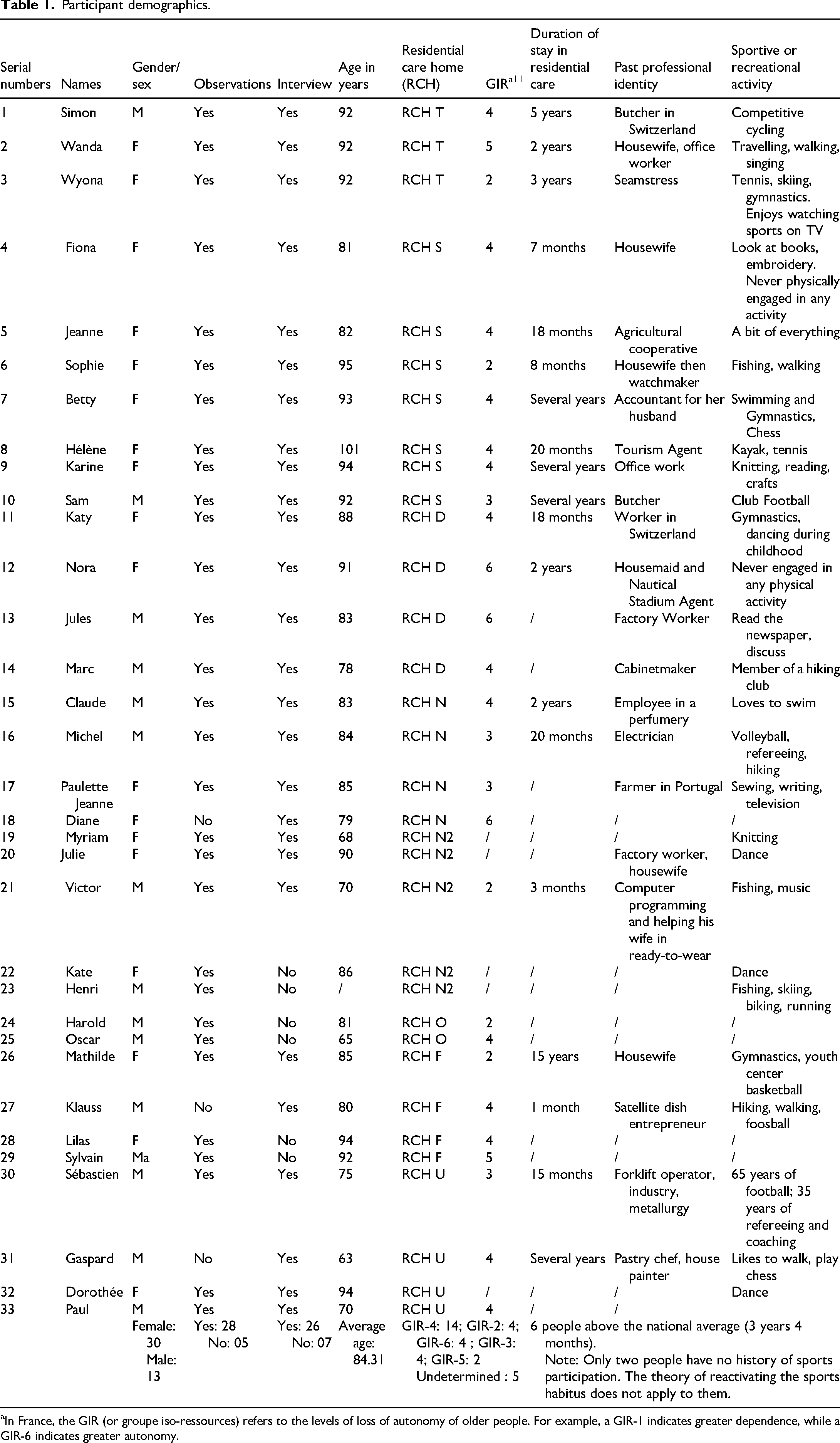
In France, the GIR (or groupe iso-ressources) refers to the levels of loss of autonomy of older people. For example, a GIR-1 indicates greater dependence, while a GIR-6 indicates greater autonomy.
Methods of data generation
Ethnographic data were collected by an initial group of three researchers supervised by a group of more experienced researchers. A 2-day familiarisation period was undertaken in three residential care homes before participant observations were commenced. The observations were made at a granular level by defining physical indicators, including spatial mobility, routes taken, directions, use of mobility aids, complaints, indicators related to appearance, physical reactions, psychosocial dimensions and engagement in the activity. These observations were undertaken for 3 months, while interviews were held simultaneously.
In-depth interviews acted as the second phase of the data generation process. These were aimed at documenting the body for oneself and for others during physical activity sessions. These interviews were conducted using a semi-structured interview guide, in which seven main domains were targeted. These domains included social and sporting trajectories, daily life in the residential care homes, sensations, social interactions, autonomy, physical activity and the Olympics and corporeality. The interviews were conducted in a flexible manner, adapted to the needs of the participants. Throughout the Results section, participant quotes are drawn from interviews unless explicitly noted as field observation. Observational data, drawn from field journal notes, are indicated by (obs.) in the text. For instance, interviews sometimes took place in split moments and in a simplified manner so that participants did not experience fatigue. Further, a steering committee (or COPIL) comprising of international sociologists, doctors, geriatricians and anthropologists, met throughout the process of the research study to accompany and guide the project through its various stages and guaranteed ethical practice.
Data analysis
First, we engaged in the initial listening of the recorded interviews. This allowed us to enter into a state of openness, moving from a natural attitude to a phenomenological one. The silences, repetitions, laughter and emphases in the interviewer's voice allowed us to immerse ourselves in the residents’ accounts of their past and present experiences. Subsequently, a second, more rigorous listening session facilitated the development of a tabular multi-criteria process, in which we highlighted the salient data. Finally, the interviews were transcribed and then coded in a shared summary table. The audio coding method is based on the work of Clark and Dumas (2020). This method helped us optimise time, reduce the cost of data analysis and improve the quality of interpretation and analysis (Wainwright et al., 2011). As advocated by the authors, the themes were constructed deductively and inductively (Clark and Dumas, 2020). They were subjected to thematic analysis (Paillé and Muchielli, 2021) based on the dimensions of the interview grid: life in care homes, social and sporting trajectories, relationships, the body, spaces, psychosocial data and the relationship to the physical activities. Thus, we cross-referenced the observational data with the data from the interviews. Additional themes were further developed, such as travel. All of the findings were discussed within the research group until all the categories were sufficiently investigated. In the presentation of the results below, the names from the verbatim transcripts are pseudonyms to anonymise the participants in accordance with the code of ethics in research.
The body at the centre of life courses and in care homes
For Turner (1984), human beings have and are bodies. Throughout existence, the fleshy body is ‘the closest and most immediate feature of my social self, a necessary feature of my personal location and my personal alienation in the natural environment’ (Turner, 1984: 43). At the heart of the lifecycle, the body reveals the different facets of the social world. The habitus of the body is the result of a collective past, established social dispositions and personal experiences. The older people we met had built their identities through work. Their bodies were constantly exposed and evaluated (Featherstone, 1991). For them, the idealised body was associated with youth, emphasised for its aesthetics, vitality and health, to the point of underscoring a person's social and cultural value (Featherstone and Wernick, 1995).
These men and women, who ranged in age from 61 years to 101 years, had lived through periods in which dominant norms and ways of thinking about the body had changed. While it is true that ageing has long been reduced to a stage of life that leads to social decline and has been framed in a rather negative binary discourse (Hay et al., 2016), the functional body is also individualised and sometimes used as a symbol of social distinction (Marshall and Katz, 2002).
Thus, participants’ bodily dispositions were revealed in the way they spoke, blew their noses, held themselves and communicated. ‘Our daily lives are dominated by the details of our bodily existence, which engage us in a constant labour of eating, washing, grooming, dressing, and sleeping’ (Turner, 2012: 37). The experiences of the physicality of work of former carpenters, electricians, bakers, butchers, farmers, forklift drivers and cleaners echoed Wainwright and Turner's (2003) working class bodies. For instance, Julie, who previously worked in a factory, referred to ‘real work with your hands’ (aged 90 years). For Paul (70-year-old), the act of pulling a rope in mid-air brought back memories of school.
Paulette-Jeanne (85-year-old), a former farmer, recalled the sensation of throwing potato sprouts into furrows in the ground: ‘It's the same gesture as when we planted’. Sylvain (92-year-old) was also enthusiastic about his first sporting experiences: ‘I started at a young age because our father was a postman. On Thursdays, my brother and I helped him make his rounds’. This experience was a springboard for his first job as a messenger at a medical school. Sylvain's cheerful tone and radiant face came alive when he recounted memories of falls and balance, of the sensation of speed. He then recalled how, in 1960, he rode his bicycle for 60 kms a day to get to his job as a butcher. Consequently, past physical practices resurfaced in the discourses of the participants, similar to our earlier published results (Lefèvre and Vieille-Marchiset, 2024).
For some residents, sporting experiences were virtually non-existent apart from during compulsory school lessons. Fiona (81-year-old) reported only playing sports at school; her life had primarily led her to work and travel. Her life story can be considered as being typical of women from working-class rural backgrounds in the 1940s and 1950s, where focus was on work and not so much on leisure sporting activities. Marc (78-year-old) talked about being unable to learn to swim or participate in physical activities due to lack of opportunities in the village in the 1960s: ‘There were no swimming pools’ and ‘there was nothing back then’. Nevertheless, Marc asked to use the exercise bikes, as he found them making a clear improvement to his physical sense of self and giving him a sense of purpose.
In the interviews, several residents talked about the moment they stopped playing sport and the reasons for doing so. These were mostly external factors. For instance, Sam (92-year-old) pointed to marriage and family responsibilities: ‘I used to love football, but it takes up too much time. Yeah. Yeah. My wife didn’t really like it that much’. Hélène (101-year-old) talked about the war: ‘after the war, things were different: sports became more accessible’, while Marc (98-year-old), Simon (92-year-old) and Karine (94-year-old) indicated to progressive illness. Additionally, for Michel (84-year-old) the bereavement of a spouse led to stopping sport, and Dorothée (94-year-old) indicated to societal norms: ‘And then it wasn’t really the done thing for women to do sport; it wasn’t like that yet. […] Yes, I liked it. It just wasn’t really done. And we didn’t have the time’. Sport, therefore, play varied roles in people's lives. In later life, most participants had given up on the idea of participating in sports. Moving into a retirement home could reinforce these beliefs, unless – as we will see – the circumstances are more favourable.
Moving to a specialised care home can change one's relationship with the body in all its dimensions. In these closed environments, boredom can be systematically recounted. For instance, days follow with repetitive routines of waking up, toileting, having breakfast, taking walks or participating in activities, like having dinner and going to bed. ‘I don't do anything’, said Claude (83-year-old), as was the observation of most of the participants. Family visits and doctor's appointments were considered as the only times when this routine was broken.
The participant dependent older people often talked negatively about their bodies. Fatigue was viewed as being omnipresent and insomnia as common. Apart from physical activities, participants often complained: ‘I'm tired’, ‘I need a nap’, ‘I didn't sleep well’. This led to them becoming irritable and peer relationships were experienced as being very difficult. For most, living in a group was a burden.
The issue of personal hygiene was also at the centre of our discussions. For instance, Wyona (92-year-old) recounted: ‘I have to brush my teeth three times a day, otherwise I feel dirty’. Similarly, Claude (83-year-old) recalled that, ‘I shave every morning, once a week I have to take a shower, but I haven't had one for two weeks’.
The fear of urinary incontinence, passing urine in public or spilling urine preoccupied participants’ thoughts. For example, Wanda (92-year-old) said, ‘I can't go to the toilet. I have a bag and when I move, I tear the bag off, and I have the catheter all the time’. Irrespective of the situation, it was about maintaining a good image for oneself and for others. These moments of bodily care seemed truly essential for the participant older people.
Similarly, meals were considered as an important time. For some, it was a matter of survival (e.g., ‘I eat just to survive’), and for others, it was a matter of pleasure. However, during these collective moments, the gaze on and from the others reflected an image of the degradation of the body in all its dimensions: ‘Look at her, she can't walk by herself’, ‘he can't talk anymore’, ‘he needs help to eat’. The participants felt that others were losing their abilities, while they tried to remain as autonomous as possible.
The body itself was less controlled, the body for oneself was transformed, and the body for others remained degraded. For instance, Julie (90-year-old) said, ‘It hurts. If you only knew how much it hurts to swallow, to move’. Irrespective of the course of life, ways of perceiving and acting seemed to be homogenised. Bodily habitus adjusted and merged to adapt to the spatial-temporal environment of the residential care homes. At this level, social status did not seem to be a determining factor.
Despite this, the preservation of the body in all its dimensions required all the participants to be physically active daily. For example, Simon (92-year-old) summed up that ‘You know, when you're old, you have to force yourself’. Dorothee (94-year-old) explained: ‘Every morning, I do exercises with my feet. I take my husband's belt well, the belt from my bathrobe that I don’t use – and I place it under my foot and lift. It means you’re proving to a lot of people, so to speak, that you’re still capable of doing things, even when you’re elderly’.
The effort was significant to mobilise the body every day to preserve a satisfactory body image for oneself and for others (Feillet, 2012). Sporting activities seemed to encourage these adjustments to the body habitus within the daily life of these institutions for the older people.
Participation in the Olympics and the revival of a sporting habitus
The preparations for the 2024 Paris Olympics provided an opportunity to organise a unique sporting event: the Care Home Olympics. In France, the preparations for the Paris Olympics received extensive media coverage with the aim of showcasing French expertise in sports, the arts, and technology. As a result, this event holds special cultural significance for most people of France, including the older adults.
Furthermore, deeply rooted in contemporary conceptions of ageing and the struggle against a functional vision of the body in decline, the Care Home Olympics became a process of combating the ‘inevitability of ageing’ (Blaikie, 2002). The organisation of sporting events based on physical activity, as a group exercise, aims to not only increase a sense of social belonging, psychological well-being and physical abilities (Fougner et al., 2019), but also quality of life, to ensure positive or ‘active’ ageing (WHO, 2002).
Six events, including pétanque, rings, billiards, skittles, darts and memory, combining precision and flexibility, and energy management and concentration, were offered to the participants. To reach a significant number of older people, the games were initially held in 30 residential care homes throughout the region.
As in a classic sports championship, the participants first prepared themselves with training sessions and then competed against each other to reach the grand finale, a moment of apotheosis for the participants. The sporting events were held in a gymnasium, sometimes dozens of kilometres from the residential care homes, and the host teams were dressed in matching outfits, such as in the colours of the different care homes. The event continued with a convivial meal and a musical ball game. Like all sporting events, the day ended with an awards ceremony, complete with a podium, medals, and trophies. The way in which these Olympic Games were conceived by the political actors and the teachers of adapted physical activity, aimed to promote physical experience, pleasure and sporting competition, while respecting human dignity. At the grand finale, the sporting areas were designed to accommodate a wide range of bodies, including those supported by walkers, walking sticks or wheelchairs. Chairs were placed around the workshops to allow participants to observe and appreciate bodies in action and to rest their bodies. The proximity and accessibility of the toilets further confirmed this attention to welcome and preserve bodies that may have been constrained, tired, and changing with age.
Bodies in themselves, for themselves and for others at the Care Home Olympics
During the training sessions that were observed, the body for itself, or the biological body, seemed to dominate the participants’ actions. Uncontrollable rasps, sighs, giggles, cries of disappointment or joy, flatulence and grimaces all arose in the participants. Cracking noises and a few bone or mechanical thumps were reminiscent of the functional body. Paulette Jeanne (85-year-old) pointed out that her body ‘cracks’ during the activities. Sometimes traces of urine showed through the layers of pants of some participants. However, for instance, one participant claimed that the chair he was sitting on was wet and refused to change his pants. For others, their chests heaved and breathing became noisy. During an exercise with an elastic band, Hélène (101-year-old) wondered, ‘What if I broke you in two? It looks easy … But it hurts everywhere’ (obs, RCH S, May 2022).
Some residents, like Kate (86-year-old), described the stress of the upcoming tests: ‘The fear of falling reveals a weakened confidence in a body that no longer responds sufficiently’. ‘It's my knees, I'm afraid of falling’, said Paulette-Jeanne. In practice, pain manifested through facial tension and wrinkling of the mouth, especially during exercises that mobilised the neck and the shoulders (obs, RCHN, April 2022). However, complaints were rare and diffused, such as brief confessions of ‘I’m hurting’ (Lilas, 94-year-old; Marc, 85-year-old).
The body for others took on an important dimension for the participants for whom physical activity was an opportunity to get dressed. Myriam (68-year-old), for instance, liked to wear her shiny T-shirt during training sessions, while Katy (86-year-old) wore her glittering sandals. As a former seamstress, Katy loved jewellery, such as her bright-eyed cat necklace, which she adorned to participate in group sessions. The desire to maintain an appearance that Wanda (92-year-old) described as ‘presentable’ during activities was reflected in self-care, personal hygiene, flirting and the desire to beautify oneself. Women were generally neatly dressed, while men seemed to pay less attention. These findings extend those of Fougner et al. (2019) on the perception of the active lived body, where appearance is even seen as a communication tool to gain respect, a sense of belonging and social well-being. Appearance then becomes synonymous with vitality (Cameron et al., 2019).
This attention to others resonated with the body for others, which was analysed by Dagognet (1992) as the body that the older person offers to the gaze of others (Feillet et al., 2011; Söderhamn, 2013). Positive image and attractiveness were important for women. Söderhamn (2013) notes that to take care of themselves, older people need to be physically active and in contact with others. Activity then takes on a beneficial dimension as a space for socialisation and for rearranging the body. During training sessions, physical practice was the subject of comment and was conducive to exchanges between participants. For instance, Henri (age unknown) used a lot of strength. He hit the target almost every time. Because he succeeded, Julie (90-year-old) laughed and said, ‘But what have you eaten today!’ to which Henry smirked. He then returned to his chair with slow, sluggish steps, but maintaining a satisfied smile. He had got the best score. His facial expressions were controlled during the activity but lit up when someone congratulated him and took an interest in him (obs, RCH2, April 2022).
These small words of encouragement reflected the importance of recognition and relatively low self-esteem. Yet, self-deprecation was omnipresent during training sessions. For example, Wyona (92-year-old) exclaimed, ‘Oh no, I can't do that anymore’, ‘Why bravo? It's not that great …’. Even when scores increased or the target was reached, reactions were negative, reflecting a standard to be attained. The older body appeared to be incapacitating, reminding the older person of a progressive loss of the ability to act. However, during the activity, we recognised the variations among the participant older people and the influence of gender stereotypes in appreciating bodies and putting them into words. While women seemed to be more aware of their ageing bodies, formulating sources of limitation and pain, men were more discreet about the declining capacities of their advanced age. Mathilde (85-year-old) struggled to pick up a dumbbell from the floor next to her armchair: ‘I’m furious. I used to be able to do so much before. Now, I can’t even get up, and I can’t even manage to pick anything up off the floor’. The participants talked about the past, while the body's activity for its own sake was smoothed out and muted, as if age had put bodily sensations to rest.
Reactivation of sporting habitus
The Care Home Olympics event, thus, created the conditions for a sporting challenge with regular training, regulated events, and an institutionalised organisation under the aegis of the European Community of Alsace. Ethnographic observations of the training and the competitions revealed sport-specific behaviours and dispositions that gradually emerged. First, the organisation of training required rigour and concentration. If laughter accompanied the sessions, the bodies were prepared for an activity such as darts. ‘When I shoot, I concentrate’, explained Myriam (68-year-old). Technical comments accompanied the practice. For example, the participants often verbalised what they were doing: ‘first the blue … then I put my foot on the yellow … now I take the ring …’. Similarly, errors made were accompanied by negative comments and swearing. The participants had to look good in front of others, invest, and succeed to be good enough. The sporting logic of surpassing oneself was very much present. For instance, the participants needed to try to overcome the awkwardness and the pain they experienced, even if the rest periods increased as the training sessions progressed. The body tired quickly, but the training had to continue, day after day. For Victor (70-year-old), training prepared the body: ‘During training, I prepare myself to win, which is good for everyone. This training is good for my body and my morale’.
At this level, the participants seemed united. Encouragement supported the logic of overcoming: ‘It's there, hats off!’ said one participant. Applause accompanied every performance. For example, Julie (90-year-old) quickly clapped her hands by raising them high over her shoulders. At the level of her face, she sometimes held her hands flat and clasped, as if in prayer, near her lips for a few seconds before returning to a quiet position. This was indeed a great show of support, even in the case of failure (obs, RCHN2, May 2022).
Katy (86-year-old) had the same difficulties as Julie (90-year-old). She turned the darts, leading her to miss the target. She shrugged her shoulders and lowered her arms along her body, slapped her hands on the sides of her thighs to express her disappointment. In the second round, she became impatient, and her gestures of annoyance became more frequent. ‘Today is not the day!’, said Katy. She did not smile, but her face showed no signs of aggression. Only her shrugs and arm gestures characterised her impatience. But Julie (90-year-old) supported her: ‘Oh … she's out of luck’ or ‘Bloody hell!’. Well, your thing's a bit dodgy, isn't it?’. Finally, Katy managed to plant a dart. Julie (90-year-old) continued to encourage her: ‘It's better than nothing’.
Respect for the rules was also omnipresent, even if some tried to circumvent them, even playing with the rules. Henri hit the target several times. He kept his smile on. The others congratulated him. In the next round, he collected the balls that hit the target and came back to throw them again. Julie (90-year-old) said, ‘You're cheating, you're cheating! Hey, he's cheating! It doesn't bother you’ while looking at the others. Henri hit nine out of ten balls with this technique. He smiled and said: ‘Yes, I cheated, three times’. The circumvention of the rules was thus reprimanded by the group as part of a form of self-arbitration.
The sporting logic of progress and surpassing others, of mutual help and respect for the rules, was therefore omnipresent in the physical practices of these older people. According to them, they rediscovered their youth. In fact, behind this reference to their youthful past, was also a sporting past that was brought to life. For example, the sporting habitus seemed to be reactivated when Sébastien (75-year-old, a former coach and football player) confidently proclaimed: ‘I want the gold medal. I'm not coming down for nothing!’. His enthusiasm was such that he corrected the other participants during the sessions. For Gaspard (63-year-old), the Care Home Olympics were stimulating because of the opportunity to play and meet other residents. He explained: ‘it allowed me to go beyond myself, to help me get out of the chair’. Kate (88-year-old) explained: ‘We always want to push ourselves. And then, just when we’re about to, we mess it up. We want to do better’, and ‘The desire to win is what makes it important to do this. And besides, it was fun. Afterwards, there's a lot of training to do, and that's what feels good too’.
This sporting habitus, a system of dispositions acquired during childhood and adolescence for this generation, was put aside in their older age, especially with the loss of functional autonomy. This had a more general dimension than Wacquant's (2014a) pugilistic habitus, linked to a fighting ability, or Bunn's (2016) mountaineer habitus, which emphasises time management, especially speed. Sport helped the participants to surpass themselves (Quéval, 2004), while respecting the rules of fair play, especially respect for others (Guay, 1993).
This sporting vision of the world is part of a bodily habitus that is primarily associated with social class and gender (Bourdieu, 1977). We thus agree with the position of Wacquant (2014b, 2016), who defends the idea of a habitus as a multiscale and evolving scheme of action linked to specific social conditions and configurations. Sporting dispositions are, therefore, part of the embedded habitus, but peripherally linked to social and gendered belonging. They can be set aside during life and then reactivated, according to the social conditions encountered. During the Care Home Olympics event analysed herein, sporting dispositions reappeared despite ageism, which inexorably pushed older people away from sporting activity. They were put to sleep, as Lahire (2003) says, to be reactivated in a more favourable situation.
Conclusion
During the Care Home Olympics analysed within this study, physical and sporting activities were perceived by the participant older people as a form of adaptation to the new situation, experienced by the body. Indeed, movement reactivated the sporting aspect of the bodily habitus that were integrated by some throughout their lives through competitive or recreational experiences. Eroded with advancing age, the incorporated sporting dispositions resurfaced during training sessions and the competition. For instance, rigour and application were required to progress, where everyone needed to surpass themselves to give their best, and a game with rules was clearly identifiable. For the vast majority of the older adults involved, the various components of the sporting habitus was, thus, observed to have taken the form of a resurgence of an agonistic and playful relationship with the body and the world. However, this form of revitalisation was only possible in a particularly favourable situation: a sporting event associated with the organisation of the Olympic and Paralympic Games in Paris. Thus, participating in the Care Home Olympics was also a way for the participants to remain integrated into the national community, by experiencing the event physically, rather than merely participating vicariously in front of the television.
On a theoretical level, our investigation raises the question of the malleability of bodily habitus (Wacquant, 2014b). Our question was whether incorporations during primary socialisation determined social behaviour throughout life. In other words, is habitus insensitive to circumstantial variations? Is it uniform or multiscale? Can it be broken down to identify the part that is in flux in a given situation?
The assumed homogeneity of the habitus does not stand up well to testing in the field, particularly when researchers analyze people's life courses in detail. Indeed, in our ethnographic study, conducted within care homes for dependent older people, the introduction of a sporting event revealed changes in all dimensions of the body. Using Dagognet's (1992) concept of the multiple body, the body in itself, the body for oneself and the body for others, change in a unique spatio-temporal context was observed. For the participant older people, this experience was marked by a developing body culture, regardless of social trajectories, the ways of perceiving, feeling and moving, revealing a relative homogenisation of bodily habits.
In order to further explore the relationship with the body, it would have been interesting to gather the opinions of the participants’ family members during the Care Home Olympics event. In addition, longitudinal follow-up would have made it possible to refine the form and persistence of the reactivation of sporting habitus. It would also have been wise to extend this research to several fields in different countries to explore other socio-cultural and political variables. Yet, in our case, gender effects were noticeable, differentiating between the robustness of women and the fragility of men (Volery and Legrand, 2012). The reactivation of sporting habitus, therefore, seems to be linked to a gender order that is incorporated throughout life, which should be investigated further from an intersectional perspective.
Footnotes
Acknowledgements
We would like to thank Nicolas Durrheimer for collecting the data and Rashmi Rangarajan for the translation.

Consent to participate
Informed consent was obtained from all participants.
Ethical approval
In France, social science research is not required to be reviewed by an ethics committee. An ethics charter was developed by the collaborative research team to protect the vulnerable populations being studied.
Funding
The authors disclosed receipt of the following financial support for the research, authorship, and/or publication of this article: The research and publication of this article were supported by the CEA (European Community of Alsace): Deliberation CD-2021-6-0-3.
Declaration of conflicting interests
The authors declared no potential conflicts of interest with respect to the research, authorship and/or publication of this article.