







Abstract
Indigenous peoples in the Philippines face persistent poverty and social discrimination, with their cultural identity deeply rooted in ancestral lands. The Alta, an Indigenous group in the Sierra Madre region, rely on the mountain range for their livelihood, traditions and way of life, yet their environment is increasingly threatened by deforestation, illegal mining and logging. This study explores the perspectives of 34 Alta youth (ages 10–25) on environmental conservation and an ecotourism initiative along the Diteki River in San Luis, Aurora. Using qualitative methods, including pakikipagkwentuhan (story-sharing) and focus group discussions, analysed through interpretative phenomenological analysis, the research reveals that the Alta youth perceive their environment as essential for sustenance, protection and cultural continuity, while recognising human activities such as illegal logging and mining as significant threats. They view ecotourism as a potential means of balancing economic opportunities with conservation, as it provides an alternative source of income to them while they preserve their environment. However, they believe there is a need for stronger collaboration between their community and the government to promote environmental preservation. Participants highlight ecotourism’s potential to provide alternative livelihoods and reinforce conservation efforts. However, illegal resource extraction and inadequate policy support are the challenges that need to be addressed. This study emphasises the importance of integrating Indigenous youth into conservation and sustainable tourism policies, which position them as key stakeholders in safeguarding cultural heritage and ecological integrity. By amplifying their voices, this research contributes to global Indigenous-led conservation discourse, emphasising youth leadership in sustainable development.
Introduction
Indigenous peoples (IPs) worldwide face profound socio-economic challenges, including extreme poverty, malnutrition, systemic discrimination and limited social protection. The United Nations Development Programme (2022) reports that IPs are nearly three times more likely to experience these hardships. In the Philippines, Indigenous communities constitute approximately 8.7% of the population, or around 9.4 million individuals (World Bank, 2024). Many reside in remote areas, such as the Sierra Madre mountains, where they serve as vital stewards of cultural heritage and environmental knowledge. Despite their contributions, Indigenous communities remain among the most marginalised, confronting barriers to education, healthcare, clean water and social assistance (World Bank, 2024).
For Indigenous Filipino youth, education offers pathways to overcoming socio-economic and cultural marginalisation. However, obstacles such as high tuition costs, language barriers, discrimination and limited access to culturally sensitive programmes can hinder their personal and professional development (Estacio & Marks, 2010; Rogayan, 2019). Meanwhile, the youth’s deep connection with ancestral lands stresses the crucial role of natural environments in sustaining both cultural identity and livelihoods (Terol, 2022, 2024).
Environmental degradation, such as deforestation, climate change and pollution, poses additional challenges to Indigenous communities. Addressing these threats requires active collaboration between local stakeholders, government and communities. The Indigenous youth, as customary stewards of ancestral territories, play a crucial role in conservation and sustainable resource management. However, while the Indigenous Peoples’ Rights Act of 1997 (Republic Act No. 8371) recognizes and protects ancestral domain management and community participation, it does not explicitly address the role of Indigenous youth in governance, conservation, or sustainable development of ancestral lands (RA 8371, 1997). Nevertheless, Indigenous youth active engagement in intergenerational land governance is essential for ecological resilience, soil and watershed health, and community well-being (Reed & Diver, 2023). Indigenous-led approaches to land and water management have shown significant promise for ecological sustainability globally (Sogbanmu et al., 2023).
Ecotourism, particularly community-based ecotourism (CBET), has emerged as a strategy to integrate environmental conservation with local development. Defined by the Philippine Department of Environment and Natural Resources (DENR) and the Department of Tourism (DOT) as tourism conducted in natural settings to preserve ecological and cultural significance while fostering environmental education (Department of Environment and Natural Resources & Department of Tourism, 1998), ecotourism offers Indigenous communities economic alternatives to extractive activities such as logging and mining (Buckley, 2012; Honey, 2008). CBET emphasises local participation, equitable benefit-sharing, and sustainability across environmental, social, and economic dimensions (Scheyvens, 1999; Tosun, 2000; World Wide Fund for Nature, 2001). When effectively implemented, CBET fosters cultural pride, supports intergenerational knowledge transfer and provides alternative livelihood pathways for Indigenous youth. For example, the Kamoro community in West Papua actively use tourism to showcase their arts, revive traditions among younger generations, and enhance economic well-being (Kambuaya et al., 2024).
The Sierra Madre, the Philippines’ longest mountain range, spans 540 km from Cagayan to Quezon and covers 1.4 million hectares across 10 provinces. Its diverse ecosystems host over 3,500 plant species—58% of which are endemic—and support Luzon’s highest avian diversity (Forest Foundation Philippines, 2022, 2023). The range also functions as a natural storm barrier, reducing typhoon impacts, and regulating rainfall distribution, while sustaining 14 major river systems (Bagtasa & Racoma, 2023). Within the Sierra Madre, the Alta, an Indigenous group concentrated in Aurora Province, relies on the mountains for livelihood, cultural practices, and daily sustenance. Yet, deforestation, land dispossession, and socio-economic pressures threaten their traditional lifestyles, language (Edimala), and territories (Headland, 2010).
Given all these challenges, the Indigenous youth are at the forefront of cultural preservation efforts and environmental stewardship. They experience displacement, urban migration, and socio-economic disparities that expose them to educational barriers, discrimination, and mental health risks, including depression and substance misuse (International Organization for Migration [IOM], n.d.; UNESCO, 2013). Integrating traditional ecological knowledge into sustainability efforts through initiatives, such as UNESCO’s Local and Indigenous Knowledge Systems (LINKS) and the Global Youth Biodiversity Network, provides pathways for youth to reclaim their roles as custodians of their ancestral lands while mitigating socio-economic vulnerabilities (UNESCO, 2022; Convention on Biological Diversity, 2011).
This study explores how the Alta youth in Aurora Province in Central Luzon, Philippines perceive environmental conservation and ecotourism initiatives along the Diteki River. Specifically, it aims to:
Examine Alta youth’s understanding of environmental conservation and ecotourism. Assess ecotourism’s role in fostering both economic development and environmental stewardship. Identify the challenges and opportunities youth encounter in promoting sustainable practices within their community.
By documenting the perspectives and initiatives of Alta youth, this research addresses a critical gap in the literature on Indigenous ecological knowledge and youth engagement in conservation. The study emphasises the importance of integrating youth into conservation and ecotourism policies, which position them as key stakeholders in safeguarding cultural heritage and ecological integrity. Ultimately, it contributes to global discourse on Indigenous-led conservation and sustainable development, highlighting youth leadership as crucial in environmental and cultural sustainability.
Conceptual Framework
Indigenous Youth as Key Agents in Sustainable Development and CBET
This study is anchored in the principles of Positive Youth Development (PYD), a strengths-based framework emphasizing that youth flourish when provided opportunities for skill-building, meaningful engagement, and supportive relationships, fostering competence, confidence, connection, character, caring, and contribution (Benson et al., 2019; Lerner et al., 2015). Within this framework, Indigenous youth are positioned not merely as passive recipients of environmental or cultural programs but as active agents whose traditional ecological knowledge, cultural heritage, and leadership capacities can be intentionally developed to support sustainable development through youth-led community-based ecotourism (CBET).
Focusing on Indigenous youth is important in sustaining both their cultural heritage and the ecological integrity of their ancestral lands. They serve as bridges between traditional ecological knowledge and contemporary sustainability strategies, shaping CBET in three interrelated domains:
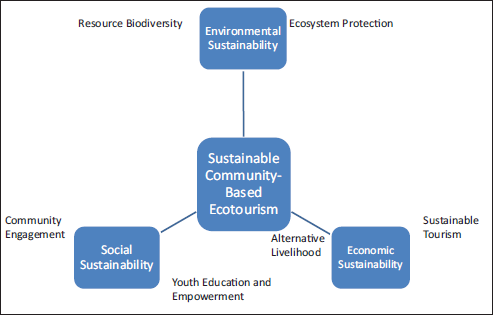
Environmental sustainability—As custodians of ancestral territories, Indigenous youth apply traditional ecological practices to conserve forests, watersheds and biodiversity. Their active engagement ensures that ecotourism initiatives reinforce ecological stewardship while integrating modern conservation strategies (Idrobo, 2021; Sithole et al., 2024).
Economic sustainability—Participation in CBET provides alternative livelihoods, reducing dependence on extractive industries such as illegal logging and mining. Through cultural tours, handicrafts and sustainable agriculture, youth generate income while preserving cultural heritage (Kambuaya et al., 2024).
Social sustainability—CBET fosters community cohesion, cultural pride and intergenerational knowledge transfer. By engaging in leadership, advocacy and environmental education, Indigenous youth strengthen their cultural identity, resilience and local environmental stewardship (Kambuaya et al., 2024).
This model illustrates how Indigenous youth drive sustainable development by integrating cultural heritage, ecological knowledge and active participation in CBET. It emphasises the interconnected pillars of environmental, social and economic sustainability, highlighting the balance between conservation, cultural preservation and economic resilience. Youth engagement safeguards forests, biodiversity and watershed; strengthens climate adaptation and ecosystem restoration and ensures that ecotourism remains community-led and inclusive.
Documenting the perspectives and initiatives of Alta youth provides critical insights into Indigenous resource management and informs policies and programmes that support youth leadership in conservation. Empowering Indigenous youth as environmental stewards and entrepreneurs fosters a holistic approach to sustainable development, preserving both ecological and cultural heritage for future generations.
Anchored in Positive Youth Development (Lerner et al., 2015), this model, as developed by the author, illustrates how Indigenous youth drive sustainable development by integrating cultural heritage, ecological knowledge, and active participation in CBET. It emphasizes the interconnected pillars of environmental, social, and economic sustainability, highlighting the balance between conservation, cultural preservation, and economic resilience (Honey, 2008) (Figure 1).
Youth-driven Indigenous Conservation and Ecotourism Stewardship Model.
Research Method
Project Profile
The study was conducted in Diteki, San Luis, Aurora Province, Central Luzon, Philippines (15.6251°N, 121.3915°E), situated at an elevation of 1,065.1 m. The site lies within Alta ancestral lands, with the Diteki River serving as the focal point for ecotourism initiatives managed by the local Indigenous community.
Socioeconomic Profile
Diteki’s population increased from 1,181 in 1990 to 1,784 in 2020, reflecting an average annual growth rate of 2.68% (Philippine Statistics Authority [PSA], 2021). The median age of the population is 23 years, and the age dependency ratio is 63 dependents per 100 working-age individuals (PSA, 2021). The community comprises Alta, Tagalog and other ethnic groups, with Indigenous youth playing a crucial role in conservation and ecotourism initiatives (National Commission on Indigenous Peoples [NCIP], 2021).
Participants and Sampling
The study involved 34 Alta youth (11 boys and 23 girls) aged 10–25 years from San Luis, Aurora, Philippines. Participants’ educational backgrounds included 1 college graduate, 4 college-level students, 12 high school students and 17 elementary students. Data-gathering sessions were conducted in the tribal hall and in the cottages by the river, with support from community gatekeepers who facilitated access and ensured cultural sensitivity.
Purposive sampling was employed to recruit participants who were actively engaged in ecotourism initiatives and environmental conservation efforts. This approach ensured that participants could provide rich, context-specific insights into youth perspectives.
Data Collection and Analysis
To promote meaningful engagement, the research team collaborated with community leaders who introduced researchers to elders and local government leaders. Orientation sessions explained the study’s objectives, emphasising voluntary participation, confidentiality and the right to withdraw at any time. Written parental consent was obtained for minors, and all participants provided informed consent.
Data were collected through six focus group discussions and pakikipagkwentuhan (story-sharing), an Indigenous Filipino method of informal yet purposeful dialogue. Each session consisted of six to seven participants, exploring perceptions of environmental conservation and ecotourism (Smith & Osborn, 2015). Discussions were audio-recorded with participants’ consent, transcribed verbatim and analysed using interpretative phenomenological analysis (IPA) (Smith & Osborn, 2015).
The IPA process involved repeated immersion in the transcripts to understand participants’ lived experiences, with reflexive notes capturing emerging meanings. Line-by-line analysis focused on descriptive, linguistic, and conceptual elements to identify participants’ interpretations. Codes were organised into themes, which were iteratively refined into superordinate themes to reflect shared experiences while remaining grounded in individual narratives. Interpretation employed a double hermeneutic approach, considering both participants’ meaning-making and researchers’ analytic lens. Themes were reviewed, cross-checked against raw data, and discussed with community representatives to ensure credibility (NCIP, 2021; Smith & Osborn, 2015).
Ethical Clearances and Approvals
The study received ethical clearance from the institutional Ethics Review Board, the National Commission on Indigenous Peoples, and the Local Government Unit (LGU). The research adhered to Free and Prior Informed Consent protocols throughout data collection (NCIP, 2021).
Community Validation and Report Dissemination
Findings were presented to the community for validation. Participants and community members were invited to provide feedback and clarifications. Their insights informed the development of capacity-building workshops tailored to local needs, ensuring that research outcomes were meaningful and actionable for the Indigenous community.
Results
This study explored the perceptions and strategies of Alta youth in the Diteki River area in San Luis, Aurora, regarding environmental conservation and ecotourism management. The LGU of San Luis oversees governance in the municipality, while tribal leaders and elders, including a representative for IP, lead the Alta community specifically. Government initiatives have been actively supported in the area, with recent infrastructure developments, such as the newly constructed Diteki Bridge by the Department of Public Works and Highways (DPWH), which facilitates access and tourism opportunities in the region.
Indigenous Governance and Youth Involvement in Ecotourism
This section presents findings regarding the perceptions of the Sierra Madre Alta youth about environmental conservation and their views on ecotourism initiatives within their ancestral domain in San Luis, Aurora Province, Philippines. The results are organised according to the study’s objectives and are illustrated with English-translated verbatim responses from the participants.
Tourism management at the Diteki River is led by the Alta community, particularly the younger members, who play a pivotal role in maintaining their ancestral lands. The Alta youths’ inherent connection to their environment highlights the importance of Indigenous stewardship in resource management.
Understanding of Environmental Conservation
The youth express a deep understanding of the environment as a source of basic needs, protection and livelihood. Their narratives highlight the essential role that nature plays in their daily lives.
Connection to Nature: Source of Livelihood, Safe and Healthy Living
Ana, an Alta girl, shares, ‘We have a great connection with nature because nature is our source of food, water, everything’. Carlos echoes this sentiment, stating, ‘Here live the various creatures where we humans live’.
Maria described nature’s richness: ‘Nature is beautiful—land resources, water resources, human resources, tree resources, animal resources. There are islands, there are trees, there are rivers, there are rocks’. Juan emphasised nature’s livelihood value: ‘This is good. Because it is beautiful and good. This is a livelihood, it allows selling, a source of income from coconut/young coconut’. Ana added, ‘Nature is important because of livelihood’, emphasising the economic reliance on their environment.
In terms of protection, Liza notes, ‘First, in times of calamity, if nature is sustainable, then it is safe when calamity comes. Nature can also help in building a house. The air is also clean. Nature brings fresh air that helps human bodies’.
Caring for Nature
The Alta youth recognise the importance of caring for nature. Pedro emphasised, ‘Burning plastic is prohibited, cutting down trees is prohibited. Water the plants, the flowers. Keep the river clean, collect garbage in the river’. Sofia noted proper waste disposal: ‘It is necessary to dispose of waste in the proper bins—some are taken to the Barangay for segregation, some are burned’. Carlos remarked on aesthetic and ecological reasons: ‘So as not to damage the tourists’ perception, so that the world does not become ugly; for everyone to live, so that people will not also die’. Jasmine explained the consequences of environmental degradation: ‘To keep it clean. Without trees, when the mountain is damaged, there will be none to absorb water’, reflecting the community’s lived experience with flash floods, which they clearly remembered.
Livelihood and Economic Support
Juan explains, ‘For us who are here by the river, there are also cottages that help us. When we were younger, we had our own cottage. We saved that money for us. It helps us, it adds income’. Marites adds, ‘For us natives, we get everything from here. It seems that our main livelihood comes from nature’.
Environmental Challenges
Participants highlighted the detrimental impact of human activities on their environment, emphasising illegal logging, mining and littering. Rico shared, ‘Illegal logging is rampant in almost all the land and mountains of Diteki. It’s not the natives doing this but others ordered to do it for money. Even mining here on the property of Diteki continues amid studies claiming there is gold’. Maya added, ‘Cutting of trees and littering’. Tomas explained, ‘They are burning the mountain; slash-and-burn activity when overdone causes great destruction’.
Impact of Environmental Damage: Calamities and Decline in Tourism
Nina recounted, ‘Destruction of homes. I remember the 2004 calamity; the whole Diteki was washed away because of flooding. Houses were destroyed. Landslides also occur, and improper soil disposal causes mud damage’. Pedro highlighted tourism concerns: ‘It can affect us because tourists may think the place is dirty, and fewer tourists will visit’.
Community and Government Response: River Cleanup, Addressing Illegal Activities
Alex mentioned, ‘We have an organization where together with soldiers, we pick up trash’. Elaine, as the Indigenous People’s Mandatory Representative (IPMR), shared her experience confronting illegal mining, documenting offenders and intervening despite personal danger, ultimately halting the activity.
Hope for Government Action: Stop Illegal Activities
Carmen expressed, ‘I hope the government will provide answers. Contructors cannot be approved without government approval. People will probably listen if educated and explained to’.
Plea for Change
Luis appealed to offenders: ‘We are asking that this should not happen again. We want to fix our land, our lives. We are happy here’. Marco, Lito, Grace, Elaine, Nick, Julia and Emma affirmed the value of conservation and stewardship through guidance on sustainable practices, wildlife protection, and promotion of spiritual connection.
Alex noted that interactions with tourists are significant: ‘Interacting with tourists—taking pictures with tourists, vloggers’, highlighting the symbiotic relationship between community and ecotourism.
Mixed Impacts of Tourism
For the Alta youth, tourism’s impact is a mix of benefits and challenges. Nina shared pride in showcasing nature’s beauty. Rico highlighted the dual nature of interactions: ‘Sometimes cleaning, sometimes littering—we earn money while renting out cottages to tourists’. Dante, Lara, Sam, Rafael, Tina and Amie described irresponsible or destructive tourist behaviour, such as theft of forest flora, local conflicts associated with drunkenness and reflecting ongoing challenges in balancing tourism with community harmony and conservation. Gina asked, ‘Beautiful nature, there is ecotourism, but there are thieves. What to do?’ encapsulating the community’s struggle in welcoming tourists and in setting the necessary boundaries to protect the harmony and the preservation of their ancestral domain.
Protection Against Ill-impacts of Ecotourism
Community members advocated proactive measures for environmental stewardship and communal harmony. Chloe emphasised planting more crops, Leo highlighted returning taken plants, Mia urged new policy enforcement, Drew focused on proper waste disposal, Hana advocated for peaceful coexistence, and Jake reinforced prohibitions on cutting trees and taking plants. Together, these insights form a framework for a sustainable ecotourism model that benefits both the environment and the community.
Discussion
Understanding of Environmental Conservation and Ecotourism
This study examined how Alta youth in San Luis, Aurora, Philippines perceive environmental conservation and ecotourism along the Diteki River. Findings reveal that the youth possess a profound and culturally grounded understanding of environmental conservation, shaped by lived experiences, daily reliance on natural resources and Indigenous cultural values. As Ana stated, ‘Nature is our source of food, water—everything’, highlighting the centrality of the environment in daily life. Maria emphasised the interconnectedness of land, water, humans and animals, reflecting holistic ecological awareness. Liza further noted that sustainable practices can mitigate calamities, demonstrating insight into ecological resilience and long-term stewardship (Berkes, 2017; UNESCO, 2024).
Participants also recognised ecotourism as an instrument for both conservation and economic development. They understood that preserving the environment not only protects biodiversity but also attracts visitors, providing incentives to safeguard their ancestral lands (Honey, 2008; Satrya et al., 2023). This awareness aligns with Indigenous ecotourism principles, which integrate cultural heritage, environmental stewardship, and the community’s socioeconomic well-being (Kambuaya et al., 2024).
Ecotourism as a Mechanism for Sustainable Development
The study’s second objective focused on ecotourism’s role in fostering economic development and environmental stewardship. Youth participants highlighted ecotourism initiatives such as local cottage rentals and guided tours as sources of income that could reduce reliance on extractive industries like logging and mining. Juan noted that cottage rentals provide economic opportunities, while Carlos emphasised that maintaining a pristine environment is critical for attracting tourists. This dual recognition illustrates the youth’s evolving understanding of ecotourism as a pathway to sustainable livelihoods while promoting conservation (Honey, 2008; Satrya et al., 2023).
The integration of positive youth development (PYD) principles into Indigenous conservation initiatives, as exemplified by the YICESM framework, strengthens youth leadership, cultural preservation and economic empowerment. The framework enables Indigenous youth to participate meaningfully in ecotourism, bridging traditional ecological knowledge with modern sustainability strategies.
Challenges and Opportunities in Promoting Sustainable Practices
The third objective investigated the challenges and opportunities faced by Alta youth in promoting sustainable practices. Participants reported threats, including illegal logging, mining, pollution, weak policy support, and limited inclusion in decision-making processes (van der Ploeg et al., 2011). Despite these obstacles, youth actively participate in community initiatives, such as river clean-ups and biodiversity monitoring, demonstrating agency, resilience and commitment to environmental stewardship. However, there is a call for greater government accountability and the need for policies that align with community-driven conservation efforts (Coria & Calfucura, 2012; World Economic Forum, 2024).
An assets-based approach recognises the strengths of Indigenous youth, particularly their ecological knowledge and cultural wisdom, positioning them as key contributors to sustainable development (Benson et al., 2019). Meaningful youth engagement; mentorship programmes with elders and skill development in leadership, ecotourism and environmental management provide opportunities to address socio-economic and ecological challenges while preserving cultural heritage (Scheyvens & Keyser-Van der Watt, 2021; Sithole & Leonard, 2024; Wexler et al., 2019).
Role of CBET and Indigenous Youth Leadership
The study demonstrates that Indigenous youth perceive conservation and ecotourism as deeply interconnected within a CBET framework. Participation in CBET initiatives fosters environmental stewardship, social cohesion and economic sustainability, aligning with global Indigenous-led conservation models (Musadad et al., 2022; World Commission on Environment and Development, 1987). Youth involvement cultivates ownership, strengthens intergenerational knowledge transfer and develops leadership skills that enhance both individual and community resilience (Andrews et al., 2019).
Integration of PYD principles through frameworks like the YICESM enhances Indigenous youth capacity to lead conservation initiatives while fostering cultural resilience. By combining environmental stewardship, economic engagement and social participation, the Alta youth contribute meaningfully to sustainable development and ecotourism efforts along the Diteki River. Past initiatives that mobilise the youth towards environmental preservation have shown some level of success (Reed et al., 2022; Ruiz-Mallén & Corbera, 2013), which highlight the potential of youth-driven conservation, especially when provided with institutional backing, capacity-building programmes, and financial support.
Conclusions
The Alta youth of San Luis, Aurora Province in the Philippines demonstrate a sophisticated understanding of environmental conservation and ecotourism, grounded in lived experiences, cultural values, and practical reliance on natural resources. They recognise the potential of ecotourism to provide sustainable economic opportunities while reinforcing conservation efforts, positioning themselves as key stakeholders in shaping community and regional sustainability.
However, challenges, such as illegal resource exploitation, weak policy support, and exclusion from decision-making processes persist, limiting their full participation in environment preservation efforts. Supporting youth leadership through culturally relevant education, mentorship, and institutional frameworks strengthens conservation initiatives, promotes cultural continuity, and fosters socioeconomic empowerment.
Beyond the local context, youth-driven Indigenous ecotourism initiative can serve as a model for broader regional and national sustainability, contributing to biodiversity protection, cultural preservation, and community resilience. The findings stress the importance of recognising Indigenous youth as significant actors in harmonising environmental, economic, and cultural sustainability, consistent with global Indigenous-led conservation strategies as those endorsed by the United Nations Permanent Forum on Indigenous people.
Recommendations
Youth participation in decision-making: Policymakers, conservation practitioners and ecotourism developers should actively involve Alta youth in planning and decision-making processes, ensuring that their knowledge and leadership inform sustainable strategies. This will further promote their sense of ownership of the environmental protection initiatives that will secure their ancestral domain for future generations.
Community-led ecotourism initiatives: Develop ecotourism programmes that integrate Indigenous knowledge, cultural heritage, and environmental stewardship, providing economic opportunities for youth while protecting ancestral lands. This will also protect their ancestral domain from harmful practices that degrade the environment in exchange for economic gain.
Capacity-building and education: Implement culturally relevant training programmes in leadership, ecological stewardship, and sustainable entrepreneurship. Environmental leadership education initiatives should strengthen youth skills in conservation and community advocacy.
Legal protection and policy support: Strengthen frameworks to prevent illegal resource extraction, safeguard Indigenous territories, and formalise youth participation in conservation policies.
Collaborative governance: Promote partnerships among local governments, NGOs, and Indigenous communities to support youth-led conservation and ecotourism initiatives. Programmes should emphasise intergenerational mentorship, cultural knowledge transfer, and inclusive governance.
Monitoring and evaluation: Establish mechanisms to assess the ecological, social, and economic impacts of youth-driven ecotourism programmes to ensure sustainable outcomes.
With the implementation of these recommendations, Indigenous youth can be empowered as leaders in environmental conservation and sustainable tourism, ensuring the long-term resilience of the Sierra Madre’s ecological and cultural heritage.
Footnotes
Declaration of Conflicting Interests
The author declared no potential conflicts of interest with respect to the research, authorship and/or publication of this article.
Funding
The author disclosed receipt of the following financial support for the research, authorship and/or publication of this article: This study is made possible through support from the Association for Asian Studies Cultivating Humanities and Social Sciences Grants, Forest Foundation Philippines, and Sweden Sverige.
