







Abstract
Few national laws or collective agreements provide specific rules determining the elements of the minimum rates of pay due to posted workers. As a consequence, there is confusion between the neighbouring expressions of ‘minimum wage’ (national concept) and ‘minimum rates of pay’ (EU concept) which countries have a tendency to consider as being equivalent. Furthermore, the distinction between two key questions – on the one side, the establishment of the components of the minimum rates of pay of the host country and, on the other side, the sums paid by the sending employer that can be compared to the minimum rates of pay of the host country – is not always made by countries. The aim of this article is to analyse how the targeted countries and sectors concretely define the components of the minimum rates of pay and then to focus, as a useful example for other countries, on the rules applicable in French law.
Keywords
1. Introduction
Directive 96/71/EC (the Posting Directive) 1 concerning the posting of workers in the framework of the provision of services aims to promote the cross-border provision of services in the framework of the Single Market, while providing protection to posted workers and ensuring a level playing field between foreign and local competitors.
The adoption of the ‘Posting Directive’, however, has not removed the controversy surrounding the topic of posted workers. The Posting Directive and the posting of workers in general consistently has been the subject of an intense debate between EU and national policy makers, social partners and scholars. Some of these players have even contended that the legal framework in relation to posting is conducive to ‘social dumping’, 2 resulting in displacement effects on local businesses and workers and limiting trade unions’ rights to take collective action.
A couple of years ago, the European Commission came forward with a proposal for a separate directive aimed at improving the supervision and enforcement of employment and working conditions for posted workers. The Enforcement Directive (Directive 2014/67/EU) 3 was adopted on 15 May 2014 and was due for transposition into national legislation by 18 June 2016. It is aimed particularly at remedying problems related to the implementation, monitoring and enforcement of the Posting Directive, as well as to circumvention, fraud and abuse in this context. From a strictly legal point of view, this Directive does not add substantially to the concept of remuneration for posted workers.
In particular, the adoption of the Enforcement Directive ignores a number of persisting problems, related to the controversial or unclear interpretation of the terms and conditions of employment referred to in Article 3(1)(c) of the Directive.
Let us recall that pursuant to the Posting Directive, Member States must ensure that, whatever the law applicable to the employment relationship, the undertakings guarantee workers posted to their territory the terms and conditions of employment covering the following matters: (a) maximum work periods and minimum rest periods; (b) minimum paid annual holidays; (c) the minimum rates of pay, including overtime rates (this point does not apply to supplementary occupational retirement pension schemes); (d) the conditions of hiring-out of workers, in particular the supply of workers by temporary employment undertakings; (e) health, safety and hygiene at work; (f) protective measures with regard to the terms and conditions of employment of pregnant women or women who have recently given birth, of children and of young people; and (g) equality of treatment between men and women and other provisions on non-discrimination.
The central point of this so-called ‘hard core’ is the minimum rates of pay. The application of the Posting Directive poses a number of legal and practical challenges, which can be illustrated by the following example. A company lawfully established in one Member State (‘the sending state’) posts a worker in another Member State (‘the host state’). In the host state, a collective agreement provides for a minimum hourly wage. A bonus for hard labour is also provided for by the collective agreement. What remuneration is the posted worker entitled to receive? Are the minimum rates of pay limited to the minimum hourly wage? Should the bonus be included in the minimum rates of pay? And how should the sending employer concretely meet the requirements? Notwithstanding the risks of fraud and abuse, several legal problems arise. Two of them concern the host state: which instruments (legal, conventional, and so on) apply for the setting of minimum wages in the context of cross-border posting? What are the constituent elements of the minimum rates of pay and, in turn, what amount is the posted worker entitled to receive? A third question, targeting sending employers, also arises: to what extent does the remuneration paid to the posted worker reach the host country’s ‘minimum rates of pay’ amount? In other words, which elements of pay granted by the employer can be included in order to assess whether the posted worker has received the ‘minimum rates of pay’? These issues have already been tackled in various studies. 4
Unfortunately, the answers are not found in the Posting Directive. Its wording is a source of confusion. The Posting Directive either refers to the ‘minimum rates of pay’ (Article 3(1)(c)) or to the ‘minimum wage’ (Article 3(7)). The inconsistency in the vocabulary has practical consequences since it is not unusual that national legislation and social partners at national level confuse both concepts even though they do not have the same definition. The minimum wage, which is a national concept, does not have the same meaning as the minimum rates of pay which is a European concept (see below). The ambiguity is visible in some key provisions of the Directive.
First, the Posting Directive determines that posted workers are entitled to the minimum rates of pay. However, in practice identifying this rate is rather complex. They find their sources in the law, regulation or administrative provisions (Article 3(1) of the Posting Directive), and/or in collective agreements or arbitration awards which have been declared universally applicable (Articles 3(1) and (10) of the Posting Directive). Furthermore, the concept of ‘universal application’ as explained in Article 3(8) of the Posting Directive 5 is difficult to implement.
Second, the notion of minimum rates of pay is a hybrid concept of both EU and national scope. It is obviously a national concept since Article 3(1) of the of the Posting Directive provides that ‘[f]or the purposes of this Directive, the concept of minimum rates of pay referred to in paragraph 1 (c) is defined by the national law and/or practice of the Member State to whose territory the worker is posted’. The Court of Justice of the European Union (CJEU) ruled however that ‘in so far as that definition, deriving from the legislation or relevant national collective agreements, or as interpreted by the national courts, does not have the effect of impeding the free movement of services between Member States’. 6
Third, it is not easy to determine whether the Posting Directive focuses on constituent elements of the minimum rates of pay or whether it also deals with the question to know to what extent the sums actually paid by the sending employer can be compared with the minimum rates of pay as applicable according to the host state’s law. These two perspectives coexist in the Directive, but in a confused manner. For instance, when the Directive provides that the minimum rates of pay includes overtime rates (Article 3(1)(c) of the Posting Directive), it refers to the constituent elements of the minimum rates of pay of the host country. The perspective is reversed when the Directive states that ‘[a]llowances specific to the posting shall be considered to be part of the minimum wage, unless they are paid in reimbursement of expenditure actually incurred on account of the posting, such as expenditure on travel, board and lodging’ (Article 3(7) of the Posting Directive). In this case, the wage is looked at from the point of view of the posted worker’s employer.
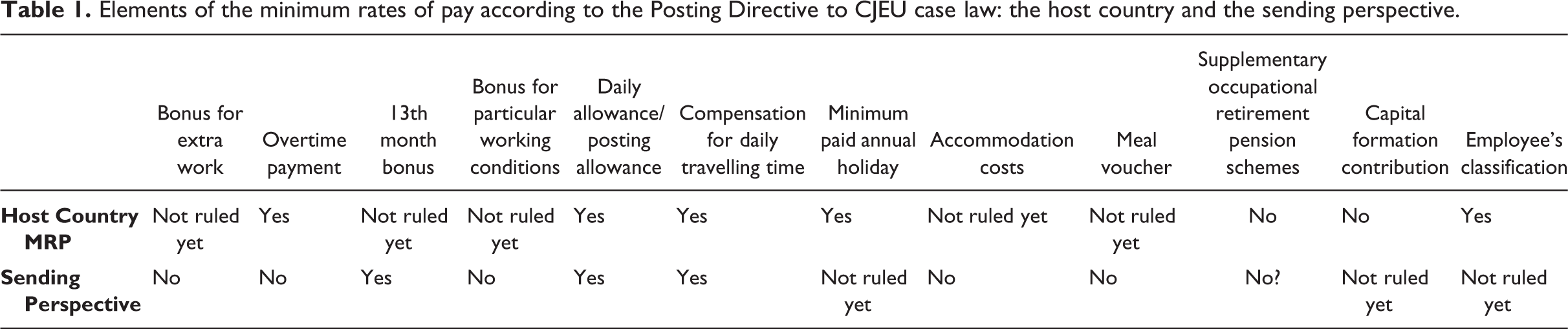
The CJEU adds to the confusion by not duly distinguishing both perspectives even though the three relevant cases would have made it possible to do so. In particular, the Finnish Trade Union case, 7 where a set of preliminary ruling questions were addressed from both sides, confirmed the inadequacy of the solutions. We understand that the payment of some bonuses by the employer must be taken into account in order to know whether the host country’s minimum rates of pay are reached, 8 but not the coverage of the cost of those workers’ accommodation or an allowance taking the form of meal vouchers. 9 We also learn, in another case, that the ‘capital formation contribution’ is not a constituent element of the minimum rates of pay, 10 whereas a compensation for daily travelling time and the pay which the posted workers must receive for the minimum paid annual holidays are such constituents. 11 It is also settled case law that the Directive does not preclude a calculation of the minimum wage for hourly work and/or for piecework, which is based on the categorization of employees into pay groups. 12
Besides these concrete solutions, it is nearly impossible to say whether the jurisprudential solutions are relevant from the point of view of the host country (constituent elements of the minimum rates of pay) and/or from the point of view of the sending country (components of remuneration paid to the posted worker in order to ensure that the minimum rates of pay of the host country is guaranteed). Furthermore, in many cases, it remains difficult to evaluate whether a given sum is a constituent element of the minimum rates of pay of the host country. There is a ‘grey area’ of components not clearly belonging or excluded from the constituent elements of the minimum pay rates. Conversely, it is difficult for sending employers to assess which elements of remuneration actually paid to the posted workers can be compared to the minimum rates of pay of the host country. Table 1 below recaps the elements of a solution based on the Directive and on the case law to date.
Elements of the minimum rates of pay according to the Posting Directive to CJEU case law: the host country and the sending perspective.
With this unstable legal background, the Commission ordered a survey of the Posting Directive covering nine countries
13
and four sensitive sectors.
14
Seven tasks were defined: Provide a mapping of wage setting mechanisms; Investigate to what extent the differences in such wage setting mechanisms influence the level of minimum rates of pay, as well as how the minimum rates of pay differ from the host Member State’s average or general wage conditions and how they impact them; Identify what are considered to be the constituent elements in the notion of minimum rates of pay and examine how the differences in the definitions of minimum rates of pay impact the income levels of posted workers, taking into account compensation of expenses; Identify the Member States where (some of) the constituent elements in the notion of minimum rates of pay are of a ‘social protection nature’, such as for instance accommodation allowances or different types of occupational insurances; Examine to what extent the ways in which minimum wages are set influence the share of workers who earn above, and at the minimum rate of pay and investigate to what extent they influence whether all workers are effectively ensured to receive the minimum rates of pay, as well as what groups/what share of workers do not receive the minimum rates, and what reasons can be identified for that; As regards collective bargaining, examine whether there are any recent trends visible, such as for instance a move from centralized to company agreements, as well as what the effects of such trends are; Assess how an extension of the legal instruments currently available to the Member States for determining the terms of employment of posted workers, for instance by including collective agreements that do not meet the criteria as laid down in Article 3(8)(2) first and second indent of the Posting Directive, would affect the cross-border provision of services, including costs and incentives for businesses and posted workers’ working conditions and wages.
The study was carried out between June and October 2015. It was based on a field study (including interviews of local stakeholders) and on a theoretical analysis. 15 Since the deadline for the transposition of the Enforcement Directive was pending when the report was written for the Commission, this Directive does not form part of the study. Nor is the proposal for a Directive amending the Posting Directive published by the Commission on 8 March 2016 included in the report. 16 At this stage, it is still far from certain that this proposal will be enter into force. Instead, we will focus on the concept of minimum rates of pay, looking at it from a comparative law perspective (Section 2) before describing the instructive example of one country, namely France (Section 3).
2. The minimum rates of pay: the comparative perspective
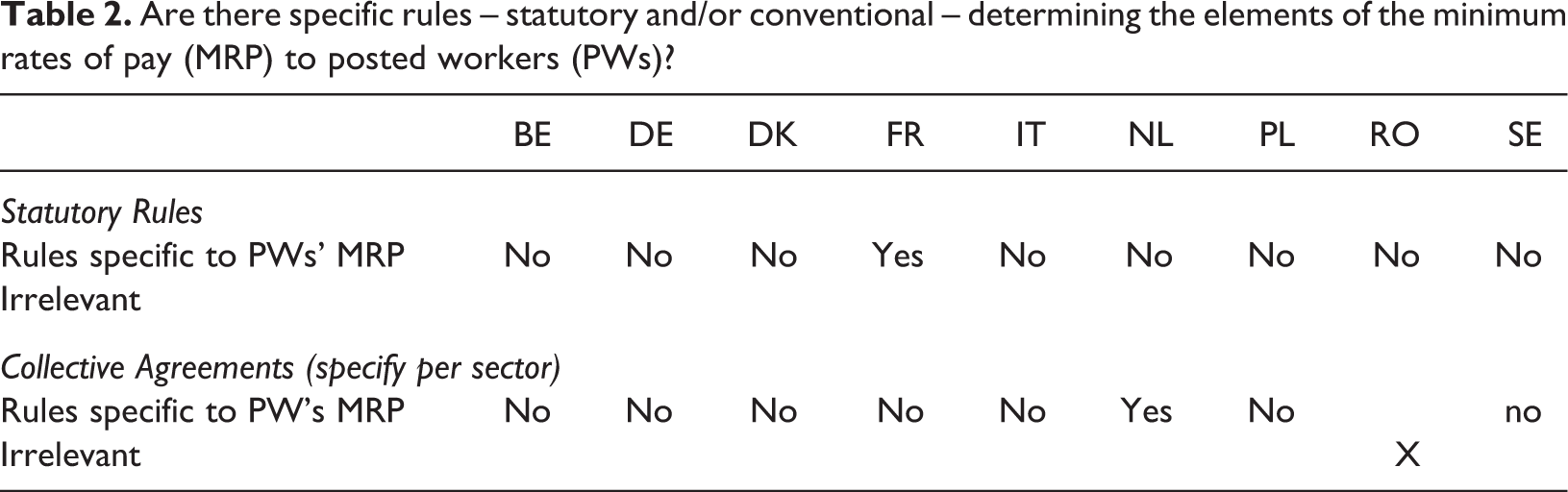
There is one striking conclusion: almost all of the selected countries have no special rule (legal or conventional) dealing with the minimum rates of pay under the meaning of the Posting Directive (see Table 2). A minority of countries have implementing rules – via statutory instruments or through a collective agreement – whose purpose it is to define the constituent elements of the minimum rates of pay guaranteed to posted workers. In practice, there can be a combination of specific rules for posted workers and ‘standard rules’ which are more or less clearly applied to the posted workers. Most countries are governed by a system where constituent elements of minimum rates of pay are directly linked to the rules on the minimum wage that usually apply to domestic employment relationships. This approach is understandable: they consider that posted workers are subject to the same minimum wage rules as any other workers in the national labour market. However, in some cases, it is not easy to determine if – and to what extent – the rules relating to the domestic minimum wage are actually applicable to posted workers.
Are there specific rules – statutory and/or conventional – determining the elements of the minimum rates of pay (MRP) to posted workers (PWs)?
The absence of clear rules on the components of the minimum rates of pay is visible from the perspective of the country where the worker is posted (Section 2.A.). From the perspective of the sending company, the rules to be respected in terms of minimum rates of pay are also unclear: which payments made to posted workers can (or cannot) be considered for the purposes of assessing compliance with the host country’s minimum rates of pay (Section 2.B.)?
A. Components of the minimum rates of pay: the host country perspective
It is necessary to establish the minimum rates of pay of the host country. In other words, the minimum sum to be guaranteed to posted workers by the host State as required by the Posting Directive. This sum may comprise of a number of individual elements. Two firm conclusions can be drawn from the study. First, most host countries consider that their minimum rates of pay refer to th’e gross salary. This unanimous attitude is not surprising since the CJEU ruled that ‘it is the gross amounts of wages that must be taken into account’. 17 Second, for the vast majority of countries, overtime rates are a constituent element of the minimum rates of pay. This trend is in line with the text of the Directive. Unfortunately, for the other components of remuneration, practices are far from uniform between countries and across sectors.
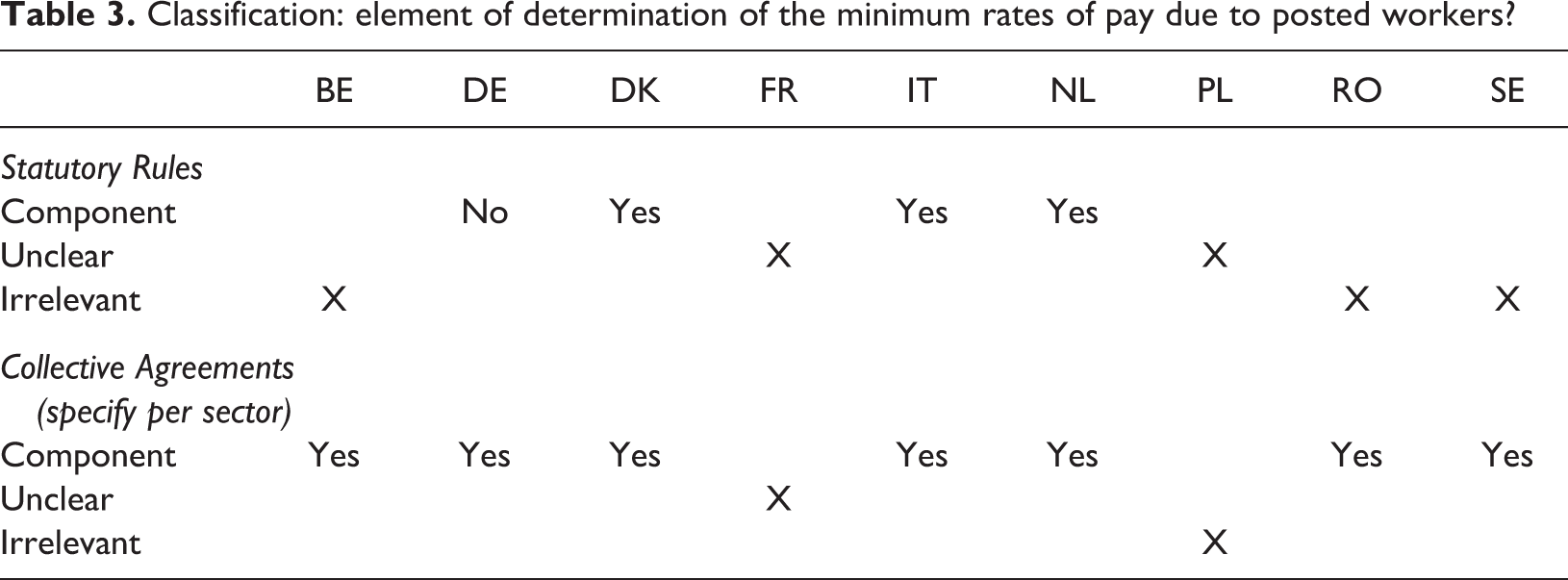
The matter of the classification of jobs is a good example of the lack of unity. At national level, the minimum wage paid to domestic employees is often connected to a classification between jobs. The transposition to posted workers of this system, which leads to the existence of several levels of minimum wage, is far from being evident. As demonstrated by Table 3, it is mainly through collective agreements that countries may envisage the classification as a component of the minimum rates of pay. Let us recall that by contrast the CJEU ruled that the posted workers’ minimum rates of pay can be determined according to the employees’ classification and their categorization into pay groups. 18 It entails that posted workers with certain skills or experience should be entitled to higher minimum rates of pay corresponding to their classification in the host country.
Classification: element of determination of the minimum rates of pay due to posted workers?
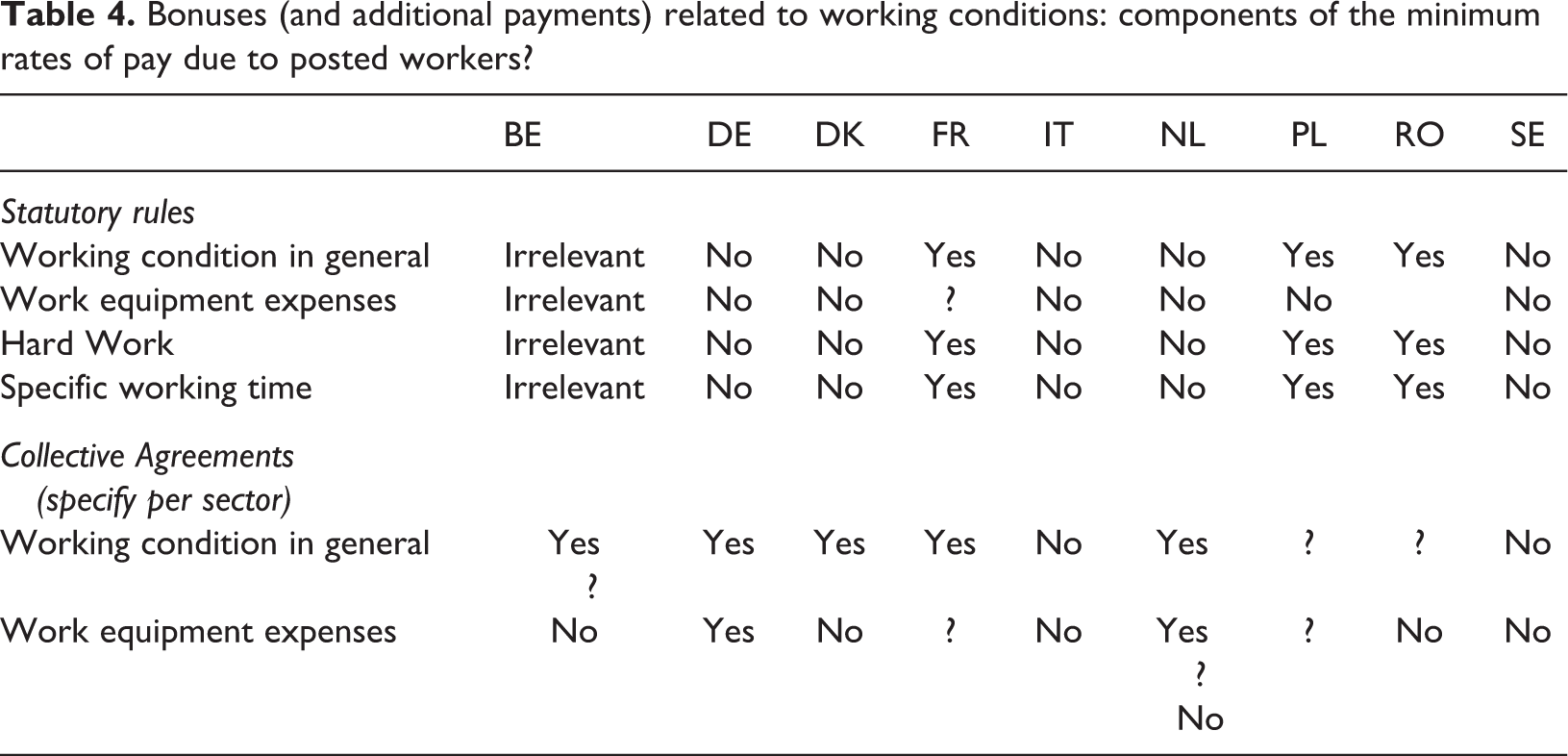
For bonuses and other supplements, the CJEU gives some useful indications. Bonuses, such as a reward in respect of the 13th salary months ‘which do not alter the relationship between the service provided by a worker and the consideration which that worker receives in return’, 19 are constituent elements of the minimum rates of pay. On the contrary, the CJEU held in the same case that account need not be taken of component elements of the minimum rates of pay, of ‘flat-rate sums calculated on a basis other than that of the hourly rate’. 20 At the national level, the status of bonuses and other supplements is complex. It is hard to come up with a clear-cut response on whether a given advantage is part of the constituent elements of the minimum rates of pay. A case-by-case analysis of the bonus purpose has to be carried out. An effort can be made by countries to follow the reasoning of the CJEU, but not many countries are familiar with such a methodology. Furthermore, it is not always apparent whether the status of bonuses and other supplements is analysed by countries from the perspective of the component of the minimum rates of pay of the host country or from the perspective of the sums paid by the sending employer that can be compared to the minimum rates of pay of the host country. In this context, it is not surprising that responses are partial and conflicting solutions arise (see below Table 4).
Bonuses (and additional payments) related to working conditions: components of the minimum rates of pay due to posted workers?
With regard to mobility-related payments, the CJEU follows a transparent direction. Whereas reimbursement of costs effectively incurred are, in conformity with the Directive, explicitly excluded from the constituent elements of the minimum rates of pay, all payments which do not alter the relationship between the service provided by a worker and the consideration which that worker receives in return are part of the minimum rates of pay. 21 For example, compensation for daily travelling time, provided by a host country collective agreement, which is paid to the workers on the condition that their daily journey to and from their place of work is more than one hour’s duration, ‘is not paid in reimbursement of expenditure actually incurred by the worker on account of the posting’ and is therefore a constituent element of the minimum rates of pay. 22
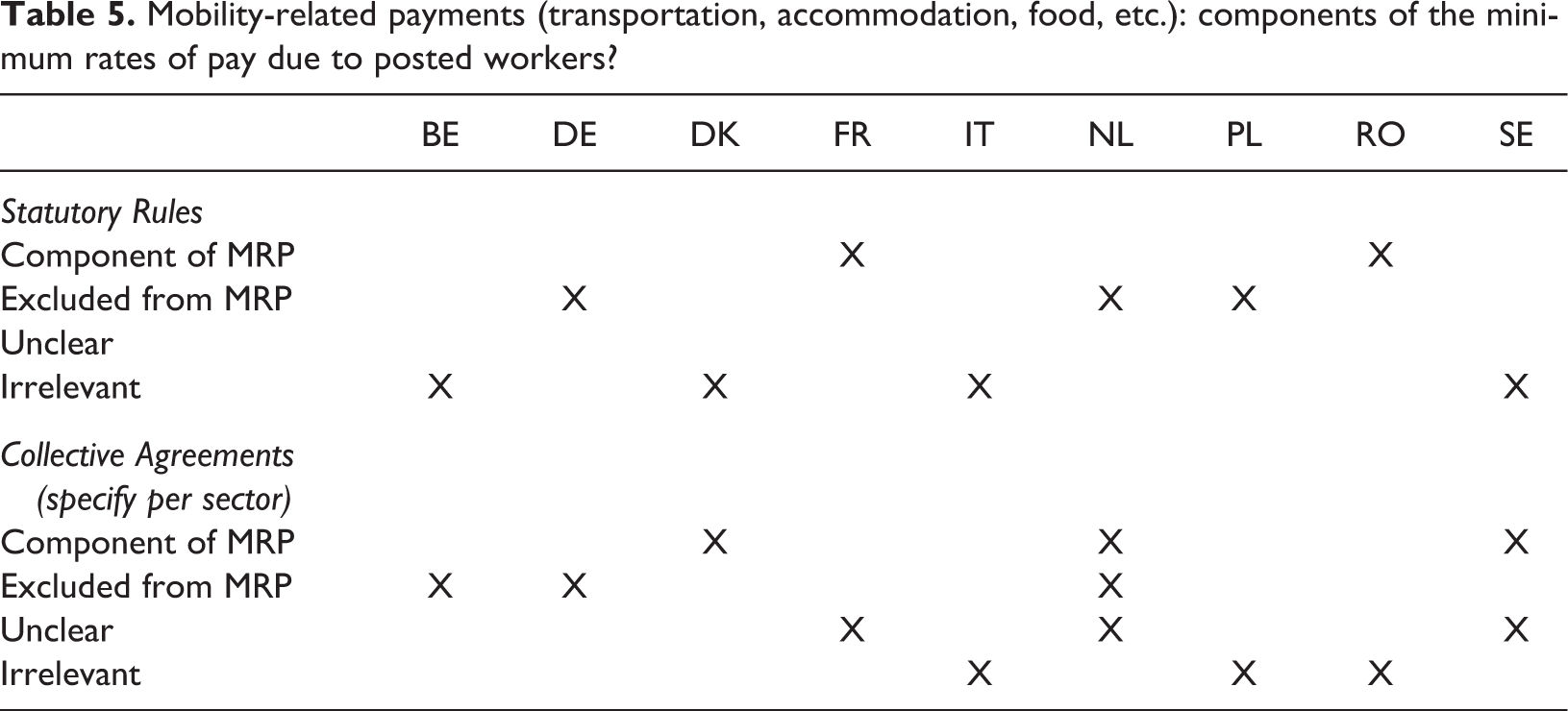
Conversely, but from the perspective of the sending country this time, the CJEU ruled in the same case that the coverage of accommodation costs as well as an allowance taking the form of meal vouchers provided to the posted workers by their employer are not to be considered part of the minimum wage. 23 From a practical point of view, the CJEU’s analysis is not simple to implement at national level. Table 5 below underlines the absence of any overall trend. At the statutory level, these payments are periodically a component of the minimum rates of pay, but at other times not, and sometimes the solution is unclear. At collective agreement level, the same observation is made. There can be contradictions between sectoral agreements of one country. However, differences are more understandable at this level since sectors have their own features.
Mobility-related payments (transportation, accommodation, food, etc.): components of the minimum rates of pay due to posted workers?
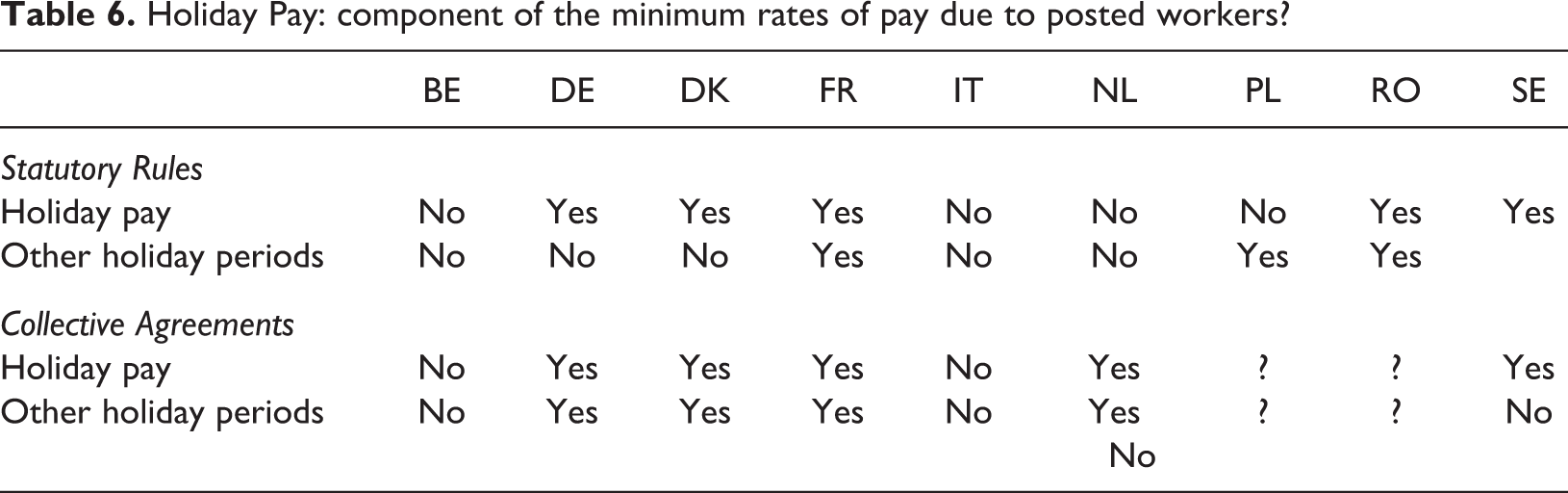
The status of annual holiday and other periods of leave related payments leads to comparable conclusions. We know that the CJEU assigns a specific status to compensation for periods of annual leave. The reason for this is that, as recalled in Sähköalojen, ‘the right to paid annual leave must be regarded as a particularly important principle of EU social law, [it] is thus granted to every worker, whatever his/her place of employment’. 24 Hence, ‘the minimum pay which the worker must receive, in accordance with point (b) of the second indent of Article 3(1) of the directive, for the minimum paid annual holidays corresponds to the minimum wage to which that worker is entitled during the reference period’. 25 The CJEU explained that ‘the pay which the worker receives during the holidays is intrinsically linked to that which he receives in return for his services’. 26 The implementation at the national level (see Table 6) reveals the difficulty in extracting common denominators. A law may state explicitly that posted workers are entitled to annual paid holiday; collective agreements can stipulate that a holiday allowance is a component of the minimum rates of pay. Nevertheless, solutions are not uniform: some countries keep the holiday pay out of the components of the minimum rates of pay. For other holiday allowances, solutions are even less stable and occasionally they can be contradictory. Some countries do not seem to have any settled opinion.
Holiday Pay: component of the minimum rates of pay due to posted workers?
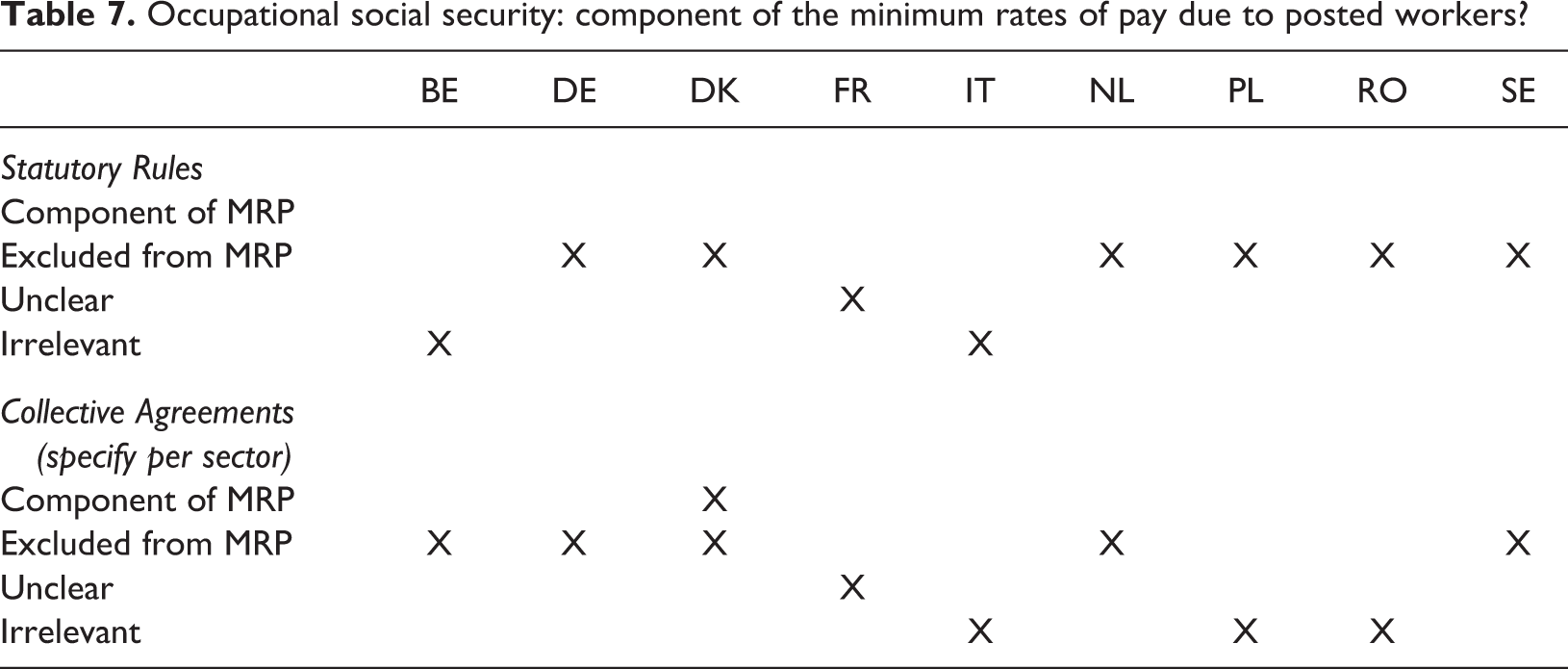
In the field of social protection, clearer orientations could have emerged since supplementary occupational retirement pension schemes are excluded from the minimum rates of pay by Article 3(1) of the Posting Directive. For the purposes of evaluating whether the posted employee has received an amount equivalent to the host country’s minimum rates of pay, the CJEU ruled in conformity with the Directive that account need not be taken of contributions to supplementary occupational retirement pension schemes. 27 National level regulations partly reflect the European regulation depicted above (see Table 7). Statutory rules usually exclude occupational social security advantages from the scope of the minimum rates of pay. This remark is also true at the level of collective agreements. It means that employers’ contributions to medical expenses may not be a component of the host country minimum rates of pay. The same rule applies to the supplementary/occupation pension. Welfare fund advantages granted by collective agreements often presuppose a stable, long-lasting employment relationship, to such an extent that it is sometimes difficult to conceive their application in situations of posting. Still, the situation is less homogeneous than it seems. Some countries do not explicitly exclude supplementary occupational retirement pension schemes from the scope of posted workers’ rights. Furthermore, not all countries consider that occupational social security advantages alter the relation between the worker’s service and consideration provided by the employer. A collective agreement can incorporate into the minimum rates of pay an additional amount corresponding to pay during sickness, education and cooperation fund, maternity and pension contributions. Likewise, various occupational social security coverages can result in an additional amount to the minimum rates of pay.
Occupational social security: component of the minimum rates of pay due to posted workers?
B. The sending perspective: how to meet the host country requirements?
What are the mechanisms used for comparing the remuneration (in all its components) actually paid to the posted workers by the sending company to the minimum rates of pay of the host state? This section seeks to find answers from the positions of the host country’s authorities and of the sending employers.
In general, receiving countries do not pay too much attention at identifying the elements of remuneration paid to the posted worker that can (or cannot) be compared with their local minimum rates of pay. National authorities and social partners are not usually aware of the need to deal with this situation. The analysis reveals that there is a difference across the Member States studied, regarding the extent to which the host states include different payments when comparing the sums received by the posted worker with its minimum rates pay and the extent to which such payments are disregarded in the comparison (for example, as payments made in reimbursement of expenditure actually incurred on account of the posting).
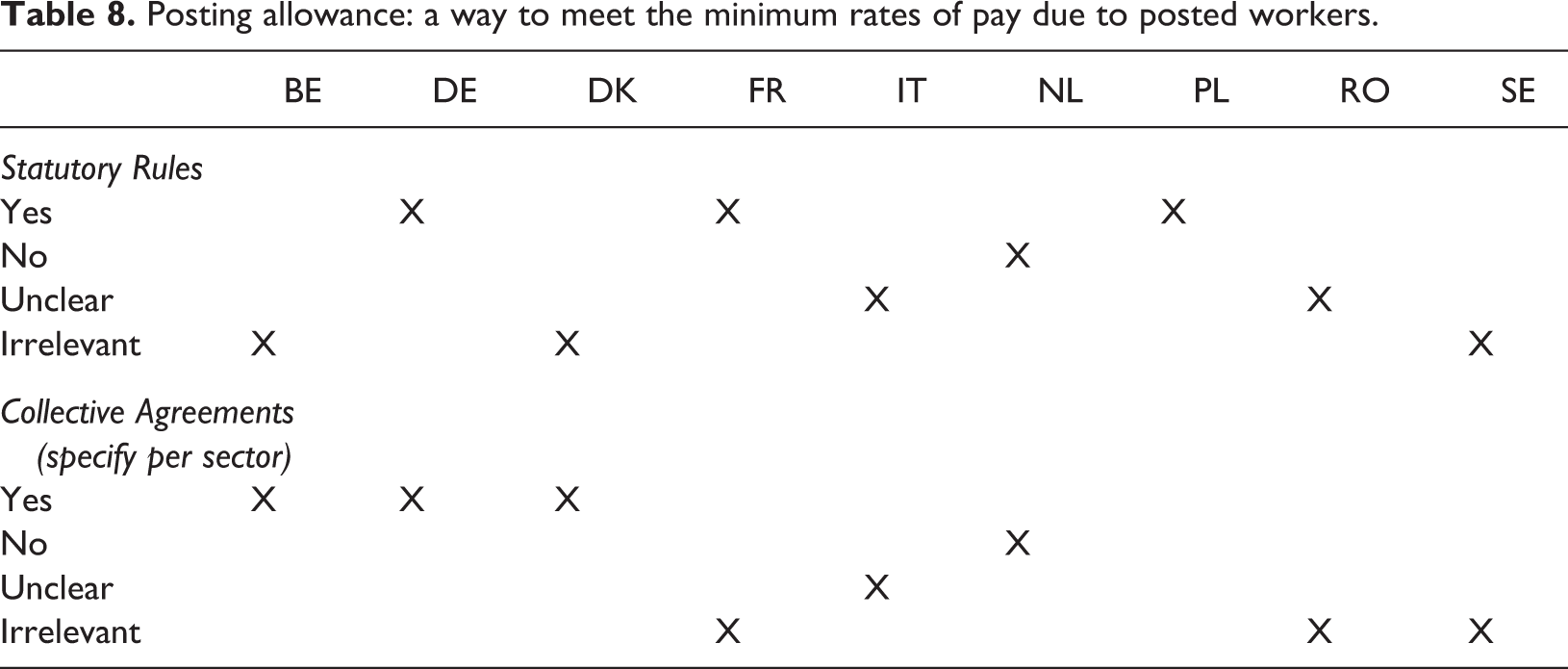
The posting allowance paid by the posted workers’ employer is the usual way to meet the minimum rates of pay of the host country in the majority of the countries studied (see Table 8). Actual expenses are usually excluded for the calculation of the host country’s minimum rates of pay; the same applies to travel reimbursement, transportation costs, accommodation and meals. Other forms of payment raise debates and illustrate the complexity of the situation. For example, remuneration components paid by foreign employers are not taken into account for the context of the minimum rates of pay if they are not directly linked to the work performance (for example, purely flat-rate payments; social protection related advantages, such as premiums for supplementary health coverage, overtime increments and incentive bonuses that bare no direct relation with work provision).
Posting allowance: a way to meet the minimum rates of pay due to posted workers.
For companies established in sending countries with high minimum wages, the question of granting the minimum rates of pay of the host country is often not relevant and there is little information available on compliance. Where a gap exists, it is covered by a differential payment taking the form of a specific posting allowance.
At EU level, there are two categories of obstacles when it comes to the minimum rates of pay. Firstly, it is not clear since neither the Posting Directive nor the case law of the CJEU reveals whether it has the same meaning from the perspective of the host country (which elements of remuneration are counted for the definition of the minimum rates of pay of the host country) and from the sending country (which payments made to posted workers by their employers can be considered for the purposes of assessing compliance with the host country minimum rates of pay). Secondly, the Directive and the existing case law do not deal with all the possible elements of remuneration. Only a few of the components have been subject to the CJEU’s interpretation. Therefore, in many concrete cases at national level, it remains challenging to evaluate whether an element of remuneration is classified by the host country as a constituent element of the minimum rate of pay – and for sending employers to evaluate which elements of remuneration actually paid to the posted workers are taken into account for the calculation of the minimum rates of pay of the host country.
The many uncertainties surrounding the solutions at EU level have a direct impact on national rules. This is not surprising since similar problems exist in national law when it comes to determining the minimum wage owed to a domestic worker. Few national instruments (law or collective agreements) provide specific rules on the minimum rates of pay due to posted workers. The interviews carried out by national experts have confirmed that the stakeholders do not always distinguish between the host country and the sending perspective. Another source of misunderstanding derives from the neighbouring expressions of ‘minimum wage’ and ‘minimum rates of pay’. Stakeholders have a tendency to consider them as being equivalent.
If we look at the results from a regulatory point of view (statutory versus collective agreements), the impression is that social partners are more likely to address the matter of the minimum rates of pay than the legislator. The analysis of the four sectors indicates that there are no transversal solutions between collective agreements, whether we look at the results from a national perspective (all sectoral agreements of one country) or from a sectoral perspective (collective agreements of one sector for all countries). This observation is also the consequence of the specificities of each sector.
3. The minimum rates of pay: the French perspective
It is important bear in mind at this stage that the task given to the national experts was, amongst other things, to define the ‘minimum’ and ‘actual’ rates of pay due to posted workers in four clearly identified sectors: agency work; construction; road transport; and health and care services.
As far as the identified sectors are concerned, it is worth mentioning that they do not always correspond to sectors identified in France as particularly relevant to posted work. Although in 2013, 42% of the total posting declarations were made within the construction and public procurement sectors and 23% within temporary work agencies, health and care services have not been identified by the French Labour Ministry as relevant to posting. 28 Moreover, within road transport, where there is undoubtedly an unfair competition issue, the application of the Posting Directive may not provide – according to the relevant stakeholders – the most adequate solution to the problems encountered. 29 As a result, as far as France is concerned, it would have been appropriate to adapt the scope of the research in order to include other sectors, such as industry or agriculture.
Regarding the posted workers’ ‘actual’ earnings, it should be mentioned that there is no way to clearly identify them. Although, posting declarations mention, among other things, the monthly gross salary paid to posted workers, the French Labour Ministry has made no use of such data in order to draw any conclusions. The reason lies with the fact that they did not think these data were sufficiently reliable. As a result, in practice it is impossible to compare the actual median remuneration paid to posted workers with that of local employees in the same category. This is of course unfortunate, given that the payment of a salary according to the standards and specific requirements of the host country stands at the heart of the Posting Directive and seems to represent an adequate but also an effective means for combating unfair competition and social dumping.
Exacerbating the difficulty of identifying the posted workers’ median salary is the fact that the French legal system provides neither for a ‘minimum’ rate of pay (in the sense of a minimum amount), nor for minimum rates of pay (in plural) for each relevant sector. As a result, the relevant stakeholders (most notably the Labour Inspection (Inspection du travail) tend to confuse the minimum rates of pay due to posted workers, with the minimum wage either at the national (often) or sectoral level (more rarely). This is true notwithstanding the compelling reasons to clearly identify and therefore distinguish the minimum rates of pay due to posted workers from the national minimum wage to which every single employee within the French territory is entitled, including posted workers. 30
Although neither statutory law nor sector-wide collective agreements directly define the minimum rates of pay for posted workers, an indirect method does exist to achieve this goal through identifying its constituent elements. In effect, if we were able to draw up a full list of mandatory wage supplements applicable to posted workers, we would also be able to calculate the amount of the minimum rates of pay for each sector. This particular approach is, however, difficult to implement in practice. This is because neither the legislature, nor the social partners have identified at the sectoral level the constituent elements of minimum rates of pay. For its part, the French legislature has confined the constituent elements of the posted workers’ minimum rates of pay to those wage supplements identified as such by the host country. As a result, French law ignores wage supplements paid by the Foreign Service provider (employer undertaking) following the requirements of the country of origin. 31 In doing so, the French legislature inadvertently contributes to the distortion of fair competition to the detriment of the foreign service provider.
Two main issues follow: first, the constituent elements of the minimum rates of pay will be identified according to statutory law and collective agreements (Section 3.A.). Then, the particular concerns arising from the distinction between minimum rates of pay and minimum wages will be analysed (Section 3.B.).
A. Constituent elements of the minimum rates of pay according to statutory law and collective agreements
The Posting Directive has been implemented into French law by Statute n°93-1313 32 and subsequently revised, by Statutes n°2005-882 33 and n°2012-1404. 34 These legal provisions have identified statutory law and ‘extended’ collective agreements as the only foundations of the posted worker’s minimum rates of pay. They also provided indications as to the constituent elements of that minimum pay obligation.
Statute n°2015-990, 35 revised the existing legal framework in order to echo the recent CJEU case law and to anticipate the proposal for the revision of the Posting Directive. By way of contrast, social partners have so far shown little interest in defining the minimum rates of pay even in sectors where posting is highly relevant.
1. Statutory provisions: Between certainties and uncertainties
Article L1262-4 of the French Labour Code (Code du travail) provided, until 5 August 2015, that ‘employers that temporarily post their workers within the French territory are subject to statutory and conventional provisions normally applying to employees occupied by permanently established within the French territory undertakings of the same sector regarding (among others): 8° minimum salary and payment of salary including overtime premiums’. 36
Three points can be made here. First, as far as the determination of the minimum rates of pay is concerned, the statutory provision clearly identifies statutory law and collective agreements as the only foundational basis of the posted workers’ minimum rates of pay. Nevertheless, not all collective agreements are intended to provide the posted workers’ minimum rates of pay or its constituent elements. Only ‘extended’ collective agreements may do so, meaning collective agreements negotiated at sectoral level which apply – thanks to a ministerial decision (order) – to all undertakings falling within the territorial and professional scope of the relevant agreement, even where the employer undertaking is not a member of the signatory employers’ organization. 37 The proposed revision of the Posting Directive adopts exactly the same viewpoint: it circumscribes equality of treatment to the generally applicable collective agreements, excluding posted workers from the benefit of company-level collective agreements even where they provide for more favourable terms and conditions of work.
A second point relates to the constituent elements of the minimum rates of pay. Article L1262-4 of the French Labour Code initially only referred to two potential components of the minimum rates of pay – the minimum salary (salaire minimum) and overtime premiums. However, Article R.1262-8 (resulting from the incorporation of a statutory instrument implementing Article 3(7) of the Posting Directive), provides that ‘allowances specific to posting are presumed to form part of the posted workers’ minimum rates of pay’. This explicit reference to ‘minimum rates of pay’ as opposed to ‘minimum salary’ – an expression used by the statutory provision – indicates an intended distinction between ‘minimum rates of pay’ – also used by the directive – and ‘minimum salary’ or ‘minimum wage’ which is but one component of the minimum rates of pay. 38
As a result, until recently, it was necessary to aggregate three distinct components to determine posted workers’ minimum rates of pay: (1) the posted workers’ minimum wage, as statutorily defined (national minimum wage) or based on sector-wide ‘extended’ collective agreement; (2) overtime premiums, where relevant; and (3) allowances specific to posting when they are not paid to the worker in reimbursement of actually incurred expenses. This narrow approach was confirmed by the French Supreme Court (Cour de Cassation) on 13 November 2014, 39 when the latter had to determine whether a posting allowance was part of the posted worker’s minimum rates of pay. The Supreme Court recognized that the aforementioned allowance was part of the posted worker’s minimum rates of pay, and that the salary paid to the worker met the host country’s requirements.
A third point is that posted workers are entitled to the national minimum wage or to the sector wide minimum equivalent, whichever is more favourable. In effect, given that posted workers are not explicitly excluded from the personal scope of the national minimum wage, there is no legal justification for denying posted workers access to the national minimum wage. Additionally, where there is a sector-wide generally applicable collective agreement, posted workers may be entitled to more than just the minimum wage at the bottom end of the provided pay classification grid. It however is probable that employers should also take into account the following criteria: experience; qualifications; seniority; technicality; responsibility and autonomy in order to provide posted workers with better pay conditions. Unfortunately, French law does not explicitly address this issue, nor does the proposed Posting Directive revision. Only a bold interpretation of Article R.1261-2 of the Labour Code might suggest that posted workers should be entitled to the salary corresponding to their specific qualification, seniority and experience – even when acquired beyond the French territory – following the application of the classification grid as a whole. However, in the absence of concurring case law, legitimate doubt on this issue remains.
This relatively restrictive approach to the constituent elements of the minimum rates of pay, appears consistent with the spirit of the Posting Directive – as it stands at present – notably in view of Recital 13 that explicitly remarks that posted workers are entitled to ‘a nucleus of mandatory rules of minimum protection’. Similarly, the CJEU refers the definition of the minimum rates of pay to the host country ‘in so far as that definition, deriving from the legislation or relevant national collective agreements, or as interpreted by the national courts, does not have the effect of impeding the free movement of services between Member States’. 40
Yet this restrictive approach has been challenged by Statute n°990-2015 (Article 280) amending Article L1262-4 of the French Labour Code. This Statute requires that wages for posted workers include ‘wage supplements provided for by statutory provisions and collective agreements’. This seems to be a radical change compared to the law as it stood before. Although national law apparently echoes the recent CJEU case law, extending the constituent elements of minimum rates of pay to wage supplements such as a compensation for daily travelling time and minimum paid annual holidays, 41 goes far beyond the limits of an extensive interpretation. As a result, only the adoption of the revision proposal would be able to comfort the French position. The boldness of the French legislature would have been puzzling, unless seen as a demonstration of a willingness to anticipate the Posting Directive’s revision and to force equality of treatment instead of minimum protection.
It is worth emphasizing that the interpretation of ‘wage supplements provided for by statutory law and collective agreements’ will not be easy to implement in practice. Which wage supplements are concerned? Should we wait for a statutory instrument (ministerial order, circular) or should we encourage social partners to handle the issue?
2. Collective bargaining: a soft focus
National experts were also expected to identify collective agreements specific to posting and/or to minimum rates of pay within the four relevant sectors. In France, only one such agreement relevant to the posting of agency workers beyond the French territory exists. It dates back to 2 December 1986. 42 In all other sectors, there are neither collective agreements specific to posting, nor provisions relative to the constituent elements of the minimum rates of pay. It seems therefore that social partners do not attach much importance to the constituent elements of the minimum rates of pay or to the integration of posted workers to classification grids. This is rather surprising given that it is their own members that suffer the consequences of unfair competition practices. Thus, the question is whether this default is due to mere oversight or is a more deliberate omission.
When we asked social partners about the posted workers’ due salary, their replies varied extensively. Some asserted that posted workers are entitled to the application of sector-wide collective agreements on the same conditions as the local labour force of the same qualification. After scrutiny, we discovered that in fact posted workers are rarely paid more than the sector wide minimum wage at the bottom end of the pay scale. In other terms, seniority, experience, technical knowledge and ability are not taken into account to improve posted workers’ rights to a fair remuneration. Therefore, social partners should be encouraged to introduce an interpretation guidance in order to integrate posted workers into the pay scale. Unless they do so, French sector-wide collective agreements will not be deemed compliant with the CJEU’s interpretation requiring that any generally applicable collective agreement be mandatory, accessible and clear. 43
As for employers’ organizations belonging to the sector of temporary work agencies, they seem to think that there is no use negotiating minimum rates of pay for temporary posted workers at the sector level, because temporary workers’ remuneration depends on the applicable collective agreement in the user company. The proposal for the revision of the Posting Directive also adopts this view, which is already applicable in France. Consequently, even if the proposed revision were not adopted, temporary workers posted on French territory would still, at least in theory, receive the same salary as user company permanent workers of the same qualification. Yet the reality is quite different. Trade union representatives denounce that temporary agency workers posted in France are not treated equally relative to the local workforce.
Decree n°990-2015 has undoubtedly emphasized the importance of collective bargaining to determining posted workers’ remuneration. Wage supplements such as daily allowances including two meals and compensation for spending the night outside a worker’s residence are now due to lorry drivers. The same applies to employees in the construction sector whose applicable collective agreement provides for a daily travel allowance depending on the distance between their home (here: temporary residence) and their place of work. Although national law and recent case law of the CJEU seem to favour the inclusion of such wage supplements to the posted workers’ minimum rates of pay, ambiguities remain – such as the inclusion into the minimum rates of pay of increments related to special conditions of work (such as noise, heat, hardship bonuses), complementary medical or other social coverage (supplements of social nature?), workers’ participation – which should be explicitly addressed.
Instead of waiting for national law or case law of the CJEU to interpret the meaning of ‘minimum rates of pay’ on an occasional basis, it would be logical and even both cost and time effective for social partners to define, within each sector, the constituent elements of the minimum rates of pay. Failure to do so not only disrespects the posted workers’ rights but also perverts competition. However, this failure to act is hardly understandable given that social partners in France have a legitimate interest in ensuring that both foreign service providers and local clients can easily identify the actual price of posting. It should be stressed at this point that implementation of the Enforcement Directive into French law has extended employers’ liability for the payment of minimum rates of pay to local clients who may become jointly liable for the payment of posted workers’ remuneration in case their employer defaults on payment. 44
B. The distinction between minimum rates of pay and minimum wage: a delicate but unavoidable issue
When we questioned the French Labour Inspection on posted workers’ earnings, we often received bewildering replies. Although control agents invariably report abuses relating to pay, such as remuneration levels substantially below the national minimum wage, they insist at the same time that the majority of the illegal acts relate to maximum working hours, insecure conditions of work or indecent accommodation. According to them, pay is rarely an issue and when it is, they restrict themselves in making sure that the posted workers’ gross salary includes neither overtime premiums nor reimbursement for travelling and accommodation expenses. However, once they secure that posted workers receive a salary equivalent to the national minimum wage or to the sector-wide bottom end equivalent, they seem to forget that the ‘minimum rates of pay’ include statutory or sector-wide wage supplements. 45
In effect, posted workers in France are entitled to the national minimum wage, and where appropriate, to the equivalent sector wide minimum wage. Additionally, they are entitled to overtime bonuses and all wage supplements related to their specific conditions of work (such as night work, dangerous and unhealthy work supplements), holiday allowances, and so on. However, it is unclear whether they are entitled to additional social security coverage or participation schemes because these are considered additional benefits not directly related to the provision of work. 46
Although Decree n°990-2015 extended posted workers’ rights to a fair/equitable remuneration by the explicit inclusion of supplements to the minimum rates of pay, it did not completely dissipate the risk of confusion between minimum wages and minimum rates of pay. In effect, Article L1262-4-3 of the French Labour Code now provides that clients or other order providers may incur liability if they are informed that their direct contractors or indirect sub-contractors fail to pay the national or sectoral minimum wage and they do not react either by terminating the contractual relationship or by formally inviting infringing subcontractors to proceed to payment. This reference to minimum wage instead of minimum rates of pay is rather surprising and all the more incomprehensible in the view of Decree n°2016-27, 47 which extends joint liability to the payment of remuneration (broadly construed) due to each posted worker.
Accordingly, as long as there is no clear definition of the constituent elements of minimum rates of pay either at national or at sectoral level, posted workers may be denied access to (some) wage supplements to which they would be otherwise legally entitled to. In the absence of sufficient national case law, the only ready-made solution is to refer to the minimum rates of pay defined by the CJEU, according to which minimum rates of pay include ‘wage allowances and supplements which do not alter the relationship between the service provided by the worker and the consideration which receives the worker in return’. 48
In light of the previous, it seems that the equality of treatment principle would still be the best option. While the proposal for the revision of the Posting Directive has had a poor start, 49 let us hope that it will eventually make its way through, at least on this particular point.
4. Conclusion
It appears that most EU countries do not have a clear and transparent definition of the minimum rates of pay within the context of the Posting Directive. In most cases, the minimum rates of pay is confused with the statutory minimum wage. Would the proposal for the revision of the posting Directive be an improvement in this respect? At first glance, the answer seems positive. Indeed the proposal leaves behind the concept of ‘minimum rates of pay’ and replaces it with ‘remuneration’, adding that
remuneration means all the elements of remuneration rendered mandatory by national law, regulation or administrative provision, collective agreements or arbitration awards which have been declared universally applicable and/or, in the absence of a system for declaring collective agreements or arbitration awards to be of universal application, other collective agreements or arbitration awards within the meaning of paragraph 8 second subparagraph, in the Member State to whose territory the worker is posted. 50
This change of vocabulary and the definition provided is unfortunately unlikely to be sufficient to resolve the problems of implementation described in this article. It will indeed remain within Member States’ competence to set the rules on remuneration in accordance with their law and practice. Moreover, even if the host country rules on remuneration were to apply to posted workers, they would still have to be justified by the need to protect posted workers and should not disproportionately restrict the cross-border provision of services. This delicate balance of interests makes the scope of ‘remuneration’ uncertain. The national courts may therefore have to seek the interpretation of the CJEU in the future. Implementation problems might be even more sensitive than they are now since the objective set in the Preamble of the proposal for the revision of the Posting Directive is to ensure equal treatment between domestic and posted workers in terms of remuneration, not only a minimum wage in favour of the latter as is the case in the current Directive.
Footnotes
Authors’ note
The full study is available at, European Commission, Study on wage setting systems and minimum rates of pay applicable to posted workers in accordance with Directive 96/71/EC in a selected number of Member States and sectors, http://ec.europa.eu/social/BlobServlet?docId=14965&langId=en.