







Abstract
In a new line of case law on the interpretation and application of Article 52(3) of the Charter of Fundamental Rights, the European Court of Justice has explicitly applied the autonomy of EU law in the field of fundamental rights protection by referring to the non-binding Explanations relating to Article 52(3) CFR. According to these Explanations, Article 52(3) CFR has the purpose to ensure the consistency of the interpretation of the Charter with the European Convention on Human Rights, without ‘adversely affecting the autonomy of Union law and of that of the Court of Justice of the European Union’. Since the Grand Chamber judgment in N. (C-601/15 PPU, 15 February 2016), 23 cases have subsequently made this same reference to the autonomy of EU law when applying Article 52(3) CFR. The main point of this article is to showcase how the ECJ uses the Explanations in this line of case law as an instrument to establish an autonomous interpretation of the fundamental rights of the CFR, which are influenced, but not fully determined, by the ECHR.
Keywords
Introduction
Ever since the European Court of Justice (ECJ) recognized Community fundamental rights stemming from the ‘common constitutional traditions of the Member States’ and the ECHR 1 in its ‘famous trio of rulings’ in Stauder, Internationale Handelsgesellschaft and Nold, 2 the European Convention on Human Rights (ECHR) and the jurisprudence of the European Court of Human Rights (ECtHR) have been of special significance for the protection of fundamental rights in the EU. 3 In fact, the ECJ only started operating regularly with the EU's own Charter of Fundamental Rights (CFR) after the treaty of Lisbon incorporated the CFR into primary law and made it legally binding. 4 Up until that point, it was the ECHR that had become ‘the main rights instrument in the ECJ's jurisprudence’. 5 In recent years however, the relationship between the ECtHR and the ECJ has become increasingly strained, 6 having reached ‘rock bottom’ after the failure of the accession of the EU to the ECHR following Opinion 2/13. 7 Despite the recent progress in the accession process, 8 the EU still has not (yet) acceded to the ECHR and is hence not formally bound by the Convention. 9
Due to this special significance of the ECHR for fundamental rights protection in the EU (recognized as general principles of EU law in Article 6(3) TEU) and not least since all EU Member States are also Members of the Council of Europe, the proper functioning of the multilevel regime of fundamental rights protection in Europe needs to rely on (other) mechanisms of coordination and consistency. To that end, the first sentence of Article 52(3) CFR stipulates, that ‘[I]n so far as this Charter contains rights which correspond to rights guaranteed by the Convention for the Protection of Human Rights and Fundamental Freedoms, the meaning and scope of those rights shall be the same as those laid down by the said Convention.’ This passage will hereinafter be referred to as the ‘consistency clause’. 10 Meanwhile, the second sentence of Article 52(3) CFR allows for ‘the Union to guarantee more extensive protection’.
From the perspective of the autonomy of EU law, being – albeit only indirectly, for lack of accession – bound by international law and decisions of an external court when it comes to the interpretation of EU law provisions (such as the CFR), creates a threat to the self-referential and autonomous character of EU law. 11 This results in a tension between upholding the autonomy of EU law on one hand and ensuring coherence between the CFR and the ECHR on the other hand, which is inherent in the regime set up by the CFR itself. 12
It is in this context that a new line of cases on the interpretation of Article 52(3) CFR has emerged and has begun to manifest a novel way to deal with the tension between autonomy and consistency. Before this line of cases, the ECJ had not explicitly mentioned the autonomy of EU law in the context of fundamental rights protection or an ‘autonomous’ interpretation of the Charter. 13 Even when applying Article 52(3), the Court almost exclusively referenced the ‘consistency’ part of that provision (see Figure 1). Recently, however, the ECJ has started to refer to the autonomy of EU law in the context of the CFR by drawing on the (non-binding) Explanations to Article 52(3) CFR. 14 Unlike the CFR itself, the Explanations relating to the Charter mention the autonomy of EU law explicitly and specify that the consistency requirement in Article 52(3) CFR is not meant to ‘adversely affect […] the autonomy of Union law and of that of the Court of Justice of the European Union’.
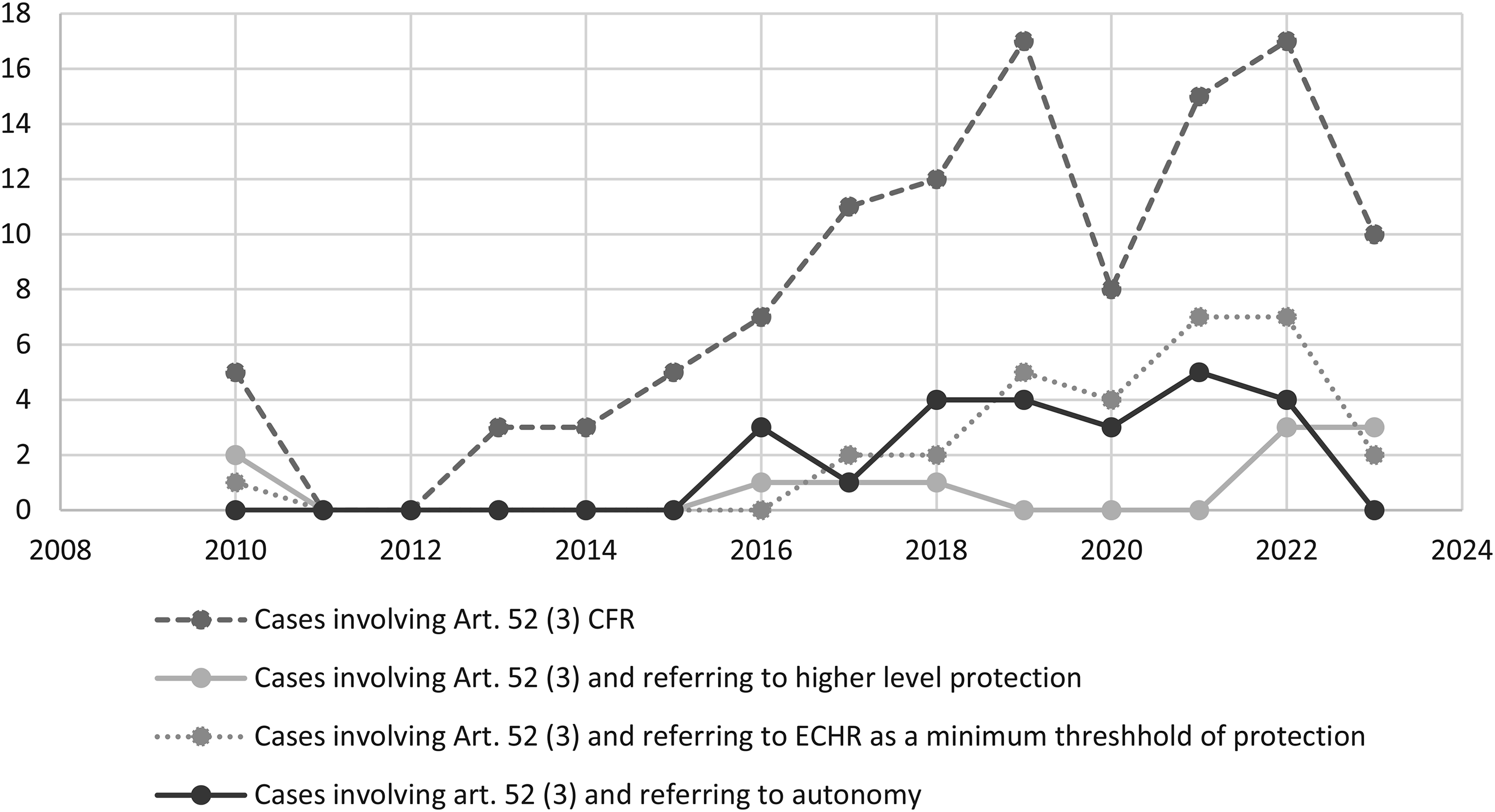
Case law on Article 52(3) CFR.
The ECJ referred to the Explanations to Article 52(3) CFR for the first time in the Grand Chamber decision of 15 February 2016 in the N. case, 15 handed down only 14 months after the failure of the EU's accession to the ECHR in Opinion 2/13. 16 Following N., the just quoted passage on autonomy derived from the Explanations has subsequently been reiterated in 23 other judgments regarding various different fundamental rights, half of which have also been decided by the Grand Chamber. 17 In 2017, the ECJ dropped the reference to the Explanations and simply referred back to its own case law from then on, thus overcoming their non-binding legal nature. 18 A distinct line of case law has thereby formed in a remarkably short period of time. 19 These cases show a clear trend towards what is described here as a process of ‘autonomization’ of EU fundamental rights protection.
The main point of this article is firstly, to show how the ECJ uses the Explanations relating to Article 52(3) CFR in this new line of cases as an instrument to establish an autonomous interpretation of the fundamental rights of the CFR, which are influenced but not fully determined by the ECHR. Secondly, the article explores how this jurisprudence shapes the incremental ‘autonomization’ of the fundamental rights under the Charter and thirdly, how this development relates to the autonomy of the EU's legal order on the whole.
To that end, section 2 will explain the origins of the tension between consistency and autonomy, thus providing the context for the subsequent case law analysis in section 3. Section 4 circles back to the autonomy of EU law in more general terms and investigates the doctrinal, communicative and institutional functions of the autonomy of EU law in this line of cases, followed by some concluding remarks (section 5).
When it comes to the relationship between EU law and international law in general, the autonomy of EU law functions akin to the ‘armour of sovereignty’, which shields the legal order of a sovereign national state from external influences, thus creating an ‘armour of autonomy’. 20 This creates a rapport of a ‘selective permeability of the Union's internal legal system for external norms, with the ECJ as a gatekeeper’, 21 conditioned upon the compatibility with the EU's own ‘constitutional framework’. 22 In many cases, the autonomy of EU law has led to an incompatibility of envisaged international agreements with EU law, because they may have had ‘interpretative spill-over effects’ 23 on the interpretation of EU law by a court situated outside of the system of EU courts (Article 19(1) TEU).
It is against this background that the Plenary Chamber of the Court in Opinion 2/13 on the failed accession of the EU to the ECHR clearly stated that ‘[T]he autonomy enjoyed by EU law in relation to the laws of the Member States and in relation to international law requires that the interpretation of those fundamental rights be ensured within the framework of the structure and objectives of the EU.’ 24 Kokott and Sobotta convincingly interpret this passage as meaning that ‘the final word on the interpretation of EU fundamental rights remains with EU Court of Justice’ and conclude that ‘the autonomy of EU law and submission to the jurisprudence of an external court, such as the Court of Human Rights, appear difficult to reconcile’. 25
The tension between ensuring both the coherence between CFR and ECHR on one hand and safeguarding the constitutional principle of the autonomy of EU law on the other, however, exists even without an accession of the EU to the ECHR. It emanates from the very provisions that regulate the relationship between the CFR and the ECHR, i.e., Article 52(3) and Article 53 CFR.
Article 53 CFR sets the ECHR as a minimum standard of fundamental rights protection. 26 Article 52(3) sentence 1 CFR obliges the ECJ to maintain consistency when interpreting fundamental rights that correspond to the ECHR. According to the Explanations relating to the Charter, this includes the case law of the ECtHR. 27 But even the close connection created by the consistency clause does not create a direct binding effect of the ECHR in the EU legal order. 28 It does, however, ensure the continuous substantive synchronization 29 between the fundamental rights protection offered by the CFR and the ECHR. Nonetheless, Article 52(3) sentence 2 CFR allows for the EU to adopt a higher level of protection, which is in line with the ECHR being understood as a minimum standard (see Article 53 ECHR). 30
This leads to an indirect binding effect of the Convention and the case law of the ECtHR when it comes to the corresponding fundamental rights of the CFR. 31 This ‘special link to sources of EU primary law’ 32 is intended to prevent a fragmentation between standards of fundamental rights protection by prohibiting the ECJ from adopting an interpretation which may run counter to the ECHR and – according to the Explanations to the Charter – the ECtHR jurisprudence, 33 notwithstanding the possibility to adopt a higher level of protection according to Article 52(3) CFR second sentence. As de Witte put it, the CFR as the EUs own ‘bill of rights’ could have rid the EU and the ECJ of the need ‘to “borrow” rights elsewhere, and the EU legal order could become self-sufficient in this respect. However, the CFR text itself prevents this self-sufficiency from happening, through its Articles 53 and Article 52(3)’. 34 In other words, the respective clauses in the Charter prevent the full autonomy of the CFR, turning corresponding rights guarantees into semi-autonomous provisions of EU law. 35 In turn, this limits the autonomy of the Charter and the ECJ in the field of fundamental rights protection. 36
The tension between consistency and autonomy has found expression in the wording of the Explanations to Article 52(3) CFR, which state the following: Paragraph 3 is intended to ensure the necessary consistency between the Charter and the ECHR by establishing the principle that, insofar as the rights in the present Charter also correspond to rights guaranteed by the ECHR, the meaning and scope of those rights, including authorised limitations, are the same as those laid down by the ECHR. This means in particular that the legislator, in laying down limitations to those rights, must comply with the same standards as are fixed by the detailed limitation arrangements laid down in the ECHR without thereby adversely affecting the autonomy of Community law and of that of the Court of Justice of the European Communities. (emphasis added)
The Explanations relating to the Charter are non-binding but are to be given ‘due regard’ in the interpretation of the Charter provisions (cf. Article 52(7) CFR and Article 6(1) TEU). They were first drafted by the Fundamental Rights Convent from 1999 to 2000 alongside the CFR, and later revised by the Constitutional Convent in 2003/2004. 37 As can be seen from the wording of the Explanations, the coherence clause is mainly directed at the EU legislator. The passage about the autonomy of the Court seems to be inserted as a mechanism to protect the autonomy of EU law and the ECJ, despite the required coherence. In fact, during the Charter drafting process, concerns about safeguarding the autonomy of EU law were discussed extensively, mainly in the context of potential jurisdictional conflicts between the Strasbourg and Luxembourg courts, 38 especially with regard to a future accession of the EU to the ECHR. 39
Before the N. case, the ECJ had not referred to the Explanations to Article 52(3) CFR. Similarly, the ECJ rarely ever referred to Article 52(3) CFR itself. It also did not explicitly mention the autonomy of EU law in the context of fundamental rights protection or an ‘autonomous’ interpretation of the CFR. 40 Even when applying Article 52(3), the Court almost exclusively referenced the ‘consistency’ part of that provision (see Figure 1).
However, as demonstrated in Figure 1, the number of cases in which the ECJ operates with Article 52(3) CFR has increased significantly over the years, amounting to a staggering 113 cases today. 41 In most of these cases however, references were made to the part of the provision relating to consistency, 42 whereas the higher level of protection has only been invoked in 11 cases; 30 cases referred to the ECHR as providing a (mere) minimum standard. 43 The novelty of the line of cases analysed in detail in this article lies in the fact that the ECJ not only refers to the coherence prescribed by Article 52(3) CFR, but also stresses the autonomy of EU law in the field of fundamental rights protection, by referring to the Explanations to the Charter.
The cases
Through the prism of the tension between autonomy and consistency, four groups of cases have been identified in the line of cases pertaining to Article 52(3) CFR and the autonomy of EU law analysed in this section.
In the cases of the first category, the Court only conducts a simple ‘compatibility check’ 44 with regard to the consistency between CFR and ECHR. These cases tend to display a high level of coherence between the two fundamental rights regimes and were mostly decided in areas of mutual recognition, shaped by the conflicting institutional approaches to fundamental rights protection taken by the ECJ and the ECtHR (see section 3.A). In the second group of cases, the ECJ granted a higher level of protection than the Convention in politically sensitive areas, such as data retention. Thirdly, in cases justifying EU-specific deviations from the Convention, the ECJ's assessment of fundamental rights has been characterized by specific features of the EU, such as concerns about the protection of the internal market or provisions of EU secondary law. Fourthly and finally, some cases deal with fundamental rights that have largely ‘emancipated’ from the ECHR, such as Articles 47 and 50 CFR.
The division of the cases into these categories showcases the different ways in which the abovementioned basic tension has been dealt with by the Court and thus allows for a more nuanced and contextual understanding of the case law. Within the categories, there are overlaps between certain multi-faceted cases.
Cases with a simple ‘compatibility check’ 45 regarding the ECHR
In the first category of cases, the ECJ typically only turns to the ECHR at the end of its judgment, to confirm its own autonomous interpretation of the scope of a certain CFR right. While these cases typically display a high level of consistency between the CFR and the ECHR in the substantive interpretation of the specific rights, they have been described as an attempt ‘to minimize the effect of Art. 52(3) of the EU Charter’, 46 given that the ECtHR case law was only referred to ‘as some sort of afterthought or crosscheck’. 47
Most of the cases stem from areas of mutual recognition, namely judicial cooperation in criminal matters and asylum. 48 These areas of law have been affected by conflicts between the ECJ and the ECtHR. 49 The origin of that conflict lies in the conflicting institutional approaches to fundamental rights protection, that result from the ‘completely different roles’ 50 of the two courts. While the ECtHR ‘conducts an external and subsidiary human rights review to ensure that fundamental rights of individuals are sufficiently protected in specific cases’, 51 the ECJ takes a more systemic view, 52 since it must ‘avoid the collapse of the system based on mutual trust and mutual recognition’ and safeguard the ‘uniformity, primacy, and effectiveness of EU law’. 53
The first judgment that referred to autonomy in accordance with the Explanations to Article 52(3) CFR was the N. case, handed down by the Grand Chamber on the 15 February 2016. In the main proceedings in N., an asylum seeker who had previously committed several offences was detained on the basis of Article 8(3)(e) of Directive 2013/33/EU on the asylum procedures, ‘on grounds of protecting national security or public order’. 54 The referring Raad van State (Dutch Council of State) requested a preliminary ruling on the validity of the abovementioned ground for detention in light of Article 6 and 52(3) CFR 55 and with regard to a specific judgment of the ECtHR, according to which a detention of asylum seekers ‘not imposed with a view to removal’ violates Article 5(1)(f) ECHR. 56
The ECJ began its analysis by pointing out that according to its well established jurisprudence, the ECHR ‘does not constitute, as long as the European Union has not acceded to it, a legal instrument which has been formally incorporated into EU law’. 57 Therefore, the ‘examination of the validity’ of the provision in question ‘must be undertaken solely in the light of the fundamental rights guaranteed by the Charter’, 58 whereas the ECJ underlined regarding the Convention provision, that only ‘[A]ccount must […] be taken’. 59 Thereby, the ECJ ‘reformulated a national court's ECHR-based question into a Charter-based one’. 60
After confirming that the limitation imposed on the rights under Article 6 CFR, which corresponds to Article 5 ECHR, ‘may not exceed those [limitations] permitted by the ECHR’, the ECJ for the first time referred to the Explanations relating to Article 52(3), according to which the ‘necessary consistency’ must be ensured between the CFR and the ECHR, ‘without thereby adversely affecting the autonomy of Union law and […] that of the Court of Justice of the European Union’. 61 According to Imamović, the ECJ referred to autonomy ‘to dismiss national courts’ questions regarding the consequences of Article 52(3) of the Charter’. 62
In substance, the ECJ held that the limitation of the right to freedom under to Article 6 CFR was justified with regard to other aims, in particular the effectiveness of the asylum procedures directive, in which the EU legislator had struck the appropriate balance between freedom and security. 63 Furthermore, the ECJ came to the conclusion that the provision in question did ‘not disregard the level of protection afforded by the second limb of Article 5(1)(f) of the ECHR’. 64 By proceeding in this manner, the ECJ first developed an autonomous interpretation of the Charter-right in question and then examined, whether the previously established interpretation was compatible – or rather, not incompatible 65 – with the ECHR as a sort of final ‘ECHR check’. 66 While the reasoning of the ECJ has been described as ‘technically correct in this specific case’, 67 the judgment was criticized as a manifestation of ‘Charter-centrism’, 68 meaning that ‘the consistency between the Charter and the ECHR must be ensured only to the extent that it does not affect the autonomy of EU law and of the Court itself’. 69 Nonetheless, the Court did engage with the ECtHR jurisprudence in order to make sure there was no violation of the Convention, whilst at the same time addressing the specific purposes of the EU Directive in question. In this manner, the ECJ chose to ‘highlight the interpretive autonomy it enjoys in deciding the matter’ by not relying on the interpretation of another court, 70 while at the same time making sure the consistency requirement was maintained. In this sense, the Court struck an appropriate balance between autonomy and consistency. What is important with regard to the autonomy of EU law, however, is that in this decision, the ECJ claimed the ultimate interpretative authority to determine the extent to which the ECtHR’s jurisprudence is relevant within the EU legal order. 71
In cases following N., the Court highlighted the autonomy of the Charter in a similar fashion and examined the compatibility with the Convention only at the end. 72 For instance, the judgment in JZ 73 concerned the question of whether a curfew in conjunction with the obligation to wear an electronic tag was to be considered a ‘detention’ within the meaning of Article 6 CFR and Article 5(1) ECHR. The obligation of a consistent interpretation of a legal term used both in EU law and in the ECHR poses a typical threat to the autonomous interpretation of EU law. 74 Unsurprisingly, the ECJ stressed several times that according to 52(3) CFR, the concept of ‘detention’ had to be interpreted in consistency with the ECHR, but ‘must be given an autonomous and uniform interpretation throughout the European Union, which must take into account the terms of that provision, its context and the objectives of the legislation of which it forms part’. 75 Overall, the Courts reasoning and approach allowed the ECJ to meet the demands for greater sensitivity to fundamental rights and consistency with the fundamental rights requirements of the ECHR and the national constitutional courts as well as to safeguard the effectiveness of EU (secondary) law and to preserve the autonomy of fundamental rights protection under the CFR at the same time.
Cases granting higher-level protection under the CFR
In the second category of cases, the Court referred to the autonomy of EU law to provide a higher level of fundamental rights protection compared to the ECtHR. As mentioned, neither Article 53 CFR nor Article 53 ECHR prohibit the EU and the ECJ from doing so, since the Convention is understood to only establish a minimum standard. 76 Meanwhile, adopting or adhering to a higher level of protection limits the Member States’ political room of manoeuvring. As will be shown in the cases discussed below, this has led to criticism or even resistance from Member States and, at times, their Courts. This was the case in judgments revolving around the ne bis in idem principle (a) as well as data protection (b). These subcategories differ in an important key feature: while ne bis in idem concerns the relation between state (power) and EU citizens (subjected to said power), the data retention decisions concern a somewhat multipolar conflict between the positive obligation to provide security under Article 6 CFR and the fundamental right to privacy and data protection under Articles 7, 8 and 11 CFR. Therefore, within the latter subcategory of cases, a ‘higher’ level of protection per se does not exist. This has implications on both the compatibility with the coherence clause and the legitimacy of a deviating ‘higher’ standard of protection.
Case on the ne bis in idem principle
The fundamental right of ne bis in idem has been protected by European Community and then EU law since the 1960s 77 and is both a pre-requisite as well as a guarantee for the free movement of persons within the area of freedom, security and justice. 78 Unlike under the ECHR, the EU's ne bis in idem principle has a transnational character, meaning it applies to both national and cross-border cases. 79 This is why Article 50 CFR can ‘in certain circumstances (when there is a cross-border element) be regarded as a noncorresponding right’. 80 In such a case, the ECJ is not obliged under Article 52(3) to respect the ECtHR case law. 81 However, with the exception of bpost, 82 the cases in the series of cases examined here concern single jurisdiction and thus corresponding-rights scenarios, in which the ECJ did provide a higher level of protection pursuant to the second sentence of Article 52(3) CFR.
In cases concerning the implementation of the Schengen Convention, the ECJ decided that idem had to be defined autonomously and based on a factual (idem factum) rather than a normative assessment (idem crimen). 83 Otherwise, the question of the identity of acts (idem) would depend on the legal assessment in each and every Member State, causing a risk of double proceedings in cross-border scenarios and hence potentially severe impediments to the freedom of movement. 84 In the Menci and Garlsson Real Estate judgments, 85 the ECJ extended this autonomous and ‘broad interpretation of idem to cover situations of duplicative administrative/criminal proceedings in the same national legal order’. 86
The ECtHR had previously adopted the ECJs definition of idem and hence an ‘approach which favours the guarantees for individuals’. 87 However, in the A and B v. Norway decision from 2016, 88 the Strasbourg Court changed its jurisprudence on the duplication of proceedings in which a penalty is imposed (concept of bis) by allowing for a proportionate combination of so-called ‘combined (administrative and criminal) proceedings which are sufficiently closely connected’. 89 This effectively lowered the standard of protection of ne bis in idem under the Convention. 90 According to Luchtman, this revirement in Strasbourg came about due to the ‘immense pressure by many signatory states’. 91
The ECJ reaffirmed the higher – and autonomous – level of protection afforded by EU law in its decision in the Menci case. Following the Opinion of Advocate General Sánchez-Bordona, 92 the ECJ justified its more stringent approach by reiterating that the consistency between the CFR and the ECHR shall not compromise the autonomy of EU law. 93 The Court maintained its previous level of protection, which now exceeded that of the Convention, 94 whilst still leaving some room of manoeuvre for Member States to take into account ‘the specificities of the shared European legal order’. 95 Lenaerts and Gutiérrez-Fons have therefore labelled the Menci judgment as an ‘arrêt de principe’, that shows that the ‘cohérence normative entre la Charte et la CEDH ne saurait porter atteinte à l’autonomie du droit de l’Union’. 96
The ECJ confirmed its jurisprudence in Menci and Garlsson Real Estate in the subsequent judgment in Parchetul de pe lângă Tribunalul Braşov. 97 In bpost, 98 the Grand Chamber consolidated its case law on the ne bis in idem principle ‘across all fields of EU law enforcement’ and in cases within one and across several jurisdictions 99 and extended the autonomous factual interpretation of idem to competition law. 100 That being said, the ECJ allowed for restrictions of ne bis in idem in a limited set of circumstances and referred to the decision of the ECtHR in A and B v. Norway, partly quoting directly from the Strasbourg case or phrasing the criteria in a very similar fashion. 101
Cases on data retention regimes
A similar phenomenon can be observed in the three cases involving data retention regimes and the autonomy of EU law in the context of Article 52(3) CFR, namely Tele2 Sverige, La Quadrature du Net and SpaceNet. The cases have in common that, as seen above, they relate to multiple conflicting the fundamental rights and that the Court held that several data retention regimes set up by Member States under Article 15(1) of the E-Privacy Directive 102 did not comply with the fundamental rights guaranteed in Articles 3, 4, 6 and 7 CFR.
In doing so, the ECJ granted these fundamental rights a more extensive protection under the CFR than the ECtHR had done under the Convention. However, the incumbent restrictions of the Member States’ scope of action in politically sensitive fields such as national security (which remains the core task and exclusive competence of the Member States according to Article 4(2) TEU 103 ) and the fight against serious crime put the ECJ under pressure to justify its more stringent position vis-à-vis the Member States and, in part, their courts. To that end, the Court again drew on the autonomy of EU law.
The first of the three decisions, the Tele2 Sverige 104 case, concerned a data retention regime in the UK under the E-Privacy Directive. 105 The referring court asked whether the previous ECJ decision in the case Digital Rights Ireland 106 ‘expand[s] the scope of Articles 7 and/or 8 of [the Charter] beyond that of Article 8 of the European Convention of Human Rights…as established in the jurisprudence of the European Court of Human Rights…?’ 107
The ECJ rejected this question as inadmissible, arguing that since the ECHR was not formally part of EU law, the interpretation of the Directive at issue ‘must be undertaken solely in the light of the fundamental rights guaranteed by the Charter’. 108 Next, the Court referred to the Charter Explanations relating to consistency and autonomy with regard to the relationship between the ECHR and the CFR. The Court held that the question of the level of protection under the ECHR was not relevant for the interpretation of the Directive in light of the CFR, because the level of protection offered by the CFR could not only go beyond that of the Convention, but also contained guarantees that had ‘no equivalent’ in the ECHR. 109 Thereby, the ECJ clearly rejected the referring courts implication that the ECJ could be bound by a lower and (partly non-corresponding) level of protection established by the ECtHR and thus affirmed the autonomy of EU law. 110
The second decision on data retention, La Quadrature du Net, 111 was rendered upon referral by the French Conseil d’État and the Belgian Constitutional Court. The Conseil d’État asked, inter alia, whether an encroachment on fundamental rights by means of an ad-hoc general data retention regime based on Article 15(1) of Directive 2002/58 could be justified in the light of the right to security (Article 6 CFR) as well as Article 4(2) TEU, which puts the protection of national security under the sole responsibility of the Member States. Similarly, the Conseil d’État asked, inter alia, if limitations imposed on fundamental rights through ‘the general and indiscriminate retention obligation imposed on providers’ on the basis of Article 15(1) of the E-Privacy Directive could be justified in the light of the ‘right so security guaranteed in Article 6 of the [Charter] and the requirements of national security, responsibility for which falls to the Member States alone pursuant to Article 4 [TEU]’. 112
Both referring courts invoked the case law of the ECtHR on ‘positive obligations’ to protect and provide security through effective law enforcement according to Articles 3 and 8 ECHR, especially in the case of threats to the physical and mental well-being of children in the context of depictions of sexual abuse of children (so-called child pornography), which may lead to a positive obligation under the Convention to allow data retention regimes to a certain extent. 113 Although the questions were phrased with a view to corresponding positive obligations based on the CFR (Articles 4 and 7), their origin lies in the ECtHR case law. With Member States and their courts pointing out that the ECtHR allows certain general data retention regimes with regard to safeguarding security, 114 the ECJ came under pressure to relax the high standard it had established in Tele2, especially since the referring courts suggested a possible violation of the Convention.
Despite this pressure, the ECJ upheld its previous standard, while at the same time spelling out the (narrow) conditions under which general and indiscriminate data retention would be permitted. 115 In view of the various positive obligations under the ECHR, it held that different interests and rights (the protection of ‘national security and the fight against serious crime as a contribution to the protection of the rights and freedoms of others’ within Articles 3, 4, 6 and 7 CFR versus the right to liberty and security under Article 6 CFR) had to be balanced and reconciled in a proportionate manner. 116 Thereby, the ECJ integrated the aspect of the protection of liberty through security into the process of balancing rights, but continued to impose stricter requirements than the more lenient ECtHR. 117 To justify its approach, the ECJ referred to the autonomy of Union law. 118
The origins of some of the stricter requirements have been traced back to the jurisprudence of national courts on the original Directive on data retention (2006/24/EC). 119 Meanwhile, some Member States and partly also their courts continue to insist on their duty to secure national security. A particularly striking example for this is the ruling of the Conseil d’État from April 2021, where the French court refused to follow the ECJ's jurisprudence on data retention in the light of the protection of national security. 120 After this judgment of the Conseil d’État, the most recent decision on data retention in SpaceNet was handed down upon a preliminary reference by the highest German administrative Court (Bundesverwaltungsgericht, BVerwG) with regard to the German regulation in the Telecommunications Act (Telekommunikationsgesetz, TKG). 121 The BVerwG argued that this law should be considered as partially compatible with EU law, because the measures provided for with regard to the type of data stored and the storage period were more restrictive than the respective provisions in the Tele2 case and stricter data protection safeguards were guaranteed. 122 The BVerwG also referred to the ‘obligation to act, arising from the right to security enshrined in Article 6 of the Charter’ and the incumbent restriction of ‘the discretion of the national legislature in an area concerning the prosecution of crimes and public security, which, in accordance with Article 4(2) TEU, remains the sole responsibility of each Member State’. 123 Finally, the BVerwG argued that the ECtHR had held that certain instruments of ‘mass surveillance of cross-border data traffic’ were permissible with a view to Article 8 ECHR. 124
Based on its previous case law, the ECJ held that the provisions of the Telecommunications Act on data retention did not comply with the requirement of Article 15(1) of Directive 2002/58 in the light of Articles 7, 8, 11 and 52(1) of the CFR. 125 In its judgment, the ECJ explicitly pointed out that several governments had referred to the ECtHR’s judgments in Big Brother Watch and Centrum för Rättvisa v. Sweden 126 during the oral hearing to argue that the ECHR did not preclude ‘a general and indiscriminate retention of traffic and location data’. 127 Nevertheless, the ECJ held that this ‘cannot call into question’ its own interpretation of Article 15(1) of Directive 2002/58. 128 After distinguishing the question at hand from the ones decided by the Strasbourg court, the ECJ held, in the same paragraph, that ‘[I]n any event, it should be borne in mind that Article 52(3) of the Charter is intended to ensure the necessary consistency between the rights contained in the Charter and the corresponding rights guaranteed in the ECHR, without adversely affecting the autonomy of EU law and that of the Court of Justice of the European Union, with the result that, for the purpose of interpreting the Charter, account must be taken of the corresponding rights of the ECHR only as the minimum threshold of protection […].’ 129
With this subcategory of cases, the ECJ emphasized the autonomy of EU law and rejected the Member States’ suggestion to adhere to the (lower) level of protection guaranteed by the ECtHR. Hence, the Court carved out space for its own, autonomous balancing of rights, which may, however, lead to Member States being obliged under EU law to disregard their positive obligations under the Convention. From the perspective of coherence, these deviations can be particularly problematic in scenarios regarding different conflicting fundamental rights. According to some scholars, the ECJ’s data retention case law also deepened the fragmentation in European fundamental rights protection and prioritized the autonomy of Union law. 130 In any case, this jurisprudence seems to reflect ‘an ever more confident stance of the ECJ, especially in areas dealing with fundamental rights where EU law is going ahead of ECHR developments, including data protection’. 131 Indeed, the cases offering higher protection give the ECJ the opportunity to present itself as a fundamental rights court.
Cases justifying EU-specific deviations of the CFR from the ECHR
The ECJ not only draws on Article 52(3) CFR to justify deviations in the sense of providing more extensive protection, as showcased in the previous subsection. Rather, many cases are not about the level of protection (i.e., higher or lower), but more about a certain EU law specific interpretation of fundamental rights.
The reference to autonomy serves to carve out a certain room of manoeuvre for the EU and thus provides an inroad to introduce EU specificities into fundamental rights cases, such as the internal market logic, the compound legal structure of the EU legal order or simply the aim to uphold the balancing of rights laid down in secondary law by the Union legislator. 132 Examples include the cases on ritual slaughtering and the conflict between copyright and media freedom, which will be discussed next.
One example where the ECJ upheld the EU legislator’s balancing of rights is the judgment in Centraal Israëlitisch Consistorie van België, 133 which concerned the restriction of ritual slaughter on animal welfare grounds. In the original proceedings, the Belgian region of Flanders had enacted a ban on ritual slaughter. The ECJ upheld this ban despite the incumbent restriction of religious freedom pursuant to Article 10 CFR in order to protect animal welfare, as enshrined in Article 13 TFEU.
Since there was no consensus between the Member States on the permissibility of ritual slaughter during the negotiations of the pertinent Regulation on the protection of animals at the time of killing, 134 the EU legislature granted them ‘a broad discretion in the context of the need to reconcile Article 13 TFEU with Article 10 of the Charter, for the purposes of striking a fair balance between, on the one hand, the protection of the welfare of animals when they are killed and, on the other, respect for the freedom to manifest religion’. 135
In its judgment, the ECJ extensively drew on the ECtHR case law on religious freedom 136 and came to the conclusion that there was no violation of the ECHR, since the ECtHR had previously declared prohibitions on ritual slaughter to be compatible with religious freedom as long as believers had access to meat produced in accordance with their religious beliefs. 137 This aligns with the reasoning of the ECJ on the compatibility of bans on ritual slaughter with the CFR, since the importation of such meat from other EU Member States was not prohibited and the majority of Member States allowed for slaughtering without prior stunning. 138
Rather than establishing a uniform minimum standard, the Court thus gave room to constitutional pluralism in the realm of fundamental rights protection. It also accounted for the room manoeuvre the EU legislator had granted to the Member States in implementing the Regulation, as well as for the principle of subsidiarity. 139 The ECJ drew a line to the Member States’ regulatory room of manoeuvre, where the freedom of the movement of goods and hence the internal market would be affected by a ban on imports of ritually slaughtered meat, 140 thereby applying a criterion that reflects a specificity of the EU.
The Grand Chamber took a similar ‘EU-specific’ approach in the two judgments in Funke Medien NRW and Spiegel Online, which revolved around the conflict of copyright under the Copyright Directive 141 on one hand and freedom of expression, information and the press protected by Article 11 CFR on the other. 142 The Copyright Directive had created a closed and partially fully harmonized copyright protection regime in the internal market, which protects copyright as ‘strong exclusive rights’, whilst conceptualizing ‘exceptions and limitations as deviating and thus in need of justification’; the regulation of exceptions from copyright in the light of Article 11 CFR was left up to discretion of the Member States. 143 In accordance with the ‘closed structure’ of the Copyright Directive, the ECJ did not allow for an ‘external freedom of expression exception’ based on fundamental rights, which would go beyond the scope of exceptions foreseen in the Directive. 144 The ECtHR on the other hand ‘frames copyright enforcement measures in general as derogations from the freedom of information and freedom of expression’ 145 granted by Article 10 ECHR.
Regarding the relationship between rules and exceptions established by the Copyright Directive, the referring court asked whether ‘a national court may depart from a restrictive interpretation of the [provisions on copyright protection] […] in favour of an interpretation which takes full account of the need to respect freedom of expression and freedom of information, enshrined in Article 11 of the Charter’. 146
The ECJ chose copyright as a starting point of its reasoning in line with the regime established by the Copyright Directive. However, it decided that the exceptions to copyright under the Directive should be interpreted broadly instead of narrowly, in order to enable the effective protection of fundamental rights. 147
In both of these decisions, the Court referred to Article 52(3) CFR and the coherence between the guarantees enshrined in Article 11 CFR and Article 10(1) ECHR, but also stressed the autonomy of EU law. 148 The ECJ's refence to the autonomy of EU law in these cases had three purposes: firstly, to limit the regulatory margin of the Member States in order to take due account of the fundamental rights concerned; secondly, to uphold the secondary law regime and the internal market and thirdly, to interpret the Directive in question in a way that complied with both the CFR and the ECHR. 149
The two groups of cases mentioned in this subsection show how the ECJ operationalized the autonomy of EU law to somehow deviate from the ECHR and ECtHR case law, often by being slightly stricter than the ECtHR, in order to implement certain EU (law) specificities, such as the balancing of rights laid down by the EU legislator in secondary law or considerations resulting from the protection of the internal market.
Cases concerning largely ‘emancipated’ EU fundamental rights
The third category of fundamental rights cases in which the ECJ made use of the autonomy argument concerns highly ‘emancipated’ EU fundamental rights. Some specific fundamental rights, such as the right to a fair trial (Article 47 CFR), have evolved beyond the corresponding right in the Convention. They have ‘metabolized’ the ECtHR case law 150 through their application in the EU, accounting for the ‘special constitutional requirements relating, first, to its effective enforcement in a composite legal order and, second, to the necessary bridging, for the sake of creating a common area of justice, freedom, and security, of the divides separating the different national judicial structures’. 151 There are overlaps between the cases falling into this category of largely ‘emancipated rights’ and the previously presented ‘higher level of protection’ category, like in the case of Article 50 CFR in cross-border scenarios. The higher level of protection may even be a stage in the process towards becoming a fully emancipated right. The building of a substantive body of EU case law and an autonomous interpretation in case of ‘emancipated rights’, however, not only concerns the level of protection but makes the reference to the ECHR and the ECtHR case law superfluous. It therefore symbolizes a true emancipation from the origins in the ECHR as a source of that right, 152 leading to an even larger degree of autonomization.
In the cases concerning Article 47 CFR, even though the ECJ regularly engages with the pertinent case law of the ECtHR, the Court often refers to the Convention as a mere minimum standard and highlights the autonomy of EU Law. 153 Similarly to the cases on Article 6 CFR discussed as part of the first category above, the ECJ will often first interpret the CFR. Going even further, the ECJ frequently stresses that since Article 47 CFR implements Article 6(1) ECHR, ‘[I]t is necessary, therefore, to refer only to Article 47.’ 154 This is often accompanied by the reiteration of the statement that the ECHR has not formally become part of EU law. 155 Since the right to an effective remedy according to Article 47 CFR offers more extensive protection than the corresponding Article 13 ECHR and has ‘acquired a separate identity and substance’, 156 these statements are all manifestations of the CFR autonomization process sensu lato.
This approach stands in sharp contrast to the three Grand Chamber cases concerning the right to effective judicial protection in the specific context of rule of law backsliding. 157 These cases addressed the requirements of a right to a court ‘established by law’ according to Article 47(2) CFR. In these judgments, the ECJ extensively drew on the Strasbourg case law on Article 6(1) ECHR for its own interpretation of Article 47 CFR. In contrast to the other cases on Article 47 CFR, the ECJ refrained from recalling that the ECHR has not formally become a part of EU law and that the validity of the provision(s) in question depends solely on the compatibility with the CFR. Instead, whilst choosing a much more cooperative and collaborative tone, the Court put a lot of emphasis on the common ground with the case law from Strasbourg regarding the requirements relating to judicial independence and thus on the ‘alliance’ 158 between the ECJ and the ECtHR. This tone as well as approach emphasized the consistency between the ECJ's and the ECtHR's case law. In doing so, the Court showed great awareness to the pertinent political context. This reflects the important communicative weight attached to ‘the autonomy of EU law’ in the context of fundamental rights cases and beyond, which will be discussed further in the next section.
The doctrinal, communicative and institutional functions of the autonomy of EU law in the cases
This section investigates the doctrinal, communicative and institutional functions of the autonomy of EU law that the line of cases showcased above has brought to light. 159
Doctrinally, the autonomization of fundamental rights protection in the EU has the function to contain and to mitigate the threat to the autonomy of EU law and the ECJ, by loosening the ties with the ECHR as a relevant legal source of the CFR rights, the significance of the ECHR according to the consistency clause in Article 52(3) CFR notwithstanding. The cases display a mixed picture of the interpretation of that coherence clause, which oscillates between a more extensive and a rather ‘narrow understanding’. 160 This also manifests in the different ways in which the ECJ has dealt with the basic tension of autonomy versus consistency throughout the four categories of cases.
The highest degree of autonomization can be found in the cases concerning largely ‘emancipated’ EU fundamental rights. By virtue of that emancipation, the Court only applies the right as defined under the CFR, without referring directly to the ECHR. Similarly, in the cases within the first category regarding a ‘compatibility check’, the ECJ engages substantively with the ECtHR case law, but does so only as a confirmation of its (autonomous) interpretation of the (autonomous) CFR by an (autonomous) ECJ, by conducting a more or less extensive test regarding the ‘Strasbourg-proofness’ 161 of the CFR interpretation. In both categories, the risk of opposing obligations incumbent on Member States stemming from the two fundamental rights regimes is low, either because of the emancipation from the ECHR or because of the high degree of substantive consistency. Nevertheless, the ECJ recalls the autonomy in these specific cases and can thereby interpret the fundamental right in question according to its application in a supranational setting.
The data retention cases are an exception from this and provide a particularly salient example of the ‘confident stance’ 162 the ECJ can take as a court tasked with the protection of fundamental rights. Recalling the autonomy of EU law as a preliminary remark alongside the acknowledgement of the obligation to guarantee consistency allows the Court to meet the demands for greater sensitivity to fundamental rights and consistency with the fundamental rights requirements of the ECHR (and the national constitutional courts), while at the same time preserving the autonomy of fundamental rights protection under the CFR. This is especially important since most of the cases in that category were decided in the context of the (former) systemic conflicts between the ECJ and the ECtHR. The Court thereby decided ‘[…] not to tie its hands completely and to preserve the possibility of steering its own course in the fundamental rights field, even where the Charter rights replicate those of the Convention’. 163
The engagement with the ECHR in the cases of the two categories just described corresponds to the way in which ECtHR case law is considered and quoted in the ECJ's jurisprudence in general. According to a number of interviews with members and employees of the ECJ conducted by Krommendijk, there is an ‘inclination to solve a case as far as possible on the basis of the Court of Justice's own case law and secondary EU legislation’. 164 This appears to be motivated by ‘strategic reasons related to the wish to develop an autonomous interpretation of the Charter’, leading to a lack of citations especially when the CFR rights are non-corresponding, ‘in order not to be seen as too reliant/deferential’. 165 Several authors have also observed an overall decline in ECHR/ECtHR quotations, 166 as well as less prominent references to the ECtHR jurisprudence since Opinion 2/13 167 and an occasional lack of references to the ECHR in important decisions. 168
Beyond ‘emancipated’ rights and a mere ‘compatibility check’, the second and third category contain cases that deviate from the ECHR, either ‘to the top’, i.e., by granting a higher level of protection, or ‘to the side’, i.e., by justifying deviations form the Convention in order to account for EU specificities. In the cases of the latter category, the balancing of rights laid down in secondary law by the Union legislator often forms the underlying normative assumptions that informs and guides the ECJ's interpretation of the CFR. Similarly to the cases decided in areas of mutual recognition, these cases provide particularly salient examples for the ECJ's character as ‘the Supreme Court of the European Union’, rather than ‘a human rights court’ (like the ECtHR), according to the phrase coined by the former president of the Court, Vassilios Skouris. 169
Especially in cases involving conflicting fundamental rights, where a ‘higher’ level of protection of one fundamental right usually entails the lesser protection of another, the ECJ demonstrated a holistic and general reading of Article 52(3) CFR, which not only allows to grant ‘higher’ protection, but represents a scale between strict coherence and an autonomous interpretation of CFR rights. This broad reading is covered by the equally general wording of the Explanations cited above, but it cannot justify judgments running counter to the ECHR.
The ‘external’ development of autonomization in relation to the ECHR is mirrored ‘internally’, 170 with regard to the Member States legal orders, by the significant loss of relevance of their common constitutional traditions (cf. Article 52(4) CFR) as a source for EU fundamental rights in the ECJ's jurisprudence, which Kukavica has aptly labelled as the ‘Charterization of Fundamental Rights’ in this issue. 171 Whilst the ‘Charterization’ refers to a specific development in the area of fundamental rights, the autonomization described here relates to the autonomy of the EU's legal order as a whole, as it plays out in the specific area of fundamental rights protection. 172
In many of the cases discussed above, the ECJ has referred to the autonomy of EU law as a means of communication with Member States and their courts as well as the ECtHR. With regard to what could be described as a communicative function of autonomy, 173 a brief caveat is in order. The wording of the passage referring to autonomy remains identical in all cases. When considering the style of reasoning of the ECJ, which relies heavily on ‘cut-and-paste’ quotations, 174 the use of the term could be a mere coincidence. What is more, about half of the cases in the line of case law analysed in this article have been decided by the Grand Chamber, whilst the other half were decided by smaller formations. The latter may indicate a lesser importance of the cases 175 and possibly a smaller degree of sensitivity in the wording with regard to potential communicative effects certain terms may unfold. Further research contrasting cases where the ECJ deviates from the ECHR without referring to autonomy may therefore prove enlightening. However, whilst the style of reasoning with self-quotations certainly plays a part when it comes to the exact wording of a decision, there are good reasons to assume that the term ‘autonomy’ has a high communicative value despite the identical wording, not least since the term comes with considerable ‘baggage’ in the context of the relationship between the Luxembourg and the Strasbourg Court, having been the main obstacle for the ECHR accession in Opinion 2/13. 176
The communicative function of autonomy pervades most of the cases discussed in this article. In fact, in 15 out of the 23 cases, national courts and/or Member States tried to persuade the ECJ to adhere to the ECtHR jurisprudence. 177 This is particularly striking in some of the data retention cases mentioned above, where Member States and their courts were pushing the ECJ to follow the ECtHR and allow for more data retention. Some courts even claimed a possible violation of positive obligations under the Convention, such as in La Quadrature du Net. This was refused by Luxembourg by drawing, inter alia, on the autonomy of EU law in the context of Article 52(3) CFR. The reference to autonomy can therefore serve to ‘dismiss’ 178 these arguments built on the obligation to provide a consistent fundamental rights standard. This is especially meaningful in politically sensitive fields such as national security, which remain the core task and exclusive competence of the Member States (Article 4(2) TEU) 179 and where the pressure on the ECJ to loosen the ties vis-à-vis the Member States and their courts may be particularly high.
Similarly, when courts specifically asked about the compatibility of an EU law provision with the ECHR or the ECtHR jurisprudence, the ECJ reacted by pointing to the autonomous fundamental rights protection regime of the CFR. Very often, the insistence on autonomy was thus a reaction to the arguments brought forward by national courts on ‘the consequences of Article 52(3) of the Charter’. 180 The Court often combined the reference to autonomy with the (repeated) insistence, that the ECHR ‘does not constitute, as long as the European Union has not acceded to it [the ECHR], a legal instrument which has been formally incorporated into European Union law’. 181 This passage was frequently followed by the statement that the compatibility of an EU law measure with fundamental rights must be examined solely in the light of the Charter. 182 As mentioned above, this differs remarkably from the approach emphasizing coherence in the three Grand Chamber cases concerning the right to effective judicial protection in the context of the rule of law backsliding, where the ECJ seems to have desired to present a unified front with the ECtHR in the face of some Member States’ attempts to undermine the rule of law, which affects both the Strasbourg and the Luxembourg court.
From an institutional point of view, the autonomization process is likely to strengthen the position of the ECJ as a fundamental rights court and hence its legitimacy as the ultimate umpire amongst the network of European apex courts. Invoking the autonomy of EU law puts the ECJ in the position to determine the level of consistency between the two fundamental rights regimes and to decide on the appropriate balance between the two ends of the spectrum in the context of the relationship between the CFR and the ECHR. 183 This supports the link between the autonomy of the Union’s fundamental rights protection and the ECJ's jurisprudence with regard to the monopoly of its jurisdiction. As pointed out by de Búrca, ‘[T]he Court of Justice has become stronger and more confident in its Charter of Rights case law, but also more insistent on its exclusive jurisdiction and the autonomy of the EU legal order from other parts of the international legal system, including the international human rights system.’ 184 The reference to autonomy can therefore be regarded as a cipher for the authority of the ECJ to ascertain its interpretative last word, 185 even in the interconnected area of fundamental rights, where it is bound by the consistency clause in Article 52(3) CFR.
This also goes back to one of the ‘widely accepted’ underlying reasons for the ECJ to conduct its own fundamental rights review in the first place, starting with the cases mentioned in the introduction of this article, i.e., ‘to maintain the autonomy and supremacy of EC law, and to avoid domestic court and domestic litigant claims that Community law must be subordinate to national constitutional rights’. 186 In this context, autonomy is as much about the relationship between the ECJ and national Courts as it is about the relationship with the ECtHR.
Concluding remarks
This article has shown how the ECJ brings to the fore the autonomy of EU Law in a new line of cases relating to Article 52(3) CFR by referring to the Explanations relating to the CFR. This allows the Court to further defend and secure the autonomy of the EU legal order in the field of fundamental rights protection and reflects ongoing and incremental process of emancipation and shielding of the CFR from the ECHR and in turn an increased focus on the Charter has been referred to here as an ‘autonomization’ of EU fundamental rights protection.
After the CFR was made legally binding by the Lisbon Treaty, this autonomization of the CFR can be seen as the next important stage in the ‘constitutional coming-of-age of human rights within the EU legal and constitutional framework’. 187 In many instances, the autonomous interpretation of the Charter carried out by the Court appropriately reflects the specific institutional context of the EU's internal market and compound legal system, comprised of the EU's supranational and the Member States 27 national legal orders, connected by the principles of loyalty, mutual trust and mutual recognition.
However, this autonomization also entails a greater risk of divergence between the CFR and the ECHR. 188 In extreme cases, it could result in an obligation of Member States under EU law to violate Public International Law they are bound by, i.e., the ECHR.
The self-imposed obligation in 52(3) CFR should therefore continue to be understood as a normative statement in favour of coherence over autonomy, in so far as coherence is ‘necessary’, as stipulated by the Explanations relating to Article 52(3) CFR.
The autonomy of EU law means that the final word about the necessary degree of consistency and autonomy in the CFR rests with the ECJ. It therefore seems essential for the ECJ from a normative as well as methodological point of view, just as for the national (constitutional) courts, to duly consider the pertinent case law from Strasbourg (and vice versa 189 ) and to strengthen comparative constitutional methodology as well as the corresponding reasoning to (help national courts 190 ) navigate adjudication in the multilevel regime of fundamental rights protection in Europe. This type of responsivity is especially important with regard the continuous lack of an accession to the ECHR as well as the ever-increasing overlaps and hence also possible conflicts between the three tiers of fundamental rights protection in Europe, not least since an increasing number of national constitutional courts have started interpreting the CFR. 191 Striking the right balance between coherence and autonomy will enable the ECJ to give due consideration to the special significance of the ECHR for the EU's fundamental rights protection, but also allow the ‘coming-of-age’ of the CFR to proceed in a legitimate way.
Footnotes
Acknowledgements
I would like to thank the peer-reviewer, all commentators during the YELS conference in Maastricht in June 2023 as well as Dr Marcin Barański, Justine Batura, Nicolas Dewitte and Alba Hernandez Weiss for their helpful and constructive feedback on different versions of this article. All remaining errors are of course my own.

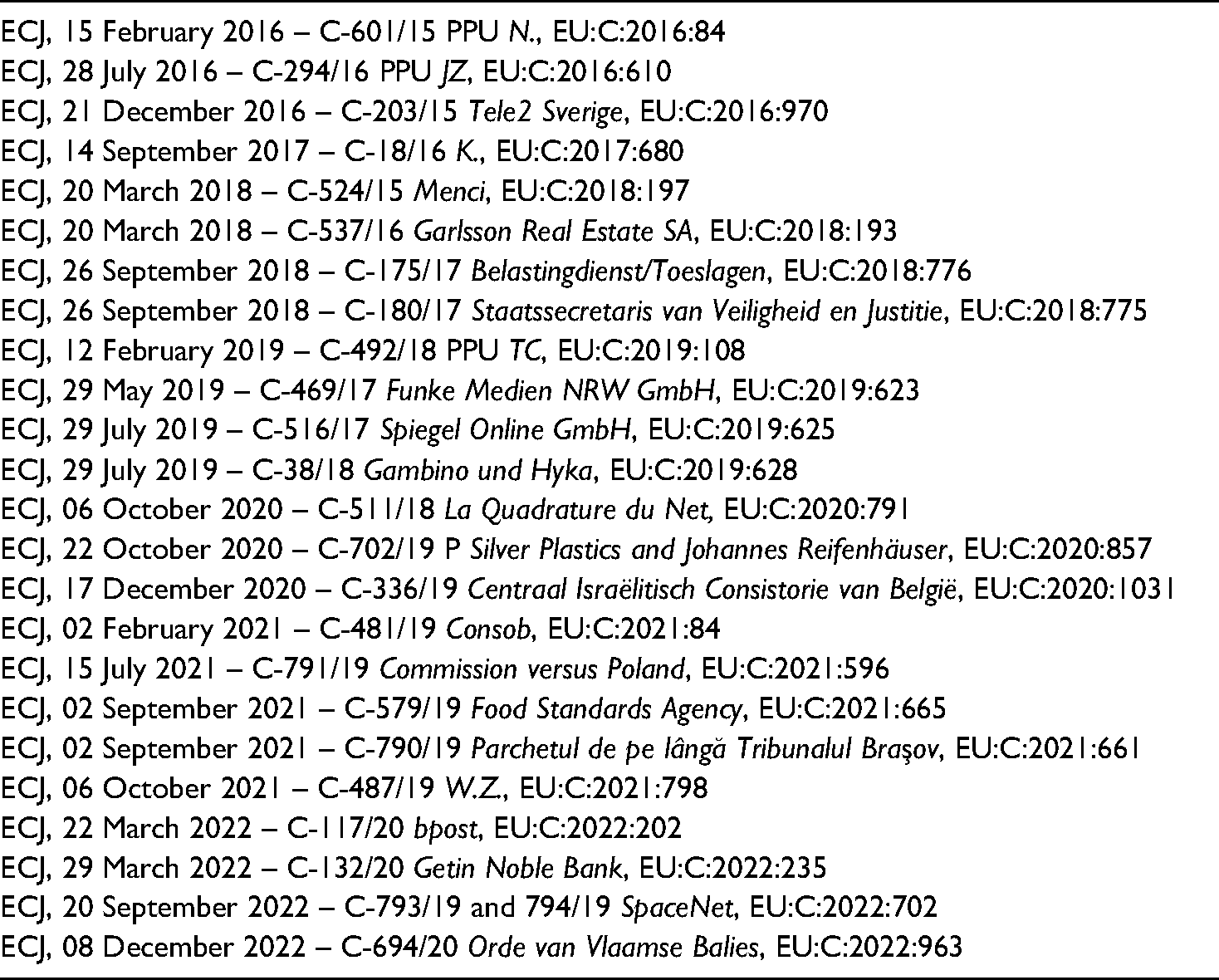
Appendix: table of cases 192
| ECJ, 15 February 2016 – C-601/15 PPU N., EU:C:2016:84 |
| ECJ, 28 July 2016 – C-294/16 PPU JZ, EU:C:2016:610 |
| ECJ, 21 December 2016 – C-203/15 Tele2 Sverige, EU:C:2016:970 |
| ECJ, 14 September 2017 – C-18/16 K., EU:C:2017:680 |
| ECJ, 20 March 2018 – C-524/15 Menci, EU:C:2018:197 |
| ECJ, 20 March 2018 – C-537/16 Garlsson Real Estate SA, EU:C:2018:193 |
| ECJ, 26 September 2018 – C-175/17 Belastingdienst/Toeslagen, EU:C:2018:776 |
| ECJ, 26 September 2018 – C-180/17 Staatssecretaris van Veiligheid en Justitie, EU:C:2018:775 |
| ECJ, 12 February 2019 – C-492/18 PPU TC, EU:C:2019:108 |
| ECJ, 29 May 2019 – C-469/17 Funke Medien NRW GmbH, EU:C:2019:623 |
| ECJ, 29 July 2019 – C-516/17 Spiegel Online GmbH, EU:C:2019:625 |
| ECJ, 29 July 2019 – C-38/18 Gambino und Hyka, EU:C:2019:628 |
| ECJ, 06 October 2020 – C-511/18 La Quadrature du Net, EU:C:2020:791 |
| ECJ, 22 October 2020 – C-702/19 P Silver Plastics and Johannes Reifenhäuser, EU:C:2020:857 |
| ECJ, 17 December 2020 – C-336/19 Centraal Israëlitisch Consistorie van België, EU:C:2020:1031 |
| ECJ, 02 February 2021 – C-481/19 Consob, EU:C:2021:84 |
| ECJ, 15 July 2021 – C-791/19 Commission versus Poland, EU:C:2021:596 |
| ECJ, 02 September 2021 – C-579/19 Food Standards Agency, EU:C:2021:665 |
| ECJ, 02 September 2021 – C-790/19 Parchetul de pe lângă Tribunalul Braşov, EU:C:2021:661 |
| ECJ, 06 October 2021 – C-487/19 W.Z., EU:C:2021:798 |
| ECJ, 22 March 2022 – C-117/20 bpost, EU:C:2022:202 |
| ECJ, 29 March 2022 – C-132/20 Getin Noble Bank, EU:C:2022:235 |
| ECJ, 20 September 2022 – C-793/19 and 794/19 SpaceNet, EU:C:2022:702 |
| ECJ, 08 December 2022 – C-694/20 Orde van Vlaamse Balies, EU:C:2022:963 |