






Abstract
The design and development effective light-harvesting molecular systems is a revolutionary step towards the production of upcoming solar fuels. In this regard, a new N1,N2-diphenyl acenaphthene-quinone naphthylene-1,2-diimine (DAD) molecule was synthesised and designed as an effictive light harvesting chromophoric ligand that may combine with rhodium to create a potent organometallic photocatalyst (Rh-DAD). Highly selective CO2 photoreduction was made possible by this hybrid complex's remarkable photophysical behaviour and broad-spectrum visible light absorption. Remarkably, the Rh-DAD photocatalyst effectively facilitated NAD⁺/NADH photoregeneration under visible light irradiation (400–600 nm), finally generating a significant amount of formic acid (76.27 μmol) from CO₂, underscoring its promise as a next-generation solar-fuel platform.
Introduction
This work highlights the quickly increasing interest in combining enzymatic and photocatalytic techniques for artificial photosynthesis. 1 The confluence of photocatalytic cofactor renewal with enzymatic CO₂ conversion gives a viable path for C1-neutral chemical synthesis.1–5 Maintaining metabolic efficiency is largely dependent on cofactor recycling, especially the regeneration of two-electron-reduced species like NADH or flavin derivatives. 2 Although chemical catalysis or oxidoreductase-driven enzymatic routes have historically been utilized to recycle NADH, the development of visible light-powered conversion systems presents a more environmentally friendly and sustainable option for CO2 fixation3–5 into C1 solar chemicals such as solar fuels (HCOOH). To promote smooth photoenzymatic CO2 reduction in this situation, a strong photosensitizer must interact with catalytic domains in an efficient manner. DAD-based ligands offer a very appealing basis for creating sophisticated photocatalytic structures because of their excellent metal-binding abilities and adjustable electrical characteristics.6–8 They are perfect building blocks for next-generation solar-driven transformations because of their capacity to modify both the optical responsiveness of the ligand framework and the catalytic environment of the metal centre. 9 All things considered, the Rh-DAD platform shows how careful molecular design can enable effective CO2 valorisation, connecting cofactor engineering, artificial photosynthesis, and chemical manufacturing powered by renewable energy. 10
Numerous colleagues conducted extensive research on several metal-bipyridylene ligand complexes. 11 The bipyridine derivative's rhodium η5-cyclopentadienyl half-sandwich complex was successfully placed on a redox-active electrode for NADH cofactor regeneration, 12 although CO2 fixation (Figures 1, 2(a) and (b)) with such organometallic complexes has not been documented. Organometallic rhodium complexes are known to speed up the synthesis of NADH in buffer aqueous solutions.13,14 At the forefront of solar-driven CO2 conversion research continues to be the strategic design and synthesis of light-harvesting organic ligands capable of creating extremely effective photocatalysts. A key step in connecting molecular photochemistry with catalytic CO2 fixation in this attempt is the creation of a strong DAD light harvesting materials. 15
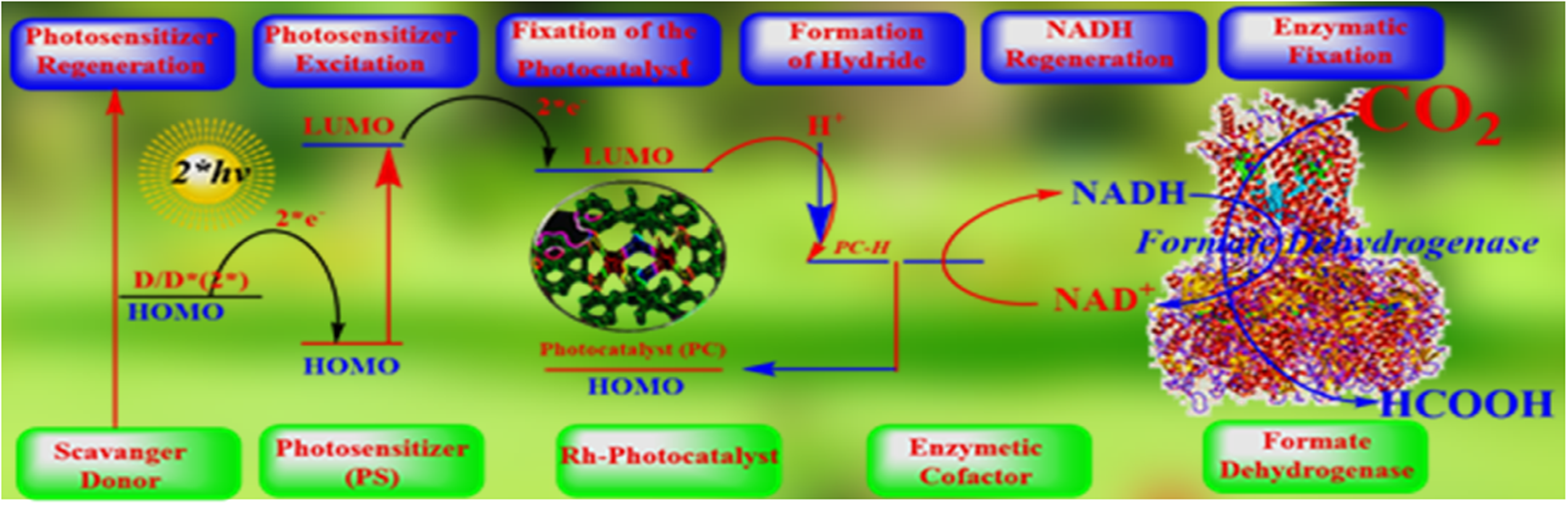
D stands for donor, PS for photosensitizer, PC for hydrogenation catalyst-oxidized form, PC-H for hydrogenation catalyst-active hydride species, CO2 for carbon dioxide, and HCOOH for solar fuel product in this diagrammatic energy diagram and reaction pathway for the photochemical reduction of NADH using related enzyme processes.
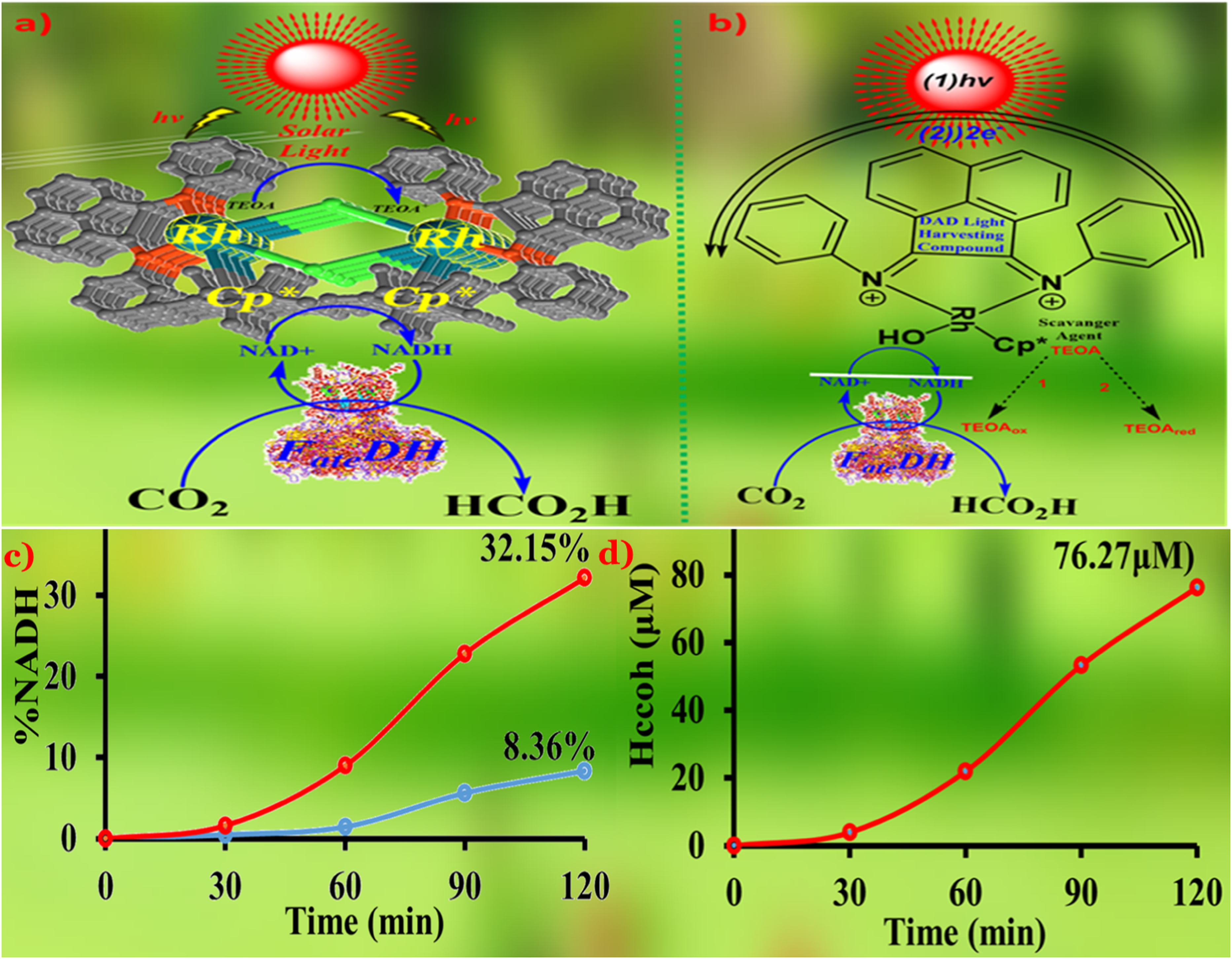
(a) diagrammatic representation of the Rh-DAD photocatalyst–enzyme linked system that produces HCOOH exclusively from CO2, (b) two catalytic routes are illustrated for the solar-chemical fixation of NAD + to NADH by Rh-DAD photocatalyst: (I) the donor scavenger agent TEOA reductively quenches the excited state of the Rh-complex, which is then exclusively consumed by formate dehydrogenase enzyme in the presence of CO2 to form selective formic acid (76.27 μmol), (c). Rh-DAD and DAD photocatalytic activity for (a) the regeneration of NADH [b-NAD+ (1.24 mmol), TEOA (1.24 mmol), and photocatalyst (0.5 mg) in 3.1 mL of sodium phosphate buffer (100 mM, pH 7.0)], and d) the selective enzymatic synthesis of formate dehydrogenase (3 units) in 3.1 mL of sodium phosphate buffer (100 mM, pH 7.0) in the presence of visible light.
Experiment
Synthesis of DAD and organometallic rhodium-based photocatalyst (Rh-DAD) for formic acid production
A simple, carefully regulated condensation process was the first step in the synthesis of the DAD ligand. Acenaphthenequinone (600 mg), acetic acid (6 mL), and aniline (0.65 mL) were mixed in a 50 mL round-bottom flask to create a suitable environment that was favourable for the synthesis of imine bonds (See details along with NMR spectroscopy in SI Figure S1a and b).8,16
Mechanistic studies
The good catalytic efficacy of Rh-DAD complexes in hydrogenation, hydride transfer, and NAD⁺ reduction reactions has long been praised without additional addition of Rh comples. They are essential in bioinspired redox chemistry and artificial photosynthesis due to their capacity to preferentially produce the enzymatically active 1,4-NADH isomer. 17 Their great selectivity, quick reaction times, and suitability for both homogeneous and heterogeneous systems are all highlighted in several research1.5–17 Additionally, attempts to immobilise rhodium complexes on conducting substrates for electrocatalytic applications highlight how versatile they are in the chemical, photochemical, and electrochemical domains (See details in SI).
Photocatalytic NADH regeneration and formic acid production from CO2
The Rh-DAD photocatalyst-driven selective 1,4-NADH regeneration mechanism is depicted in Figure 2(a) and (b)18–21 (See details in SI Figure S4).The rhodium complex initially hydrolyses under buffered circumstances to produce the in-situ aqua-coordinated species [CpRh(bpy)(H₂O)]2⁺. A β-hydride elimination happens when it interacts with formate, releasing CO2 and producing the important in-situ Rh–hydride intermediate [CpRh(bpy)(H)]⁺. After that, the Rh-DAD photocatalyst injects electrons into the rhodium centre, forming a compact, reduced intermediate that may bind NAD⁺. This electron-rich molecule produces the necessary 1,4-NADH with strong regioselectivity by effectively facilitating hydride transfer, and finally generating a significant amount of formic acid (76.27 μmol) from CO₂, underscoring its promise as a next-generation upcoming solar-fuel.18,19 Such a transition is facilitated by two likely catalytic mechanistic pathways (see in SI).20,21
Using a solar light source, the photocatalytic studies were carried out in an inert quartz reactor. Rh–DAD (31 μL), β-NAD⁺ (248 μL), TEOA (310 μL), and sodium phosphate buffer (100 mM, pH ∼7) were mixed to regenerate NADH. The remarkable photoredox performance of the Rh–DAD catalyst was confirmed by quantifying 1,4-NADH production using UV-visible spectroscopy.17,22,23 The device outperformed previously reported photocatalysts with linear NADH accumulation up to 32.15% (Figure 2(c)). Formate dehydrogenase (3 units) was added to a similar reaction mixture for CO2 fixation, and CO2 gas was bubbled at a rate of 0.5 mL/min. Photocatalytic production was triggered by light following a period of dark equilibration. Out of all the photocatalysts evaluated, Rh–DAD produced the good amount of formic acid (Figure 2(d)) 76.27 μmol. This outcomes demonstrate that Rh-DAD has a potential candidate for solar-powered carbon-neutral fuel generator.24,25 The details structural conformation of the materials is explained in supporting in SI. 26
Conclusions
Our work reveals a strong and potent Rh-DAD photocatalyst, which represents a significant advancement in the search for solar fuel. The Rh-DAD system is quite compatible with photocatalytic conditions, where TEOA serves as a dependable sacrificial electron donor, because of its structural advantage. The Rh-DAD photocatalyst activity is a remarkable in terms of 1,4-NADH regeneration yield of 32.15% and selective formic acid production from CO₂ (76.27 μmol), indicates that the DAD scaffold is a very effective solar-harvesting unit. All things considered, our findings establish Rh-DAD as a better photocatalyst than previously documented systems and establish a new standard for artificial photosynthesis. This discovery presents a potential new path for building next-generation solar-driven materials for sustainable fuel generation as it is the first demonstration of a small, light-collecting Rh-DAD photocatalyst.
Supplemental Material
sj-docx-1-mgc-10.1177_10241221261456939 - Supplemental material for Organometallic rhodium-based photonic synergy: An innovative light-harvesting DAD facilitating strong CO2 reduction
Supplemental material, sj-docx-1-mgc-10.1177_10241221261456939 for Organometallic rhodium-based photonic synergy: An innovative light-harvesting DAD facilitating strong CO2 reduction by Surendra K Jaiswal, Rajesh K Yadav, Quang Le Dang, Kanchan Sharma, Shaifali Mishra, Anupma Yadav, Geeta Srivastava, Rehana Shahin, Rahul Maddheshiya and Jin OoK Baeg in Main Group Chemistry
Footnotes
Acknowledgments
We express our sincere gratefulness to Madan Mohan Malaviya University of Technology, Gorakhpur. Author also acknowledges the support gained by Dr Jin Ook Baeg, KRICT.

Funding
The authors received no financial support for the research, authorship, and/or publication of this article.
Declaration of conflicting interests
The authors declared no potential conflicts of interest with respect to the research, authorship, and/or publication of this article.
Supplemental material
Supplemental material for this article is available online.
References
Supplementary Material
Please find the following supplemental material available below.
For Open Access articles published under a Creative Commons License, all supplemental material carries the same license as the article it is associated with.
For non-Open Access articles published, all supplemental material carries a non-exclusive license, and permission requests for re-use of supplemental material or any part of supplemental material shall be sent directly to the copyright owner as specified in the copyright notice associated with the article.
