







Abstract
Despite declining union density, the existence of works councils in the core sectors of the economy gives German trade unions considerable institutional power. Besides collective bargaining, the training and activation of works councillors is the trade unions’ most important sphere of activity. Through their involvement in the ‘Arbeit 2020’ project analysed in this article, three industrial unions have been attempting to find answers to the question of how Industry 4.0 will be shaped on the shop floor. With the assistance of publicly funded external consultants and the involvement of the workforce, the change processes in selected plants were investigated. In a number of them, agreements on the future shaping of digital change were successfully concluded. The project was devised as an experiment, since the very diverse situations in the various plants meant it was impossible for outsiders to go in with fixed specifications for the shaping of change. The largest of the unions involved, IG Metall, intends to use these experiences in the next two years as the basis for training 1000 full-time and voluntary officials to act as ‘promoters of change’ in the workplace.
Introduction
It is no accident that the term ‘Industry 4.0’, a notion that has since spread to the whole world, was coined by representatives of the German Academy of Science and Engineering (acatech) under the direction of Henning Kagermann, the former CEO of SAP. Germany has a highly competitive manufacturing sector that sees itself as a ‘global leader in the manufacturing equipment sector’ (acatech, 2013: 9). In order to maintain this position, German manufacturing industry has to be rigorous in integrating information and communications technologies into its traditional high-tech strategies so that it can become the leading supplier of smart manufacturing technologies.
Industry 4.0 was developed, first and foremost, as a template for the as yet unrealised smart factories networking suppliers and customers. Furthermore, it was intended to generate a new spirit of optimism among policy-makers and those seeking to implement such smart factories. To this end, acatech drew up various policy recommendations, for instance for focusing the German government’s high-tech strategy on the shaping of digital change. In contrast to the apocalyptic warnings of massive job losses (Frey and Osborne, 2017), Industry 4.0 is seen as an opportunity not only to safeguard the competitiveness of German manufacturing industry but also to come to grips with crucial challenges such as environmental protection and climate change.
The trade unions involved in implementing ‘Arbeit 4.0’, in particular the metalworking union IG Metall, also succeeded in using it as a basis for developing a blueprint for shaping tomorrow’s world of (production) work. Further intensification of a Taylorist mode of work organisation based on short-cycle, highly standardised, monotonous work tasks is regarded as a cul-de-sac, contradicting the new technologies’ potential for increasing efficiency. Instead, the greater complexity of future work will require highly qualified workers able to operate independently. The aim should be to establish flexible, decentralised forms of work organisation requiring highly qualified personnel, particularly since simple, low-skill activities are largely being rationalised out of existence. Even in Germany, with its corporatist tradition, it is unusual, in a document produced on the initiative of private business, for a key role to be assigned to employee co-determination: ‘From this point of view, good work, technological innovation and co-determination on the Industry 4.0 project represent not a contradiction but rather a compass bearing pointing to the future in the search for solutions that are both technologically efficient and socially balanced’ (acatech, 2013: 58).
Leading representatives of the German trade unions, including the former head of IG Metall, Detlef Wetzel, share the view that the future of manufacturing jobs in Germany depends on how quickly and effectively German industry takes advantage of the opportunities offered by the new digital technologies. In his view, the very survival of Germany’s industry-based trade unions as key players in shaping the future of work and employment conditions is at stake and can be only secured by the unions’ pre-emptive participation in the introduction of new technologies (Wetzel, 2015).
However, there is a world of difference between employers’ assertions on co-determination in policy documents and the actual involvement of unions and works councils in the shaping of structural change in the workplace. In recent decades, the restructuring of value chains has also been used to revoke the social compromises of the past. The share of precarious employees has risen, and many activities have deliberately been outsourced to supplier firms without collective agreements or works councils, seriously weakening unions. As a result, union density in Germany has fallen from a peak of 36 per cent in 1991 to just 16.5 per cent in 2016 (OECD, 2019a), while collective agreement coverage has decreased from around 85 per cent in the mid-1990s to 56 per cent (OECD, 2019b).
At the same time, however, the trade unions in the core sectors of the dualised German labour market where they are still well organised, mainly in manufacturing and the public sector, continue to have at their disposal considerable institutional power resources, by virtue not only of a high level of organisational power but also of the workplace representation rights vested in works councils and board-level co-determination.
Since the shop floor is the setting in which members can be gained by means of a persuasive policy but can also subsequently be lost, an active shop-floor policy is, alongside collective bargaining, part of the trade unions’ core business. German unions are investing considerable resources in further training for works councillors and trade union members of supervisory boards and offer them advice on their day-to-day work. They coordinate the activities of the works councils, making every effort to ensure that the latter sign up to the trade unions’ common objectives.
A key challenge for the unions is thus to persuade works councillors to make the shaping of digital change a key part of their activities. The question of how this can be done is investigated in this article. Besides the frequent reluctance of companies to negotiate, the greatest difficulty is that there are no ready-made formulas for such pre-emptive participation. Future job and work profiles usually emerge out of a lengthy process of experimentation. In most cases, the shop floor is still far removed from the model of the company that has undergone a complete digital transformation associated with Industry 4.0 (Hirsch-Kreinsen, 2015). In the vast majority of cases, processes are networked in stages, often in conjunction with investment cycles when existing plant is written off or new orders make the investment cost-effective. It is often difficult to identify what is actually new in such incremental changes. In view of these uncertainties, therefore, the trade unions cannot come in from outside with pre-defined demands but must try to gain a holistic understanding of the changes, to determine and accommodate employees’ interests, to analyse different workplace experiences and to reflect the results of this shared learning back into the workplace. Radical change of this kind, with extremely variable starting conditions depending on the workplace in question, requires an experimental approach (Murray, 2018), in which the unions try out new strategies and then, if they are successful, consolidate them into new approaches to shaping working and employment conditions.
For some years now, German trade unions have been testing precisely such experimental approaches to their participation in the shaping of Industry 4.0. One pivotal example is the joint ‘Arbeit 2020’ project being implemented by three trade unions, the metalworkers union (IG Metall) with 2.27 million members, the Mining, Chemicals and Energy Industries Union (IG Bergbau, Energie und Chemie, IGBEC) with 651,000 members and the Food, Beverages and Catering Union (Gewerkschaft Nahrung-Genuss-Gaststätten, NGG) with 204,000 members in North Rhine-Westphalia (NRW), the most populous of the German Länder with some 18 million inhabitants. In the first phase of the project (2015–2017), data on the change processes triggered by digital technologies were collected in 28 selected establishments with the support of outside consultants and the participation of the workforce but without any prior restrictions on the topics to be addressed. The aims were to enable works councillors to understand the various dimensions of digital change in the workplace, to develop their own ideas on the shaping of that change and to conclude agreements with management on how to proceed with the joint shaping of Industry 4.0. If new members were acquired along the way, that would be welcome, but it was not the primary objective.
In order to be able to derive proposals for other countries from this experimental approach, we need first to describe the specific national context in which it was developed. To that end, the role of works councils in the German industrial relations system will be outlined (Section 2). This is followed by a brief review of the debates on trade union renewal in Germany, to which the project under investigation is linked (Section 3). The methodology and the most important empirical results of our evaluation 1 of ‘Arbeit 2020’ will then be presented (Section 4). Finally, an attempt will be made to ascertain whether the trade unions have achieved the goal they set themselves in launching the ‘Arbeit 2020’ project and what conclusions are to be drawn for their future activities (Section 5).
The key role of the works councils
In contrast to the Scandinavian employee representative bodies, works councils are not trade union bodies, since they are elected by all employees in an establishment, regardless of whether or not they belong to a trade union. Unlike trade unions, the principle of trustworthy cooperation with the employer applies to works councillors. They must not call for industrial action. In the event of disputes over co-determination issues, they can call on an arbitration committee whose decisions are binding. They offer employees a legally well protected and resourced system of interest representation (Box 1).
Box 1. The most important provisions of the Works Constitution Act
Employees benefit from the co-determination rights only if a works council has been elected. In companies with works councils, plant and company agreements have in practice become the main standard-setting instrument on many important issues, such as the organisation of working time (Bosch, 2018). Works councils have been elected in almost all large companies, though this share decreases with company size. This also explains the pronounced differences between industries. In well-established sectors dominated by large companies – such as manufacturing or energy – the majority of employees are represented by works councils. In industries with many small companies and start-ups, on the other hand, works councils are the exception. In small and medium-sized enterprises particularly, there are widespread attempts by companies to hinder their establishment (Behrens and Dribbusch, 2014).
In 2010, approximately 174,000 German works councillors were elected on a voter turnout of almost 80 per cent. Around 8400 of these were released from all work and around 1000 from some of their work duties to perform their council duties. Around 75 per cent of them were trade union members. They were mostly trained at trade union training centres at their employers’ cost. More than two-thirds of works councillors are members of a DGB trade union (Greifenstein et al., 2011). By virtue of their access to resources, works councils have emerged as the biggest source of trade union power at company or establishment level. Only in big companies do trade union shop stewards operate alongside works councils.
The extensive empirical literature on works council practices shows that they act in very different ways. For instance, Kotthoff (1981) found that the majority of works councils did not fully avail themselves of their rights in the early 1980s. In his follow-up study of the same establishments more than a decade later, the more assertive works councils were in the majority (Kotthoff, 1994). By realigning their plant-level policy in order to provide better advice and training, the trade unions had obviously succeeded in encouraging the works councils to behave more forcefully. In those establishments in which works councils are strong, management often seek dialogue and consensus in order to prevent potentially awkward blockages, such as the withholding of approval for overtime.
The great challenge with regard to Industry 4.0 was to get works councils to understand the importance of the topic and jointly to find starting points for effective action. It was also necessary to do away with defunct co-determination models and encourage works councils to act more effectively. The unions’ new shop-floor policy was embedded in a more assertive collective bargaining policy and a greater willingness to exert political influence. At the same time, the federal government was prevailed upon to provide funding, as part of its high-tech strategy, for an additional strand of research on the ‘Future of Work’ (BMBF, 2016), the aim of which is to develop and test new plant-level models of work organisation and skills development.
‘Going over to the attack’ – The debate on trade union renewal
The English-language literature on trade union renewal focuses mainly on the organising of members (Frege and Kelly, 2003). Such an emphasis is hardly surprising since trade unions in the USA and the UK, for example, have virtually no institutional power resources at their disposal and are dependent almost exclusively on their own strength. The German trade union movement has learnt lessons from these organising approaches and deployed them, with varying degrees of success, to recruit members in plants without trade union representation (Wetzel, 2013). At least equally as important as the resource-intensive organising of new plants for the German trade unions is the retention and extension of their established strength in the core sectors of the economy.
In their evaluation of numerous international trade union renewal projects, Lèvesque and Murray (2010) observed that ‘unions can have power resources […] but are not particularly skilled at using them’ (Lèvesque and Murray, 2010: 341). In their view, unions needed to develop the strategic capability to mediate between the various interests of employees and, in doing so, ‘to replenish the stock of narrative resources’ (Lèvesque and Murray, 2010: 343). Furthermore, trade union policy demands and objectives had to be translated into strategic plans embedded in a persuasive narrative and also attractive to other political camps. The most important of these ‘other camps’ were corporate management teams who were to be offered a socially acceptable, less conflictual structural change with higher productivity and quality.
The existence of works councils means that German trade unions have more resources at their disposal, particularly in medium-sized and large firms, than their counterparts in many other countries. They also have opportunities to access public funds, inter alia through their exercise of political power. Particular mention should be made here of the state-funded research programme on the Humanisation of Work in the 1970s and 1980s (Fricke, 1994). Public money was used to fund not only numerous plant-level ergonomic projects involving the works councils but also the recruitment of specialist staff by the social partners. These specialists processed the results of humanised work organisation and job design projects, such as the introduction of groupwork or health and safety improvements, helping to implement them more generally. The explicit goal of the programme was to strengthen the social partners’ strategic capability to improve working conditions through joint learning.
Their experiences with the Humanisation of Work programme changed the unions’ plant-level policy. It became more strategic and focused on implementing jointly devised objectives. For more than a decade, as the weekly working time reductions were being implemented between 1983 and 1995, the unions coordinated several generations of company agreements on the socially acceptable organisation of working time through joint learning processes (e.g. Bosch et al., 1988).
In both periods of reorganisation, either the trade unions or policy-makers set the priorities. This changed in the second half of the 1990s, when employers in many plants were able to extract concessions from the unions, particularly on working time and wages, due to the rise in unemployment following German reunification. Because of the increasing number of exit options open to employers, who could threaten to shift production either to German suppliers not bound by collective agreements or abroad, the trade unions were susceptible to blackmail. For several years, uncontrolled decentralisation prevailed; during this period, local union branches agreed concessions, in some cases without the agreement of union headquarters.
The unions drew their lessons from the bad experiences of this uncontrolled decentralisation. It was stipulated that derogations from collective agreements that aimed to safeguard jobs could be implemented only by firms in emergency situations. The negotiations on such derogations were coordinated centrally in order to prevent workforces being played off against each other with excessively far-reaching concessions and also to ensure an eventual return to the industry-level agreement. Union members in the plants in question were also involved. They had to agree to the derogations. This mobilisation of union members actually led to an increase in union membership in the plants concerned (Haipeter and Lehndorff, 2009).
Nevertheless, the trade unions remained on the defensive in the negotiations on derogation clauses. This raised the question of how they could go on the offensive again. The keyword for the change of strategy was ‘proactive modernisation’. It was based on the experience that most companies in economic difficulties in the past had not taken advantage of the opportunities to modernise their production processes and product ranges and had reacted to the continuous deterioration in their competitive position with nothing more than efforts to reduce costs.
But where were the unions, already overburdened with the increase in their bread-and-butter work at a time when their resources were declining, to obtain the competences required for participation in the pre-emptive shaping of change? In the quest for answers, a period of experimentation began. Following in the tradition of the Humanisation of Work programme, the unions’ own limited resources were supplemented by public money from the European Social Fund, something that would have been impossible without corresponding political pressure.
The aim of the two projects launched by IG Metall in North-Rhine-Westphalia – ‘Competence and Innovation’ (Kompetenz und Innovation) (2006–2007) and ‘Better rather than Cheaper’ (Besser statt Billiger) (2008–2011) – was to develop alternatives to redundancies by drawing on innovative ideas put forward by the workforce. The eponymous paradigm, ‘Better rather than Cheaper’, which now stands behind all of IG Metall’s innovation initiatives, is intended to make it clear that the future of German manufacturing can be safeguarded only by innovative solutions and not by cutting costs. The public money was used to finance external consultants without whose help plans for modernising manufacturing companies could not have been developed. The aim was to develop proposals for improvements at plant level, but this time with the trade unions taking the lead. This deployment of strategic resources was to be the basis for developing and documenting showcase projects from which other works councils in similar situations would be able to learn (Nettelstroth et al., 2011).
The evaluations revealed the limitations of this approach. While in several cases a threat to relocate jobs was averted by detailed proposals on increasing efficiency, the responses did not however materialise until redundancies were already being discussed, i.e., at the end of a decision chain (Lehndorff et al., 2010: 451). This approach was inappropriate for those seeking to influence the transformation processes ensuing from the introduction of Industry 4.0. The new ‘Arbeit 2020’ project was intended to go one step further by focusing not simply on individual departments threatened by relocation. The aim was, first and foremost, to consider the change processes induced by digitisation in an entire plant and, by involving the workforce as well as collaborating with other trade unions, to improve the local union’s branch own competences in matters of industrial policy, as the following statements indicate: For us, the purpose of this project is also to document our competence in matters of industrial policy for the outside world and to provide proof of our expertise. (NGG trade unionist) We must enable our works councillors to deal with such processes of radical change. Our day-to-day business will always be to draw up redundancy plans, to engage in collective bargaining and to prevent planned redundancies. In future, however, we must also make it our business to ensure that works councillors give some thought in advance to how they might best support such a process of radical change. (Consultant)
The ‘Arbeit 2020’ experimental project
In its initial phase, the ideal-typical approach involved a baseline study, conducted with workforce participation, on the introduction of digitisation and the problems it created for employees. This initial study was given visual expression in a so-called ‘plant map’ (Haipeter et al., 2018: 220). The second phase focused on strategy development and the third on the conclusion of an agreement with management on the digital future which set down the objectives, issues to be addressed and procedures for the future shaping of digitisation. For the baseline study, funding was provided by the European Social Fund for up to 10 consultant-led workshops, which could be topped up for the preparation of a future agreement. Additional funding was provided by the trade unions. Five project secretaries from the financially well-off IG Metall took part in all the workshops held in the various plants, ensuring that the project always remained recognisable as a union initiative. Because of its low staffing levels, the NGG was not in a position to deploy resources on such a lavish scale, meaning that the baseline study was conducted mainly by the consultants alone. The project was carried out in accordance with reflective practice. The key players (trade unionists, consultants and the accompanying researchers) met regularly to exchange experiences. Training was provided for the works councillors involved and experiences were discussed in project meetings. A total of 28 industrial plants took part in the project during this period; we provided evaluation services for 19 IG Metall and NGG 2 plants. Plants’ headcounts ranged from 160 to 4900.
Our opening question was whether the unions’ self-imposed objective, namely to enable the works councillors to participate in the shaping of technological change, had been achieved. Our evaluation was based on participant observation, following in the tradition of many studies in industrial sociology and organisational development (Burawoy, 1991). Besides taking the minutes of more than 130 all-day workshops held in the plants, we conducted a further 22 qualitative supplementary or group interviews with works councillors, trade unionists and external consultants. As the project is ongoing, this present article is only an interim report. Since the evaluation ended in mid-2018, a further two expert interviews were conducted for this article with trade union project leaders on the evaluation of the project and future prospects for action.
We summarise below the most important results on the process of selecting and obtaining the cooperation of the plants (4.1), the management of the comprehensive baseline study with workforce participation (4.2), the conclusion of agreements on the digital future (4.3) and the role of the consultants and trade unionists in this process (4.4).
Selecting the plants and obtaining their cooperation
Critical to the success of the project, the selection of the plants required a great deal of work on the part of all concerned. A broad spectrum of establishments of varying technological status, size and sector affiliation was to be included in the sample. Another decisive factor, however, was the willingness of the works councils and managements to take part in the project, which was not forthcoming in all cases following the initial discussions. Their willingness was documented in a ‘letter of intent’. This selection on the basis of willingness to participate was intended to increase the chances of concluding concrete agreements on the shaping of future working and employment conditions, which would scarcely have been possible in an uncooperative environment.
Because of this selection process, interest levels among the works councillors involved were naturally very high. In particular, the intensive external support was seen as a promising opportunity: ‘That was definitely a really great opportunity. Industry 4.0 is happening anyway and the more we know about it, the better able we’ll be to respond appropriately or specify what we want.’ (Works council chairman, automation technology 2018)
Management reactions in the plants involved ranged from a neutral lack of interest, via a wait-and-see attitude to warm approval, as in this metalworking plant with some 300 employees: ‘Our managing director […] is very interested in such technological developments […] I think he found the approach very innovative and very good. At any rate, he maintains to this day that the trade unions are much more advanced in matters of industrialisation than his employer associations.’ (Works council chairman, metalworking 2018)
The key factor in obtaining management agreement was the professional approach involving experienced consultants and the project’s public funding: ‘For the employers, when they hear that it’s being supported by the Ministry of Labour, they consider it something serious and not “just” a trade union project.’ (Trade unionist 2018)
The baseline study
The extent of digitisation and its effects on employment, skills and working conditions in all departments of the establishment were recorded with the aid of the Metaplan technique 3 under the guidance of the consultants. Problem areas, such as expected redundancies, excessive workloads or inadequate skills development, were visualised by red buttons. Green buttons indicated improvements in working conditions. The result was given visual expression in every establishment by means of a simple diagram, the so-called ‘plant map’ (see Figure 1). 4 Data were provided for all departments.
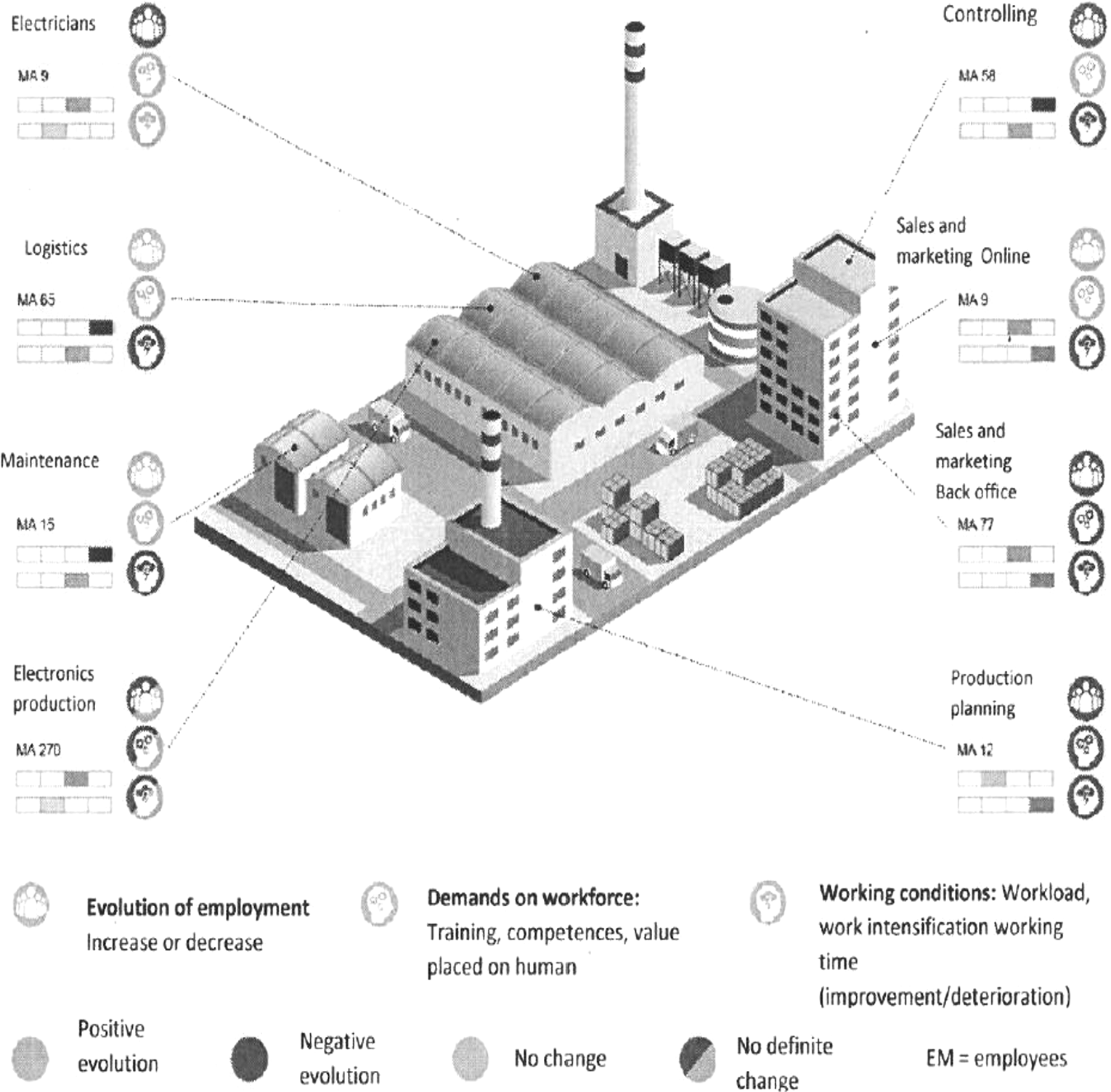
The ‘plant map’ – a visual representation of a typical production plant study.
The map also afforded insights into departments in which the works councils had hitherto been inadequately represented: The plant map is an instrument that offers a great opportunity to depict a company in its entirety as it has never before been represented and perceived […] Works councillors in particular sometimes have great difficulty in familiarising themselves with departments that are not represented on the works council. More often than not these are white-collar departments. (Trade unionist 2018)
Initially, it was left up to the works councillors to decide whether to involve employees and, if so, how many: ‘We ascertained that, in those cases where the workforce was involved, the project was naturally received quite differently within the plant…When the workforce is available to be interviewed, for example,…they also want to know what has become of it!’ (Trade unionist 2018). Later on, both consultants and trade unionists insisted that employees should be involved as a matter of course; cooperation agreements with the companies concerned meant that they could be made available without any problem, with the results thereby gaining in impact in terms of plant-level policy.
A number of works councillors also reflected critically on their initial hesitation about involving employees: In the beginning, in fact, our approach was to contact anyone who might be well disposed towards us. That’s not the approach I would adopt now. […] Now I would go into a department meeting, introduce the project and then say: OK guys, have a think about it, those of you who want to take part […] In that way, whatever happened, you’d get at least one enthusiastic person turning up afterwards. (Works council deputy chairman, metal processing plant 2018) If the committee could further ride the momentum or at least sustain it at its present level and has the feeling that it’s really great to do or to be able to do this sort of works council work, then that’s a real step forward. The power to shape events has really begun to emerge. A feeling of togetherness has begun to develop. Specialist knowledge is being produced. People have started to get involved who have never been involved before. So it’s a different experience of works council work. (Trade unionist 2018) There were two companies trying to sort out working time issues at the same time as we were doing our study. The works councillor there said: I do things in exactly the same way as with the production plant map. I now go from department to department and note down each department’s preferences with a view to building up a picture: what actually are the working time preferences in each department and in each field of work? (Trade unionist 2018) At [metal working company] the works councillor brought in managerial staff to every discussion. That meant we had managers, works councillors and employees sitting around the same table. This immediately made the results sacrosanct: they could no longer be challenged in any way at all. (Consultant 2018)
Agreements on the digital future
As to what the journey’s final destination was intended to be, the trade unions initially described it in fairly general terms as ‘activation of the works councils’. It was only as the process unfolded that the conclusion of agreements on the digital future began to take shape as the ultimate objective. Opportunities to conclude such agreements arose because management in most of the plants were also impressed by the professionalism with which the production plant maps were produced and saw an opportunity to obtain support for their corporate restructuring projects. It is not surprising that, with one exception, the agreements were concluded in owner-managed businesses with a high degree of local autonomy but not in the branches of large groups where strategic agreements are almost always negotiated at corporate level.
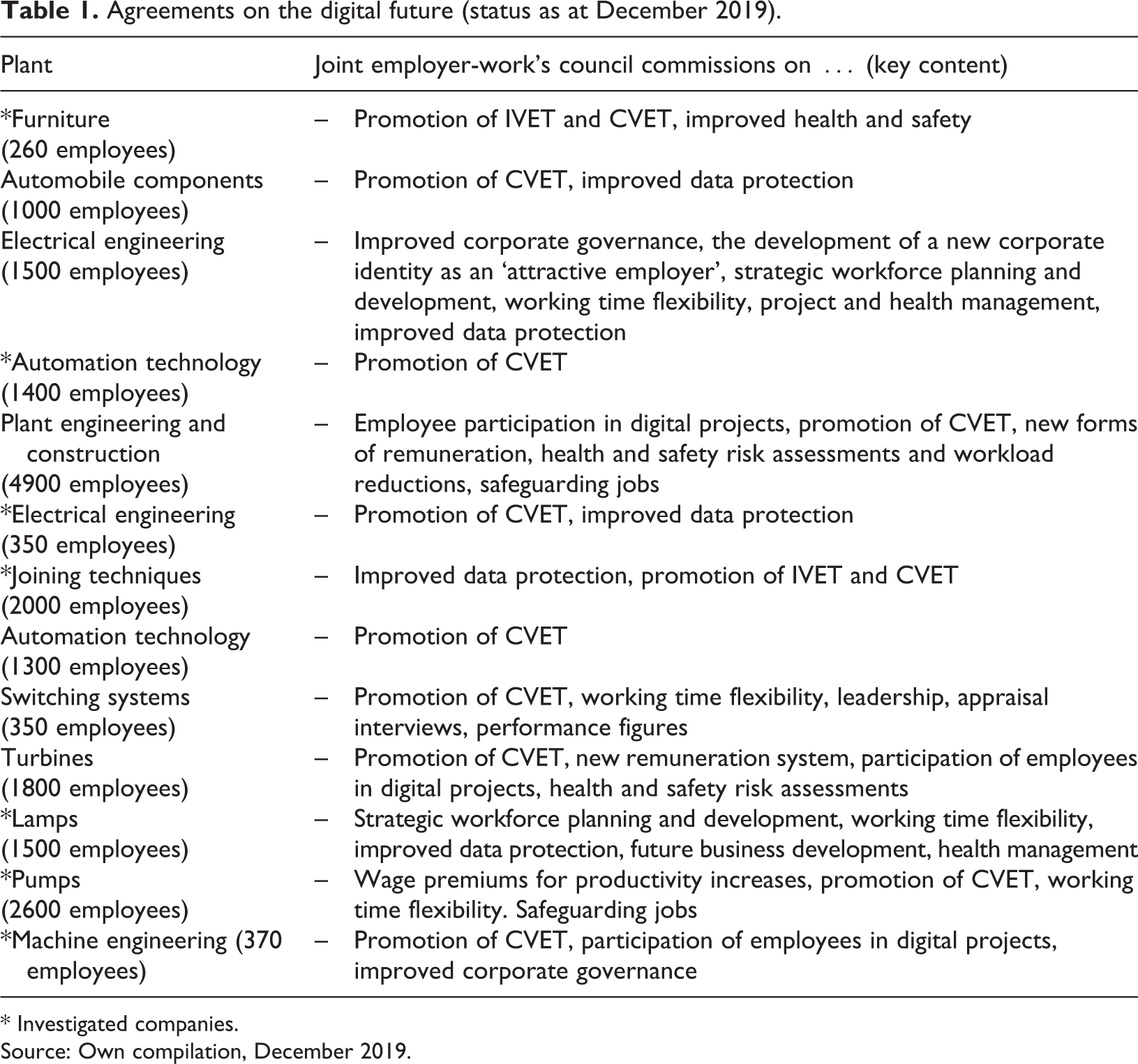
By December 2019, agreements on the digital future had been concluded in 13 of the 28 selected plants, all of them in IG Metall’s organisational sphere (Table 1). IG Metall took part in the negotiations and was a joint signatory to eight of them. The unions’ involvement in plant-level bargaining, hitherto conducted solely between works councils and management, was a first in the German dual system of industrial relations. The NGG, a poorer trade union with a large organisational sphere, was unable to conclude any agreements. It just did not have the capacity to persuade and advise works councils. The works councils in the two food companies and one of the metal companies we studied relied on the traditional channels of the German system of co-determination (see Box 1).
Agreements on the digital future (status as at December 2019).
* Investigated companies.
Source: Own compilation, December 2019.
Provisions to strengthen plant-level skills development were included in all agreements. Working time flexibilisation, data protection, monitoring of employee performance, project management, corporate governance, health and safety and workload reductions, early involvement of works councils and employee information and involvement were all listed as topics for future negotiations. Some of the agreements also provided for more concrete actions, such as the expansion of vocational training or the systematic identification of individual training needs. All agreements contain provisions for further joint work. The various topics are to be dealt with in joint committees, set to meet regularly.
It is not yet possible to provide a final evaluation of the agreements on the digital future. Ultimately, they place obligations on works councils and management to take action in the future and have first to be filled with substantive content. In other plants, the same topics are being discussed but within existing structures, which can definitely lead to similar successes.
However, there was also resistance from some works councils. In two metalworking plants, the works council chairmen halted the negotiations with management, declaring that they wanted to continue without the unions. In another plant, the works council chairman suddenly no longer saw any need for an agreement and ended the project without further explanation. These examples show the difficulties associated with a trade union plant-level policy based on participation when a works council chairman wishes to maintain his privileged access to management.
The role of the consultants and the trade unionists
The ‘Arbeit 2020’ project was conceived by the trade unions involved as a strategic project for their own future work. This raised the question of the distribution of roles between the trade unions and consultants. After the unions had reached agreement with the works councils and management on their participation in the project, the spotlight fell on the consultants. It was they who led the all-day workshops and presented regular interim assessments. The consultants’ professionalism was consistently acknowledged by the works councillors: ‘The way they went about it. I couldn’t have done it; I don’t have the training for it. In any event, they did it very well’ (Works council chairman 2018).
The IG Metall secretaries made substantial contributions to the discussions during the workshops. This was necessary, since the compilation of the production plant map proved to be more than a purely technical exercise. It developed into a political process in which the works council’s modus operandi to date, including its customary perception of operational problems, was also put to the test: Yes, it may be possible to put the map together in four hours and also get a picture of the plant. However, what you certainly won’t have changed is the works council’s attitude. There was constant bickering in the team about how long it was taking […]. To which I replied: ‘We’re not working on a technical issue, we’re working on people’s attitudes.’ And […] if it’s the case that the works councillors feel themselves to be powerful and influential, then […] you can draw up an action plan and give them the feeling that they can put it into practice. (Consultant 2018) Yes, you also need the skills. For example, he (the union official) knows exactly how such an agreement has to be put together so that, on the one hand, it doesn’t overburden the company or the management but, on the other hand, it is sufficiently binding that you can really do something with it afterwards. He did that very skilfully […] We wouldn’t have managed it by ourselves. (Works council chairman, furniture manufacturer 2018)
Conclusions
The unions’ objective in taking part in the ‘Arbeit 2020’ project was to break out of the defensive posture into which they had been forced by the negotiation of derogations from collective agreements and the numerous social plans put in place to cushion redundancies, and to take on a proactive role in shaping digital change. The project was set up as a major ‘field trial’ with the aim of strengthening co-determination. In view of the extreme variability of both the extent of digitisation and its effects on working conditions, the unions did not go into the plants with pre-defined demands. Rather they worked with the interest representation bodies and the workforce to carry out comprehensive baseline studies on the introduction of the new technologies and the problems they caused for employees. Our opening question was whether this approach could strengthen co-determination in the digital structural change. Since the project has not yet ended, we can offer only a provisional answer. Five important findings can be derived from the evaluation.
First, the trade unions took much firmer control of the process than in the past, when the negotiation of agreements was left to the works councils following a consultation. The union officials were intensively involved in the development of the ensuing strategies and the conclusion of the digital futures agreements, and as a result were able to build up a hitherto unknown presence in the plants concerned.
Secondly, the scope for action was considerably extended through the use of public funds to pay the external consultants, without which the impoverished NGG would not have been able to take part. With their expert knowledge, it proved possible to compile an overview of the situation with Industry 4.0 and the challenges for upcoming years that was transparent and easily interpretable by all involved. The legitimisation of the project by the commitment of public funds, the competence of the consultants and the well-documented baseline study, which also reflected the employees’ perspective, aroused the interest of management, who were themselves still searching for the ‘right’ recipes for shaping the future.
Thirdly, the intensive involvement of the workforce broke new ground. While it was true that employees had been consulted on other occasions, such as the votes on derogations from collective agreements, this process of employee participation strengthened the unions and the works councils in their work, since the subsequent calls for the joint shaping of digital change could rely on the support of the workforce. Some works councillors have learnt from this and begun to develop a policy based on greater employee participation, in which the core elements of company agreements would be voted on by the workforce.
Fourthly, learning processes have been established beyond the individual plants, with the experiences being discussed in reflective practice workshops involving players from the trade unions and plants, including the evaluation research team, and at conferences attended by plant representatives.
Fifthly, the failures caused by management’s obstructionist attitude or works councils’ withdrawal from the project should not be overlooked. Although the unions acted cautiously and made every effort to empower the works councillors rather than patronising them, some works councils withdrew from the project for fear of losing power.
Just as important as the project’s successes, however, are its limitations. Our trade union interlocutors – and it is their evaluation and not ours that will determine the trade unions’ future actions – saw the ‘Arbeit 2020’ project as a pilot phase, during which they themselves obtained some initial ideas as to how processes of change might be organised in the workplace. However, those plants that have concluded agreements on the digital future are, not least because of the selection process and the intensive input of resources, trailblazers that are absolutely not representative of the organisation as a whole. This is evident from a large-scale IG Metall survey of almost 2000 works councillors representing some 1.7 million employees. The results are summarised in a ‘transformation atlas’ that documents their assessments of technological change, working conditions and co-determination in Germany. According to this survey, more than 50 per cent of works councillors regard themselves as insufficiently well informed and 62 per cent are not involved in shop-floor change management projects. At the same time, the works councillors report that skills requirements are routinely assessed in only 35 per cent of plants. More than three-quarters of works councillors said they needed extensive advice and guidance in order to be able to carry out their co-determination functions (IG Metall, 2019a).
In view of this initial situation, the debate within the trade union movement revolves around the question of how the experiences gained can be disseminated more broadly, i.e., incorporated into everyday trade union activity. Consequently, at its conference in October 2019, IG Metall decided to make the participatory approach adopted for ‘Arbeit 2020’ and similar projects the basis for an organisational reform. The transformation atlas shows that the close dialogue between the social partners that characterised ‘Arbeit 2020’ is by no means the rule and that the principal challenge is to generalise it. To that end – as stated in a conference motion – the officials responsible for plant-level work in pilot branches are to be given training on ‘promoting change in the participation and transformation process at plant level’ in the union’s training centres. For this, some 1000 full-time and voluntary trade union officials are to be trained as ‘change promoters’ in the next two years. This training is to be embedded within an organisational reform. This means that specific projects are being put in place on the ground; besides the joint shaping of digital change, these projects may address questions such as union organising, CVET and dealing with generational change within the trade union. The projects are to be grouped together thematically. To this end, project management organisational structures will be developed at both local and national level (IG Metall, 2019b).
The ‘Arbeit 2020’ project is continuing and the trade unions involved have managed to acquire additional public funding for it. Within IG Metall, however, it is to become part of a larger project structure. To this end, the plant-level phase of analysis is to be reduced to three days and exchanges with other plants, including those not involved in the project, will be intensified in order to achieve greater dissemination. In contrast to the preliminary pilot phase, the advice and guidance to be given will include more in the way of substantive content. In the meantime, at least, many plants have acquired experience with new, flexible working time models or with the identification of skills / CVET needs, so that the agreements on the digital future now have to be filled with substantive content. Important inputs have now been developed by other parties. These include, for example, the joint modernisation of the existing occupational profiles by the social partners and the creation of new occupational profiles within the German dual VET system. These new profiles are an important reference point for plants as they modernise their IVET and CVET centres and provide further training for their own training staff.
To conclude, developments can be summarised as follows. The shaping of digital change began with a large-scale experiment that has now led to another, even larger-scale experiment within IG Metall, where the objective is to mainstream the pilot project. The smaller, poorer NGG, on the other hand, is not in a position to fund a similarly costly process of organisational change but, like the IGBCE union, is also benefiting from the joint exchange of experiences with IG Metall and from the new occupational profiles. The IG Metall agreements on the digital future may become models for innovative multi-employer collective agreements in all German industries.
Footnotes
Funding
This work was supported by the Hans-Böckler-Foundation [grant 2015-924-1].