






Abstract
Deep decarbonisation requires overcoming carbon lock-in and prioritising green ‘phase-in’ over necessary ‘phase-out’ strategies in fossil fuel-intensive energy and industrial sectors. This article analyses a case of localised transformative agency in Civitavecchia (Rome metropolitan area, Italy), a territory dependent on a major coal-fired power plant. Integrating a power resource framework with literature in environmental labour studies, we examine how a heterogeneous inter-union collaboration (CGIL, UIL, USB) achieved wider cooperation and subsequently shifted strategy from defensive opposition to demanding an affirmative just transition combining job creation and clean energy infrastructure. Using extensive qualitative data, we argue that strategic mobilisation of coalitional power is essential for union renewal and for challenging the structural privilege of incumbent fossil fuel capital. Localised democratic experimentation by unions can successfully disrupt national-level political inertia, driving policy implementation for high-road job creation and local environmental sustainability. But upscaling and institutional support for such struggles remain necessary to secure these outcomes.
Introduction
The objective of limiting global warming to 1.5°C, enshrined in the Paris Agreement, necessitates a profound transformation of existing production and consumption systems. This global push for decarbonisation poses severe challenges for organised labour, particularly in heavy, carbon-intensive industries, such as energy and steel, where climate mitigation entails major industrial restructuring and risks significant job displacement. In response to this existential dilemma, workers and unions worldwide are increasingly recognised as pivotal, albeit contested, actors whose capacity to move beyond defensive measures will determine whether transition pathways lead to incremental economic adjustments or systemic socio-ecological transformation.
Current research on climate politics is increasingly rooted in critical political economy (CPE) (Berglund and Bailey, 2023), which frames decarbonisation as a profound distributive struggle embedded within complex power configurations. However, existing research often encounters critical gaps when it comes to explaining how organised actors successfully overcome inertia. Traditional economic and national growth literatures, while essential for diagnosing high costs and industrial structural weaknesses, tend to provide a descriptive rather than an explanatory account of the failure to achieve comprehensive decarbonisation. Specifically, these frameworks struggle to explain why, despite clear technological pathways, governments frequently prioritise ‘phase-in’ policies for new green capacity – such as subsidies or tax incentives – while failing to implement corresponding ‘phase-out’ policies to close high-emission infrastructure or build the necessary 21st century clean energy infrastructure to tackle the climate crisis. This sustains ‘carbon lock-in’ (Vachon, 2023).
A crucial political and strategic framework guiding labour’s engagement is the concept of a ‘just transition’, which seeks to embed goals of social equity and job security within climate policy (Benegiamo et al., 2023; Galgóczi, 2020; McIlroy et al., 2022; Morena et al., 2020; Pedaci and Betti, 2025; Stevis and Felli, 2015). In pursuit of such a high-road strategy trade unions are often required to relaunch themselves as ‘political subjects’ engaging beyond traditional collective bargaining to aggregate political and social interests. This article examines the political conditions that enable unions to engage with climate policy and adopt transformative political agency, focusing on labour initiatives in Civitavecchia, a coastal industrial town near Rome. Historically dependent on a major coal-fired power plant (operated by energy company ENEL), Civitavecchia provides a compelling instance of a local economy confronting structural inertia in the face of managed decline, and how a diverse union coalition mobilised to influence the planned phase-out by demanding a proactive, pro-renewable just transition strategy.
This study addresses this critical case of localised union innovation and coalition-building in Italy, focusing on how these unions adopted new social equity and job security goals while rallying wider public support. We argue that overcoming entrenched structural inertia requires the strategic application of union coalitional power, forged at the local level. Our central contribution is a detailed account of how divergent union and community interests converged to form an ‘insurgent sustainability coalition’ (Price et al., 2025) capable of generating a ‘worker climate strike’ that effectively challenged national policy inertia and corporate power. By mapping the internal dynamics of negotiation within this politically diverse coalition, we shed light on how less privileged societal forces can bridge their differences to achieve transformative agency, a crucial but under-theorised prerequisite for democratic union renewal and effective climate action.
Our research emphasises the importance of worker agency (Pansera et al., 2024) in this ecological initiative, deepening our understanding of the relationship between labour and the environment while addressing the limitations of focusing solely on green jobs or on the economic impacts of a transition to a clean energy economy. We argue that the active role of workers and citizens can promote pride and recognition of labour’s wider social importance, serving as a crucial source of empowerment during the ecological transition towards a sustainable economy. In this context, our study investigates the following research question: how did a just transition-inspired coalition, driven by inter-union collaboration, emerge in Civitavecchia?
We focus on two interconnected but distinct processes. First, how and why broader cooperation and coordination developed among different trade unions, namely the ‘established’ CGIL (Confederazione Generale Italiana del Lavoro) and UIL (Unione Italiana del Lavoro), and the ‘grass-roots’ USB (Unione Sindacale di Base); second, how these unions expanded their collaboration across distinct sectors of employment. This case of union mobilisation is distinguished by its unique ‘bottom-up’ participation, with trade unions leading a broad social negotiation process that openly aligns with just transition principles in its effort to forge an alternative, renewable-based plan that balanced maintaining current employment levels in healthy workplaces and protecting the environment by reducing both coal-related pollutants and carbon emissions. Its exceptional qualities, spanning city borders, stem from a political conflict that successfully integrated ecological and labour interests, while also establishing a strategic outlook that could effectively put people to work in high-quality jobs and build the 21st century infrastructure needed to tackle the climate crisis and reduce greenhouse gas emissions.
The data presented draw on a two-year, nationally funded research project titled ‘Just Transition in the Factory’, which concluded in February 2026. The study compared four cases of decarbonisation and industrial restructuring in the automotive and energy sectors. The methodology included various qualitative analyses: reviewing media and grey literature to trace each case’s historical development; conducting interviews, focus groups (three of which were conducted for the Civitavecchia case), and participant observation at public events such as meetings, assemblies and debates involving production sites. Protocols for interviews and focus groups had a standard structure but allowed flexibility for case-specific modifications. In 2024 and 2025, 61 interviews 1 were conducted in Civitavecchia with 66 key stakeholders across sectors, 32 with workers and union representatives, 12 with technical experts, 13 with environmental advocates, 6 with political representatives, and 3 with business spokespersons. Document analysis included ENEL memos, municipal, regional and national government documents, press releases, speeches and ethnographic conversations at local trade union meetings.
The article is organised as follows. The next section outlines our power resource framework, showing how worker agency and coalitions between trade unions and environmental groups can promote an ecological agenda that balances employment and environmental concerns. Subsequent sections analyse the development of union and citizen mobilisation for a just transition in Civitavecchia and the significance of our findings for unions as climate actors.
Resources, coalitions, and insurgent worker agency
The emerging field of environmental labour studies (Räthzel et al., 2021) increasingly underscores that trade unions and workers are neither inherently oppositional nor natural allies of green transitions (Kalt, 2022). This ambivalence stems from the interconnectedness of industrial relations and environmental sustainability, shaped by institutions, power dynamics and political economy (Tomassetti, 2020). Unions exhibit contrasting trends because of their dual roles. In the workplace, they focus on essential economic interests, such as wages, working conditions and firm-level decision-making. At the same time, many unions also work to influence broader societal issues by advocating for progressive economic and social policies aimed at transforming the socio-economic system and securing fundamental rights, such as collective bargaining and the right to strike (Thomas and Pulignano, 2021). A key aspect of this second role involves issues of social and environmental justice, as well as how unions increasingly embed these concerns into their broader political agenda (Doerflinger and Thomas, 2025; Frege et al., 2004).
This clash of interests can cause tensions within union organisations. As workers have diverse interests and structural conditions influence their strategic actions, workers’ attitudes towards ecological transition often depend on how exposed their jobs are to emerging climate policies (Snell and Fairbrother, 2010). For example, sectors in traditional fossil fuel-based industries with significant carbon footprints, such as the European utilities sector, often have well-unionised workforces with favourable collective agreements, which can hinder support for a green transition in contrast to newly established ‘green’ workplaces in renewable energy (Thomas and Pulignano, 2021). Trade union strategies can also vary across levels of action, as in large confederal unions, where the interests of workers in different employment sectors can lead to hesitancy and limited support for unions in climate action across policy statements, collective bargaining decisions and implementation. But it is crucial to be aware of the factors that enable trade unions to act as climate advocates rather than as opponents of the eco-transition. Structural conditions or external forces – such as institutional arrangements and emerging climate or economic policy opportunities – can facilitate union agency (Dupuis et al., 2026). Changing employer investments and emerging political opportunities provide the context within which unions operate as active agents. Workers’ capacity to organise, mobilise and strategically leverage resources is crucial to their strategic response to climate change and emerging decarbonisation policies (Mendonça and Adăscăliței, 2020; Tattersall, 2010; Tattersall and Reynolds, 2007).
The literature on union renewal, emerging in the 1990s, offers the most helpful background for understanding how unions can revitalise themselves and address climate change amidst the challenges of neoliberal globalisation and market deregulation (Ibsen and Tapia, 2017). Research highlights how unions can develop proactive strategies to mobilise new resources to take on ever-greater challenges once they have taken the measure of new priorities (Turner, 2004). The impact of globalisation can seriously undermine union power. But this depends on how the unions respond and mobilise resources, and how new strategies are developed to build power (Lévesque and Murray, 2002, 2010). Frege and Kelly (2004) identify several key revitalisation strategies, ranging from new efforts to organise and build partnerships for political action, to more robust coalition-building and enhanced international solidarity. Such strategies influence union activity in relation to membership and in the economic, political and institutional spheres (Behrens et al., 2004). Lévesque and Murray (2002, 2010) highlight how resources such as proactivity/strategic capacity, mobilising action frames, and internal and external solidarity boost union power. Internal solidarity involves workplace mechanisms for cohesion and deliberation, while external solidarity includes links with other unions, community groups and social movements.
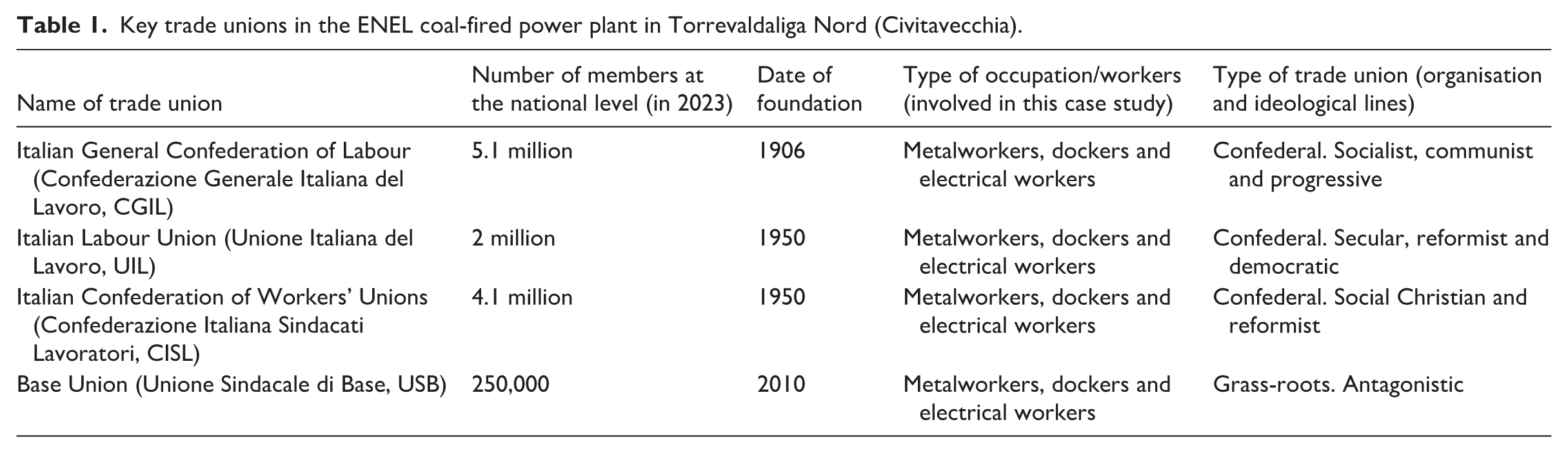
Our analysis is in line with Skinner’s (2020) claim that a climate agenda advanced by workers and unions provides the labour movement with opportunities to increase membership, coordination and social influence, particularly through alliances with environmental groups, new research networks or broader inter-union collaborations (Brigden and Kaine, 2013). Our case study offers valuable insights into the development of ‘internal solidarity’, which extends beyond workplaces to encompass different employment sectors such as metalworkers, dockworkers and electricians. ‘External solidarity’ pertains to inter-union collaboration and coalitions with other grass-roots organisations, and is linked to coalitional power as the ability to build relationships, align interests and establish common goals in order to drive change together (Tattersall, 2024: 119). This perspective is especially relevant in Italy’s pluralistic industrial relations system, where unions are divided along ideological lines and often compete, sometimes leading to disunity that many governments have exploited to push unpopular labour reforms. Italy’s system includes three main confederations (CGIL, CISL, UIL), some smaller unions and autonomous grass-roots unions, such as USB (see Table 1). While there is often cooperation among the major unions, it is not always consistent, and collaboration with grass-roots unions remains infrequent (Signoretti et al., 2026).
Key trade unions in the ENEL coal-fired power plant in Torrevaldaliga Nord (Civitavecchia).
We contend that focusing on the internal cohesion of trade unions, as well as on broader inter-union collaboration is especially important when examining climate mobilisation in Italy. Understanding how cooperation between unions can be established within a neoliberal policy environment – one that has led to new divisions among workers and weakened horizontal links with local unions in the same sector – enhances our knowledge of how organised labour can respond to external challenges or take advantage of political opportunities (Lévesque and Murray, 2002, 2010). Furthermore, occupational and organisational differences among unions may impede inter-union collaboration (Milner et al., 2025), so understanding the conditions under which cooperation among unions – whether in collective bargaining, mobilisation or organising, or politically – remains influential is equally critical (Tattersall, 2024). But key questions include: how can unions navigate divisions and jurisdictional disputes while building coalitions? How can they develop the technical expertise to quantify job creation and actively design green energy and industrial policies? And how can unions build campaigns that challenge capital, influence government and secure the grass-roots support necessary to bring about change?
The Civitavecchia coalition: from defensive opposition to proactive advocacy of renewables
This case study examines the ENEL coal-fired power plant in Torrevaldaliga Nord (TVN), located in Civitavecchia. Since the 1960s, Civitavecchia’s economy has relied on what some interviewees refer to as an energy ‘monoculture’ (I-8), a term a former electrical worker describes simply as ‘servitude’ (I-45) to ENEL. For many years, this small but industrialised area has hosted several polluting facilities, including 10 fossil fuel power units built by ENEL from 1962 to 1986: four at TVN, two at Fiumaretta (initially coal-fired, later fuel oil-fired, now decommissioned), and four at Torrevaldaliga Sud (TVS), now managed by Tirreno Power. As one interviewee noted, ‘the economy of this area has always been linked to energy production, precisely because it is a national utility’ (I-7).
In post-Second World War Italy, energy hubs were critical for rapid industrialisation, driven by fossil fuels and generating wealth and near full employment, but also leading to environmental and public health crises (Mori, 1992). The positive economic impacts were felt immediately, from the 1960s to the 1980s, but ecological damage became evident only from the 1990s (Baldasseroni et al., 2024). As environmental problems appeared alongside capitalist reforms – such as factory closures and relocations – job insecurity increased, and environmental degradation worsened. In this sense, Civitavecchia can be considered a ‘sacrifice zone’, because workers and their communities suffered twice: first from severe health impacts caused by fossil fuel use, and then from unemployment during the shift to a ‘green’ economy (Vachon, 2023).
In Civitavecchia, a 2019 memo from the Municipal Council on the construction of a new waste incinerator highlights the city’s long-term health issues. As reported by Amato in Il Messaggero newspaper (9 August 2019), the memo states: The poor health of the local population, linked to heavy environmental burdens, has been documented in numerous studies. These studies indicate that over the years, due to the presence of power stations, the population has suffered from a range of diseases. Because the state of public health is now compromised by environmental damage experienced over the past decades, it is crucial to implement primary prevention measures today, such as limiting the population’s exposure to all local sources of pollution related to energy plants, heating, road and maritime traffic. (Amato, 2019)
In May 2019, ENEL announced plans to replace coal-fired power plants with new methane-fired units, in line with Italy’s goal to phase out coal by 31 December 2025. The announcement, made through a newspaper ad in Il Messaggero, played a key role in provoking strong opposition from workers and encouraged local trade unions to become active participants in climate debates. According to former unionist and energy expert Agostinelli (2024), such a PR strategy could be characterised as ‘ENEL’s mistake’, as it openly showed the company’s intention to completely bypass social dialogue on the matter. In point of fact, no unions or local authorities were consulted or invited to discussions beforehand. This dismissive attitude quickly generated scepticism among local groups, and unions and community stakeholders quickly began to scrutinise the details of the decision.
First, from an energy infrastructure perspective, unions and community groups highlighted that, while the plan was profitable in the short term and politically acceptable at the national level, it was completely misaligned with the European Union Green Deal (of 2019), which prioritised medium- and long-term renewable energy development. Second, environmental groups pointed out that ‘natural’ gas remains a fossil fuel with limited potential for decarbonisation. Third, regarding employment, unions expressed concern that transitioning from coal to methane would lead to a significant decline in jobs, reducing the workforce from approximately 800, including direct staff and subcontractors in specialised metalworking firms, down to just 40–50, according to ENEL’s own estimates.
With its awkward presentation and problematic content, ENEL’s transition plan was thus the main catalyst for a worker climate strike in Civitavecchia. The company’s proposed energy transition created a ‘lose-lose’ scenario: mass lay-offs for workers and no shift to renewables for environmentalists. It was fear of these unfavourable outcomes that spurred wider mobilisation and conflicts. Unions such as CGIL and UIL (initially also CISL), along with grass-roots groups such as USB, united against the plan out of fears of job losses and environmental damage. Environmentalists – who realised the shortcomings of a shift to a gas-fired power plant – did not neglect employment concerns, differently from other Italian industrial disputes over recent decades. With this intersection of interests among unions, environmentalists and community members, an unprecedented worker climate strike was triggered on 24 July 2019.
The strike platform’s list of demands was very clear. A FIOM-CGIL leaflet stated: ‘The power plant’s facilities require maintenance, yet work has been at a standstill for months, and there has been an increase in lay-offs and industrial crises among metalworkers. Furthermore, ENEL’s conversion plan currently guarantees very few jobs. There is a need for ongoing maintenance and for an alternative project that protects everyone’s health and jobs!’ (2019). Participation was very high, with over 90 per cent of workers at the TVN striking and thousands more protesting at Molo Vespucci, urging the company to abandon its plan. As a FIOM unionist later reflected: In 2019, we began to mobilise, as metalworking companies had been heavily relying on the redundancy fund for several months. ENEL justified this decline in work exactly because the market demanded energy produced from other sources [. . .] We fought this, of course. But it was also an opportunity to reimagine the facility’s future. In 2019, some might have thought this was premature, but we made a different choice. Given that the ecological transition process is massive, it could not be tackled with little time available. (I-3)
As several interviews indicate, all claims made by workers and citizens during the July 2019 strike reflected a just transition perspective, even though this internal debate was often not explicitly expressed at the time. However, it remains to be clarified how and why this strong mobilisation of unions, union coalitions and broader alliances with environmentalists led to a new set of demands for phasing out fossil fuels at the local energy plant (Grasso and Delatin Rodrigues, 2024) and a transition plan focused on renewable energy. Key factors include union agency, broader structural conditions and emerging political opportunities (Vachon, 2023), which made possible a worker climate strike in Civitavecchia. But crucial to the emergence of the climate strike were internal solidarity (alignment of interests across different employment sectors) and external solidarity (new linkages with other trade unions and civil society advocacy groups).
Italy’s trade unions rarely ally with non-labour groups, but when they do, it is often with ecological movements (Leonardi et al., 2024). In 2019, the making of such alliances intensified amid a surge in climate activism, as Fridays for Future 2 (FfF) mobilised over a million students on 15 March and 27 September. But where unions aligned with FfF nationally (Feltrin and Leonardi, 2023), especially after the famous dispute at the former GKN factory (Leonardi and Manconi, 2025), in Civitavecchia, by contrast, student climate strikers came out in support of union demands for a just transition. In the summer of 2019, climate strikes at the TVN plant criticised ENEL’s plan and pushed for a just transition in Civitavecchia. As a USB unionist observed: ‘The 2019 strikes and the new alliance with climate movements and energy experts challenged the status quo, with environmental activists physically present at workplaces’ (FG-3). The third FfF National Assembly was held at Civitavecchia’s Dock Workers’ Cooperative (a significant labour movement institution) and condemned ENEL’s plan to convert TVN into a methane power plant, which threatened jobs, and demanded a transition away from fossil fuels (2022).
What makes the labour-climate alliance in Civitavecchia particularly significant is the unique coordination of internal solidarity across different employment sectors, complemented by external solidarity through inter-union collaboration among diverse labour groups and between them and environmental groups. To understand the foundations of such solidarity, it is helpful to consider the role of the hybrid political education and activism of young unionists – in both the environmental movement and the workers’ movement – who served as critical intermediaries between movements, acting as ‘coalition brokers’ (Obach, 2004). These organisers played a far more significant role than unions simply recruiting environmental organisers as staff, a practice seen in several Green New Deal campaigns across North America (Brecher, 2024). For example, a USB organiser recalls: My activism on environmental and climate issues goes back a long way. I participated in my first demonstration against fossil fuel pollution in 1994, when I was a minor. It was helpful that there were associations in Civitavecchia that discussed and organised demonstrations on purely ecological issues. These issues became more radical when ENEL decided to promote the conversion of the TVN power plant from fuel oil to coal in the late 1990s. (I-1)
This path was not unique, as other founding members of the local committee No al Fossile [No to fossil fuels] have remained active within the workers’ movement. This shared ecological background of organisers cut across CGIL, UIL and USB and facilitated internal convergence across unions, enabling the creation of a shared climate-labour framework. A USB interviewee summarises this point: Nationally, the relationship is still, shall we say, characterised by rifts and moments that are not always easy. However, it must be said that there has been political and, let’s say, pre-trade union agreement on this issue [of just transition]. There is a certain worldview. As we would have said in the past, a worldview that has brought us closer to overcoming the barriers that could exist and still exist between organisations. (FG-3)
Moreover, this shared ecological background among organisers strengthened several of the unions’ strategic outlooks. As a UIL unionist states: We have done things together and continue to do so because I believe, like the others, that being united makes us stronger. [. . .] From the beginning, when we started out opposing the gas-fired power plant, the community as a whole won – together with trade unions, environmental groups, and ultimately politicians – and forced ENEL not to build the methane-fired power station here. (I-51)
Equally important to collaboration among unions was the strengthening of connections between rank-and-file militants and leading officials across various unions, including those within CGIL, such as FILT and FIOM, as well as among different employment sectors, such as dockers, electrical workers and metalworkers, at both the grass-roots and leadership levels. This dynamic helped to promote the internal solidarity seen in Civitavecchia after 2019, especially among diverse employment groups.
The dockworker strikes became an opportunity for a qualitative leap forward. There was a climate strike of convergence, at which a banner was displayed bearing the slogan ‘Metalworkers, Dockers and Precarious Workers United in the Struggle’, which provided a symbolic snapshot of this qualitative leap. On that occasion, port worker leaders and metalworker unionists began to cooperate. In fact, the representative of the CGIL port workers’ union (FILT) stated, as quoted in Il Messaggero (17 July 2019): It was inevitable that the two disputes would merge. This is also because the shutdown of the ENEL plant was not only causing a crisis for related companies or for MINOSSE [the firm responsible for unloading coal]. It is a bigger issue. ENEL has been doing business in Civitavecchia for seventy years; it cannot just say ‘I’m leaving, goodbye’. And gas would not solve the employment problem. Thus, we made three requests: construction of the dry dock; construction of the large-scale dock; opening of a technology hub that invests not just in photovoltaics, but in innovation and research in fields such as hydrogen and thermodynamics, and which provides for activities and start-ups in the hinterland to create quality employment. (Gazzellini, 2019)
Finally, the labour movement’s climate strike – and interest in forging wider alliances – was propelled by additional demands from dockworkers. Facing the phase-out of coal imports and the shutdown of the coal-burning power plant, dockworkers also demanded redevelopment to secure jobs and the port’s future. As a USB activist noted: The metalworkers’ dispute is linked to ENEL’s new energy policy, which is geared towards the conversion of TVN and other Italian coal-fired power stations to gas. However, it is also linked to the battle being fought by dockworkers, who in recent months have seen a drastic reduction in orders related to coal handling. Today’s strike is the starting point for redefining the port’s development plans and one of the few opportunities to free Civitavecchia from its chronic subordination to fossil energy production. That is why today we took to the quayside alongside dockers and metalworkers. (I-25)
The worker climate strike as political opportunity: challenging structural vetoes from below
In 2019, alongside the dockworkers’ strike, an environmental, ‘blue-green’ labour alliance was established in Civitavecchia, bringing together unions such as CGIL, UIL and USB, as well as environmental groups such as Fridays for Future, Comitato S.O.L.E. [Salute, Opportunità, Lavoro, Ecologia – Health, Opportunity, Labour, Ecology], and No al Fossile. This was noteworthy because it marked a shift, after nearly 20 years of conflict, between labour groups who prioritised defending jobs and environmental and community activists who sought to protect the environment. The new alliance skilfully merged the legacy of worker safety struggles from the 1970s and 1990s – in which health served as a strong ‘bridging frame’ (Mayer, 2009) – with new environmental advocacy efforts. But what made the worker climate strike in Civitavecchia especially distinctive was its capacity to grow, both industrially and politically.
Trade unions played a leading role in the forging of this eco-social alliance. An official from CGIL explains: For some years now, we have been saying that a real energy transition requires an almost total conversion of metalworking sites to an electricity system powered by renewable sources. Therefore, in 2019 [. . .] we began by ‘communicating’ (through strikes) to local and national institutions the urgency of taking action on power plants. The issue was taken up as a central one by the entire confederation. The great thing was to start a concrete dialogue with the whole world of environmental associations. (I-3)
A USB activist echoed this sentiment: We conceived of the employment issue in our alternative projects, since we discussed it together with engineers, technicians, and the world of operative professionals. We were committed to convincing institutions (which were very slow to take on board some of the inputs). Still, we succeeded and a new phase opened up. (I-1)
The key function performed by trade unions is confirmed by an expert who was instrumental in planning an alternative path for energy production: The Civitavecchia case is emblematic, as it started with a process of relationships-building that even preceded the actual design [of renewable-based industrial plans]. It started with a frank discussion amongst different social actors in the city [. . .] the world of trade unions was always present. (I-53)
Another key actor in the eco-social alliance was the S.O.L.E. committee. Founded in autumn 2019, it served as a socio-cultural platform and experimental space in which to come up with a new model of work that prioritised health and ecological sustainability. The committee included a diversity of profiles, such as renewable energy experts, environmentalists (including students involved in FfF), community activists and trade unionists, and it championed an industrial approach that promoted renewable energy sources as a sustainable option for local and national economies, explicitly opposing multinational fossil fuel corporations. Over time, the committee established itself as a catalyst for social innovation by co-producing expert and community knowledge, while also fostering a space for grass-roots democratic practices (Caligari and Asara, 2024).
The S.O.L.E committee directed its advocacy and mobilisation for the ‘Porto Bene Comune’ (Port as a Common Good), a broad proposal for environmentally sustainable port development in Civitavecchia. The proposal focused primarily on integrating renewable energy sources and green hydrogen into the redesign of industrial facilities. It secured additional support from the Port Authority and ultimately led to Civitavecchia port’s participation in the European Union’s Green Ports call under the Horizon 2020 programme in 2021, with a project called ZEPHyRo. The ZEPHyRo project differed significantly from ENEL’s 2019 methane-based plan (Rocchi et al., 2022). It examined the overall feasibility of generating electricity in Civitavecchia exclusively from renewable sources, balancing their intermittency through storage and conversion into green hydrogen, which can function subsequently as an energy carrier for various local applications. Specifically, electricity would be produced both from large-scale photovoltaic installations on sites designated for decommissioning (such as coal depots and harbour shelters) and from an offshore wind farm. However, only the former technology was tackled effectively in the project, while the latter was merely mentioned. Although ZEPHyRo ultimately did not secure Horizon 2020 funding, it served as an important forum for discussion and democratic mobilisation. This project initiation was crucial as expert contributions, particularly from those specialising in offshore wind power, interacted with trade union demands for local shipbuilding investment to secure metalworker jobs and environmental critiques of pollution from large cruise ships.
As the broader eco-social alliance gains momentum, now openly supported by local stakeholders, the growing number of informed debates has caught investors’ attention, prompting them to view the supportive atmosphere as an economic opportunity. Notably, ENEL decided to abandon its shift to methane in favour of a renewable-energy trajectory. Although it lacked EU economic backing, the proposal for a renewable energy alternative gained support from municipal officials and the regional (and later national) government. In December 2021, the Lazio regional government announced plans to invest in offshore wind and to halt all new fossil fuel projects. The revised Regional Energy Plan aligned fully with EU decarbonisation objectives. It aimed for a substantial increase in wind capacity – which, with the 71.9 MW generated by the 49 onshore plants, constituted only 1 per cent of total electrical production in the Lazio region – envisioning the establishment of a new floating wind farm off the coast of Civitavecchia. Following a call for interest organised by the national government, the partnership between GreenIT (the joint venture between ENI Plenitude and Deposits and Loans Fund, a major public financial institution) and the Danish renewable energy fund Copenhagen Infrastructure Partners (known as Divento) was tasked with funding and implementing the project ‘Tyrrhenian Wind Energy’. These floating turbines, 20–30 km offshore, would be connected to the mainland via under-sea cables and would generate 504 MW, with the possibility of further expansion to 1 GW. This project entered the environmental approval process and was approved by the Italian Ministry of the Environment on 28 March 2024. Unlike previous plans, this project emphasised the importance of local employment, initially creating 570 direct jobs, with prospects for further growth as the hub expanded.
Union efforts sought primarily to promote industrial initiatives to offset job losses caused by the running down of the TVN power station through a renewable energy-based industrial strategy. After the initial strike on 24 July 2019, several union-led actions spurred the development of alternative, renewable-focused redevelopment plans for Civitavecchia. For instance, on 5 December 2019, a unified strike by metalworkers ended with a large protest in Rome outside the Ministry of Economic Development, aimed at pressuring ENEL and the government to approve a conversion plan aligned with the Porto Bene Comune proposal and the demand for green port development. Additionally, following a formal meeting at the Ministry on 21 February 2020, at which FIOM-CGIL called for a sustainable industrial plan and job preservation, joint mobilisations in October 2020 by FIOM-CGIL, UIL and USB continued to oppose ENEL’s plan to transition from coal to methane gas. The unions once again demanded ‘jobs for all’ through clean energy technologies such as green hydrogen, photovoltaic panels and offshore wind farms. Importantly, the unions frequently organised strikes to expand the pro-labour elements of the plan. An unprecedented aspect of this post-pandemic period was the call for a land-based production site to manufacture infrastructure components locally: ‘regarding employment and the offshore wind farm, we advocated for alignment between the energy goals and the construction of land-based blades, piers, and quays, which would ensure continuous employment for metalworkers and stable income, essential for a Just Transition’ (I-1). FIOM’s local secretary, Casafina (2020), linked such development to concerns over importing parts from China, stating: ‘For us, the future lies in investing in the production of renewable energy plants and components, shipbuilding, and dry dock facilities’.
In 2021, as the Port Authority announced its participation in the ZEPHyRo project, the union coalition organised another unified strike to support these efforts. FIOM-CGIL praised the pilot project but questioned ENEL’s true commitment to employment, a concern that could not be fully addressed within the existing ZEPHyRo policy proposal. Unions called for a broader employment commitment, asking: ‘Why is ENEL, the region’s largest company, focusing on renewables at the national and international level, while locally, in an area vital to national needs and with many workers, it is pursuing a project that will employ only a few dozen once operational?’ (FIOM-CGIL Civitavecchia Roma nord Viterbo, 2021).
Finally, the coalition’s mobilisations aimed to hold both public and private stakeholders accountable. During the summer of 2021, USB raised concerns about potential bureaucratic delays, stating: ‘An offshore wind farm project proposed by ENI, which is certainly of great interest, faces serious risks of not materialising. Without clear institutional support and proactive encouragement from the proponents, it is unlikely to succeed within the required timeframe. Meanwhile, the city, after decades of pollution, is urgently seeking new sustainable investments that provide decent jobs and protect the environment’ (USB Civitavecchia, 2023). A few years later, a UIL unionist echoed this concern: The dangers are mainly due to the lack of political capacity that could be needed to bring these projects to completion [. . .] Given that there are [municipal] elections coming up [in 2024], we need a strong administration that is capable of implementing all these projects, which could create jobs. (I-21)
At the beginning of October 2023, during the metalworker strikes organised together with UIL and USB, FIOM-CGIL commented: ‘regarding the only project officially on the table [Tyrrhenian], well it is not yet clear whether it will be accompanied by a supply chain that also manufactures the components necessary to guarantee full employment’. In this case, the metalworkers demanded a multifunctional green port for shipbuilding and logistics, and the redefinition of the industrial area with investments in renewable technologies. Regarding the October strikes, an observation by a metalworker seems apt: ‘These struggles were important. The demonstration we held was huge, with a march from the courthouse to the municipality of Civitavecchia, a long march with many people, we had more than 300 people who took part, while later on in front of the town hall, there were other workers and dockers, more than 100 people.’ (I-58)
In summary, the proactive inter-union collaboration and the labour-environmental coalition were crucial in the development of several fossil fuel phase-out initiatives and calls for a local green energy economy. Together, these alliances successfully blocked the shift from coal to natural gas and supported renewable alternatives. Significantly aided by structural conditions – that is, the looming ‘lose-lose’ scenario of transitioning to methane – unions, environmentalists and community stakeholders opposed and developed new ‘win-win’ proposals for offshore wind farms, port development and manufacturing facilities. By means of strikes, demonstrations, meetings and collective actions such as those of Comitato S.O.L.E. and Fridays for Future in Civitavecchia, which engaged with – and pushed for improvements to – government proposals, the blue-green coalition gained expertise, developed new strategies and effectively pressured the company and government officials to act.
Coalitions and the challenge to decarbonisation
In 2026, however, the outlook seems gloomy for the long-term success of the blue-green coalition in Civitavecchia. Internationally, support for the EU Green Deal has diminished (Bocquillon, 2024). Ecological initiatives lack public funding, which is reducing their effectiveness and public support across Europe. Domestically, Italy’s energy ministries have failed to implement substantive policy measures, either by withholding funds or by failing to endorse ecological transformation. The turning point was Minister Adolfo Urso’s speech on 6 August 2025. Notwithstanding the approval in March 2024 of the Environmental Impact Assessment (EIA) for the Civitavecchia wind farm project, he said: On 31 July, the Chamber of Deputies voted on an agenda committing the Government to propose a revision of the Energy National Plan, providing only for the postponement of the phase-out of coal in Italy to 2038. Consequently, only a cold shutdown of power stations will be carried out to ensure national energy security, without compromising environmental standards, aligning with measures adopted by other European countries, such as Germany, which has kept some coal-fired power stations in reserve. (2025)
Part of the reason why renewable energy and green redevelopment proposals in Civitavecchia have experienced delays is the political shift to the right at both the regional (2023) and national (2022) levels. At the municipal level, however, the mayor elected in 2024 – Marco Piendibene (Democratic Party) – was supported by a centre-left coalition and explicitly renewed support for the Tyrrhenian project, emphasising the promotion of renewable energy sources, such as offshore wind farms and energy communities. He also pledged to attract Italian and international entrepreneurs to develop the hub for component manufacturing. Furthermore, the Mayor and the municipal council organised an open Ecological Transition city council plenary in Civitavecchia on 14 February 2025 to engage major stakeholders, including ENEL, the Lazio Region and the national government. However, the plenary revealed that ENEL currently does not plan to invest in Civitavecchia, nor does it have any industrial projects in the TVN area. Local unions interpret the national coal phase-out delay as a sign that the power plant may resume fossil fuel operations within a few months.
Changes in government and rebranding of the Ministry of the Environment between 2021 and 2022 have also created new hurdles for low-energy development. In February 2021, the government led by technocrat Mario Draghi created the Ministry for Ecological Transition, aligning it with the EU Green Deal’s goals. Later, a right-wing government renamed it yet again as the Ministry of the Environment and Energy Security, emphasising technological neutrality. These shifts show that balancing climate policies with institutional and economic realities remains difficult (Castree, 2000). Agreements apparently made by Ministries are now frequently reversible and dependent on a volatile political climate. These dynamics frustrate local agency-led just transition initiatives and highlight the need to upscale just transition and labour struggles (Coe and Jordhus-Lier, 2023).
Additionally, street protests and strikes in Civitavecchia have largely petered out. Throughout 2025, workers noted that the ecological transition was progressing more slowly than expected after years of active mobilisation, mainly as a result of decisions by the new national and regional governments. Conversations with workers also indicated waning hope in the just transition-inspired plan, and some ENEL employees expressed resistance to environmentalist demands because renewable energy projects have not yet been completed.
Nevertheless, if current conditions make it unlikely that the broader goals of renewable energy expansion and industrial renewal will be met, the union-led climate strikes have had several tangible impacts on energy policy and industrial development in Civitavecchia and beyond. These include:
The 2021 Regional Energy Plan prohibits the construction of new power plants running on fossil fuels.
In 2024, the national government launched a national call for interest for designing an offshore wind farm.
Union-led coalitions have successfully prevented a coal-to-methane transition, which would have been extremely harmful to employment.
Retraining and reskilling programmes were discussed in general terms by both public and private institutions over the course of 2023–2024, with detailed implementation roadmaps expected to be developed through a forthcoming Programmatic Agreement.
Both public and private investments have been mobilised via the DiVento partnership.
Inter-union collaboration and the cooperation between unions and environmental groups have fostered a scenario based on the just transition framework, promoting renewable-focused industrial development. However, this scenario remains only a potential future rather than an established reality. Its realisation will hinge on political will across different organisational levels. Recently, leadership changes in the Lazio Region and the Italian government have weakened earlier commitments, including plans for new power plants and offshore wind farms. How Civitavecchia’s labour and blue-green coalitions respond will play a crucial role in whether they successfully secure new climate legislation that advances renewable energy and redevelopment projects that create unionised jobs with high labour standards.
Conclusion
This article has examined a case in which trade unions successfully organised a comprehensive just transition project rather than supporting conservative approaches that hinder ecological change. Notably, the worker climate strike in Civitavecchia stands out, particularly within Italy, for its unique cross-sector solidarity and inter-union cooperation, as well as external support through a blue-green alliance. This event marks the first of its kind in a key economic sector, showing that, with favourable political conditions, workers can lead ecological mobilisations, challenge corporate interests and end stagnation within wider government circles.
Our case study demonstrates that workers can become climate advocates by forming alliances with environmental groups and technical experts involved in energy transition. A key feature of the Civitavecchia eco-convergence among labour and environmental actors is the leading role unions played from the outset, starting with the 2019 worker climate strike. In Italy, this has had a number of effects. The work of the coalition and alliances has highlighted the industrial aspect of decarbonisation by engaging environmental movements within production systems rather than focusing solely on lifestyles. At the same time, the unions’ use of climate strikes has emphasised the class dimension of this challenge, earning recognition at national, continental and global levels. Just as importantly, the labour/eco-social alliance has developed new sources of strategic leverage, given that the strike originated at an active production site, allowing them to threaten the vital interests of their opponents. These effects, in turn, contributed to union renewal processes by increasing political credibility, aligning sectoral interests around decarbonisation as a shared benefit, and uniting unions such as CGIL, UIL and USB around ecology as a source of collective empowerment.
Despite recent setbacks, it is evident that the situation in Civitavecchia is an ongoing, complex conflict that extends beyond the workplace and local context. The future success of its blue-green coalition will depend on its ability to address and build on key social and political interests within and beyond the local region. This scenario underscores the significance and difficulties of scaling up initiatives. Following Tattersall (2024), we should avoid a solely instrumentalist approach that equates success simply with political or workplace-based victories and instead focus on the nuanced processes and cultures that shape relationships between people and organisations. Focusing solely on the current deadlocks caused by government opposition to renewable industries at the regional and national levels risks overlooking an essential aspect: the need for a distinct labour perspective on – and response to – the climate crisis and the need for decarbonisation. In this context, the worker climate strike in Civitavecchia has emerged as one of Italy’s most significant industrial and environmental disputes in recent years.
Footnotes
Acknowledgements
We would like to thank all the interviewees who contributed to this study.
Funding
The authors disclosed receipt of the following financial support for the research, authorship, and/or publication of this article: The research for this article was supported by the Italian Ministry of Universities and Research through the project ‘Just Transition in the Factory – Workers’ mobilisations and participatory innovation in emergent Italian experiences’ [Prin 2022S2Y4PC, E53D23011950006].
Declaration of conflicting interests
The authors declared no potential conflicts of interest with respect to the research, authorship, and/or publication of this article.